Yet another thing I genuinely don’t get: why women want to part of a club that resolutely keeps telling them to fuck off.
It is a very good question. Here is my answer. A lot of it is similar to this post, which I wrote back in 2010. Some of it, however, is considerably more hopeful than I was in 2010.
I should first make it absolutely clear that I am deeply disappointed and saddened by yesterday’s Synod decision. It hurts like hell. I think it is bad for the Church’s mission, in terms of both ministry within and credibility without. I had almost begun to believe that we would see the first female bishop in the Church of England before I turned thirty – and could then move on to eradicating inequality elsewhere.
With this decision the Church of England has, of course, rendered itself unworthy to speak on the topic of inequality, hurt and betrayed hundreds of its own best ministers, and, it seems, hung out a huge sign saying WE DON’T WANT YOU.
I, however, am staying. Here are some reasons why:
The overall vote was 72% in favour. 72% of Synod do want us.
The measure got through the bishops. It got through the clergy. It only failed in the laity. Of course this is disappointing and infuriating, and highlights how bloody stupid the voting system is, but I am, in an odd way, encouraged. The bishops and clergy are there because that’s their job – and the vast majority of the bishops and clergy want women to be bishops. The laity are there because they’re fanatics with an axe to grind, on one side of the debate or the other, who have gone through all the hassle of being elected to Synod in order to grind that axe. (I, of course, am a fanatic with an axe to grind. I’m not on Synod, so just think how fanatic they’ll be who actually are.)
I wasn’t able to listen to the actual debate, being at work and all and therefore restricted to the Church of England’s Twitter feed, but I understand from people who were listening that several people who spoke (and, presumably, voted) against the measure did so because they felt that it did not protect women bishops enough. A clearer case of shooting oneself in the foot I never saw, but it does suggest that the House of Laity is not entirely a herd of misogynist dinosaurs. Of course, misguided idealists can do just as much damage…
Outside of London, where all things can be found, I very much doubt that I’ll find another congregation that’s simultaneously sound on women and LGBT, and has a decent choir. I’ll be interested to hear the Rector’s sermon on Sunday; I suspect it will be along the lines of ‘keep working for this, because we will get there’.
In a repeat from 2010:
This is my Church. It is my Church by right as an Englishwoman, by baptism, by faith, and by inheritance. I am working to see it become more like the Kingdom of Heaven, and I am not going to stop doing that just because those members who wish to restrict the ministry of other members have ‘won’ this time.
The Church of England is still the Established Church. For as long as it remains so, it behoves me as a member of the Church that belongs to the nation to make sure that the doors remain open to the nation.
In fact, in a bizarre way, this feels a lot more hopeful than 2010. I stopped crying last night when I thought how other members of my church would be feeling the same way as me. This time it’s not just me and a couple of other wingnuts on the internet. This time it feels like the vast majority of the Church of England, the rank and file, the clergy and the congregations, crying out in pain and fury. We are all standing at the foot of each other’s crosses. It’s rather like the end of Life of Brian.
We wanted it. And we will get there. And I want to be there when we do.
It was about time I did another long walk anyway. Having most of a week to myself to walk out allowed me to integrate some things that were buzzing around in my head. (‘Integration’ and ‘integrity’ seem to be this year’s words; I was aiming for ‘balance’, but of course there’s an element of separation to that which turns out to be not what I need…)
Quite apart from the usual OMGWTFBBQ sea! butterflies! lizards! houses! yachts! cliffs! thing (um, God revealed in creation, you know what I mean…); also, a Non-Tame Lion, and connected spontaneous thankfulness, I did manage to get some thoughts, if not nailed down, then at least with a paperweight on them for five minutes.
It mostly seemed to be about sex and the Incarnation. I got about a third of the way through Women’s Experience of Sex (Kitzinger) – it’s very eighties and occasionally made me want to punch someone, but had some good stuff in – specifically, about letting sex be about more than genitals. And I read this post about the Incarnation and the necessity (or otherwise) of the Crucifixion, which is an elegant rendering of the idea that Anne and I ran into over pasta and sardines on Maundy Thursday in Redecilla. (Incidentally, I have been catching up on La Vuelta a España, and getting very excited when I see Camino waymarkings at the roadside. I have been looking out for them specifically, but still.)
What I have been getting from this particular combination is that I need to get my sexual and spiritual aspects meshing with each other, I think. This is yet another thing about myself of which I do not have to be frightened, but it’s not that easy. That in becoming human Jesus made the physical world good, or demonstrated that it was good. That it doesn’t matter whether he was married or gay or whatever, because just by being human he made it right to be what you are. (This makes more sense in my head.) (If anyone can recommend any reading around this, preferably something that isn’t a How To Have Good Christian Sex manual, that would be extremely useful.)
That’s probably enough brackets. Anyway, it all feels like a significant spiritual gear shift, and there will probably be more to it than that. I have been feeling surprisingly positive of late (Friday evening, big brain crash, excepted), reading all the back entries of Hannah’s blog and not feeling jealous of her for having a calling. (This is something that I struggle with more than I like to admit.) And this despite the fact that I’m slightly dreading going back to work, though going back to work will allow me to sort out some of the things that have been bugging me, and usually the vocation jealousy pops up when I am feeling frustrated when work isn’t going too well…
… is the message I am getting from this story – which is unfair both on Cameron and my PE teachers, most of whom were fairly decent sorts. However, it does seem to me that there are two competing aspirations here, both laudable, and making school sports more competitive will only work for one of them. To win more Olympic medals, and to get the nation’s children, and, indeed, the nation’s adults, more active.
Let me tell you about how I became more active.
I hated sports at school. As I have hinted above, this was not because of my teachers. It was because of me. I was unremittingly hopeless and, because I was good at pretty much everything else (Design Technology excepted) my sporting incompetence was horribly conspicuous. This held true from primary school (where I was in a year group of five) through Key Stage 3 (class of thirty, year group of ninety) to GCSE, where I was in a year group of one and managed to lose it from my timetable.
I was hopeless. I was the fat asthmatic kid with glasses (not all at the same time, I will admit – the asthma came first, then the glasses, then the fat) and, no matter how hard I tried, I was never anything other than slow and clumsy. I did try. I was a conscientious child, at least in other people’s time, and not being good at stuff frustrated me, so I tried to get better – but my classmates always improved more, and so I continued to be slow and clumsy, and increasingly disillusioned with sports as played at school, with the (apparently insufficient) emphasis on competition. I was never going to be as good as Nicky or Jack or Abby, so why was I even trying?
None of which stopped me being reasonably active. I skipped; I hit tennis balls against walls; I taught myself to ride a bike by throwing it and myself down the drive until I stopped falling off. I stayed fit despite school sports, competitive or otherwise, not because of it. (Although, now I come to think of it, I did do trampolining for a while as an after-school club; that was fun, and I wasn’t too bad.)
Then we moved to the Isle of Wight, and to a house with a much smaller garden, I moved schools three times in one year, I hit puberty (late), my parents separated, and my first bout of depression set in. None of that was much fun, and I stopped doing pretty much everything that could be even vaguely described as ‘physical activity’.
When I was eighteen I got a job at a hotel two miles away. The job was pretty grim, but the two miles was wonderful – I could walk it. Two miles of soul-cleansing cliff-top, two miles of beauty, two miles of exercise – and the first glimmerings of my independence. I started walking between my parents’ houses, four miles apart, and those four miles became mine in a way that neither house ever did. They connected my broken family, but they also gave me space away from it. And – incidentally – I was getting fit. Suddenly I had a form of physical exercise (I’m not sure one can really call it a ‘sport’) that I loved wholeheartedly. The same thing has happened this year with cycling. I’m one of the slowest things on the road – and that’s not a bad thing. It’s not a good thing. It’s just a thing, and meanwhile I keep cycling.
And so my point is this: making school sports more competitive may well give us our next generation of Olympic medallists, and I will be as pleased for them as I am for the current ones – but it will not get the nation fitter all round, because it will do nothing for those of us who don’t do exercise that way, who don’t particularly want to compare themselves to other people, who just want to find something they enjoy and to do it. I have found that I enjoy activities that get me from A to B and allow me to enjoy the scenery. Other people will enjoy other things. Trampolining! Badminton! Judo!
Maybe it’s the fact that it’s at school that’s the problem, the way that most people hate most of the books they had to read for English. I don’t know. I don’t think there is an obvious answer – and I am convinced that making school sports more competitive isn’t it.
(As for the private vs state school question – the GCSE years, where I managed to escape sports altogether, were at a hilariously terrible private school. I will tell you about my wacky adventures there some other time.)
I love my trike with an A because it makes anywhere accessible. Additionally, it is affecting my assertiveness amazingly. I hate it with an A because argh! my arse! All that admitted – Allez! Allez! Allez!
#ilovemybike with a B because otherwise the hashtag won’t pick it up. Down with this two-wheeled exclusivity!
I love my trike with a C because it carries copious cargo on my commute.
I love my trike with a D, dashing downhill 😀
I love my trike with an E because it enhances my eccentricity. Its name is Epona and I bought it from eBay. I extol Evans. Excelsior!
I love my trike with an F because it is teaching me to swear.
I love my trike with a G for the goslings on the green and the gregarious guys who greet me on the road to Guildford.
I love my trike with an H, in spite of hailstorms, headwinds, harassment and honking.
I love my trike with an I because it gives me my independence.
I love my trike with a J because I can jog around the jams. And I don’t jump the red.
I love my trike with a K, and count in kilometres.
I love my trike with an L for liberation, looking forward to likely lungs and legs – though I’m lairy of lycra. I hate it with an L for long loud lorries – and look at my legs!
I love my trike with an M, managing the Mars Trail on Midna, making misty Monday mornings magical.
I love my trike with an N, though I bought it on the never-never so, nitpicking, it’s not mine.
I love my trike with an O; it is my obvious obsession. I hate it with an O for the obnoxious overtakers.
I love my trike with a P, because precious little else would have me parade in pink shorts. I hate it with a P because every pothole is painfully palpable. It is a Pashley.
I love my trike with a Q, because it’s quick around queues.
I love my trike with an R for the rolling English road. I hate it with an R for the rain.
I love my trike with an S for its stability swooping through Surrey, not stranded on the station waiting for South West Trains to stop being stuck at Surbiton.
I love my trike with a T for its three wheels. I hate it with a T because there is no such thing as a tailwind. It is a Tri-1. T’other is a Trailmate.
I love my trike with a U in the urban undergrowth. I hate it with a U because other users undertake me more than I ever undertake anybody, and how can this road be uphill both ways?
I love my trike with a V because I am visible. I hate it with a V for the van drivers.
I love my trike with a W when I whoosh around Woking. I hate it with a W because Walnut Tree Close is a wind tunnel, without mentioning the woeful wonder that it is the longest road in the world.
I love my trike with an X because it allows me to indulge my xenophilia and imagine exploring.
I love my trike with a Y. Its name is You Bastard.
I love my trike with a Z, zipping along with the zeitgeist, zero to zoom.
Waking. Fighting the dry, tickling cough until the inevitable defeat. Up. Kettle burbles and clicks; computer sings. Now for a proper cough. Feeling more human: patter between bedroom and study to deal with emails (ping!), alarms (bringle, bringle, up and down the scale). Gather together the necessaries for work (‘I shall be late!’ and cursing freely), pack the bag and unlock the trike (‘what’s the time? I shall be late!’), and – now it starts:
– the click-click-click of the freewheel, the clunk of the gear change, the whir of the tyres. A sulky purr from the car behind me (‘yes, well, you can wait, can’t you?’), a honk if I’m unlucky, the roar as it passes. If it’s a motorbike, roar-whoosh. If a bike (they’re all faster than me, and can pass more easily) a slight disturbance in the air, and perhaps a ‘good morning’.
Birds. I never used to hear birds on my way to work; the fresh air never moved fast enough past me. My own gasping breathing (‘come-on-you-bastard, come-on-you-bastard, come-on-you-bastard’) – and down the other side of the hill, and I’m not sure whether I hear the air or feel it.
Back towards the main road, now. A siren. A hundred engines ticking over. The shrill peeping of the pedestrian crossing. The clatter of a train. Sometimes this seems like the longest road in the world. I am so nearly there.
Into work. ‘Kayjay!’ I am not fit for human interaction until I have had a shower. And yes, I am allowed to take the lift to it. I’ve just cycled seven miles you know. GROUND. FLOOR. Lift going up. SECOND. FLOOR. The extractor fan in the shower sounds more like a jet engine.
Phones. ‘Good morning, how can I help?… I see – when is your meeting?… have you spoken to your branch?… I’ll get the duty officer to give you a ring back…’ Will this bloody computer never load up? ‘Where are we with this committee?’ ‘What’s the craic?’ Always questions. The sickening crunch that means the photocopier has broken again.
The hum and the bleeping of the microwave. The inane witterings of whoever’s presenting this property show. A colleague’s get-rich-quick scheme (why does he never try them, if they’re so good?)
More phones. The tinny Westminster chimes of the doorbell. It is the photocopier man, who is not best pleased at being out here again. Or a courier with a trolley. ‘You coming out for a fag?’ Of course one of the smokers’ phones goes immediately afterwards. ‘No, I’m afraid he’s away from his desk at the moment. No, he’ll only be ten minutes or so. Can I get him to give you a ring back?’
‘Bye everybody!’ And then the long ride home. Whir, gasp, click, whoosh.
I am a tenor when I shower at home. ‘Yes! let me like a soldier fall!‘ The camper the better. ‘this breast expanding for the ball to blot out every stain. Brave manly hearts confer my-hy doom, which gentler wu-huh-huh-uns may tell… and the planet of love is on high, beginning to faint in the light she loves, on a bed of daffodil sky‘. Marie Lloyd used that to prove that smut was in the eye of the beholder. I don’t think she would have had to try very hard, but I suppose they hadn’t invented Eng. Lit. back then, at least, not the sort that deals with Subtext. ‘Beginning to faint in the light she lo-oves, to fa-int in the li-ight and – to die! Come! Come! Co-ome, my own, my sweet! Co-ome, my own, my sweet! Maud! Maud! Come! Come! I am here at the gate – alone! pom pom pom pom’.
The sizzle of hot fat. ‘I know I say this every time, but I don’t half make a damn good omelette.’ Somebody hits ‘shuffle’ on iTunes. Something loud and French. Or something sugary and soppy by the Kings Singers. Bairstow. Jackson. Or Youtube. Horrible Histories (‘My name is – my name is – my name is – Charles the Second’) or QI (‘Good evening, good evening, good evening, good evening good evening’).
And so to bed. ‘Night night.’ ‘Sleep tight.’ ‘Do not let the bedbugs bite.’ ‘Wake up in the morning light.’
A single car passes. And the call of a night train – wah-waaah.
I had to look it up. In London I walk north to south, Euston to Waterloo – Bloomsbury, Holborn, Charing Cross. Where I do not walk I do not know. What is the Edgware Road? Merely a notch on the Bakerloo. ‘What is the Edgware Road?’ I asked.
‘It goes whoosh to Marble Arch.’
And so I must have been there; I have eaten Tesco sandwiches in Hyde Park; I know Marble Arch. Or am I thinking of somewhere else? I like London, but it has never felt as if it belongs to me. Knowing it would take more time, more energy than I have to give it.
Marble Arch at one end, then, but where does it go the other way? After all, a road must have two ends, perhaps more, and if you can’t say much about the one, follow it the other way. Back to the A-Z, and run out of pages at Maida Vale. Just as well: show me a map that took it further and I’d be planning to follow it.
Early to bed, early to rise, in a land that only woke properly in the evenings. I had walked for weeks, and seldom seen a true night sky in that time. I had walked for miles, through Navarra, La Rioja, Castile, and now León, from the snowy Pyrenees to the arid plain; the variation in the landscape had petered out (though I was following James), the relief of walking a flat path at last replaced by the tedium of crossing a flat plain, hundreds of feet above sea level and with nothing on earth to see.
But the sky. My God, the sky.
It was cold. I stood, bare-foot, bare-legged, at the centre of a wooden O, a tiny world, between bed and bar and bathroom, and there was the great bowl of the sky curving above me, reaching down beyond me on every side, deep velvet blue spangled with countless stars, all of space layered thick in one dark illuminate dome.
Occasionally I come across posts by people who have benevolently shared their favourite recipes with the internet, only to have somebody try it, alter it in some vital particular, and then whinge (on the internet) that it didn’t taste very good.
I will confess before I begin that I have – once – done this myself, commenting that a stir-fry sauce came out rather too sweet for my taste and only remembering some time later that I’d used preserved ginger rather than root. I still think it would have been too sweet, but I will admit guilt in this case. And I can see how frustrating it must be for the poor poster, who is left muttering, ‘Well, if you didn’t put the cocoa powder in how do you expect it to taste chocolatey…?’
At the same time, I have some sympathy for the experimental cook, particularly with some of the more outlandish recipes you get out there. It can be a great help to know that one can tamper with a recipe without having too adverse an impact upon the resulting dish.
Tonight, for example, I am making a ‘West Country Casserole’ from the ‘Schwartz Herbs & Spices Seasonal Hints and Menus’ booklet. It is in the oven at the moment, and I have already altered the recipe in the following three ways:
– the recipe calls for bacon. I got to the fridge and discovered that the bacon was off. Rather than risk food poisoning, I left the bacon out.
– there were several quantities that I didn’t bother measuring. It’s unlikely, for example, that I put in exactly 28g plain flour, 170g carrots or 113g mushrooms. (I am not making any of those up. They’ve obviously converted directly from ounces.)
– none of the herbs or spices (there are three in total) called for were produced by Schwartz, as the recipe specifies.
*pauses to eat it*
And indeed it was excellent, despite the alterations I’ve mentioned above.
Experienced cooks will be screaming by now: of course the Schwartz recipe book wants you to use Schwartz products, and of course it won’t make any difference if you don’t. Of course it’s OK to leave the bacon out: that’s the point of stew/casserole/hotpot. You can leave out any given ingredient, or you can substitute something for something else, and it will still taste wonderful. But to some extent the knowledge of what you can and can’t leave out, of what an ounce of flour looks like, and that most people can’t tell the difference between granulated and caster sugar, is something that can only be gained by experience. You don’t start out cooking knowing all that; you pick it up as you go along.
Not everybody knows this stuff. And for this reason sometimes it’s very helpful to see that an intrepid fellow-cook has got to a recipe before you and has made those mistakes for you. There are remarkably few people who actually want to cook a dish exactly as specified in the book or in the post. There are dietary restrictions, monetary restrictions, practical restrictions. Maybe I don’t have dark soft brown sugar: will the dish be inedible if I use light soft brown sugar? Maybe I don’t have a waffle iron and don’t want to get one just for this dish: would the toastie maker work? Maybe I am cooking for a friend who can’t eat milk products: can I use soya spread, or will it stick to the tin and burn? Maybe I can’t get hold of Bosnian Vegeta: would a bouquet garni do?
It’s extremely useful to know just how far you can stretch a recipe, to see whether it’s even worth cooking in the first place. If it is dust and ashes without seven-year vintage oak-smoked Kazakhstan paprika only available from a very exclusive little shop in York then I’m not going to bother.
And so the commenter who crashes in and says ‘This macaroni cheese recipe was horrible. I couldn’t get Gouda so I used Wensleydale with cranberries instead’ is, perhaps, doing more of a service than the poster thinks. Though they should still think twice before posting.
This is going to be a somewhat mixed bag. It’s all the result of (sometimes bitter) experience. Some of it will refer specifically to the Camino Francés; some to pilgrimage in general; some to any kind of long-distance walk. Pick and mix, as you feel moved. I may come back to this and add bits as I remember them.
– I think pretty much everyone reading this will already have worked this out, but it’s still top-of-the-list important, so I’m still putting it down. Know at least a bit of the language of every country you’re going to pass through. That tiny bit of consideration makes the people you meet that much more likely to want to help you. Even if it’s just to order a cup of coffee. And yes, there are still places where people don’t speak English, and yes, there will come a time when you need to ask for help.
– Rest days are important. It’s horribly tempting just to press on, because yes, I know that I can easily walk another 10km before dinner, but before you know it, it’s 30km through waist-deep snow, and you’re exhausted. (I exaggerate, but only slightly.) Keeping on doing that day after day ruins your feet and your knees. There is no shame in walking only 5km in a day. Or 1km. Or not walking at all.
– You can get away without earplugs, so long as you’re always the first one to bed and are a sound sleeper. But there are people who snore at a quite remarkable volume.
– Look after your feet. My own personal routine went like this: in the evening, wash, dry, talc, sleep. In the morning, vaseline, let it soak in, socks, boots. Liner socks + hiking socks. Well-fitting boots. I didn’t get a single blister until I was actually in Santiago de Compostela, and spent too long wandering around in sandals that didn’t quite fit.
– If you have a pair of telescopic walking poles, people will mock you, but it’s worth it.
– Looking back on it, waterproof trousers would probably have been a good investment, particularly in the snow. The problem was not so much walking through it, as melted snow running off my [waterproof] rucksack cover and soaking me from the waist down.
– It’s quite nice to have a map, for moral support, but once you’re well into Spain you can just follow the waymarkings.
– Do practice walks. Do practice walks with a heavy rucksack, because that’s the part that’s wearing: it’s not the walking (well, it is the walking, but you know what I mean) but the carrying.
– Speaking of heavy rucksacks, make yours as light as possible. You do not need: razors, deodorant, bivvy bags, books, inflatable mattresses, binoculars, makeup.
– I always set out with 2l of water, which was probably too much – I only finished that on a couple of days, and I’m pretty sure we passed fountains on those days. Do take water, though.
– You will end up stinking, but so will everybody else you meet. Just don’t take clothes you’re particularly fond of, and shower whenever you get the chance.
– This is a useful diagram depicting the stuff you actually need.
– You’ll be doing a lot of laundry by hand. Safety pins are good for attaching socks, pants, etc, to the back of a rucksack to dry along the way. Not if it’s raining, though, obviously.
– Hi-tech fabrics tend to be beautifully light, but may not dry very fast. Try it out at home.
– Soap is soap. We ended up using cheapo shampoo for hair, body, and clothes – though be careful if you have sensitive skin, of course.
– Useful things: a credit card and a mobile phone.
– There is always somewhere to sleep. There was only one day in seven weeks where we had to walk on to another village to find a bed.
– Compeed is fantastic stuff, but do NOT repeat NOT put it on blisters that have burst. The result is painful.
– Don’t leave your walking boots too close to an open fire, no matter how sodden they be.
– I had a navy blue Guernsey sweater. While this was relatively heavy, most days I was wearing it, so didn’t notice. Most importantly, I didn’t have to wash it once.
– Take as few valuables as possible, and keep them with you. There are no safes.
Farewell and adieu to you fair Spanish ladies,
Farewell and adieu to you ladies of Spain,
For we’re under orders to sail for old England,
And we may never see you fair ladies again.
One is meant to hug Saint James – his gilded, pilgrim-clad statue that stands behind the altar in his cathedral – but I couldn’t quite work up the courage. I patted him on the shoulder, instead. I did hug Anne, though, just before we went in. It was a quite remarkable feeling, having got there, having got there together, being in the place we’d been aiming at for so long.
Black Madonna in Santiago cathedral
We wandered around the cathedral in a bit of a daze. It’s a remarkable building: a lovely Romanesque structure encased in a baroque exterior (the latter adorned here and there by various forms of plant-life, which was not what we were used to). The famous botafumeiro, the giant thurible, hung at the crossing: we’d just missed mass for St John’s day. I’m told that it’s quite spectacular in action.
Having gawped at the cathedral, we toddled off to the pilgrim office to have our passports checked and our certificates awarded. Since we counted as ‘religious/spiritual’ pilgrims (as opposed to sporting/cultural/other sorts of pilgrim) we got Latin compostelas. On our way out, we saw Gillian again – she’d had her hair done as a celebration, and she looked fantastic.
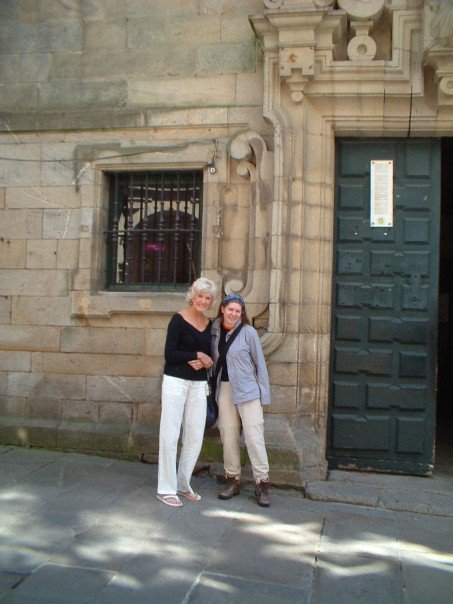
Anne and Gillian outside the pilgrim office
We meant to go to Finisterre. We really, really did. We were in Santiago in good time to set out for Finisterre and return to catch our train (not that we’d booked a train, but we had a pretty good idea of when we’d need to hop on one, and that time was several days away). When it came to it, though, we just never left. Didn’t want to. We were in Santiago de Compostela and that was good enough for us.
Instead, we spent the time exploring the city. We left the refugio we were in and booked into a guest house in the old town – very reasonably priced for a twin room with a balcony, and much less guilt about taking up beds that other pilgrims might be needing.
We went to the midday mass every day. Admired the singing of one particular nun, and despaired of that of everyone else. Met new friends and re-met old ones. Returned to the sundae bar for chocolate con churros – the thickest hot chocolate, by the way, that I’ve yet seen. Mocked (at a distance) tourists in the cathedral shop who were telling each other, ‘well of course, in the olden days people actually walked here, on pilgrimage, you know?’ Visited the Museum of Pilgrimage, learnt about the jet trade. Bought scallop shells carved in jet. Explored the cathedral, including its crypt and chapels. Bought skirts – after seven weeks in the same pairs of trousers, these felt like a real luxury. Went to the final of a Galician folk music competition with the Ely Four (gaitas very much in evidence; also the percussive effect of a bowl of water.) Ate all the things we’d been craving that were impossible to carry. (Watermelon. Jelly. And so on.)
We met the Ely Four again. How did it feel, we asked John and Linda, to finally be at Santiago, having stopped and started again so many times as they walked a few weeks at a time? Very odd, they said. Very odd.
And we found perhaps the most hilarious translation blooper in the history of the Camino. Speaking of a cad who was so bold as to attempt to make off with the cathedral bells, the English version of the ‘Legends of the Camino’ book we had in Spanish proclaimed, ‘Some type of divine punishment receives Almanzor, because your horse dies exploded after drinking water from a fountain.’ To this day, ‘your horse dies exploded’ proves a handy filler for awkward gaps in conversation.
So we passed our time in Santiago de Compostela. The day before we were due to leave, we wandered down to the station to buy tickets to Ferrol. No such luck. We could only get tickets that went as far as A Coruña. No matter. The trains we were aiming at, running along the narrow gauge Via Estrecha from Ferrol to Santander, only left a couple of times per day, so we would have plenty of time to sort out the next leg when we got there.
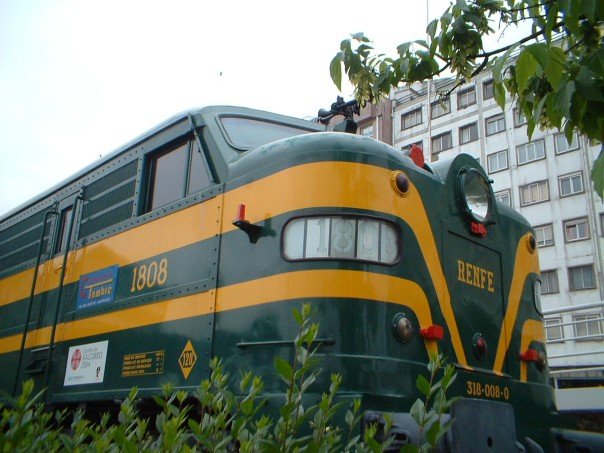
Loco commemorating Holy Year 2004 in the forecourt at Santiago station
After all, we were in no hurry. If we had been, I wouldn’t have planned a rail journey that took two days; as it was, taking our time over the return seemed fitting, even if we were no longer walking it. And I’d been promised that the Via Estrecha was as spectacular a train ride as any in Europe.
It took the best part of a morning to get from Santiago to Ferrol, changing in A Coruña (which, at least in our admittedly transitory experience of it, bore few signs of Sir John Moore’s dramatic end). We ate lunch in Ferrol, making the most of the hour’s layover, then boarded the little train for the antepenultimate leg of our journey.
There really are no words to describe the Via Estrecha. One doesn’t hear much about the north coast of Spain, and I have no idea why, because it’s utterly beautiful. For almost all the way, the railway runs as close to the sea as it can get, albeit about a hundred feet above sea level, clinging to the cliffs, in and out of tunnels. Through the afternoon we travelled through Galicia and into Asturias. (In Asturias the horreos are different – larger and squarer.) As night fell a bevy of teenagers joined the train, dressed up for a night out in Oviedo. We also alighted in Oviedo, but in search of a bed rather than the bright lights.
My anxiety about finding somewhere to sleep, never quite alleviated on the pilgrimage, went into overdrive now we weren’t on the Camino Frances. However, even from the station we could see a sign advertising camas (beds), and, despite the relatively late hour (it was gone nine o’clock) we had no trouble getting a room in the building to which it was attached.
The next day we breakfasted at the station before setting off again on the narrow-gauge. The landscape was not quite so spectacular, but all the way the presence of the sea on our left told us: we were on the way home.
Today our objective was Santander – the end of the line, and the last stop in Spain. We had booked our ferry tickets home when we booked the tickets out, so the sailing was a fixed point. No danger of missing it, though: we had almost twenty-four hours in Santander. I put the hotel bill on my credit card, and we set out to explore.
Santander is a pleasant town, if not wildly interesting. It being a nice sunny afternoon, we wandered along the seafront, vaguely considered a boat trip, thought better of it, and bought ice creams instead. A small child in the queue tested out her English on me, much to Anne’s amusement.
And then we went back to the hotel. Showered. Made use of the more frivolous toiletries we’d acquired (i.e. more frivolous than plain soap – these included razors). It may or may not have been due to the fact that our room had no windows to speak of, but we discovered we were utterly exhausted, and went to sleep. This meant that we missed dinner, but that saved having to think about it.
In the morning we checked out and hauled our rucksacks around the town. A little more wandering took us to the cathedral, which reminded me agreeably of Portsmouth in its mixture of ancient and modern, and nautical associations. At lunch we discovered further hilarious translation errors (‘Galician Octopussy’ – ‘Hake of hook to the Roman’) which, together with the people ordering in English and not even trying to speak Spanish, reminded us that we were in a port, and, more to the point, in the port on the way home.
About the voyage home, the less said the better. It was the one and only time I’ve ever been actually seasick. We didn’t even attempt the reclining chairs this time round, and bagging a decent spot on the floor was definitely a good move. It still didn’t improve matters much. And then the only available reading material was the Daily Express. The Madeleine McCann case was just breaking, and so was the ‘silver ring’ test case.
All in all, sleep was a blessed relief, and I didn’t wake until the call came over the ship’s tannoy that we would soon be docking in Plymouth. ‘Soon’, in this case, meant ‘in a few hours’. Ironically, we’d dissuaded my boyfriend from driving down from Exeter to Plymouth to meet us on the grounds that he’d have to go far too fast if he didn’t want us to wait around for hours. In the event we were about an hour getting off the boat, so he would have made it easily, but really, getting the train was hardly going to kill us.
The Exeter train was quite full, and our bags were large. Anne and I lolled in the vestibule, and grinned at each other in an accomplished, tired, contented sort of way.
Niton. Portsmouth. Caen. Saint Palais. Ostabat-Asme. Saint-Jean-Pied-de-Port. Roncesvalles. Viskarret. Larrasoaña. Cizur Menor. Puente la Reina. Estella. Los Arcos. Viana. Logroño. Navarrete. Azofra. Santo Domingo de la Calzada. Redecilla. Villafranca Montes de Oca. Atapuerca. Burgos. Hornillos del Camino. Castrojeriz. Frómista. Carrión de los Condes. Ledigos. Bercianos. Reliegos. Arcahueja. Virgen del Camino. Villar de Mazarife. Hospital de Orbigo. Astorga. Rabanal. Riego de Ambros. Cacabelos. Villafranca del Bierzo. Vega del Valcarce. Hospital de Condesa. Triacastela. Sarria. Portomarín. Ligonde. Palas de Rei. Arca. Santiago de Compostela. A Coruña. Ferrol. Oviedo. Santander. Plymouth. Exeter.


 Kathleen Jowitt
