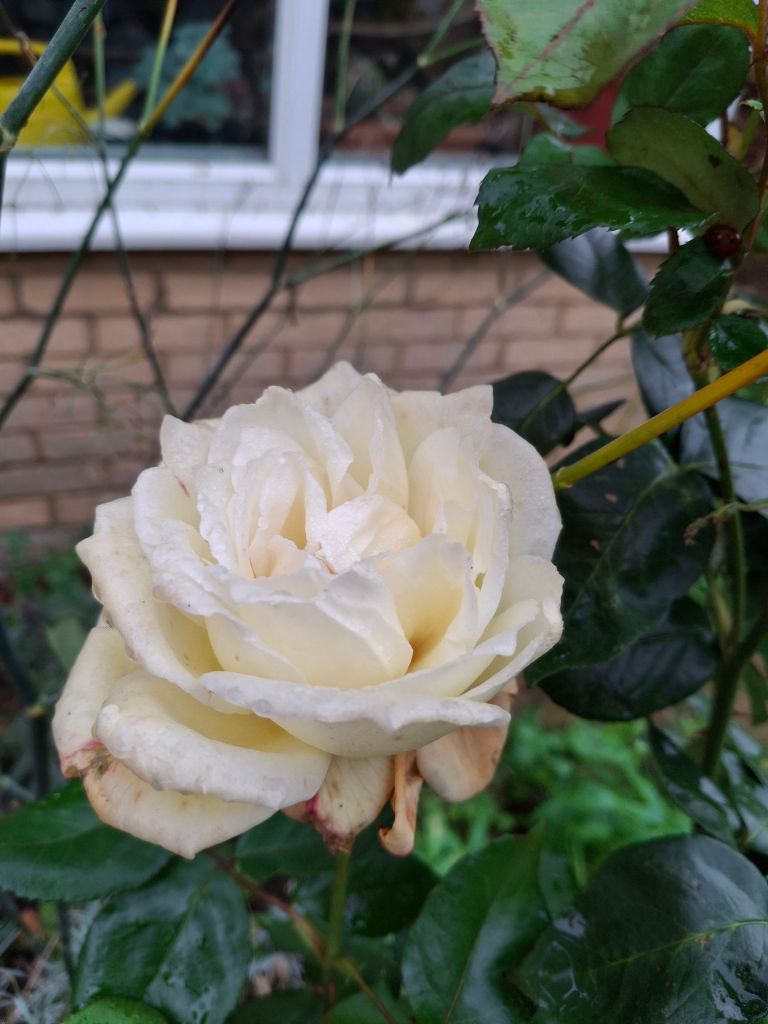
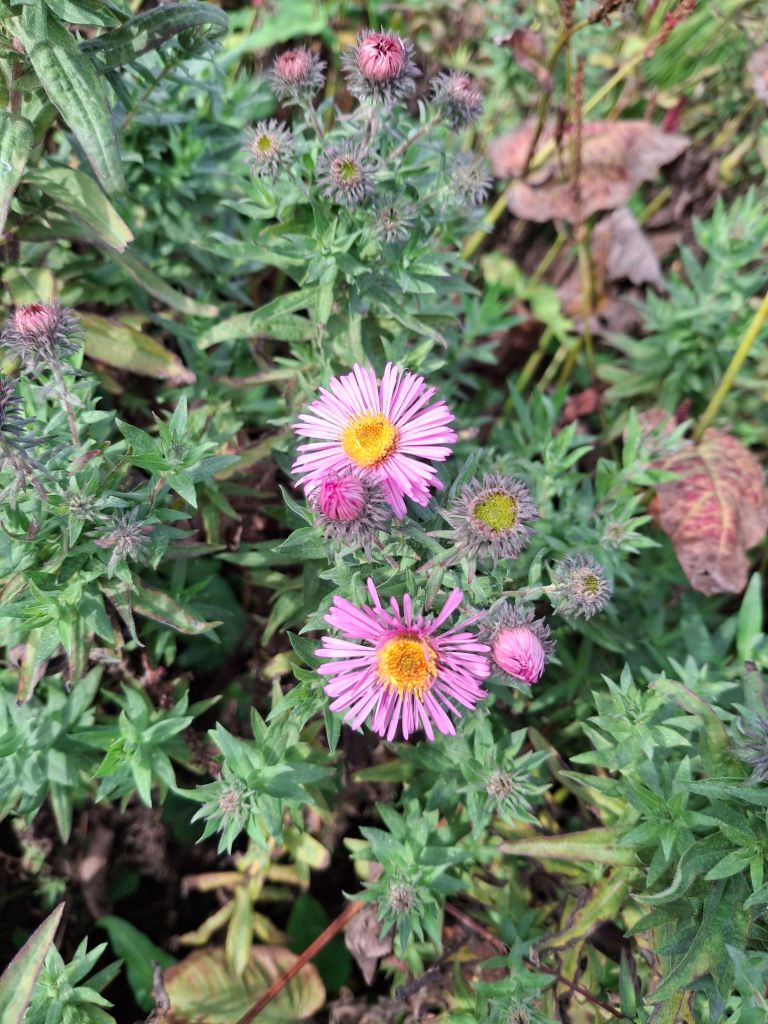
Gosh, the seasons have been weird this year. Here we are at the beginning of November – the beginning of winter, if you go by the Celtic calendar, which I often do – and I’ve just picked a pound of green tomatoes. (They’re not going to ripen now.) Just enough to make it worth making a batch of chutney, I reckon. And here’s this rose still blooming away. It’s always the first to flower. The other bushes, pink roses, are still going, too, though the climbing rose I planted earlier this year has, I think, finished.
I’m trying to notice and appreciate and not worry too much (worry leads to despair; despair leads to a complete inability to do anything about the problem I’m worrying about), and this is my favourite of the roses in the garden; it has a lovely, gently lemony, scent. So here we are. A white rose for All Saints’ day.
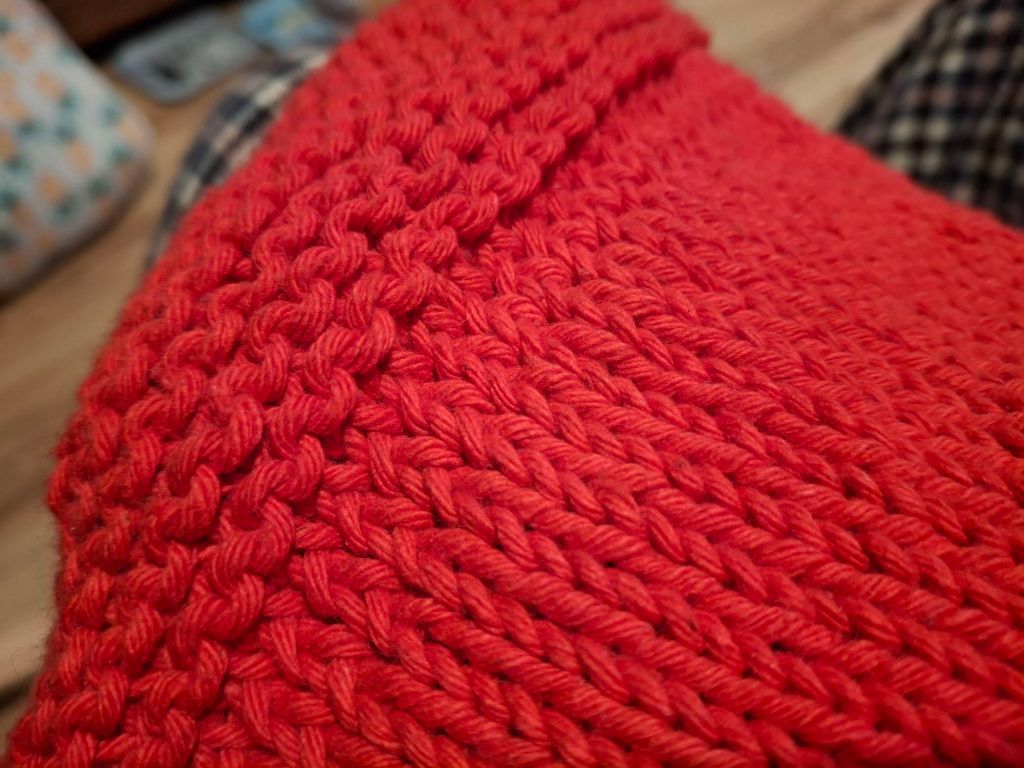
My stocking stitch has been wonky for a long time. Not, I think, forever, but definitely a while. I remember my mother remarking on it (she rather liked it, I should say), and I don’t think we’d knitted in the same room since Covid. You can see it in the picture: after the waggly lines of garter stitch on the cuff, there are a couple of rows where the stocking stitch shimmies right and then left, the tails of each stitch crossing over each other rather than lying flat next each other.
For a while I thought it was just something about the way I held the yarn, or something like that, just one of those things. Then I started knitting socks, got my head around knitting in the round, and suddenly my stocking stitch was flat and well-behaved. Hmm, I thought.
When you’re knitting flat, you have to knit the front one way and the back the other. To make stocking stitch, you knit (needle goes through the stitch from front to back, left to right) on the right side and purl (back to front, right to left) on the wrong side. But when you’re working in the round, you can just keep knitting and knitting and knitting, no purl required unless you’re doing something fancy.
So, like an inadvertent elimination diet, my knitting in the round had revealed the problem. If the knit stitches were fine, it must be the purl. Some time after this (because actually I much prefer knitting in the round and didn’t have any flat projects) I went back to the books. And there it was. All these years, I’d been taking the yarn clockwise to make the purl stitches, and it should have been anticlockwise. You can see in the picture the moment I tried it the other way.
Or maybe not. That’s one of a pair of sleeves, you see, so I had to do the second one to match, and goodness knows I can’t remember which one was which.
I announced my discovery and a friend said this is in fact a recognised variant called combination stitch. So now I know.
What I don’t know is when I started doing it. Have I always been purling backwards? It’s possible. But switching to anticlockwise felt very natural, so much so that I had to keep stopping to check that I was doing it right now. So did I start out doing it by the book? If so, when did I switch? Do I have enough old knitting projects still extant to find out? Am I really that bothered? Probably not, to be honest, but it’s interesting how the brain can accept that of course things are a certain way when in fact they might not be that way at all.
St Michael and All Angels. Don’t pick any blackberries after today: the Devil spits on them. Or possibly wees on them. Actually, they’ve been looking a bit sad for a while now. There’s the odd one or two that still look tempting, but mostly they’re all very shrivelled.
It’s definitely getting to the end of the fruit harvest. As always, there has been more than I could triage despite my best efforts. Not so much in the way of apples and pears, this year (the apples mostly went bad and fell before they got good); a few raspberries eaten straight off the canes; loads of Victoria plums; the most greengages we’ve ever had.
Yesterday I filled four carrier bags with grapes – too small and pippy for eating off the stalk, but enough people from the local free-sharing Facebook group wanted some to make it worth the picking. Again, we’re approaching the end of the harvest: I passed some bunches over for being either mouldy or wannabe raisins, and the recipients will have to pick them over before making wine or jelly or whatever it is they’re going to do with them.
Last night I made baked apples: the last three from the tree. There’s still a punnet of greengages in the fridge. I think I’ll make another plum torte. Green, not purple, in this case.
And everything else will have to be for the birds, or the invertebrates, or the compost bin. Or, I suppose, for the Devil to leave his bodily fluids on. Time to accept I’ll never get to everything, and move on.
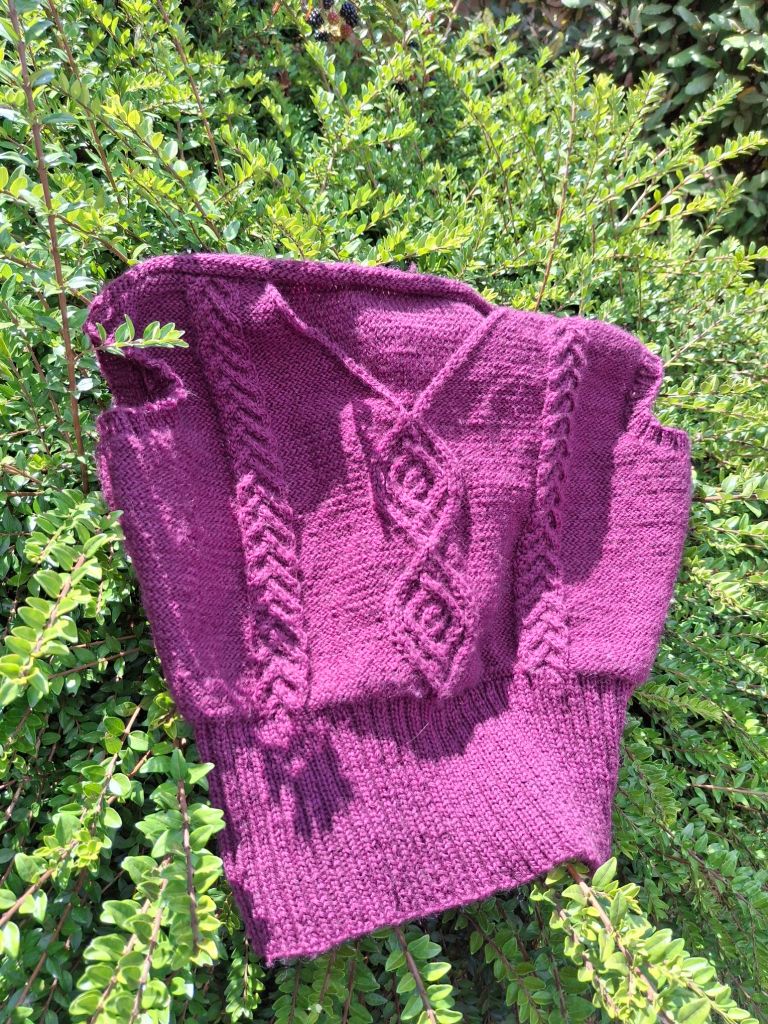
That’s straitened without a gh, you note. As in straitened circumstances. In this case, I had five balls of wool from the British Heart Foundation shop (three quid apiece, not bad for pure wool). The Internet could tell me absolutely nothing about it, so that was all I was ever going to have and I didn’t know what would play nicely with it. So I had five balls of wool. And this is what I did with them.
I started with a pattern from Knitting in Vogue, but I hadn’t even got to the end of the ribbing before it became obvious that I wasn’t going to have enough. So I made up my own pattern. I knitted tension squares (I hate knitting tension squares) and looked up cable patterns and did a lot of arithmetic. I started with the front, then did the back, sewed them together, then knitted on the smallest amount of rib that I could get away with, around the arm holes, and then went round and round the bottom edge with more rib until I ran out of yarn.
I’m really pleased with it. It’s the first pattern I’ve designed, it’s a great colour (the photo isn’t quite right; it’s more purple in real life), it gets to my waist (just about – I have a long back); it works. And I did all the ribbing on double-pointed needles because I didn’t have an appropriate cable one and I just wanted to get on with it. That feels quite badass. I only really regretted it a couple of times.
Now I think I want a high-waisted flared skirt in plum needlecord to go with it…
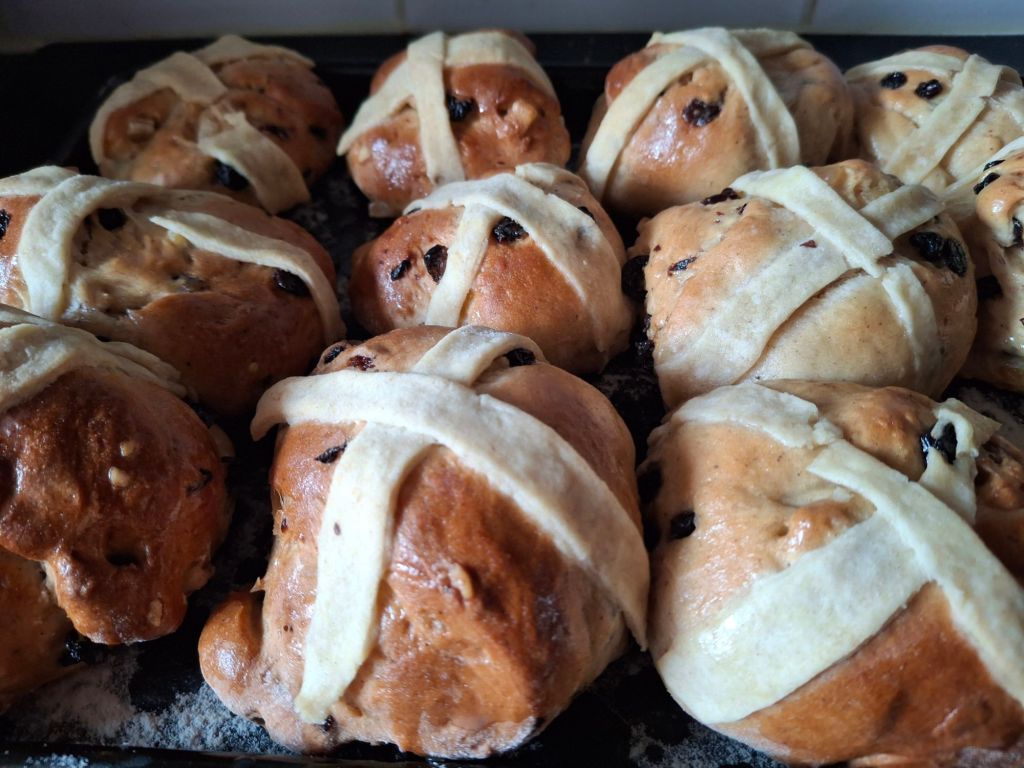
I used to be a bit of a hot cross bun purist. Good Friday only. This was the rule when I was a child: I don’t think they were in the supermarkets for so much of the year, and anyway, we didn’t go to the supermarket all that often.
Marrying someone who didn’t grow up with that rule meant that there were hot cross buns in the house more often. I still didn’t buy them outside of Holy Week, you understand, but if they were already there then I might very well eat one or two.
Then in 2024 I was suffering with a diseased gallbladder, with any injudicious consumption of fat resulting in excruciating pain and vomiting, and at a phone appointment early in Lent the dietician recommended hot cross buns as a suitable snack food. So I ate them all year until I had my gallbladder removed in December. And by that point the rule was well and truly broken.
I can’t see myself making them more than once a year, however, because what with the mixing and the waiting for the yeast to froth and the mixing and the raising and the forming into bun shapes and the waiting for them to rise and the making pastry and laying out the cross shapes and the baking and the glazing the process takes all day. Granted, there was some hanging out of washing and eating lunch and a trip to the swings and some weeding in between all that, but I don’t think the buns lost out. That’s just how long they take.
I actually made them yesterday, Maundy Thursday, knowing that this morning would be taken up with church and vaguely remembering that they take a while. I’m glad I did. Even allowing for the fact that I don’t do the Three Hours these days, there wouldn’t have been time.
Anyway, there were hot cross buns for Good Friday. The symbol of the cross is obvious. My mother always used to say that the currants were for the wounds of Christ, though there are far too many per bun.
My recipe (the Good Housekeeping cook book) calls for 100g or 4oz of currants between a dozen buns, and even if you assume that the currants weigh as much as a gram each, that’s still at least three too many. As it is, I can count as many as that in the quarter that’s left of the bun I’m eating now. We’re looking at something more like Saint Sebastian.
There’s also mixed peel in there. I am not aware of any symbolic value attached to that, though if pressed I’d say it was something about bitterness.
If you have no daughters, give them to your sons. I do have a daughter. She is usually partial to a hot cross bun, though these ones were Different and therefore Wrong.
One a penny will not cover the cost of the ingredients, never mind my time. Two a penny, doubly so. Never mind. I enjoyed making them and I am enjoying eating them.
And my husband came home yesterday with another two packets from the supermarket. But those keep, so we’ll be eating them through Easter week. Hot cross buns!
I started them in 2025, and am enjoying them enough to finish them. I just didn’t get them over the wire before the end of the year.
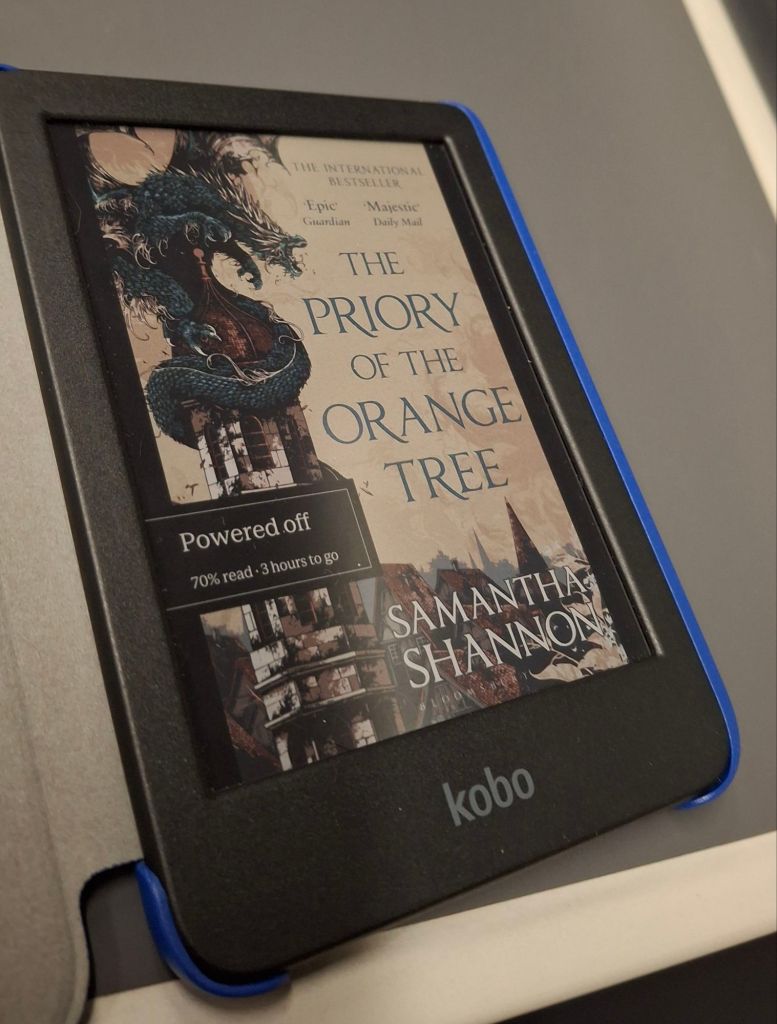
The Priory of the Orange Tree (Samantha Shannon) would probably have got there but for the fact that it’s a library book. My e-loan expired on Boxing Day, when I was somewhere around the 65% mark. I went straight back to the hold queue, and managed to borrow it again on New Year’s Eve. Now I have until the 15th, and the pressure’s off. Maybe too much so. We’ll see if I can finish it before then. Anyway, it’s great fun: an epic fantasy that’s attempting to, and generally succeeding in, evoking all the dragon mythology of East and West, and throwing in 16th century politics too.
Towers in the Mist (Elizabeth Goudge) has in fact been in progress since before 2025. I can’t remember when I started it, but it was probably some time in 2024. I was enjoying it, but was finding it harder work than I had the brain for at that point. Now I suspect it’s getting in the way of my starting The Players’ Boy, which arrived several months ago and which (most unusually for me and Antonia Forest) I haven’t yet opened. I’m sure I will be in the mood for atmospheric historicals sooner or later.
Public Schools and the Great War: the generation lost (Anthony Seldon and David Walsh) is research for the work in progress now tentatively known as Household Rancour. It’s about as depressing as you’d expect, but very interesting, and very useful for my purposes. I’m very glad that I stumbled across the recommendation while idly scrolling with no thought of writing in my mind.
Everything I’ve Ever Learned About Change (Lesley Garner). Everything I’ve Ever Done That Worked was one of the books that shaped my mind and attitude when I read it in my teens, and I still consciously apply many of its principles (Be A Music Listener; When The Sea Is Rough Mend Your Sails; The Sea Is Your Dinner Companion, etc). Now I’m 40 and have worked more of this stuff out for myself, so Garner’s later books (I also read Everything I’ve Ever Learned About Love last year) aren’t blowing my mind in the same way, but I’m still enjoying this, whrn I remember to read a chapter over lunch.
Spirituality in Season (Ross Thompson) follows the liturgical year, starting with Advent, and I’m reading it in real time, so to speak, so if all goes well I’ll finish it at Christ the King – the end of November.
Everyday Nature: how noticing nature can quietly change your life (Andy Beer) is a book with a section for each day. I started in the autumn of 2024, was going quite well in the spring of 2025, and then, like so many things, put it down when my mother died. So now I’m trying again. I’ve read the bit about dunnocks twice now and still can’t tell the difference between them and sparrows.
On a similar note, The Morville Year (Katherine Swift), a collection of garden columns. But that follows the old year and runs March-March, so I’m saving it.
This will not be remembered as my most successful knitting project. However, it’s finished; it used up one annoying little ball of yarn; it will keep small feet warm, and I am no longer scared of the cable needle.
I’ve embarked on one of last year’s Christmas presents, Everyday Nature by Andy Beer. This has a couple of paragraphs for each day, each examining a different natural phenomenon.
This being the week it’s been, I haven’t been able to act on much of it. New Year’s Day, for example, we were encouraged to go out for a nature walk. Not a hope. Today’s entry is on Venus: it’s cloudy.
But never mind. This morning on the bird feeders I saw: bluetits, a robin, a starling, and something that might have been a dunnock. (I am not very good at telling the difference between sparrows and dunnocks.) There were two grey squirrels chasing each other along the back fence. Yesterday there was a wren on the trellis.
This evening I returned to my goldfinch sock (self-striping yarn from West Yorkshire Spinners). Goldfinches were in the book for 2 January: I didn’t see any on Thursday (maybe I’ll get a nyger seed feeder to encourage them) but I can at least enjoy their sense of style.
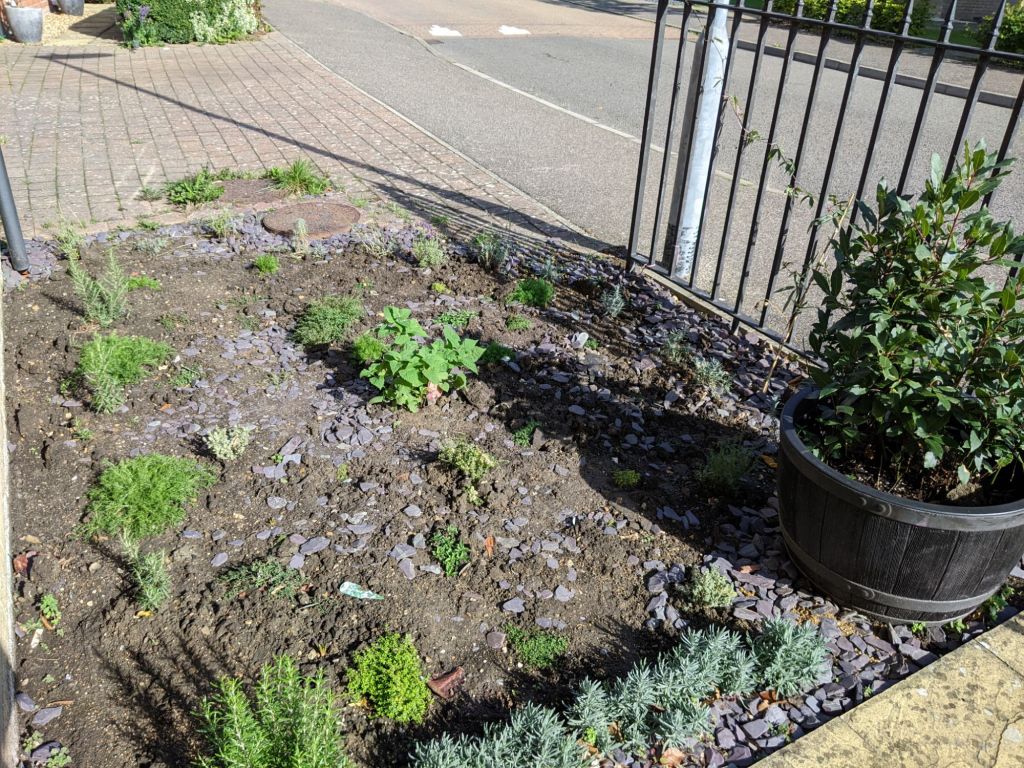
When we moved into this house, the front garden was entirely covered in chips of purple slate. Now it is almost entirely covered in green.
I don’t have a proper ‘before’ photo, because the whole thing was so boring that I never bothered (and when I finally came to getting rid of slate and planting plants I had very limited time and other priorities).
Here you see the boringness relieved by a pot of tulips:
You also see the irritating little weeds that grew among the stones. Shallow roots, but a pig to keep on top of and very obvious, at least when I didn’t have a magnificent tub of tulips to lead the eye elsewhere.
Last autumn, my maternity leave project (and I cannot at this distance think why I thought that this was a good idea) was transforming this into an actual garden, with intentional plants growing in the soil.
You might remember me asking on here for ideas of what to do with a small eastward facing plot that probably wasn’t going to get a lot of watering. A friend suggested that Mediterranean was the way to go. I’ve always loved herbs, so it didn’t take much effort to come up with a plan of rosemary against the house, lavender around the edges, and thyme as ground cover, with peonies (because what the hell, why not) to make the middle interesting. One of our bay trees (wedding present, 14 years ago) could go at the front corner, and what about an olive tree? And I was going to grow a passion flower up the railings.
I got Tony to gather up the slate chips (eventually a friend took them away to cover up a much less promising bit of ground). I ordered some plants from Thompson and Morgan, and quite a lot more from Norfolk Herbs. (I highly recommend Norfolk Herbs, by the way: their prices are extremely good and the delivery was swift.) On a whim, I threw some chamomile and bergamot into the order. The Thompson and Morgan stuff came in dribs and drabs; the Norfolk Herbs, all at once.
And every time I had a spare twenty minutes, when the baby had fed and gone to sleep deeply enough to notice that I’d handed her to someone else, I dashed out the front and put in another two or three plants. I’d leave the front window open so I’d hear when she started crying. I chucked a bulb or two in with each plant – tulips, daffodils, crocus, tête-à-tête, iris… Bit by bit, it got done.
We didn’t get all the slate up first go. For a long time afterwards I was picking up a dozen chips and moving them to the edge every time I went out.
Then, of course, everything went dormant over the winter, and I had to wait to see what was going to happen next.
The bulbs came first. A brave blue iris, then the tête-à-tête narcissi.
It was at this point that I started getting really happy with what I’d done. They cheered things up immensely.
On Mothering Sunday, I was presented with a pot of purple primulas. Those went in too.
Then the tulips flowered.
Meanwhile, the herbs were beginning to get going. Come May, there was still quite a bit of earth showing between the plants, but they’d woken up. The bergamot, which I’d thought had maybe died, was very enthusiastic.
We got our olive tree, too.
Over the summer, everything went absolutely bananas. The chamomile flowered and went everywhere. The bergamot came out such a gorgeous, vivid deep pink that I felt my whim was vindicated a hundred times over.
And it all kept going.
It’s less exuberant now, obviously: it’s November again. And I trimmed the chamomile back, and I’m half way round cutting off the dead lavender flowers. Even so, it’s less tidy than the slate was, but it’s much more cheerful and welcoming – not least for the bees. I was rather pleased to read, several months into this process, that:
If you want to help a variety of bees, the best way is to plant flowers that bloom sequentially from early spring to late autumn – even if you only have a window box or pots on a patio.
Which I seem to have achieved almost accidentally. I’m glad the bees are enjoying it. I certainly am.