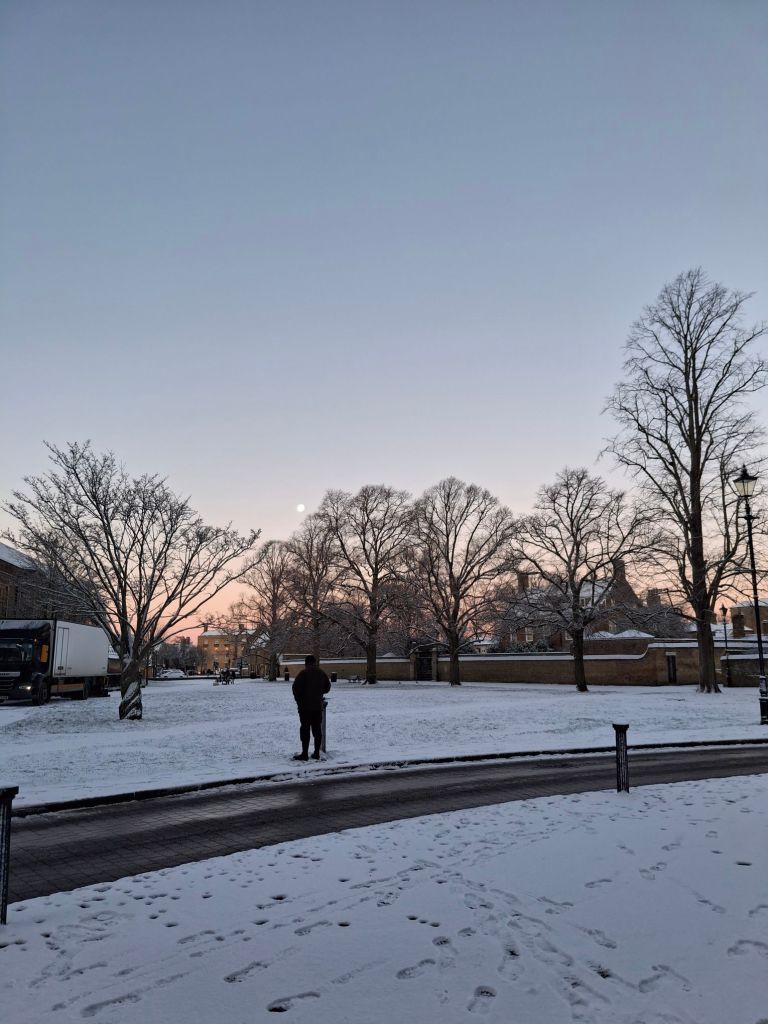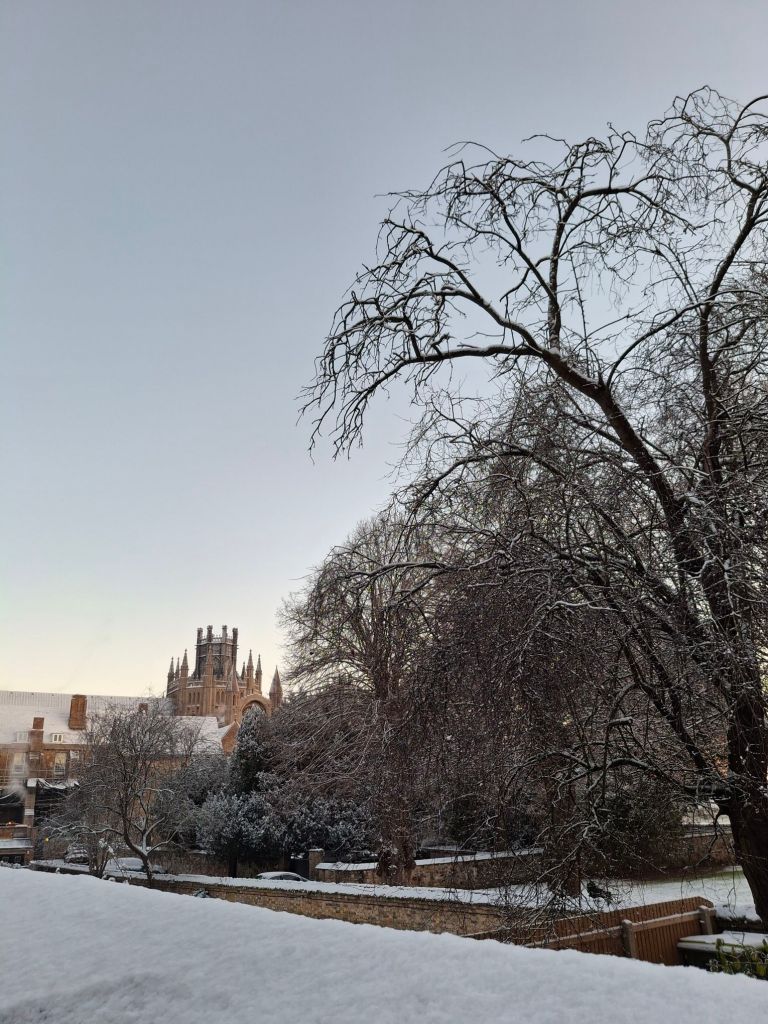
Autumn skies

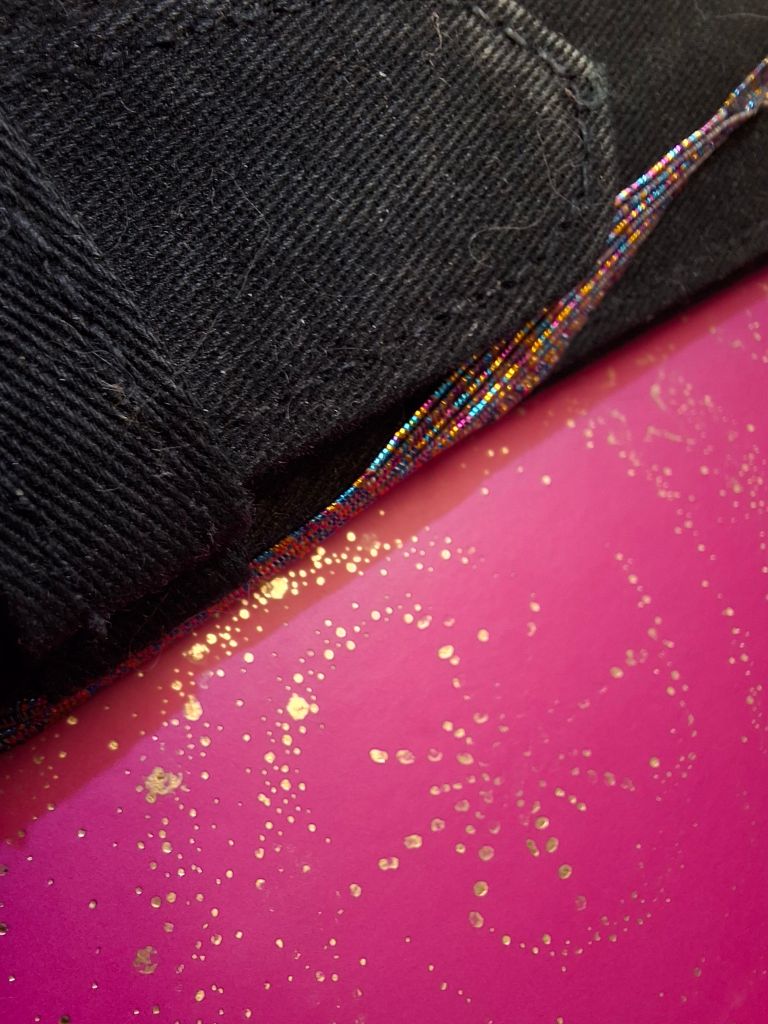
Close-up shot of bright pink card scattered with gold dots and stars, with the edge of a black pencil case and a brightly coloured length of elastic

I opened the door to get the milk in at half past five this morning and was greeted by the most spectacular sight: a rising crescent moon; a bright planet very close to it; Orion striding away from it. And other stars.

I’ve been trying half-heartedly to get better at identifying constellations over the last decade or so. I’ve known Orion and the Great Bear (/Plough/Saucepan/Charles’s Wain) since childhood; Cassiopeia is easy enough to identify, if not to spell; Andromeda, with her boxy body and flailing limbs, is quite distinctive. About five years ago I got Cygnus pinned down: great big cross, and we’re in the northern hemisphere.

Recently I read this fascinating piece about the Pleiades, and that taught me that Orion is chasing Taurus, the bull. This morning I looked at Orion and then looked to the right, and there they were, though I couldn’t parse the bull-shape. And I remembered that Sirius is the brightest star in the sky and is also part of Orion’s dog, though again, I couldn’t really make out the rest of the constellation. Still, little by little I’m building up my map.

I loaded up Stellarium and discovered that the planet was Jupiter. Mars was also around, though much less striking. (In fact it turns out that the Moon and Jupiter get very close indeed today, though it’ll be too light to see Jupiter where I am. So I’m feeling quite pleased to have noticed the beginning of a significant astronomical event without knowing it was going to happen.) Then I went back inside – the milk had to go into the fridge, after all – and got down my analogue star map and the Philips Guide to the Night Sky. Sir Patrick Moore says that some people think that autumn skies are not so good for stargazing, but that they are wrong. I agree. Although he sees the fact that Orion doesn’t rise until the morning as a disadvantage, and today that’s not the case at all.

The sky was lightening as I left the house, and there was the beginning of a fine red sky visible from the top of the hill. Down by the railway (and, more to the point, down by the river), the mist had rolled in, though, and on the train there was only soft blackness in the windows. That, and the fact that I had to run for the train, is why you get a very human-made star in the photo on this post.

Last week I cleared all the old train tickets out of the pockets of my reflective cycling jacket. A few from September. Lots from May. I hadn’t realised I was wearing it all the way into the summer. So perhaps that means nine months of starry mornings still to come.
Michaelmas

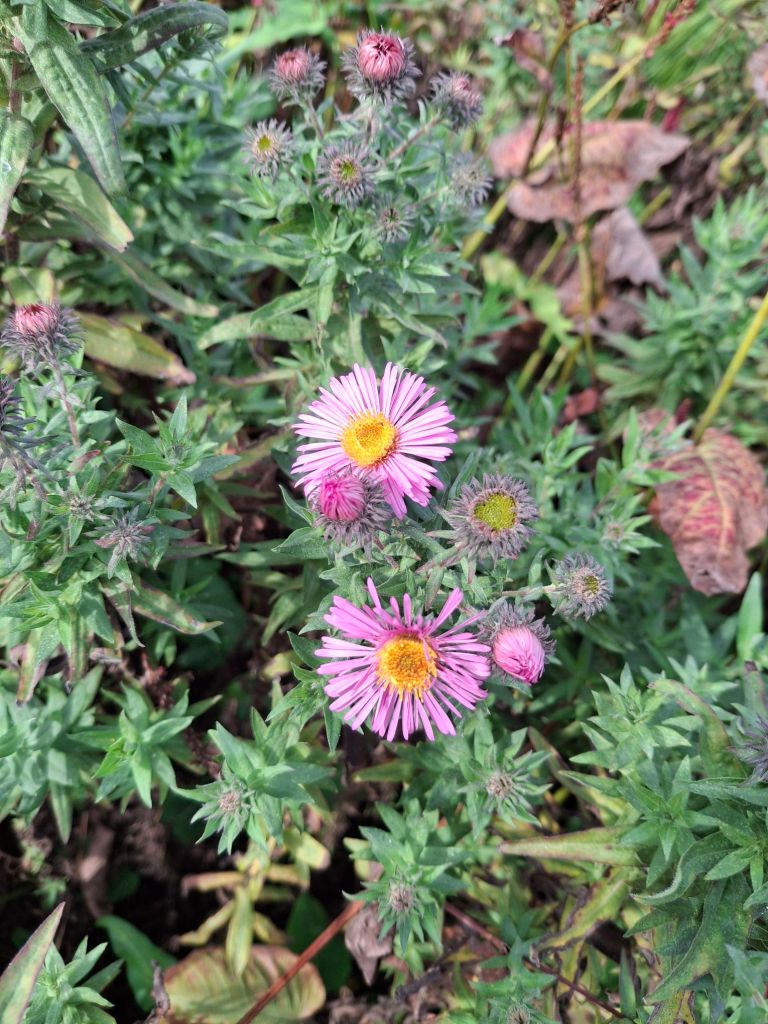
A plant with spiky-looking flower heads and narrow pink-purple petals around a yellow centre
Michaelmas daisy at Wimpole Hall

St Michael and All Angels. Don’t pick any blackberries after today: the Devil spits on them. Or possibly wees on them. Actually, they’ve been looking a bit sad for a while now. There’s the odd one or two that still look tempting, but mostly they’re all very shrivelled.

It’s definitely getting to the end of the fruit harvest. As always, there has been more than I could triage despite my best efforts. Not so much in the way of apples and pears, this year (the apples mostly went bad and fell before they got good); a few raspberries eaten straight off the canes; loads of Victoria plums; the most greengages we’ve ever had.

Yesterday I filled four carrier bags with grapes – too small and pippy for eating off the stalk, but enough people from the local free-sharing Facebook group wanted some to make it worth the picking. Again, we’re approaching the end of the harvest: I passed some bunches over for being either mouldy or wannabe raisins, and the recipients will have to pick them over before making wine or jelly or whatever it is they’re going to do with them.

Last night I made baked apples: the last three from the tree. There’s still a punnet of greengages in the fridge. I think I’ll make another plum torte. Green, not purple, in this case.

And everything else will have to be for the birds, or the invertebrates, or the compost bin. Or, I suppose, for the Devil to leave his bodily fluids on. Time to accept I’ll never get to everything, and move on.

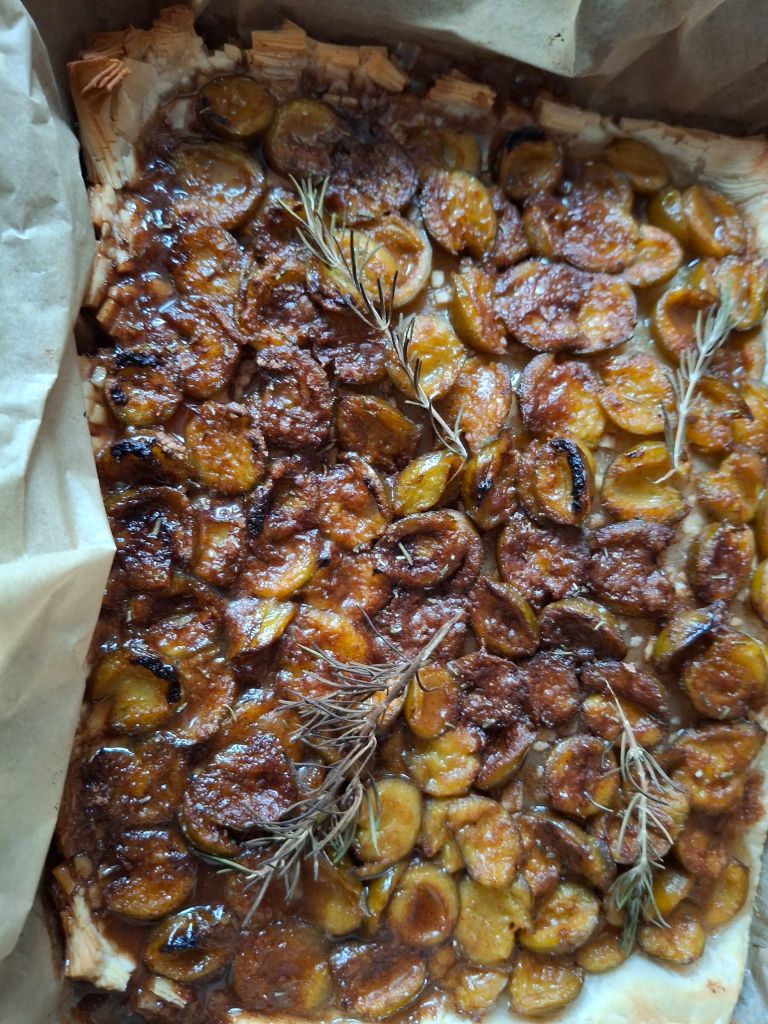
Greengage and rosemary tart

Puff pastry tart filled with small green plums and a caramelised glaze, with sprigs of rosemary

The plum trees have gone absolutely bonkers this year. We missed the best of the Victorias – we always do – because we were on the Isle of Wight, though I managed to freeze three trays full against the winter months. The greengage, though, is doing better than I’ve ever seen it. I’ve made six jars of jam, there’s easily as much fruit again still on the tree, and a load on the ground as well. (It’s been such a hard summer, I’m leaving that for the birds.)

This tart comes from the original Roasting Tin book. Rukmini Iyer uses huge, beautiful purple plums, which look much prettier cooked. But she had a food stylist and (I assume) didn’t have a glut of greengages. It is extremely tasty no matter how it looks.

Anyway, it’s dead easy: lay out ready-made puff pastry in a lined roasting tin, cover with stoned halved plums of whatever variety (this was 400g, about 5 minutes worth of picking and 20 of prepping), skin side down; mix 75g soft brown sugar with a teaspoonful of ground cinnamon and about the same of finely chopped rosemary and sprinkle it over the plums; add a few more sprigs of rosemary, and bake at 220°C (200°C fan) for half an hour.

It was the first time I’ve used the “Green Ginger” variety of rosemary, too. It’s the furthest away from the door, but I thought it would be worth including it in this one. I’m not sure how much of a difference it really made, but since the whole thing was very pleasant I’ll probably do it again next year. Maybe with more rosemary.

Sundays in the park

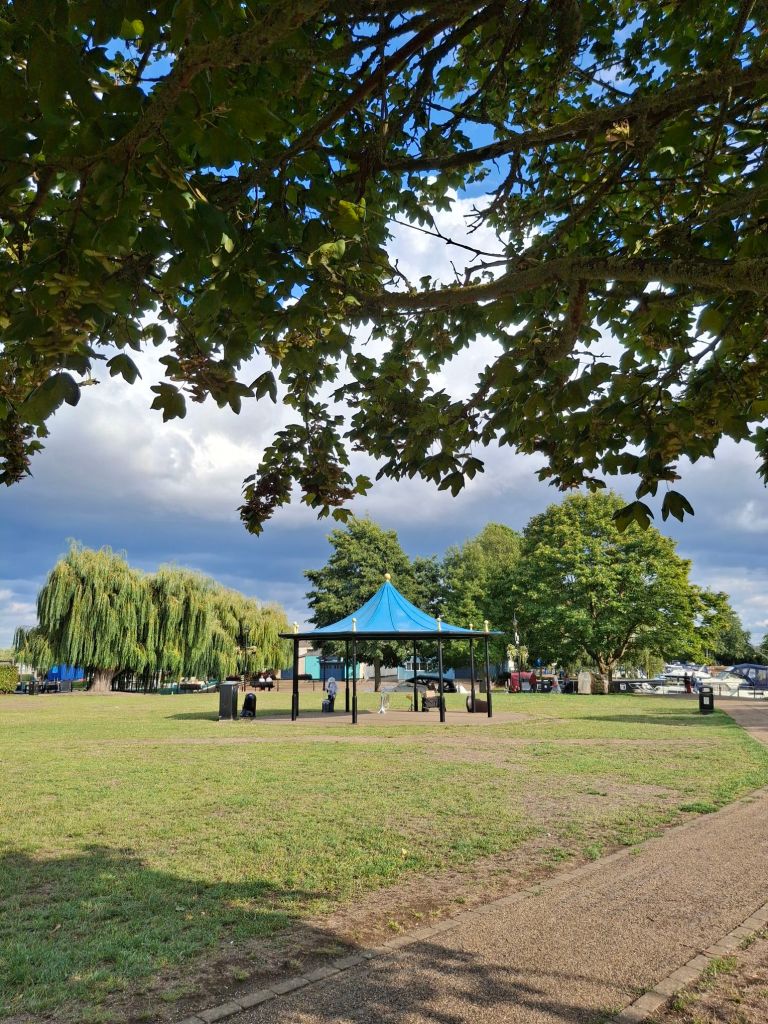
A circular bandstand with a blue roof stands in an almost deserted park. Under the bandstand there is one lone tuba standing upside down on its bell and one lone human

All through June and July and August, every Sunday afternoon that we weren’t doing anything else, we’ve gone down to the riverside to hear the brass band playing at the bandstand. Brass bands plural, rather; it’s a different group every week, coming in from the towns and villages all around. One thinks of brass as a Northern, industrial thing, but the council or whoever organises this doesn’t seem to have any trouble filling the schedule. Round here I suspect it’s more of a military, or legacy-military thing, or simply an enjoying-making-music thing.

It’s a lovely way to spend an afternoon, lazing under the trees, listening to live music, with the toddler running between our spot and the play area. In fact, it’s the one sort of concert where I feel really confident bringing a toddler. Maybe we send someone along the riverbank to the ice cream van.

It’s a brilliant community thing. The audience is always a mixture of friends of the band, regulars (their numbers growing through the summer as more and more people catch on) and passers-by. Last week we got there slightly late and found that our next door neighbours, plus extended family, had set up just in front of our usual spot. Yesterday there was one of the nursery families, who’d really just come for the slide and been pleasantly surprised by the music.

I say brass bands. Most of them were: some called themselves jazz orchestras or swing orchestras, but either way, there was a lot of brass involved. There has to be, really, if you want to make yourself heard outdoors with minimal amplification (any singers will get a mic, likewise the bass guitar if there is one, obviously, but that’s about as far as it goes).

Anyway, there’s a wide, if predictable, repertoire. There’s the jazz and the swing, obviously, and when it was one of the less specialist groups you could generally bet on the programme including: some show tunes, probably in medley form, a military march or two, some film music,  TV themes (I know I’ve played that Star Trek compilation at some Saturday morning youth music scheme, a decade and a half before I saw any Trek, and I played cello; there must have been a version for full orchestra), a hymn, and some classic rock. It is extremely accessible, and that is entirely appropriate for the time and place. On Sunday I was standing next the climbing frame, alternately offering encouragement and singing along with The Teddy Bears’ Picnic (and getting a little thrown by the repeats not coming where I expected them).

It’s been hot, and dry (you may have noticed). Most weeks, the audience must have been hard to spot from the bandstand, hiding under trees or any other patch of shade. The grass got progressively more parched. The musicians generally took their jackets off. The willow trees stayed green, but there was a depressing expanse of yellow between us and them, and the sky was aggressively blue. This was about the only bearable outdoor activity. Abide with me, the band played a couple of weeks ago, fast falls the eventide, in glaring sunshine. Mind you, up the hill at the cathedral Evensong would just have started.

As the summer wore on, we evolved more and more elaborate seating arrangements (we are, I should say, by no means the only people with folding chairs and a festival trolley). Sometimes I brought a flask of tea; occasionally, a cake from the market; often, a punnet of strawberries. Somebody always has a better-looking picnic: full marks to the people the other week who’d fixed themselves up with a cream tea complete with fizz. My own Glyndebourne-level aspirations will have to wait another year.

Because it’s over. This Sunday was the last concert of the year. It was a bit of a toss-up whether we’d make it, having been away the night before. I’m glad we did. It was the right way to round out August. One last trip to the ice cream van. Some absolute bangers (technical term). A late, blessed, prolonged soaking has turned the grass green again. Towering grey clouds hint at more if we’re lucky. The folding chairs are back in the garage. The Lord’s My Shepherd (tune: Crimond), always imbued for me with a slightly beery, teary nostalgia, is lingering in my head, but the last tuba player has packed up and gone home.

One a penny, two a penny

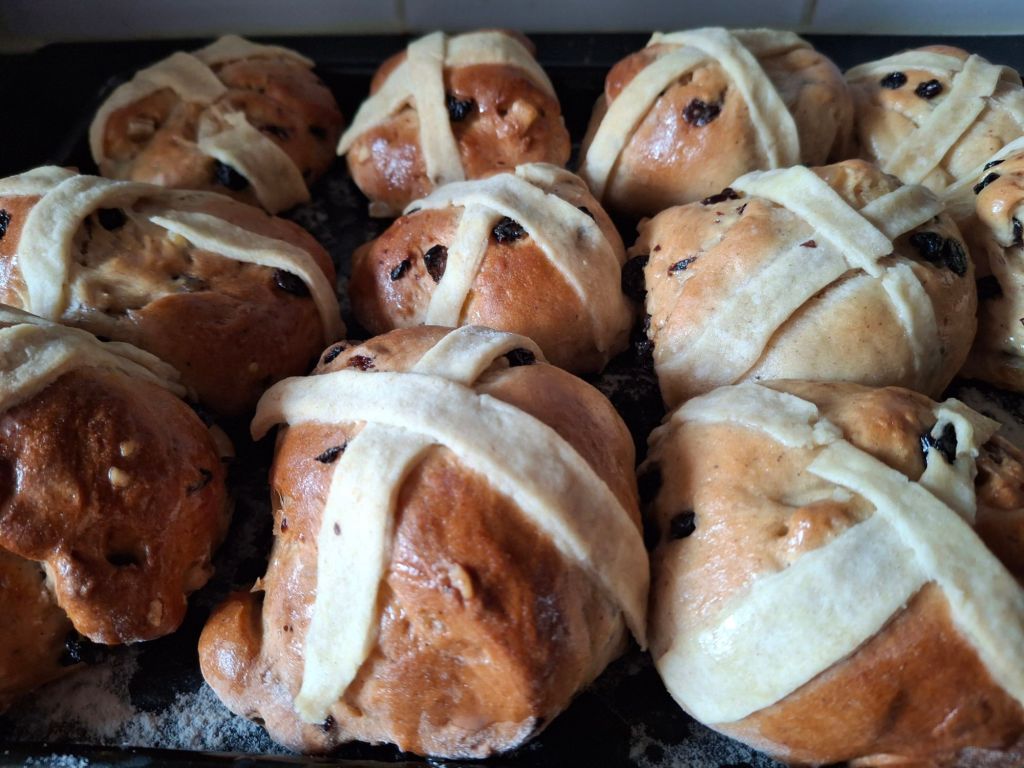
Tray of wonky but beautifully golden brown hot cross buns

I used to be a bit of a hot cross bun purist. Good Friday only. This was the rule when I was a child: I don’t think they were in the supermarkets for so much of the year, and anyway, we didn’t go to the supermarket all that often.

Marrying someone who didn’t grow up with that rule meant that there were hot cross buns in the house more often. I still didn’t buy them outside of Holy Week, you understand, but if they were already there then I might very well eat one or two.

Then in 2024 I was suffering with a diseased gallbladder, with any injudicious consumption of fat resulting in excruciating pain and vomiting, and at a phone appointment early in Lent the dietician recommended hot cross buns as a suitable snack food. So I ate them all year until I had my gallbladder removed in December. And by that point the rule was well and truly broken.

I can’t see myself making them more than once a year, however, because what with the mixing and the waiting for the yeast to froth and the mixing and the raising and the forming into bun shapes and the waiting for them to rise and the making pastry and laying out the cross shapes and the baking and the glazing the process takes all day. Granted, there was some hanging out of washing and eating lunch and a trip to the swings and some weeding in between all that, but I don’t think the buns lost out. That’s just how long they take.

I actually made them yesterday, Maundy Thursday, knowing that this morning would be taken up with church and vaguely remembering that they take a while. I’m glad I did. Even allowing for the fact that I don’t do the Three Hours these days, there wouldn’t have been time.

Anyway, there were hot cross buns for Good Friday. The symbol of the cross is obvious. My mother always used to say that the currants were for the wounds of Christ, though there are far too many per bun.

My recipe (the Good Housekeeping cook book) calls for 100g or 4oz of currants between a dozen buns, and even if you assume that the currants weigh as much as a gram each, that’s still at least three too many. As it is, I can count as many as that in the quarter that’s left of the bun I’m eating now. We’re looking at something more like Saint Sebastian.

There’s also mixed peel in there. I am not aware of any symbolic value attached to that, though if pressed I’d say it was something about bitterness.

If you have no daughters, give them to your sons. I do have a daughter. She is usually partial to a hot cross bun, though these ones were Different and therefore Wrong.

One a penny will not cover the cost of the ingredients, never mind my time. Two a penny, doubly so. Never mind. I enjoyed making them and I am enjoying eating them.

And my husband came home yesterday with another two packets from the supermarket. But those keep, so we’ll be eating them through Easter week. Hot cross buns!

Happy Equinox!

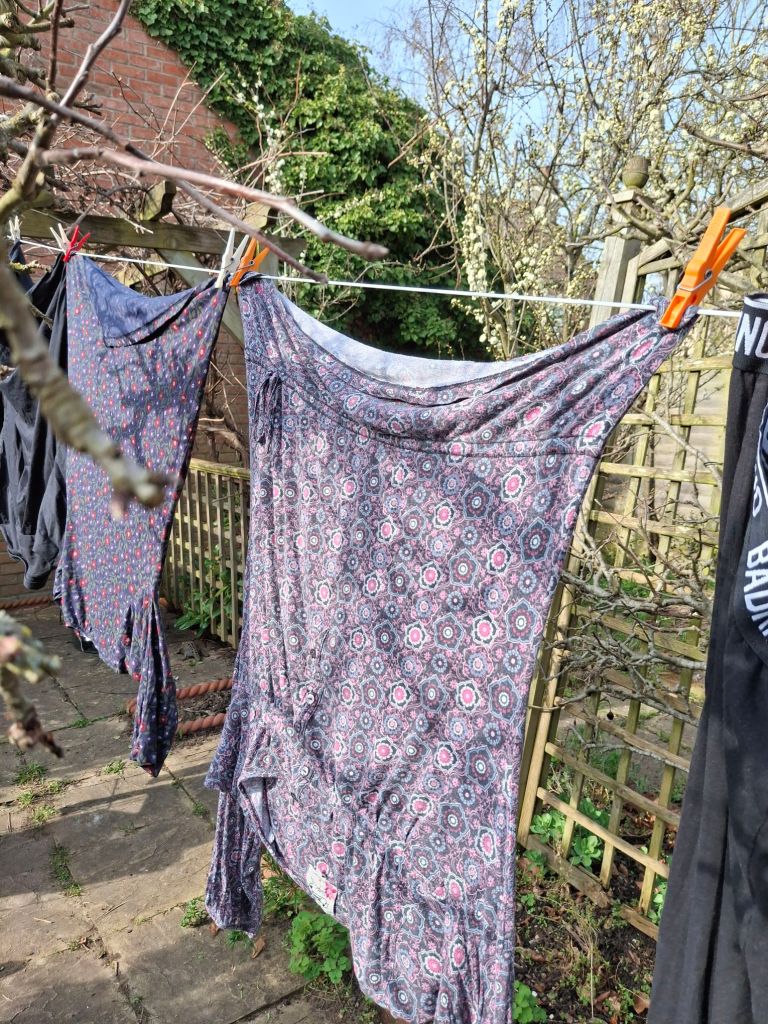
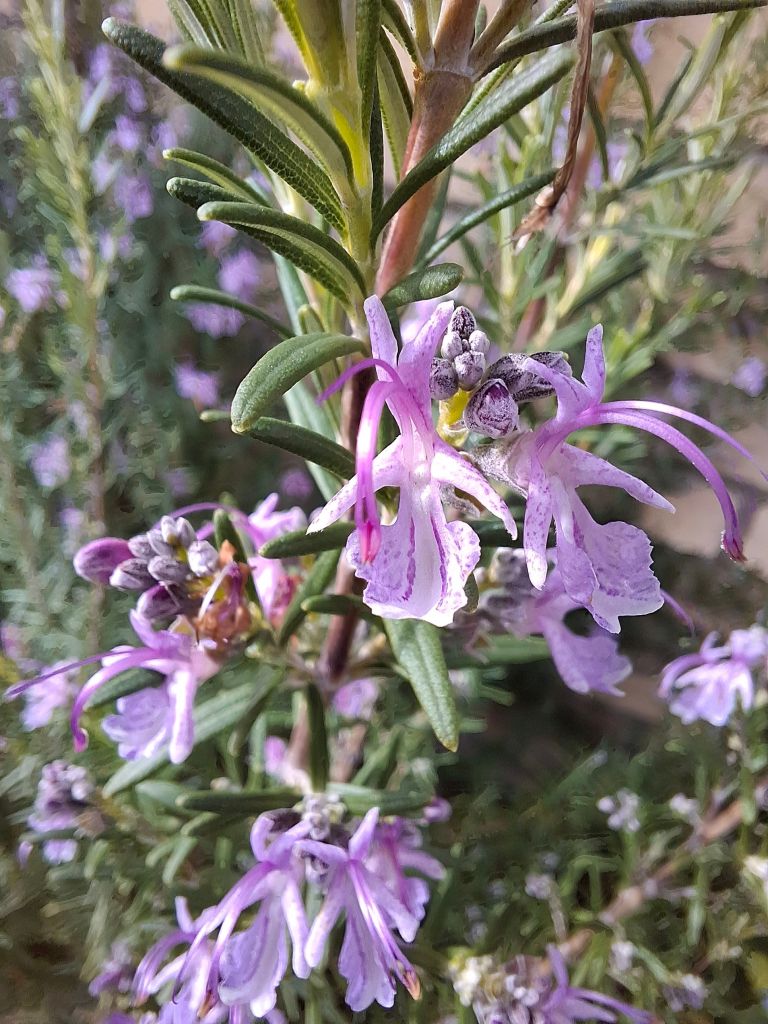
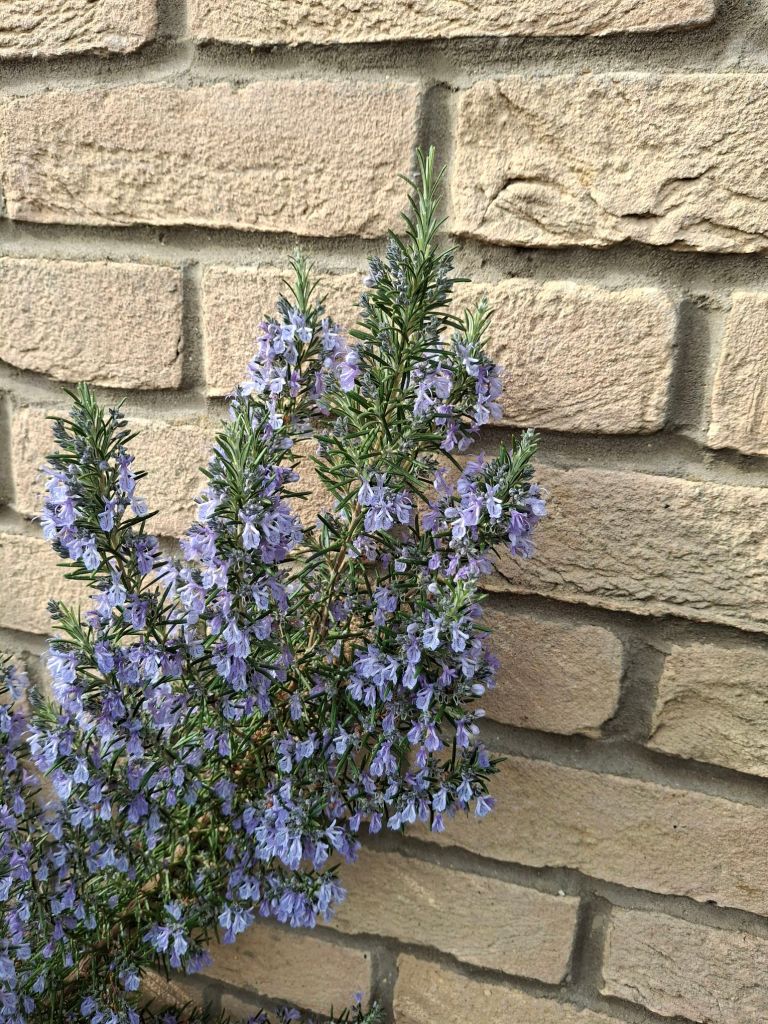
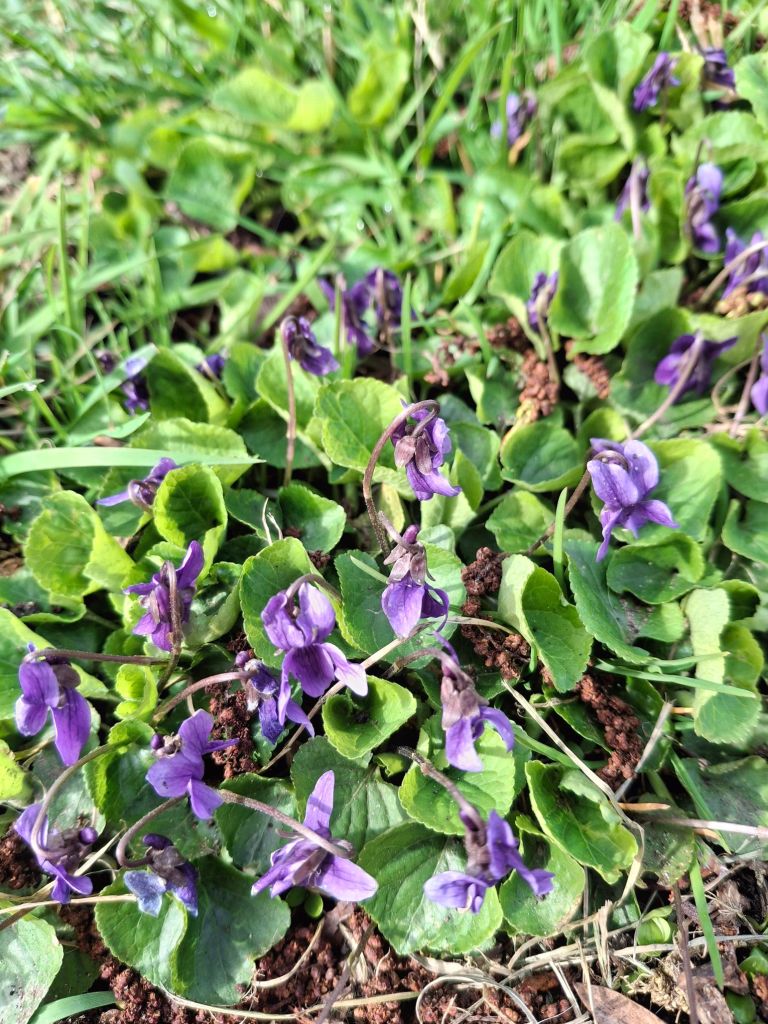
Here’s a very pink-and-purple selection of pictures to mark the tipping point between long nights and long days (in this hemisphere, at least). There’s yellow out there, but I tend to think of that as belonging earlier in the spring, or maybe a little later, as dandelions replace tired daffodils. Here, now, the rosemary is running riot (and quite right too, with Lady Day next week), and the violets are bringing their own colour, and there are grape hyacinths all over the place, and it’s a lovely day to get the washing out. Overhead, there’s white: plum blossom and cherry blossom (next door’s plums are always ahead of ours, so the show goes on and on).

Some people take today as the first day of spring. I prefer the Celtic calendar, which puts it at the beginning of February. Despite the occasional cognitive dissonance (and wasn’t February miserable this year?) I like it that way: mostly because I can’t be doing with Midsummer Day somehow being the first day of summer. Anyway, I’m in too good a mood to argue today. Today’s it’s definitely spring.

Candlemas

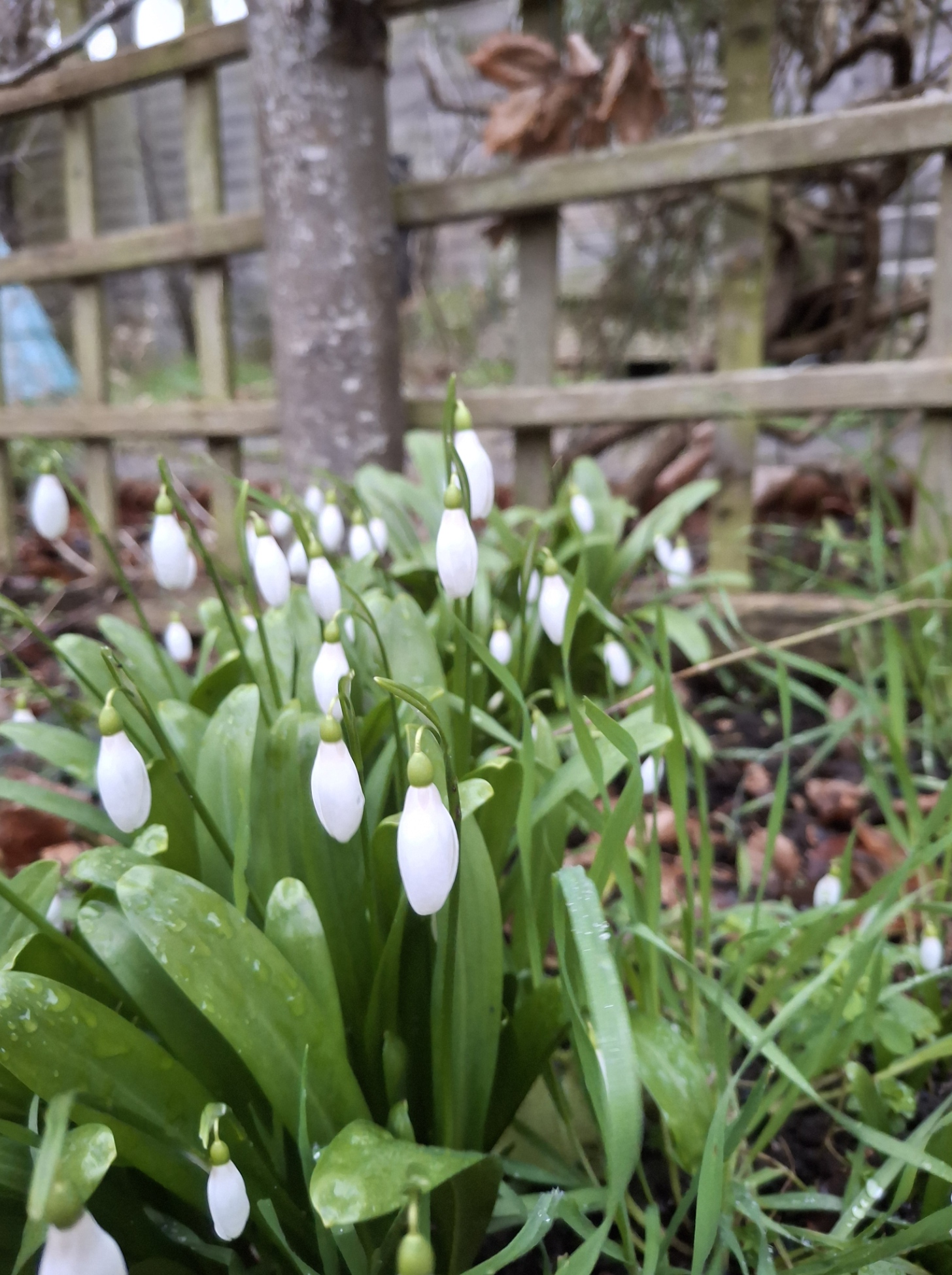
A clump of snowdrops, dotted with raindrops

The snowdrops are out for Candlemas, as they should be. It’s been a grey, heavy, sort of a day, no shadows to be seen because there was no sunshine to cast them, so I suppose we’re plodding on into spring. The days are longer. There are buds on the trees.

A presenter on Radio 3 said earlier that Candlemas is the Christian festival of light, and, while I suppose that isn’t entirely untrue, it’s far from being the first thing that springs to mind for me. If I told you that Christmas is the celebration of the mystery of the Incarnation, I’d be correct but pedantic. But for me The Presentation of Christ in the Temple is in the same size print as Candlemas. The light is figurative, although it’s coupled with the physical light of the lengthening days. I rarely manage to get to church in the evening at all these days, so miss out on the candlelit procession which in any case was not much a feature in many of my previous churches.

For me, it’s most poignant as the hinge between Christmas and Holy Week, looking back and looking forward, prophecy and fulfilment and prophecy again. It calls back the glow and the glory, the paradox of God entering God’s world and God’s temple all but unnoticed, and it warns of the sword and the falling and rising. It picks up the disquieting note of myrrh and underscores it: this child was born to die.

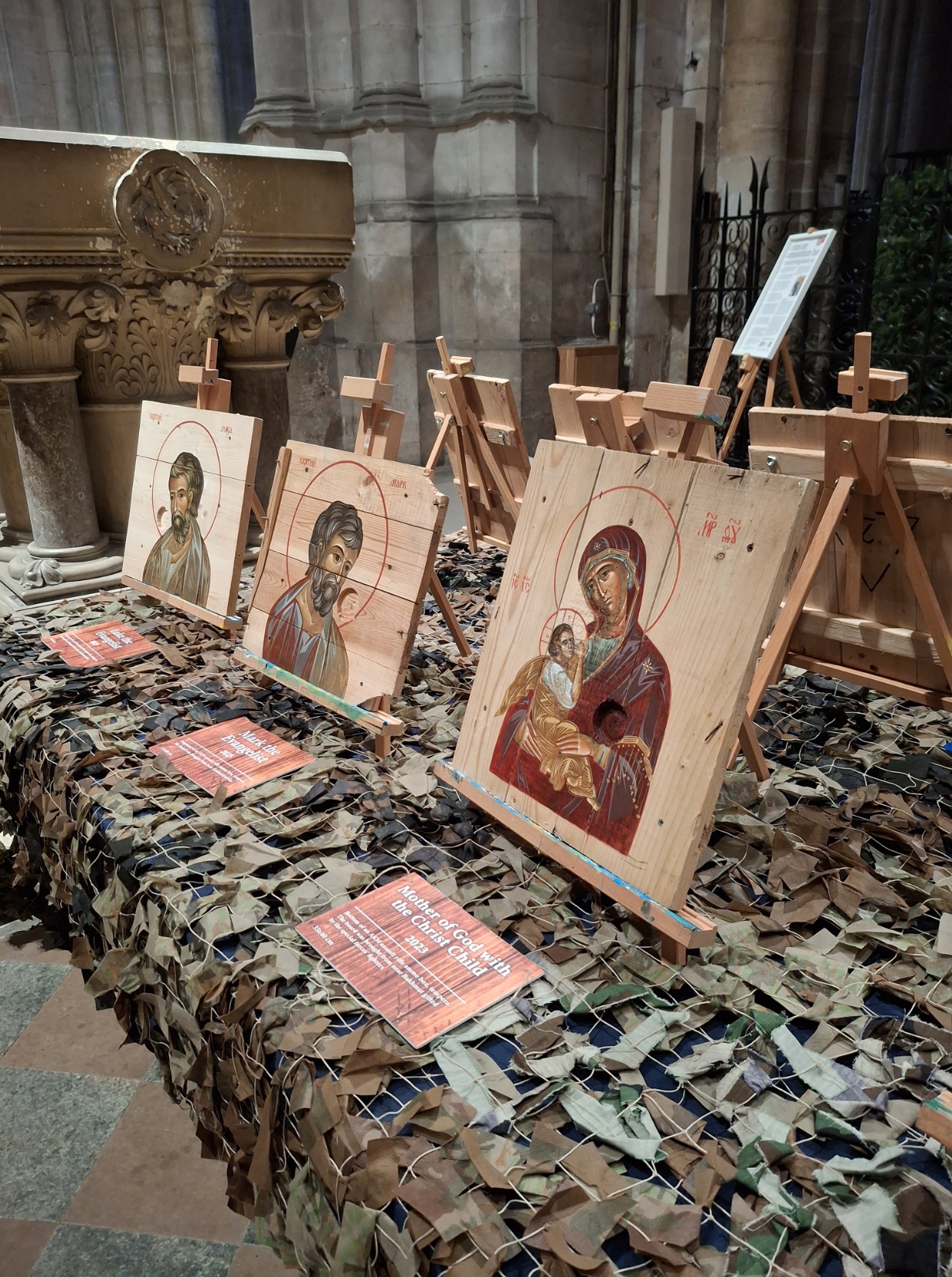
Icons of Luke the Evangelist, Mark the Evangelist, and the Mother of God with the Christ Child painted on untreated wooden boards

Last week I was able to see these icons by Sonya Atlantova and Oleksandr Klymenko, which are on temporary display in Ely Cathedral. They’re painted on fragments of ammunition boxes recovered from battle zones of the war in Ukraine. The symbolism is obvious but no less effective for that: war and death transformed into love and beauty – but you can’t, shouldn’t, mustn’t forget it. Look at that hole where Mary’s heart is.

Loving anybody leaves you open to the certainty of grief when you have to leave them or lose them (it’s the anniversary of my father’s funeral today, too, Lord now lettest thou thy servant depart in peace); the alternative is, of course, monstrous. Parenthood makes you vulnerable, or, perhaps, aware of how vulnerable you are, how very little you can do alone to protect those who look to you for protection. Candlemas is, for me, when we understand a little more deeply what Christmas means. This child is born to die, because all of us are, and even if this birth and this death change birth and death for all of us, it isn’t going to hurt any the less.


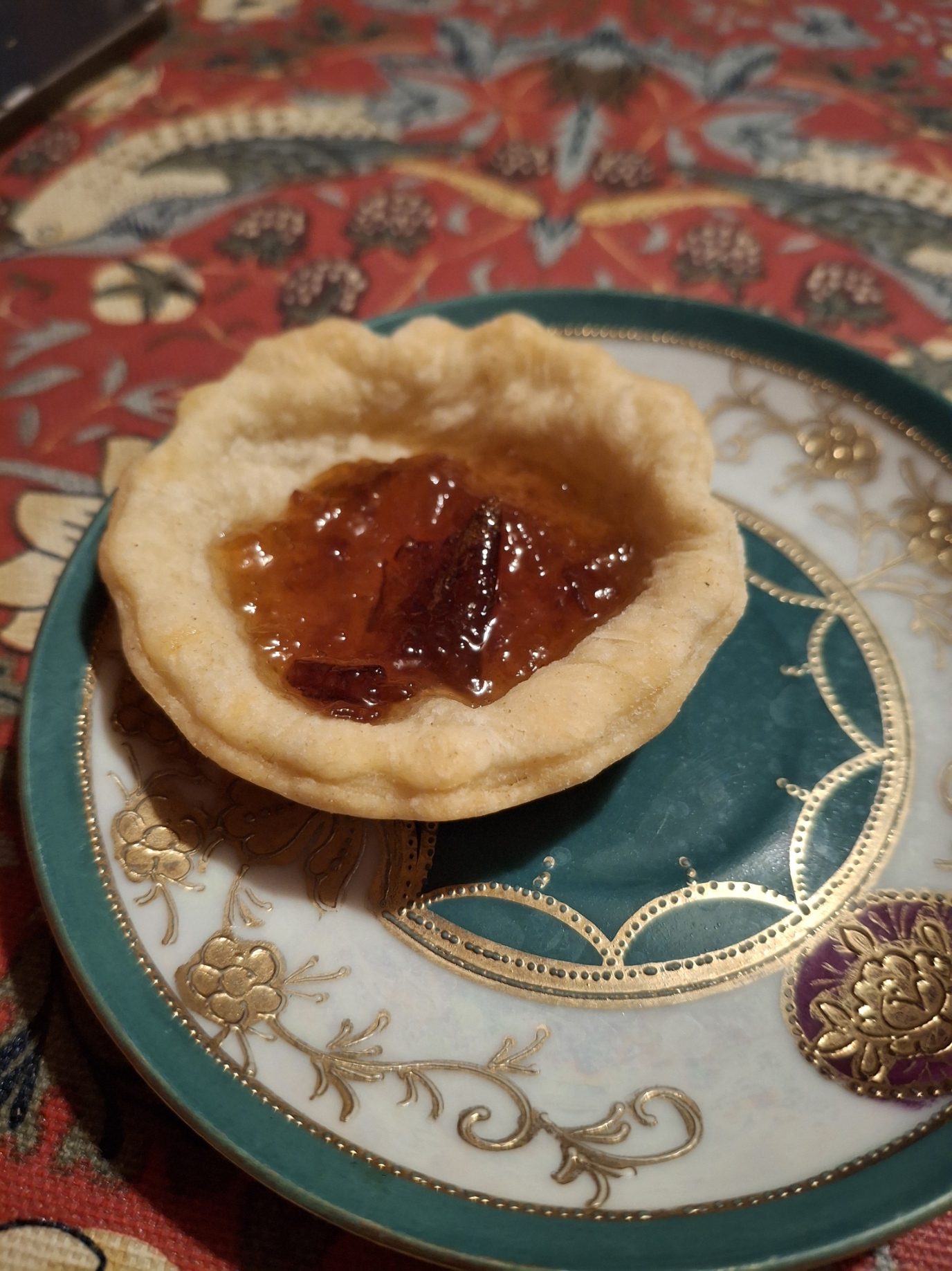
On a lighter (ha!) note, I recall from the Journal of Saw It Somewhere Studies that jam tarts are a traditional Candlemas treat. The shape recalls the Christ Child’s cradle, apparently. This was never a part of my own tradition, but I was making chicken pie for dinner and had some pastry left over, so here we go.

A small jam tart on a small plate

Twelfth day (note to self: things get better)

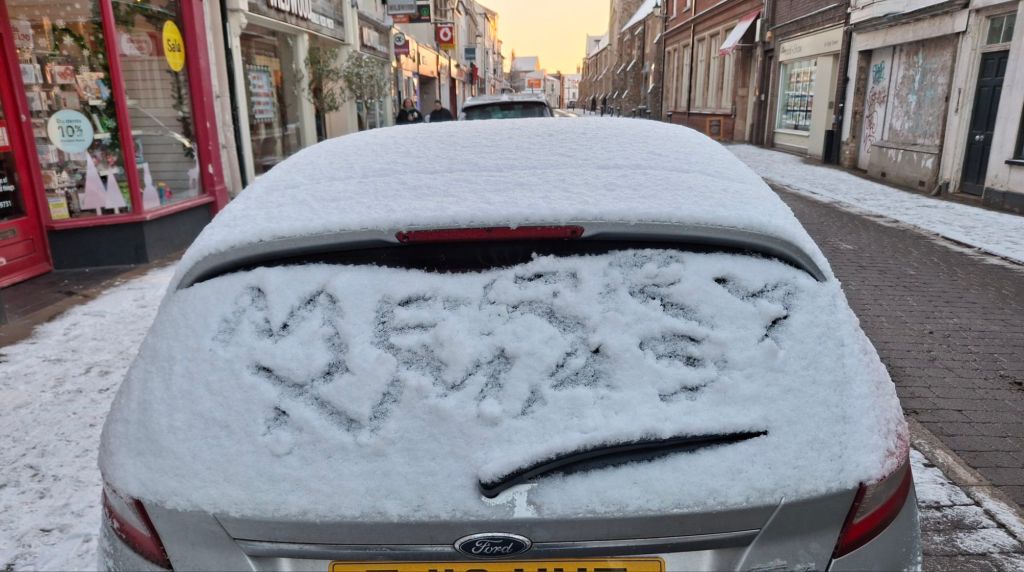
A car parked on a snowy street. Someone has written "MERRY XMAS" in the snow on the rear windscreen.

It snowed overnight! We don’t get much of it round here; in fact, it’s been almost exactly a year. So either the perpetrator of this mild act of vandalism is keeping the full twelve days of Christmas, or else someone’s driven in quite a long way without clearing their back windscreen.

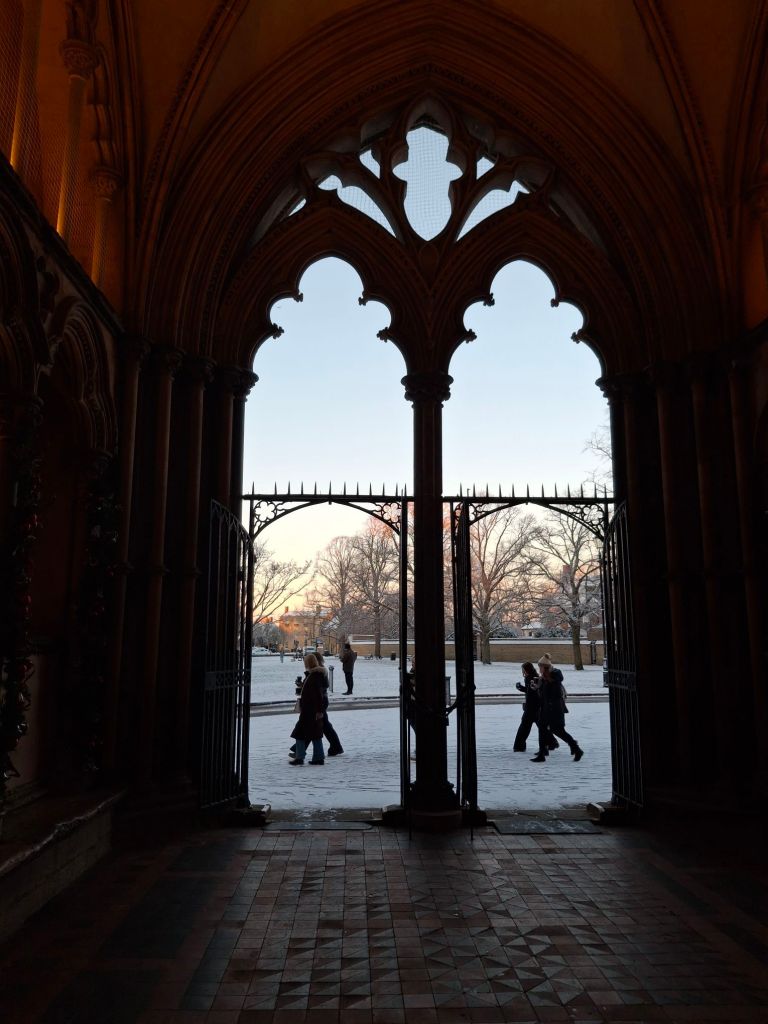
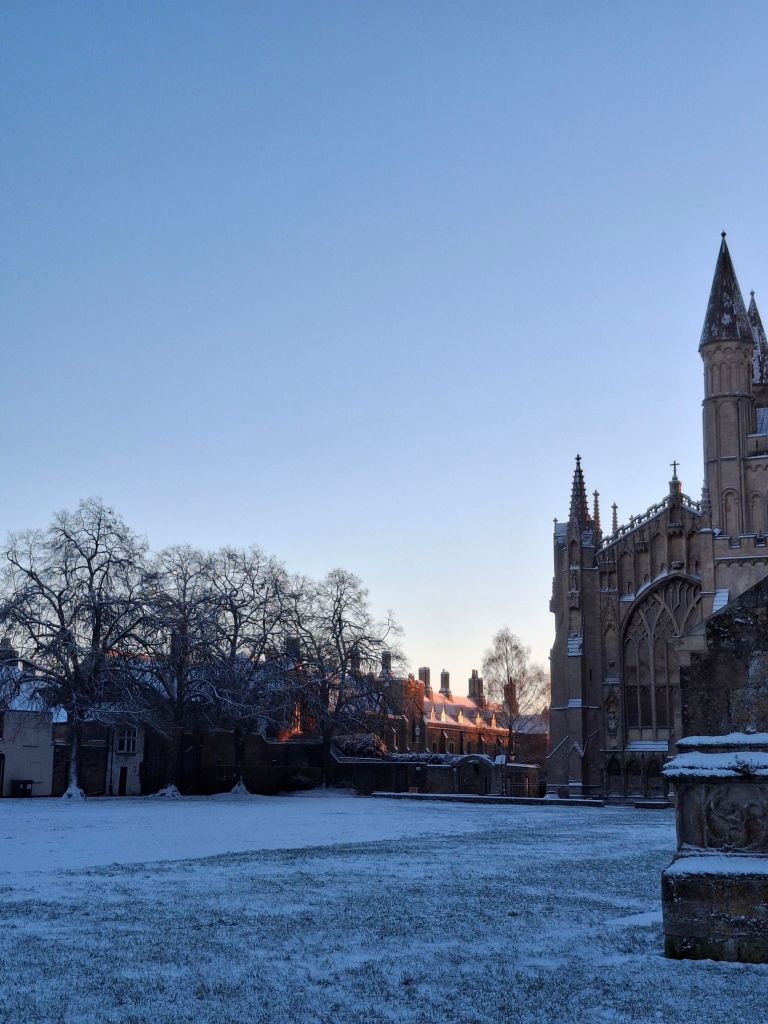
Anyway, this time last year we had a pathetic little dusting of snow, and I was in bed, in a good deal of pain and unable to keep any food down, as the leftover gas from my gallbladder removal surgery fought its way around my abdomen. (What sorted it out, for anyone in similar straits, was a little pill called Wind-eze. The packet wasn’t very clear on how it works, but it does.) Today, by contrast, I was able to walk across town in my Wellington boots, stopping at the cathedral to walk the labyrinth (still in wellies – that’s a first!) and eat the last cherry cream choux bun in Caffè Nero. So, contrary to my gloomy posts of the last month, I can and do get better.

And it really was ridiculously beautiful. See:

Darkness, doubled

A lighted candle

I’m still ill. Three weeks, now; in fact, a little more. The really obnoxious symptoms have gone, but if I do just a little too much I find getting out of bed the next day very difficult indeed.

So today I sampled the solstice daylight from the door and then retired, so far as I could, to the sofa. The choir sang O Oriens at Evensong, though I didn’t hear it. Once again, it’s not really how I’d have liked to mark the solstice, but it feels oddly appropriate. And if it feels particularly dark this year – well, it was a new moon yesterday, so maybe it was.

Yesterday we went out to a stately home. There was a choir (OK but not great) singing Christmas carols outside the café, and in the chapel there were volunteers leading any visitors who cared to join in (and most seemed to) in more carols. Yesterday would have been my mother’s birthday. She would have enjoyed nitpicking the choir’s performance, and she always went carol singing on her birthday if she could. I cried, but I was so glad to have done it.

O Oriens. O morning star. O radiant dawn. Come and enlighten those who dwell in darkness and the shadow of death. A whole chunk of morning prayer unexpectedly brightening the evening.

My moon app tells me it’s a waxing crescent, 3% illuminated. Of course it’s not visible in the night time at all, and even if it were, it’s tipping it down out there. Nevertheless, despite all appearances, it might be possible that things are already getting better.

Waiting

A fluffy black cat (she has white bits, but they aren't visible in this photo) sinks into a burgundy velvet cushion, her eyes only just open

If I’ve been a bit slow on the uptake, I suppose I can blame this lingering lurgy. It’s been two weeks and I’m still lethargic and very conscious that I’m not yet well. I’m better, I think, than I was on Advent Sunday, when I was cold and wobbly and wondering what on earth was wrong with me; certainly better than last Friday, or this Monday; but still not entirely well.

Some friends observed recently that in these days of antibiotics and painkillers (both undoubted benefits to the world at large, let me be clear) we’re stumped by minor illnesses whose symptoms persist. I couldn’t take antibiotics for a cold, and, while I was glad enough of paracetamol and pseudephedrine when my head and ears were aching and I couldn’t breathe without thinking about it, there’s been nothing to be done with the fatigue. Except, of course, waiting. A hundred years ago that would just have been the way things were. You’d have to give your immune system time to do its job, you wouldn’t be able to dose yourself up and power on through.

This year I’ve been reading, very slowly, Kathleen Norris’s The Noonday Demon, in which she examines the cardinal sin/bad thought (depending on which theologians you ask) of acedia. This concept has some overlap with the clinical condition of depression, and is often translated as ‘despair’, but, Norris seems to argue, is perhaps best interpreted as the desire to be somewhere other than where you are. This resonated, often when the toddler just wouldn’t go to sleep, but at other times too.

And recently I picked up Ross Thompson’s Spirituality in Season, in which he talks about three kinds of ‘abyss’, or exclusion:

First, there is exclusion from God, which because God embraces us always, can only be self-wrought; this is sin, leading to hell. Second, there is exclusion from life and being, which by definition is death. And third there is exclusion of our fellow human-beings, which in much of the teaching of Jesus… seems to be equated with the judgement; we are already judged, it seems, by our own response to our neighbour in need.

Then he draws a contrast between the two penitential seasons of Lent and Advent, noting that in Lent we actively confront this abyss (because, as he says, it’s all the same thing) while in Advent we ‘vulnerably experience their great danger, before experiencing at Christmas the one who saves us’.

And then he goes on to talk about waiting, using the example of waiting for a bus. We wait for something (or someone) over whose arrival we have no control at all.

(Here, I would add, we have two options: we can watch, or we can seek distraction. I’m very conscious that lately – the last few months, maybe longer – I’ve been seeking distraction. I’ve been very reluctant to face the inside of my own head, or heart. Too tired. And it’s going to hurt. Maybe. That might or might not be what’s going on. I need to look at that too.)

I read this… in November, if not October. I gleaned some useful facts for my O Antiphons workshop. I noted the reference to W. H. Vanstone’s writing on passivity in the events of Holy Week, which I have also read, and found useful.

And then I spent the first ten days of Advent absolutely hating where I was, furious that I didn’t have the energy to engage in anything that felt like a meaningful observance. And not being able to prepare for Christmas, the sacred or the secular versions, either.

And then it clicked. Waiting. I’m waiting. I’m waiting to feel better. I have very little control over how my body deals with this illness; even my capacity to do nothing is limited. This is, or could be, more meaningful than any Advent devotional book, could teach me more than any twenty-four windows I could open. This is a particularly immersive way to experience waiting, and, therefore, to observe Advent.

Has it helped? Immensely. If nothing else, laughing at my own failure to get it improved at least a couple of days last week. And not at all. Today, for instance, I wrote, I am losing sight of the concept of anything getting better. (And about three minutes after I wrote that, it did.) But that’s the way it goes. If I’d assimilated this brilliant new insight immediately, discovered how to embrace my enfeebled physical state as a symbol of my mortal human state, and glided up to new heights of spiritual consciousness I’d have missed the point, wouldn’t I?

So here I still am. Waiting.