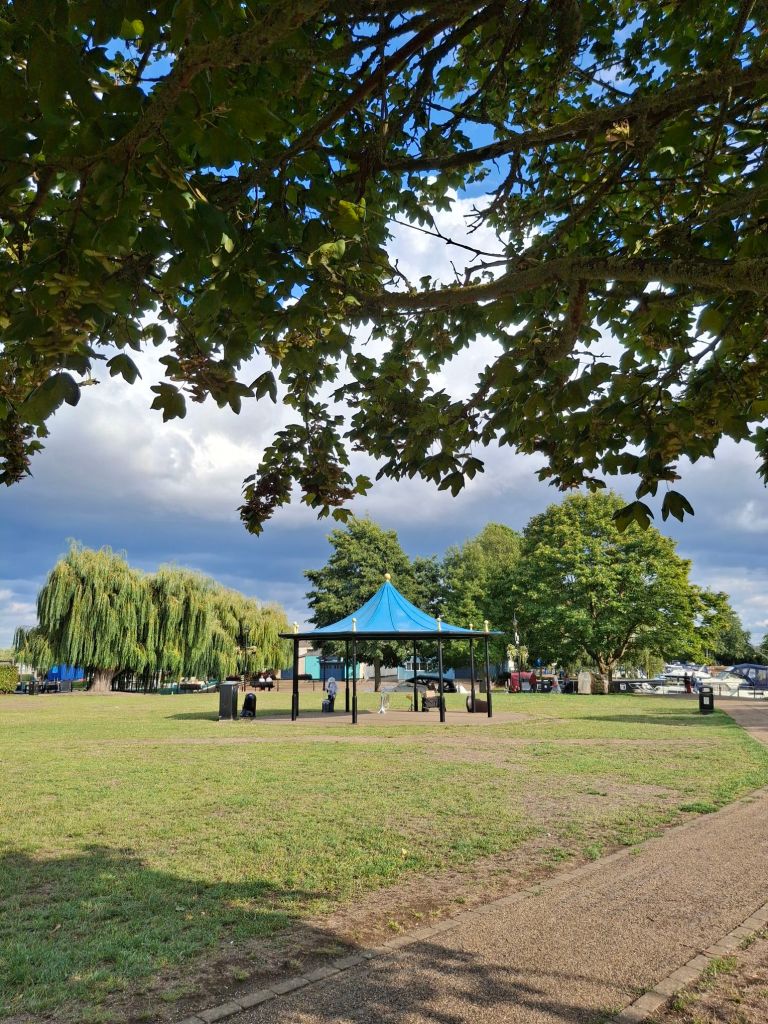
Sundays in the park

A circular bandstand with a blue roof stands in an almost deserted park. Under the bandstand there is one lone tuba standing upside down on its bell and one lone human

All through June and July and August, every Sunday afternoon that we weren’t doing anything else, we’ve gone down to the riverside to hear the brass band playing at the bandstand. Brass bands plural, rather; it’s a different group every week, coming in from the towns and villages all around. One thinks of brass as a Northern, industrial thing, but the council or whoever organises this doesn’t seem to have any trouble filling the schedule. Round here I suspect it’s more of a military, or legacy-military thing, or simply an enjoying-making-music thing.

It’s a lovely way to spend an afternoon, lazing under the trees, listening to live music, with the toddler running between our spot and the play area. In fact, it’s the one sort of concert where I feel really confident bringing a toddler. Maybe we send someone along the riverbank to the ice cream van.

It’s a brilliant community thing. The audience is always a mixture of friends of the band, regulars (their numbers growing through the summer as more and more people catch on) and passers-by. Last week we got there slightly late and found that our next door neighbours, plus extended family, had set up just in front of our usual spot. Yesterday there was one of the nursery families, who’d really just come for the slide and been pleasantly surprised by the music.

I say brass bands. Most of them were: some called themselves jazz orchestras or swing orchestras, but either way, there was a lot of brass involved. There has to be, really, if you want to make yourself heard outdoors with minimal amplification (any singers will get a mic, likewise the bass guitar if there is one, obviously, but that’s about as far as it goes).

Anyway, there’s a wide, if predictable, repertoire. There’s the jazz and the swing, obviously, and when it was one of the less specialist groups you could generally bet on the programme including: some show tunes, probably in medley form, a military march or two, some film music,  TV themes (I know I’ve played that Star Trek compilation at some Saturday morning youth music scheme, a decade and a half before I saw any Trek, and I played cello; there must have been a version for full orchestra), a hymn, and some classic rock. It is extremely accessible, and that is entirely appropriate for the time and place. On Sunday I was standing next the climbing frame, alternately offering encouragement and singing along with The Teddy Bears’ Picnic (and getting a little thrown by the repeats not coming where I expected them).

It’s been hot, and dry (you may have noticed). Most weeks, the audience must have been hard to spot from the bandstand, hiding under trees or any other patch of shade. The grass got progressively more parched. The musicians generally took their jackets off. The willow trees stayed green, but there was a depressing expanse of yellow between us and them, and the sky was aggressively blue. This was about the only bearable outdoor activity. Abide with me, the band played a couple of weeks ago, fast falls the eventide, in glaring sunshine. Mind you, up the hill at the cathedral Evensong would just have started.

As the summer wore on, we evolved more and more elaborate seating arrangements (we are, I should say, by no means the only people with folding chairs and a festival trolley). Sometimes I brought a flask of tea; occasionally, a cake from the market; often, a punnet of strawberries. Somebody always has a better-looking picnic: full marks to the people the other week who’d fixed themselves up with a cream tea complete with fizz. My own Glyndebourne-level aspirations will have to wait another year.

Because it’s over. This Sunday was the last concert of the year. It was a bit of a toss-up whether we’d make it, having been away the night before. I’m glad we did. It was the right way to round out August. One last trip to the ice cream van. Some absolute bangers (technical term). A late, blessed, prolonged soaking has turned the grass green again. Towering grey clouds hint at more if we’re lucky. The folding chairs are back in the garage. The Lord’s My Shepherd (tune: Crimond), always imbued for me with a slightly beery, teary nostalgia, is lingering in my head, but the last tuba player has packed up and gone home.

hear the prayer we offer (and the one we don’t)

DSC_0805

I have a rather tiresome cough at the moment, which has made singing in the church choir… interesting. On Sunday I’d got to the point where the singing was mostly OK, but I was paying for it in the spoken bits. I don’t understand the physiology enough to explain why I could force my way through the Gloria (sung) but was having to miss whole chunks of the Creed (said) in order to cough.

Anyway, I suspect nobody in the congregation actually noticed, particularly over the sound of the rain, but I was aware that it must have sounded rather as if I was having theological objections to some of the least controversial bits of the Creed. I coughed through ‘and was buried’, for example, but managed ‘and the Son’, ‘the holy, catholic and apostolic Church’, and ‘the communion of saints’ with no problems at all.

That reminded me of someone I knew at a previous church who refused to say the line about ‘the resurrection of the body’, because she didn’t believe in it, which then reminded me of a story the rector of that church told about a couple whose thoughts about Firmly I believe and truly used to be very audible, because they just stopped singing when they got to a bit they didn’t believe in.

Personally I can do most of Firmly I believe and truly, though I do mentally cross my fingers when I get to ‘and her teachings as his own’.

There are plenty of reasons to dislike a hymn beside theological or moral objections. Clumsy use of language. A melody line that goes too high or too low (I cannot tell manages to be both, for a lot of people), or is simply banal. (Brother, sister, let me serve you, I’m looking at you.)

There are various different ways to deal with the discovery that a hymn you really dislike is coming up next. You could walk out (though you probably won’t). You could sing the bits you agree with and keep your mouth shut for the bits you don’t. You could spend the whole thing looking for cash for the collection. You could rewrite the words on the fly. I’ve used all those tactics except the first one on the second verse of In Christ Alone.

I try to avoid altogether any kind of service where there’s a danger of I vow to thee, my country. I refuse to offer my country ‘the love that asks no question’: that kind of idolatry is how we end up with the mess we’re in now. And Thaxted is a tune that wasn’t written for the human voice, and it shows.

So far, so uncontroversial. Or, I suppose, so predictably controversial. But my own particular peeve is a hymn that’s sung a lot in ordinary Church of England parish churches, particularly during Lent. Father, hear the prayer we offer.

It’s the first verse that annoys me: Not for ease that prayer shall be/But for strength…

The subtext of this hymn is: I could cope with this, if only you would make me stronger. I don’t know much about the life of Love Maria Willis, the writer: it’s quite possible that it wasn’t easy; that she had to put up with a lot and not complain about it. But this – like I vow to thee, my country, in fact – is mixing up the human values of a bygone century with the values of the kingdom of heaven.

I want to ask: what’s wrong with praying for ease? What’s wrong with praying for things to be easier? That prayer may not be answered, but that doesn’t mean it’s not a worthy prayer.

The assumption that there is something wrong with it drives me up the wall. I think it’s picky and prideful; it’s that old human fault of telling God how to fix things.

What would happen if, rather than assuming that we aren’t strong enough, we entertained the possibility that actually, this situation is intolerable?

I know.

But we worship one whose strength was made perfect in weakness, whose yoke is easy and whose burden is light. God does not tell us to put up and shut up, but Come unto me, ye that are weary and heavy laden, and I will give you rest. Our insistence on our own strength is risible in the face of that almighty understanding.

No, give me the steep and rugged pathways and the green pastures. To be fair, the rest of the hymn does; it’s just the first verse that I object to.

Fortunately, it’s easily fixed:

Father, hear the prayer we offer:
Both for ease that prayer shall be,
And for strength that we may ever
Live our lives rejoicingly.