Back to Stancester

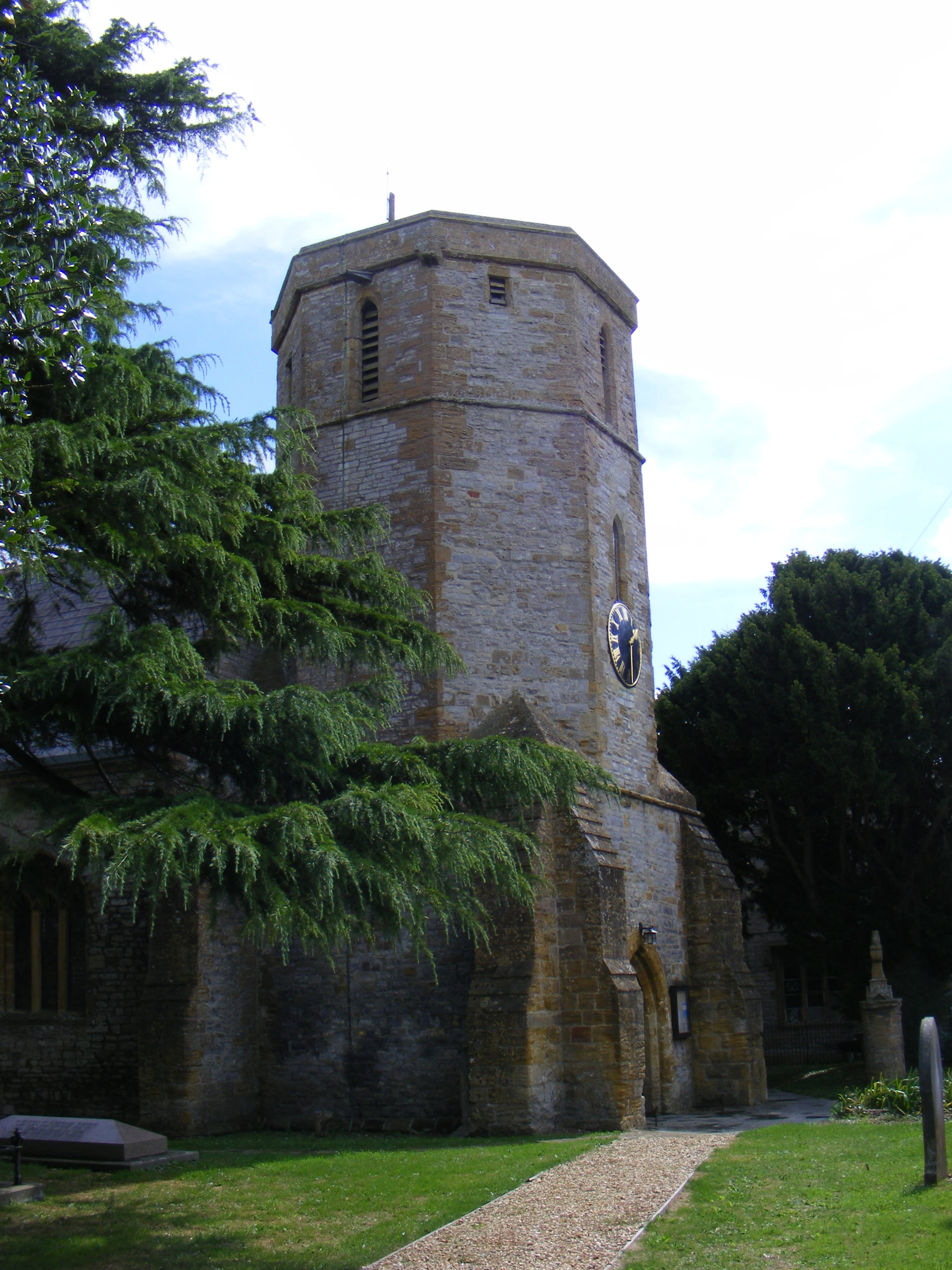
Church with an octagonal tower

I’ve been reading my own books.

I was at least partly prompted, I have to admit, by an entity that emailed me assuring me that it was not a spammer, telling me how inspirational my books could be, and scolding me for what a disaster my publicity has been of late. I know, sender of unsolicited negging guilt-trippy business pitches. I know.

At the present moment, I would have trouble telling you where you can actually buy my books, and I’m painfully aware that they aren’t available in as many places as they should be. As for things like having a social media presence, for what that’s worth these days, and knowing whether or not my mailing list works… *hollow laughter*

Up until very recently, I didn’t care at all. I did not have the capacity to care. The last five years have not left me much room to write, still less to care about selling about what I’d already written. And it was the not-writing that was bothering me.

In a slightly wacky but nonetheless effective practice, I had an imaginary conversation with the version of my future self who has actually been managing to write something. She had robust opinions about my correspondent’s sense of boundaries, but she agreed that my books were worth reading, and suggested I do that.

I was going to start with the work-in-progress workbook on how to write your book while you have a day job, in the hope that my past writing self would have something helpful to say, but, for fairly obvious reasons, the books I have in EPUB format are the ones I’ve already published. So I returned to Stancester. Speak Its Name last Tuesday. The Real World last Wednesday.

Anyway, it turns out they aren’t bad at all. Rereading, I have (of course) found several things I’d do differently now, but only a couple that really made me cringe. (Although I think I had an old file for Speak Its Name. I have vivid memories of fixing all those inconsistently curly inverted commas, and who the hell is Lucy? Didn’t I write her out? Combine her with Georgia?) A while ago I thought The Real World was the best thing I’d ever written, but then it got comprehensively ignored. Now I don’t think it’s stand-out brilliant, but I do think it’s still pretty good. They keep you reading. At least, they kept me reading – and I know what happens.

And now I seem to be writing the third. Don’t get excited: it’s four pages, just over 1000 words, and only about half of those are new. (Yes, I had started writing it some time in the five years of life upheaval…) And does anyone actually want to read Will and Georgia’s lockdown diaries? I doubt it. I’m not even sure that I want to write them. But there’s still a shred of that magnificent indifference clinging to me. I don’t care whether anybody wants to read it. It’s what wants to be written, so off we go.

Meanwhile, my future writing self is drinking coffee and smiling quietly, and talking me down from the old familiar “but can I really write this?” wobble. I haven’t broached the topic of sorting out distribution and publicity for the books I already have. It does not feel like a priority, not when there’s writing to be done. Still, I have just gone through all the links from my book pages and removed some of the dead ones. It’s a start. Thank you for the nudge, mystery correspondent.
A tiny bit of book news

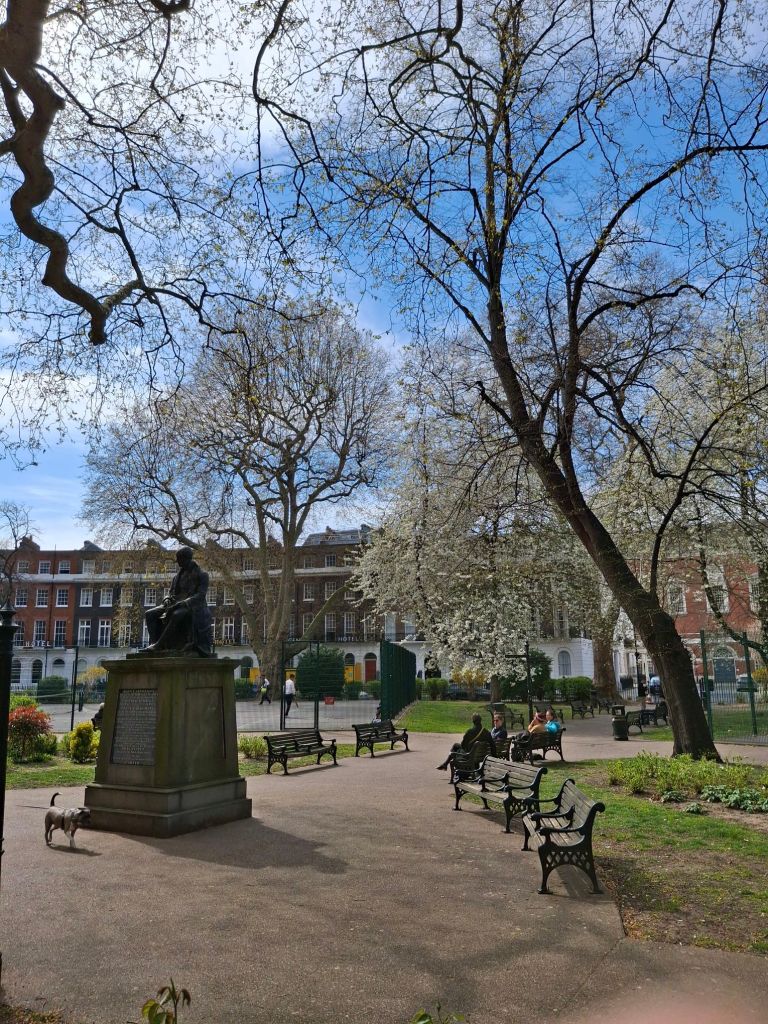
A London public garden on a sunny spring day, with trees and tennis courts and a statue of a seated luminary

You probably won’t be surprised to hear that I have been doing pretty much nothing in the way of book promotion lately. However, since I got my act together and sorted out my Draft2Digital account, I have been getting the occasional notification of the occasional sale. It’s always a pleasant surprise, a reminder that I had something to say (a decade ago in one case, my goodness) that is still saying something, and a reassurance that I still do have something to say, that it’ll bubble up to the surface in its own good time, and that someone out there will want to read it when it does.

Jae’s Sapphic Book Bingo is back for 2026, and this week’s featured square is sapphic books set in a school or academia*. Which I can very much help with. You can have Speak Its Name for undergrad, and The Real World for postgrad. You could also use The Real World for ‘Established couple’ further down the card, and, at a stretch, Speak Its Name for ‘Sapphic character involved in politics’, though I should stress it’s student politics and the involvement is not exactly voluntary. In my ‘Free Reads’ section, The Mermaid would count for the ‘Free book or free choice’ square. (It’s a short story, but Jae says explicitly that a few of those are allowed.)

Readers in the US, both Stancester books are now available through the Queer Liberation Library, along with all sorts of other good stuff. Worth a look if, very understandably, you need a distraction.

Meanwhile, I am deeply amused by Smart Bitches Trashy Books’ (not sure where the apostrophe should go, there) Unhinged Romance Bingo. I am, I think, relieved to report that none of my books fit into any of these squares, except perhaps the cycling and silversmithing in A Spoke In The Wheel for “niche business or hobby”. That said, I don’t really write romance-the-genre (ASitW is definitely the closest), so maybe it’s not really surprising. You never know, though. Maybe one day I’ll write an aggressively twee small town. In the meantime I’ll be cackling at First Name Last Name Does A Thing and Title: A Noun of Stuff and Things.

*Hence the picture. This is Cartwright Gardens, opposite the University of London’s Garden Halls.

Books I intend to finish in 2026

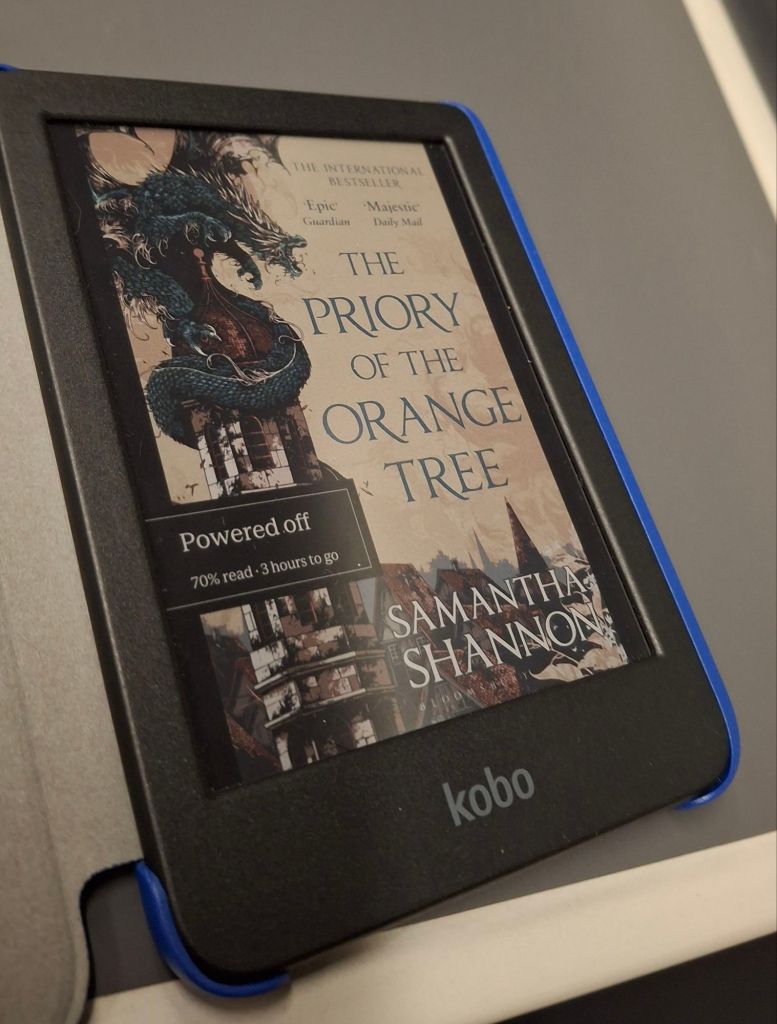
Kobo ebook reader showing the cover of The Priory of the Orange Tree (Samantha Shannon) at 70% read

I started them in 2025, and am enjoying them enough to finish them. I just didn’t get them over the wire before the end of the year.

The Priory of the Orange Tree (Samantha Shannon) would probably have got there but for the fact that it’s a library book. My e-loan expired on Boxing Day, when I was somewhere around the 65% mark. I went straight back to the hold queue, and managed to borrow it again on New Year’s Eve. Now I have until the 15th, and the pressure’s off. Maybe too much so. We’ll see if I can finish it before then. Anyway, it’s great fun: an epic fantasy that’s attempting to, and generally succeeding in, evoking all the dragon mythology of East and West, and throwing in 16th century politics too.

Towers in the Mist (Elizabeth Goudge) has in fact been in progress since before 2025. I can’t remember when I started it, but it was probably some time in 2024. I was enjoying it, but was finding it harder work than I had the brain for at that point. Now I suspect it’s getting in the way of my starting The Players’ Boy, which arrived several months ago and which (most unusually for me and Antonia Forest) I haven’t yet opened. I’m sure I will be in the mood for atmospheric historicals sooner or later.

Public Schools and the Great War: the generation lost (Anthony Seldon and David Walsh) is research for the work in progress now tentatively known as Household Rancour. It’s about as depressing as you’d expect, but very interesting, and very useful for my purposes. I’m very glad that I stumbled across the recommendation while idly scrolling with no thought of writing in my mind.

Everything I’ve Ever Learned About Change (Lesley Garner). Everything I’ve Ever Done That Worked was one of the books that shaped my mind and attitude when I read it in my teens, and I still consciously apply many of its principles (Be A Music Listener; When The Sea Is Rough Mend Your Sails; The Sea Is Your Dinner Companion, etc). Now I’m 40 and have worked more of this stuff out for myself, so Garner’s later books (I also read Everything I’ve Ever Learned About Love last year) aren’t blowing my mind in the same way, but I’m still enjoying this, whrn I remember to read a chapter over lunch.

Spirituality in Season (Ross Thompson) follows the liturgical year, starting with Advent, and I’m reading it in real time, so to speak, so if all goes well I’ll finish it at Christ the King – the end of November.

Everyday Nature: how noticing nature can quietly change your life (Andy Beer) is a book with a section for each day. I started in the autumn of 2024, was going quite well in the spring of 2025, and then, like so many things, put it down when my mother died. So now I’m trying again. I’ve read the bit about dunnocks twice now and still can’t tell the difference between them and sparrows.

On a similar note, The Morville Year (Katherine Swift), a collection of garden columns. But that follows the old year and runs March-March, so I’m saving it.

Waiting

A fluffy black cat (she has white bits, but they aren't visible in this photo) sinks into a burgundy velvet cushion, her eyes only just open

If I’ve been a bit slow on the uptake, I suppose I can blame this lingering lurgy. It’s been two weeks and I’m still lethargic and very conscious that I’m not yet well. I’m better, I think, than I was on Advent Sunday, when I was cold and wobbly and wondering what on earth was wrong with me; certainly better than last Friday, or this Monday; but still not entirely well.

Some friends observed recently that in these days of antibiotics and painkillers (both undoubted benefits to the world at large, let me be clear) we’re stumped by minor illnesses whose symptoms persist. I couldn’t take antibiotics for a cold, and, while I was glad enough of paracetamol and pseudephedrine when my head and ears were aching and I couldn’t breathe without thinking about it, there’s been nothing to be done with the fatigue. Except, of course, waiting. A hundred years ago that would just have been the way things were. You’d have to give your immune system time to do its job, you wouldn’t be able to dose yourself up and power on through.

This year I’ve been reading, very slowly, Kathleen Norris’s The Noonday Demon, in which she examines the cardinal sin/bad thought (depending on which theologians you ask) of acedia. This concept has some overlap with the clinical condition of depression, and is often translated as ‘despair’, but, Norris seems to argue, is perhaps best interpreted as the desire to be somewhere other than where you are. This resonated, often when the toddler just wouldn’t go to sleep, but at other times too.

And recently I picked up Ross Thompson’s Spirituality in Season, in which he talks about three kinds of ‘abyss’, or exclusion:

First, there is exclusion from God, which because God embraces us always, can only be self-wrought; this is sin, leading to hell. Second, there is exclusion from life and being, which by definition is death. And third there is exclusion of our fellow human-beings, which in much of the teaching of Jesus… seems to be equated with the judgement; we are already judged, it seems, by our own response to our neighbour in need.

Then he draws a contrast between the two penitential seasons of Lent and Advent, noting that in Lent we actively confront this abyss (because, as he says, it’s all the same thing) while in Advent we ‘vulnerably experience their great danger, before experiencing at Christmas the one who saves us’.

And then he goes on to talk about waiting, using the example of waiting for a bus. We wait for something (or someone) over whose arrival we have no control at all.

(Here, I would add, we have two options: we can watch, or we can seek distraction. I’m very conscious that lately – the last few months, maybe longer – I’ve been seeking distraction. I’ve been very reluctant to face the inside of my own head, or heart. Too tired. And it’s going to hurt. Maybe. That might or might not be what’s going on. I need to look at that too.)

I read this… in November, if not October. I gleaned some useful facts for my O Antiphons workshop. I noted the reference to W. H. Vanstone’s writing on passivity in the events of Holy Week, which I have also read, and found useful.

And then I spent the first ten days of Advent absolutely hating where I was, furious that I didn’t have the energy to engage in anything that felt like a meaningful observance. And not being able to prepare for Christmas, the sacred or the secular versions, either.

And then it clicked. Waiting. I’m waiting. I’m waiting to feel better. I have very little control over how my body deals with this illness; even my capacity to do nothing is limited. This is, or could be, more meaningful than any Advent devotional book, could teach me more than any twenty-four windows I could open. This is a particularly immersive way to experience waiting, and, therefore, to observe Advent.

Has it helped? Immensely. If nothing else, laughing at my own failure to get it improved at least a couple of days last week. And not at all. Today, for instance, I wrote, I am losing sight of the concept of anything getting better. (And about three minutes after I wrote that, it did.) But that’s the way it goes. If I’d assimilated this brilliant new insight immediately, discovered how to embrace my enfeebled physical state as a symbol of my mortal human state, and glided up to new heights of spiritual consciousness I’d have missed the point, wouldn’t I?

So here I still am. Waiting.

Some things I have read

… since the last time I posted about reading, which I am aware was some time ago. I haven’t been reading much at all, and it’s almost all been non-fiction. (Exception: Where Late The Sweet Birds Sang, Kate Wilhelm; the latest Jill Mansell; and, very early on Sunday morning, Blood Sweat Glitter, Iona Datt Sharma, which was exactly what I needed.)

A lot of that non-fiction has been one good idea, maybe two, expanded upon at great length until a book happens. Examples: several parenting books (your child is a person; whatever they are doing or not doing at the moment, it probably makes sense in their head and it will help you both to try to understand); Oliver Burkeman’s Meditations for Mortals (life is short; might as well get on with things; start anywhere); and Radical Candor (Kim Scott). This was mentioned in the women’s development programme I’m undertaking at work, and turned up in the library, so I borrowed it. As I’m not a manager, most of it was of limited relevance for me, but again, the subtitle (How To Get What You Need By Saying What You Mean) tells the story. I’m not sure that it tells you much that an Ask A Manager addiction wouldn’t.

Nurture the Wow (Danya Ruttenberg). Awful title. I assume this is the “two countries separated by a common language” thing, because I know very few Britons who would be able to say this one without either throwing up or dying of embarrassment, but clearly the US publishers thought it would work. Fortunately I a) knew what it was getting at; and b) had read enough of Rabbi DR’s other work to know that I like her writing. The subtitle is more descriptive, if not much less skin-crawly: Finding Spirituality in the Frustration, Boredom, Tears, Poop, Desperation, Wonder, and Radical Amazement of Parenting. Anyway, this is the best book I’ve yet read that’s intended for religious people who have become parents. It draws on many different traditions, my own included, and addresses pretty much all the emotional and physical and spiritual challenges (and opportunities) that parenthood presents. I’ve just sent my copy off to a friend who’s recently had a baby.

Wholehearted Faith and Searching for Sunday (Rachel Held Evans) – not so much about parenthood, but just the thing when I needed to read something by an intelligent Christian woman of more or less my age who’d thought about things.

To get them off my shelves, where they’ve been since 2013 or thereabouts when I bought them from a Woking junk stall, Honest to God (John A. T. Robinson) and The Ferment in the Church (Roger Lloyd). A fascinating snapshot of the preoccupations of the Church of England in the 1960s, and I think mainly interesting to me as such. Much of it is either the way I think about things anyway or has been superseded. I was amused by the way it seemed to take the Bishop of Woolwich the entire book to notice that he’d replaced one metaphor with another.

Eat Up! (Ruby Tandoh) – enthusiastic about pretty much every sort of food, sceptical about fad diets, scathing about food snobbery. A delicious book.

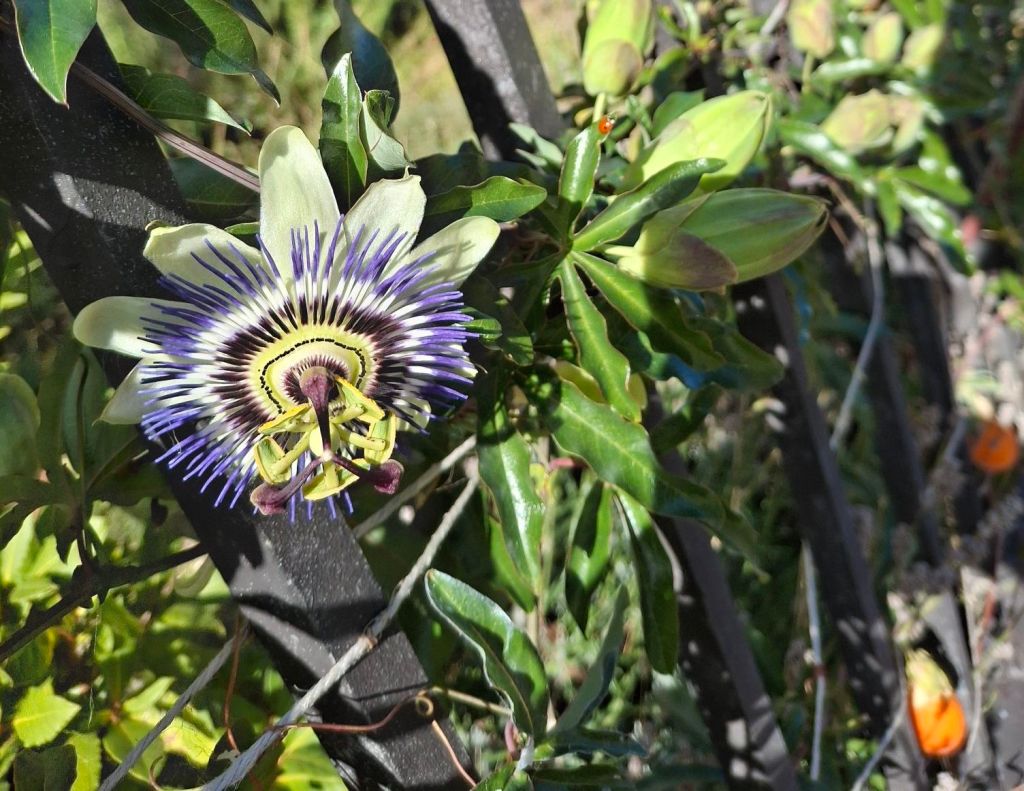
And here’s a picture of a passion flower, because why not.

A passion flower. On a nearby leaf is a small ladybird.

Good enough is not bad at all, or, Book Bus Stories: this year it’s a zine

A stack of photocopied A3 paper covered in dense handwritten text. Some sheets have been folded down into A6 booklets.

Last year, Book Bus Stories was an exhibition. Next year, it might finally be a book. But this year, it’s a zine.

I haven’t been writing much in recent months; you may have seen how quiet I’ve been over here and guessed that it reflects a prolonged period of literary inactivity offline. I haven’t had much time, I haven’t had much energy, and, if I’m honest, a lot of the time I’ve been lacking the inclination too. It’s a side-effect of motherhood that I didn’t expect at all: for well over a decade I’d had a story more or less constantly writing itself in my head – until I had a baby, and it all just – went. It was if my brain had been replaced with someone else’s, someone who didn’t write, and had no interest in writing. Which was just as well, really, because she didn’t have the time and the energy.

Every now and again an idea rushed back in, and I’d get very excited. And either I’d lie awake with a sleeping child in the crook of my elbow and know that if I moved I’d wake her, or by some miracle I’d find an hour and get it written down, and then it would stick there because by the next time I got a free hour there’d be something else that needed doing, or that seemed more fun.

Meanwhile, Smashwords (which I use to distribute the ebook versions of my Stancester books) kept sending me emails about migrating my account to Draft2Digital, which kept reminding me that I’d never sorted out my tax code on there and therefore had (a frankly pitiful amount of) money sitting on my account, and every time I felt irritated and slightly despairing of ever selling any more of my existing books, let alone ever finishing a new one. 2020 – the last time I published a book – was getting longer and longer ago, and I was feeling less and less like the person who’d done it.

Then one lunchtime I went to the Wellcome Collection. They had an exhibition of zines, mostly by disabled people. They talked about how zines are amateur, scruffy, don’t have to be perfect. In the corner was a table with paper and pens and a sign encouraging you to have a go at making your own zine, about saying the things you had to say.

I had things to say, things about grief and loss and memory.

I thought, I could do a zine.

A book still seemed a very long way out of reach, but I could do a zine. Or I could at least try one. I went back to my desk and folded a sheet of A4 paper into eighths. I drew a bus across two of them. A little doggerel quatrain emerged from my mind with barely any trouble at all.

Back at home, I unearthed an A3 pad and started on the real thing. There was a poem I’d written years ago, intended for the eventual Book Bus Stories book, which went straight in. In a charity shop I found a book of photographs of Paris, all chic and moody and monochrome, which, combined with the experience of speedrunning a dozen years of (moody, monochrome) family photographs while preparing for my mother’s funeral, made me think everything looks better in black and white, and then, everything looks sadder in black and white. That became a piece.

I photocopied several pages of my father’s Paris Is Well Worth A Bus and, after several false starts, got a reasonable blackout poem down.

I stuck down a Kimberley Ales beermat and an Artichaut de Bretagne sticker to make wheels. I got out the Dymo machine.

The cat trod on the paper while I was working on it and I remembered my father yelling “Trolloper!” at her; I drew a cloud around the pawprint and wrote about how it helps and hurts to remember things like that.

I filled in the body of the bus, the platform, the window frames. I thought I was done. Then I went to Gay’s The Word (on a bit of a weepy high because the General Synod of the Church of England had finally done away with Issues in Human Sexuality as a requirement for ordinands), picked up Joe Brainard’s I Remember, read about twenty pages, and knew that I needed to fill in all the white space with the things I don’t remember.

On Friday I took the whole thing to the library and did a photocopy by way of a test. It looked great. (Everything does, in fact, look better in black and white.) I took it to the print shop and got a proper print run (fifty, in fact) done. Then I took the whole lot home and, over the weekend and today, cut and folded the lot into booklets. Now they’re packed in a box, ready to go down to Ventnor Fringe and the Book Bus with me tomorrow. It’s a good feeling.

I made a zine. It’s not perfect. And it’s not a book. But it’s good enough, and it turns out that good enough is actually great.

February reads

Moss grows in the cracks between paving stones

Twelve Words for Moss (Elizabeth-Jane Burnett) was a Christmas present from one of my brothers. It’s uncategorisable: poetry, (family) history, memoir, nature – it takes as its starting points the author’s grief at the death of her father and her enthusiasm for mosses, and weaves a narrative between the two.

I got a few chapters in before I noticed that the last sentence of each becomes the first of the next, and went back to the beginning to see what else I’d missed. When I made the deliberate effort to slow down and read the words one by one, it burst into life and turned out to be poetry. Although this did make the occasional nature-documentary-voiceover style introductions of experts somewhat jarring.

What felt simply odd to me was the absence of any sense of Burnett’s father’s personality. I think it must have been a deliberate choice, to convey the gravity of the loss by not really talking about the one who was lost, and I’m not even sure that I can say that it didn’t work for me, but it was alien. If I’d got interested in moss to the extent that Burnett has, my father would have known about it, would have got interested in it on my behalf, and would have bought me books on moss in charity shops and phoned me up to tell me that he’d heard a programme about moss on the radio,and every time I encountered moss now I’d think of him. For me, grief is about that shared connection that can’t be shared any more,  that recoils on me with a jolt because there’s nowhere for it to go now. And fair enough, maybe that’s not the sort of person that Burnett’s father was, but my point is that you just can’t tell from this book.

That doesn’t take away from how interesting a book it is, though, or how lovely the words, and I always enjoy seeing people getting really, really enthusiastic about something. And I have been noticing moss much more.

I’ve been struggling a bit with fiction recently: I find myself not wanting to feel things deeply (plenty of that in real life), so this month’s choices have been deliberately light. Although not in subject matter. Actually, I suppose both this month’s novels grapple with the question of how far we are entitled to influence the lives of our loved ones:

Hate Follow (Erin Quinn-Kong) deals with a subject that’s interested me since it first started hitting the news a decade or so ago: what happens when the children of internet personalities come of age (literally or metaphorically) and are in a position to object to their parents’ use of their names, likenesses, and actions. This was a rather superficial take on the subject: it suffered from a desire to make too many people basically well-meaning and decent. I couldn’t quite believe in the daughter’s ignorance of what her mother was sharing, or in the lawyer’s willingness to be so conveniently helpful.

I picked up The Burden (Agatha Christie, in her Mary Westmacott persona) from the library returns trolley and got through the first part the same day, and the rest of it the day after. It’s the story of the complicated relationship between two sisters; it starts out as a piece of devastating psychological realism (Christie is never sentimental about children or marriage) and goes totally bonkers in the third act. I would not have stopped reading it, though. Interesting data point for the “depiction of disabled character” files: the disabled character is appalling, but they are appalling before they become disabled and the experience does not reform them; they just become appalling in a different way.

Then I spent a lot of yesterday reading The Cuddled Little Vice (Sandman) (Elizabeth Sandifer), a very long article which did a very good job of explaining to someone who never got into comics (no shade on people who did; I just find the combination of visual storytelling and all-caps text harder work than makes for an enjoyable experience) why Neil Gaiman is such a big deal, and how he got into a position to do and get away with what he did and got away with. 57000 words – that’s basically a book – and fascinating, although, of course, horrifying.

Having written all that out, I can’t help thinking of Granny Weatherwax’s adage that sin is treating other people as things. I can’t fit Elizabeth-Jane Burnett into that, though: you could say she treats moss as people, but I don’t see the harm in that.

Recent reads: January

A fluffy black cat lies on a sofa, looking ill-used
As it happens, I have been yelling, if not ‘Touch not the cat!’, ‘Not her face!’ and ‘Not her tail!’, and ‘Don’t pull her fur!’, quite a bit of late…

Mostly non-fiction so far this year. The exception is:

Touch Not The Cat (Mary Stewart), which I read for my romantic suspense book club. We started it last year: I’d been keeping myself to the two chapters per week for scheduled discussion up until the second week of January, when I gave in and finished it off. Having read a fair few Stewarts for this group – and not the Arthurian ones – I was rather surprised by the ESP element (this isn’t a spoiler; it’s introduced very early on) but it worked rather well. I wasn’t so convinced by the parallel 1835 timeline. Usually I read Stewart romances for the armchair travel; this was more armchair nostalgia, as the bulk of the action is set in the region where I grew up. It was equally enjoyable: Stewart is always good for an evocative description or several.

Permanent, Faithful, Stable: Christian same-sex partnerships (Jeffrey John) has been  on the shelf for ages, and I felt both that I really should have read it and that I was fed up with it being there making me feel guilty. A quick read – and it is one – sorted that out. I think it’s probably the most succinct summary of the theological debate around same-sex relationships that I’ve read and would recommend it on that basis, though I did have a few quibbles. (Specifically: I did not feel that the author engaged adequately with the argument that marriage is a human institution and replicates human, patriarchal, systems of exploitation. More generally, I have been bearing a grudge to the tune of the most biphobic remark I’ve ever heard from the platform at a supposedly LGBTQ affirming event. The scene in The Real World where Colette walks out of the LGBTX West Country meeting? Not terribly far from real life.)

This was a fairly old edition, and events, in the form of thousands of actual same-sex marriages, have overtaken it. The arguments still feel very familiar, though.

The Queer Parent: everything you need to know from Gay to Ze (Lotte Jeffs and Stu Oakley) – very much the book I needed to read, squaring as it did the vicious circle where I’ve been feeling increasingly adrift from my bi identity but very conscious that as parenthood goes I haven’t had to deal with any problems that are not common to all. In a weird way, it was most affirming to read an interview with a bi couple who said that they were finding it hard to reconnect with the queer community. But it was interesting (and often humbling) to read about the experiences and decisions that I haven’t even had to think about, from surrogacy to IVF to doing the whole thing as a trans person.

The Road Less Traveled (M. Scott Peck) – was a wild ride. It’s one of those books whose existence I’ve been vaguely aware of for a long time, but could have told you nothing about beyond ‘er, self help?’ Then I read bell hooks’ All About Love last year and was intrigued by Peck’s definition of love which hooks quotes:

the will to extend one’s self for the purpose of nurturing one’s own or another’s spiritual growth

And I think that probably was the most useful part of the book. To summarise the rest of it: life is suffering, because life is change and change inevitably involves suffering; we have the choice as to how we engage with that. It was extremely readable – short chapters, and with most of them the promise of a mystery worked through, which is what I always enjoy about case studies (really I should just go and read more Oliver Sacks). I did feel that it rather lost its way when it got more heavily into the spiritual side of things. And there were a few ‘yikes!’ moments where it became less possible than usual to forget that this was published in 1978.

So it’s going back to Oxfam and I’m keeping All About Love. I’m not sure that I entirely adopt that definition, but it’s still better than a lot that I’ve seen.

December Reflections 4: best book of 2024

This book deserves a longer post, but I’ve lost the evening to a gallbladder flare-up and am feeling too sore/sleepy/shaky to say much more than that it’s good to see someone with the intellectual clout of bell hooks talking seriously about love – something you don’t often come across outside self-help and theology. There’s a bit of both of those in there, but it’s more than that.

Recent reads

Gilt angels support the dark wood roof beams of a cathedral

I ran out of renewals on a library book, which is something I don’t remember having done in a long time, maybe never, and if I did it was probably because I’d lost the book, rather than because I honestly wanted to finish it but was going painfully slowly, which was the case here. The book in question was Eva Ibbotson’s A Glove Shop in Vienna and (as this edition was trying to market itself) Other Winter Stories. In fact I don’t think that even half the stories were particularly wintry, but never mind.

I’m very on-off with Eva Ibbotson. I adored her witch stories when I was a child. Two decades or so later I found her romances for adults simultaneously enchanting and infuriating, and reading this collection I remembered why. On the one hand, there’s the food, the scenery, and the balletomania. This collection also has a carp swimming in a bathtub, which will make perfect sense to anyone who’s encountered a Mittel- to Eastern European Christmas Eve, and made me smile. On the other, there are the manic pixie dream girls (not like other girls!) and the not-really-examined nostalgia for the Austro-Hungarian and Russian empires. I kept finding that I had to be in a very specific mood, and given that I had to be in it eighteen times over it’s no wonder that I ran right up against the renewal limit. But I got there on Thursday lunchtime, wooden spoon in one hand and book in the other, and the second last story nearly made me cry, and I remembered to take it back to the library on Friday morning, so everything was ok.

I continue to read speculative fiction on my e-reader when I find myself awake at strange hours of the night. In more or less chronological order:

Babel (R. F. Kuang) This had a stonkingly good premise and some important things to say, but I kept getting kicked out by careless anachronisms. For reasons which become apparent over the course of the book, it is vital that it is set in the 1830s; a pity, then, about the fountain pens, the respectable women thinking nothing of going into pubs, and the running water in student digs. At one point a character reflects that there will be no omnibus at that time of night. (‘Nor that decade,’ I muttered to myself.) The author has clearly gone to a lot of trouble to get Oxford right, but it’s Oxford of about five years ago. I kept reading, however; couldn’t help it.

Lady Eve’s Last Con (Rebecca Fraimow): a space caper. Our heroine is navigating intergalactic high society, trying to get revenge on the rich bore who broke her sister’s heart, and trying not to fall for his charismatic half-sister. Absolutely delightful.

The King Is Dead (Naomi Libicki): a young man who has failed to distinguish himself on the field of battle is appointed as armour bearer to the deeply traumatised brother of the eponymous late king. As complicated as that sounds, it gets more so. I really appreciated the thoughtful worldbuilding in this: religion, the way magic works, food practices, gender dynamics, all of it coming together to make a complicated and coherent society. And a really satisfying story, too.