Camino de Santiago 6: bulls, storks and donkeys

Pamplona to Logroño, 26th March – 1st April 2007

The Hitch Hiker’s Guide to the Galaxy has a few things to say on the subject of towels…

A towel, it says, is about the most massively useful thing an interstellar hitchhiker can have. Partly it has great practical value – you can wrap it around you for warmth as you bound across the cold moons of Jaglan Beta; you can lie on it on the brilliant marble-sanded beaches of Santraginus V, inhaling the heady sea vapours; you can sleep under it beneath the stars which shine so redly on the desert world of Kakrafoon; use it to sail a mini raft down the slow heavy river Moth; wet it for use in hand-to- hand-combat; wrap it round your head to ward off noxious fumes or to avoid the gaze of the Ravenous Bugblatter Beast of Traal (a mindboggingly stupid animal, it assumes that if you can’t see it, it can’t see you – daft as a bush, but very ravenous); you can wave your towel in emergencies as a distress signal, and of course dry yourself off with it if it still seems to be clean enough. – The Hitchhiker’s Guide to the Galaxy, Douglas Adams.

The Larrasoaña refugio had been almost full; we resolved to make a good start the next morning. When we left it was still dark. (It must be noted, however, that the clocks had just gone forward, so this was not entirely due to extreme keenness on our part.) We were well down below the snowline by now, and made good progress almost as far as Villava, until we took a wrong turn across a muddy field and ended up having to climb over a wire fence. Once we had got ourselves back on the right track we found ourselves looking down on the motorway, and felt rather superior to the cars and lorries heading towards Pamplona. Pilgrims had been going that way for over a thousand years. We were there first.

Crossing the bridge into Trinidad de Arre

We tramped on past the Trinidad de Arre church and refugio, through Villava, alongside a stream, and through the Portal de Francia into Pamplona. Pamplona, of course, is where the famous Bull Run happens, but we were three months too early and not overly bothered. Upon reaching the centre of the city I was afflicted by an intense reluctance to make any decisions, so Anne took charge and settled that we would eat lunch at Bar Iruña, a vast, mirror-lined establishment with a certain decayed glamour. The atmosphere seemed familiar; by the end of our (three-course) lunch we had pinned it down. It was very similar to the Imperial Hotel, the J. D. Wetherspoon’s pub in Exeter. The cheap food, the battered, once-lavish décor, the sense of having gently come down in the world, all were reminiscent of the Imp. Bar Iruña was a favourite haunt of Hemingway’s, according to the menu. Fair enough.
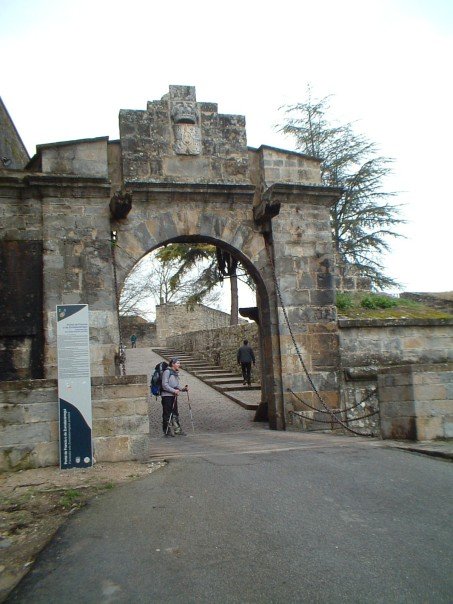
Anne at the Portal de Francia, the gate into Pamplona on the French side of the city

It was after lunch that things started going seriously wrong. First Anne’s debit card was rejected by two separate cash machines, then we failed to find a post office. We did manage to find a souvenir shop, where we purchased such essentials as postcards, and the best fabric badge of my entire collection, and a chemist, where we were able to buy ‘Hansaplast’, the Spanish equivalent of Compeed. We began to make our way out of the city. The weather, having been dull and grey all morning, suddenly turned sunny. Anne’s blisters were seriously painful now; I was getting a headache and beginning to be irrationally worried that the refugios in Cizur Menor, the next village, would be full before we got there. We sat down on a bank on the west side of the university for Anne to inspect her feet. One of the blisters had burst; she applied Compeed. This, we learned later, was a serious mistake.

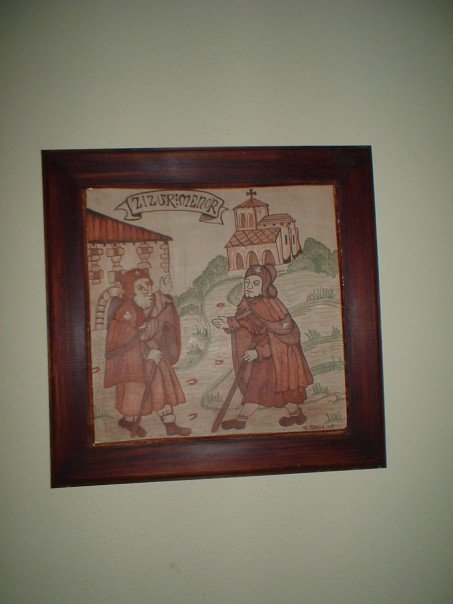
We made it, however, to the Roncal refugio in Cizur Menor, where there was plenty of space both in the dormitories and on the drying racks. We also found Brantz, who had indeed pushed on to Zubiri the day we had stopped at Viskarret and regretted it; he had got very cold and his knees were giving him problems. He had been obliged to take a rest day in Pamplona. The refugio catered to every conceivable pilgrim whim: it had a kitchen, a common room with TV and internet station, and even a vending machine selling everything from cans of San Miguel to vacuum packed olives. The sun was still flooding the courtyard. Regardless of the fact that it was now pushing 4pm, we did our laundry and hung it out to dry. I tried toasting the little bread rolls called pan de leche in an attempt to make them more interesting. Whether I succeeded depends on how interesting one finds carbon, really. I certainly succeeded in toasting them. Meanwhile, Anne watched the TV, which seemed mostly to be showing a commercial for facial lotion, advertised for some bizarre reason with shots of snails slithering over leaves. By the time I worked out the machine to my own satisfaction I had wasted a lot of bread, but it was edible eaten with spreadable processed cheese, and olives from the vending machine livened things up no end.
46
Cizur Menor

The lady who signed us in and stamped our credenciales had told us that there would be Mass at the village church at 7.30pm, so we wandered up there with a few minutes to spare beforehand. We sat there for quite a long time waiting for something to happen. Several children of varying ages got up and disappeared into what we assumed was the vestry; then they came back again. Some older members of the congregation got up to do what we assumed were confessions. At around eight o’clock we gave up and went back to the refugio. We then abandoned our high principles and used the internet machine to send an email detailing the debit card fiasco to Anne’s parents. It was agreed that it was probably just the card being temperamental, as it had been before we left, but that her parents would be prepared to transfer some money into my account if necessary. With that settled, we went to bed, first checking on the laundry, which had predictably enough failed to dry. We draped it around our beds and hoped for the best.

The next morning it was as grey and drizzly as if the previous afternoon’s sun had never happened. The laundry was still not dry; Anne’s towel was, in fact, still sopping. I opened a tin of sardines in tomato for breakfast and managed to get oily tomato all down the front of my waterproof, where it remained for the duration of the trip. Matters did not improve much once we started walking. The drizzle became rain. The rain was wet and getting wetter. So were we. I was again getting wetter than Anne because I had no waterproof trousers. I was wet; I was cold; I just wanted to stop. My diary says succinctly ‘Ascent to Zeriquiegui hellish.’ When we reached that village we joined a flock of other pilgrims, ponchoed and dripping, under a kind of veranda affair. It seemed to be the exterior of a pilgrim centre that was still under construction, but it provided some degree of shelter. We nibbled biscuits, and I persuaded Anne that we should stop at the next refugio, because it was so cold and miserable.

That was the low point of the day, however, and our spirits rose along with our altitude as we approached the Alto de Perdón. The mist was thick here, and we came across a miniature landslip, a few last streaks of snow, and a lot of water. Things were improving none the less. We were amused when, nearing the top, we looked up and realised that we were standing directly underneath a wind turbine. The thing was so quiet compared to the wind itself and so completely veiled in fog that we would never have seen it had we not stopped. At the very top stands a line of silhouettes cut from sheet metal representing pilgrims from medieval times to the present day; they are much larger than life and looked very dramatic against the swirling mist. We did not stay long to admire them, however; the wind was uncomfortably strong, and we began the descent. We passed several little cairns of stones. We added to the first one, but after that found them increasingly irritating. The most pointless sort, we thought, were the ones that had been begun on top of concrete waymarkings: any more than seven or eight medium-sized stones and they would start falling off. Sometimes, when we were feeling particularly wicked, we would push the stones off ourselves.

Pilgrim silhouettes
Pilgrim silhouettes


We were heading downhill towards Uterga, which was the first village listed in the guidebook as having a refugio. Here, I had insisted, we would stop. However, as with Valcarlos, and Burguete, and Espinal, when we got there we simply didn’t feel like it. We did stop at one of the two refugios, because it also sold coffee and doubled as a pilgrim souvenir shop. I sat near the radiator, drinking coffee, and steamed gently. Anne bought a sunhat embellished with a camino shell (a yellow, stylised affair, much like what would happen if one crossed the Shell Oil symbol with a comb) despite the awful weather, on the grounds that she would be sure to need it sooner or later. Then we pressed on through Muruzábal and Obanos to Puente la Reina. There was a recommended detour to look at a 12th century church in Eunate, but we felt it was not worth it, given the conditions. We plodded on through the rain.

Puente la Reina was, historically, the site where the two routes over the Pyrenees met. It was also the place of our first real rest day, the first time we saw storks, managed to buy stamps, melted my boots, and learned the hard way about just how temperamental refugio laundry facilities could be. The refugio in question was attached to the monastery of the Padres Reparadores, and consisted of two rooms of bunk beds, another containing two showers, two lavatories, a sink and a tumble dryer, and a dining room with benches and an open fire.

Pilgrims who had arrived before us had already taken advantage of this last, and had arranged their boots in pairs in front of it to dry out. We did likewise. This, as it turned out, was not the most sensible idea. Nor was assuming that the tumble dryer would work well enough to dry all our clothes adequately, and washing them, and then discovering that it wouldn’t. As a result, I discovered a new use for my towel. I had already wrapped myself up in it against the cold, not of the moons of Jaglan Beta, but of snowy Viskarret, and later it would serve very nicely as part of an improvised icepack, but for now, fastened with a couple of safety pins, it made a passable skirt. Once again I had no dry trousers.

We went out (in the rain) for dinner; Bar La Plaza had a pilgrim menu for €8.90, helpfully advertised in four languages. Despite the fact that I was wearing that most unpilgrimlike of garments, a skirt, we were handed this menu without question, and made a good meal from it. Anne’s blisters were particularly troublesome by now, and she took one of her poles out with her to use as a makeshift walking stick. When we returned to the refugio – somewhat tipsy after sharing a bottle of red wine – we found a German lady lecturing a group of footsore Koreans about the importance of proper foot care and rest days. She seized upon Anne’s foot with a kind of horrified glee, and solemnly exhibited it to her audience as an example of the state that feet should never be allowed to get to. We decided that we probably ought to take a rest day.

I had blisters too, but not on my feet. My boots had got too close to the fire, and the rubbery sealant had melted and bubbled. It did not do much to improve their appearance, but I was luckier than some. My boots merely looked slightly silly, and I found that the accident made no perceptible difference to their performance; others’ had burned right through.

We could not help feeling a little smug in the morning, seeing that it was still raining, and knowing that we did not have to walk that day. I left an explanatory note in my best Spanish for the hospitalero; we were allowed back later, so it must have worked. We took advantage of the fact that we were in a town at a sensible hour, and visited the Post Office, a café, a pharmacy and the church. (I had been to the pharmacy the previous evening, and cursed the fact that Lil-lets do not appear to exist in Spain. Attempting to work out how the hell applicator tampons work, in Spanish, and after half a bottle of red, is not recommended. In the end I pulled the thing to pieces.) There were some ladies sweeping and dusting in the church, but we said Mattins anyway. We found when we came out that it had at long last stopped raining. We returned to La Plaza for lunch, and discovered to our amusement that a meal that had been merely adequate the previous day, after a walk of eighteen kilometres, was now extremely filling. We spent the whole afternoon there, eating, drinking, writing postcards and thinking theological thoughts. The staff had either forgotten about us completely or were content to let us squat in the dining room. Eventually returning (via the supermarket) to the refugio, we saw, amid a messy nest of straggling sticks on the top of a yellow tower, our first stork.

Stork's nest on top of a tower in Puente la Reina
Stork’s nest on top of a tower in Puente la Reina

Anne is the bird enthusiast, but I was equally excited. Perhaps it was a vague memory of reading The Wheel on the School when I was a little girl, perhaps insidious margarine marketing, perhaps an idea never quite dispelled by years of proofreading birth stories that storks bring babies, or perhaps simply the sheer exoticism of something I had never seen, either in England or elsewhere; whatever the reason, there is something special about these white and black birds with their clumsy red legs and their over-sized, gloriously chaotic nests. We must have seen getting on for a hundred storks in our progress westward, but the novelty never wore off. Storks on church towers, storks on their own dedicated poles, storks following tractors; each stork merited attention, and frequently a photograph. So attached did we become to the storks that – much further along the camino, at Villalcázar de Sirga – we took the almost unprecedented step of cluttering ourselves up with tourist junk and purchased pin badges depicting a nesting pair.

This, however, was all in the future, and for the moment we stood enthralled by the very first stork of all. Our second stork appeared a few minutes later, when we returned to the refugio; there was a nesting pair on the monastery bell-tower. We also met another interesting character: a French gentleman who had no hesitation in informing us that he had been to Santiago eight times, and producing laminated certificates to prove it. He also attempted to convince a girl with knee problems that all her troubles would be solved if only she had a European health insurance card; given that she was Australian, he was unsuccessful in this. I seemed to be the only other person in the hostel who spoke French. This meant that he frequently called upon me to interpret various gems of wisdom – to beware, for example, of the fleas in León. We, and the Australian girls, concluded that he was a bit weird.

The next morning we left Puente la Reina, crossing the Queen’s Bridge at last. We saw some more unfamiliar birds; Anne said they were black redstarts. I had no reason to disbelieve her. We climbed up towards Cirauqui; a tiring, muddy, slippery stretch, during which we discussed how amusing it would be if Captain Jack (of Doctor Who fame) turned out to be the Master – a speculation that had been entirely Jossed by the time we got back to Blighty, but none the less diverting for that. Cirauqui itself was a pleasant enough place, cascading down from the top of the hill. I was excited to discover a Calle Santa Catalina; this was before I worked out that Catalina was what every Spanish Catherine was called. We crossed a Roman bridge to leave the village; shortly after this one of my telescopic walking poles telescoped and refused to remain untelescoped for some considerable time. The camino was then diverted around a section of motorway, which was confusing, and probably longer than it would otherwise have been. We lunched in Lorca, drank lemonade in Villatuerta, and arrived at last in Estella after an uncomfortable stretch of concreted road.

I spent part of the evening wandering around Estella (an attractive town of narrow streets and old buildings) searching for some new underwear. I succeeded… sort of. I managed to get extra-large child-size knickers, which fitted, but not very comfortably. We found M. Huit Fois à Santiago again; he had also made it to Estella and was staying at the refugio. We avoided him. An Australian couple, Terry and Marg, were more promising acquaintances.

A highlight for many pilgrims on the road out of Estella is the wine fountain at Irache. We stopped there, and I drank a token quarter of an inch of wine from a plastic mug. It was, after all, early in the day, and we had a long way to walk. We also wanted to visit the adjacent monastery, which was not yet open, so we sat on a bench outside and said Matins. We did the visit and got the sello. Then we moved on, climbing up slopes occupied mainly by dormant vineyards to Villamayor de Monjardin, where we had hoped to be able to buy lunch. Nothing was open. Not the refugio, not the other refugio, not the bar. We cursed and headed down the hill again. We were not looking forward to the afternoon’s walk; Heloise had described the section approaching Los Arcos (where we intended to spend the night) as ‘no shade, hard walk’. As we approached the bottom of the hill we saw a cheering notice. It suggested the possibility of food, and drink, and only a slight detour from the path. We decided to follow the detour.
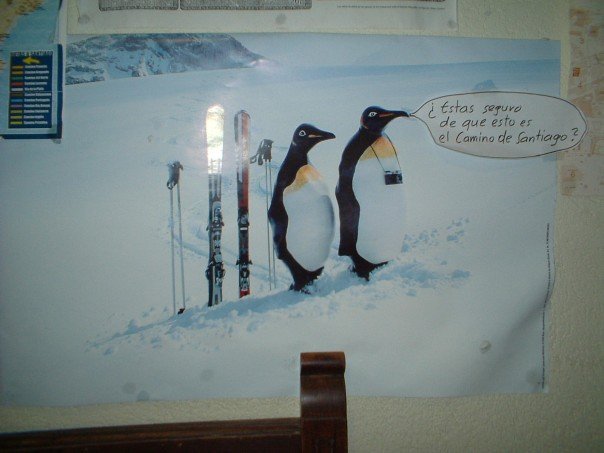
Are you sure that this is the Camino de Santiago?

After a very satisfactory lunch, the proprietor of the bar directed us back to the camino with the help of an aerial photograph, and we set out on what turned out, despite all our misgivings, to be a very pleasant afternoon’s walk. We wandered, singing, through fields and vineyards, through a marshy green area noisy with the croaking of frogs (I spent some time looking for them, but only ever saw the splash that indicated where they had been a second before), to Los Arcos. It was nowhere near as arduous as we had been expecting it to be; in fact, it felt like a gentle stroll. We signed ourselves into the Albergue de la Fuente, Casa de Austria, with no problems. It was a laid-back, hippyish kind of place on three floors. It had a well-stocked bookcase (containing, to Anne’s delight, a paperback copy of The Two Towers, and a poster of a pair of penguins with the caption: ‘Estas seguro de que esto es el Camino de Santiago?’ We approved.
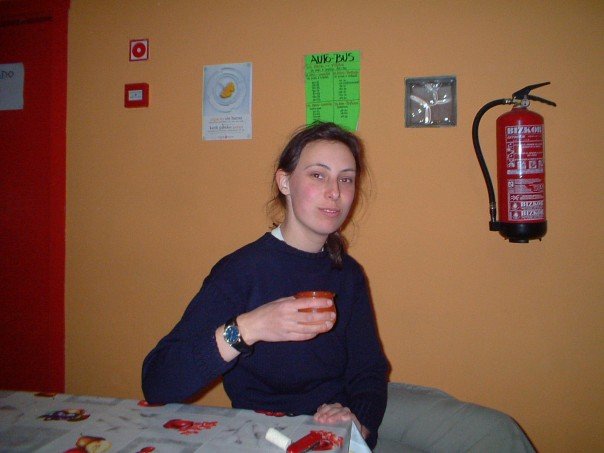
Drinking wine from a terracotta pot in Los Arcos

After a meal of pasta and tomato sauce (accompanied by red wine; I was perhaps excessively proud of myself for having opened the bottle with the corkscrew on my penknife) we went out to the pilgrim mass at the church of Santa María – a terrifyingly gilded edifice with a larger than normal population of cherubs. We were accompanied by Marg, and Ursula, an Austrian pilgrim who had begun walking with her and Terry; later we got to know all three well. I believe that this was the first point where Anne as I, as Anglicans, started to feel somewhat excluded from the mass; there seemed to be very little for us to join in with. During the distribution a hymn was sung. I recognised the tune; it was Nearer, my God, to thee, so I sang that. As pilgrims, we were all called forward to be blessed at the end of the service, and received a small prayer card with a photo of the church’s statue of Saint James. I reproduce the prayer here:

Lord, you who recalled your servant Abraham out of the town Ur in Chaldea and who watched over him during all his wanderings; you who guided the jewish people through the desert; we also query to watch your present servants, who for love for your name, make a pilgrimage to Santiago de Compostela.

Be for us,
a companion on our journey
the guide on our intersections
the strengthening during fatigue
the fortress in danger
the resource on our itinerary
the shadow in our heat
the light in our darkness
the consolation during dejection
and the power of our intention
so that we, under your guidance, safely and unhurt, may reach the end of our journey and strengthened with gratitude and power, secure and filled with happiness, may join our home.
For Jesus Christ, Our Lord. Amen.

Apostle James, pray for us.
Holy Virgin, pray for us.

We giggled over it a little – but later. Later still we worked out a better approximation. Marg, who had been into the church earlier in the day, led us into the cloister to show us the floats that had been assembled ready for the Holy Week processions – life size models depicting the Last Supper, the Crucifixion… It was, unfortunately, too dark to have a proper look at them, but we saw another set at Santo Domingo de Calzada, and were able to marvel at the sheer religious exhibitionism there.

57
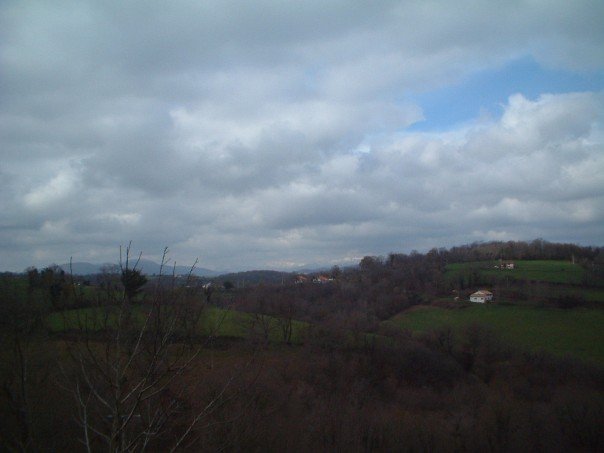
The landscape through which we walked

It was still a fair old way to Santo Domingo, however. We left Los Arcos in golden-green morning light, and found early on that we had problems. I lost my faithful blue hanky, which annoyed me slightly, but that was but a minor irritation. We stopped in San Sol so that Anne could examine her feet. They were not pretty. She rearranged her elaborate system of wadding and cushioning and soldiered on. We stopped again in Torres del Rio. I have had a postcard of the ceiling of the church in Torres del Rio blu-tacked to my bedroom wall almost since Heloise sent it back in 2000; it is an intriguing octagonal shape. It was one of the things I had assumed I would see somewhere along the Camino. The church was locked, however, and although the guide book directed us to a certain house where the key could be obtained neither of us was in a mood to do so. We passed it by – once Anne had applied more Compeed.

Anne limped on bravely to Viana, which made it a respectable 17.5km day. The refugio there provided rather daunting three-decker bunks in part of a converted monastic building. It was adjacent to some most fascinating ruins; Anne was infuriated that she could not bear to walk far enough to look at them properly. I, meanwhile, was too busy revelling in the luxury of a working washing machine and tumble drier, and wandering around the town in search of a shop that would sell bread. It was remarkably difficult. There was a market offering leather purses, strings of beads, reproduction medieval weapons and, in fact, all the heart could desire, apart from bread. Eventually I found some in a shop called Schlecker, which looked more like a chemist’s, but served the purpose. Perhaps it was some kind of health food. Six months later, in a Frankfurt branch of Schlecker, I bought my whole family Lebkuchen for Christmas. It was a useful kind of shop.

The next day – it was Palm Sunday – Anne’s feet were still dubious, so we decided that I would walk on to Logroño alone, and she would take the bus, along with our Austrian friend Ursula. I had a happy morning’s walk, mentally contrasting my solitary way with the crowds lining the streets on the way into Jerusalem, and duly noting that I was crossing from Navarra into La Rioja. I walked carefully around the edge of a flock of sheep with attendant dogs in what appeared to be a large park, and headed into the suburbs of Logroño. A woman called out as I passed, and invited me in to drink some coffee. She put a sello in my book, and then I moved on.
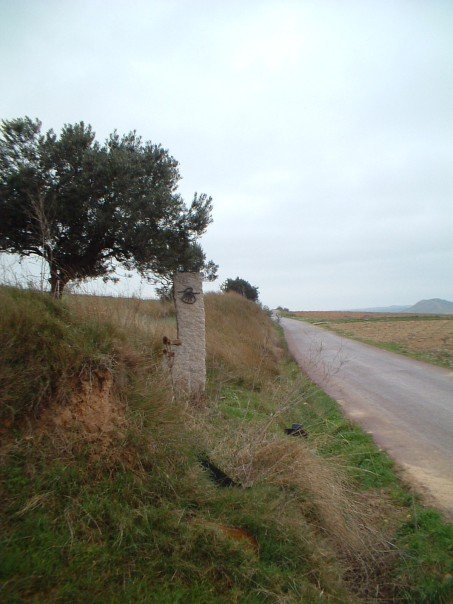
Waymarking on the road to Logroño

Anne and Ursula, meanwhile, were not progressing so well. It being Palm Sunday and, therefore, presumably a public holiday, the bus timetable was even less comprehensible than usual. They waited for a longer than reasonable period, until, finally despairing, Ursula flagged down a passing car and asked when the bus went. The driver either did not know, or knew that the bus did not go at all; she gave the pair of them a lift.

We were reunited in the church of Santiago, where we gathered up olive branches and joined in the Palm Sunday celebrations. (I stuck a sprig of olive in my hat; it stayed there for quite a long time before it dried out and fell off.) After the service the priest, recognising us as pilgrims, sought us out and led us to the parish rooms, where he showed us where to find packet soup, frozen pizza, and the wherewithal to cook them. We were most grateful – particularly Anne and Ursula, who had got cold with all the standing around. The room was adorned with a framed series of blue and white tiles depicting the life of a San Vicente, all captioned with rhyming couplets. Eventually, around mid-afternoon, we decided that it was probably time to leave, so we moved on to the refugio; I’d noted it earlier in the day.

Part of the life of St Vincent, as told in tiles at the parish rooms

The refugio was large, occupying several floors, and crowded. It was backed with a courtyard with a fountain, where boots were to be washed. Other than a life-size statue of a pilgrim in the stairwell, there was not much to recommend it. It was clean, and had a well-stocked kitchen, which were assets that we would have appreciated later in the pilgrimage, but, operating at capacity (it was full by 7.30 that evening, and the first refugio that we had come across that had been obliged to close) it was distinctively claustrophobic. The dormitories were packed with bunk beds; there must have been at least seventy sleeping in the same room. A vocal minority of them were children (it being the beginning of Holy Week, some people were obviously doing stages of the camino en famille), which did not make for a good night’s sleep. We wondered, nervously, if it was going to be like this all the way from here.

5


Camino de Santiago 5: Excelsior!

Over the Pyrenees, 23rd-25th March 2007

NB. I quote extensively from Longfellow’s poem Excelsior! in this section. The complete work can be found here.

‘High are the hills, the valleys dark and deep,
Grisly the rocks, and wondrous grim the steeps.’
The Song of Roland

Breakfast at 55 rue de la Citadelle

Jeannine presided over breakfast the next morning. Our French companions were going no further; they would return when the weather had improved enough to make the Route Napoleon feasible. Michel presented everyone in the refugio with a little medallion of the Virgin. Meanwhile, Brantz (I regret that I never knew how this was spelt), a Slovenian with dreadlocks and a magnificent leather hat, asked if he could join us for the day’s walk. We agreed readily.

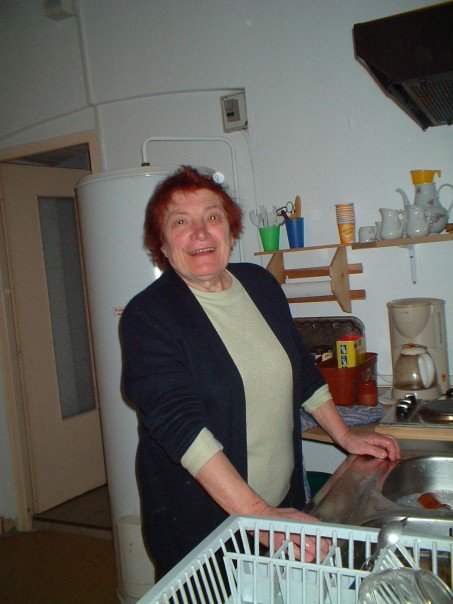
Jeannine
Jeannine

The shades of night had not entirely departed by the time we left, at around a quarter to eight, and a slight drizzle was falling. We went wrong almost immediately, having mistaken the left turn that we were on no account to take for the road upon which we should continue for a while until we came to the dangerous turn. Fortunately for us the gentleman from the Accueil Saint Jacques had come out, either for an early morning walk or else specifically to warn unwary pilgrims, and he pointed the right way with his umbrella. Unlike the foolhardy young man in Excelsior! (‘Try not the pass!’ the old man said,/ ‘Dark lowers the tempest overhead!/ The roaring torrent is deep and wide!’ And loud that clarion voice replied: ‘Excelsior!’) we listened to the local knowledge and took the right turn.

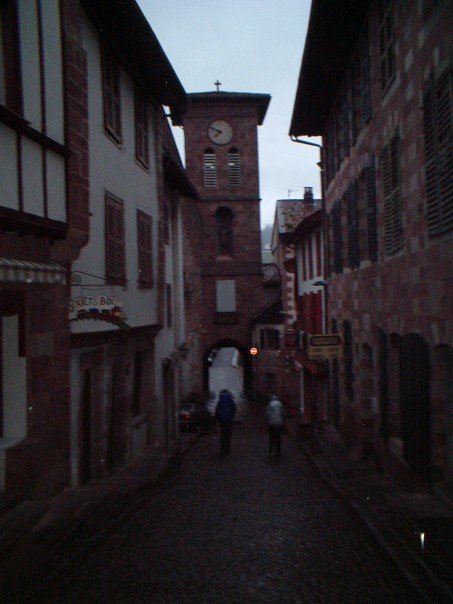
Leaving St-Jean-Pied-de-Port

I must admit to not knowing exactly where we crossed the border. It was, I know, somewhere after the duty free shop where we stopped for more bread and sardines (with lemon, this time) and somewhere before or perhaps in Arnéguy, but we saw nothing to mark it. The signs here pointed pilgrims down two equally likely looking roads; after some debate we took the right-hand road and continued, facing the oncoming traffic as per the Highway Code, to Valcarlos.

Anne and I had meant to stop at Valcarlos, thinking that it might be somewhat foolhardy to attempt the entire pass in one day. We did take a longish rest; it was now raining hard, and I discovered that the lid had come off my tub of raisins, so I was obliged to pick dried fruit from the remotest corners of the pocket. It was, however, only 10.45am, and we were in no mood to stop. (‘O stay, O stay,’ the maiden said,/ ‘And rest this weary head upon this breast.’/ A tear stood in his bright blue eye/ But still he answered with a sigh,/ ‘Excelsior! Excelsior!’) Above the spectral glaciers shone – well, we had just seen the first patch of snow on the ground – but we kept going along the road.

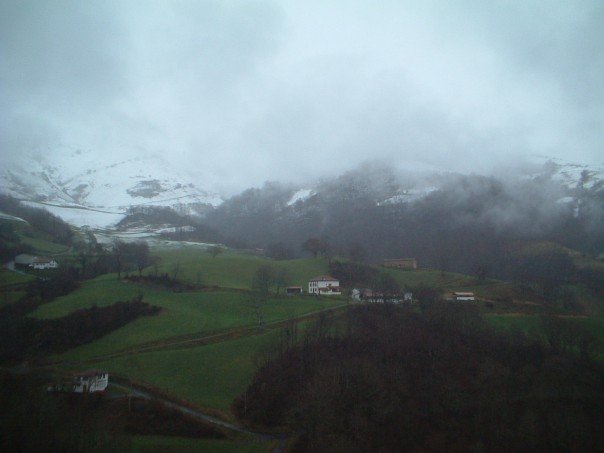
The mountains, seen from Valcarlos

The Confraternity guidebook claims that ‘close to Km 61 the camino leaves the road and uses paths and tracks to the Puerta de Ibañeta’. So it does. After the first off-road venture, however, we decided that the paths and tracks were too unnerving given the snowy and icy conditions, and we stuck to the road. This probably added several kilometres to the day’s walk, but at least we knew where we were. We stopped to eat our lunch in a layby; it was cold, and windy, but at least we were not getting run over.

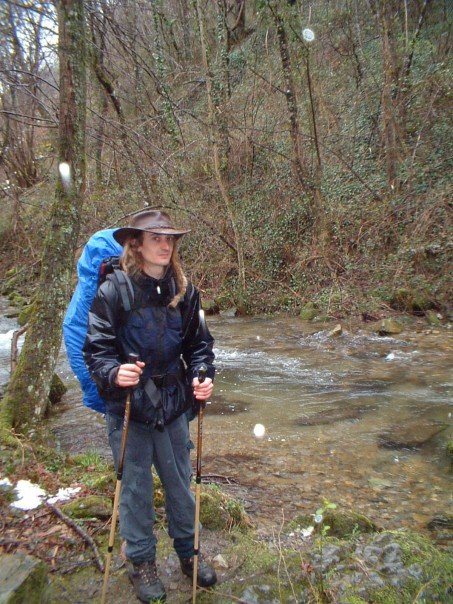
Brantz, in one of the less terrifying parts of the off-road section
Nice place for a picnic

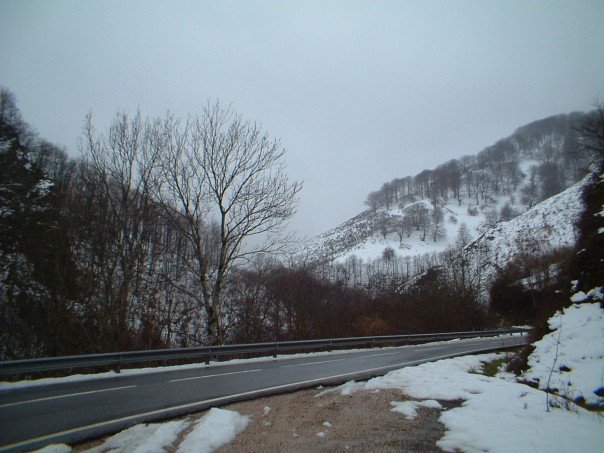
This consolation wore increasingly thin, however, as we toiled ever onwards and upwards round unending hairpin bends, occasionally being forced off the road and into a snowdrift to get out of the way of the traffic. As the altitude increased so did the depth of snow, and the precipitation grew ever thicker, and the visibility ever poorer. Worst of all, however, was the complete lack of any form of sign or, in fact, any indication at all as to where we were. All we had was a post every kilometre; they told us how far we had come, but we were unsure about how far we had yet to go. My trousers were soaked through, a situation worsened by the fact that the water ran off my rucksack cover and straight down the backs of my legs. Anne knew that her blister was getting worse and worse, but there was nowhere to stop. We were almost glad to hear another gang of dogs yapping away ahead of us: surely that meant we were nearing civilisation? Apparently not. It was the only house in sight. There was further to go still. Brantz kept forging ahead. Anne kept lagging behind. I drifted between them, straining to see if there was anything ahead that might be a village, a settlement, a house, anything.

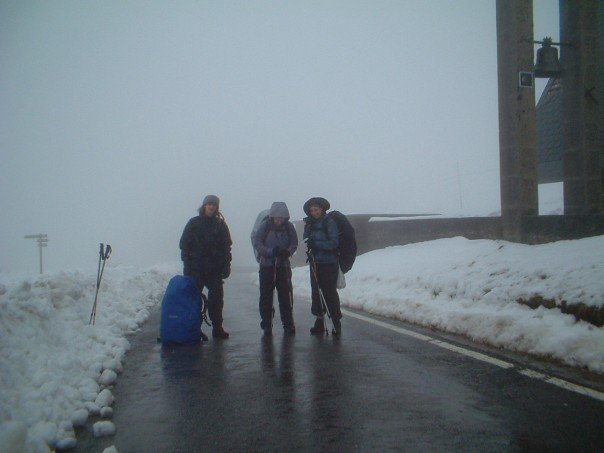
We came to the end, of course. At the top of the road a huge cross loomed out of the mist. A brown road sign next it said ‘Ibañeta 1057m’. ‘Ah,’ I thought confusedly, ‘we’re only a kilometre away from Ibañeta. Good.’ It took me a while to realise that 1057m was the altitude: we were already at Ibañeta and the cross was attached to the chapel. At the foot of the cross – now, this was bizarre – was a man building a snowman. Do angels build snowmen? We certainly couldn’t have been more glad to see him had he been an angel. He cheered us up immeasurably by informing us that there was no way it was more than a kilometre, a kilometre and a half at the outside, to Roncesvalles. His girlfriend, it seemed, worked in the village and he was amusing himself up here while he waited for her to finish for the day.

At Ibañeta
At Ibañeta

We staggered on the last kilometre into Roncesvalles, then resolved to find the tourist information office. We were saved the trouble, however; a monk with an umbrella swept out of the Casa Sabina and gathered us up. (‘Peregrinos? Vamos!’) He led us into the monastery, booked us into their refugio, and showed us to the dormitory. This refugio was the first – and only – one that had had the sense to install a heated towel rail. We managed to squeeze a fair number of our sopping garments on there along with the other pilgrims’. Both my pairs of knickers were now wet, so I was forced to do without for the rest of the evening. The dormitory was quite comfortably warm, due in part to the sheer number of bodies that had somehow been fitted in there. We braved an expedition to the Casa Sabina to book places for supper, and filled in the intervening time drinking lemonade and watching a Western on the TV. I expended some mental effort in trying to work out whether it was one I’d seen. I don’t think it was. The food was very good indeed – fish and chips (after all, it was Friday), but not as we knew them. The fish were still in their scales, with heads and tails attached, not battered lumps. The wine was good, but the pudding was not exciting by any manner of means – a sort of wobbly pink yoghurt. As a whole we found that Spanish puddings were not usually exciting.

Anne and I had chosen to eat at 7pm (although we achieved this more by luck than judgement, as I had thought ‘a las siete’ was referring to the price of the meal) in order to attend the pilgrim mass at 8pm. Even in our exhausted state we were able to appreciate the serenity of the service and the beauty of the monastery chapel and of the monks’ singing, which we compared favourably to that of the monks at Buckfast Abbey. Further on in the camino we would become slightly discontented with the exclusivity of Catholic mass, but at Roncesvalles we were satisfied simply to experience the sacrament at second-hand, letting the peace and stillness wash over us. We had much to be thankful for that day.

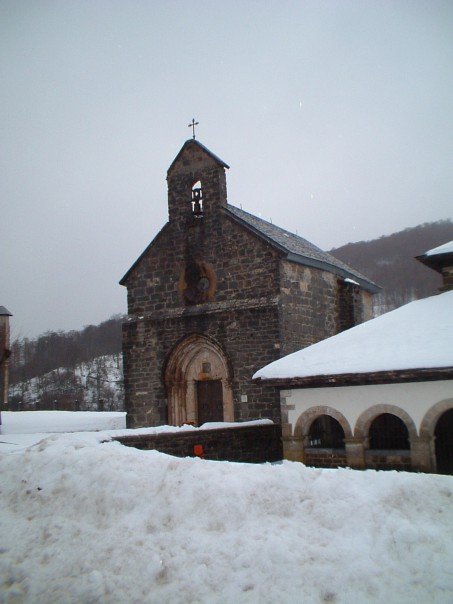
The monastery at Roncesvalles
Capilla de Santiago at Roncesvalles

At break of day, as heavenward/ The pious monks of Saint Bernard (though I’m not sure that they were)/ Offered the oft repeated prayer, we were getting ourselves together ready to leave. We really were not planning to go very far, after the previous day’s strenuous passage. Brantz was going on to Zubiri, 22km on; we thought Burguete, the very next village mentioned in the Confraternity guidebook, and only 3km down the road, sounded a better bet for us. On this reasoning we managed to persuade Claire, a Korean lady who was having trouble with her feet, not to catch the bus to Pamplona but to walk with us.

A depressing and inaccurate distance

It turned out to be another ‘stopping at Valcarlos’ scenario, although happily with considerably less dire consequences. We reached Burguete well before any shops were opened, and the only logical course seemed to be to keep walking. The alternative was to sit around in the cold, and my trousers were already soaked. We were still disinclined to leave the road, which, a glance at the map assured us, would take us through all the villages in its own sweet way, so we trudged on. The wind was, if anything, worse than the day before, and it was snowing. Anne and I, now mindful of the terrible feeling of isolation possible in such conditions even when only a few tens of metres apart, took it in turns to go in the front and at the back. Claire declined to lead the party at any time, and professed herself quite content to follow us. We stopped at the campsite outside Espinal and sheltered for a little while under its awning, then retraced our steps to the road and continued to the village itself. We saw several hostales, but again nowhere seemed to be open.

The next village, Viskarret, was another 4.5km on. More importantly, it was the last settlement listed before Zubiri. If we were to stop anywhere it must be here. We knew that there was no refugio in the village, but we spotted a hopeful looking sign on the door of an otherwise unremarkable house. I stepped inside and called ‘Hola?’ An old gentleman in a black beret emerged. I attempted to explain, in my poor Spanish, that we were pilgrims and were hoping for a bed to sleep that night. He summoned his wife, who explained that yes, she had beds, a twin room would be €26, with dinner for €11 and breakfast for €3.50, all of which sounded good to us. The rooms were well-equipped, and – what I cared most about at that moment – in close proximity to a hot shower. My legs had gone a wonderful lobster shade of pink. Both my pairs of trousers now being wet, I borrowed Anne’s spare pair and draped mine over the radiator. Then I zipped myself into my sleeping bag and went to sleep.

When I woke up again it had stopped snowing. In fact, the sun had come out and it was looking distinctly appealing outside. Given that we needed to stock up on food and also to obtain a sello (stamp) for our pilgrim passports, venturing outside the house seemed like quite a good idea. We thought that a sello would be available at the church. The church was locked, so we gave up on that idea and looked for the shop instead. This solved both our problems: besides chorizo slices, chocolate and pan de leche we also found the all-important stamp. Claire considered buying a pilgrim staff , but thought better of it. We bought our provisions and stamped our books. Then the lady shooed us out; it was closing time. We returned to the posada and lazed away the rest of the day.

The next day there was still snow on the ground, but the wind had dropped. We decided to risk the camino for the first time since Km 61, and left the road. Just after we passed through Linzoain we saw some large, brown birds. ‘Eagles?’ Claire asked. Anne was intrigued: they were too large to be anything but birds of prey, but there were far too many of them. Most birds of prey hunt alone or in pairs; they need a large territory in order to be able to find enough food for themselves. There were six or seven of these. They could only be vultures.

The landscape had been Tolkienesque a few days ago; now it was more like Narnia. We were walking through coniferous woods where melting snow dripped from the trees and ran along the paths. It was good to be off the road; we no longer needed to worry about the traffic, to keep a constant ear out for approaching cars. Somewhere near the Alto de Erro there is supposed to be a rock called Pasos de Roldán, marking the length of Roland’s stride. We kept a careful lookout for this – I had, for family reasons too obscure to go into, long been called ‘Roland’ myself, and Anne had studied the Chanson de Roland in a History module – but failed to find it, and concluded that it must have been buried under the snow. At the Alto de Erro we joined the road again, and followed it as far as Zubiri. There were armed policemen in green uniform at the entrance to the village; we did not know what they were doing, inspecting the traffic, perhaps, but they waved at us in a friendly manner.

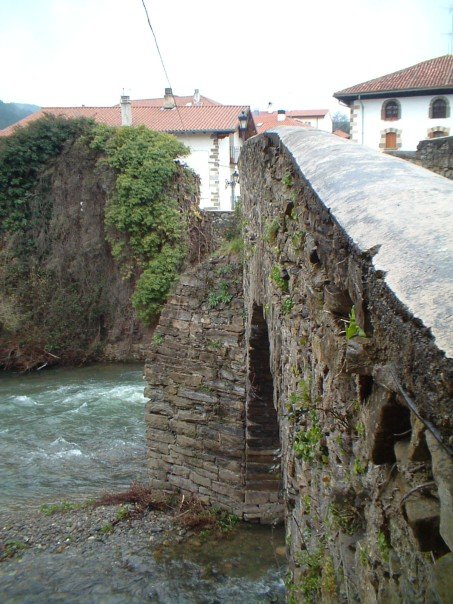
The bridge at Zubiri

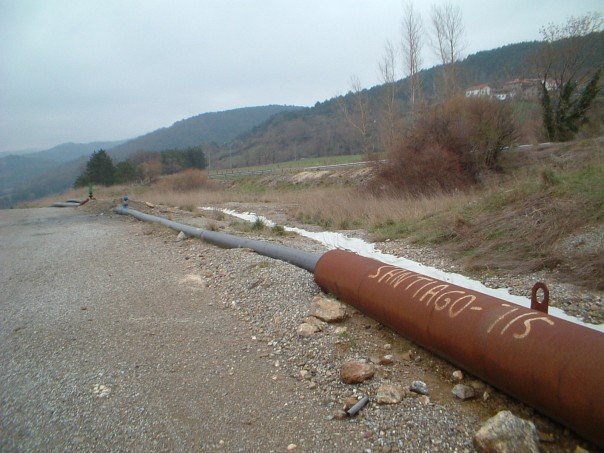
It was Sunday; fortunately we found a cashpoint to which one could gain access by swiping one’s card, a bar in the leisure centre that was open and selling coffee, and an open shop, where we bought some lunch. We sat on the (medieval) bridge to eat it. After Zubiri, the guidebook says, the camino goes round a large magnetite plant but is well waymarked. Indeed it does, and is. On the pipes of the magnetite plant.

Santiago - 715
Santiago – 715

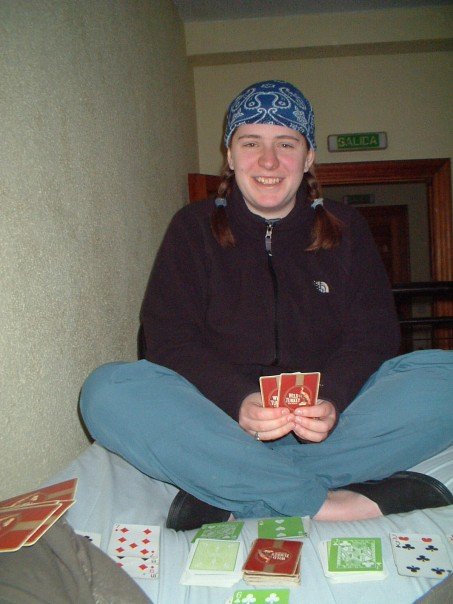
We continued to Larrasoaña, crossing into the village by way of another splendidly antique bridge. Here we found the refugio despite the waymarkings – of which there were plenty – rather than because of it. No one looking at all authoritative was present when we arrived; someone advised us just to bag (literally) a bunk each and to wait for the hospitalero to turn up. We did so, and passed a pleasant evening experimenting with instant noodles, chorizo sausage and the microwave, and playing Spite and Malice with a pack of disturbingly psychedelic playing cards. There was a curious, bulky machine that claimed to offer internet access, but we were being virtuously Luddite and ignored it.

Playing Spite and Malice at the albergue in Larrasoaña

It was the first day since we had crossed the border that I had avoided getting drenched.

Camino de Santiago 4: the hobbits’ first sight of the Misty Mountains

Saint-Palais to Saint-Jean-Pied-de-Port, 21st-22nd March

‘He often used to say there was only one Road; that it was like a great river: its springs were at every doorstep and every path was its tributary. “It’s a dangerous business, Frodo, going out of your door,” he used to say. “You step into the Road, and if you don’t keep your feet, there is no telling where you might be swept off to.”‘ – The Fellowship of the Ring, J. R. R. Tolkien

Anne leaving Saint-Palais

My first discovery upon preparing to set out was that I had stapled the pages referring to the French stage of the Camino into the guidebook for the Spanish leg in the wrong order. Even once I had straightened this confusion out the way out of the town was not immediately apparent until Anne spotted a yellow sticker on a road sign. It was a waymarking placed there by a Dutch cycling organisation, but it served the purpose admirably.

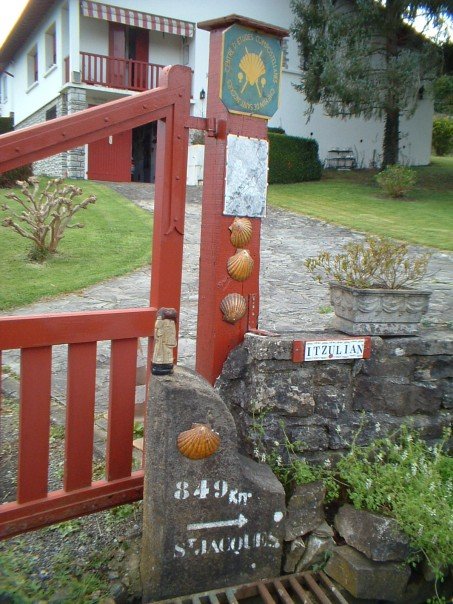
We were soon heading out of Saint-Palais, passing as we did so a house lavishly decorated with scallops and other Jacobean memorabilia. A stone propped in front of the proclaimed ‘849km → St JACQUES’. It may or may not have been accurate, but at this early stage in the Camino we had not yet learned to distrust distance markings. As we looked at it a man came out onto the balcony of the house and called ‘Bonne route!’

‘Merci!’, we called back, and continued up the hill.

849km -> St Jacques
849km -> St Jacques

It was at the top of that first hill that we caught our first glimpse of the Pyrenees. From here there was about 75km of fields and woodland between us and the mountains, and they were little more than a gleam of snow below the clouds. Even from here, however, their beautiful, icy grandeur was commanding. It seemed faintly unlikely that in a matter of days we would be crossing them. As Anne put it, we felt rather like the hobbits, reared among rolling green fields and lush farmland, seeing for the first time the majestic savagery of the Misty Mountains.

The first sight of the Pyrenees

At the bottom of the hill we met our first significant landmark: a monument showing where three routes (from Paris, Vézelay and Le Puy) were thought to have met. Its significance was attested by five dogs, one of them lame, who came out from the adjacent farmyard and barked furiously until we had moved on, presumably in case we were thinking of walking away with it. The monument marked the directions of three routes, and also that of the one, combined route: straight up the next hill. This one was rather steeper than the last, and its surface was ruder. We soon established that our personal methods of tackling hills were at variance with each other: Anne plods, maintaining a steady pace, while I prefer to take it in short bursts, moving fast, and then stopping to get my breath back. We each went up in our own way, but reached the top more or less together and stopped at the summit to rest in the Chapelle de Soyarza and admire the view. Now we could see much more of the Pyrenees. The chapel itself, surrounded by a circle of trees with branches interlaced, was locked, but the covered rest area next it was easily accessible. We shared out a ration of chocolate and dried apricots, regretted that as yet our water supplies did not need replenishing, for there was a very tempting drinking water tap next the chapel, and continued down the other side of the hill.

Tree sculpture surrounding the Chapelle de Soyarza

The landscape here began to resemble something more like an English woodland. In Harambeltz it began to rain, and for the first time we struggled with each other’s rain cover. Anne had brought waterproof trousers; I, knowing how much I hated the hot stickiness of such garments, settled for my jacket. We tramped on through the woodland. I was rather intrigued by some yellow flowers that seemed to be some kind of primrose, but which were smaller than any others I had seen. The waymarkings here were yellow plastic arrows, adorned with a yellow on blue, stylised, shell and the legend ‘Roncevaux’. I remember remarking that it would feel very strange when we reached Roncesvalles and the waymarkings would then say something else, Pamplona, perhaps. We passed a few houses; one had an advertisement for a pilgrim hostel in Ostabat-Asme, the village where we were planning to stop that day. We did not, however, pay much attention to it. I was more interested in a large cage of rabbits that stood next the path.

We reached Ostabat via a path that seemed to have got itself confused with a stream, so splashed rather than strode the last few hundred yards into the village. The gîte d’étape was easily located; unfortunately it was also closed, and likely to remain so, it seemed, until April. This was something of a blow. We rather wished we had paid more attention to the advert on the fence… It was getting on for lunchtime, so we visited the village shop and purchased bread, sardines in tomato, and La Vache qui Rit cheese. No sooner had we consumed an acceptable portion of this than a snow shower swept in, which was more than a little perturbing. I went round all the bars the village seemed to possess. Neither of them was open for food, drink or shelter; nor could they provide accommodation for the night. The landlady of the second, however, said something about somewhere ‘huit cent mètres là-bas’. Well, at this point our options were looking somewhat limited: either we walked on another 17km to Saint-Jean-Pied-de-Port (not a tempting prospect, given the weather) or we took a chance on whatever was eight hundred metres ‘that way’. Both options necessitated following the road out of the village, so once the snow had passed we did so. We peered curiously at each dwelling as we passed it, wondering whether any of them could be this mythical gîte. None of them seemed terribly likely; they were either too dilapidated, too obviously something else, or simply lacking in any form of identification. We plodded on. As each building appeared over the brow of the hill we looked at it hopefully. As we came closer each building revealed itself to be impossible. We must have come eight hundred metres by now? No?

We were, slowly but surely, losing hope. The extra seventeen kilometres were looking depressingly likely. It was with a kind of desperation that I walked up the drive of the last farmhouse on the right, just to check that it wasn’t the one. It was. The drive branched off to the left, leading up to what had perhaps once been a barn. It was now most definitely pilgrim accommodation. Lucie, the lady of the house came out to greet us. ‘Vous n’avez pas telephoné?’ Misunderstanding, I explained that we had thought it unlikely that any hostel would be full this early in the year, and this early in the day. It was not full; Lucie waved us into a cloakroom, where we were to divest ourselves of boots and waterproofs, then showed us to a very comfortable room. It seemed that we still had another night of luxury ahead of us. It was €33 for the room, dinner and breakfast – and after dinner we declared that it was well worth it. I finished Sparrow Story, showered, and napped. Anne did likewise, but never reached the end of her theological tract. She was, it appeared, already afflicted with blisters, but then she had never expected her feet to behave for any length of time. The Pyrenees were nearer, now.

The daunting prospect of the Pyrenees


Later in the afternoon another party turned up: three French pilgrims. These were the people who had telephoned. The excellent supper included seemingly endless courses of ham, sausages and pâté from the farm, a kind of noodle soup to which we were encouraged to add some kind of fiery spice – ‘C’est un aphrodisiac,’ Michel, the gentleman of the French party was told jokingly – omelette made with eggs from the farm, with red wine. We learned over the course of it that they had reached Saint-Palais at 11am and, deeming it too early to stop, had gone on the 15km that we had thought was a respectable day’s walk. My French came back, and I was able to join in the conversation to my own satisfaction, while Anne said she followed most of it – including the part where I mentioned that she was always the last one out of bed. Bernard, our host, entertained us with Basque song after supper; Anne and I responded with a rather risqué Welsh number about taking Megan to Towyn, which ended abruptly when we realised that neither of us could remember the words of the last verse. Finally we all retired to bed, amid protestations from Anne and Nicole that they would be the first up the next day.

Our hosts; Anne; and two of the three French pilgrims


I don’t remember now who was first up out of either party. We left more or less together, Nicole expressing horror at the weight of Anne’s rucksack, then seemed to spend the rest of the day overtaking and being overtaken by them. We were still together when we forded the stream at Larceveau, where I was intrigued by a giant earthworm – the size of an average snake. They forged ahead, but stopped to rest at the Croix de Galzetaburu, where we caught them up. Then they got well ahead again while we rested and said Matins there. All the while the Pyrenees were getting steadily nearer. We overtook the French party just before Bussunarits; it had started to rain, and they were eating their lunch huddled under waterproof ponchos. We sailed on down the hill and found a very inviting little shelter at the side of the road. The remainder of the bread from the day before, spread with cheese, and followed by dried apricots, made a rudimentary but filling lunch. It did not occur to us until a good deal later that it would be much easier to use the penknife than the spork to spread the cheese; I don’t know why. The French trio passed us again and expressed good-natured jealousy at the fact that we had a roof over our heads. We plodded onwards, noticing again how possessive and excitable Basque dogs seemed to be; at almost every house a dog would come out as far as he was able (most of them were tied up) and bark at us until we had passed.

Resting at the Croix de Galzetaburu


We arrived in Saint-Jean-Pied-de-Port at about twenty to four in the afternoon. The town must be one of the few in the world where the old quarter is the cheapest to stay – at least if one is in possession of a pilgrim passport. The pilgrim path leads one straight into the cobbled rue de la Citadelle, where much of the pilgrim accommodation was and is located. No sooner had we passed under the Porte Saint Jacques than a guide swept us up with great delight and showed us off to a party of tourists. He pointed out our scallop shells (I had fastened one of the gilt shell-shaped buttons to the string of my hat, and Anne had affixed hers to her rucksack) and explained that here were two genuine pilgrims. The tourists seemed impressed; some of them may even have taken photographs.

Anne at the gate of St-Jean-Pied-de-Port

When they had let us go we headed, as instructed by the Confraternity guidebook, for the Accueil Saint Jacques. The volunteers here sorted out places for us at 55 rue de la Citadelle, gave us real scallop shells with holes punched in them and string threaded through (Anne’s was flat and pink, mine contoured and orange), and also provided us with several useful sheets of paper – a profile map of the Camino, a list of all the known refugios from there to Santiago, and a guide to crossing the Pyrenees. They also gave us some good advice with regard to the latter: on no account, given the weather conditions, were we to attempt the Route Napoleon, the higher, more dangerous, more spectacular route. Three Korean girls had tried it the day before and had been forced to turn back. On leaving the town we were to turn right, not left. It was all rather Excelsior.

The lady from the Accueil accompanied us to no. 55, where we found Nicole leaning out of the window to greet us. ‘Voilà les p’tites anglaises!’ the former said to her. It was rather nice to know that our friends of only a day were looking out for us. We were, however, beginning to wonder whether there was something about us that appealed to French ladies’ maternal instincts, a suspicion that gained weight when Jeannine, the hostess of the auberge, took us under her wing. After scolding us mildly for leaving our rucksacks on the bunks, she noticed that Anne was suffering from a slight cold, upon which nothing would satisfy her but that a certain (revolting, I’m told) compound, followed by a bowl of tea, was consumed. Meanwhile I attempted to ingratiate myself with the resident cat, a beautiful pale-coloured tabby.

Cat at Accueil Saint-Jacques

Then, after we’d posted some of the heavier and less useful items of Anne’s (the books, an inflatable sleep map and a pair of socks that had proved unsatisfactory) back to York, at the regrettable cost of €29, Jeannine sent us out to purchase milk and butter for breakfast at ‘Champion’. It took us a while to locate this shop, and then when we were there I had to ask a shopper what a ‘brique de lait’ was. (It turned out to be a Tetrapak carton.) We picked up a few items for ourselves at the same time, the most useful of which were chocolate-coated waffles (which kept us going for long after we crossed the border) and a pair of plimsolls – Anne hadn’t brought a pair of light shoes to wear in the evenings, and these served the purpose more than adequately. I had a pair of ancient crochet ballet-style pumps, and was becoming uncomfortably aware of a mysterious pain in my right foot. To this day I don’t know what caused it; there was no obvious swelling or abrasion, and I hadn’t noticed any particular fall or twist. I did my best to ignore it.

We ate that night at Chez Dédé on Jeannine’s recommendation; our French friends were there too, and were rather put out when they failed to persuade the waitress that we should be seated next to them. The food was good, and what we then thought of as cheap: €9 for two courses. We drank only water, however, and retired to bed early in preparation for the great climb the next day. Route Napoleon or, as in this case, no Route Napoleon, there was no way it was going to be an easy day’s walk.Collapse

Camino de Santiago 3: Breakfast in Caen, Lunch in Paris and Supper in Saint-Palais

Crossing to and across France, 19th-21st March

“The man, therefore, read it, and looking upon Evangelist very carefully, said, Whither must I fly? Then said Evangelist, pointing with his finger over a very wide field, Do you see yonder wicket-gate? The man said, No. Then said the other, Do you see yonder shining light? He said, I think I do. Then said Evangelist, Keep that light in your eye, and go up directly thereto: so shalt thou see the gate; at which, when thou knockest, it shall be told thee what thou shalt do.” – The Pilgrim’s Progress, John Bunyan

The Solent ferry was called Saint Cecilia, which was, we thought, rather appropriate for a pair of choral singers. It was a vehicle ferry; the foot passengers walked on via the same gangway. Anne and I could well have been the only foot passengers, and the only vehicles were a few cars and a couple of lorries. The cabin was all but deserted and we spent the crossing grinning nervously at each other and making banal remarks like ‘Well, this is it’.

Once in Portsmouth we were obliged to walk to the railway station in order to find a taxi. It was a chilly night, but we were too excited for this to affect our spirits; besides, walking was what we were planning to do, so why not begin early? We had allowed plenty of time to reach the continental ferryport. Anne got her walking poles caught in the top of the door and fell rather than climbed into the cab, but sustained no damage either to herself or to the poles in so doing. With hindsight I would have advised her to make the most of her undamaged state; it was not to last more than a week.

Five pounds’ worth of taxi ride later we were checking in. Our sailing was delayed by well over an hour, so we raided the vending machines. A man nearby commented that my hat had something of the Indiana Jones about it. He had a point. We then settled down with the books Anne had brought for the train. (I had excised such fripperies from my bag ruthlessly – weight again – but she was planning to post them home once finished.) Both were religious in subject: I had Sparrow Story, a retelling of the Gospel set in present-day Palestine, while hers was a theological work by a Roman Catholic monk. The latter had some reference to God in the title, a fact which attracted the attention of the Irish family sitting opposite. (‘You’re not religious, are you? You are? Are you Catholic? No? It’s all about the priest, isn’t it? The difference is, only the priest is allowed to drink the wine…’) Their sailing (to Bilbao) had been seriously delayed, and they had evidently been compensating for the monotony of the intervening hours with copious amounts of Stella Artois. The grandmother of the party was enchanted to discover that my name was Kathleen (as was hers) and almost equally disappointed to find that I had absolutely no Irish blood in me – a reaction I was to encounter more than once along the Camino, although never again with so much Stella involved. I earned the undying gratitude of the whole family by donating a hair bobble for the granddaughter. The little girl’s father was also very taken (‘I’d carry your rucksacks for you any time… I’d sit round your campfire with you…’)

They were still waiting for their sailing when we went off to see where ours had got to, when we found ourselves a quiet corner to say Evening Prayer, when we were finally called, and, for all I know, when the Normandie departed. It was well past midnight by this point, so we decided immediately to hunt for our accommodation. Being young, free and poor we’d gone for the cheapest option: the ‘reclining seat’. These turned out to be in the on-board cinemas and to be upholstered in a particularly hideous floral velour, not that this bothered us particularly by this time. I ran through my footcare routine by way of an experiment: wash feet thoroughly; apply Vaseline; wash socks; hang socks to dry over nearest suitable object, which in this case was the luggage rack in the cinema. Then I retired to bed or, rather, to seat. It very shortly became apparent that I was unlikely to get any sleep in this monstrosity, so I unpacked my sleeping bag and stretched myself out on the floor. This proved more conducive to slumber, and I got a reasonable amount of rest before being woken by the announcement that we would be disembarking at Caen-Ouistreham in approximately an hour’s time. I stuffed the sleeping bag back into its drawstring bag, safety-pinned my (still damp) socks to the back of my rucksack, and waited for Anne to do likewise. I then shovelled the remainder of my English small change into the RNLI charity box (no sense in carrying extra weight), and we hovered around the ferry’s main passenger doors until she was secured in the harbour, the gangway was in place and we were able to walk out onto French soil. Phase One complete.

Caen ferryport is not, in fact, situated in Caen; it’s in Ouistreham, a village a few kilometres to the north. We caught the bus into town (I had bought the tickets, €3 each, in the port, while Anne reminisced about continental family holidays when all she and her brother would eat was jambon frites). We were the only passengers on a 53-seater coach; the driver was very friendly. I should have asked for the gare, not centre-ville, but I either did not know or hadn’t remembered that the bus and railway stations were as good as neighbours. It was not a problem, in any case. I knew Caen fairly well, having spent three weeks there on a French exchange in 2002, there were maps dotted around the town, and we had plenty of time. We ate breakfast (satisfyingly French: café noir, pain au raisin; , pain au chocolat) in the station café, then passed the time by buying postcards, the first of which got sent from Saint-Jean-Pied-de-Port, enquiring of a station attendant how the tickets worked, and saying Matins. A passer-by seemed to object to this, but we didn’t understand her complaint, nor did she speak English, so the incident passed off quickly.

Anne at the railway station in Caen

The train journey to Paris was uneventful; Anne spent most of it asleep and I spent most of it looking out of the window and thinking how nice French trains were. We had the luxury of a compartment to ourselves, something that I’d assumed had passed with the age of steam. We passed through Lisieux, which prompted a discussion about which Saint Theresa Anne’s cousin was named after, and more French exchange reminiscences. When the train pulled into the Gare Saint-Lazare (a name familiar to me from the bus destination blinds that clutter up my house, but like the rest of Paris a place I’d never been to) we applied ourselves to the question of crossing the city to the Gare Montparnasse. The Métro, contrary to my dire premonitions, proved relatively easy to navigate with the help of a friendly gentleman in the advice bureau, and we emerged unscathed and in time to consume a leisurely sandwich and watch the sparrows at the Gare Montparnasse. From there we caught the TGV to Dax – again a not very interesting journey, although I was gratified to notice that we passed through Poitiers, even if it was by chemin de fer rather than chemin de Saint Jacques. Saint Rhadegund, I thought, would understand.

We emerged into the glow of evening sunshine at Dax. The railway from there to Saint-Palais is long gone, but its one-time existence is attested in a couple of surviving, useless, level crossings and the coach service that ties itself in knots meandering through the towns once served by the railway. We caught the coach, and I was at last able to stop worrying that we would miss a connection: this was the last one.

Night had fallen by the time we arrived in Saint-Palais. We were turfed out into a rather bedraggled looking car park, followed the lights into the town, and then fell to wondering what to do next. I knew what street our hotel was in, but where that street was in relation to the rest of the town I had no idea. We wandered around a little, noticing in passing the opening times of the tourist information office, but the Rue de Jeu de Paume was not immediately apparent. Fortunately a passer-by noticed us, enquired what we were looking for, and pointed us in the right direction. It was just around the corner. Phase two completed.

I would recommend the Hotel de la Paix, Rue de Jeu de Paume, Saint-Palais, to anyone. The proprietor was very kind, the beds comfortable and the food excellent – a wonderful vegetable soup, tender lamb and exquisite chocolate mousse. The room contained several helpful little ledges, over which we draped our damp socks from the day before, and our sopping socks from that day. Since the disappearance of the Franciscan house had made indulging in such luxury as a hotel a necessity for us we resolved to enjoy it. After all, it was very likely to be the last such luxury for a while.

That being so, we did not set the alarm for too early the next morning. A proper bed is not to be sneezed at. Besides, we had agreed not to leave Saint-Palais until the tourist information office was open, for we needed to get our credenciales, our ‘pilgrim passports’, stamped, and we thought that they would be able to tell us there where would be the place to go. I sat on the balcony and dusted my feet with talcum powder in the morning sun, calling back ‘Praise him and magnify him forever’ to each verse of the Benedicite as Anne presided over Matins. We lingered over breakfast – croissants with butter and jam, and excellent French coffee – then paid up and left. The proprietor and her assistant wished us well.

We headed for the tourist information office, nipping into a nearby shop to buy a map – a fairly large scale representation of the French Pyrenees, with the Grande Randonnée 61 (in other words, the Camino) marked on in a line of red dots. I noticed a box of fabric badges in the glass counter and asked to buy one. The process was made rather difficult by the fact that I had no idea what the French word for them was, but the shopkeeper worked out what I wanted, and I at least – Anne, I think, regards my obsessive decoration of my grey woollen blanket with such souvenirs with a sort of benevolent tolerance – proceeded to the tourist information office with a distinct feeling of gratification.

Getting our credenciales stamped proved, in fact, to be very easy indeed: they had a stamp in the office. The girl there was quite excited to see that this was the first stamp in our books, but not as excited as we were to have our first stamp. This was it. This was the real beginning of our pilgrimage.

Camino de Santiago 2: Preparation

Give me my scallop shell of quiet,
My staff of faith to walk upon,
My scrip of joy, immortal diet,
My bottle of salvation,
My gown of glory, hope’s true gage,
And thus I’ll take my pilgrimage.
The Passionate Man’s Pilgrimage – Walter Raleigh

As it happened, we walked it in 2007. As we approached July 2006 and graduation, it became clear that neither of us was going to find a particularly interesting job for the next year, so, prompted by Héloïse, we brought the scheme forward and joined the Confraternity of Saint James that summer. We considered leaving from Exeter and aiming to arrive in Santiago for Easter 2007. This proved to be impracticable – Easter was too early in the year – but the idea of walking in the spring remained attractive. The idea of leaving from Exeter also failed to fit into our time scheme: we were obliged to delay our departure until after my father’s 65th birthday party, which was after the end of term, rendering any such plan pointless. Having consulted the CSJ guides, we had concluded that the summer would not be congenial, with the weather too hot and the Camino too crowded, while the autumn of 2006 seemed too soon and that of 2007 too far away.

I bought new boots and telescopic walking poles, and began to get into a routine of hiking around the Isle of Wight. The distance between my parents’ houses – four miles exactly – proved to be ideal for practice walks. Anne, a town dweller, had fewer opportunities to get into condition, but, having completed the Gold Duke of Edinburgh Award, had the advantage in terms of experience. As yet, however, we had no definite date to aim for, nor even any definite starting point. Eventually I took a trip up to York to see her, defying freak weather conditions in the Solent, and we started planning in earnest. We visited the Rohan sale and bought waterproof jackets and zip-off-at-the-knee walking trousers, drifted around Millets assessing the respective merits of various rucksacks, and purchased lightweight ‘sporks’. We laid a map of the Camino out on the floor and calculated how long it would take us if we were to walk an average of 20km per day, taking one day off every week. I investigated ferry tickets and train timetables online. We quibbled a little over the starting date, but eventually fixed that we would leave from the Isle of Wight on 19th March, immediately after my father’s party.

The idea of starting from Le Puy and visiting Conques (home of Sainte Foy, whom Anne had studied in the course of her degree), or beginning at Poitiers (home of Saint Rhadegund, to whom my neighbouring parish church is dedicated) had to be abandoned: we could not afford to spend so long in France, where the accommodation would be far more costly. At the same time, we wanted to give ourselves a few days of easy walking before we tackled the daunting prospect of the Pyrenees. Eventually we plumped for Saint Palais, two days walk from the border, and allegedly the location of a house of Franciscan monks who were quite prepared to put up pilgrims. We did not realise until we got there that it actually made a rather appropriate starting point: a couple of kilometres beyond the town is a monument marking where three of the ancient pilgrimage routes across France met.

I returned home and began six weeks of intensive planning and preparation. I stepped up my walking, paying greater attention to the precise distances I covered and the weight I carried. I tried to pace myself and, like the exam candidate who spends more time colouring in their revision timetable than in revising, ended up with a beautifully planned schedule that I adhered to for perhaps a week. Beside the walking practice it included lists of kit to be purchased, borrowed or found, and a supremely haphazard teach-myself-Spanish course compiled from a pre-GCSE textbook, three freebie CDs from Sunday newspapers, an antique teach-yourself book and a helpful interactive course from the BBC website. The delicate balance of my schedule – which assumed that I would always have internet access, would always be on the Isle of Wight and at my own disposal – was of course disturbed by trips to Exeter and family crises (my mother was taken into hospital one week and moved house the next).

Nonetheless I was relatively confident in my physical and mental ability to acquit myself adequately in the challenge by the end of February, having one day completed fourteen miles of the Yar River trail, which begins very conveniently just down the road from my house, before getting lost in Brading and taking the train home. I had also fulfilled my organisational responsibilities, the principal of which was booking the tickets for the train journey across France, and over the course of several expeditions to Newport (9 miles walk, for I always took the bus home afterwards) had purchased much of the kit – and caught up with an old school friend who was now working in Blacks. I had looked out my tiny Book of Common Prayer and scoured eBay for a similarly sized Bible. On an expedition to a factory outlet mall in Portsmouth my mother bought me a pair of lightweight trousers and a microfibre towel. I was then faced with the problem of keeping the weight to a minimum; the Confraternity recommends a maximum of 8kg, including the water ration. This, I found, is almost impossible, and once we’d begun the pilgrimage I could never bear to weigh my rucksack.

As the date of my father’s party approached the opportunities for practice walks diminished as all hands fell to tidying the house, which, as anyone who has even a slight acquaintance with the family will appreciate, was no easy task – although on the day before the great event I walked from Ventnor to Niton specifically to deliver a large selection of cold meat to the relevant refrigerator. I also tried out my somewhat rusty French in booking a hotel in Saint-Palais. The Confraternity guidebook regarding the Le Puy route had proved to be some years out of date, and the monks had moved.

The party was to follow the usual pattern of cramming as many friends as possible into the comparatively limited confines of the sitting room, providing them with food and drink, and then encouraging musical performances. Suffice it to say that I was there, wearing a black velvet dress distinctly lacking in back on the grounds that this would be my last chance for glamour for the next two months, and the evening wound up with most of the guests several sheets to the wind and singing Nonconformist hymns; also that, mid-party, Heloïse and Andrew inspected our kit thoroughly and recommended the removal of several items – notably a ‘bivvy’ bag, on the grounds that firstly it was unnecessary weight and secondly we were unlikely ever to be far enough from civilisation to need it for any purpose other than sitting on.

The following day, Sunday, the festivities were concluded with a pub lunch with the remaining guests after church. It was Mothering Sunday; my mother was in Yorkshire at the Association of Radical Midwives national meeting (her singing friends, however, had turned up to my father’s party regardless, and given a spirited rendition of Longfellow and Balfe’s splendid piece of Victoriana Excelsior!). This fact did not stop the priest presenting me with a posy for her as he did all the other members of the congregation who might conceivably have a mother in the offing. I saved it and left it on her kitchen table later that day. Besides the more predictable hymns we sang To be a pilgrim (I hadn’t had the heart to inform the choirmistress that Anne in fact dislikes it intensely), and were invited to step forward for a blessing as we departed on pilgrimage. We also received a card; inside, besides the unsurprising ‘May the road rise up to meet you…’ blessing, was a prayer that I had not come across before:

Bless to me, O God,
the earth beneath my foot.
Bless to me, O God,
the path whereon I go.
Bless to me, O God,
the thing of my desire.
Thou evermore of evermore,
Bless thou to me my rest…
As thou wast before at my life’s beginning,
Be thou so again at my journey’s end.
As thou was besides at my soul’s shaping,
Father, be thou too, at my journey’s close.

I copied them both into the miniscule Bible before we left.

A fully laden practice walk to Ventnor and back on Sunday afternoon and a final dash around Newport’s shops on Monday, having taken a fond farewell of my boyfriend at Cowes, left us as ready as we would ever be for the pilgrimage. We distributed Compeed, painkillers, raisins, dried apricots and Somerfield ‘Simply Value’ instant noodles between our two rucksacks, copied friends’ addresses into the Confraternity guidebook, and checked a thousand times that our tickets and passports – and pilgrim records – were where we’d put them last. Giggling geekishly, I scrawled DON’T PANIC across the cover of the guidebook, swore at our sluggish internet connection until it came up with the timetable for ferry crossings to Portsmouth, and decided at the last minute that I could not do without a second jumper, so pulled on a navy blue guernsey. My brother John recommended pasta as a good source of slow-release carbohydrates, so I made macaroni cheese for supper while Anne tried frantically to copy all Héloïse’s annotations to her Confraternity guidebook into our up-to-date edition. She got as far as Castrojeriz, 449km from Santiago, before my mother arrived to tell us that it really was time we left if we wanted to catch the 2030 ferry, so my father promised to follow our progress in Heloise’s book and send any further annotations by text message.

Bizarrely enough, it was snowing when we manoeuvred our laden rucksacks out of the front door, snowing hard enough to make visibility something of a problem for driving. I was half afraid that our plans would be scuppered before we could even leave the Isle of Wight. The snow eased off as we neared Newport, however, and by the time we reached Fishbourne the weather was clear enough for us to look forward with confidence to the next stage in the journey.

Leaving the Isle of Wight in the snow
Leaving Niton in the snow

Camino de Santiago 1: Introduction

There’s no discouragement
Shall make him once relent
His first avowed intent
To be a pilgrim.
– John Bunyan

Life, they say, is more about the journey than the destination. I must admit that this is an attitude that I have come to apply to literal journeys as much as metaphorical ones. I love travelling; I prefer to take my time, seeing no reason why the fastest journey should necessarily be considered the best; I tend to be philosophical about delay, and I dislike being hurried. While aware of the necessity of getting from A to B, I am quite prepared to go via M, Q, or Y if M is likely to be more scenic, Q less crowded, or Y known to possess a feature of greater than average architectural merit. As with life, I am confident that I will arrive at my destination sooner or later, and if I am required to make the journey at all I would rather I made the most of it.

This principle held true for me along the length of the Camino de Santiago, the Way of Saint James, that I walked with my friend Anne in the spring of 2007. A Quaker challenged me, the summer before, about the idea of pilgrimage. God is everywhere: no place can be called holier than any other. What was the point? Actually, I agreed. Santiago de Compostela itself, the Holy City of the Iberian peninsula, held no greater attraction for me than any other place; I had my reservations as to whether it was genuinely the resting place of the mortal remains of Saint James the Apostle, and there were other European cities that would have taken precedence my ‘must see’ list. The traditional way of getting there, however, made it another matter entirely: one’s own two feet; one’s own pace – quite literally; the chance to prove that five hundred years of civilisation hadn’t turned one soft.

The Camino had been on my list of Things To Do One Day ever since my godmother, Héloïse, and her friends Andrew and John had walked it in the year 2000. I was no great walker back then, but something about the idea had appealed to me and it had sunk into my mind, resurfacing occasionally when I purchased walking boots or hi-tech rucksacks, and one chilly Saturday as I picked up a few small, pink scallop shells from the beach at Dawlish. The five mile Out of Doors Society walk was going well enough for me to mention to Anne that one day I was going to walk the Camino. She was intrigued, and I think that was that. We were going to walk the Camino – not ‘one day’, but definitely. We were going to walk the Camino when we’d finished our degrees. We were going to walk the Camino in 2008.

It was a mentality that coloured the rest of our time at Exeter University. We memorised Taizé chants; we kept thinking we ought to learn some Spanish; we embarked upon a weekly swimming regime; when the Tolkien society began debating which Middle-Earth races its members belonged to, we didn’t bother to argue – we knew we were Rangers; we continued to accompany the Out of Doors Society across Dartmoor and to despair at how often they got lost; we purchased a number of small gold-coloured shell-shaped buttons at the closing down sale of our favourite haberdashery; we got quietly excited at relevant articles in the Church Times and the other publications to which the University Chaplaincy subscribed. We were going to walk the Camino in 2008.

Reflections on the Camino

Looking back on it, the most striking thing about the Camino de Santiago (literally, the Way of Saint James) is the way that it takes you through everything. The Camino was never intended to be a tour; it is simply a more or less straight line from east to west, and as a result runs through places of no importance whatsoever, besides the ones that have made it a European Cultural Route – and, because it runs through them, you have to walk through them. We walked through seven provinces of Spain in rain, snow, wind and blazing sun; we crossed spectacular mountains, monotonous plains, and terrifying dual carriageways; we saw industrial estates and Gothic cathedrals. We never knew what to expect from day to day, and we learned very quickly not to plan too far ahead, and never to work out how much of the total distance was left to walk – it was always horribly daunting!

However, we also found that it never really mattered where we were. The daily routine of eat-walk-eat-walk-eat-sleep varied very little, and the goal of every day was to reach somewhere with food and a bed, whether we were in city or country. If we had exceeded our average of 20km we felt a particular sense of achievement, and if it seemed that our laundry had a reasonable chance of being dry by morning that was even better. (You can always tell a pilgrim by the damp socks safety-pinned to their rucksack!) Whatever the terrain, the most important thing to look out for was the waymarking. Most of the way you follow yellow arrows painted on walls, rocks or trees; in some places there are concrete bollards with blue and yellow shells to point you in the right direction; in the cities there are metal shells set into the pavement. It is surprising how much faith one puts in these markers; we very rarely looked at a map after the first week. Similarly, we just had to trust that at the end of each day’s walk there would be a pilgrim hostel with two beds free, and a shop, or a bar that served food, that was open. There almost always was: we never went without a bed, and we never went hungry.

The pilgrims are a remarkably cosmopolitan group. We walked with people of many nationalities: French, Slovenian, Korean, Australian, Austrian, Scottish, German, Finnish… The majority of them were our age (gap-year) or recently retired; the youngest pilgrim we met was a nine year-old walking with his father. On the whole they were very dedicated; some do the Camino stage by stage over a period of several years, beginning again where they left off the previous year. It is relatively rare to do the whole journey in one long stint, as we did, and we felt very lucky to be able to devote almost two months to it. I will never forget the kindness we met all along the route, not only from fellow pilgrims and hospitaleros (hostel wardens), but from ordinary Spanish citizens. It seemed that every time we were lost, or in trouble, or simply needed a little encouragement, someone would pop up to help. They didn’t seem to mind our execrable Spanish, and often seemed to go a fair distance out of their way to make up for the deficiencies of our guidebook. I owe rather a lot to people whose names I’ll never know.

And then there were the unique little experiences, the quirky things that perhaps didn’t contribute so much to my spiritual development, but are nonetheless unforgettable – the chickens that live in the cathedral at Santo Domingo de la Calzada, for example; the surreal ‘Gaudí building’ in Astorga; the young wild boar that followed its owner into a bar in Triacastela – far more than can be fitted into a short article. I am still unsure exactly what to make of them, but they were part of the experience!

Somehow, after all that, Santiago de Compostela itself avoided being an anticlimax. I was terribly afraid that it would be, after two years’ planning and seven weeks on the road, but in the event it was all we had hoped, and well worth the effort. We had originally intended to catch the bus on to Finisterre, but we decided that we liked Santiago too much, so spent all our time exploring the city or hanging around in the cathedral to see if anyone we knew would turn up. It was the right place to stop.

So – what next? I must confess that I am not entirely sure where I am headed next, but, if the Camino has taught me one thing, it is how to accept uncertainty and to trust that when I need to know the way I will be shown it.