Lockdown in the orchard

A white and black cat sleeps on a stone floor under a full length banner showing Sir Isaac Newton

We visited Isaac Newton’s apple tree a couple of weeks ago. It’s in the orchard of his childhood home, Woolsthorpe Manor, a couple of miles off what’s now the A1, the Great North Road. These days it’s a couple of hours’ drive from Cambridge (we started a little further north than that). It would have taken considerably longer in Newton’s day; nevertheless, he made the journey.

Woolsthorpe is a lovely place. It’s in the care of the National Trust now, and they’ve managed to find a satisfying balance between hands-on science and palpable history. The volunteers (apparently there is no shortage) are a mixture of enthusiastic students and gentle retirees.  It’s not exactly quiet – it couldn’t be, with children spinning balls down funnels and laughing at distorting mirrors and all the rest of it – but it feels extraordinarily peaceful. You wouldn’t think there were lorries hurtling north and south just over there. This cat was snoozing away happily in the café; later we saw it touring the yard, seeking homage from the other patrons.

I hadn’t twigged that the reason that Newton was sitting under an apple tree at his family home in the first place was that the University of Cambridge had been closed. If I’d known the year – 1665, see if you’re faster than me – I’d probably have made the connection. Bubonic plague. He was self-isolating, we might say now. Lucky to be able to do so, of course. I was conscious of a fellow-feeling: I too ended up leaving Cambridge to find a garden of fruit trees when our epidemic struck, although that was March, not apple season, and that was just the way things worked out for us.

Newton’s Cambridge was different from mine, too. He’d still be able to find his way around the city centre, and no doubt he’d be fascinated by much of what has appeared since his time. He wouldn’t have encountered tourists, or the Silicon Fenizens. It would have been much smaller, less crowded, but still a heck of a culture shock after Woolsthorpe.

And it’s interesting, isn’t it, how that massive breakthrough struck not in the intellectual ferment of the university, but in the peace of the orchard. There’s something to be said for not being where the action is.
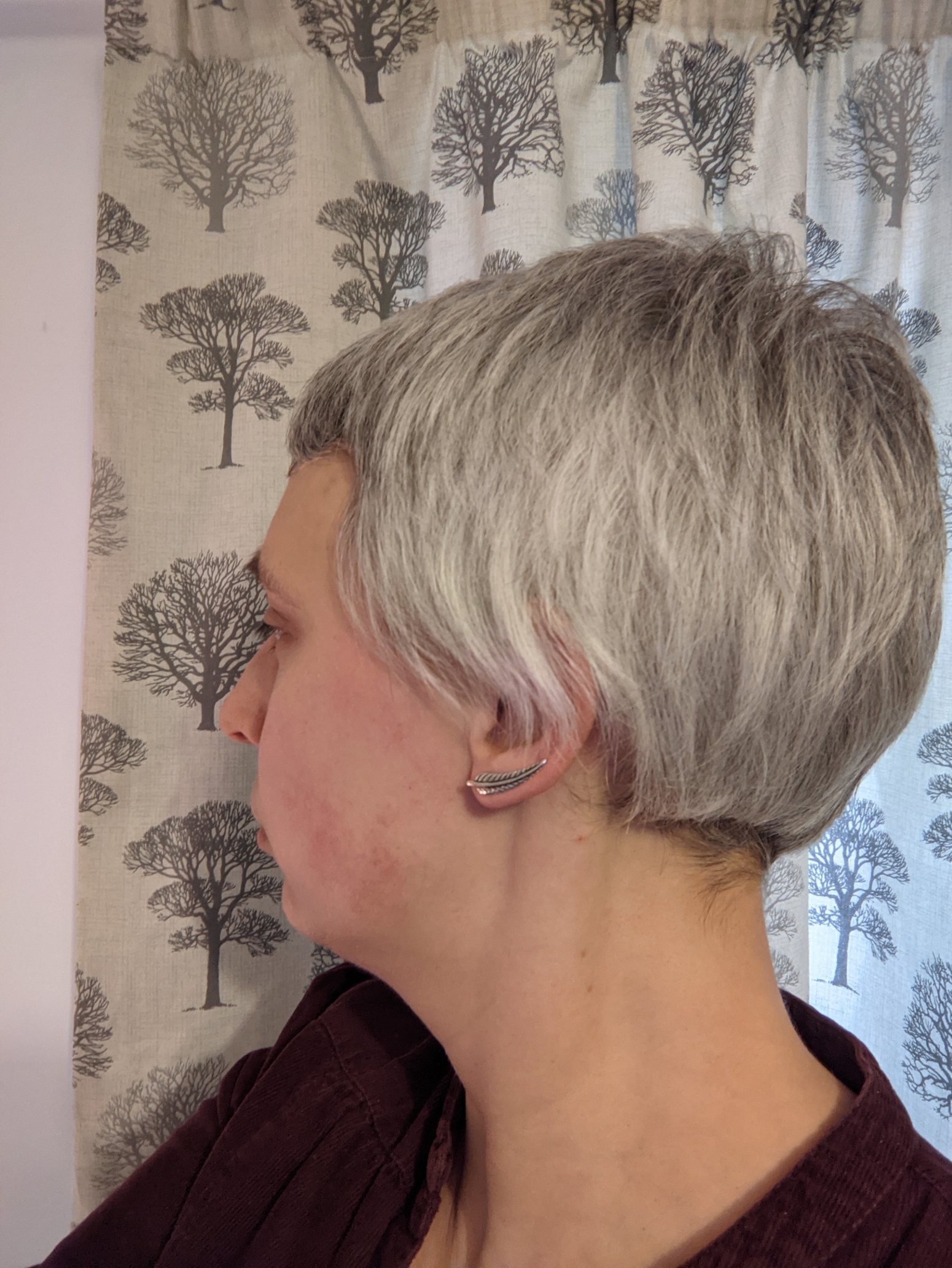
December Reflections 9: silver

A woman with short grey hair, looking away from the camera

The greying is genetic. My mother found her first grey hair at fourteen, and I was younger than that when I found mine. One of my brothers is going the same way.

Through my teens, my hair was very dark. In my wedding photos (age 23) there’s a grey streak visible if you know where to look, springing back from each temple. Through my twenties and into my thirties the white has been spreading steadily, working its way around the sides, not quite so dominant at the base or the crown. It’s a different texture, thicker and springier than the dark, and I think it may be faster growing, too.

I’ve been adamant for a long time that I wasn’t going to dye it. Or that maybe I’d wait for it all to go white and then start playing with exciting colours. (This year someon told me that white hair doesn’t take dye so well. Heigh-ho.) Whatever, I wasn’t going to get into a running-to-stand-still situation trying to keep it the colour it was when I was fourteen. (Could be worse, anyway. I was bald until the age of three.) I just let it go white.

It’s worked surprisingly well for me. Grey hair even came into fashion a couple of years ago. Women a decade younger than me were paying good money to get their hair looking like mine. It makes interesting highlights and lowlights, meaning that all my hairdresser (when I have one) has to do is cut. (Excuse the horrible job I’ve made at the base of my skull: that’s lockdown for you.) People who didn’t know me when my hair was brown are surprised to learn that it just grows like this.

It avoids awkward situations when I’m trying to buy wine or scissors (I did get carded the other day, but then I took my hat off and everything was fine). It confuses creepy men because they can’t tell how old I am. I, meanwhile, feel pretty damn glamorous.

And then there was this year, when not having a dye habit proved to be a great blessing: it looked the same as it always does (if a bit straggly), and I didn’t have a slowly widening tidemark getting me down.

It’s true, I do have to get it cut more often, because it doesn’t look so good long (mind you, I’m not sure that my dark hair wouldn’t have looked better short, come to that).

But I like it. Maybe it’s that I’m happier in my thirties than I was in my twenties. Maybe it’s that I have a more robust sense of my own style. Or maybe there is something about silver, after all.