

When we moved into this house, the front garden was entirely covered in chips of purple slate. Now it is almost entirely covered in green.
I don’t have a proper ‘before’ photo, because the whole thing was so boring that I never bothered (and when I finally came to getting rid of slate and planting plants I had very limited time and other priorities).
Here you see the boringness relieved by a pot of tulips:

You also see the irritating little weeds that grew among the stones. Shallow roots, but a pig to keep on top of and very obvious, at least when I didn’t have a magnificent tub of tulips to lead the eye elsewhere.
Last autumn, my maternity leave project (and I cannot at this distance think why I thought that this was a good idea) was transforming this into an actual garden, with intentional plants growing in the soil.
You might remember me asking on here for ideas of what to do with a small eastward facing plot that probably wasn’t going to get a lot of watering. A friend suggested that Mediterranean was the way to go. I’ve always loved herbs, so it didn’t take much effort to come up with a plan of rosemary against the house, lavender around the edges, and thyme as ground cover, with peonies (because what the hell, why not) to make the middle interesting. One of our bay trees (wedding present, 14 years ago) could go at the front corner, and what about an olive tree? And I was going to grow a passion flower up the railings.
I got Tony to gather up the slate chips (eventually a friend took them away to cover up a much less promising bit of ground). I ordered some plants from Thompson and Morgan, and quite a lot more from Norfolk Herbs. (I highly recommend Norfolk Herbs, by the way: their prices are extremely good and the delivery was swift.) On a whim, I threw some chamomile and bergamot into the order. The Thompson and Morgan stuff came in dribs and drabs; the Norfolk Herbs, all at once.
And every time I had a spare twenty minutes, when the baby had fed and gone to sleep deeply enough to notice that I’d handed her to someone else, I dashed out the front and put in another two or three plants. I’d leave the front window open so I’d hear when she started crying. I chucked a bulb or two in with each plant – tulips, daffodils, crocus, tête-à-tête, iris… Bit by bit, it got done.
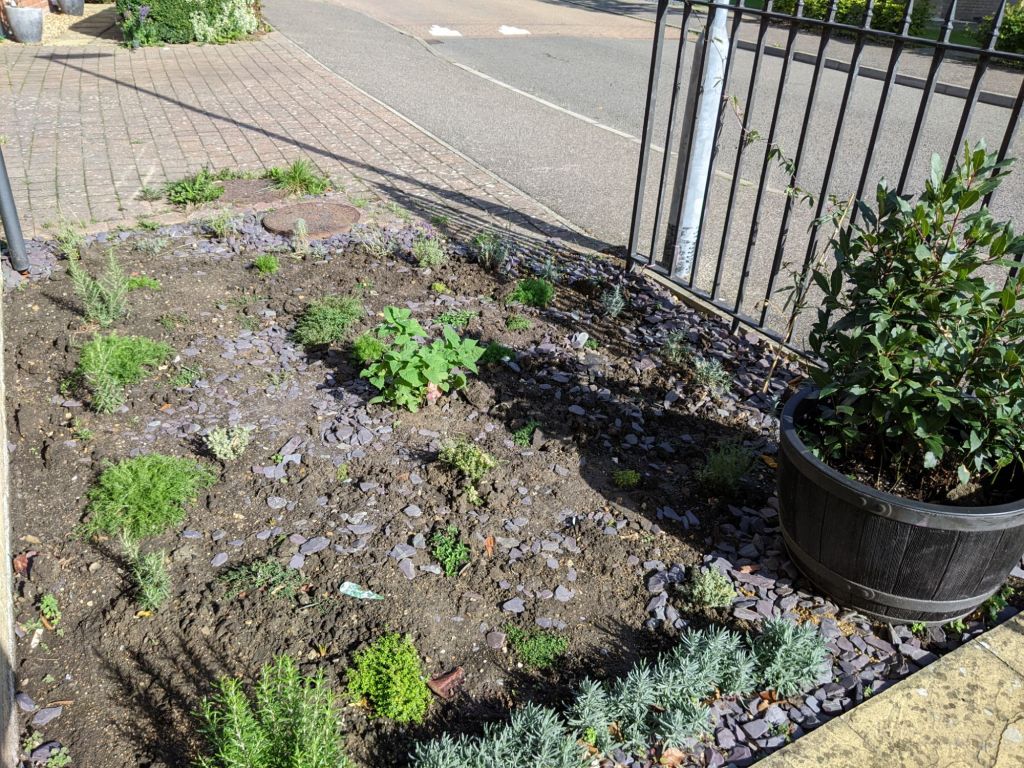
We didn’t get all the slate up first go. For a long time afterwards I was picking up a dozen chips and moving them to the edge every time I went out.
Then, of course, everything went dormant over the winter, and I had to wait to see what was going to happen next.

The bulbs came first. A brave blue iris, then the tête-à-tête narcissi.

It was at this point that I started getting really happy with what I’d done. They cheered things up immensely.
On Mothering Sunday, I was presented with a pot of purple primulas. Those went in too.
Then the tulips flowered.

Meanwhile, the herbs were beginning to get going. Come May, there was still quite a bit of earth showing between the plants, but they’d woken up. The bergamot, which I’d thought had maybe died, was very enthusiastic.

We got our olive tree, too.
Over the summer, everything went absolutely bananas. The chamomile flowered and went everywhere. The bergamot came out such a gorgeous, vivid deep pink that I felt my whim was vindicated a hundred times over.

And it all kept going.

It’s less exuberant now, obviously: it’s November again. And I trimmed the chamomile back, and I’m half way round cutting off the dead lavender flowers. Even so, it’s less tidy than the slate was, but it’s much more cheerful and welcoming – not least for the bees. I was rather pleased to read, several months into this process, that:
If you want to help a variety of bees, the best way is to plant flowers that bloom sequentially from early spring to late autumn – even if you only have a window box or pots on a patio.
Which I seem to have achieved almost accidentally. I’m glad the bees are enjoying it. I certainly am.
 Kathleen Jowitt