We’ll walk again.
We’ve known, between us,
sickness and fear, the madness
that makes friendship loneliness,
mislaid vocations, learned to love,
never quite forgotten that we walked
or that we’ll walk again.
We’ll walk again:
drink wine that springs from roadside fountains,
meet angels, know them by
their wire-spoked wing-umbrellas,
understand the Incarnation
eating sardines on Maundy Thursday,
hear the cock crow mid-Mass, standing
out where hands weren’t washed or wine poured,
toil across endless dusty plains,
follow the stars spread westwards, seen once,
follow the subtle trail of golden shells,
wonder how your great-grandfather
walked almost all the way up Everest
(and then, more, down again)
while your feet dissolve in friction.
I’ll turn out, another seven times,
not to be Irish,
disappoint another seven bands of pilgrims;
we’ll walk west,
catch wandering horreos,
sing psalms in kitchens so new,
so ill-equipped,
there’s nothing else to do there,
we’ll walk,
arrive,
hug, disbelieving, in the square,
pat St James
(timidly)
on his shoulder,
linger…
It won’t, of course, be like that this time,
but even so, we’ll walk.
‘You meet angels, of course,’ someone said. Was it Marie-Noëlle at the Emaús house in Burgos? If so, we had met one only that day.
Even if not, we knew what she meant. We had met angels; ours carried umbrellas.
At Saint-Jean-Pied-de-Port, two days into the pilgrimage, and with the forbidding snowy bulk of the Pyrenees looming ahead of us, the hospitalero came out, umbrella in hand, into the drizzle to point us the right way to cross them – away from the Route Napoleon, towards the gentler, safer way.
At Roncesvalles, a lifetime later and somehow still the same day, with night sweeping in along with the snow, we were frozen, soaked, lonely, exhausted; we had abandoned the waymarked Camino on the grounds that the road was a lot easier to follow – and as we struggled down the last few metres into the village, a monk emerged from the restaurant, his habit brushing the fallen snow and his umbrella raised aloft against what was still coming down. ‘Peregrinos? Vamos!‘ he said, and swept us into the monastery, to shelter, warmth, and a bed for the night.
At Logroño, leaving before daybreak, and already uncomfortably conscious of our propensity to get lost in cities, we missed our way. Grey sky, grey pavements gleaming under the street lights, and rain, and a man with an umbrella to point us back in the right direction.
At Burgos, a glorious, sun-soaked Easter Day, and another city to get lost in. And another angel with an umbrella to put us back on the right path, or, rather, since we had already planned on stopping, and knew where we wanted to spend the night, an angel to read our guidebook, ask the directions for which we were too tired to think up the Spanish, and walk with us until we were in the right quarter.
We met angels.
This is what I have learned about angels, and about their habit of carrying umbrellas:
They are, as is generally rumoured, messengers and guardians (sometimes this is the same thing, if the message is what keeps you safe).
They are quite obviously distinct from you, and your needs are different from theirs. (Even in everyday life I find using an umbrella irritating beyond belief, and it would be an impossible encumbrance for a walking pilgrim; but an angel might well use one, and so might any other normal person on the street.)
They provide you with what you need (and it is not something that they lose by sharing it with you).
They do not neglect their own needs in caring for others (and this, more than anything, is where I am still learning from them).
What items did you tick off your dream list in 2012? What other, unexpected, dreams came to fruition?
What are the top three items on your dream list for 2013?
I was assigned to work with the LGBT group, which is a post I’d hankered after ever since I joined my employer – and discovered that, like any other group, it is full of people, some of whom are easier to work with than others. As a direct consequence I went to some Prides on purpose.
I walked all the way around the Isle of Wight, which is something I’ve wanted to do for a long while. This was unexpected in a way, because I’d originally planned to do Offa’s Dyke, but decided against it for financial and fitness reasons – then realised that I could walk the coastal path, the way I’d always wanted to.
I bought myself a dinner jacket, and have worn it twice this year. With the monocle.
My top three items for 2013? Actually, that’s quite a difficult one, because I am waiting for certain things to shake down. 2013 is the year that everything changes, and it’s hard to see how to be ready when you’re not quite sure how it’s going to change. But here’s how I’d like things to work out:
1. Tony finishes his PhD in style, floppy hat, etc., and finds that there are jobs on the other side.
2. Anne gets well enough to be able to come and live with us.
3. I get myself into a position where I have a choice to stop working where I work now, if I feel like that. I don’t have any plans to do that at the moment, but I feel as if I would like to have the option.
What was the greatest gift you received in 2012? What was the greatest gift you gave?
What do you intend to give yourself in 2013?
In terms of the difference it’s made to my self-perception, the greatest gift I received was, I think, the support and encouragement of the Pico community. The discipline of posting snippets of writing, the enjoyment of reading other people’s, the excitement when somebody says something nice about my own, all keeps me interested in my own writing. We had three months of Pico this year, and it was all extremely useful. It’s a gift that makes more of my gift, such as it is.
As for the greatest gift I gave – well, I’m still trying to take my youngest birthday to the theatre, but he is on stage so much himself that it’s been difficult to find a weekend. Use of our spare bed, for various friends and family members, also springs to mind, though it’s damned uncomfortable. Honourable mention goes to yesterday, when I was entrusted with the proceeds of two whip-rounds, and came back with a) a sponge bag filled with smellies, and an extremely enviable travel journal, for the person who is leaving our office to go travelling; b) a set of baby-gros and a box of Roses, for the person who is currently on maternity leave. I ended up with 30p left over, which I thought was pretty good going; I am usually rubbish at that sort of girling.
In 2013 I want a new camera. Mine broke and I borrowed Tony’s, but, even though it is the identical model, it is NOT THE SAME and I want my very own. My photography was improving no end before that happened, and that’s something that I would love to keep up.
What colour best represents the year you had in 2012? And why?
What colour would you like to invite into your life in 2013?
Be as literal or metaphorical, clever or crazy, or just plain off-the-wall with this as you choose!
I think it’s been a blue year.
Lots of different shades of blue. I have had turquoise seas and skies that faded from a blue almost as bright, paler and paler, until it darkened again into navy, midnight.
I have been looking for gold shells on blue backgrounds. Bright, vibrant, royal blue. Gold stars, too, and arrows. It’s a very medieval colour scheme, as much at home on the ceiling of Sainte-Chapelle as on the waymarkings of the Camino de Santiago. (Neither of which I’ve seen in the flesh this year, but let that pass.)
Something blue. I’ve been to four weddings this year, missed one because I was ill, and heard with pleasure of three to come next year. (Two on the same date, but there you go. I suppose there are only so many Saturdays.)
The blues have been squatting in my head for a while. Never mind them.
Next year. Next year I’m not sure about. Perhaps something very crisp and bright, with a glow around the edges. Yellow, perhaps, or a very young spring green. Something new and full of potential. Something that’s going to explode into something else.
It can be a town, city, country or region — real or imaginary — and doesn’t matter if you actually got there or not!
Prestatyn.
Don’t laugh.
No, really. One of my mad schemes for this year was to walk Offa’s Dyke, the 8th century earthwork that marks the border between England and Wales. I was going to go south to north, for some reason that now escapes me, starting in Chepstow and ending in Prestatyn.
My reaction to most long-distance paths is, ‘ooh, when can I practicably walk that one?’ and Offa’s Dyke is no exception. This was going to be the year. I didn’t do it in the end, because I wasn’t rich enough and I wasn’t fit enough, and I did the Isle of Wight Coastal Path instead, this being much easier and less pressurised, but I do still want to get to Prestatyn. Or Chepstow. Whichever.
Please post your favourite picture of yourself from 2012, self-portrait or otherwise!
By all means! This is me, on Midna-the-trike, on the way to watch the Women’s Cycle Road Race at the Olympic Games. Picture taken by Tony and sepiafied by Sam, his brother-in-law.
It was about time I did another long walk anyway. Having most of a week to myself to walk out allowed me to integrate some things that were buzzing around in my head. (‘Integration’ and ‘integrity’ seem to be this year’s words; I was aiming for ‘balance’, but of course there’s an element of separation to that which turns out to be not what I need…)
Quite apart from the usual OMGWTFBBQ sea! butterflies! lizards! houses! yachts! cliffs! thing (um, God revealed in creation, you know what I mean…); also, a Non-Tame Lion, and connected spontaneous thankfulness, I did manage to get some thoughts, if not nailed down, then at least with a paperweight on them for five minutes.
It mostly seemed to be about sex and the Incarnation. I got about a third of the way through Women’s Experience of Sex (Kitzinger) – it’s very eighties and occasionally made me want to punch someone, but had some good stuff in – specifically, about letting sex be about more than genitals. And I read this post about the Incarnation and the necessity (or otherwise) of the Crucifixion, which is an elegant rendering of the idea that Anne and I ran into over pasta and sardines on Maundy Thursday in Redecilla. (Incidentally, I have been catching up on La Vuelta a España, and getting very excited when I see Camino waymarkings at the roadside. I have been looking out for them specifically, but still.)
What I have been getting from this particular combination is that I need to get my sexual and spiritual aspects meshing with each other, I think. This is yet another thing about myself of which I do not have to be frightened, but it’s not that easy. That in becoming human Jesus made the physical world good, or demonstrated that it was good. That it doesn’t matter whether he was married or gay or whatever, because just by being human he made it right to be what you are. (This makes more sense in my head.) (If anyone can recommend any reading around this, preferably something that isn’t a How To Have Good Christian Sex manual, that would be extremely useful.)
That’s probably enough brackets. Anyway, it all feels like a significant spiritual gear shift, and there will probably be more to it than that. I have been feeling surprisingly positive of late (Friday evening, big brain crash, excepted), reading all the back entries of Hannah’s blog and not feeling jealous of her for having a calling. (This is something that I struggle with more than I like to admit.) And this despite the fact that I’m slightly dreading going back to work, though going back to work will allow me to sort out some of the things that have been bugging me, and usually the vocation jealousy pops up when I am feeling frustrated when work isn’t going too well…
Early to bed, early to rise, in a land that only woke properly in the evenings. I had walked for weeks, and seldom seen a true night sky in that time. I had walked for miles, through Navarra, La Rioja, Castile, and now León, from the snowy Pyrenees to the arid plain; the variation in the landscape had petered out (though I was following James), the relief of walking a flat path at last replaced by the tedium of crossing a flat plain, hundreds of feet above sea level and with nothing on earth to see.
But the sky. My God, the sky.
It was cold. I stood, bare-foot, bare-legged, at the centre of a wooden O, a tiny world, between bed and bar and bathroom, and there was the great bowl of the sky curving above me, reaching down beyond me on every side, deep velvet blue spangled with countless stars, all of space layered thick in one dark illuminate dome.
This is going to be a somewhat mixed bag. It’s all the result of (sometimes bitter) experience. Some of it will refer specifically to the Camino Francés; some to pilgrimage in general; some to any kind of long-distance walk. Pick and mix, as you feel moved. I may come back to this and add bits as I remember them.
– I think pretty much everyone reading this will already have worked this out, but it’s still top-of-the-list important, so I’m still putting it down. Know at least a bit of the language of every country you’re going to pass through. That tiny bit of consideration makes the people you meet that much more likely to want to help you. Even if it’s just to order a cup of coffee. And yes, there are still places where people don’t speak English, and yes, there will come a time when you need to ask for help.
– Rest days are important. It’s horribly tempting just to press on, because yes, I know that I can easily walk another 10km before dinner, but before you know it, it’s 30km through waist-deep snow, and you’re exhausted. (I exaggerate, but only slightly.) Keeping on doing that day after day ruins your feet and your knees. There is no shame in walking only 5km in a day. Or 1km. Or not walking at all.
– You can get away without earplugs, so long as you’re always the first one to bed and are a sound sleeper. But there are people who snore at a quite remarkable volume.
– Look after your feet. My own personal routine went like this: in the evening, wash, dry, talc, sleep. In the morning, vaseline, let it soak in, socks, boots. Liner socks + hiking socks. Well-fitting boots. I didn’t get a single blister until I was actually in Santiago de Compostela, and spent too long wandering around in sandals that didn’t quite fit.
– If you have a pair of telescopic walking poles, people will mock you, but it’s worth it.
– Looking back on it, waterproof trousers would probably have been a good investment, particularly in the snow. The problem was not so much walking through it, as melted snow running off my [waterproof] rucksack cover and soaking me from the waist down.
– It’s quite nice to have a map, for moral support, but once you’re well into Spain you can just follow the waymarkings.
– Do practice walks. Do practice walks with a heavy rucksack, because that’s the part that’s wearing: it’s not the walking (well, it is the walking, but you know what I mean) but the carrying.
– Speaking of heavy rucksacks, make yours as light as possible. You do not need: razors, deodorant, bivvy bags, books, inflatable mattresses, binoculars, makeup.
– I always set out with 2l of water, which was probably too much – I only finished that on a couple of days, and I’m pretty sure we passed fountains on those days. Do take water, though.
– You will end up stinking, but so will everybody else you meet. Just don’t take clothes you’re particularly fond of, and shower whenever you get the chance.
– This is a useful diagram depicting the stuff you actually need.
– You’ll be doing a lot of laundry by hand. Safety pins are good for attaching socks, pants, etc, to the back of a rucksack to dry along the way. Not if it’s raining, though, obviously.
– Hi-tech fabrics tend to be beautifully light, but may not dry very fast. Try it out at home.
– Soap is soap. We ended up using cheapo shampoo for hair, body, and clothes – though be careful if you have sensitive skin, of course.
– Useful things: a credit card and a mobile phone.
– There is always somewhere to sleep. There was only one day in seven weeks where we had to walk on to another village to find a bed.
– Compeed is fantastic stuff, but do NOT repeat NOT put it on blisters that have burst. The result is painful.
– Don’t leave your walking boots too close to an open fire, no matter how sodden they be.
– I had a navy blue Guernsey sweater. While this was relatively heavy, most days I was wearing it, so didn’t notice. Most importantly, I didn’t have to wash it once.
– Take as few valuables as possible, and keep them with you. There are no safes.
Farewell and adieu to you fair Spanish ladies,
Farewell and adieu to you ladies of Spain,
For we’re under orders to sail for old England,
And we may never see you fair ladies again.
One is meant to hug Saint James – his gilded, pilgrim-clad statue that stands behind the altar in his cathedral – but I couldn’t quite work up the courage. I patted him on the shoulder, instead. I did hug Anne, though, just before we went in. It was a quite remarkable feeling, having got there, having got there together, being in the place we’d been aiming at for so long.
Black Madonna in Santiago cathedral
We wandered around the cathedral in a bit of a daze. It’s a remarkable building: a lovely Romanesque structure encased in a baroque exterior (the latter adorned here and there by various forms of plant-life, which was not what we were used to). The famous botafumeiro, the giant thurible, hung at the crossing: we’d just missed mass for St John’s day. I’m told that it’s quite spectacular in action.
Having gawped at the cathedral, we toddled off to the pilgrim office to have our passports checked and our certificates awarded. Since we counted as ‘religious/spiritual’ pilgrims (as opposed to sporting/cultural/other sorts of pilgrim) we got Latin compostelas. On our way out, we saw Gillian again – she’d had her hair done as a celebration, and she looked fantastic.
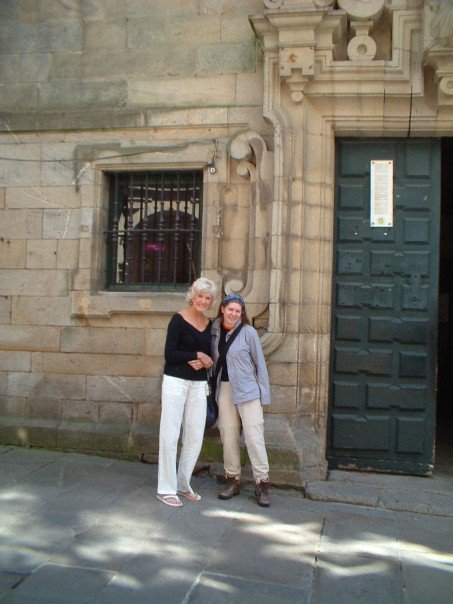
Anne and Gillian outside the pilgrim office
We meant to go to Finisterre. We really, really did. We were in Santiago in good time to set out for Finisterre and return to catch our train (not that we’d booked a train, but we had a pretty good idea of when we’d need to hop on one, and that time was several days away). When it came to it, though, we just never left. Didn’t want to. We were in Santiago de Compostela and that was good enough for us.
Instead, we spent the time exploring the city. We left the refugio we were in and booked into a guest house in the old town – very reasonably priced for a twin room with a balcony, and much less guilt about taking up beds that other pilgrims might be needing.
We went to the midday mass every day. Admired the singing of one particular nun, and despaired of that of everyone else. Met new friends and re-met old ones. Returned to the sundae bar for chocolate con churros – the thickest hot chocolate, by the way, that I’ve yet seen. Mocked (at a distance) tourists in the cathedral shop who were telling each other, ‘well of course, in the olden days people actually walked here, on pilgrimage, you know?’ Visited the Museum of Pilgrimage, learnt about the jet trade. Bought scallop shells carved in jet. Explored the cathedral, including its crypt and chapels. Bought skirts – after seven weeks in the same pairs of trousers, these felt like a real luxury. Went to the final of a Galician folk music competition with the Ely Four (gaitas very much in evidence; also the percussive effect of a bowl of water.) Ate all the things we’d been craving that were impossible to carry. (Watermelon. Jelly. And so on.)
We met the Ely Four again. How did it feel, we asked John and Linda, to finally be at Santiago, having stopped and started again so many times as they walked a few weeks at a time? Very odd, they said. Very odd.
And we found perhaps the most hilarious translation blooper in the history of the Camino. Speaking of a cad who was so bold as to attempt to make off with the cathedral bells, the English version of the ‘Legends of the Camino’ book we had in Spanish proclaimed, ‘Some type of divine punishment receives Almanzor, because your horse dies exploded after drinking water from a fountain.’ To this day, ‘your horse dies exploded’ proves a handy filler for awkward gaps in conversation.
So we passed our time in Santiago de Compostela. The day before we were due to leave, we wandered down to the station to buy tickets to Ferrol. No such luck. We could only get tickets that went as far as A Coruña. No matter. The trains we were aiming at, running along the narrow gauge Via Estrecha from Ferrol to Santander, only left a couple of times per day, so we would have plenty of time to sort out the next leg when we got there.
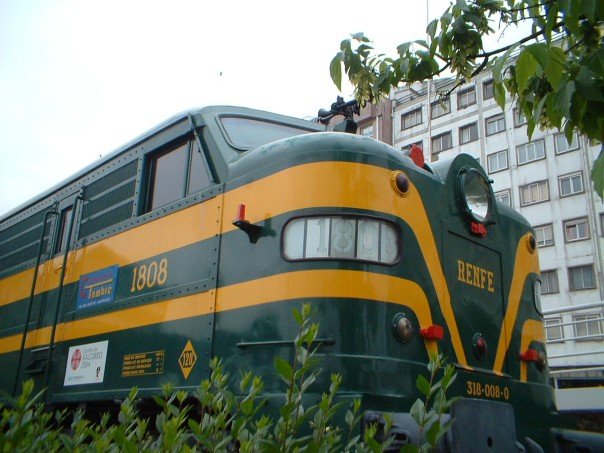
Loco commemorating Holy Year 2004 in the forecourt at Santiago station
After all, we were in no hurry. If we had been, I wouldn’t have planned a rail journey that took two days; as it was, taking our time over the return seemed fitting, even if we were no longer walking it. And I’d been promised that the Via Estrecha was as spectacular a train ride as any in Europe.
It took the best part of a morning to get from Santiago to Ferrol, changing in A Coruña (which, at least in our admittedly transitory experience of it, bore few signs of Sir John Moore’s dramatic end). We ate lunch in Ferrol, making the most of the hour’s layover, then boarded the little train for the antepenultimate leg of our journey.
There really are no words to describe the Via Estrecha. One doesn’t hear much about the north coast of Spain, and I have no idea why, because it’s utterly beautiful. For almost all the way, the railway runs as close to the sea as it can get, albeit about a hundred feet above sea level, clinging to the cliffs, in and out of tunnels. Through the afternoon we travelled through Galicia and into Asturias. (In Asturias the horreos are different – larger and squarer.) As night fell a bevy of teenagers joined the train, dressed up for a night out in Oviedo. We also alighted in Oviedo, but in search of a bed rather than the bright lights.
My anxiety about finding somewhere to sleep, never quite alleviated on the pilgrimage, went into overdrive now we weren’t on the Camino Frances. However, even from the station we could see a sign advertising camas (beds), and, despite the relatively late hour (it was gone nine o’clock) we had no trouble getting a room in the building to which it was attached.
The next day we breakfasted at the station before setting off again on the narrow-gauge. The landscape was not quite so spectacular, but all the way the presence of the sea on our left told us: we were on the way home.
Today our objective was Santander – the end of the line, and the last stop in Spain. We had booked our ferry tickets home when we booked the tickets out, so the sailing was a fixed point. No danger of missing it, though: we had almost twenty-four hours in Santander. I put the hotel bill on my credit card, and we set out to explore.
Santander is a pleasant town, if not wildly interesting. It being a nice sunny afternoon, we wandered along the seafront, vaguely considered a boat trip, thought better of it, and bought ice creams instead. A small child in the queue tested out her English on me, much to Anne’s amusement.
And then we went back to the hotel. Showered. Made use of the more frivolous toiletries we’d acquired (i.e. more frivolous than plain soap – these included razors). It may or may not have been due to the fact that our room had no windows to speak of, but we discovered we were utterly exhausted, and went to sleep. This meant that we missed dinner, but that saved having to think about it.
In the morning we checked out and hauled our rucksacks around the town. A little more wandering took us to the cathedral, which reminded me agreeably of Portsmouth in its mixture of ancient and modern, and nautical associations. At lunch we discovered further hilarious translation errors (‘Galician Octopussy’ – ‘Hake of hook to the Roman’) which, together with the people ordering in English and not even trying to speak Spanish, reminded us that we were in a port, and, more to the point, in the port on the way home.
About the voyage home, the less said the better. It was the one and only time I’ve ever been actually seasick. We didn’t even attempt the reclining chairs this time round, and bagging a decent spot on the floor was definitely a good move. It still didn’t improve matters much. And then the only available reading material was the Daily Express. The Madeleine McCann case was just breaking, and so was the ‘silver ring’ test case.
All in all, sleep was a blessed relief, and I didn’t wake until the call came over the ship’s tannoy that we would soon be docking in Plymouth. ‘Soon’, in this case, meant ‘in a few hours’. Ironically, we’d dissuaded my boyfriend from driving down from Exeter to Plymouth to meet us on the grounds that he’d have to go far too fast if he didn’t want us to wait around for hours. In the event we were about an hour getting off the boat, so he would have made it easily, but really, getting the train was hardly going to kill us.
The Exeter train was quite full, and our bags were large. Anne and I lolled in the vestibule, and grinned at each other in an accomplished, tired, contented sort of way.
Niton. Portsmouth. Caen. Saint Palais. Ostabat-Asme. Saint-Jean-Pied-de-Port. Roncesvalles. Viskarret. Larrasoaña. Cizur Menor. Puente la Reina. Estella. Los Arcos. Viana. Logroño. Navarrete. Azofra. Santo Domingo de la Calzada. Redecilla. Villafranca Montes de Oca. Atapuerca. Burgos. Hornillos del Camino. Castrojeriz. Frómista. Carrión de los Condes. Ledigos. Bercianos. Reliegos. Arcahueja. Virgen del Camino. Villar de Mazarife. Hospital de Orbigo. Astorga. Rabanal. Riego de Ambros. Cacabelos. Villafranca del Bierzo. Vega del Valcarce. Hospital de Condesa. Triacastela. Sarria. Portomarín. Ligonde. Palas de Rei. Arca. Santiago de Compostela. A Coruña. Ferrol. Oviedo. Santander. Plymouth. Exeter.
Sarria to Santiago de Compostela(2nd – 7th May 2007)
I was glad when they said unto me: we shall go into the house of the Lord.
Our feet shall stand in thy gates: O Jerusalem.
Ps 121
In Sarria we discovered a novelty: te con leche. Tea with milk. Excellent, we thought; Anne had been missing proper tea. It turned out, however, not to be tea with milk, but tea made with milk: a cup of hot milk with a tea bag in it. I was never so glad of my taste for black coffee.
A pleasant, if rainy, morning’s walk along green lanes. The waymarkings now came at regular intervals: concrete pillars, about waist-height, telling you where, if anywhere, you were, and how far it was to Santiago. The count-down was beginning to get exciting.
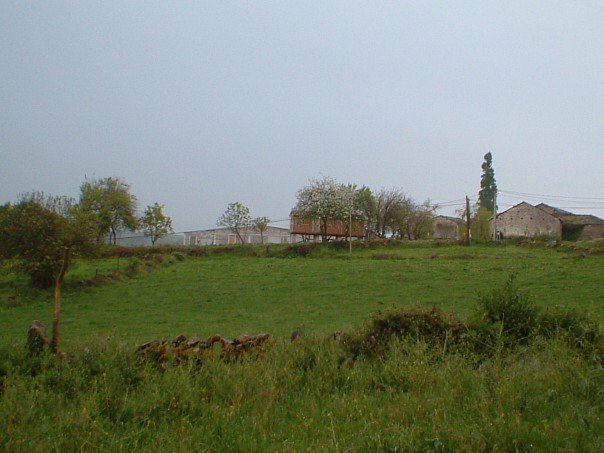
Just outside Barbadelo I saw my first horreo, a kind of small barn elevated on legs to keep it out of reach of the rats. Local legend says that at night these buildings get up and wander around the countryside; but we were never out after dark to see them.
The first horreo
At Ferreiros, at the less-than-100km-to-go bar (why yes, of course there is one), we had lunch, and another first: tarta de Santiago. This is an almond mixture baked in a pastry case, with the viciously pointy Santiago cross stencilled onto the top in icing sugar. Delicious, but best eaten in very thin slices, if one were planning on moving anywhere after lunch, and after some debate we decided that we were.
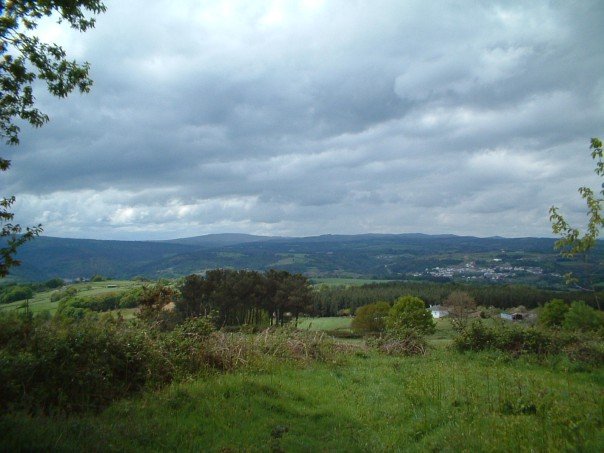
It was another 9km to Portomarín, down the hill and across the reservoir. At the bottom of the reservoir lies the old town of Portomarín, all except the church, which was dismantled and moved stone by stone to the top of the hill before the valley was dammed and the water flowed in.
Looking down towards Portomarín
The albergue was modern and spacious, and looked out over the reservoir. There were few other pilgrims, and we lazed away the remainder of the afternoon, stocking up on supplies at the food shop, doing our washing and hanging it out to dry in the laundry at the far end of the albergue, and chatting to an American pilgrim by the name of Sarah. She had lost time with an injury, and would now be unable to walk the rest of the way to Santiago before her flight left.
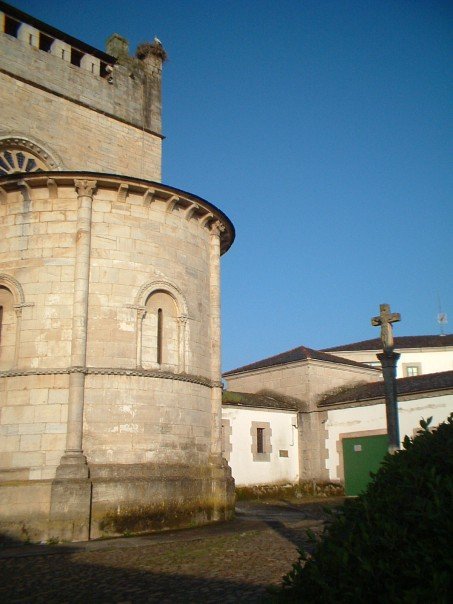
The next morning, while we sat in the town square waiting for the translated church to open, she caught the bus. The church took its time; we went postcard shopping and said Matins before it opened, but it was worth the wait. A remarkable example of Romanesque architecture before the flooding, the move made it more remarkable still. The portal was another of Master Mateo’s works – not so impressive, we understood, as the Pórtico de la Gloria at Santiago cathedral, but still a fine work. On the top of the tower was a stork’s nest – more friends seen, without knowing it, for the last time.
Waiting for the bus in PortomarínThe last storks’ nest
The way out of Portomarín was a steep track through the woods. We took our time and discussed, for no obvious reason, Shakespeare’s propensity for resurrecting dead women in his plays. It took a while to find the albergue in Hospital de la Cruz, and found, when we did, that it was closed. We settled for lunch and went on another four or five kilometres to Ligonde. There we found a small but airy hostel with chickens scratching around outside and a grand total of two saucepans in the kitchen, one very large and one very small. No matter: they served our purpose.
At Ligonde, we met Jim and Daniel, an Irish father and son. Daniel must have been about ten, the youngest pilgrim we’d met. (The youngest we’d met to speak to, anyway; the noisy kids at Logroño didn’t really count.) Jim joined the ever-increasing band of people who were disappointed that I wasn’t Irish myself, with a name like that.
The next morning we made instant couscous in the very large saucepan, ate it, and set out upon the way. It soon became clear that the day’s walk would not be a pleasant one, for me at least: my period had started the night before, and the cramps were excruciating, worse than I’d ever had before or have had since. None the less, we decided to take a detour to take a look at (what else?) an interesting church: at Vilar de Donas, the church of El Salvador has rather fine wall-paintings and the effigies of knights of the Order of Santiago. Dan Brown would have had a field day, and Anne enjoyed herself, but I was in no state to look at anything. We trudged back towards the main camino. ‘I feel sick,’ I said. ‘I’m not going to be sick; it’s a different system, but I feel sick.’
We stopped for a drink and (more importantly) a rest in the bar at Portos, where the diversion rejoined the camino. About a minute after finishing my coffee, I was sick. Then, since the proprietor was evidently keen to shut up for the morning, we moved on.
Progress was slow. Since the only attitude that afforded me any relief was a kind of doubled-up foetal position, which is obviously difficult to adopt while walking, I spent much of the time seeking out and sitting on low walls. Anne shifted more and more of my gear over to her rucksack. Occasional passing pilgrims stopped and asked if there was anything they could do, but there wasn’t, really; we were in the middle of nowhere and the only thing was to press on.
According to the book it was 7.5km to Palas de Rei, and we must have covered most of that. Happily, however, a huge, shiny, new municipal albergue had been erected since its publication, a fair way before the town itself. Unhappily, it had not yet opened for the day; but by now we were both happy to sit on the bench outside and wait to be let in.
The doors opened at one o’clock. Anne saw me safely tucked up in (unusually for me) a lower bunk, before going out to town to find herself some lunch and other useful things. I slept for a good couple of hours, which improved matters greatly. Anne returned with food, some fearsome Bridget-Jones knickers, and the news that there was a small ferret-like creature hiding under the front desk. We looked, but there wasn’t much more to see than a pair of round eyes and a pointy nose; and neither of us is much good on mustelidae.
The showers were effective but singularly lacking in curtain, but at four hundred miles in I’d lost most of my modesty, and no one else came in, anyway. We had thought the kitchen utensil range at Ligonde narrow enough, but the mod cons at Palas de Rei were spectacularly useless. While it was fully equipped with stove, sink, etc, the only container of any description was a plastic colander. We ate bread with salmon pâté and raw carrots, then, since the kitchen was obviously not going to be of any use to anyone else, we commandeered it as an oratory and said Evensong.
By this time I was pretty much recovered and we went out for a wander. As we passed a kind of bar/restaurant in the park the Ely folkies hailed us: they were staying elsewhere in the town. We joined them for a drink and an ice cream; it made a satisfying end to a difficult day.
Back at the albergue, a further failing became clear, apart from the curtainless shower and the pan-less kitchen: the lights could not be switched off. Very odd. We went to bed anyway.
In the morning we were able to proceed as normal. It didn’t look as if we’d missed much by not staying in Palas de Rei itself, so we didn’t linger there, but pushed on through suburbs and villages, keeping a good pace as far as Liboreiro.
Crossing into the province of A Coruña
It was a good day for a walk, sunny but not too hot. At Furelos we visited the church of San Juan. The priest showed us the main point of interest: a crucifix in which Christ has only the left hand nailed to the cross. The right arm dangles, or reaches, down. I found it extraordinarily moving: Christ who bridges the gap between earth and God, Christ who is divine in weakness.
We also asked why Saint Roch has a dog, having wondered about this for a while, but the priest didn’t know.
Leaving Furelos, we ate our lunch on tree-trunk benches just outside Melide. In Melide itself we stopped off in a rather dingy bar for a drink. The guidebook recommended stopping for octopus, but we’d had enough of seafood after Sahagún, and pressed on, dodging around a wedding party. Past the 50km mark, now, we carried on and stopped in a lovely church in Boente. It was open and empty, so we took the opportunity to say Evening Prayer.
Another five kilometres, up and over a little ridge, and we stopped at the bottom of the valley. The albergue at Ribadiso do Baixo was just over the bridge, with buildings spread over a large compound. Plenty of washing lines, although something of a peg shortage, but we coped. Supper was back up the hill: spaghetti at Bar Manuel. Afterwards, we stood on the bridge and watched the fish jump. It was a gorgeous, still evening.
Laundry and horreo at Ribodiso do Baixo
Next morning the lazy feeling persisted, and we dawdled as far as Arzúa. Now we were so near, it felt important not to rush things, to make the most of the last few days on the road. We stopped for breakfast, and I muddled the ordering of breakfast completely; my Spanish was still far from perfect. Still, we ate.
We ate again in Calle; while passing through the woods we met a man who recommended the tarta Santiago at a certain bar there. We followed his advice and partook of it; it was indeed excellent. I made a note of the brand for future reference. The next settlement was Salceda, where we had a boccadillo lunch and ice creams, and moved on again. The landscape had changed again: we were now walking through eucalyptus woods, tall twisting trunks and a mild fragrance reminiscent of snuffles. We halted by a spring in Santa Irene and said Evening Prayer in the afternoon sun.
Corkscrew-trunked eucalyptus tree
The nearer we got to Santiago, the larger the albergues became. Or so it seemed. The one at Arca (or Pedrouzo, or O Pino – it appeared to have several names, and one more than the number of languages spoken in the area) was fairly massive. In early May it was by no means full, but there was still a good number of pilgrims around. There was a kitchen, which looked comparatively well-equipped, but we had no food and couldn’t be bothered, so went out to the restaurant in the village. This proved to be full for the moment, but also to have coin-operated internet machines, so we went online and rejoiced in the fact that –
tomorrow we would be in Santiago –
Then there was a table free, so we went through, and ate, and talked, and filled a few more pages of the pink notebook of deep thoughts.
Tomorrow we would be in Santiago.
We left early, breakfasting in a café up the road. The camino led through more of the eucalyptus forest. A drink in another café, where we met some more English pilgrims, Christians, but not, as I understood them, Roman Catholic. It would have been good to talk further, to compare notes, but we never saw them again. Onwards and upwards: Lavacolla, where ‘Santiago’ airport is. Closer and closer, but the camino snaked all over the place. Finally: Monte del Gozo (“Mountjoy!” cry Roland and Oliver). Monte del Gozo is supposed to be the first point from which one can see the cathedral of Santiago de Compostela. Of course, the trees have grown up, and one can’t. Instead, we inspected a vast sculpture set up to celebrate the Pope’s visit, and another, smaller, one of a pilgrim assessing the state of her feet.
Down the other side of Monte del Gozo, and into Santiago de Compostela itself. We entered through the suburb of San Lázaro, passing a great arch decorated with portraits of famous pilgrims. Remembering our earlier experiences entering cities, we decided to stop for lunch now, rather than pressing on hungry and grumpy. The Hotel San Lázaro had a long, narrow dining room, and entirely acceptable food – apart, as always, from the puddings.
San Lázaro arch
As we walked, the suburbs gave way to the old city and the architecture became interesting. Jim and Daniel, our friends from Ligonde, caught up with us, to our great delight, and we walked through the old town and into the Plaza del Obradoiro together, to see the great facade of the cathedral rise up in front of us.





 Kathleen Jowitt
