
I nearly used this for ‘stars’, but ‘moon’ works just as well.

Stories that make sense
Here’s a meme that’s been annoying me:

I have never written any blue curtains, so I can’t comment on those. In fact, I think I’ve only written two pairs of curtains, and specified the colour of one of those pairs. They were yellow.
This is what my English teacher told me:
Every word on that page is there because the author wanted it to be there.
The curtains are only in the book at all because the author wanted them to be there. If they described every item of furniture, every fixture and fitting, in a room, then the reader would die of boredom long before any action could begin. Instead, the author has to trust that the reader will fill in the background details subconsciously. This can cause problems for someone trying to convert a textual work into a visual one. In fact, it’s called the Jane Austen’s curtains problem.
Given that, why mention the curtains at all? Why make them blue, if not some other colour? There’s probably a reason, and it’s worth thinking about what it might be.
Colette’s room looked out over the back garden, down towards the railway and across the town. The terraces ran in neat russet lines down the hill; on the other side of the river, the beech trees in the park were vivid amber, and the yellow-grey stone of the old town glowed gold in the October light.
‘Wow,’ Lydia said, ‘you get a lovely view of the cathedral from here.’
‘I know; I’m very lucky. It’s my reward for having the smallest bedroom.’
The window was open, a cool breeze stirring the yellow curtains. Down in the garden they could hear Peter bellowing, ‘Fa-ac me-e te-e-cu-um plangere!’ as he put his laundry up on the clothesline.
When I gave Colette a pair of yellow curtains – and, almost more importantly, when I didn’t take them out again during editing – there were various things in my mind.
I don’t have a particularly visual imagination, and find that inventing objects doesn’t come naturally to me. Consequently, I do tend to appropriate real life objects. The horrible red leather sofa at Balton Street, for example, is real; it was an eyesore in a university friend’s flat. Colette’s curtains belonged to one of my own housemates. (No, that doesn’t mean that she’s the model for Colette. If it comes to that, the friend with the red leather sofa is nothing like anybody at Balton Street.)
The yellow curtains call back to the first paragraph in that extract, where there’s already a lot of colour. Russet, amber, yellow-grey, gold: Stancester in autumn. Autumn is traditionally associated with decay, but this is the beginning of the academic year and the beginning of the story. I had to make it all glow very brightly. And yellow can be autumnal but it’s also strongly associated with spring: jasmine, daffodils, primroses, and so on. The beginning of the year. Things awakening.
In the Church (not Lydia’s church, but she doesn’t need to know this) yellow equals gold equals white: the colour of rejoicing, the colour for feasts, for Christmas and Easter, for weddings and baptisms. In most of the rest of the book the dominant colour is purple. Partly because I like purple, yes, but partly because it’s associated with waiting, penitence, mourning, fasting. Colette, the out bisexual character, could very well have purple curtains. But she doesn’t. She isn’t waiting or penitent or mourning or fasting at the moment, though she’ll do all of those things over the course of the book. She’s content in who and what she is in a way that Lydia can’t understand yet. And the curtains are yellow.
Did I do all that consciously, deliberately? I doubt it, at least in the first draft. As best I can remember, my thought process went something like:
looking out of the window – oh, better have some curtains, then – any particular curtains? – A’s curtains – yellow curtains
That’s not really the point. The point is that they remained yellow. This mention of yellow was a lot less deliberate than any mention of purple, but I kept it because it worked.
Later, when Lydia recalls the incident, the curtains are mentioned again, but their colour isn’t:
And the clear autumn breeze lifting the hem of the curtain, and Peter singing in the garden, and her soul standing on the threshold of its self-made prison, not yet ready to step out, but knowing for the first time that there was a world outside it.
Because their colour isn’t relevant here. The point now is that the window’s open.
It’s always worth thinking about the curtains.
And this approach goes for any detail. Why is Peter singing that particular line? Because it’s a lot of fun to sing, and I know that because I’ve sung tenor in the Dvorak Stabat Mater myself. Because it does sound a bit dirty if you don’t immediately realise that it’s not in English, and this scene needed to go a little way beyond Lydia’s comfort zone.
One could also say that the meaning of the Latin is relevant. Make me weep with you. The speaker is asking to enter more fully into the suffering of Mary, the Mother of God, and there is certainly a sense in which the book is about expanding one’s spiritual experience.
But that’s a bit of a stretch. I’m pretty sure that I wasn’t thinking of that when I put it in. So I don’t know, maybe the maker of that meme has a point after all.
Yes, the curtains were fucking yellow. But if there hadn’t been a reason for that then they wouldn’t have existed at all.

presence is the word for 2017
presence
- as in here
- as in now
- as in presents
- as in being
- as in showing up
- as in real
- as in poise
Here are a few more:
As in being there.
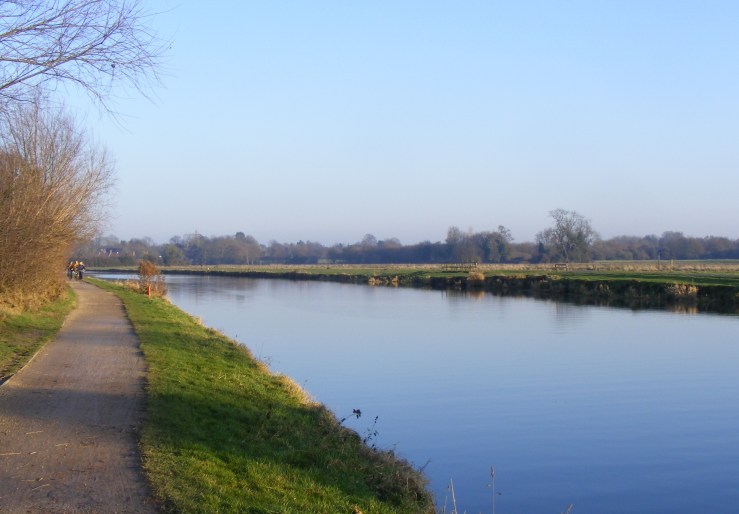
Much has happened in 2016 for which I am grateful.
That was not going to be the opening sentence. I have just deleted an apologetic introductory screed in which I explained that I knew it had been a dreadful year on the large scale. I am not going to apologise for having had some things that were not unilaterally appalling happen to me. Some good things did happen.
Thank you, 2016, for:
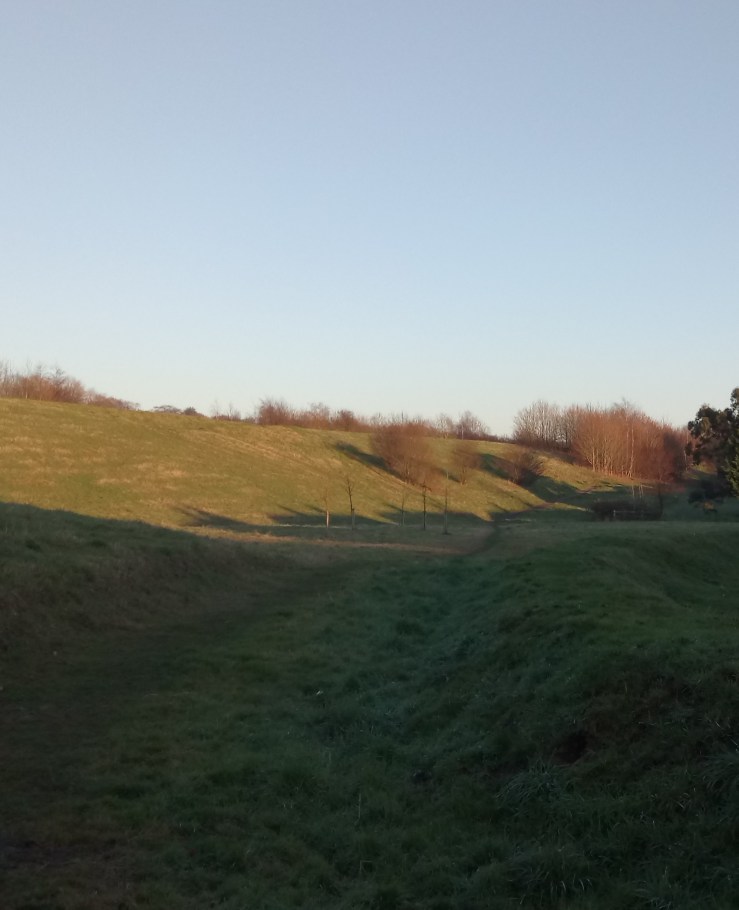
Today I was in Surrey, spending a day with some university friends and our various partners and children, as has become traditional for this week between Christmas and New Year. In the afternoon we walked out to the playground near Merstham station, and I was struck by the beauty of the winter sunlight.
Just on the other side of this bank is the M25. Walk up to the top of it (we didn’t, today, but I have in the past) and the noise of the traffic hits you, thousands and thousands of cars and lorries orbiting London on the country’s most notorious motorway.
And yet from this side you wouldn’t know. One hears the trains – two lines cross at Merstham, and even in these days of Southern Fail there are plenty of trains passing through to entertain the children – but the motorway doesn’t intrude itself upon one’s notice. It has its uses, of course: one party would have found it difficult to get there without it.
My wish for 2017 is to see clearly, to see what’s really there, to know about both the beautiful and the ugly, the good and the bad, to recognise that they’re intermingled in ways that I’ve yet to comprehend, and not to discount the one or to deny the other.
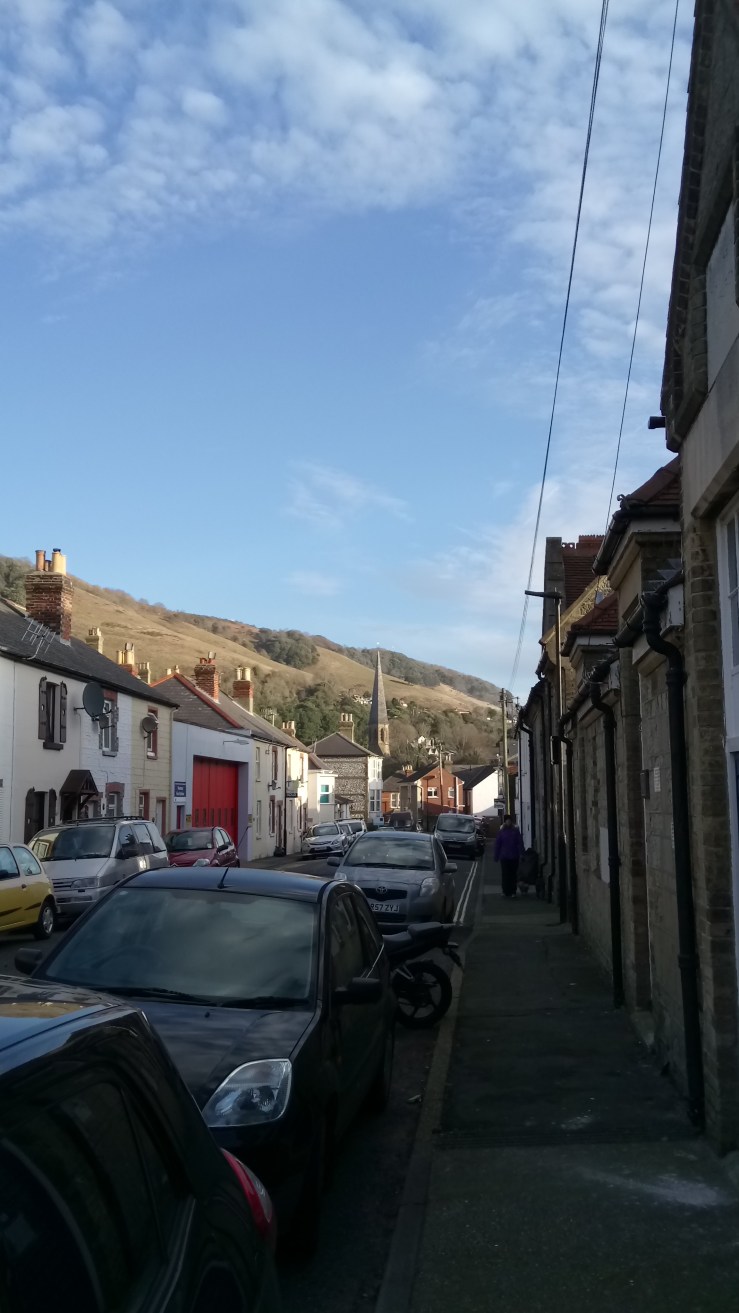
On a busy day, one has to take one’s quiet moments where one finds them. Waiting for the rest of the family to put their coats on and come out to the car. Guarding the bags in a shopping centre coffee shop while everyone else takes their half hour browsing the sales. On a slow train trundling through the Surrey hills at sunset.
There have been plenty of quiet moments, it turns out, when I’ve looked for them.

… is just about visible beyond all the flash and mess. I cleaned this mirror earlier, but the bright light brings out everything I missed.
But there I am, sneaking in around the edge, managing to look in the right direction. Still here,and glad about it.

‘History is not what you know. It is what you can remember.’
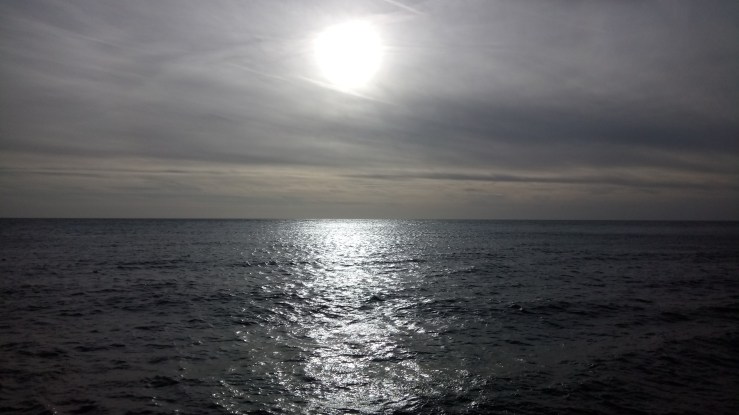
In purely physical terms, all the energy I burn or eat or listen to or read by has come from the sun in one way or another. That warmth and light nourishes me, or nourishes things that nourish me.
On another level, there is something very powerful about that great expanse of sea, about solitude and something larger than myself.


