Waiting

A fluffy black cat (she has white bits, but they aren't visible in this photo) sinks into a burgundy velvet cushion, her eyes only just open

If I’ve been a bit slow on the uptake, I suppose I can blame this lingering lurgy. It’s been two weeks and I’m still lethargic and very conscious that I’m not yet well. I’m better, I think, than I was on Advent Sunday, when I was cold and wobbly and wondering what on earth was wrong with me; certainly better than last Friday, or this Monday; but still not entirely well.

Some friends observed recently that in these days of antibiotics and painkillers (both undoubted benefits to the world at large, let me be clear) we’re stumped by minor illnesses whose symptoms persist. I couldn’t take antibiotics for a cold, and, while I was glad enough of paracetamol and pseudephedrine when my head and ears were aching and I couldn’t breathe without thinking about it, there’s been nothing to be done with the fatigue. Except, of course, waiting. A hundred years ago that would just have been the way things were. You’d have to give your immune system time to do its job, you wouldn’t be able to dose yourself up and power on through.

This year I’ve been reading, very slowly, Kathleen Norris’s The Noonday Demon, in which she examines the cardinal sin/bad thought (depending on which theologians you ask) of acedia. This concept has some overlap with the clinical condition of depression, and is often translated as ‘despair’, but, Norris seems to argue, is perhaps best interpreted as the desire to be somewhere other than where you are. This resonated, often when the toddler just wouldn’t go to sleep, but at other times too.

And recently I picked up Ross Thompson’s Spirituality in Season, in which he talks about three kinds of ‘abyss’, or exclusion:

First, there is exclusion from God, which because God embraces us always, can only be self-wrought; this is sin, leading to hell. Second, there is exclusion from life and being, which by definition is death. And third there is exclusion of our fellow human-beings, which in much of the teaching of Jesus… seems to be equated with the judgement; we are already judged, it seems, by our own response to our neighbour in need.

Then he draws a contrast between the two penitential seasons of Lent and Advent, noting that in Lent we actively confront this abyss (because, as he says, it’s all the same thing) while in Advent we ‘vulnerably experience their great danger, before experiencing at Christmas the one who saves us’.

And then he goes on to talk about waiting, using the example of waiting for a bus. We wait for something (or someone) over whose arrival we have no control at all.

(Here, I would add, we have two options: we can watch, or we can seek distraction. I’m very conscious that lately – the last few months, maybe longer – I’ve been seeking distraction. I’ve been very reluctant to face the inside of my own head, or heart. Too tired. And it’s going to hurt. Maybe. That might or might not be what’s going on. I need to look at that too.)

I read this… in November, if not October. I gleaned some useful facts for my O Antiphons workshop. I noted the reference to W. H. Vanstone’s writing on passivity in the events of Holy Week, which I have also read, and found useful.

And then I spent the first ten days of Advent absolutely hating where I was, furious that I didn’t have the energy to engage in anything that felt like a meaningful observance. And not being able to prepare for Christmas, the sacred or the secular versions, either.

And then it clicked. Waiting. I’m waiting. I’m waiting to feel better. I have very little control over how my body deals with this illness; even my capacity to do nothing is limited. This is, or could be, more meaningful than any Advent devotional book, could teach me more than any twenty-four windows I could open. This is a particularly immersive way to experience waiting, and, therefore, to observe Advent.

Has it helped? Immensely. If nothing else, laughing at my own failure to get it improved at least a couple of days last week. And not at all. Today, for instance, I wrote, I am losing sight of the concept of anything getting better. (And about three minutes after I wrote that, it did.) But that’s the way it goes. If I’d assimilated this brilliant new insight immediately, discovered how to embrace my enfeebled physical state as a symbol of my mortal human state, and glided up to new heights of spiritual consciousness I’d have missed the point, wouldn’t I?

So here I still am. Waiting.
A winter tradition

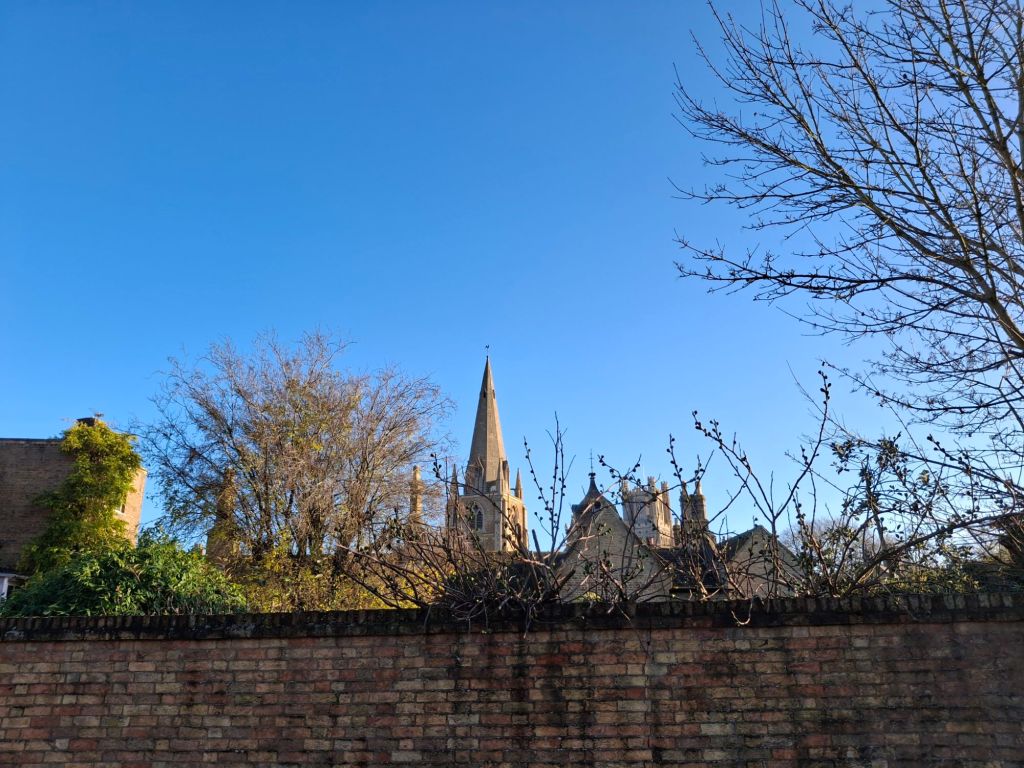
An assortment of towers and spires seen beyond the top of a high yellow brick wall against a clear blue sky

I always take the first week of December as annual leave, and I always tell people that I don’t plan to do very much with it. Well, not two years ago, when I was on maternity leave, obviously, and last year it was the last week of November, but before that I had a long-standing tradition of taking the first week of December as annual leave, and this year I reinstated it.

The theory is that I get a bit of breathing space with which to start my new year. I observe at least the beginning of Advent in a meaningful way. I take some time to look back at the past year and forward to the next one. I do some writing, perhaps. I get a break from the enforced cheeriness of secular office Christmas (this is less dire than it used to be before the pandemic). I take long walks. I contemplate vast clear skies. And yes, I do a bit of shopping and go to the post office at a time of day when the queue isn’t out the door.

That’s the theory.

I’d forgotten that what actually happens is that I get ill. Whatever stinking cold is making the rounds, the moment I take my early December break, it hits me. Cough, headache, runny nose, nosebleeds, any combination of the above.

This year there’s been an earache and a sticky eye as well. Apparently there’s something absolutely miserable going around, and since it’s lasting a fortnight (so says my neighbour) I probably have another week to go.

(Last year, by way of variation, I was fine during my week off, but then had an unpleasant gallbladder flare-up the week after. The year before that, who knows, I had a five-month-old baby and I can’tremember. The year before that I was pregnant and still in the “constantly exhausted” stage. Before that I might have dodged it with the help of the pandemic restrictions. But before Covid it was definitely a thing.)

I’m particularly annoyed this year because this happened when I took three days off in September, too. But I was tired, and I knew that I was tired. I suppose it’s been a hell of a year, and that’s all there is to it.

So I’m trying to let this be a time of patience, as I suppose is only fitting. If I’m not feeling up to trimming the hearth and setting the table, I can still look east, believing that Love the Guest doesn’t mind the cat hair on the cushions or the toys on the floor. (That carol has been in my head a lot recently; I was meaning to write a post about it. Not this week, though.) I’m trying to accept the experience of being ill, even if I can’t enjoy it, rather than wishing I was somewhere, somebody, else. I’m trying to keep my temper. I’m trying not to worry too much about the next few weeks, and mostly managing it, because I just don’t seem to have the energy.

Next year, then, I might remember that my body seems to need rest as much as my mind needs to process and review. I might make myself a list of things that are gentle and restful but still feel appropriate to the season. I might be prepared for the first week or so to be utter chaos, and to trust that there’s meaning in the chaos too, there’s help for my helplessness, there’s space for everything I need to do, and grace for everything I don’t get to. And this year I’ll try to live that.

The limits of capacity: post-Covid and writing chronic illness

A fluffy black and white cat on a blanket on a sofa
The view from the sofa

On Easter Monday I reread A Spoke In The Wheel. ASITW, as I shall refer to it henceforth, was my second novel, which dealt with the coming to terms of a disgraced cyclist and a disabled cycling fan. Easter Monday was day 18 of my convalescence, if we’re counting from the first day I tested negative for Covid, and was, like many of the previous 25 days, spent mostly lying on the sofa.

While my main reason for rereading was being in a mood for more cycling after watching both Paris-Roubaix races in the afternoon of Easter Day, and also to see if there was any mileage in a spin-off story for the B couple, it was quite an interesting experience. This is, if not the most ill I’ve been in years, certainly the longest duration of illness I’ve had, and I couldn’t help looking out to see what I’d got wrong.

Of course I’d done my homework at the time, getting two ME sufferers of my acquaintance to check and double-check for errors and faux pas, but this is as close as I’d want to get to experiencing chronic illness for myself. I’m very thankful indeed that I do seem to be getting steadily better. I’m noticing tangible improvements from week to week, if not necessarily from day to day. On Monday I went into the office for the first time since the middle of March. Yesterday I had to have a lie-down as soon as I’d shut down my laptop. Tomorrow I’ll try riding my bike to the station.

So what did I find? Actually, not all that much that spoke directly to my comparatively short experience of illness. The whole point of ASITW was that it was talking about long-term conditions. I was writing about two people who spent most of their lives at the limits of their physical capacity, who were intimately familiar with that territory. It’s new ground for me. Anything I might have added from my current experience would be part of a prequel, or, just about conceivably, a flashback.

My limits are changing all the time. Not, perhaps, so fast as I’d like, certainly not so fast as the Protestant work ethic thinks they should be, but they’re changing. I know about as much about chronic illness from a month of post-Covid as the person who does a one-night fundraising sleepout knows about what it’s like to live on the streets. Which is to say, not much at all. If I were writing ASITW now I’d still need my specialist editors. Maybe even more so than I did before, lest I think I know it all now. (A little learning is a dangerous thing…)

And the other thing is that it came from the point of view of someone who had been disabled and now wasn’t, with all the assumptions that implies. Ben’s experience of disability is far in the past even if his experience of not being able to do everything he wants to do is very recent. He was always going to start out as a clueless git, and being a clueless git is, I would argue, not something that one needs personal experience to write. (I have often been clueless. I have tried not to be a git.) If I’d had this month of fatigue when I was writing ASITW I wouldn’t really have had anywhere to put it. Or, if I had, it would have been a very different book. And, you know, rereading the one I actually wrote, I’m pretty happy with the way it ended up.

Some links

Autistic on Wheels – Katherine’s advice and comments were immensely helpful to me when I was writing ASITW. She’s doing important advocacy work.

The rise of sensitivity readers – an article from Independent.ie quoting the formidable Susan Lanigan

A Spoke in the Wheel