Unexpectedly, I had lunch with two of my brothers last Thursday. If I’d thought about them at all when I got into London on Thursday morning, I’d have assumed they would be minding their own respective business on the Isle of Wight, but I got a text message at about half past ten asking if I had any plans for lunch.
It turned out that one of them had come up to London to get ski boots fitted and, while he was in the area, to visit the Confraternity of St James and see if they had any advice on cycling the Camino de Santiago.
Why do the Camino?
When one arrives at Santiago de Compostela, one is asked to give one’s motivation for doing the Camino, choosing from religious, sporting, cultural, historical, spiritual, and so on. Well, I am a fairly religious/spiritual sort (often coming down more decidedly on one side of the balance or the other, depending on my mood), and so, when offered a choice by the pilgrim office at the cathedral, I went for that, and got my certificate in Latin. But really, I can’t claim that religious and spiritual reasons were what sent me off down that road.
But it’s more than that – at least, it is in my experience. The Camino isn’t pure nature, pure challenge, the way that Everest is. The Camino is a human construct, human roads leading to a human city, and it’s often the human connection that draws us to it.
My brother wants to do the Camino because I did the Camino, back in 2007.
I wanted to do the Camino because a group of family friends did the Camino, back in 2000. The postcards, in Andrew’s spiky or Heloise’s scrawly handwriting, arrived over the course of several weeks, bringing with them the sense of space, of adventure, of time, and leaving me with a tiny seed of a wish.
The way I get into most things is by hearing somebody else talk about them, and thinking, I want to do that. I bet I could do that.
My brother wants to do the Camino. He knows about the Camino because I did the Camino, and because Andrew and Heloise and John Murray did the Camino.
I want to do the Camino again because I did the Camino before, and my greatest regret is that Anne, my companion of my last Camino, is not well enough to join me again: my best friend, who, when I said, ‘I want do do this,’ said, ‘I want to do that too,’ and came with me.
As for my other brother’s reason for coming to London? He just thought it sounded fun.
I’d flicked through the book in the shop, as you do, but it was only when I’d brought it home and started at the beginning that the irony struck me.
I remembered the problem – my problem, I should say – with Julia Cameron.
Morning pages. Or, rather, her insistence that morning pages are essential, that, before you do anything else, you should dump the contents of your head into a notebook, and that if you have to get up early to do it, then that’s what you should do.
I understand the theory, and I am perfectly willing to admit that dumping the contents of my head into a notebook has been very useful to me on more than one occasion. I just can’t do it every day, and I definitely can’t do it first thing in the morning.
I am not a morning person. I am particularly not a morning person when it’s dark when I have to get up. And I have to get up at six thirty as it is. September hits me like a steamroller, every year, when the morning retreats that little bit further and whatever it is in my head that gets me out of bed stops working. If I were to set the alarm for 6.10am, I would spend the twenty minutes between it going off and my having to start getting ready for work lying in bed hating myself. I’ve tried it.
In fact, I was very happy to realise this morning that it’s now October and therefore not too depressing to look forward to the clocks going back.
And so morning pages are not an option for me. I am not even tempted. At this time of year, any sort of ritual that asks me to get up earlier than strictly necessary is not an option for me. So I’m not doing them.
I will, however, read the rest of the book with interest and an open mind.
What I am working on at the moment is retaining the baby – in this case, Julia Cameron’s otherwise humane, compassionate and patient approach to the artistic process – while ditching the bathwater. She runs the bath too hot for me.
My mother used, whenever one of my cousins (and I have a lot of cousins) turned eighteen with the intention of going to university, to buy them an electric kettle as a birthday present. We, the children, would get mugs to go with it. The result was a gift that was both symbolic and practical.
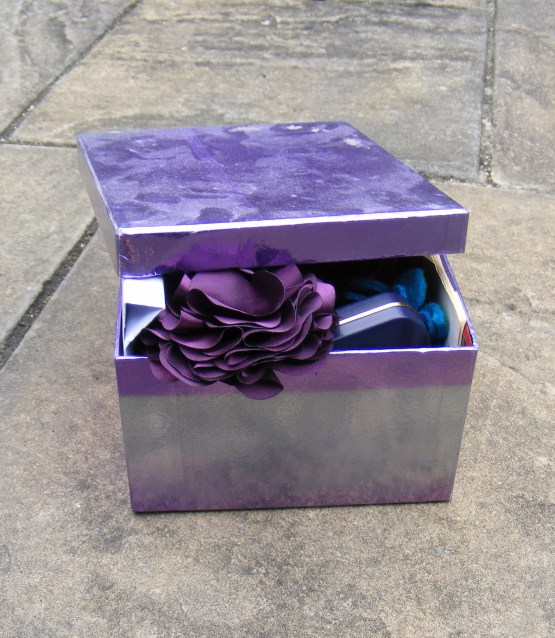
When I turned eighteen, one of my cousins returned the favour and gave me the purple box in the picture above. It contained:
a mug, and two teabags
a packet of instant soup
a tin of baked beans
a jar of Marmite
a tin opener
a potato peeler
two tea-towels
a bar of chocolate
It also contained two pages of (hilarious) instructions on the use of the above items, which has allowed me to reconstruct the contents at over a decade’s distance, and concluded:
9. The box. This will be useful for keeping things in. During your years at university you will come across many things that cannot be defined or categorised. Put these things in the box, to avoid having to define or categories them. It is also shiny, which is always good!
The contents have gone the way of all flesh – actually, the tin opener might still be knocking around – but the instructions and the box itself survive.
The things that I have apparently been unable to define or categorise, as evidenced by their inclusion in the box, are:
my last pair of glasses
a previous pair of glasses
six fabric floral corsages
a luggage label in the shape of a cat’s face
two CDs of wedding photographs
an enamel rose-shaped brooch
a monocle
one of those fancy plastic combs that’s meant to make it easier to do a French pleat, now completely useless to me
an elastic band with a sequinned flower on it, which I suppose I could use as a bracelet these days
seven bottles of nail varnish
a pillbox full of glass-headed pins
more safety pins than I can be bothered to count
two small scallop shells
a pair of nail clippers
a quantity of small change in euros
a toy car
a badge saying ‘Altos prefer it underneath’
a magnetic bookmark with my name on it, telling me that I’m ‘A female tower of strength’
a brooch made of buttons and wire
a cross and a fish made of clay, which date from the Methodist and Anglican Society Welcome Week event 2005, at a guess
a medal of the Blessed Virgin Mary, provenance unknown.
Gosh. That was illuminating. And it saves me from making a cheap point about how the only thing I found that I was unable to define or categorise was myself, which I would otherwise be tempted to do.
No, my cousin attended to my practical needs. My aunt on the other side of the family, meanwhile, presented me with a stack of useful books and newspaper supplements. They included, as I recall, The Bluffer’s Guide to University, the Cambridge University Student Union guide to pretty much everything (my cousin – I have, as I’ve mentioned, a lot of cousins – was an elected rep of some sort), and several years’ worth of the ‘how to survive at university’ insert the Sunday Times produces annually. To this I added Gaudy Night and Dear Bob, which I think I must have received the previous Christmas, and which was an amusing, if incomplete, guide to being Christian at university.
Armed with all that, I did reasonably well, academically and socially, at university, and mostly enjoyed myself hugely. But the book I was missing was the one that said ‘there’s more than one way to be Christian, and that’s not incompatible with not being straight…’
So I wrote it. I’d love to think that it’ll make it into someone else’s university survival kit one day.
[content note: discussion of a biphobic document, including a specifically biphobic quotation]
Issues in Human Sexuality has become a very Anglican idolatry: a discussion document published in 1988, elevated without consultation to quasi-doctrinal status and making the lives of LGBT members of the Church of England a misery ever since. It’s the document that ordinands are asked to submit to, the document whose logical conclusion is that same-sex marriages can’t be performed or even blessed in church.
Paragraph 5.8, which attempts to deal specifically with bisexuality, has been floating around Twitter lately, and since I have more to say on the matter than will fit into 140 characters, I’ve taken it to the blog.
5.8 The first is that of bisexuality. We recognise that there are those whose sexual orientation is ambiguous, and who can find themselves attracted to partners of either sex. Nevertheless it is clear that bisexual activity must always be wrong for this reason, if for no other, that it inevitably involves being unfaithful. The Church’s guidance to bisexual Christians is that if they are capable of heterophile relationships and of satisfaction within them, they should follow the way of holiness in either celibacy or abstinence or heterosexual marriage. In the situation of the bisexual it can also be that counselling will help the person concerned to discover the truth of their personality and to achieve a degree of inner healing.
The depressing thing about this – no, there are many depressing things about this, but one of the first that springs to mind is that it relies on a definition of bisexuality that no bisexuals use, a myth that is in wide circulation beyond the Church, namely, that ‘bisexual activity… inevitably involves being unfaithful.’ The majority of my secular straight acquaintance agrees that the Church’s attitude to homosexuality is bafflingly uncharitable, but I’ve had to explain a tedious number of times that no, I’m still only sleeping with the person I’m married to.
I began identifying as bisexual in 2007, having first heard the word in 2006. At that point I was in a relationship with the man I was to marry in 2009. Our seventh wedding anniversary was last Monday. Now, you can make all the ‘seven year itch’ jokes you like, but I have never been unfaithful – unless you subscribe to a particularly literalist interpretation of Matthew 5:28, in which case I suggest you check your own eye for logs. I have from time to time developed crushes on other people, told my husband about them, laughed, and moved on. I will be very surprised if that’s not true for the majority of straight people and gay people.
The paragraph also relies on another common misapprehension about bisexuality: that it ceases to exist when somebody begins a monogamous relationship. My own experience gives the lie to that. I was already in a monogamous relationship when I took a long, hard look at the list of everyone I’d ever been attracted to and realised they weren’t all the same gender. Nor did I not stop being bisexual on 20 June 2009. In fact, it was some of the hard thinking that I had to do as part of marriage preparation that gave me the impetus to come out to my husband. (Whose response, by the way, when I showed him this paragraph the other night, was ‘What the fuck?’)
I am ‘capable’ of celibacy, abstinence and heterosexual marriage, though not all at the same time. I’ve done all three in my time, I’ve seriously considered all three, plus a relationship with someone of the same gender, as possible futures, and all the time I’ve been bisexual. What is ‘bisexual activity’, anyway? At present I, a bisexual, am typing a blog post in my lunch break, drinking tea and listening to the Sullivan cello concerto. No infidelity involved. That’s as far as my bisexual activity goes.
I have had counselling in the past. It helped, but not in the way that Issues seems to think it might. It was the beginning of an attempt to achieve what this calls ‘a degree of inner healing’. What eventually came to the surface was the inevitable conclusion that my attempt to ‘follow the way of holiness in… heterosexual marriage’, ignoring all the bits of my personality that didn’t fit that story, hadn’t worked at all; it had led to me leaving half of myself outside the church door. That stint of counselling, and all the thinking I did after that, didn’t ‘heal’ me of being bisexual, because bisexuality is not something that needs to be healed. ‘Dealing with’ bisexuality by ignoring it is, pastorally speaking, a terrible move.
And guess what? The truth of my personality is that I’m bisexual, no amount of counselling is going to take that away, and accepting it, celebrating it, has brought me a degree of inner healing that pretending to be a straight wife never did.
When I was little, we had some traveller friends who lived in a converted bus in our back yard. Since most of our other friends lived a mile down a very busy road, my brothers and I spent quite a lot of time with Ed and Jenni, Izak and Riley. When it was fine, we played in the garden. When it was raining, we went to the bus.
Jenni had a copy of Mary Berry’s Step By Step Desserts. I spent many happy hours looking through this book. Later, they moved to France, and we moved to the Isle of Wight, and I haven’t seen them in years, though my father and brother visited them a few weeks ago.
All the same, when I saw a copy in a charity shop I snapped it up. I make recipes out of it occasionally, but mostly I just look, and remember contented rainy afternoons, and very hospitable friends.
Minor spoilers for Speak Its Name in this, including an extract from a chapter very near the end.
Visibility charm
I mentioned last time that my main purveyor of author tracts (warning: that’s a link to TV Tropes, and if you follow it you may lose the rest of the day) in Speak Its Name was Peter. Which is not really surprising, when you consider that the book started out as a story of how getting too interested in student and/or Christian politics can play havoc with what you thought was a vocation to ordained ministry. That’s pretty much where I was when I started writing it, after all, so it made sense to bestow some of my own opinions upon the character who was dealing with that.
The other one was Abby, who is Lydia’s cousin, and who is in some ways much closer to an author avatar (TV Tropes again), or at least an author caricature. (‘A self-insert who turns up at the end to pontificate,’ was how I put it to one of my editors.) I am not blonde, or pregnant, or given to wearing pink, but at the time of writing I was very aware that I looked a lot like the Perfect Christian Woman. And – aside from the fact that my family is much less of a clusterfuck than the Hawkins – this was very much what my experience looked like.
‘What I wanted to say,’ Abby said, ‘was that I know that our family is not at all helpful when it comes to relationships that happen in anything like the real world, and that I know that your parents are if anything less helpful than my parents and that – if you wanted me to – I would come out.’
Lydia choked on her prosecco. ‘What?’
Abby told Colette, in a stage whisper, ‘I said it wasn’t a helpful family.’ Then, in more serious tones. ‘I’m bi.’
Lydia could think of nothing to say. Colette, clearly amused, said, ‘She looked less shocked when I told her I had a crush on her.’
Abby smiled, though it looked like an effort. ‘I wasn’t ever going to tell anyone. Not in the family, at least. It never occurred to me that I might not be the only one.’
‘Same,’ Lydia just managed to squeak. ‘Does Paul know?’
‘Of course – I wouldn’t have married him if I couldn’t tell him that.’
‘People must do,’ Lydia said. ‘Oh, God, this must happen all the time.’
Abby nodded. ‘I know four or five – happily married, most of us, still in love, still Christian, still trying to find a way to be truthful, always knowing how bloody lucky we are: that we could so easily have gone the other way, fallen for someone we couldn’t take to church with us…’
Except… when I was reading it through, on the second to last editing pass, I was struck by the horrifying thought, Good grief, that sounds miserable.
And then I remembered that was me, that the last paragraph there describes precisely the way I thought about myself and my faith and my bisexuality at the time I was writing. I might as well have put it in there so that I could say to anyone who asked, ‘You know the bit with Abby at the end? That’s basically where I am.’
Not any more. Somewhere in the writing process I’d moved far beyond where Abby was. I was mostly out, as opposed to being mostly closeted. I’d stopped thinking that the only appropriate way for me to be bisexual was quietly. I’d realised what a mess I’d made of myself by trying to do that. I’d started speaking up, and out.
The project is never what you think it is. I thought Speak Its Name was about vocation, and politics, and faith, and sexual orientation, and it is, but it is mostly about being OK with who I am, and I had to learn more about that before I could finish it. Writing a book changed the book, and changed me.
I suspect that writing Wheels will have something to teach me about working too hard and physical capacity and the importance of not doing things. I asked to learn more about that, after all.
I suspect that I do not currently have the breadth of understanding to imagine what it’s going to teach me. I suspect that it’s going to go far beyond juggling my working patterns and keeping every other weekend free. I suspect that it’s going to take me apart and put me back together again, and maybe I’ll notice while it’s actually happening, and maybe I won’t. Maybe, like last time, I’ll just happen to glance back over my shoulder and think, Good grief, is that where I was? What a very long way I’ve come.
My family game is Racing Demon*. It’s a fast, vicious game played with several packs of cards, which get strewn across the table in the course of play and have to be sorted out at the end of the round. Therefore it’s useful to have cards with distinctive backs. It’s rough on the cards: therefore it’s useful to have a lot of cheap packs.
Over the years, I’ve collected quite a few packs of playing cards. If all my aunts and uncles and cousins turn up at once, I’ll be ready. It’s become a bit of a thing. At least this means that people always know what to give me for Christmas. Playing cards, or books about playing cards. This was one of them.
*Rules vary: that link was the best description on the first page of Google, but in our house it’s ten points for a king, none for going out (going out is advantage enough in itself, for heaven’s sake!). And adding an extra card to your hellpile if you went out in the last round is not optional at all. You do get to take it off again if somebody else goes out in the next one, though.
A friend asked me the other day how things were going with the current book. This was my reply:
I’ve dragged it kicking and screaming to 16K and have hit the stage where I think it’s all terrible and the characters are cardboard and I haven’t done enough research and it shows and I’ve got everything wrong and should just dump the entire project.
Interestingly, this state of affairs didn’t particularly bother me. Because, as I went on to say, I remember this happening last time round. In fact, I officially gave up on Speak Its Name at least twice because I thought it was all terrible and the characters were cardboard and I hadn’t done enough research and it showed and I’d got everything wrong. So I just dumped the entire project.
Except I didn’t, obviously, because twice – or more – I came back to it, dug in again, and sorted out what was wrong.
This time round, I see exactly what’s going on. I recognise the stuckness as a minor annoyance rather than a major existential crisis. I also see why it’s feeling stuck.
Massive mess vs massive progress
The picture at the top of the page shows the sitting room of the flat we rented in Woking, during the process of packing up almost everything to move it to Cambridge. For tedious work-related reasons, I did most of the packing while my partner started his job out east (he did all of the driving, so it worked out more or less even).
I hate moving house. It’s commonly said to be one of the most stressful experiences of modern life, and I’ve done it far more times than I ever wanted to. What that means is, I’m getting better at it.
Here, an extract from our chatlogs:
K: the packing is getting me down
I think it gets worse before it gets better
T: yeah
K: I am hoping that you will come back and see Massive Progress
I am just seeing Massive Mess
T: That is what progress usually looks like
K: heh
ALL OF THE THINGS
T: One hundred percent of them
K: yes
and they all need to be in boxes
or somewhere else that is not in the flat
The more often it comes, the easier it is to recognise it
The first time I got depression, I didn’t know what it was. I didn’t know there was an ‘it’ to know: it works by erasing all your previous frame of reference, so you start believing that this grey expanse of meh is all there ever was and all there ever will be.
The first time it went away was because of a change of scenery and Bruckner’s fourth symphony. It was as if someone had switched the lights on; and that was when I learned not to mistake a low mood for a loss of faith. I can forgive myself for having been mistaken, though: it was a very, very ongoing low mood.
The next time was when several awful things (two bereavements, a bedsit with leaks and mice, a temp job in a cellar) all showed up in a bandwagon and depression jumped on.
The time after that I went to see the doctor about it and he said, yes, depression. My brain lying to me about the way things are, not the way things actually are.
A while after that, I started recognising the feeling that I should break up with my partner for his own good as not just a very bad idea, but a symptom of the returning visitor.
These days, it comes and goes, and I get better and better at recognising it. I’ve got to know its little ways so well that I could almost mark it on the calendar, and when it turns up say, ‘oh, yes, August’.
Twenty-four per cent
The current wordcount for Wheels (I thought briefly about changing the title to Bonk this morning, but I fear I’d disappoint a lot of Jilly Cooper fans) is 19,354. Assuming I’m aiming for eighty thousand words, that puts me just under a quarter of the way there.
Actually, it puts me nowhere near a quarter of the way there. I’m not expert enough yet to guess how much editing and reading and re-editing and re-reading I’m going to need to do once I’ve got the first draft down, but I know it’s going to be a lot. I can tell that from looking at what there is of the first draft.
That’s why I’m thinking it’s all terrible and the characters are cardboard and I haven’t done enough research and it shows and I’ve got everything wrong.
You don’t realise how much stuff you have until you try to put it all into boxes, and then you have boxes everywhere and also stuff everywhere. Moving is always horrible. Depression is always horrible. The more often you have to deal with either, the better tools you pick up and the quicker you are to recognise what’s wrong, but at no stage does this make them fun.
At twenty-four per cent, the book is terrible and the characters are a bit thin, and I do need to do more research, and I probably have got some stuff wrong. And, yes it does show.
The vital information that I was missing at this point in the last book is that this is all true, but nothing is wrong. This is just the way that things look at sixteen thousand or nineteen thousand words into the first draft. Massive progress looks like massive mess. It can’t possibly look like anything else, not until I get a long way further in.
I’ve been here before, and it’s much less scary this time around.
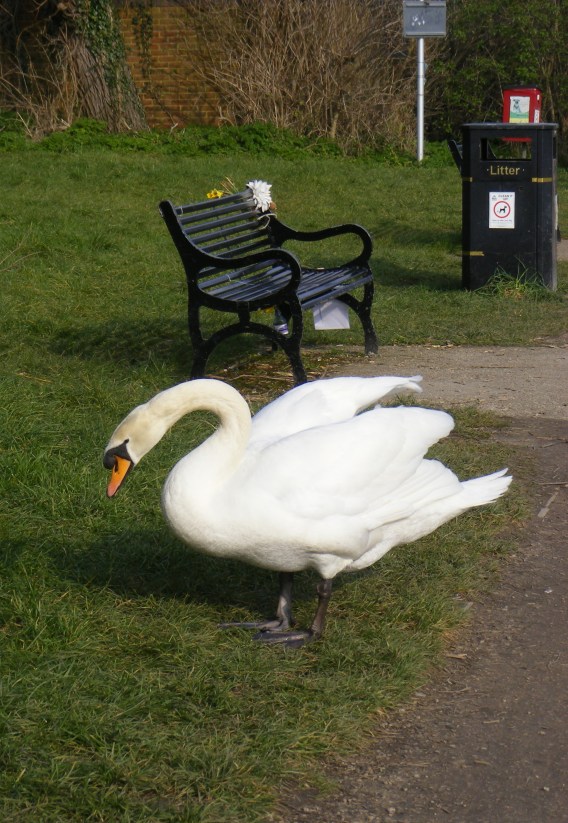
A threatening-looking swan, for no particular reason.
Well, anything within reason.
Well, anything within reason about Speak Its Name.
You can ask me about Wheels, too, though that’s almost certainly not going to be its name, and I might not answer due to a) being paranoid; b) not actually knowing the answer.
But seriously, if there are things you want to know about me and my writing, comment on this post, and I’ll do my best to give an interesting and coherent answer.
I’m assuming for the purposes of this post that your church is one that wants to make bisexuals feel welcome, that perhaps already has some sort of ‘LGBT’ outreach or ministry, that’s wondering where all the bisexuals are, that’s thinking that perhaps it doesn’t have any.
If that’s not the case, some sort of LGBT outreach would be a good start. And if you are starting from scratch, here’s how to include bisexuals in that.
The tl;dr version:
See us. Let us know you’ve seen us. Believe us when we tell you who we are. Or, if you can’t see us at the moment, let us know that it’s safe to be visible.
Don’t make assumptions.
Understand that you almost certainly have bisexuals in the congregation already. Who knows – they might even have got married in your church. Yes, even if your church doesn’t do same-sex marriages.
A significant relationship pattern among my friends is bisexual Christian woman + straight atheist man. That’s what mine looks like. In fact – let’s take that a little further. My husband goes to church almost as much as I do, and the potential for hilarious misunderstandings is endless. Quite often people come to the conclusion that he’s Roman Catholic – a Polish middle name and a habit of coming to the communion rail for a blessing rather than to receive will do that. They see us sitting side by side in the choir, and they assume that we’re a straight Christian couple.
But he’s not Christian. And I’m not straight.
The moral of this story is: don’t make assumptions about people’s sexuality based on their relationships.
Similarly, don’t make assumptions about people’s relationships based on their sexuality. For me, when I say that I identify as bisexual, I’m talking about potential: what might have been, what might still be. For most married bisexuals, our sexual identity just doubles the pool of people with whom we’re not committing adultery.
None of which is to say that there aren’t other models of relationships that are valid. Christians can be celibate; Christians can be polyamorous. A bisexual might have committed to only pursuing relationships with people of the opposite gender. A bisexual in a different-gender relationship might not want to get married because they know that if they’d fallen in love with someone different, they wouldn’t be able to.
Speaking for myself, I got married when I was 23, and I wouldn’t do it again. Not because of any difficulties in our relationship (except for that incident the other week where I laughed when he dropped his pizza…) but because I’ve come to find society’s insistence on marriage as the highest expression of human relationships damaging and verging on the idolatrous. But that’s just me, and I don’t speak for all bisexuals, not even all Christian ones. Don’t make assumptions based on me, or on anyone else.
Include bisexuality. Explicitly.
I went to a church where we once sang Over The Rainbow under a rainbow flag. It still took me years to come out, because I wasn’t sure that I was queer enough to ‘count’. I came out to the rector, who was fantastic. I was never out to the congregation at large. It would probably have been fine, but I didn’t know. I wasn’t sure that people would accept me as a bisexual. I wasn’t sure that they’d believe me: they’d seen me get married to a man, after all. And so, for five years in a church that I loved, that was fantastic in all other respects, I was never quite myself.
It’s very reassuring to know that my church would accept me if I were to turn up with a partner of the same gender, but that doesn’t tell me that it sees and accepts me as I am now. So talk about bisexuality. Show that you understand that some people are attracted to more than one gender. Show that you understand what that means.
Remember that bisexuality exists. Don’t assume that people with same-sex partners are the only ones who have problems with, or in, the Church. Don’t use ‘LGBT’ if you just mean ‘lesbian and gay’. Don’t include the B and the T in the acronym in the top line of your sermon or newsletter article and then talk about ‘gay people’ all the way through the rest of it. It’s lazy and it doesn’t make us feel included; it shows that you haven’t actually thought through the distinctive experience of bisexuals – let alone trans people. (That’s a post of its own, and I’m not the person to write it.) Similarly, assuming that bisexuality is included on the basis of the ‘everyone’s bisexual really’ meme erases the experiences of those who do identify as bisexual, and of those who explicitly don’t.
Understand that bisexuals are likely to have specific pastoral issues.
There is a statistic floating around that says that bisexuals are more likely to have mental health problems than either gay people or straight people. I resemble that statistic. And I am not remotely surprised.
Whatever our relationship might look like, we’re always half in and half out of the closet – or we’re having to work very hard swimming against the tide of other people’s assumptions. We’re always aware that there’s a side of us that people are choosing not to see. We feel guilty, as if we’re hiding something, but we fear that if we are explicit about our identity then people will accuse us of attention-seeking. Sometimes we worry that we are attention-seeking, but if we try to settle into the role that society has assigned to us we’re always aware that there’s something else, something that we must acknowledge or be damned.
The Christian life calls us to a sexuality that’s pretty much the opposite of the promiscuity that popular culture ascribes to bisexuals. The more we try to live out our Christianity, the more our sexual identity is erased. Monogamy is mistaken for monosexuality, and we disappear into the gap between straight and gay. Being invisible is not healthy, spiritually speaking, and if your vocation is to care for your congregation, then you need to care for both halves of us.





 Kathleen Jowitt