Some things I have read

… since the last time I posted about reading, which I am aware was some time ago. I haven’t been reading much at all, and it’s almost all been non-fiction. (Exception: Where Late The Sweet Birds Sang, Kate Wilhelm; the latest Jill Mansell; and, very early on Sunday morning, Blood Sweat Glitter, Iona Datt Sharma, which was exactly what I needed.)

A lot of that non-fiction has been one good idea, maybe two, expanded upon at great length until a book happens. Examples: several parenting books (your child is a person; whatever they are doing or not doing at the moment, it probably makes sense in their head and it will help you both to try to understand); Oliver Burkeman’s Meditations for Mortals (life is short; might as well get on with things; start anywhere); and Radical Candor (Kim Scott). This was mentioned in the women’s development programme I’m undertaking at work, and turned up in the library, so I borrowed it. As I’m not a manager, most of it was of limited relevance for me, but again, the subtitle (How To Get What You Need By Saying What You Mean) tells the story. I’m not sure that it tells you much that an Ask A Manager addiction wouldn’t.

Nurture the Wow (Danya Ruttenberg). Awful title. I assume this is the “two countries separated by a common language” thing, because I know very few Britons who would be able to say this one without either throwing up or dying of embarrassment, but clearly the US publishers thought it would work. Fortunately I a) knew what it was getting at; and b) had read enough of Rabbi DR’s other work to know that I like her writing. The subtitle is more descriptive, if not much less skin-crawly: Finding Spirituality in the Frustration, Boredom, Tears, Poop, Desperation, Wonder, and Radical Amazement of Parenting. Anyway, this is the best book I’ve yet read that’s intended for religious people who have become parents. It draws on many different traditions, my own included, and addresses pretty much all the emotional and physical and spiritual challenges (and opportunities) that parenthood presents. I’ve just sent my copy off to a friend who’s recently had a baby.

Wholehearted Faith and Searching for Sunday (Rachel Held Evans) – not so much about parenthood, but just the thing when I needed to read something by an intelligent Christian woman of more or less my age who’d thought about things.

To get them off my shelves, where they’ve been since 2013 or thereabouts when I bought them from a Woking junk stall, Honest to God (John A. T. Robinson) and The Ferment in the Church (Roger Lloyd). A fascinating snapshot of the preoccupations of the Church of England in the 1960s, and I think mainly interesting to me as such. Much of it is either the way I think about things anyway or has been superseded. I was amused by the way it seemed to take the Bishop of Woolwich the entire book to notice that he’d replaced one metaphor with another.

Eat Up! (Ruby Tandoh) – enthusiastic about pretty much every sort of food, sceptical about fad diets, scathing about food snobbery. A delicious book.

And here’s a picture of a passion flower, because why not.
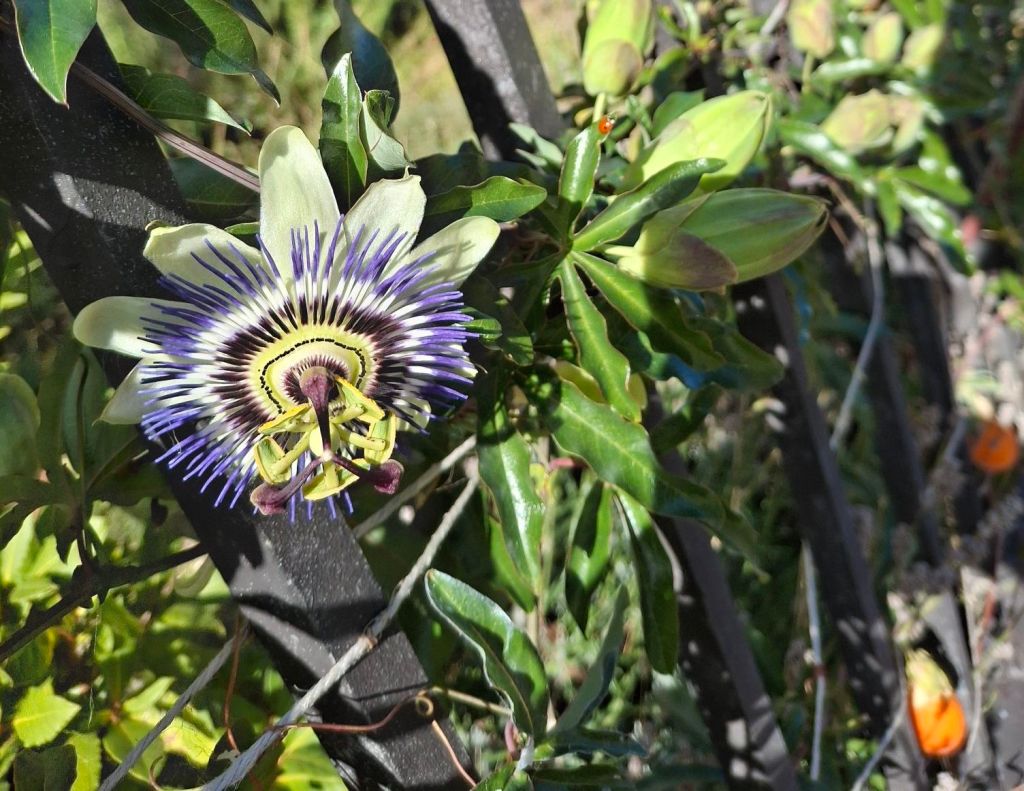
A passion flower. On a nearby leaf is a small ladybird.

Lockdown in the orchard

A white and black cat sleeps on a stone floor under a full length banner showing Sir Isaac Newton

We visited Isaac Newton’s apple tree a couple of weeks ago. It’s in the orchard of his childhood home, Woolsthorpe Manor, a couple of miles off what’s now the A1, the Great North Road. These days it’s a couple of hours’ drive from Cambridge (we started a little further north than that). It would have taken considerably longer in Newton’s day; nevertheless, he made the journey.

Woolsthorpe is a lovely place. It’s in the care of the National Trust now, and they’ve managed to find a satisfying balance between hands-on science and palpable history. The volunteers (apparently there is no shortage) are a mixture of enthusiastic students and gentle retirees.  It’s not exactly quiet – it couldn’t be, with children spinning balls down funnels and laughing at distorting mirrors and all the rest of it – but it feels extraordinarily peaceful. You wouldn’t think there were lorries hurtling north and south just over there. This cat was snoozing away happily in the café; later we saw it touring the yard, seeking homage from the other patrons.

I hadn’t twigged that the reason that Newton was sitting under an apple tree at his family home in the first place was that the University of Cambridge had been closed. If I’d known the year – 1665, see if you’re faster than me – I’d probably have made the connection. Bubonic plague. He was self-isolating, we might say now. Lucky to be able to do so, of course. I was conscious of a fellow-feeling: I too ended up leaving Cambridge to find a garden of fruit trees when our epidemic struck, although that was March, not apple season, and that was just the way things worked out for us.

Newton’s Cambridge was different from mine, too. He’d still be able to find his way around the city centre, and no doubt he’d be fascinated by much of what has appeared since his time. He wouldn’t have encountered tourists, or the Silicon Fenizens. It would have been much smaller, less crowded, but still a heck of a culture shock after Woolsthorpe.

And it’s interesting, isn’t it, how that massive breakthrough struck not in the intellectual ferment of the university, but in the peace of the orchard. There’s something to be said for not being where the action is.

Good enough is not bad at all, or, Book Bus Stories: this year it’s a zine

A stack of photocopied A3 paper covered in dense handwritten text. Some sheets have been folded down into A6 booklets.

Last year, Book Bus Stories was an exhibition. Next year, it might finally be a book. But this year, it’s a zine.

I haven’t been writing much in recent months; you may have seen how quiet I’ve been over here and guessed that it reflects a prolonged period of literary inactivity offline. I haven’t had much time, I haven’t had much energy, and, if I’m honest, a lot of the time I’ve been lacking the inclination too. It’s a side-effect of motherhood that I didn’t expect at all: for well over a decade I’d had a story more or less constantly writing itself in my head – until I had a baby, and it all just – went. It was if my brain had been replaced with someone else’s, someone who didn’t write, and had no interest in writing. Which was just as well, really, because she didn’t have the time and the energy.

Every now and again an idea rushed back in, and I’d get very excited. And either I’d lie awake with a sleeping child in the crook of my elbow and know that if I moved I’d wake her, or by some miracle I’d find an hour and get it written down, and then it would stick there because by the next time I got a free hour there’d be something else that needed doing, or that seemed more fun.

Meanwhile, Smashwords (which I use to distribute the ebook versions of my Stancester books) kept sending me emails about migrating my account to Draft2Digital, which kept reminding me that I’d never sorted out my tax code on there and therefore had (a frankly pitiful amount of) money sitting on my account, and every time I felt irritated and slightly despairing of ever selling any more of my existing books, let alone ever finishing a new one. 2020 – the last time I published a book – was getting longer and longer ago, and I was feeling less and less like the person who’d done it.

Then one lunchtime I went to the Wellcome Collection. They had an exhibition of zines, mostly by disabled people. They talked about how zines are amateur, scruffy, don’t have to be perfect. In the corner was a table with paper and pens and a sign encouraging you to have a go at making your own zine, about saying the things you had to say.

I had things to say, things about grief and loss and memory.

I thought, I could do a zine.

A book still seemed a very long way out of reach, but I could do a zine. Or I could at least try one. I went back to my desk and folded a sheet of A4 paper into eighths. I drew a bus across two of them. A little doggerel quatrain emerged from my mind with barely any trouble at all.

Back at home, I unearthed an A3 pad and started on the real thing. There was a poem I’d written years ago, intended for the eventual Book Bus Stories book, which went straight in. In a charity shop I found a book of photographs of Paris, all chic and moody and monochrome, which, combined with the experience of speedrunning a dozen years of (moody, monochrome) family photographs while preparing for my mother’s funeral, made me think everything looks better in black and white, and then, everything looks sadder in black and white. That became a piece.

I photocopied several pages of my father’s Paris Is Well Worth A Bus and, after several false starts, got a reasonable blackout poem down.

I stuck down a Kimberley Ales beermat and an Artichaut de Bretagne sticker to make wheels. I got out the Dymo machine.

The cat trod on the paper while I was working on it and I remembered my father yelling “Trolloper!” at her; I drew a cloud around the pawprint and wrote about how it helps and hurts to remember things like that.

I filled in the body of the bus, the platform, the window frames. I thought I was done. Then I went to Gay’s The Word (on a bit of a weepy high because the General Synod of the Church of England had finally done away with Issues in Human Sexuality as a requirement for ordinands), picked up Joe Brainard’s I Remember, read about twenty pages, and knew that I needed to fill in all the white space with the things I don’t remember.

On Friday I took the whole thing to the library and did a photocopy by way of a test. It looked great. (Everything does, in fact, look better in black and white.) I took it to the print shop and got a proper print run (fifty, in fact) done. Then I took the whole lot home and, over the weekend and today, cut and folded the lot into booklets. Now they’re packed in a box, ready to go down to Ventnor Fringe and the Book Bus with me tomorrow. It’s a good feeling.

I made a zine. It’s not perfect. And it’s not a book. But it’s good enough, and it turns out that good enough is actually great.

As well as these things can go

A family of swan and cygnets on a small spit in a river in an urban environment
Meanwhile, across the water from the memorial gathering…

“I hope the funeral goes well,” several people said to me, and many of them added, “or as well as these things can go.”

I very much appreciated the sentiment behind that wish. And I knew exactly what they meant.

And yet. And yet it didn’t quite sit right with me, as if there was somehow an implication that because a funeral is necessarily a sad event, there would be things that would not go well. That things would go wrong, even. That because it wasn’t a joyous occasion it must necessarily be somehow slipshod, drab. That difficult and sloppy sit near each other on the same axis.

I don’t believe for a moment that anyone who used that phrase to me meant to imply any of that, of course I don’t. But this kept worrying away at me until I prodded it back.

I’ve been involved in planning all sorts of events – in my professional life, in my voluntary roles, and in my personal life. Courses, parties, retreats, church services, training days, conferences, seminars, weddings.

And yes, funerals.

I can make an event go really well. My mother’s funeral? You bet I was going to do everything I could to make that one go as well as it possibly could.

It went really well – yes, as well as it could. But better than that. Both parts – the “she didn’t want a fuss” church service and crematorium committal, and the “but more people want to pay their respects than will fit in the church” arts centre gathering the next day.

And it was really, really hard. I was very glad, in retrospect, that I didn’t put myself forward to do any reading or give any tribute at the church service, because that gave me space to fall apart completely. I’d done the work of remembering which hymn my mother wanted (yes, I found myself saying to several people afterwards, she specifically wanted the verse about the worms) and guessing which other one she might have liked, of suggesting the readings, of burrowing in the boxes of CDs in the garage to find the Bruckner Te Deum, of liasing with my brothers and the minister and my aunt, of typesetting the order of service and getting it printed. I’d done all that, and now all I had to do was to turn up. The minister carried it, and the liturgy, and my brilliant family who will absolutely sing in four-part harmony if you give them the sheet music.

The next day I was the one at the front of the room, explaining what was going to happen, introducing the musicians, finding a graceful way to bring in someone who’d arrived late but still wanted to say something. Holding the space. I remember thinking at one point that I had my work head on, because that’s what I do.

And that was hard, too. I will probably never be able to listen to Here comes the sun again, maybe never sing Auld Lang Syne.

Some things went wrong, of course. I’d have liked to have got to the church earlier and had some time on my own (as opposed to having a flaming row over a sandwich and having to spend far longer than necessary putting my make-up on and calming down). I’d have liked to have the Brahms run all the way to the end of the track. And I think the funeral directors had some trouble with the hearse and the very tight little lane, but that wasn’t my responsibility. It wasn’t perfect. But on the whole, it went very well indeed.

But it was hard because it went well. It was hard because it did what it needed to do. It was hard because there’s no way that catharsis is going to be easy. It was hard because it said what it needed to say: This person is gone, and we loved her. We loved her, and this is the last thing we can do for her.

And because it was the last thing we could do for her, we did it as well as we could.

Thank you, friends. It did indeed go as well as these things can go.

Margaret Jowitt, 1955-2025

Black and white photo of a woman and toddler seated in the back of a parked van

My mother died at the end of April. It was a shock and not a surprise: we knew she hadn’t been well, but we weren’t expecting this. (This, it turns out, was a pulmonary embolism, the sort of thing you can’t expect, and not the thing we were actually worrying about. I think it makes it easier, but it’s quite hard enough.)

There’s a great gap now, in the world of childbirth rights and maternity services reform, and in our lives.

Mend March: honeycomb heel

A grey sock is stretched over a wooden disc. A worn patch has been mended with coral pink thread

This is your proverbial stitch in time: I got to it before the worn patch wore right through, and have consequently got away with a honeycomb darn. I like doing these: they are comparatively quick; they take no set-up whatsoever; the technique is easy (it’s just blanket stitch, with each stitch of each inside ring catching the bar of the one before), and when the worn patch inevitably gets broader you can add another round or two. I probably shouldn’t have used pink; it’s going to look like my heel’s bleeding. Oh well.

February reads

Moss grows in the cracks between paving stones

Twelve Words for Moss (Elizabeth-Jane Burnett) was a Christmas present from one of my brothers. It’s uncategorisable: poetry, (family) history, memoir, nature – it takes as its starting points the author’s grief at the death of her father and her enthusiasm for mosses, and weaves a narrative between the two.

I got a few chapters in before I noticed that the last sentence of each becomes the first of the next, and went back to the beginning to see what else I’d missed. When I made the deliberate effort to slow down and read the words one by one, it burst into life and turned out to be poetry. Although this did make the occasional nature-documentary-voiceover style introductions of experts somewhat jarring.

What felt simply odd to me was the absence of any sense of Burnett’s father’s personality. I think it must have been a deliberate choice, to convey the gravity of the loss by not really talking about the one who was lost, and I’m not even sure that I can say that it didn’t work for me, but it was alien. If I’d got interested in moss to the extent that Burnett has, my father would have known about it, would have got interested in it on my behalf, and would have bought me books on moss in charity shops and phoned me up to tell me that he’d heard a programme about moss on the radio,and every time I encountered moss now I’d think of him. For me, grief is about that shared connection that can’t be shared any more,  that recoils on me with a jolt because there’s nowhere for it to go now. And fair enough, maybe that’s not the sort of person that Burnett’s father was, but my point is that you just can’t tell from this book.

That doesn’t take away from how interesting a book it is, though, or how lovely the words, and I always enjoy seeing people getting really, really enthusiastic about something. And I have been noticing moss much more.

I’ve been struggling a bit with fiction recently: I find myself not wanting to feel things deeply (plenty of that in real life), so this month’s choices have been deliberately light. Although not in subject matter. Actually, I suppose both this month’s novels grapple with the question of how far we are entitled to influence the lives of our loved ones:

Hate Follow (Erin Quinn-Kong) deals with a subject that’s interested me since it first started hitting the news a decade or so ago: what happens when the children of internet personalities come of age (literally or metaphorically) and are in a position to object to their parents’ use of their names, likenesses, and actions. This was a rather superficial take on the subject: it suffered from a desire to make too many people basically well-meaning and decent. I couldn’t quite believe in the daughter’s ignorance of what her mother was sharing, or in the lawyer’s willingness to be so conveniently helpful.

I picked up The Burden (Agatha Christie, in her Mary Westmacott persona) from the library returns trolley and got through the first part the same day, and the rest of it the day after. It’s the story of the complicated relationship between two sisters; it starts out as a piece of devastating psychological realism (Christie is never sentimental about children or marriage) and goes totally bonkers in the third act. I would not have stopped reading it, though. Interesting data point for the “depiction of disabled character” files: the disabled character is appalling, but they are appalling before they become disabled and the experience does not reform them; they just become appalling in a different way.

Then I spent a lot of yesterday reading The Cuddled Little Vice (Sandman) (Elizabeth Sandifer), a very long article which did a very good job of explaining to someone who never got into comics (no shade on people who did; I just find the combination of visual storytelling and all-caps text harder work than makes for an enjoyable experience) why Neil Gaiman is such a big deal, and how he got into a position to do and get away with what he did and got away with. 57000 words – that’s basically a book – and fascinating, although, of course, horrifying.

Having written all that out, I can’t help thinking of Granny Weatherwax’s adage that sin is treating other people as things. I can’t fit Elizabeth-Jane Burnett into that, though: you could say she treats moss as people, but I don’t see the harm in that.

Where did January go?

Snowdrops growing in clumps on bare soil

Everyone else seems to have been talking about January going on forever, but that wasn’t my experience. In fact, it just seems to have disappeared. Between recovering from surgery and recovering from a cold, with a party in the middle, I haven’t been waiting for January to be over so much as for myself to be well enough to enjoy things regardless of the calendar.

I shall not complain. The days are getting longer, the snowdrops are out, and everyone suddenly seems much more cheerful.