
There are plenty of knives in the Peter Grant series; plenty of other nasty stuff, too.
The north bank skyline is from Matteo Pericoli’s gorgeous London Unfurled.

Stories that make sense
There are plenty of knives in the Peter Grant series; plenty of other nasty stuff, too.
The north bank skyline is from Matteo Pericoli’s gorgeous London Unfurled.
A Spoke in the Wheel stands at 69,591 words, and I think it’s done. It’s gone through a ream of paper and goodness knows how many drafts.
So far, I’ve had comments from seven people on one or more of those drafts. Some were on early drafts that frankly I’m blushing to think about now. Some were on what was, up until yesterday, the very latest draft. Some of those comments have been detailed, line by line, word by word. Some have been more general. Some have been delivered in person, some via email, some over the phone. Some were on very specific aspects of the book. Some were on the thing as a whole.
(Nobody picked up on the fact that I had two Chapter 10s. Or Chapters 10. Whatever. I caught that just now.)
Some of them have me muttering, ‘Oops!’ Some of them have me muttering, shamefacedly, ‘Oh, good point.’ Some of them have me muttering, defensively, ‘Well, it works on the eschatological level!’ Some of them I just don’t agree with. Some of them flat out contradict each other.
Two novels’ worth of experiment have left me with a workable approach:
If two people whose judgement I trust make the same comment, I act on it.
One person might miss a reference or misunderstand something, or simply fail to see what I’m trying to do. But if two people say the same thing, I don’t argue.
I might not make the change that either one of them suggests. I might change something to make what I originally meant to say clearer. I might delete an entire scene to get away from it.
And I can be one of those two people. If one person’s comment has me muttering, ‘Oh, good point,’ then the chances are I’ll be changing something, even if nobody else mentions it.
And here’s the other important thing:
If someone who knows more than I do about the subject I’m writing about tells me that I’ve got something wrong, I act on it.
In this book, I’ve changed things after being advised on How Wheelchairs Work, How To Go Running, Things One Might Purchase To Improve One’s Bike, and How Prescriptions Work, among other things. No doubt there will be something that all of us have missed, and if I’m lucky it will be something as innocuous as that chapter heading, because, for a self-publisher more than anybody, the buck stops here.
That being so, I am most sincerely grateful to all my editors, beta readers, nitpickers, whatever you want to call them. Their work, their patience, their enthusiasm, their encouragement, make the writing process much less lonely and the work so much better. Without them I don’t think I’d ever finish this book. Indeed, the next thing on my list is to write the acknowledgements page.

Well, pinkish. ‘Pinky’ is another of those words that I never use.
The combination of series title and book title here never fails to make me giggle.
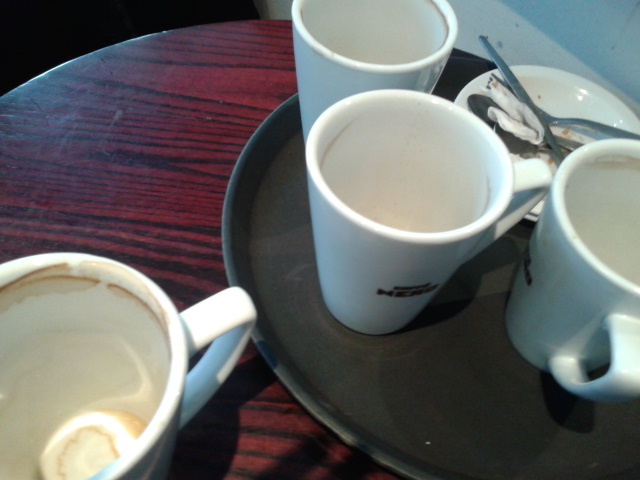
Once upon a time I thought this book would be an easy bit of fluff between hard-hitting diatribes on the state of the Church of England. Not any more.
Quick, have an extract before I do something stupid like try and rewrite the whole thing from somebody else’s point of view.
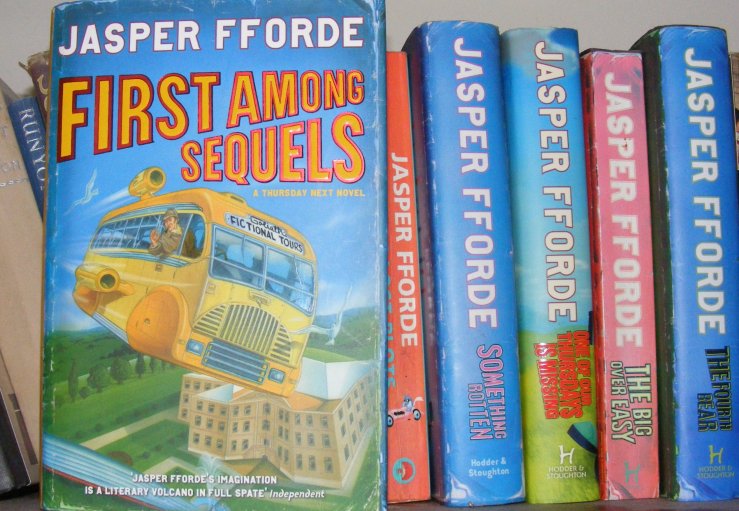
One reads the Thursday Next series as much for the literary snarking as for the plot. And shelving is part of that snarking.
‘The sub-genre of Literary Smut has finally been disbanded with Fanny Hill and Moll Flanders being transferred to Racy Novel and Lady Chatterley’s Lover to Human Drama.’
We diligently wrote it all down…
Entirely coincidentally, this is the top shelf of my bookcase. I will confess that I have cropped this picture quite severely in order to make the dust less obvious. That – besides a dreadful picture – is what you get for taking photographs above your head.
My own system of shelving is bound by the physical constraints of book size and shelf height. I try to keep series and authors together, but otherwise it’s a free-for-all. To the left of Jasper Fforde there’s Damon Runyan; to the right, Archy and Mehitabel.
On Thursday I got the last email through from my horde of editors, beta-readers, and nitpickers. At least, the last one that I’m going to pay any attention to. At least, the last one that I’m going to pay any attention to until I’ve got the manuscript prepared for print, at which point I’ll bring in a proofreader. And I’m only paying attention to this one because I’d already heard most of the comments over a pint the previous week and decided that they were things that I could fix.
Because I’ve reached the point where I am just about ready to be done with this book. Next time I will schedule the launch for September or October, so that I’m not doing all the preparation during my busiest time at work.
Work know about my writing now – and are very supportive of it. Sometimes terrifyingly so. ‘Kathleen can run a creative writing workshop! And a self-publishing one!’ somebody said the other day. I responded ‘Self-publishing is mostly hiding under the table and crying.’ I haven’t yet reached that stage. Not quite. However, I really am very tired and very aware that I could have made this easier for myself.
The feeling of just having had enough, though, that’s one that comes with every book (at least, it’s been two out of two so far). As the last of the comments come in I find myself wanting somebody to say,
‘It’s fine. Stop worrying. Just put it out there.’
They don’t. They won’t. Quite right, too. I didn’t ask them to. I asked them to find things that needed fixing, that didn’t ring true, that held up the pace, and they’ve done that. And the thing about self-publishing is that there’s only one person who can tell me that it’s time to put it out there. And that person is me.
I’m not quite ready to say it yet. But I’m very nearly there.

This has been my favourite Lent book for a very long time, and, as I slowly work my way through past series of Star Trek and get round to reading sci-fi classics that I’ve been hearing out forever, it only becomes more so. The metaphors of exploration, of setting out into the unknown with little but faith in the merits of the endeavour for sustenance, of coming to terms with mysteries that must always be beyond our comprehension, resonate deeply.
Lent is often a difficult time of year for me: it’s the very beginning of spring, and I find myself thinking that everything should be fine now that we’re out of winter, but in actual fact it takes my body a while to catch up. Remembering that Lent isn’t actually meant to be easy helps. Sometimes it’s something to engage with; sometimes the best I can do is hope to endure it.
It feels as if I’m getting further and further away (from what? from reality, from what I want to be doing, from the Divine), but in the end it brings me closer.
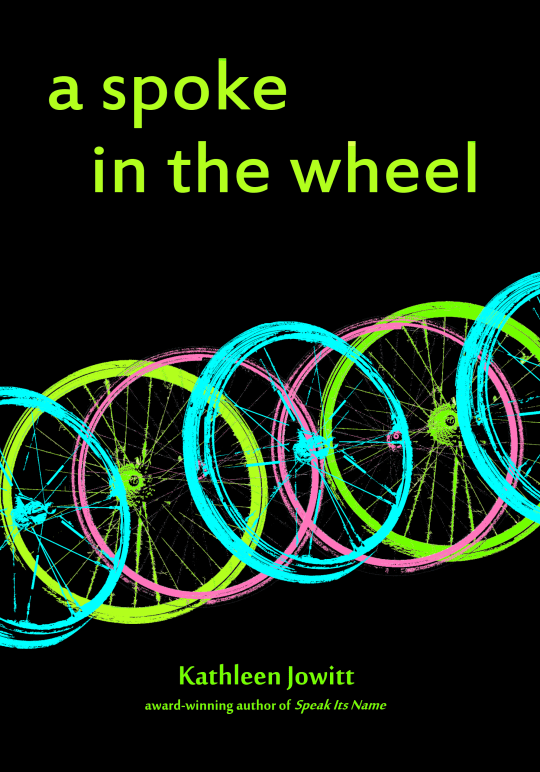
Three things make a post, or so they say. Well, I can manage two and a half.
Firstly, and most obviously, A Spoke in the Wheel now has a cover. My very grateful thanks go to those who took their personal conveyances to bits so that I could take photographs of the wheels.
The thing itself is on track (odd metaphor, for a bicycle/wheelchair book!) to be launched (even odder metaphor!) on Saturday 5th May. (That way there’ll be something to do if the Giro d’Italia is boring. Which it might be. There’s been so much controversy around where it’s starting and who’s starting it that the race itself could be a huge anti-climax.)
Secondly, I’ve been asked to judge a writing competition to celebrate the public service union UNISON’s 25th anniversary. I don’t talk much about the day job over here, but I’ve been working for UNISON for eight years now. Most recently I’ve been in Learning and Organising Services, which oversees training for reps and learning for all members – generally speaking, continuing professional development or building confidence.
One of the most wonderful things about what we do there is getting to meet people, who, having assumed or been told all their life that they can’t, suddenly discover that they can. That’s what learning is about, that’s what this competition is about, and I’m really looking forward to reading the entries.
And – here’s the half, because it’s very closely related to the above – I’ve written a blog for Unionlearn about finding the time and the confidence to write. It’s over here.

About a decade ago, I had a temp job in the local hospital. I was based in the library and my task was to go through the shelves and find books that had updated editions, journals that were now available online, and so on, so that outdated material could be replaced with more recent thinking.
In among the back issues of The Lancet and The Journal of Otorhinolaryngology there were some really interesting books, and I spent quite a few of my breaks reading through The End of Innocence: Britain in the time of AIDS and Suffer the Children: the story of thalidomide, as well as a book whose title I can’t remember but which was about planning a hospital’s response to potential disasters.
And then there was Susan Sontag’s Illness as Metaphor, which I, a year on from the end of my English Literature degree in which I’d paid a lot of attention to the Victorians, found absolutely fascinating. The illness in which she’s mostly interested is tuberculosis, or consumption if you want to be all romantic about it. She dissects the disconnect between the horrors of the disease itself and the otherworldly depiction it receives in so many nineteenth century novels. (I wrote ‘Victorian’ at first, but of course one of the most famous is La Dame aux Camélias by Dumas fils.)
I do not possess copies of any of the books I’ve talked about here, so here are two that deal with tuberculosis. Poor Helen Burns in Jane Eyre shares the fate of two of Charlotte Brontë’s sisters: dying of the disease at boarding school. Last year, we had The Essex Serpent in which the suffering character, Stella Ransome, experiences a spes pthisica that manifests as an obsession with all things blue. I’ve included that blue glass bottle (with its distinctly unVictorian plastic spray top) in her honour.
There’s been a little bit of controversy this week around the new Staunch prize for thrillers where ‘no woman is beaten, stalked, sexually exploited, raped or murdered’. And about time, says one side of the argument. For too long, lazy writers have been fridging women for the sake of a cheap plot point, and exploitative writers have been using violence against women to titillate male readers. The other says, No. Writers need to be free to explore and subvert difficult themes. Women should not be told that their own experience is off-limits.
As a reader, I can see myself falling on either side of the fence depending on my mood. It might be quite nice to read a book in the knowledge that it’s safe to get attached to the female characters. On the other hand, if I pick up a book knowing that a character, or several characters, must get to the end of it alive because otherwise it wouldn’t have been eligible for this prize, that would spoil the suspense a little.
‘Does a woman die in this?’ is a bit of a blunt instrument, but then so is any means of categorizing books.
As a writer, I don’t have a horse in this race. The books that might possibly end up being eligible for this prize are third and fourth in the ‘to write’ queue, so we won’t be seeing much of either of them for a good five years, I’d have thought – by which point this prize will have become well established, or else have disappeared entirely.
I don’t really see much point in getting upset about this. Establishing a prize for books that don’t include one particular plot point doesn’t stop anybody writing that plot point, it just stops their book being entered for that prize. I’m sure that 2018 and 2019 will see just as many dead women on the bookshelves as previous years, and that many of those books will still engage with the question in a thoughtful or angry manner. If we start to see an increase in people arguing that the only right way to write something is not to write it, that’s when I’ll start getting worried.
No prize is for everyone. I’m not just talking about criteria that restrict entry according to age or whether one’s been published before. Most prizes are out of bounds to me because of my self-published status (and it’s an absolute delight to find one that isn’t). What I mean is, not every book will be suitable for every prize. In 2007 I thought briefly about entering (a very embryonic version of what eventually became) Speak Its Name for a Scripture Union writing competition in memory of Patricia St John. I’ll pause here for you to read up on Scripture Union and Speak Its Name. And then laugh.
No, there’s no point in my getting irritated by a prize that I’m not going to enter. It does raise a more interesting question, though. How do we respect our own and others’ experience? How do we give an honest portrayal of the problems that a [member of a marginalised group] is likely to encounter without giving the impression that being a [member of a marginalised group] is wall-to-wall awfulness? Where is the line between representation and exploitation? Can we say that we’ve dealt with enough of all this bullshit in the real world and just give ourselves a night off?
This is something that I’m thinking about quite a lot as I work through the final edits on A Spoke In The Wheel, and as the sequel to Speak Its Name unfolds itself in my mind. How do I show the grinding misery that is the modern British benefits process without buying into damaging assumptions about what makes life worth living for disabled people? How do I show Lydia engaging with the institutional homophobia of the Church of England and its vocations process (yes, we’re going there) without undermining her integrated identity as a lesbian Christian? It is something that I think about as I watch Yuri!!! on Ice, where homophobia just doesn’t exist, and as I read Check, Please!, where homophobia exists but never touches our heroes, and the ways that those work and don’t work for me.
I’m still thinking, and still writing, and really, the best answer that I can come up with is that no single book is going to do this. We need the escapist books that can be opened in the confidence that everybody’s going to be OK. We also need the books that expose the awful things that people do to other people. We need the books in the middle, where we know that awful stuff will happen or might happen, but that the characters we love will come through somehow. That middle space is where my books – or at least the ones that have emerged so far – sit, and all I can do is write them the best I can. And, so far as I’m concerned, people are very welcome to establish prizes for any of them.
 Kathleen Jowitt