I discovered a few months ago that there is in fact a term for ‘can’t call it young adult, because the characters are rapidly departing their teens’. It’s ‘new adult’, which means, so far as I can make out, ‘young adult but with slightly older characters and more swearing’.
This is useful to know. Because really, Speak Its Name is, in structure at least, closest to those old-fashioned boarding school books where we see a little bit of the main character’s family but everyone else’s is pretty much irrelevant, the focus is on a group of people of about the same age within a confined space, and all the action happens in term-time.
But with less coyness about same-sex attraction. And more swearing.
I don’t like the term much – ‘young adult’ always sounded patronising to me, and ‘new adult’ feels even more so – but it’s useful to have something to put in the search box.
I keep a bottle of brandy in my desk. Not to drink – I can’t write drunk, and, as it happens, it’s the Christmas pudding brandy – but because it makes me feel a bit like Raymond Chandler.
It doesn’t make me write like Raymond Chandler, but it does make me write. Playing at being a writer does result in actual, real-world, words. It’s something about ceremony and ritual, together with not taking any of it too seriously. It’s like putting on a designated writing hat, or socks with a pattern of pen-nibs; something that says to me, and to the world, ‘OK, I’m a writer now.’
It could be argued that this dressing up lark is a bit childish. To which I reply, firstly, that I don’t care; and secondly, that one of the few points with which I still agree wholeheartedly with C. S. Lewis is on childlike things.
Plenty of music in this house; this happened to be what was on the top of the pile. I bought it solely for the fourth of the Vier Ernste Gesaenge, though the whole book’s too difficult for me as yet.
For most of this year, all the time I’ve been working on the thing that’s currently entitled Wheels, I’ve had a target wordcount in my head. Eight thousand words over the course of the two weeks of each month that I spend writing. Aim for a thousand words each commuting day, not usually hitting that, but making up the difference when I type it up.
August was different. I knew that from the beginning of the month, but couldn’t quite work out why. After a while I remembered (read: was forcibly reminded) that seasonal depression always kicks in for me in August; also, I’d be spending a lot of my evenings watching the Olympics. I was glad that I’d already decided that I wasn’t going to worry too much about the wordcount. Instead, I was going to concentrate on getting my head around one of my characters, one I didn’t feel I quite knew yet. And I’m getting to know her. Slowly. A little bit faster than my narrator is.
As it happens, I ended up not too far short of that eight thousand, but that’s not the point. I needed very badly to give myself a break, and moving the goalposts helped.
To a certain extent, this is a thing that happens automatically: it’s all very well aiming to write two thousand words a day, or whatever it is (personally, I go for a thousand, and rarely make it), but after a while you have a novel’s length, or even more, and you have to start cutting things instead. You’re forced to redefine ‘a good writing day’.
But sometimes, even if you’re still on the first draft and have just got bogged down at the 25K mark, it can help to say, ‘Well, this month I am not going to worry about wordcount at all, but I am going to try to nail the scene where the main character comes to a major realisation about herself, because I have been scared of getting this wrong so I have been putting it off.’ Or, ‘I’m not particularly bothered about whether I finish chapter three this week, but I do want to get a handle on Bob’s character.’
Often, that kind of little shift can give me enough space to unstick whatever’s got stuck. Occasionally I am tempted to beat myself up about not being able to keep up my ideal rate. But this is my pitch and my game, and I put the goalposts wherever I damn well please.
‘Cute’ is not a word that I use. Ever. At least, not since I was about six and was reproved for bringing it home from school, having picked it up from one of my friends.
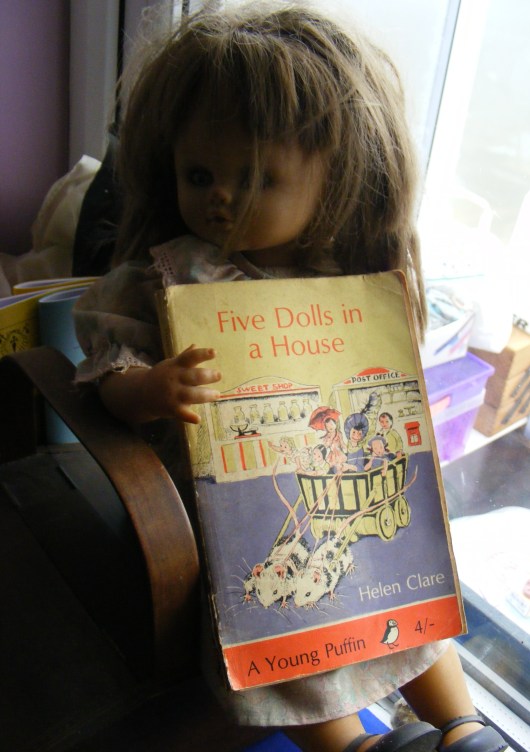
This was my favourite book at that time, and I went on liking dolls and dolls’ houses for quite a long time after that. It’s always irritated me that dolls are seen as ‘creepy’ while other, less gendered or differently gendered, toys are not. The one in the picture is my first doll; she’s called Katie.
This is rank heresy in the church of People Who Tell You How To Write. The doctrine, as I learned it, went something like this:
Seek only criticism. If you seek encouragement, you will find only people who tell you what you want to hear. That way lies egotism, laziness and dreadful writing.
There are two reasons for ignoring this, or, at least, taking it with a giant pinch of salt.
Firstly, a lot of self-appointed critics of other people’s writing are… not very good at it. They tend to have subscribed to a rigid interpretation of supposed ‘rules’ for good writing, many of which they don’t even know how to apply properly, and the results are ridiculous.
Weigh writing advice carefully. Anything presented as a rule is not a rule. At best it’s general advice presented as a rule. At best. Half the time it’s bad advice to begin with. But always consider advice. Consider it seriously, and if you find it won’t work for the project at hand, put it aside.
Secondly, accentuating the negative is depressing. In every piece of writing there will be good things and there will be things that could do with some more work. This applies all the way from My Immortal (and I’m linking to the TVTropes entry there because it always cheers me up; very funny, very NSFW, also don’t blame me if you lose the rest of the day, you’re welcome) to War and Peace. Most writers know that their writing needs work. Some find it easy to work out what particular work it needs, and how to do it. Some don’t. Either way, random people on the internet (or, for that matter, random people in the library; this applies to offline writing groups too) aren’t necessarily the best source of advice. (See reason one, above.) And once someone has had a piece of writing ripped apart by enough people they’re much less likely to show it to anybody at all. And that way lies sticking it up unedited, and nobody wants that.
I am a member of an online writing group, and it is one of the most supportive, encouraging communities that I’ve ever been part of. People are delighted when you’ve had a good day’s writing and can report a wordcount of 2000. They commiserate when you’ve had a bad day, and written three words, or nothing, or have spent the entire day down a Wikipedia rabbit hole and aren’t even sure you can call it ‘research’. Nobody tells you that Jane Austen wrote with all her family bouncing off the walls so why can’t you. They will find something nice to say about whatever you post. And even a supportive comment can make you realise that something isn’t working. ‘You’ve really nailed the fifties atmosphere,’ for example, when the story’s set in the present day. No, sharing writing with this group doesn’t make me lazy. It makes me want to come back, and to come back with something more positive to report.
Later – much later, when I’ve got a story that’s as close to perfect as I can get it unaided – I bring out the big guns. I email the people I know I can trust to tell me what needs doing and where, and I promise them a bottle of gin apiece, and tell them to do their worst. But the cheerful, uncomplicated support of my online group in the early stages of a project is invaluable in getting the thing off the ground.
My mother used, whenever one of my cousins (and I have a lot of cousins) turned eighteen with the intention of going to university, to buy them an electric kettle as a birthday present. We, the children, would get mugs to go with it. The result was a gift that was both symbolic and practical.
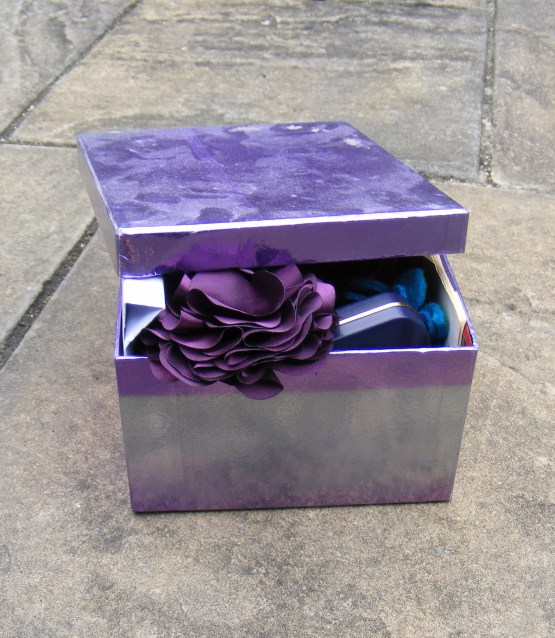
When I turned eighteen, one of my cousins returned the favour and gave me the purple box in the picture above. It contained:
a mug, and two teabags
a packet of instant soup
a tin of baked beans
a jar of Marmite
a tin opener
a potato peeler
two tea-towels
a bar of chocolate
It also contained two pages of (hilarious) instructions on the use of the above items, which has allowed me to reconstruct the contents at over a decade’s distance, and concluded:
9. The box. This will be useful for keeping things in. During your years at university you will come across many things that cannot be defined or categorised. Put these things in the box, to avoid having to define or categories them. It is also shiny, which is always good!
The contents have gone the way of all flesh – actually, the tin opener might still be knocking around – but the instructions and the box itself survive.
The things that I have apparently been unable to define or categorise, as evidenced by their inclusion in the box, are:
my last pair of glasses
a previous pair of glasses
six fabric floral corsages
a luggage label in the shape of a cat’s face
two CDs of wedding photographs
an enamel rose-shaped brooch
a monocle
one of those fancy plastic combs that’s meant to make it easier to do a French pleat, now completely useless to me
an elastic band with a sequinned flower on it, which I suppose I could use as a bracelet these days
seven bottles of nail varnish
a pillbox full of glass-headed pins
more safety pins than I can be bothered to count
two small scallop shells
a pair of nail clippers
a quantity of small change in euros
a toy car
a badge saying ‘Altos prefer it underneath’
a magnetic bookmark with my name on it, telling me that I’m ‘A female tower of strength’
a brooch made of buttons and wire
a cross and a fish made of clay, which date from the Methodist and Anglican Society Welcome Week event 2005, at a guess
a medal of the Blessed Virgin Mary, provenance unknown.
Gosh. That was illuminating. And it saves me from making a cheap point about how the only thing I found that I was unable to define or categorise was myself, which I would otherwise be tempted to do.
No, my cousin attended to my practical needs. My aunt on the other side of the family, meanwhile, presented me with a stack of useful books and newspaper supplements. They included, as I recall, The Bluffer’s Guide to University, the Cambridge University Student Union guide to pretty much everything (my cousin – I have, as I’ve mentioned, a lot of cousins – was an elected rep of some sort), and several years’ worth of the ‘how to survive at university’ insert the Sunday Times produces annually. To this I added Gaudy Night and Dear Bob, which I think I must have received the previous Christmas, and which was an amusing, if incomplete, guide to being Christian at university.
Armed with all that, I did reasonably well, academically and socially, at university, and mostly enjoyed myself hugely. But the book I was missing was the one that said ‘there’s more than one way to be Christian, and that’s not incompatible with not being straight…’
So I wrote it. I’d love to think that it’ll make it into someone else’s university survival kit one day.
This happens for me automatically: I quite often run out of writing time before I get to the end of the scene I’m writing. I can’t, obviously, sit on the train and finish it off, or I’d end up being taken straight home again, so I have to stop. Mid-sentence, sometimes.
Also, sometimes I run out of steam at or around Finsbury Park, so I shut the notebook and look to see whether there’s an update from Lady B-, the Comfortable Courtesan as was.
On the train home, I often find that the morning’s part, which I’d thought would only take a paragraph or so to wrap up, wants to run on and on into the next scene. Or a different part of the book entirely. I’m not fussy.


 Kathleen Jowitt