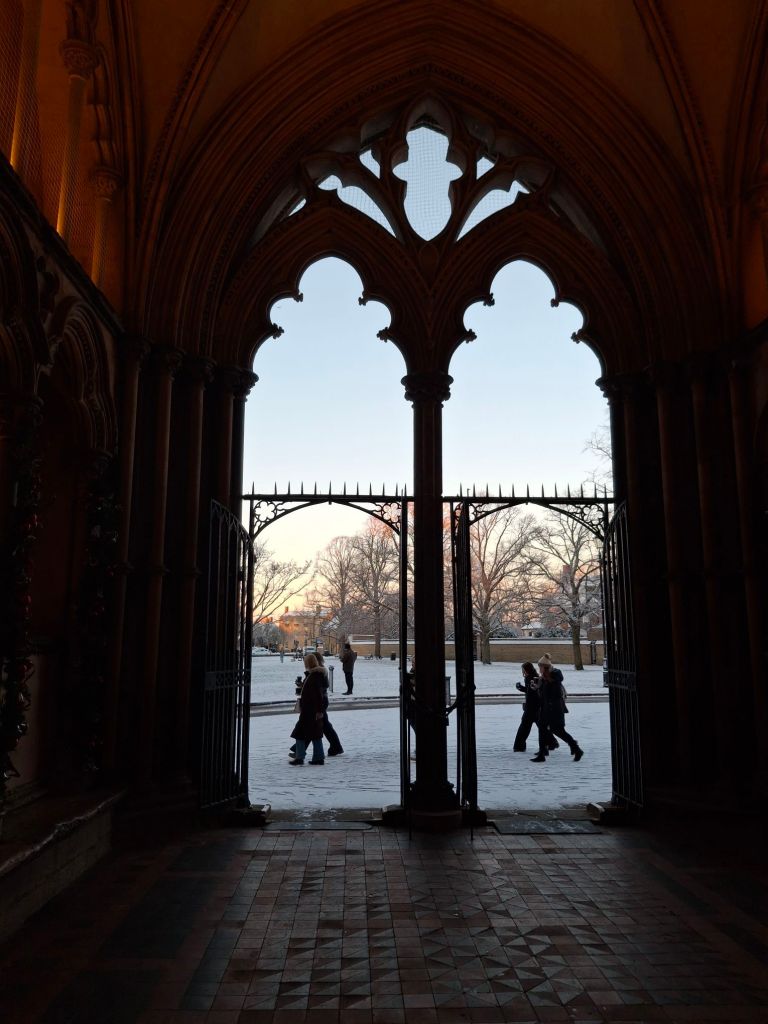
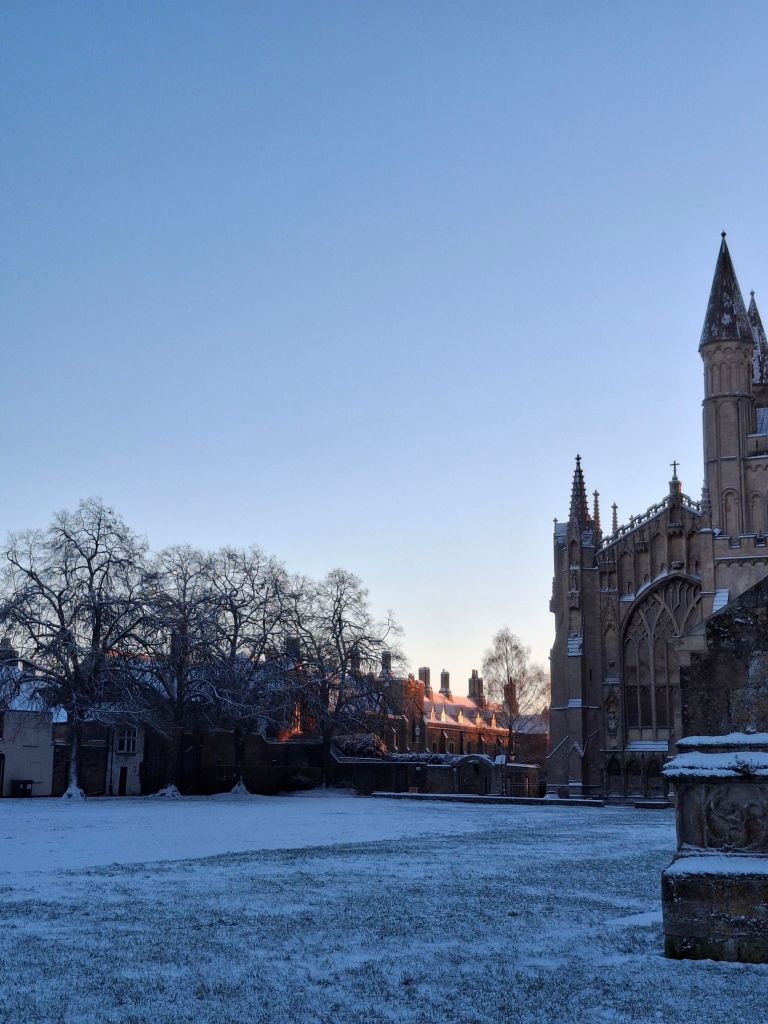
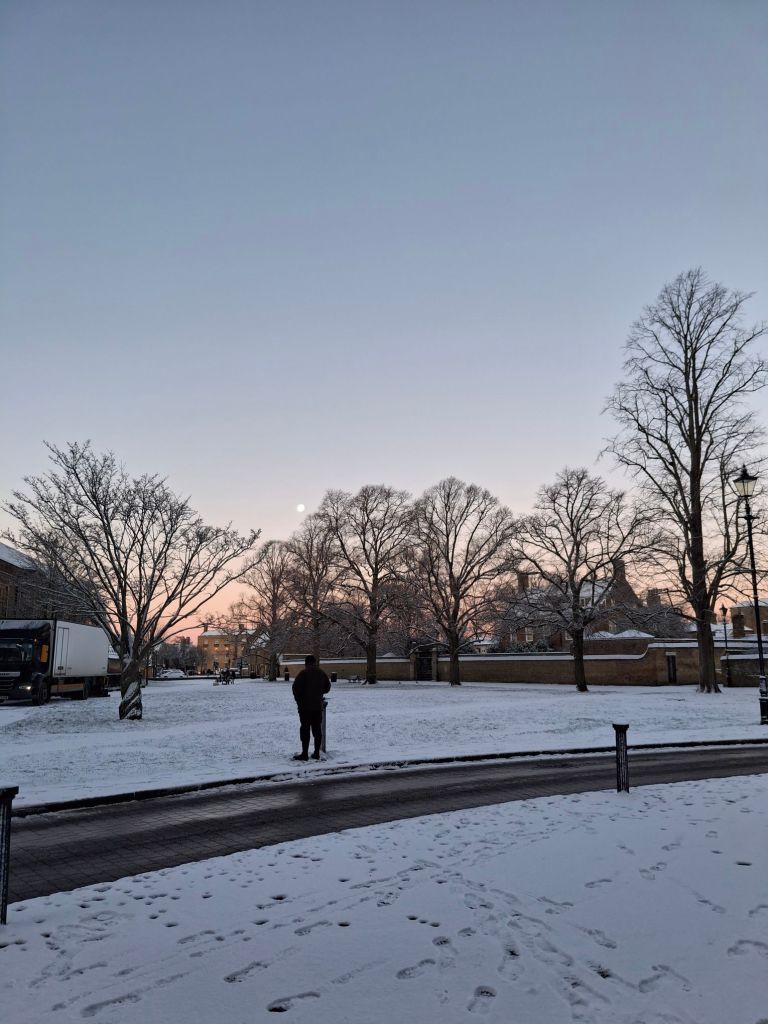
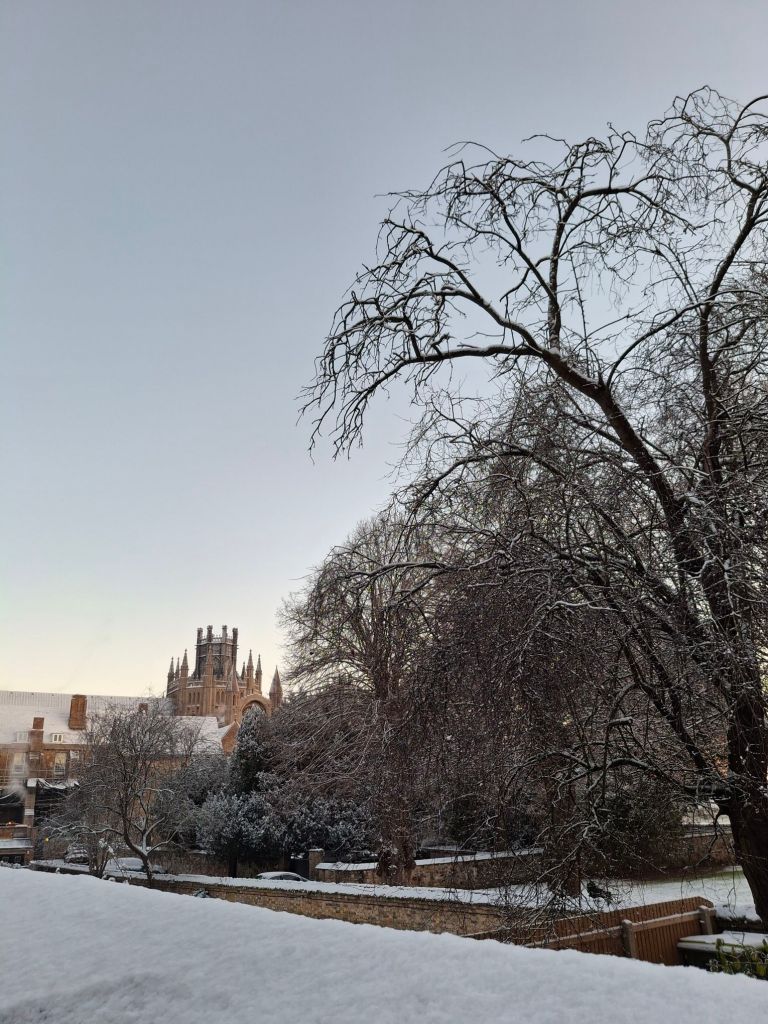
It snowed overnight! We don’t get much of it round here; in fact, it’s been almost exactly a year. So either the perpetrator of this mild act of vandalism is keeping the full twelve days of Christmas, or else someone’s driven in quite a long way without clearing their back windscreen.
Anyway, this time last year we had a pathetic little dusting of snow, and I was in bed, in a good deal of pain and unable to keep any food down, as the leftover gas from my gallbladder removal surgery fought its way around my abdomen. (What sorted it out, for anyone in similar straits, was a little pill called Wind-eze. The packet wasn’t very clear on how it works, but it does.) Today, by contrast, I was able to walk across town in my Wellington boots, stopping at the cathedral to walk the labyrinth (still in wellies – that’s a first!) and eat the last cherry cream choux bun in Caffè Nero. So, contrary to my gloomy posts of the last month, I can and do get better.
I’m still ill. Three weeks, now; in fact, a little more. The really obnoxious symptoms have gone, but if I do just a little too much I find getting out of bed the next day very difficult indeed.
So today I sampled the solstice daylight from the door and then retired, so far as I could, to the sofa. The choir sang O Oriens at Evensong, though I didn’t hear it. Once again, it’s not really how I’d have liked to mark the solstice, but it feels oddly appropriate. And if it feels particularly dark this year – well, it was a new moon yesterday, so maybe it was.
Yesterday we went out to a stately home. There was a choir (OK but not great) singing Christmas carols outside the café, and in the chapel there were volunteers leading any visitors who cared to join in (and most seemed to) in more carols. Yesterday would have been my mother’s birthday. She would have enjoyed nitpicking the choir’s performance, and she always went carol singing on her birthday if she could. I cried, but I was so glad to have done it.
O Oriens. O morning star. O radiant dawn. Come and enlighten those who dwell in darkness and the shadow of death. A whole chunk of morning prayer unexpectedly brightening the evening.
My moon app tells me it’s a waxing crescent, 3% illuminated. Of course it’s not visible in the night time at all, and even if it were, it’s tipping it down out there. Nevertheless, despite all appearances, it might be possible that things are already getting better.
If I’ve been a bit slow on the uptake, I suppose I can blame this lingering lurgy. It’s been two weeks and I’m still lethargic and very conscious that I’m not yet well. I’m better, I think, than I was on Advent Sunday, when I was cold and wobbly and wondering what on earth was wrong with me; certainly better than last Friday, or this Monday; but still not entirely well.
Some friends observed recently that in these days of antibiotics and painkillers (both undoubted benefits to the world at large, let me be clear) we’re stumped by minor illnesses whose symptoms persist. I couldn’t take antibiotics for a cold, and, while I was glad enough of paracetamol and pseudephedrine when my head and ears were aching and I couldn’t breathe without thinking about it, there’s been nothing to be done with the fatigue. Except, of course, waiting. A hundred years ago that would just have been the way things were. You’d have to give your immune system time to do its job, you wouldn’t be able to dose yourself up and power on through.
This year I’ve been reading, very slowly, Kathleen Norris’s The Noonday Demon, in which she examines the cardinal sin/bad thought (depending on which theologians you ask) of acedia. This concept has some overlap with the clinical condition of depression, and is often translated as ‘despair’, but, Norris seems to argue, is perhaps best interpreted as the desire to be somewhere other than where you are. This resonated, often when the toddler just wouldn’t go to sleep, but at other times too.
And recently I picked up Ross Thompson’s Spirituality in Season, in which he talks about three kinds of ‘abyss’, or exclusion:
First, there is exclusion from God, which because God embraces us always, can only be self-wrought; this is sin, leading to hell. Second, there is exclusion from life and being, which by definition is death. And third there is exclusion of our fellow human-beings, which in much of the teaching of Jesus… seems to be equated with the judgement; we are already judged, it seems, by our own response to our neighbour in need.
Then he draws a contrast between the two penitential seasons of Lent and Advent, noting that in Lent we actively confront this abyss (because, as he says, it’s all the same thing) while in Advent we ‘vulnerably experience their great danger, before experiencing at Christmas the one who saves us’.
And then he goes on to talk about waiting, using the example of waiting for a bus. We wait for something (or someone) over whose arrival we have no control at all.
(Here, I would add, we have two options: we can watch, or we can seek distraction. I’m very conscious that lately – the last few months, maybe longer – I’ve been seeking distraction. I’ve been very reluctant to face the inside of my own head, or heart. Too tired. And it’s going to hurt. Maybe. That might or might not be what’s going on. I need to look at that too.)
I read this… in November, if not October. I gleaned some useful facts for my O Antiphons workshop. I noted the reference to W. H. Vanstone’s writing on passivity in the events of Holy Week, which I have also read, and found useful.
And then I spent the first ten days of Advent absolutely hating where I was, furious that I didn’t have the energy to engage in anything that felt like a meaningful observance. And not being able to prepare for Christmas, the sacred or the secular versions, either.
And then it clicked. Waiting. I’m waiting. I’m waiting to feel better. I have very little control over how my body deals with this illness; even my capacity to do nothing is limited. This is, or could be, more meaningful than any Advent devotional book, could teach me more than any twenty-four windows I could open. This is a particularly immersive way to experience waiting, and, therefore, to observe Advent.
Has it helped? Immensely. If nothing else, laughing at my own failure to get it improved at least a couple of days last week. And not at all. Today, for instance, I wrote, I am losing sight of the concept of anything getting better. (And about three minutes after I wrote that, it did.) But that’s the way it goes. If I’d assimilated this brilliant new insight immediately, discovered how to embrace my enfeebled physical state as a symbol of my mortal human state, and glided up to new heights of spiritual consciousness I’d have missed the point, wouldn’t I?
I always take the first week of December as annual leave, and I always tell people that I don’t plan to do very much with it. Well, not two years ago, when I was on maternity leave, obviously, and last year it was the last week of November, but before that I had a long-standing tradition of taking the first week of December as annual leave, and this year I reinstated it.
The theory is that I get a bit of breathing space with which to start my new year. I observe at least the beginning of Advent in a meaningful way. I take some time to look back at the past year and forward to the next one. I do some writing, perhaps. I get a break from the enforced cheeriness of secular office Christmas (this is less dire than it used to be before the pandemic). I take long walks. I contemplate vast clear skies. And yes, I do a bit of shopping and go to the post office at a time of day when the queue isn’t out the door.
That’s the theory.
I’d forgotten that what actually happens is that I get ill. Whatever stinking cold is making the rounds, the moment I take my early December break, it hits me. Cough, headache, runny nose, nosebleeds, any combination of the above.
This year there’s been an earache and a sticky eye as well. Apparently there’s something absolutely miserable going around, and since it’s lasting a fortnight (so says my neighbour) I probably have another week to go.
(Last year, by way of variation, I was fine during my week off, but then had an unpleasant gallbladder flare-up the week after. The year before that, who knows, I had a five-month-old baby and I can’tremember. The year before that I was pregnant and still in the “constantly exhausted” stage. Before that I might have dodged it with the help of the pandemic restrictions. But before Covid it was definitely a thing.)
I’m particularly annoyed this year because this happened when I took three days off in September, too. But I was tired, and I knew that I was tired. I suppose it’s been a hell of a year, and that’s all there is to it.
So I’m trying to let this be a time of patience, as I suppose is only fitting. If I’m not feeling up to trimming the hearth and setting the table, I can still look east, believing that Love the Guest doesn’t mind the cat hair on the cushions or the toys on the floor. (That carol has been in my head a lot recently; I was meaning to write a post about it. Not this week, though.) I’m trying to accept the experience of being ill, even if I can’t enjoy it, rather than wishing I was somewhere, somebody, else. I’m trying to keep my temper. I’m trying not to worry too much about the next few weeks, and mostly managing it, because I just don’t seem to have the energy.
Next year, then, I might remember that my body seems to need rest as much as my mind needs to process and review. I might make myself a list of things that are gentle and restful but still feel appropriate to the season. I might be prepared for the first week or so to be utter chaos, and to trust that there’s meaning in the chaos too, there’s help for my helplessness, there’s space for everything I need to do, and grace for everything I don’t get to. And this year I’ll try to live that.
We got purple carrots in the veg box this week. If I told you I’d been saving them for Advent I’d be lying: in fact I fancied leek and potato soup on Monday, had a really busy day on Wednesday so just defrosted some tomato sauce and cooked some pasta, thought the broccoli was probably more urgent on Friday, and didn’t cook on the other days. So in fact it’s worked out very appropriately with these magnificent carrots arrayed in deep purple for the solemn season of Advent. Some of them even have stars in the middle, as you see, although these didn’t look as striking after cooking.
It’s St Andrew’s day as well, of course. I did think about that (very slightly) in advance, and cooked a bought salmon en croûte in his honour, and thought of my last church, dedicated, like many others in Cambridge, to the first fisherman-apostle. But it’s been a wearing day at the end of a wearing month, and I don’t quite feel as if I’ve properly got started on Advent yet, or given St Andrew the attention he deserves. Plenty more of Advent to come, of course. St Andrew might have to wait for next year.
Not long after I started taking Advent Sunday as my personal new year, somebody asked me whether I was going to push my end-of-year wrap-ups and preparations forward into November. No, I said, the idea was to take the whole of December (and the first week of January, come to that) to do it at a leisurely pace, and to give me something to do other than getting fruitlessly annoyed by all the commercial-Christmas tat.
Which still holds true. My husband bought me a packet of lebkuchen, which are already in the shops: I love them, but I couldn’t quite bring myself to touch them. Not in November. And yet this year I’ve noticed myself looking forward eagerly to Stir Up Sunday – today – the last Sunday of the Church year, Christ the King in new money – and the making of the pudding. Preparing for the preparation. And I’ve been getting out the recipe books and flicking through things that look tasty, things that look fun, things I’d never normally cook or eat but which might be approached in a spirit of “It’s Christmas”.
I do like a nice recipe book. And I have been reasonably adventurous this year. (Quince, ginger and raisin suet pudding, the other weekend, from Modern Pressure Cooking. Very good.) But I’m not usually this diverted by Christmas food.
It’s partly knowing that I’ll get much less church than in the pre-baby days, and other elements of the festival seem more promising (not that I will have any more opportunity to cook, of course).
It’s partly that this year I know I can eat it without causing myself significant abdominal discomfort. (Last year I had my gallbladder removed on 30 December; from the previous Christmas up until that point, eating anything fatty put me at risk of vomiting and hideous pain.)
It’s partly having stayed, last weekend, at a Premier Inn attached to a Beefeater which was exuberantly and prematurely Christmassy.
It’s partly having led an Advent study day yesterday, based on the O Antiphons (usually encountered 17-23 December), and having been preparing for that for several weeks. (We followed it with Evensong, and used the readings for the Eve of Christ the King. They worked very well.)
It might partly be wanting this year to be over and done with. It’s been intense, and often painful, and it’s gone very fast. So why not wrap it up now?
It might partly be wanting an answer to the question So what do we do about the Christmas pudding, in the absence of our mother, who was always in charge of it?How do we stir it, when none of us is near any of the others?
And this year the answer looked like this: I made the Christmas pudding, out of the recipe book that she always used. Except she always used walnuts where the recipe says almonds, and I didn’t have quite enough walnuts, so I made up the difference with pecans. And I found the last-but-one-apple from our trees. And I sent my brothers a Zoom invitation so that they could observe the stirring.
And now the pudding is steaming away quietly on the hob. It wasn’t remotely the same, of course. But it will do. I might even open the lebkuchen.
Here’s a picture from 2010. I loved these shoes. But that’s another story.
Earlier today I was on a video call with a new colleague. He asked how long I’d been with our employer. I joined in 2010, I said, started in a regional office, moved to HQ in 2013…
At this point another colleague joined and said, yes, new colleague had been remarking how people either seemed to have joined yesterday or have been around for fifteen years.
Yes, I said, and I’m still wondering when I flipped from the one category into the other, apparently overnight.
Inside, though, I was going, Fifteen years? Really? But yes: the arithmetic is simple, it’s the getting my head around it that’s proving challenging. The anniversary slid past without my noticing a couple of months ago. Somewhere between 2013 and here, I became an old-timer.
Compare the starting point with where I am now, and it’s obvious. I live in a different town, county, region. I look very different – my hair’s gone almost completely white. Come to think of it, I started 2010 with barely any eyebrows, having pulled them out in a bad mental health patch.
I started 2010 as a depressed temp, the confidence knocked out of me by failing to get a job I’d been doing for several months, equally scared of giving myself time to breathe and of finishing any piece of work lest there be nothing more for me to do. It took me a long time to find my feet in the union world. In some ways it seemed like the job I’d been born to do, if only I’d known it existed before, working to change the world for the better every day. In others, I felt like a fraud: too shy, too introverted, too posh, too cynical, too everything, or possibly not everything enough. These days I know what I’m good at, I can see how it serves the movement, and I mostly get to do that.
Things change gradually. Even the big changes – office, job title, team, grade – took a while for me to grow into them. There are a few days that stand out in my memory as having moved me forwards significantly, but so much of it was just turning up, and doing the job, and doing the job, and doing the job day after day, and eventually realising that actually I was pretty good at it.
Outside work, too, things changed gradually. Three books, with a couple of pages written per day, and not every day at that; gradually working up the nerve to put them out into the world myself. Getting confident cycling, first on a trike and then on a bike. Buying a house; having a baby; losing both parents: big changes, those, but again, you get used to them gradually, day by day, living in the new world until you’re at home there. Second chances (there were plenty of jobs I didn’t get); another dance with vocation, parting on better terms this time round. It’s quite a lot, really; when I stop and think about it I’m not so surprised that it’s taken fifteen years to get here.
If I could go back to 2010, if I thought 2010-me would believe me, I’d tell her… Hang in there. It works out better than you could possibly imagine.
We visited Isaac Newton’s apple tree a couple of weeks ago. It’s in the orchard of his childhood home, Woolsthorpe Manor, a couple of miles off what’s now the A1, the Great North Road. These days it’s a couple of hours’ drive from Cambridge (we started a little further north than that). It would have taken considerably longer in Newton’s day; nevertheless, he made the journey.
Woolsthorpe is a lovely place. It’s in the care of the National Trust now, and they’ve managed to find a satisfying balance between hands-on science and palpable history. The volunteers (apparently there is no shortage) are a mixture of enthusiastic students and gentle retirees. It’s not exactly quiet – it couldn’t be, with children spinning balls down funnels and laughing at distorting mirrors and all the rest of it – but it feels extraordinarily peaceful. You wouldn’t think there were lorries hurtling north and south just over there. This cat was snoozing away happily in the café; later we saw it touring the yard, seeking homage from the other patrons.
I hadn’t twigged that the reason that Newton was sitting under an apple tree at his family home in the first place was that the University of Cambridge had been closed. If I’d known the year – 1665, see if you’re faster than me – I’d probably have made the connection. Bubonic plague. He was self-isolating, we might say now. Lucky to be able to do so, of course. I was conscious of a fellow-feeling: I too ended up leaving Cambridge to find a garden of fruit trees when our epidemic struck, although that was March, not apple season, and that was just the way things worked out for us.
Newton’s Cambridge was different from mine, too. He’d still be able to find his way around the city centre, and no doubt he’d be fascinated by much of what has appeared since his time. He wouldn’t have encountered tourists, or the Silicon Fenizens. It would have been much smaller, less crowded, but still a heck of a culture shock after Woolsthorpe.
And it’s interesting, isn’t it, how that massive breakthrough struck not in the intellectual ferment of the university, but in the peace of the orchard. There’s something to be said for not being where the action is.
Meanwhile, across the water from the memorial gathering…
“I hope the funeral goes well,” several people said to me, and many of them added, “or as well as these things can go.”
I very much appreciated the sentiment behind that wish. And I knew exactly what they meant.
And yet. And yet it didn’t quite sit right with me, as if there was somehow an implication that because a funeral is necessarily a sad event, there would be things that would not go well. That things would go wrong, even. That because it wasn’t a joyous occasion it must necessarily be somehow slipshod, drab. That difficult and sloppy sit near each other on the same axis.
I don’t believe for a moment that anyone who used that phrase to me meant to imply any of that, of course I don’t. But this kept worrying away at me until I prodded it back.
I’ve been involved in planning all sorts of events – in my professional life, in my voluntary roles, and in my personal life. Courses, parties, retreats, church services, training days, conferences, seminars, weddings.
And yes, funerals.
I can make an event go really well. My mother’s funeral? You bet I was going to do everything I could to make that one go as well as it possibly could.
It went really well – yes, as well as it could. But better than that. Both parts – the “she didn’t want a fuss” church service and crematorium committal, and the “but more people want to pay their respects than will fit in the church” arts centre gathering the next day.
And it was really, really hard. I was very glad, in retrospect, that I didn’t put myself forward to do any reading or give any tribute at the church service, because that gave me space to fall apart completely. I’d done the work of remembering which hymn my mother wanted (yes, I found myself saying to several people afterwards, she specifically wanted the verse about the worms) and guessing which other one she might have liked, of suggesting the readings, of burrowing in the boxes of CDs in the garage to find the Bruckner Te Deum, of liasing with my brothers and the minister and my aunt, of typesetting the order of service and getting it printed. I’d done all that, and now all I had to do was to turn up. The minister carried it, and the liturgy, and my brilliant family who will absolutely sing in four-part harmony if you give them the sheet music.
The next day I was the one at the front of the room, explaining what was going to happen, introducing the musicians, finding a graceful way to bring in someone who’d arrived late but still wanted to say something. Holding the space. I remember thinking at one point that I had my work head on, because that’s what I do.
And that was hard, too. I will probably never be able to listen to Here comes the sun again, maybe never sing Auld Lang Syne.
Some things went wrong, of course. I’d have liked to have got to the church earlier and had some time on my own (as opposed to having a flaming row over a sandwich and having to spend far longer than necessary putting my make-up on and calming down). I’d have liked to have the Brahms run all the way to the end of the track. And I think the funeral directors had some trouble with the hearse and the very tight little lane, but that wasn’t my responsibility. It wasn’t perfect. But on the whole, it went very well indeed.
But it was hard because it went well. It was hard because it did what it needed to do. It was hard because there’s no way that catharsis is going to be easy. It was hard because it said what it needed to say: This person is gone, and we loved her. We loved her, and this is the last thing we can do for her.
And because it was the last thing we could do for her, we did it as well as we could.
Thank you, friends. It did indeed go as well as these things can go.






 Kathleen Jowitt