We’ll turn it around

dscf9952

I’ve spent quite of lot of 2017 being ill. The boomerang virus has hit me three times since New Year’s Eve. At the moment it’s manifesting in a hacking cough, set off by a) singing anything longer than a bar and a half in one breath; b) laughing; c) breathing in cold air. Previously it’s made itself known in extreme lethargy, fever, sniffles tending to nosebleeds, headaches, lack of sleep, a sore throat, and a cough. Not, fortunately, all at once. Or, at least, not for long.

Consequently, I’ve spent quite a lot of 2017 wrapped up in a blanket and occupying myself with things that haven’t needed much energy. In what is perhaps not a coincidence, I have fallen hard for Yuri!!! on Ice, which is a very sweet and optimistic anime about figure skating. This despite my having had no prior interest in either anime or figure skating. It just seems to appeal to the same part of my brain that likes epaulettes and grand opera and dark chocolate. And Ruritania.

It’s probably also significant that Yuri!!! on Ice takes place in a universe where there’s no homophobia and where the sport system can be trusted. By contrast, I have spent the last year writing in a universe where sport chews you up and spits you out, and several years before that writing in a universe where homophobia is depressingly and devastatingly real. So perhaps I just needed a break.

There are parts of my brain that think it is absolutely appalling of me to be watching anything at all light and fluffy (not to mention admitting to it in public) when As We All Know The World Is Going To Hell. (There are other parts of my brain that don’t like my admitting to liking anything at all, including epaulettes, grand opera, and dark chocolate, because that’s really embarrassing, apparently. And another one that’s pointing out that I promised myself several years ago that I’d never apologise for my reading or watching material, because if an English Lit degree doesn’t give you the right to read what you like without feeling guilty about it, what does? Brains, eh?)

The thing is, it’s not as simple as that. In the same way that one can’t (at least, I can’t) read The Prisoner of Zenda and Rupert of Hentzau without reflecting that Rudolf V is actually a pathetic excuse for a king who deserves everything he gets, and wondering whether there’s a Ruritanian Communist Party, it’s difficult to watch Yuri!!! on Ice without acknowledging that, sadly, Russia doesn’t work like that, and China doesn’t work like that, and probably skating doesn’t work like that either. Which makes for some genuinely interesting fanfic; but I’ve been reading a lot of fluff, too.

It’s a constant push and pull: between escapism and realism (but how real is the realism?), between optimism and pessimism; the tension between the world as one would like it to be and the world as one fears it is; the question of what truth looks like in fiction. I feel the urge to complicate the simple stuff; and to give the miserable stuff a happy ending; to question whether an ending that an author clearly intended as happy is as happy as all that; and to equip other people’s characters with the tools to get out of the mess they were left in. It’s a question with which a consumer engages as much as a creator. Actually, I find that the lines are blurred, and that I’m arguing with something with everything I write: some other book, something someone else said, adding another layer to the debate.

On which subject: I’ve got back into the editing process for A Spoke In The Wheel this week, after spending all of January too knackered and too scared to look at it. It turns out that it’s neither as bad nor as miserable as my mind had made it out to be. (Again, I say, brains, eh?) And I find myself wondering, now, where it falls on that continuum between realism and escapism. I’ve tried to set it in the real world, where zero hours contracts and sexism and burnout exist. I’ve got a friend checking it at the moment for errors in my portrayal of the notoriously dreadful UK disability benefits process. It’s fairly cynical about sport, or, at least, the narrator is.

But I find, re-reading it, that on the whole it’s hopeful. And I’m glad about that. Apart from anything else, it occurs to me that if we can’t let ourselves imagine a better world, we’re unlikely ever to get one.

The first year

dscf0322

Thursday was Candlemas, which means several things:

  1. It’s spring! At least, it is according to the medieval calendar, which I’m choosing to follow. Having lost most of January to illness (two rounds of this flu-like virus that’s been afflicting people across the country, as I hear) and only got back to normal this past week, it feels like a good time for new beginnings.
  2. I’ve put the crib away at last.
  3. Speak Its Name has been out for a whole year.

I’m pleased with what it’s done during that year. It’s sold. It’s sold to people I don’t know. It’s had excellent reviews, from people I don’t know and from people whose judgement I trust.

I, meanwhile, have become much more confident. These days I admit to writing! These days I think nothing of contacting random bloggers and offering review copies or guest posts.

And I’ve got the first draft of the next book down. That’s not bad going for a year’s work.

In the interests of honesty I have to admit that I’m just coming out of a gigantic wibble about the next book.

It was a twofold wibble:

  1. Who am I going to upset with this? I remember worrying about upsetting people with Speak Its Name, and if I did upset them they never told me. I’m addressing the possibility by asking friends with relevant experience to read the thing.
  2. What if it’s not as good as Speak Its Name? This, of course, is the flip side of getting good reviews for Speak Its Name: I end up convinced that I’m never going to do anything so good ever again. Of course it stands to reason a first draft of one thing isn’t going to be as good as the final version of the previous thing, but you try telling that to my brain.

Maybe I’ll get over my gigantic wibbles with experience, or maybe the occasional gigantic wibble is just part and parcel of writing.

Or maybe it was just the end of the flu.

It’s been a good week for reviews

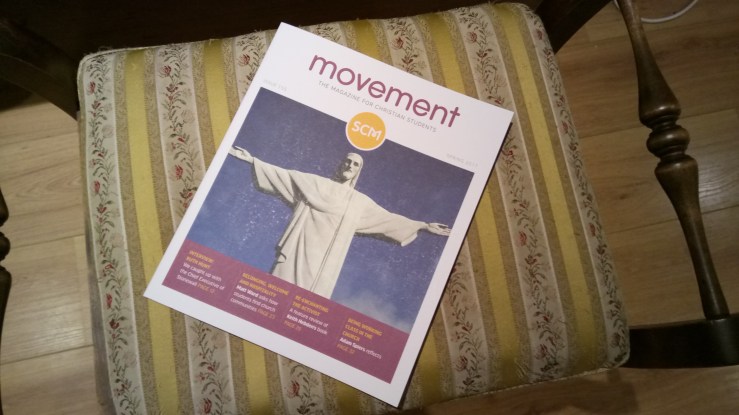
movement

Lisa at the Student Christian Movement was kind enough to send me a copy of this term’s Movement magazine, which includes a 10/10 review for Speak Its Name. The reviewer says:

Kathleen Jowitt conveys the issues of being a Christian student involved in Christian Societies well, and as I was reading it I felt that so many of the issues raised were issues that many Christian students who are active in various Christian Societies would face during their time at University.

And, over at The Good, The Bad and the Unread, Speak Its Name gets a Grade A. Stevie says:

This really was a fabulous book… Highly recommended for anyone who has ever been involved in student or local politics, has sat on a committee or has even the vaguest passing interest in how other faiths and denominations work in the 21st Century.

I’ve also had some pleasing news on a related front, but I’m going to keep quiet about that until confirmation appears online…


Delaying

dsc_0281

For me, the new year came in with a whimper, not with a bang. I was in bed long before the bangs started, knocked flat by this virus that everyone’s been getting. And it’s taken me a while to get up and running. There’s a lot to catch up with, or, at least, there could be, if I were thinking in terms of needing to catch up with things.

The crib should have gone away. It didn’t. It’s going to have to stay up until Candlemas now, and for once the Magi get to stay by the manger for more than a day. (The parrots were a present from a friend, who’d seen this crib and got ideas about how to improve mine.)

The printer is out of toner. Which means that I haven’t printed off the current draft of A Spoke in the Wheel. Which means that I haven’t read the current draft of A Spoke in the Wheel. And I’m aware that there’s more to it than the simple fact that the printer’s out of toner.

The snag is the usual one. I am scared of reading it because I am worried that I will come across a problem that is unfixable. Perhaps I have failed to do some essential bit of research and have made a mistake that’s going to kill the whole plot. Perhaps I have managed to be unintentionally yet monumentally offensive. It’s always a variation on one of those two. Perhaps. Perhaps. Perhaps.

There are two potential ways to deal with this. The first is to wait it out. I’ve lived with myself long enough to know that I do get things finished, eventually, and that if the book and I want to spend two months hiding for each other then perhaps that’s just what we need to do, and we’ll find each other in good time. The second is to get somebody else to read it for me. Sooner or later I would anyway, but this is a much earlier stage in the process, and I find myself reluctant to pass it out before it’s as good as I can get it unaided.

At the moment, while I’m still getting over this illness and blessed with a contented lack of urgency, I’m going with the first option. I spent far too much of last year worrying that I hadn’t done enough, that I wasn’t writing fast enough, and, now that feeling’s a long way off, I’m going to enjoy its absence. The book can wait.

The colour of curtains

Here’s a meme that’s been annoying me:

The curtains
The curtains…

I have never written any blue curtains, so I can’t comment on those. In fact, I think I’ve only written two pairs of curtains, and specified the colour of one of those pairs. They were yellow.

This is what my English teacher told me:

Every word on that page is there because the author wanted it to be there.

The curtains are only in the book at all because the author wanted them to be there. If they described every item of furniture, every fixture and fitting, in a room, then the reader would die of boredom long before any action could begin. Instead, the author has to trust that the reader will fill in the background details subconsciously. This can cause problems for someone trying to convert a textual work into a visual one. In fact, it’s called the Jane Austen’s curtains problem.

Given that, why mention the curtains at all? Why make them blue, if not some other colour? There’s probably a reason, and it’s worth thinking about what it might be.

Colette’s room looked out over the back garden, down towards the railway and across the town. The terraces ran in neat russet lines down the hill; on the other side of the river, the beech trees in the park were vivid amber, and the yellow-grey stone of the old town glowed gold in the October light.

‘Wow,’ Lydia said, ‘you get a lovely view of the cathedral from here.’

‘I know; I’m very lucky. It’s my reward for having the smallest bedroom.’

The window was open, a cool breeze stirring the yellow curtains. Down in the garden they could hear Peter bellowing, ‘Fa-ac me-e te-e-cu-um plangere!’ as he put his laundry up on the clothesline.

When I gave Colette a pair of yellow curtains – and, almost more importantly, when I didn’t take them out again during editing – there were various things in my mind.

Real curtains

I don’t have a particularly visual imagination, and find that inventing objects doesn’t come naturally to me. Consequently, I do tend to appropriate real life objects. The horrible red leather sofa at Balton Street, for example, is real; it was an eyesore in a university friend’s flat. Colette’s curtains belonged to one of my own housemates. (No, that doesn’t mean that she’s the model for Colette. If it comes to that, the friend with the red leather sofa is nothing like anybody at Balton Street.)

Autumn

The yellow curtains call back to the first paragraph in that extract, where there’s already a lot of colour. Russet, amber, yellow-grey, gold: Stancester in autumn. Autumn is traditionally associated with decay, but this is the beginning of the academic year and the beginning of the story. I had to make it all glow very brightly. And yellow can be autumnal but it’s also strongly associated with spring: jasmine, daffodils, primroses, and so on. The beginning of the year. Things awakening.

Liturgy

In the Church (not Lydia’s church, but she doesn’t need to know this) yellow equals gold equals white: the colour of rejoicing, the colour for feasts, for Christmas and Easter, for weddings and baptisms. In most of the rest of the book the dominant colour is purple. Partly because I like purple, yes, but partly because it’s associated with waiting, penitence, mourning, fasting. Colette, the out bisexual character, could very well have purple curtains. But she doesn’t. She isn’t waiting or penitent or mourning or fasting at the moment, though she’ll do all of those things over the course of the book. She’s content in who and what she is in a way that Lydia can’t understand yet. And the curtains are yellow.

Did I do all that consciously, deliberately? I doubt it, at least in the first draft. As best I can remember, my thought process went something like:

looking out of the window – oh, better have some curtains, then – any particular curtains? – A’s curtains – yellow curtains

That’s not really the point. The point is that they remained yellow. This mention of yellow was a lot less deliberate than any mention of purple, but I kept it because it worked.

Later, when Lydia recalls the incident, the curtains are mentioned again, but their colour isn’t:

And the clear autumn breeze lifting the hem of the curtain, and Peter singing in the garden, and her soul standing on the threshold of its self-made prison, not yet ready to step out, but knowing for the first time that there was a world outside it.

Because their colour isn’t relevant here. The point now is that the window’s open.

It’s always worth thinking about the curtains.

And this approach goes for any detail. Why is Peter singing that particular line? Because it’s a lot of fun to sing, and I know that because I’ve sung tenor in the Dvorak Stabat Mater myself. Because it does sound a bit dirty if you don’t immediately realise that it’s not in English, and this scene needed to go a little way beyond Lydia’s comfort zone.

One could also say that the meaning of the Latin is relevant. Make me weep with you. The speaker is asking to enter more fully into the suffering of Mary, the Mother of God, and there is certainly a sense in which the book is about expanding one’s spiritual experience.

But that’s a bit of a stretch. I’m pretty sure that I wasn’t thinking of that when I put it in. So I don’t know, maybe the maker of that meme has a point after all.

Yes, the curtains were fucking yellow. But if there hadn’t been a reason for that then they wouldn’t have existed at all.

A Christmas Cavil

A short story for those for whom the Christmas spirit is cynicism. Content note (white text; highlight to read): hospital trauma; implied stillbirth; enforced fun; social awkwardness.


It was dark outside. Rain pattered half-heartedly against the window. The meeting was almost over.

‘Item five, office renovations. Roy’s office should be finished next week. After that we can have the meeting room back and not have to do our team meetings in the middle of the office, which I admit isn’t ideal.’ Donna looked over the top of her spectacles. ‘Finally, arrangements for Christmas social events, and then you can all go. Over to you, Carol.’

Carol smiled at the team. ‘Friday is Christmas Jumper Day! It’s all for a good cause! Two pounds if you wear a Christmas jumper! Ten pounds – Scrooge tax – if you don’t!’

Ten pounds?’ somebody squeaked.

Carol pretended she hadn’t heard that, and continued to smile around the office. She had saved the best news until last.

‘And… you’ll never guess what! I’ve been able to change the booking for the Christmas dinner! I’ve had to bring it forward a bit, but I’ve looked at everybody’s diaries, and I’ve found a date when nobody’s on leave! Not even Justine!’

‘Oh,’ Justine said. She didn’t seem particularly pleased.

Carol asked, ‘Is there something wrong?’

‘I don’t celebrate Christmas,’ Justine said in a flat, emotionless tone.

‘Oh, come on, Justine!’ Carol said. ‘Get in the spirit of things! Even Amina’s coming out!’

Amina smiled tightly and said nothing.

‘Personally,’ Tim said, ‘I’m with Justine.’

Betrayed, Carol whirled round. ‘You can’t tell me that you don’t celebrate Christmas!’

He smiled slyly. ‘I can. It’s against my religion to celebrate Christmas before the twenty-fifth of December. I’m celebrating Advent at the moment.’

Carol did her best to be patient, but this was just like Tim. ‘You’re just being pedantic now.’

‘Perhaps I am,’ Tim said. ‘But honestly, if the Church gives us a whole season in which to be miserable and pessimistic – which is my default state, come on, Carol – you can’t expect me to pretend to be cheerful.’ Behind him, Justine had slunk back to her desk. She was shutting down her computer, slipping her pass into her handbag, and putting her coat on. Tim continued, ‘You need to have some consideration.’

Carol was infuriated. ‘Really,’ she said, ‘I think some people need to lighten up a bit.’

Donna was trying to look disapproving, but she was laughing anyway. ‘I think some people need to grow up. Thank you for that, Carol. I assume everybody’s menu choices still stand?’

‘Well, I’ll need some from Justine, obviously,’ Carol said.

But Justine had gone.

***

Carol slept badly that night. She always slept badly after distressing encounters like that. And she dreamed.

***

She was alone. The place was dark, a maze-like complex of shadowy passages. Incomprehensible signs dangled overhead; the floor felt slippery.

‘Hospital…’ she murmured. But not like St Mary’s. This wasn’t her rheumatology outpatients’ appointment; this was much longer ago than last Wednesday.

The sound of a radio drifted down the long, low-ceilinged corridor. The stars in the bright sky Nobody was around. Carol held her breath. She knew that she was out of place.

A voice. ‘Please… please… come back… don’t make me stay here… let it be over…’ It was familiar; it belonged to someone she knew, a woman, but scared, and young. She couldn’t place it.

the baby awakes, but little Lord Jesus, no crying he makes…

‘No, oh, no… please…’

Walking on tiptoe, Carol followed the voice.

Somewhere in one of the other rooms – wards, they must be wards – a baby was crying. But Carol was walking away from the baby, towards the voice, towards the grief and the pain. She wanted to stop, but she couldn’t; her feet wouldn’t obey her. She just kept on following that voice.

It was too late. Whatever was happening, it was too late. And yet it wasn’t ending.

Footsteps. Not hers. Someone was coming, someone in charge, someone who could do something. ‘Why didn’t you come before?’ she asked. ‘Why didn’t you come before it was too late?’ But the figure walked straight past Carol as if it couldn’t hear her. She shrank into a corner, knowing that neither of them could see her or hear her, yet still feeling that she was intruding.

The rustle of paper. ‘Justine Denham?’

Justine. Of course it was.

‘Mrs Denham. I’m so sorry.’ The voice was kind, but uninvolved. It skated over the surface of the pain and loneliness. It had other things to worry about. Living, crying babies. ‘I realise this is all very upsetting for you, but you need to pull yourself together.’

The door opened and shut, and Justine was alone again. Except that Carol was there, too.

***

‘No Justine today?’ Carol said brightly.

Tim looked up. ‘First Aid course. She said she’d come in if it finished early, but I don’t see how she’d manage it. It’s miles away.’

‘Oh,’ Carol said. To tell the truth, she was relieved. She had no idea what she was going to say to Justine. Justine, I had this dream… Ridiculous. Justine, I found out why you don’t like Christmas… No. Horrible. Justine, I’m really sorry. It’s none of my business what you do at Christmas time, and I shouldn’t have pushed you… That was… getting there?

She pushed it from her mind and logged on to her computer.

***

When she passed the reception desk on the way out, Roy was talking to Michelle. He caught Carol as she passed. ‘Just a minute, Carol. I’ve just been telling Michelle, she doesn’t need to wear a jumper tomorrow. I want her presenting a professional impression on the front desk here. So you don’t need to charge her, er, ten pounds.’

Carol smiled at Roy. ‘Oh, come on, Roy. It’s Christmas. It’s not fair on poor Michelle, to keep her out of the fun.’

Michelle was blushing furiously. ‘It’s up to you,’ she said. It wasn’t clear who she meant by you. ‘I’m quite happy not to wear one.’

‘Don’t be silly, Michelle,’ Carol said. ‘Of course you must wear one. You don’t want to be left out.’

***

She dreamed again that night.

Darkness. Not lonely, like yesterday. This was chilly, intimate darkness, smelling of humans and cheap soap. Somebody’s bedroom? But goodness, it was cold.

Someone was in there. Carol could hear breathing. Two people, close to sleep, but not quite there. Suddenly, a sigh.

‘What’s up?’ A man’s voice.

‘Nothing.’ This time, Carol knew the voice immediately. Michelle.

‘I bet it isn’t.’

‘Carol, at work. Christmas jumper day. Two quid. And if we don’t turn up in a jumper, then she’s going to charge us a tenner. Scrooge tax, she says.’

The man – he must be Michelle’s husband – sucked his breath in through his teeth. ‘A tenner? She’s got to be joking.’

‘You don’t know her,’ Michelle said. ‘She isn’t. It’s going to be cheaper to buy the bloody jumper.’

‘I don’t suppose my mum could knit…?’

A bubble of laughter. ‘Amazing and lovely as your mum is, even she couldn’t knit me a jumper in eight hours. Anyway, I’d have to give her money for the wool.’

He tried again. ‘I haven’t topped up the gas key yet…’

‘It’s not going to last if you don’t, is it?’

‘No,’ the man admitted.

Michelle sighed again. ‘OK. I’ll just tell Carol we can’t afford it, and let her think what she thinks, stuck-up cow. I’m not having the kids going cold. Or you. It’s not like I need a jumper in the office.’

***

And yet, when Carol got in the next morning (a little late; the traffic was appalling) Michelle was sitting there in a bright red jumper with white snowflakes knitted into it. ‘Good morning, Carol,’ she said sweetly. ‘Two pounds, wasn’t it?’

Flabbergasted, Carol took the money. She thought of saying something, but all she could think of was, ‘Well. Thank you.’

All day she wondered about it.

***

Tonight, the lights were blazing. There was no mystery about where the dream had taken her this time. Back to the office. But it wasn’t as she’d left it. The computers were newer, sleeker; the blinds had been changed; the pot plant on Tim’s desk had grown about a foot.

Tim was there himself, and Donna. (Blonde suits her, Carol thought.)

‘So,’ Tim was saying. ‘Christmas party day. Your first one as senior manager. How’s that going?’

‘Take your feet off the desk,’ Donna said, not meaning it. ‘It’s going fine. It’s the first year that poor Justine hasn’t had to pull a sickie to get out of it.’

‘Well, I hope she’s enjoying wherever it is she’s gone,’ Tim said. ‘If she’s gone anywhere. Maybe she’s just having a quiet day at home. You never wrote a single one of those sick days down, did you?’

‘Roy told me not to,’ Donna said.

Tim nodded. ‘It’s fair enough. We all knew that she’d have been in work if only Carol hadn’t badgered her into going to the Christmas dinner. And it’s not as if anybody would have been doing any work, anyway.’

Donna said, ‘I always thought that Roy should have had the fight with Carol. Tell her to lay off a bit. But he never would. I think he was scared she’d go to the tabloids or something. War on Christmas.’ She chuckled. ‘You used to do a good job of drawing her fire.’

‘Oh, shut up. I saw you slipping your Christmas jumper to Michelle and stumping up a tenner, the year before last.’

‘I seem to remember that I had a meeting with the national head of Finance,’ Donna said stiffly.

Tim snorted. ‘Pull the other one, it’s got bells on it.’

‘I did. You put it in my diary yourself.’

‘Oh, Carol,’ Tim said, shaking his head.

‘She meant well,’ Donna said.

‘Yes,’ Tim agreed, his voice carefully neutral.

There was a little silence, and then Donna said, in a rush, ‘But, do you know, I’m really enjoying things this year.’

‘Peace,’ Tim said. ‘Goodwill to all. Particularly the peace. It’s rather nice, isn’t it?’


Carol’s first thought was, Didn’t I have a retirement do, then? Then she opened her eyes. Her work skirt and blouse were hanging, neatly pressed, from the hook on the back of the bedroom door. It was still very much now.

‘I haven’t missed anything,’ she said, out loud.

Then she remembered.

Justine, alone in the hospital. Michelle, scratching around for cash to keep her children warm. Donna, tactfully admitting that Carol was a management nightmare.

Her face was hot. She wasn’t sure she could face any of them. Maybe she should pull a sickie herself. Surely they didn’t think those things about her. Surely not. After all, it had only been a dream. Even if it was true – and she didn’t believe it, not for a moment – well, then, it had given her a useful insight. Perhaps the restaurant would change the booking back. And she could tell Michelle that she’d thought about it all and agreed with Roy after all: it would look more professional if she didn’t wear a Christmas jumper.

Really, she thought, Tim and Donna, talking behind her back like that!

Michelle had found two pounds from somewhere, hadn’t she? She couldn’t have been as desperate as all that.

And it would do Justine good to go out with the gang and take her mind off it all.

No, Carol would go to work today, and she wasn’t going to change a single thing.

You know, she’d say, last night I dreamt I was retired. And I was really upset because I couldn’t remember my retirement do! So let’s make this Christmas one to remember!

December Reflections 1: on the table

dscf1874

They’re not on the table any more. They have been for the last several months; now, with a week off work, I’ve finally got round to turning up and pinning the bottom 55cm of these curtains.

My mother made these to hang in the sitting room of the house where I grew up, a rambling Victorian pile in the depths of the Marches. Two pairs: one to close off the big bay (creating a fantastic den), and the other for the other window. I commandeered that second pair when I moved into an awful bedsit in Guildford; which was also a rambling Victorian pile.

The curtains cheered it up considerably, though they didn’t do much about the dodgy light fitting, the leaking wall, or the mice.

Now I’m adapting them to shut the draught out from two pairs of french windows. Our current flat is about a century newer, and has fewer pretensions of grandeur.

I’ve persuaded myself that I don’t need to cut anything off the bottom; a metre would, I think, be my cut-off (ha ha) point for that. If I ever find myself living in a decaying Victorian mansion again I’ll be grateful for those couple of feet. I’m still a bit worried that they’ll pull the whole curtain rail down, but I think that if there’s a serious danger of that happening then it’ll happen regardless of whether I cut anything off.

Also on the table, metaphorically speaking: a quilt for my godson – which is why Voyages of the Celtic Saints is there with a pencil marking the page with a picture of a Romano-Celtic trading ship, which I’ve adapted for the design. (He’s called Joseph. I’ve put the Glastonbury thorn in there, as well. And some saw-tooth. And a pyramid. And the whole thing is very bright, riffing off the ‘coat of many colours’ theme. I’m not sure which Biblical Joseph he’s named after.) Various pre-Christmas tasks, none of which I’ve really started yet, because it feels a bit early.

And, of course, A Spoke In The Wheel. I’ve finished the first draft and I’m keeping out of its way until January. It’s been an interesting experience, going from zero to 68,000 words in the course of a year, and I’m not sure that I would choose to repeat it. At times it’s felt a bit joyless, nose-to-the-grindstone, arse-in-chair, duty-writing. And that’s even with my fortnights of not-writing in between my fortnights of writing. The next one, I tell myself, I’ll do differently. No, I’m not sure how. Yes, there’ll be a next one. Probably the sequel to Speak Its Name, though I have a few other ideas bouncing around. Whatever it is, I won’t dive straight into it – or, if I do, I’ll give myself more meaningful breaks in the middle of it.

After I finished the first draft of A Spoke In The Wheel mid-way through November I turned my attention to some shorter, light-hearted, frivolous pieces – some of which you may see here at some point – and have enjoyed widening my focus. Because if I’m writing for fun, I want it actually to, you know, be fun.