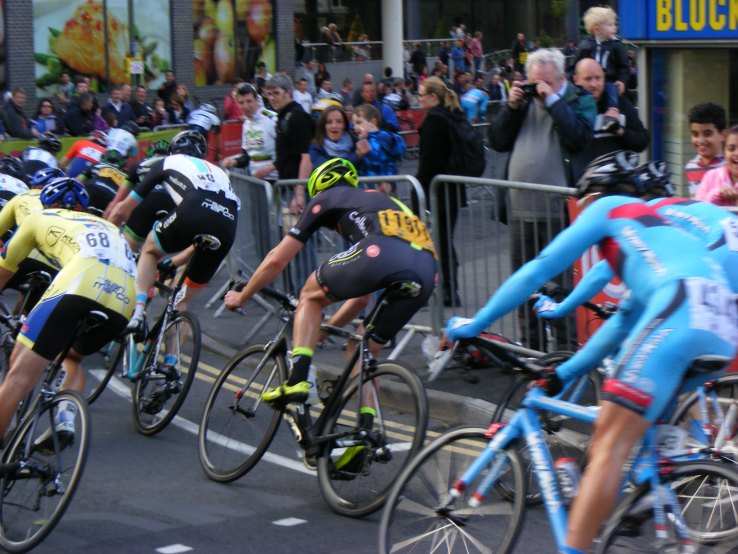
… things go whooshing past (the peloton sweeps round the Woking one-way system during the Tour Series 2013)
Wheels (that’s still its working title, and it’s still not going to be its real title) is rolling along quite nicely, sitting just under fifty thousand words. Much of what’s there at the moment is dialogue, stick figures having witty conversations in a thick fog. I’ll have to go back and put in the descriptions later.
So far, so familiar. What is a new experience for me is writing a first person narrator who’s… not unreliable, exactly, but not at all objective. True, I ended up with something similar in Speak Its Name, written in claustrophobically tight third person with a point of view character who wouldn’t come out even to herself. The difference is, Speak Its Name didn’t start out that way. It started out with multiple points of view, with multiple foibles and inconsistencies, but where I always knew what was ‘really’ going on.
Cutting everything down to fit into Lydia’s point of view was interesting. There are things that I knew and she didn’t. The most significant one is that Becky isn’t a trinitarian. If Lydia had known that – well, she’d have to deal with that, and it would add a huge chunk of drama onto a part of the book that really didn’t need any more drama. So I know that, and so do some of the other characters, whose thoughts on the matter we don’t hear, but Lydia never finds out.
Writing first person from scratch, I’m having to spend all my time in one character’s head, and I keep discovering things that he doesn’t know, and can’t know. He’s self-centred and often oblivious to subtext and body language. A friend read through the first couple of chapters few days ago, and made a throwaway comment about another character’s ‘flirtatious wink’.
‘Hang on,’ I said – to myself, ‘that wasn’t flirtatious!’ I wondered if I ought to clarify that it wasn’t flirtatious, and, if so, how.
Except the more I thought about it, the more I realised that… yes, it does make an awful lot more sense if she is flirting with him. Which puts a whole new complexion on the first half of the book, and leaves me with the problem of how to have her get over him, but it also makes the end a lot more convincing.
So now my challenge is to incorporate this new knowledge into the draft. My narrator can stay oblivious, but I can’t.
More specifically, I thought that I really ought to write something about the claim, which took me right back to the Dumbledore-is-gay revelation, that if she wanted to write a gay character she should just write a gay character and stop fannying around with all this symbolism.
Then I thought that I really couldn’t face writing something about it.
Then I remembered that I already had.
I wonder: has anyone done a study on the correlation between section 28 and the underrepresentation of LGBT characters in UK teen lit?
Section 28 was in force when I was at school. This is what it said:
a local authority “shall not intentionally promote homosexuality or publish material with the intention of promoting homosexuality” or “promote the teaching in any maintained school of the acceptability of homosexuality as a pretended family relationship”
Local authorities are responsible for, among other things, public libraries and state schools, and one of the effects of this was the complete absence of LGBT characters in children’s and teen literature that was written or published in the UK. We didn’t have the British equivalents of David Levithan, Alex Sanchez, or Nancy Garden. Nobody would publish them. The one book with any queer characters in my school library that I remember was Dare, Truth or Promise – written and published in New Zealand. Mentioning Nancy Garden above reminds me that the school library did have The Year They Burned The Books. Oh, the irony.
My theory is that UK children’s publishers have never got over section 28; there’s a whole tradition missing here.
Which is not to say that I think that it was a good idea to come out now (pun not exactly intended, but I’m not deleting it now I’ve noticed it) and say what the symbolism actually, like, means. If the reader didn’t pick it up the first time round then bashing them over the head with it isn’t going to help, and it’s just going to annoy the ones who got it, didn’t like it, and were doing their best to ignore it.
I discovered a few months ago that there is in fact a term for ‘can’t call it young adult, because the characters are rapidly departing their teens’. It’s ‘new adult’, which means, so far as I can make out, ‘young adult but with slightly older characters and more swearing’.
This is useful to know. Because really, Speak Its Name is, in structure at least, closest to those old-fashioned boarding school books where we see a little bit of the main character’s family but everyone else’s is pretty much irrelevant, the focus is on a group of people of about the same age within a confined space, and all the action happens in term-time.
But with less coyness about same-sex attraction. And more swearing.
I don’t like the term much – ‘young adult’ always sounded patronising to me, and ‘new adult’ feels even more so – but it’s useful to have something to put in the search box.
I keep a bottle of brandy in my desk. Not to drink – I can’t write drunk, and, as it happens, it’s the Christmas pudding brandy – but because it makes me feel a bit like Raymond Chandler.
It doesn’t make me write like Raymond Chandler, but it does make me write. Playing at being a writer does result in actual, real-world, words. It’s something about ceremony and ritual, together with not taking any of it too seriously. It’s like putting on a designated writing hat, or socks with a pattern of pen-nibs; something that says to me, and to the world, ‘OK, I’m a writer now.’
It could be argued that this dressing up lark is a bit childish. To which I reply, firstly, that I don’t care; and secondly, that one of the few points with which I still agree wholeheartedly with C. S. Lewis is on childlike things.
For most of this year, all the time I’ve been working on the thing that’s currently entitled Wheels, I’ve had a target wordcount in my head. Eight thousand words over the course of the two weeks of each month that I spend writing. Aim for a thousand words each commuting day, not usually hitting that, but making up the difference when I type it up.
August was different. I knew that from the beginning of the month, but couldn’t quite work out why. After a while I remembered (read: was forcibly reminded) that seasonal depression always kicks in for me in August; also, I’d be spending a lot of my evenings watching the Olympics. I was glad that I’d already decided that I wasn’t going to worry too much about the wordcount. Instead, I was going to concentrate on getting my head around one of my characters, one I didn’t feel I quite knew yet. And I’m getting to know her. Slowly. A little bit faster than my narrator is.
As it happens, I ended up not too far short of that eight thousand, but that’s not the point. I needed very badly to give myself a break, and moving the goalposts helped.
To a certain extent, this is a thing that happens automatically: it’s all very well aiming to write two thousand words a day, or whatever it is (personally, I go for a thousand, and rarely make it), but after a while you have a novel’s length, or even more, and you have to start cutting things instead. You’re forced to redefine ‘a good writing day’.
But sometimes, even if you’re still on the first draft and have just got bogged down at the 25K mark, it can help to say, ‘Well, this month I am not going to worry about wordcount at all, but I am going to try to nail the scene where the main character comes to a major realisation about herself, because I have been scared of getting this wrong so I have been putting it off.’ Or, ‘I’m not particularly bothered about whether I finish chapter three this week, but I do want to get a handle on Bob’s character.’
Often, that kind of little shift can give me enough space to unstick whatever’s got stuck. Occasionally I am tempted to beat myself up about not being able to keep up my ideal rate. But this is my pitch and my game, and I put the goalposts wherever I damn well please.
This is rank heresy in the church of People Who Tell You How To Write. The doctrine, as I learned it, went something like this:
Seek only criticism. If you seek encouragement, you will find only people who tell you what you want to hear. That way lies egotism, laziness and dreadful writing.
There are two reasons for ignoring this, or, at least, taking it with a giant pinch of salt.
Firstly, a lot of self-appointed critics of other people’s writing are… not very good at it. They tend to have subscribed to a rigid interpretation of supposed ‘rules’ for good writing, many of which they don’t even know how to apply properly, and the results are ridiculous.
Weigh writing advice carefully. Anything presented as a rule is not a rule. At best it’s general advice presented as a rule. At best. Half the time it’s bad advice to begin with. But always consider advice. Consider it seriously, and if you find it won’t work for the project at hand, put it aside.
Secondly, accentuating the negative is depressing. In every piece of writing there will be good things and there will be things that could do with some more work. This applies all the way from My Immortal (and I’m linking to the TVTropes entry there because it always cheers me up; very funny, very NSFW, also don’t blame me if you lose the rest of the day, you’re welcome) to War and Peace. Most writers know that their writing needs work. Some find it easy to work out what particular work it needs, and how to do it. Some don’t. Either way, random people on the internet (or, for that matter, random people in the library; this applies to offline writing groups too) aren’t necessarily the best source of advice. (See reason one, above.) And once someone has had a piece of writing ripped apart by enough people they’re much less likely to show it to anybody at all. And that way lies sticking it up unedited, and nobody wants that.
I am a member of an online writing group, and it is one of the most supportive, encouraging communities that I’ve ever been part of. People are delighted when you’ve had a good day’s writing and can report a wordcount of 2000. They commiserate when you’ve had a bad day, and written three words, or nothing, or have spent the entire day down a Wikipedia rabbit hole and aren’t even sure you can call it ‘research’. Nobody tells you that Jane Austen wrote with all her family bouncing off the walls so why can’t you. They will find something nice to say about whatever you post. And even a supportive comment can make you realise that something isn’t working. ‘You’ve really nailed the fifties atmosphere,’ for example, when the story’s set in the present day. No, sharing writing with this group doesn’t make me lazy. It makes me want to come back, and to come back with something more positive to report.
Later – much later, when I’ve got a story that’s as close to perfect as I can get it unaided – I bring out the big guns. I email the people I know I can trust to tell me what needs doing and where, and I promise them a bottle of gin apiece, and tell them to do their worst. But the cheerful, uncomplicated support of my online group in the early stages of a project is invaluable in getting the thing off the ground.
This happens for me automatically: I quite often run out of writing time before I get to the end of the scene I’m writing. I can’t, obviously, sit on the train and finish it off, or I’d end up being taken straight home again, so I have to stop. Mid-sentence, sometimes.
Also, sometimes I run out of steam at or around Finsbury Park, so I shut the notebook and look to see whether there’s an update from Lady B-, the Comfortable Courtesan as was.
On the train home, I often find that the morning’s part, which I’d thought would only take a paragraph or so to wrap up, wants to run on and on into the next scene. Or a different part of the book entirely. I’m not fussy.
Strelsau, recreated from textual evidence in ‘The Prisoner of Zenda’, ‘Rupert of Hentzau’ and ‘The Heart of Princess Osra’
I’ve always had a thing for fictional countries. Ruritania, Evallonia, Syldavia, you name it. Gondal, Gaaldine and Angria. Slavonia. (Points if you can name the works they appear in.)
More recently – fine, over the last fifteen years – my focus has narrowed and I’ve become interested in fictional cathedral cities. Fictional English cathedral cities. I’m not aware of examples from outside my own country, but I may not have been paying attention.
There seem to be two main ways to create one.
You can rename an existing city and all its environs, as Susan Howatch does to make Salisbury into Starbridge. Or, to take a more extreme example, you can rename everything in an entire region, as Thomas Hardy does. Even Oxford – sorry, Christminster – isn’t safe.
Or you can be a little bit fuzzy about geography. You can imply that you’re referring to a real city –
The Rev. Septimus Harding was, a few years since, a beneficed clergyman residing in the cathedral town of ––––; let us call it Barchester. Were we to name Wells or Salisbury, Exeter, Hereford, or Gloucester, it might be presumed that something personal was intended; and as this tale will refer mainly to the cathedral dignitaries of the town in question, we are anxious that no personality may be suspected. Let us presume that Barchester is a quiet town in the West of England, more remarkable for the beauty of its cathedral and the antiquity of its monuments than for any commercial prosperity; that the west end of Barchester is the cathedral close, and that the aristocracy of Barchester are the bishop, dean, and canons, with their respective wives and daughters.
The Warden, Anthony Trollope
– or you can swear that you’re not . You can stretch the map and squeeze in an extra county or two:
The diocese of Lindchester is not large, squashed as it is between Lichfield to the south and Chester to the north; so don’t worry, we will not be travelling far.
Acts and Omissions, Catherine Fox
(Incidentally, I’m convinced that this is the only possible way to fit Ruritania in where Anthony Hope puts it: between Germany and Bohemia. Most adaptations make it far too small and far too far east. Roll up that map of Europe: this is fiction.)
My own approach is somewhere between the two. I plonked Stancester down on top of a real town (Ilchester – the crossroads is a dead giveaway if you look at a map of Roman Britain, though I appear to have drawn the below map of Stancester before visiting Ilchester and writing the chapter headings that deal with its history). The geography is plausible, but the rest is pretty much all made up. I suppose I think of it as a slightly alternate universe, where the railway went through there instead of through Yeovil, though I still haven’t worked out what that means for the Great Western line. I may have inadvertently erased Wells in the process. I didn’t mean to, but I’m not sure it’s plausible to have two cathedrals of such antiquity so close to each other.
Stancester: the map I worked from, though it probably didn’t end up being entirely accurate
Or, of course, you can borrow somebody else’s, as Angela Thirkell did.
Or not put any thought into the matter at all, supplying no identifying detail. Kate Lace, I’m looking at you. And your Westhampton. Look, I know The Chalet Girl is filed under ‘romance’ or ‘chicklit’, but if you’re going to do Barchester you might put a little effort in. And do some research, and by ‘do some research’ I mean ‘not sending your Bible-bashing eco-warrior fundie bishop to a fundraising event wearing a “soutane”.’ I’m comparatively High Church – I once went to Sainsbury’s wearing a cassock – and I had to Google ‘soutane’. Turns out it’s a cassock.
Sorry, rant over.
For some reason there’s a lot more going on in the south and west than there is in the north and east, and if one assumed these cities all existed in the same universe England would have to reach further out into the Channel than it currently does. The Archbishop of Canterbury* (even Thomas Hardy didn’t overwrite Canterbury, so far as I know) has far more fictional dioceses to look after than does the Archbishop of York**. ‘Write what you know.’ Or, rather, ‘overwrite what you know’.
But where are they really? They’re not anywhere really, because this is fiction. Even if they started out being based on somewhere ‘real’, they become very different in their passage through the author’s head. Even if they keep the original name – Morse’s Oxford, for example – they remain a portrait of a city of thousands of souls as seen through a single pair of eyes.
And authors get things wrong, and so do readers. A recent reviewer thought that Speak Its Name had a very convincing Oxford atmosphere. I fear that Oxford would disagree. In fact, the point of Stancester is rather that it isn’t Oxford. Of current British students, only an extremely bitter Cambridge one would mistake Stancester for Oxford, and even they would only be pretending.
Besides, if I’d meant to write about Oxford, I’d have called it Christminster. Or would I? Never mind. The lovely thing about fictional places is that they aren’t real. You can write them any way you like, and write anything you like about them. Just make sure you get your soutane straight.
*Barchester; Christminster (plus everywhere else in Wessex); Starbridge; Westhampton (I would guess, unless maybe it’s meant to be somewhere in the Midlands?); Stancester, sorry…



 Kathleen Jowitt