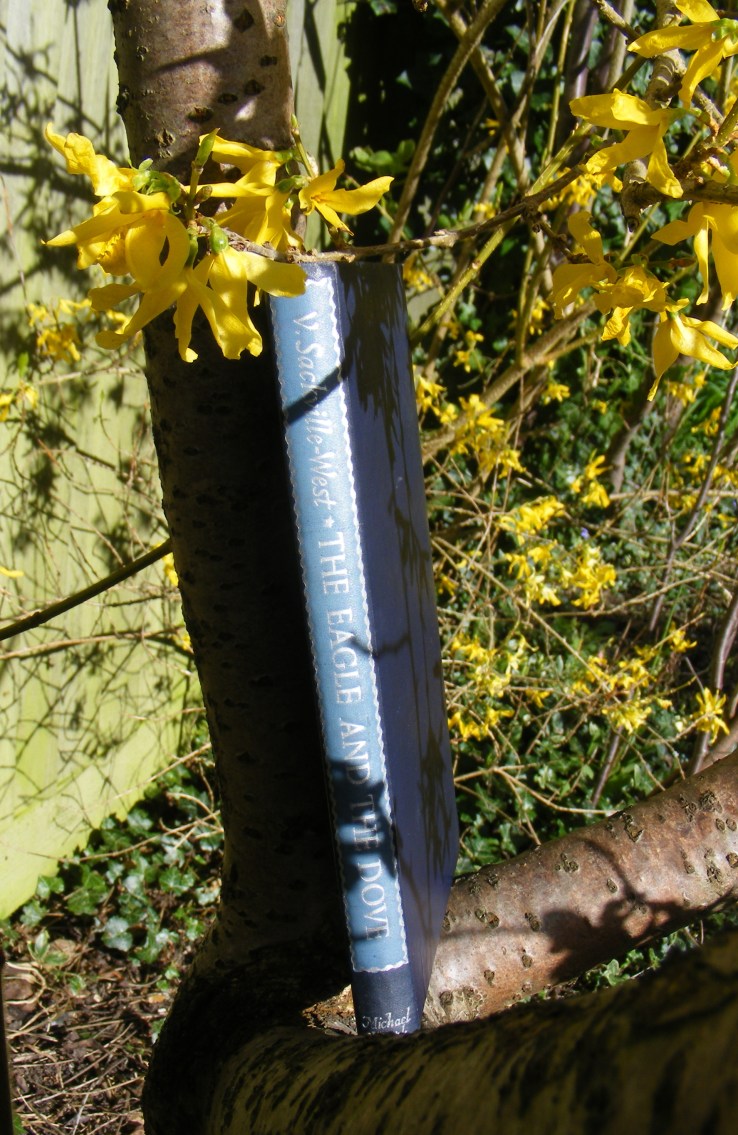
March blows in,
yellow, ragged-edged.
I wait:
too tired for anything but waiting;
too weak for anything but waiting;
soon it must surely
tear through me, open me up
until I know, heart-deep, the brightness
that now I only see.
100 untimed books: biting
100 untimed books: surrender anyway

Some books, you know that if you so much as pick them up, the rest of the afternoon, the rest of the weekend, will just disappear. If they’re the first in the a series, make that a fortnight you’ve just lost. And yet you open them anyway…
(I didn’t get this in Asda for £1.99. I got it in a charity shop for 50p.)
Two tins of tomato soup, two bottles of water, and the Oxford Companion to English Literature

Three and a half kilograms. I’m practising for the Camino Inglés by gradually increasing the weight I carry with me when I’m out walking. That was today’s load, and the first time I’d been out with the rucksack I bought at university, which I’ve never taken on a long walk. Previously I’ve used my godmother’s rucksack, which alas is no longer in a usable state. (If anyone reading this has ever experimented with re-waterproofing the inside of a rucksack, I’d love to hear about your experience!)
There are other bits of kit on my mind: sleeping bag; socks; sticks. Do I buy new walking poles (I have no idea what’s happened to my old ones) or do I take the more picturesque but less foldable hazel staff? But the question I really need to think about at the moment is: boots? Do I use my old ones, veterans of my university years, and trust they won’t fall apart on me? Do I use the current ones, which were meant to be a stopgap and feel a bit insubstantial, and trust they won’t fall apart on me? Or do I buy a new pair? If I’m going to do that, I need to do it soon, so that I have a chance to walk them in.
At the beginning of April I’m going to spend a long weekend walking the Isle of Wight Coast Path, to get some practice in on gradients. We are severely lacking in hills in Cambridge; I’m currently making do with climbing the stairs to the top of the building I work in. Meanwhile, my brother, who’ll be joining me on the walk, has spent the last few months working at a ski resort and is probably disgustingly fit. He was disgustingly fit before he left, after all. I can console myself with the thought that my Spanish is probably better than his.
It’s been good to think of Spanish as training, too; it’s meant that when I’ve found it difficult to get out of bed (this winter, with the boomerang virus; this morning, with depression) I can do five minutes of Duolingo on my phone and still feel that I’m making progress. I can also take small, practical actions that don’t take much physical energy but that still need to be done.
On Thursday, for example, I booked the ferry tickets. And that’s a momentous proceeding. All my practice walks, all my Spanish learning and my dithering over boots; all that could just be in the interests of general self-improvement. But a ferry ticket, now, you can’t argue with that. It’s going to happen!
100 untimed books: sweaters

There’s nothing like Timelord fashion. There’s nothing like Timelord fashion. And one of these days I will actually finish this jumper.
A reader’s guide to Cambridge charity shops

I have always bought books in charity shops, and, so long as charity shops, books, or I continue to exist, I always will. There wasn’t much spare money around when I was growing up, and besides, I have a perverse liking for things that are out of print.
In terms of books, charity shops are good for:
- things I have a vague idea that I’m collecting (for example, Blue Peter annuals, or John Buchans in the red Nelson edition, which is the only thing that fits on the second shelf of my big bookcase);
- last year’s bestsellers;
- impulse buys.
Charity shops are not so good for:
- things that have only just been published, though you occasionally get lucky;
- rare or specific books, though you occasionally get lucky;
- things you need within a tight timeframe, though you occasionally get lucky.
I spend less time in charity shops than I used to, mainly because there are none within walking distance of my office – at least, not if I want to get out and back and spend a reasonable amount of time actually in the shop all within my lunch break. However, there are always Saturdays. I’ve lived in Cambridge for getting on for three years now, and have explored a reasonable portion of the city in that time. There are two streets in particular that have an abundance of charity shops: Burleigh Street and Mill Road.
Charity shops fall into two broad categories. There are the carefully curated, and the undiscriminatingly chaotic.
The latter are, of course, by far the best for books. You never know what you’re going to find; you pick up things you’d never heard of because you are intrigued by the picture on the spine or because the title reminds you of something you were looking for six months ago. You never find what you’re actually looking for, but the chances are you’ll find something else worth reading.
In the carefully curated category, by contrast, you will find two stingy shelves of books, whose contents will be unremittingly boring, and suspiciously similar to those in every other carefully curated charity shop in the street. If you’re looking for last year’s bestseller, this is the place to go. If not, it won’t take you long to scan the shelves and decide there’s nothing to keep you there. (You will also find some inoffensive and deeply boring clothes, and the ones with an ‘Atmosphere’ label will probably cost a pound more than they were originally sold for in Primark.)
A more promising subset of ‘carefully curated’ is the specialist charity bookshop. There are two of these in Cambridge – the Oxfam bookshop on Sidney Street, and Books for Amnesty on Mill Road. The great advantage of these is the fact that the books are arranged in a coherent and logical fashion, and, if you know what you’re looking for, you can be in and out within three minutes.
However, the chances are that you’ll pay a similar price to those charged by specialist second-hand dealers. Which is good for the charity, of course… up to the point where you don’t buy the book because you didn’t want it that much. And of course, if you don’t know exactly what you want, the choice can be somewhat overwhelming.
My two favourite shops on Burleigh Street are Oxfam and the RSPCA. Oxfam has a vast range of all sorts of stuff over two floors. The books are helpfully arranged by category, and there are plenty of categories, and there is plenty of variety within those categories. The last thing I got in there was a book of poems by Luci Shaw, and the thing before that was A Murder Is Announced. It’s also, so my father informs me, good for Ordnance Survey maps.
The RSPCA doesn’t have such a wide selection, but what it does have is of good quality. I picked up the bulk of my Buchan collection there. The British Heart Foundation tends to have interesting books. Like all BHF shops, it’s crammed full of too much stuff, both second-hand and the hideous ‘new goods’, but it can be worth fighting your way to the back left-hand corner. I wouldn’t go out of my way to any of the others, and have resolved never to give books to the Scope shop, which sends them (so one assistant told me, at least) for pulping if they haven’t sold after only a fortnight on the shelf.
Mill Road has the Sally Ann, which is a spacious shop with a lot of stuff in it, and another Oxfam, this one affably scruffy. The YMCA is comparatively new. It has hardly any books, but I did get A Book of Escapes in there.
It is worth going beyond the railway bridge, if only for the RSPCA bookshop. This is less like a charity shop and more like something you’d find in Hay-on-Wye. Books everywhere, stacked on the top of shelves, on the floor. Penguins, Pelicans, Viragos, old hardbacks, old paperbacks… It’s wonderful.
I don’t recommend going round all the charity shops in one day. There are, after all, only so many books that can be loaded into a bike basket before the steering goes all skew-whiff.
100 untimed books: self-portrait

Violet Trefusis’ roman à clef, and interesting to read in conjunction with Orlando. What really happened with Vita Sackville-West? I’m not sure that we find out from this, but it’s fun to wonder.
I have no actual broderie anglaise, so I’ve used English paper piecing instead.
The patchwork analogy
For some people, writing a novel is like knitting. You begin at the beginning, and you go on until you get to the end, and then you stop.
Personally, I’m very glad that I was born into the age of the word processor, because I absolutely cannot do that. Oh, I’ve tried. But if a scene, a moment, a phrase, from chapter thirty-two is dancing around in my head, then I can’t settle down to write chapter one.
For me, it’s more like patchwork. Or one particular project, anyway, which was more of a freehand effort than most of my quilts. Let me demonstrate:
You have a general idea of what you want to create, and you start with an idea that takes your fancy. In this case, it was the four seasons, and I thought I’d begin with a jolly yellow sun for summer.
You might want to incorporate something that wouldn’t quite fit into a previous project. (I made more of those blue flowers than I needed. Never mind! The spares will do for spring!)

(This is a bit meta. Any patches in here which are in English, as opposed to gobbledegook, are from the now-deleted first chapter of Speak Its Name.)

You get all your ideas down and then move them around a bit, seeing how they fit best, what needs to come after what.

As you go along joining things together, you see where things can be tightened up.

You see where the gaps are, and you start filling them…

… until you get something that’s more like the right shape.

At that point, you can start tidying it up, taking out the things that were only there to hold it in shape during construction.

Now comes the backing and the pinning and the quilting, the crawling around on the floor and swearing a lot. You feel like you’re nearly there, but there’s still a frustrating amount left to do. (This is where the analogy falls down a bit. This is, oh, I don’t know, the proofreading. And waiting for people to get back to you to tell you where you’ve got things wrong.)

But once you’ve done that then there’s just the finishing off. And then you can feel rather pleased with yourself. Because the thing’s done, and while it doesn’t perhaps look exactly the way you once envisioned it, it’s not nearly as bad as you once thought it was going to be.

100 untimed books: coffee

Nobody has opinions on coffee the way a cyclist does. I should probably point out that the only thing in this picture that belongs to me is the coffee pot (there are some cyclists who don’t actually like coffee); but the book was a present from me.
Good news

Speak Its Name was a finalist in the 2016 North Street Book Prize for self-published books (scroll down to the bottom of the page – then scroll back up and read about the actual winners). I’m very pleased about this indeed.
News from the Church of England is also good, though I find myself less excited than I might perhaps have been a couple of years ago. This time around, I got so frustrated by the bi erasure from both sides that I never managed to get into the debate. And I can’t help feeling that things have come to a pretty pass when Synod opt not to note a report that was so dreadful that the Bishops felt that they had to apologise for it and we feel obliged to be grateful for this.
I’m thinking a lot about the Syro-Phoenician woman, thinking about the tables that I sit at and the ones whose legs I prowl around hopefully. Some time over the last few years, it seems, I started wanting more than crumbs.