Daily Decoration: Ljubljana dragon

Laser-cut plywood dragon set in a circle, with text 'Ljubljana' at the base

I only found out when someone mentioned it on Twitter a few hours ago, that today’s the anniversary of Patrick Leigh Fermor setting out on his epic foot journey to Constantinople. It’s rather pleasing, because I was thinking about PLF a lot when I was planning the journey on which I picked up this dragon.

My Grand Tour in 2018 was rather less epic than PLF’s journey. I only had three weeks to get it done in, though my budget was probably quite a bit more generous, courtesy of the Betty Trask Award. Going by train, I got some impressive mileage in. I didn’t get invited to stay in any castles, though I did end up having dinner with a coloratura soprano in Vienna.

But that’s by the by.

I loved Ljubljana, in much the same way as I loved Bratislava: they’re both capital cities that haven’t been capitals all that long; they’re easy to walk around, and hard to get lost in. Bratislava had the better food, and a cathedral with a wonderful eighteenth century St Martin in a pellisse. And trams.

But Ljubljana has dragons. They guard one of the famous bridges; there’s a legend about a dragon and Jason, of Argonauts fame. And actually there was some very good cake, too. And bendybuses. And a funicular.

I went to Ljubljana because two separate friends, both far more experienced than me in the art of adventure, recommended it. That was how I planned a lot of the journey: recommendations from people who knew what they were doing; places I’d always wanted to go to; things that looked good in Europe By Rail. A bit of wiggle room for emergencies, or just in case I wanted to change my mind. (I did, a couple of times.)

But all the time I was planning it I had to get around a voice in my head that was trying to tell me that this was the last fun thing, before… Before what? Well, before Brexit, before whatever horrors the next US election were going to inflict upon the world, before I lost my nerve.

And had Patrick Leigh Fermor, tramping across Europe and seeing the rise of Nazism on the ground, got into my head? Had Patrick Leigh Fermor, looking back on the adventures of his youth from the bitter experience of sixty-something (and a world war), managed to scare me, betwixt and between at the age of thirty-two, out of going? No: he was half the reason I wanted to go at all.

I can’t say that I saw a global pandemic coming. Sometimes the voice in my head tells me that it told me so.

But it wasn’t the last fun thing. It wasn’t even the last continental European holiday: we got to Lille the next year. It wasn’t the last public transport adventure: even this September we took the sleeper to Penzance and worked our way back up the West Country on buses and trains.

The Grand Tour wasn’t the last fun thing. And actually, by the end of the trip it was feeling less like the end of something and more like the beginning of something. I’d learned a lot about travelling on my own, about not actually having to speak every language, about when to rewrite a plan and how absolutely anywhere looks better after you’ve had a shower. And I’d learned that very often it is just as simple as deciding that you want to go somewhere, and going there. Here be dragons. Let’s go and see them.

If you want to read about my Grand Tour adventures in more detail, perhaps excessive detail, start here.
Daily Decoration: Dutch windmill

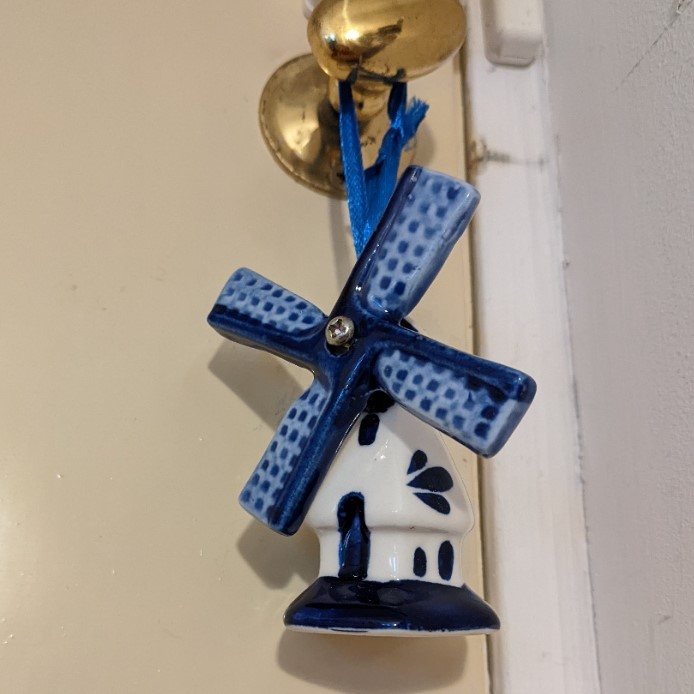
China windmill, white with blue sails and details, hanging by a blue ribbon from a brass knob

Finishing off the vaguely Dutch theme of the last few days with an actual windmill from Amsterdam. Amsterdam was a day trip: we were staying in Leiden and it was our first foreign holiday together since our honeymoon. (Really? Six years? But then there really wasn’t much money to spare for most of them.)

Most of our recent foreign holidays have been to the Low Countries. There’s a good reason for that: we only started gathering some disposable income once we’d moved to Cambridgeshire, because that was where one of the jobs was. Add to that my reluctance to fly (it’s not that I’m never flying again, but I’m going to need a very good reason indeed), a shared interest in cycling, and the proximity of the Harwich ferry and the Eurostar, and it becomes obvious that we’d visit Leiden, then Ghent, then Lille.

(Solo trips are another matter. More on that tomorrow. And we are still holding out for that rail tour alongside the Rhine.)

I wasn’t massively keen on Amsterdam. My experience throughout my travels (again, more on that tomorrow, probably) has been that I prefer the smaller cities. But I did like the Netherlands more generally, and I’d like to go back sometime when All This is under control. In the meantime, I’m exploring my own flat land.

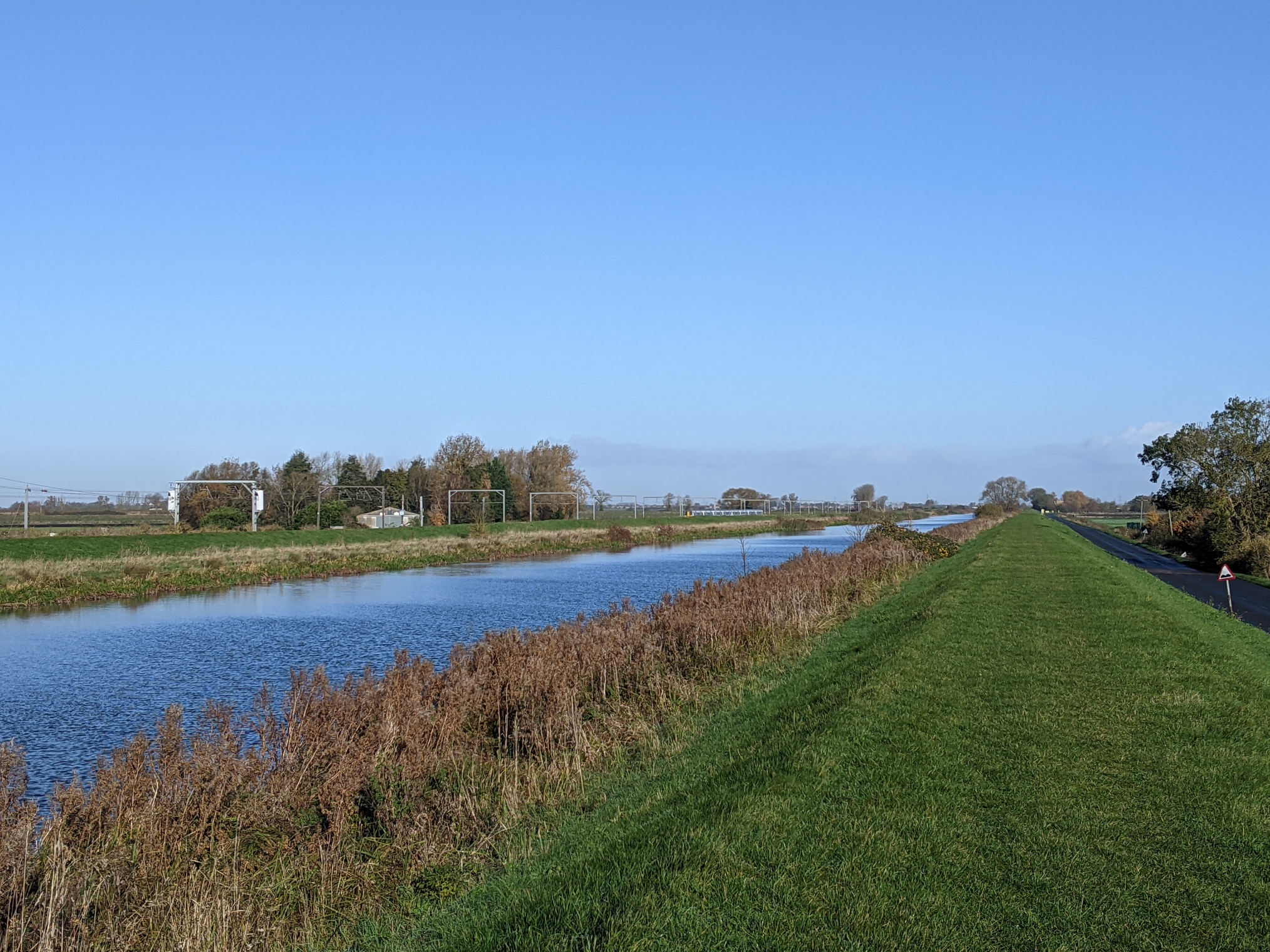
Blue sky reflected in a straight, calm, river, with reeds and a grassy artificial dike on the right bank and overhead railway power lines on the left bank
Cambridgeshire.

Daily Decoration: St Nicholas

Playmobil figures of an angel with a wide crinoline skirt and floor-length gold wings, and a man with a white beard and red bishop's mitre and robes

I’ve shared these two before, but it is St Nicholas’ day. That isn’t really a thing in my tradition, except insofar as to grump (quietly) about how everyone else is getting Father Christmas wrong: but he’s just familiar enough in his red and white, and just saintly enough with his crook and mitre, to belong there. Maybe I’ll get the angel an umbrella. The nativity scene and the Magi will show up later.

Of course, this inevitably raises questions about how to render other seasonal saints in Playmobil. Saint Lucia, with candles on her head and her eyes on a plate? There are various monks out there, who’d do as St John of the Cross, and young men who could be St John the Evangelist or St Stephen. Perhaps we’d better stop there. Collecting Playmobil babies to play the Holy Innocents would feel distinctly, if illogically, off: why should I baulk at one plastic martyrdom but not another? (But couldn’t I get an Arius for St Nick to clobber?)

Usually these two would be up on top of the piano, but I don’t trust the cat (currently attacking a scrap of red and white brushed cotton plaid) with them, so they’re sheltering on the bookcase. They don’t really have a story. I just wanted to buy a Playmobil St Nicholas.

Daily Decoration: blue and white and gold house

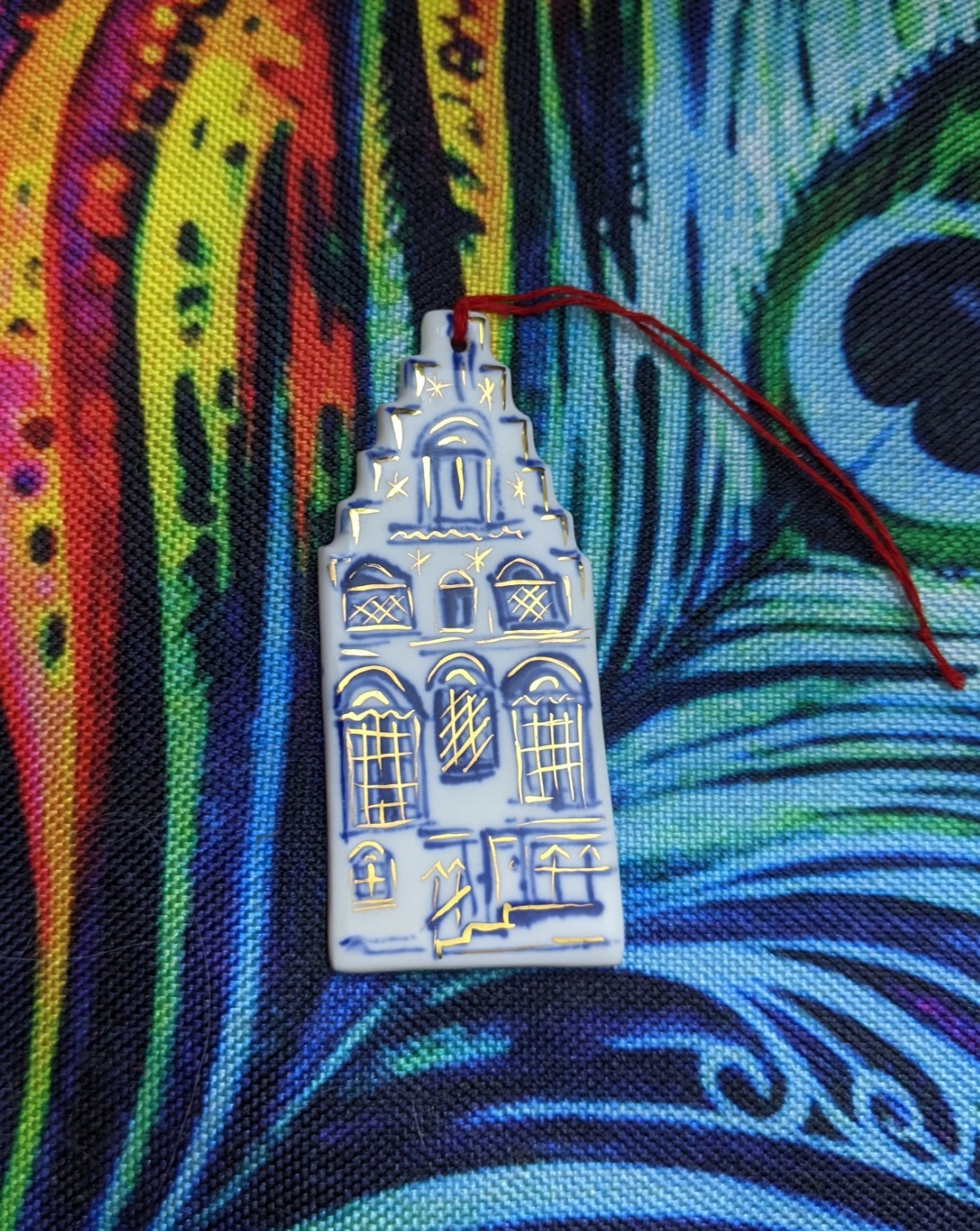
Flat ceramic Christmas tree decoration representing a tall house with Dutch gables, with doors and windows picked out in blue and gilt

This one came from an art shop in Cambridge. I think I’d just gone in to look at the art, with the intention of buying a card or two as the price of admission, but I saw this and I couldn’t not buy it. There was a whole street’s worth of houses, but I couldn’t really justify buying more than one. I bought this one. I love blue-and-white china (there’s more to come in this series), and the addition of gold makes it really lovely.

Of course, I was so terrified of breaking it that I wrapped it up very securely and tucked it away in my handbag and had forgotten all about it by the time I got home. I’m not sure that it actually made it onto the tree that year; if it did, it was at the very last minute.

I try to go and look at something once a week. (Blame Julia Cameron, probably.) Sometimes I manage it; sometimes I don’t. Sometimes it’s an exhibition; sometimes it’s a show; sometimes it’s a concert or a film. Sometimes, as here, it’s a shop that sells particularly beautiful things. Sometimes it isn’t really looking at something: it’s trying something new (an interesting looking cake, a different kind of tea, a book of poetry). Often I bring something away with me. Usually it’s something that can be stuck in my diary: a flyer, a bookmark. Sometimes it’s something that will allow me to explore the subject further: a book. Sometimes it’s something more substantial, something that’s part of the the something itself. Even if it’s tiny.

Daily Decoration: German roundels

Three laser-cut plywood Christmas tree decorations, with (left to right) a nativity scene, a church with an onion dome, and an angel kneeling on a shooting star), each in a circle with stars around the edge

These three roundels (I don’t think I can really call them baubles when they’re flat) are part of a set that was a Christmas present from my aunt several years ago. This is the aunt who lives in Germany, near Frankfurt, and in 2007 I spent a couple of months living with her and her family while I was trying to work out what to do with my life.

I don’t remember any of the churches in and around Frankfurt looking much like the one in the middle there. That’s a style that I associate more with Bavaria and Austria. When I was out there I attended a charismatic church led by one of my aunt’s colleagues. It was a bit of an eye-opener after a a childhood in rural Anglicanism and three years at the university chapel. Somebody had a prophetic image for me. I’d never had one of those before, and I didn’t really know what to do about it, though in retrospect I don’t think they were far off.

One of the questions associated with moving to a new place is: where will I go to church? Pretty soon after I came back from Germany, I moved to Guildford. I was miserable for a lot of the time that I lived in Guildford, but the one thing I never regretted was ending up at Holy Trinity for the Advent Carol Service (I’d been aiming for the cathedral, but had drastically misjudged the time it would have taken to walk there). It was just the church I needed: it had an inclusive approach, intelligent preaching, a reassuring stability, and, in its excellent but non-auditioned choir, a way that I could contribute even when my confidence was absolutely shot and I was hanging on by a thread. We kept going there even after we moved to Woking and I was quite a bit saner.

Later, we moved to Cambridge – Chesterton, to be precise. I thought that St Andrew’s was our parish church. In fact, it wasn’t, but it was the church I needed. Not that I immediately realised this. We happened to land on a family service, which was not really our thing. A couple of months later, we hit a sung eucharist and found that there was indeed a choir that we could join. I went to family services quite a bit more when we were settled there, though. I ended up contributing more than I’d expected, too: by the time we moved on, I was a PCC member, leader of the twenties and thirties study group, and occasional reader and intercessor, as well as a choir member.

I mentioned last year that moving house in a pandemic had its advantages. One of those was the fact that church went online, so I could hang on at St Andrew’s for far longer than would have been feasible in other times. I even got involved in leading informal worship (I’d imagine all that’s still on Youtube) and was still doing that up until this summer. In theory, the great onlining could also have meant that I could get a taste of other churches via their Youtube channels, though in fact I didn’t do any particular church shopping that way. When the churches opened up again after the long 2020 closure I started going to Ely Cathedral. I’m still feeling like a complete newbie (pandemic time may have something to do with this) but I’m starting to get to know people and get involved in things.

I always do seem to end up at the church I need, even if it’s not immediately obvious why that’s the case. It’s almost as if someone has a better idea than I do…

As for working out what to do with my life: well, it all worked out, but not because of any particular effort or thought on my part, and it took rather longer than two months. I’m hoping to get back to Germany next year.

Daily Decoration: distance pigs

Six small ceramic pigs with loops on their backs for hanging, lined up under a lamp

I can’t be in two places at once. Nor can anybody else. Even at Christmas. It is for this reason that in the early years of this century I started buying identical pairs of decorations, one for the tree at my father’s house and one for the tree at my mother’s.

As I and my brothers have acquired partners, who also have families and trees, the number of different places where we all could be has necessarily multiplied. So, therefore, has the number of decorations. This year there are six little pigs, one for our tree and the rest for other people’s. Just because I liked the little pigs.

This year I’ve seen more of my extended family than I’d expected, though not as much as I’d have liked. There has been some lovely news in one part of the family and some awful news in another part. A little china pig isn’t much, to say, ‘thinking of you, missing you, lots of love, maybe I’ll be with you next Christmas’. But it’s something.

Daily Decoration: childhood crib

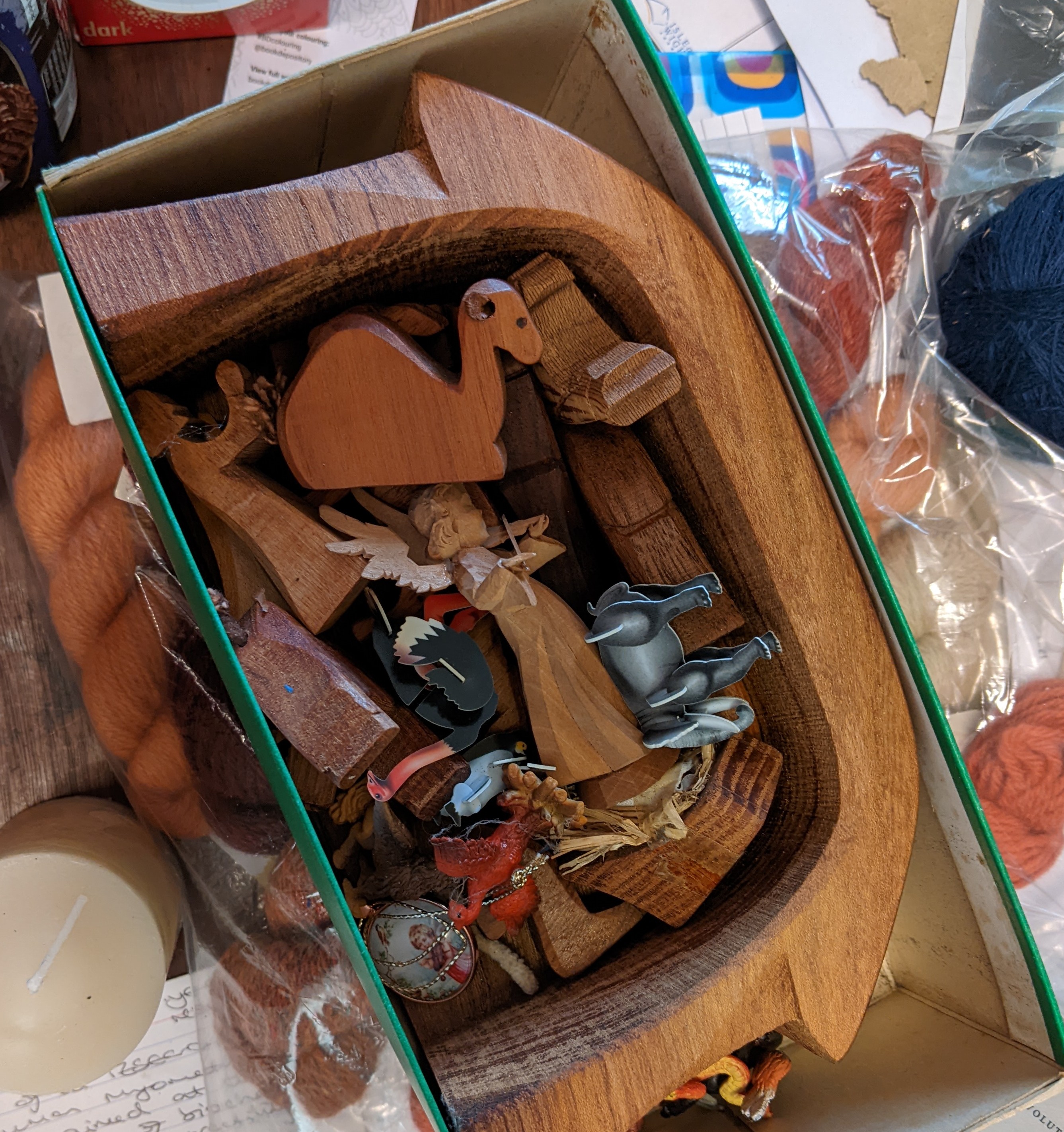
olive wood Nativity crib scene, with the stable on its back in a shoebox and the figures within it, plus some other items including a plastic elephant, ostrich and phoenix
I’m visiting family at the moment. Mine not to reason why, but the shoebox containing the Christmas crib was on the kitchen table, so here it is.

This olive wood Nativity scene was a fixture of childhood Christmases, and I’ve yet to find one that I like quite so much. Oh, there’s always a bit of a debate about which of the Magi should actually be a shepherd, and baby Jesus is sellotaped into the manger, but next to this all the sets on the market seem tacky, juvenile, or both. (Not a word against my Playmobil set, which is, after all, a toy.)

There have been a few additions over the years. The violinist angel came from my aunt in Germany. One or other of my brothers added the ostrich and the elephant. And I think the phoenix and the dragon that you can’t quite see down the side of the stable were my fault. When it comes to it, our commitment to tasteful understatement tends to come second to a slightly childish sense of humour. But after all, why shouldn’t there be an elephant?

Daily Decoration: Tree-Top Angel

A Christmas decoration representing an angel, in a plastic tube. She has ceramic head an hands, gold fabric wings, and a white satin robe.

This little angel has been sitting up on top of the bookcase ever since last Christmas – well, last Epiphany, I suppose, when we took the tree down.

She was waiting to be mended: she’s a ceramic bust attached to a plastic cone, with the joins covered up by her robe, and the glue had failed. Since her head is quite a bit heavier than her body, she was tending to tilt alarmingly.

She’s done very well, considering what we paid for her. I can’t remember what we paid for her. Less than what I spent on St Etheldreda, certainly. She came from one of those fantastic shops that sell all sorts of tat extremely cheaply and also do mobile phone repairs. This one was called Circle 7 and was on the market square in Woking. The delightful innocence of its staff can be evidenced by the fact that I once found furry handcuffs displayed in the toy section, along with the cowboy hats and water pistols. I didn’t buy any of those things. I was probably looking at stickers. I’d imagine it’s no longer there: I think that whole section of the town has been redeveloped in recent years. We left in 2013, which makes this little angel at least nine years old, possibly more.

I finally got around to fixing her on Monday evening. Lately I’ve been enjoying fixing things. Darning, mostly. There’s something rather satisfying about transforming a garment from ‘unwearable’ to ‘wearable’. But I’ve fixed the angel, too. Just a bit of superglue put her head securely back on her body.

Now she’s waiting for the Christmas tree.

Daily Decoration: Paddle Steamer Waverley

A transparent plastic bauble containing a photograph of a paddle steamer, with some snowstorm material

It’s St Andrew’s day, so it seemed appropriate to share the most authentically Scottish decoration in my possession. (Plus, this one is robust enough to be floating around the Christmas boxes without wrapping, and it’s a long time until we actually put a tree up.)

This bauble depicts the paddle steamer Waverley under way in a body of water that I can’t identify. It came in a hamper of Waverley goodies which was a present from my father a couple of years back. There was a tin of shortbread. I now use the tin for storing herbal teabags. There was a tube of biscuits. I now use the tube for storing pencils. There were probably other things with less durable packaging. And there was this bauble.

As a family, we’re very fond of the Waverley. (My great-grandparents were shipwrecked on their honeymoon when the paddle steamer Empress struck a pier at Calais. They survived the experience, as perhaps may be inferred from my existence. It hasn’t bothered later generations.) We’ve gone round the Isle of Wight and along the Dorset coast on her. You can go down and watch the engines pumping and pumping, and the smell is just glorious. I’ve dashed across London to see her steaming up the Thames under Tower Bridge. There’s something immensely moving (pun not intended) about this grand old ship still doing the thing she was built to do, seventy years on. Something that was built to serve, still serving.

Daily Decoration: St Etheldreda

Textile Christmas tree ornament representing a woman in a purple robe, holding a book and a sceptre, and with a gold halo

Saint Etheldreda here is my second-newest decoration. (The newest one is the latest in the now-traditional I-can’t-be-with-you-for-Christmas-but-this-ornament-can series, and will probably appear in a later post.)

The St Nicholas decorations are great fun, very beautifully made, and rather expensive. Expensive, I think, because they’re beautifully made, but nevertheless outside what I think of as a sensible price for a Christmas tree ornament. I bought several of the Alice in Wonderland ones a couple of years ago, week by week, and had to write them into my budget.

However! I went into the cathedral shop several months ago, and there was an Etheldreda in the sale, so I bought her.

St Etheldreda was a princess of East Anglia and, after a vow of chastity, two marriages, and no children, founded the monastic house that became, several hundred years later, Ely Cathedral. Of course it’s difficult to pick one’s way between histories and hagiographies, and this is the period of English history where plenty of rulers ended up as saints. I’ve devoted very little time to research, but I get the impression that she was a formidable woman. All her sisters ended up as saints. I think they must have been quite formidable, too.

I’ve lived in a few cathedral cities in my time – Winchester, Exeter, Guildford (look, I’m not going to be picky), and now Ely. We left Winchester before I could read, and almost every time we’ve gone back it’s been to ride on buses. In Exeter, I lived most of my life on the university campus. Guildford’s only had a diocese since the twentieth century, and the cathedral is somewhat set apart, up on a hill.

In Ely, though, I get the sense of a city that exists because of its cathedral and because of its market. Ely is tiny as cities go: it can’t get much bigger because most of the land around it is below sea level. The big expansion has happened fifteen miles south, around Cambridge. In Ely I get the sense of a city that exists in very much the same way that it has for centuries. These days the cathedral brings in tourists as well as pilgrims and the market… well, the market attracts people wishing to buy stuff, some of which the medievals would have recognised and some of which they wouldn’t.

In some ways, Ely feels like everywhere I’ve ever lived, all at once: the rich light on old stone of Winchester and Exeter and Cambridge, the proximity to agriculture (tractors!) of the Welsh borders and the Isle of Wight, the excellent rail connections of Woking, the hills and the cobbles of Guildford. In others, it feels like nowhere else.

Etheldreda wouldn’t recognise the lush farmland and the complex system of drainage ditches that supports it. She’d be completely boggled by the railway, the fact that I can get to London in little more than an hour. She’d be bewildered by my bicycle, come to that. But there’s not much you can do to that big wide sky. Contrails aside, she’d recognise that.

One last thing: it took me a little while to catch on to the fact that St Etheldreda was also, later, known as St Audrey. St Audrey as in St Audrey’s Fair. St Audrey as in tawdry. The absolute blinginess that the designers have endowed her with her is really rather fitting.

While I’m on the subject of cathedrals, I loved Dr Eleanor Janega’s latest piece. (Even if she doesn’t talk about Winchester, Exeter, Guildford or Ely.)