I was in Paperchase at St Pancras station.
Well, you see, I’d been writing everything, all of this, down in a little book, and I’d nearly finished it, so I went to Paperchase for a new one.
I always end up writing the story that I need to hear. And I don’t know whether I’ll ever be good enough to tell this one in fiction, or even if it’s a story that can work in fiction at all, ever, and it seems possible that someone else needs to hear it sooner than that. After all, I’ve found over and over again that, whatever’s happening, I’m not the only one to whom it’s happening. So I’m telling it now.
And I was looking at the shelves of notebooks, thinking about which one to choose, and I had a sudden, very strong sense that I wouldn’t need another one.
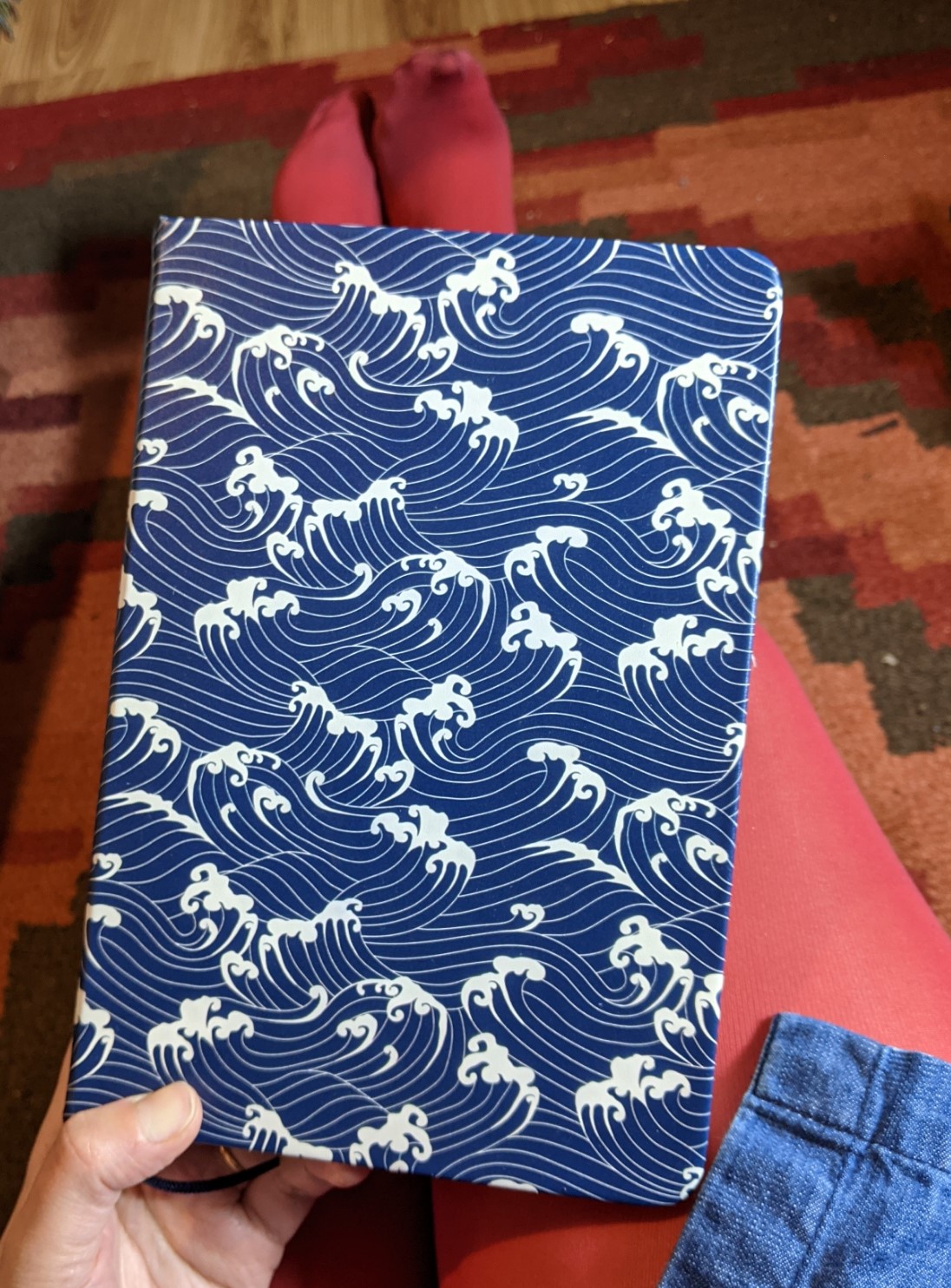
I bought one with a pattern of waves in blue and white. That was the Tuesday.
I’ve told the notebook story five or six times now. It’s a good story, a convincing one. It always surprises me how effective it is. I go in expecting pushback, argument, a compassionate suggestion that perhaps I’m mistaken in what’s going on in my own heart, and every time the other person accepts it.
Well, you’d hope they would. It’s true, after all.
On the Wednesday, I went to church. Lunchtime communion at St Pancras. St Pancras new church. And I was about half way there, walking along the pavement on the north side of the Euston Road, the wind blowing a few dead leaves around my ankles, when I understood.
It wasn’t there any more.
The leaving makes a better story than the arrival did. The arrival was cumulative, a succession of comments, questions, observations, from others.
2017. I’d been leading the twenties-and-thirties Bible study group. The ordinand we had on loan from Westcott said to the youth worker, afterwards, ‘Kathleen’s very good at this. Has she thought about ordained ministry?’
The youth worker reported this conversation to me. ‘And so I said to him, I don’t know, you should ask her!’
I thought it was just that I’d picked up some adult education skills from my day job. And forgot about it.
2018. The curate invited me to a Cursillo weekend. I thought it sounded fantastic. It wasn’t until I was signed up and paid up that she said, ‘Yes, that was where it all started for me.’
Oh, I thought. And then, Oh, well. And forgot about it.
I told a friend about the plot of the novel I was working on, how it all hinged on the fact that you can’t be ordained in the Church of England and be in a same-sex marriage. He asked me if my own vocation was going anywhere.
I’d forgotten that I’d ever told him about that.
I said no, though the curate had said what she’d said about Cursillo. And then I forgot about it.
I undertook tutor training. My first thought was how can I use this for church? It occurred to me that thirty-three was quite an appropriate age for all this to kick off again, really. I forgot about it.
I went on the Cursillo weekend and had my mind and my faith expanded in all sorts of other ways, and forgot about it.
I saw young women in dog collars – one in a bookshop, one on a train – and decided that it was confirmation bias.
I remembered Mary Poppins. The wind changes. I could smell the excitement in the air, and I knew what it was, and I didn’t want to admit it.
Returning to my novel, I asked the youth worker about the selection process. Most of my mind was focused on what I’d got wrong, what was going to screw up the timeline, what was going to rescue the arc. A little part of it was watching myself all the time to see if any of it pinged me as something that I was meant to be doing. It didn’t.
2019. I could feel it, smell it, sense it lurking in the undergrowth, waiting.
I demanded a neon sign. The next neon sign I saw said:
Started at the bottom
Now you’re here
It didn’t really help.
I decided that anything that felt that much like horrible and inevitable doom couldn’t be of divine origin. Possibly it was just that I needed a holiday.
(I did need a holiday.)
I prayed to feel better about it, if it was real.
With the twenties-and-thirties group, I was leading a course called SHAPE, designed to help people explore their gifts and their callings. In my day job, I was testing an online tool called Value My Skills. I was very aware of a parallel existence running alongside the life that I was leading, something that was more than a possibility and less than a probability.
I found myself thinking that if I got to the end of the SHAPE course without anything having come up, I was probably safe.
The week before Holy Week was peculiarly intense. Conversations and experiences piled on top of each other.
‘No, it’s not actually a thing, just a lurking sense of doom,’ I said to someone.
‘I’ve heard it often feels like that,’ they said to me.
I applied for a promotion at work in the knowledge that it was very possible that my future lay elsewhere.
I asked the Cursillo spiritual director about spiritual direction. She asked some questions about my church involvement. I answered: I was leading the twenties-and-thirties group, singing in the choir.
‘Hmm,’ she said. ‘I wonder what God’s got planned for you in, say, three years…’
I thought, oh fuck oh fuck oh fuck.
I emailed people. I dragged people out to lunch. Nobody was surprised. Their lack of surprise was both infuriating and gratifying.
I didn’t get shortlisted for the promotion. It was rather a relief: I couldn’t have fitted anything else in my head that week.
I told the curate. She prayed for me, and I, who very rarely got visual images in prayer, saw a small square of fog clear, and a set of railway points switch from one track to another. And I knew then, that if this was going to turn out to be true, that was the moment I knew it. She got me onto the reading rota and the intercessions rota and the PCC; she told the vicar.
The vicar was kindly, thoroughly, interrogative, and made it clear that I was going to have to get used to talking about this. I remembered that this was the part I’d hated the last time round.
I wept through the service. I wept because it was gone.
That was the thing: it wasn’t the first time.
At the beginning I thought I’d be able to treat it as if it was the first time, but it wasn’t long before I found myself saying, ‘Well, the last time this happened…’ and having to explain what happened last time.
‘I suppose it came out in my last year of university. I applied for a few pastoral assistant jobs, but I didn’t get any of them.’
But I couldn’t remember what it was like before. I couldn’t remember why I wanted to do it. I couldn’t remember the wanting to do it, only the desolation afterwards.
‘And it just disappeared. I walked the Camino, and by the time I got to the end it had gone, and I hadn’t noticed.’ And then I didn’t know what to do with myself, so I went to Germany as an au pair, and then I still didn’t know what to do with myself, and the year after that was the worst year of my life.
All I had was bad poetry, and a handful of stories that didn’t quite say what I needed to say. What if the widow had her mite returned to her? What if the big fish had received new orders and spat Jonah out on some beach nowhere near Nineveh? There was Abraham and Isaac, reprieved at the last moment, but that seemed a bit melodramatic. Didn’t it?
It felt like a wonderful secret. It felt terrifying and inevitable. It felt like writing a novel used to, back when I didn’t tell anybody about writing a novel.
Returning to my novel, I was struck by how wrong I’d got it. The point of view character wasn’t the one who had a vocation to ordained ministry; that was her girlfriend. But I’d bestowed on both of them the sense of creeping doom, the malevolent attraction of a black hole, that I associated with a vocation when I didn’t have one. Now I could see that it didn’t feel like that at all. When I was in the middle of the thing, there was an excitement about it, a joyful anticipation, a feeling of rightness, of everything making sense.
I read The Night Manager and for once found myself identifying with the main character accepting the call to adventure, rather than inwardly yelling at him not to do it.
I dragged out boxes of old diaries, started sifting through years’ worth of online journals. How many times had I learned this and forgotten it again? I went to Paperchase and bought a notebook with a gold-dotted blue cover. I promised myself that this time I wouldn’t forget.
I realised that I’d been thinking about it for ages. It was just that the feelings had caught up with me.
I worried about turning into a Church of England pod person with naff coasters with Bible verses on.
I knew I needed to become a person who could talk about it, and I didn’t know how to become a person who could talk about it without ceasing to be myself.
I went to an enquiries evening and was too shy to talk to the Diocesan Director of Ordinands and Vocations. I learned that the next thing to do was to book myself onto the vocations course.
I was under no illusions – certainly not the ones that would have tripped me up had I gone straight into selection and formation and ministry after university. I follow a lot of Clergy Twitter, after all.
But it seemed plausible that a decade working for a member organisation with big ideals and petty politics, one which depended for its continued operation on the labour of a lot of ageing volunteers, might have been just what I needed to equip me to deal with the Church of England. Last time might have been the wrong time. This might be the right time.
I did not book myself onto the vocations course.
I failed to do anything practical about it at all, just kept writing in my blue notebook with the gold spots.
It felt more and more like where I was going.
The Sunday before Advent, the Diocesan Director of Ordinands and Vocations was the guest preacher. I talked to her, mentioning a little petulantly that the rest of my life seemed to be trying to happen at the same time (my husband and I had finally scraped together the deposit for a mortgage). She got me booked onto the next term’s vocations course.
On the Friday, the House of Bishops put out an even more tin-eared statement than usual, and I couldn’t help seeing the funny side. I wore a rainbow skirt to church that Sunday.
I went to the first session of the course.
That was the Wednesday before I went to Paperchase.
I saw the course through, as best I could given the challenges posed by Great Northern Rail (sometimes I got from London to Ely on time, and sometimes I didn’t) and (later) having to join in by Zoom over the phone, because the course had gone online and we didn’t have broadband at the new house. It was interesting, and enjoyable, and, for me, irrelevant.
I stuck around, waiting to see if the vocation was going to come back, whether it had been scared off by my moving house, or lockdown, or something. It didn’t.
I finished the novel. I started telling people that it had gone.
It’s ten months now since it went away; it already feels like another life. After the desolation came the relief. I don’t want to do this. I would have done it if I’d had to, but I’m glad I didn’t have to.
The other day I found a mind map that I made when it was there and new and I was trying to make sense of it. There it all was, in my own handwriting, and it was nothing to do with me.
And I still don’t know why it happened: why it came, and why it went away.
Was it a piece of research that got a bit too immersive?
Did I need to know what a vocation felt like in order to know when I didn’t have one?
Am I off on another circuit of the labyrinth, bound to follow a long and winding path to get back to the same place?
The more time elapses, the less I think about those questions. The answer’s always the same, anyway: I don’t know.
And I suspect I won’t, not for a long time.



 Kathleen Jowitt