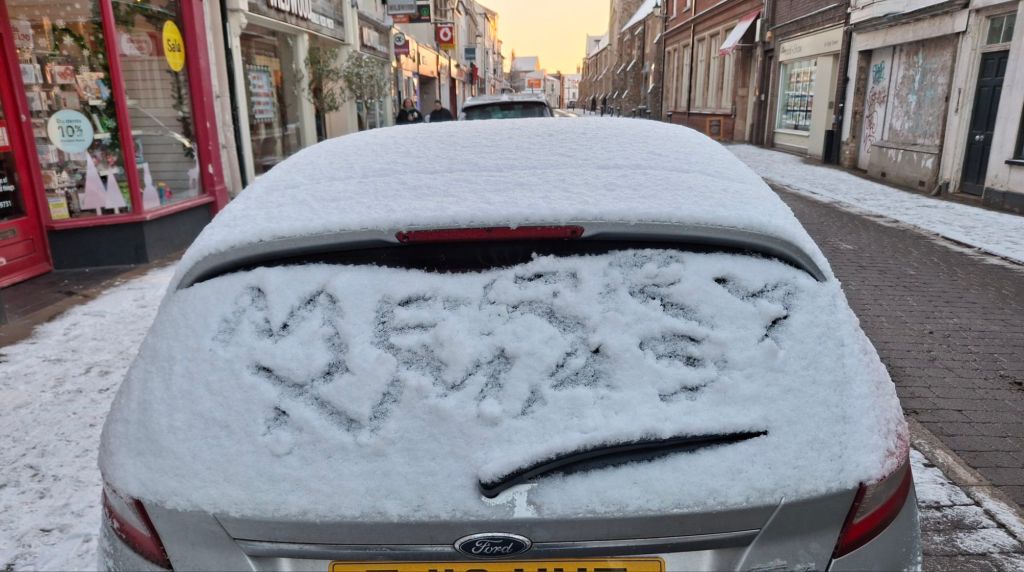
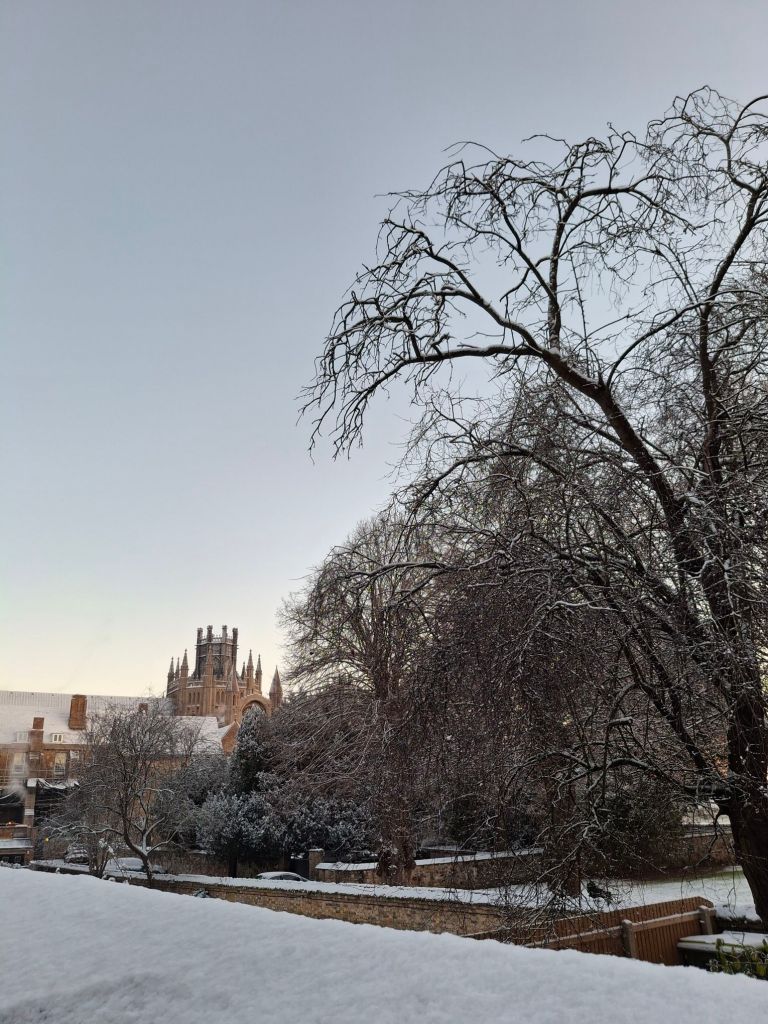
It snowed overnight! We don’t get much of it round here; in fact, it’s been almost exactly a year. So either the perpetrator of this mild act of vandalism is keeping the full twelve days of Christmas, or else someone’s driven in quite a long way without clearing their back windscreen.
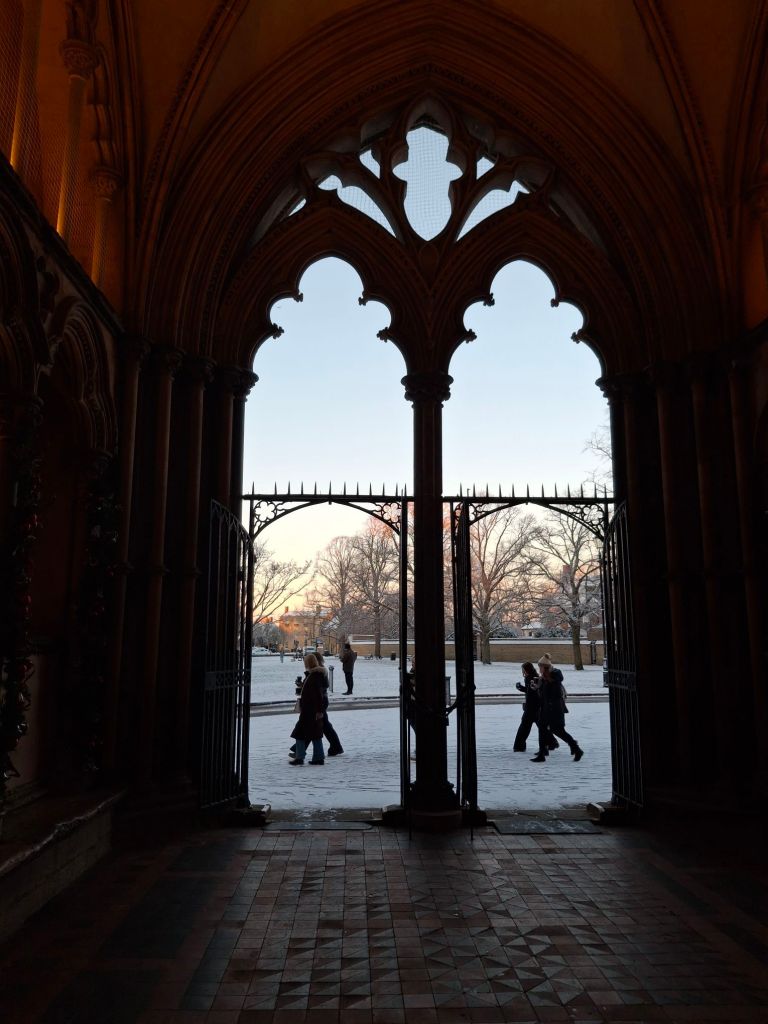
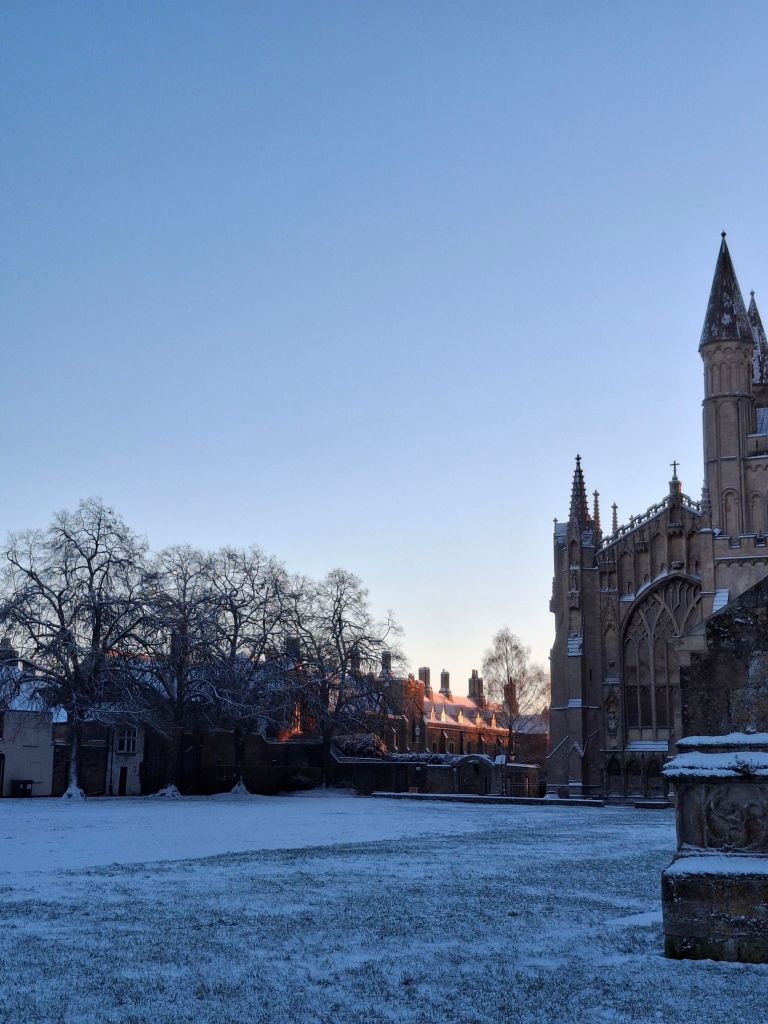
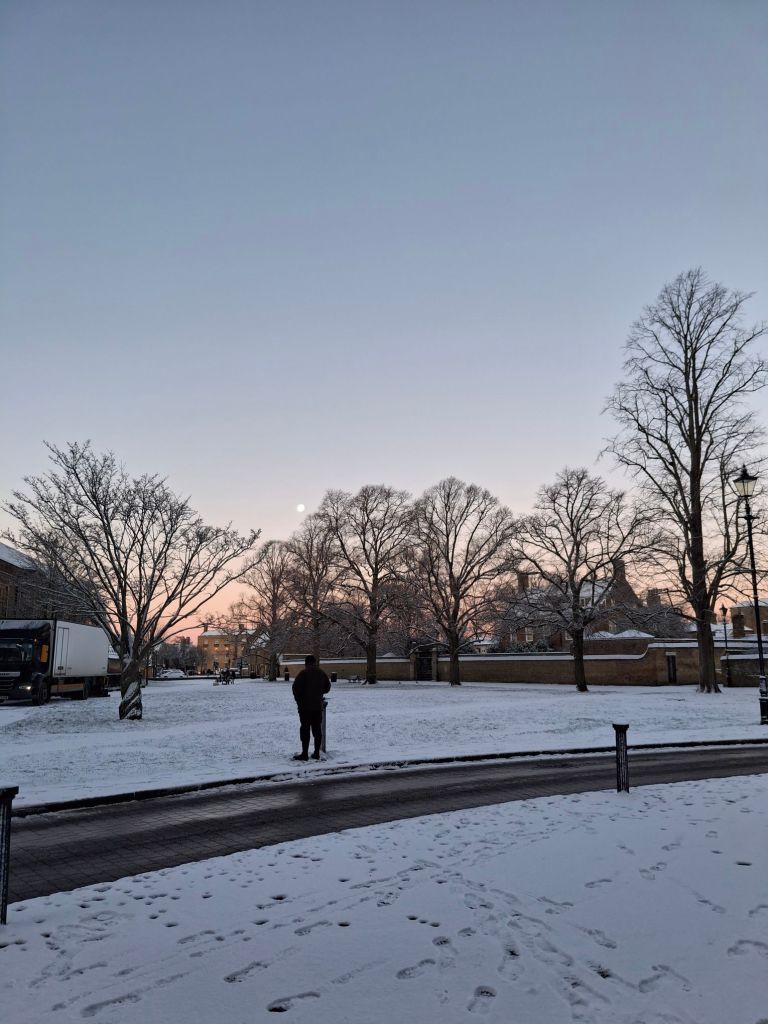
Anyway, this time last year we had a pathetic little dusting of snow, and I was in bed, in a good deal of pain and unable to keep any food down, as the leftover gas from my gallbladder removal surgery fought its way around my abdomen. (What sorted it out, for anyone in similar straits, was a little pill called Wind-eze. The packet wasn’t very clear on how it works, but it does.) Today, by contrast, I was able to walk across town in my Wellington boots, stopping at the cathedral to walk the labyrinth (still in wellies – that’s a first!) and eat the last cherry cream choux bun in Caffè Nero. So, contrary to my gloomy posts of the last month, I can and do get better.
I’m still ill. Three weeks, now; in fact, a little more. The really obnoxious symptoms have gone, but if I do just a little too much I find getting out of bed the next day very difficult indeed.
So today I sampled the solstice daylight from the door and then retired, so far as I could, to the sofa. The choir sang O Oriens at Evensong, though I didn’t hear it. Once again, it’s not really how I’d have liked to mark the solstice, but it feels oddly appropriate. And if it feels particularly dark this year – well, it was a new moon yesterday, so maybe it was.
Yesterday we went out to a stately home. There was a choir (OK but not great) singing Christmas carols outside the café, and in the chapel there were volunteers leading any visitors who cared to join in (and most seemed to) in more carols. Yesterday would have been my mother’s birthday. She would have enjoyed nitpicking the choir’s performance, and she always went carol singing on her birthday if she could. I cried, but I was so glad to have done it.
O Oriens. O morning star. O radiant dawn. Come and enlighten those who dwell in darkness and the shadow of death. A whole chunk of morning prayer unexpectedly brightening the evening.
My moon app tells me it’s a waxing crescent, 3% illuminated. Of course it’s not visible in the night time at all, and even if it were, it’s tipping it down out there. Nevertheless, despite all appearances, it might be possible that things are already getting better.
Not long after I started taking Advent Sunday as my personal new year, somebody asked me whether I was going to push my end-of-year wrap-ups and preparations forward into November. No, I said, the idea was to take the whole of December (and the first week of January, come to that) to do it at a leisurely pace, and to give me something to do other than getting fruitlessly annoyed by all the commercial-Christmas tat.
Which still holds true. My husband bought me a packet of lebkuchen, which are already in the shops: I love them, but I couldn’t quite bring myself to touch them. Not in November. And yet this year I’ve noticed myself looking forward eagerly to Stir Up Sunday – today – the last Sunday of the Church year, Christ the King in new money – and the making of the pudding. Preparing for the preparation. And I’ve been getting out the recipe books and flicking through things that look tasty, things that look fun, things I’d never normally cook or eat but which might be approached in a spirit of “It’s Christmas”.
I do like a nice recipe book. And I have been reasonably adventurous this year. (Quince, ginger and raisin suet pudding, the other weekend, from Modern Pressure Cooking. Very good.) But I’m not usually this diverted by Christmas food.
It’s partly knowing that I’ll get much less church than in the pre-baby days, and other elements of the festival seem more promising (not that I will have any more opportunity to cook, of course).
It’s partly that this year I know I can eat it without causing myself significant abdominal discomfort. (Last year I had my gallbladder removed on 30 December; from the previous Christmas up until that point, eating anything fatty put me at risk of vomiting and hideous pain.)
It’s partly having stayed, last weekend, at a Premier Inn attached to a Beefeater which was exuberantly and prematurely Christmassy.
It’s partly having led an Advent study day yesterday, based on the O Antiphons (usually encountered 17-23 December), and having been preparing for that for several weeks. (We followed it with Evensong, and used the readings for the Eve of Christ the King. They worked very well.)
It might partly be wanting this year to be over and done with. It’s been intense, and often painful, and it’s gone very fast. So why not wrap it up now?
It might partly be wanting an answer to the question So what do we do about the Christmas pudding, in the absence of our mother, who was always in charge of it?How do we stir it, when none of us is near any of the others?
And this year the answer looked like this: I made the Christmas pudding, out of the recipe book that she always used. Except she always used walnuts where the recipe says almonds, and I didn’t have quite enough walnuts, so I made up the difference with pecans. And I found the last-but-one-apple from our trees. And I sent my brothers a Zoom invitation so that they could observe the stirring.
And now the pudding is steaming away quietly on the hob. It wasn’t remotely the same, of course. But it will do. I might even open the lebkuchen.
Here’s a picture from 2010. I loved these shoes. But that’s another story.
Earlier today I was on a video call with a new colleague. He asked how long I’d been with our employer. I joined in 2010, I said, started in a regional office, moved to HQ in 2013…
At this point another colleague joined and said, yes, new colleague had been remarking how people either seemed to have joined yesterday or have been around for fifteen years.
Yes, I said, and I’m still wondering when I flipped from the one category into the other, apparently overnight.
Inside, though, I was going, Fifteen years? Really? But yes: the arithmetic is simple, it’s the getting my head around it that’s proving challenging. The anniversary slid past without my noticing a couple of months ago. Somewhere between 2013 and here, I became an old-timer.
Compare the starting point with where I am now, and it’s obvious. I live in a different town, county, region. I look very different – my hair’s gone almost completely white. Come to think of it, I started 2010 with barely any eyebrows, having pulled them out in a bad mental health patch.
I started 2010 as a depressed temp, the confidence knocked out of me by failing to get a job I’d been doing for several months, equally scared of giving myself time to breathe and of finishing any piece of work lest there be nothing more for me to do. It took me a long time to find my feet in the union world. In some ways it seemed like the job I’d been born to do, if only I’d known it existed before, working to change the world for the better every day. In others, I felt like a fraud: too shy, too introverted, too posh, too cynical, too everything, or possibly not everything enough. These days I know what I’m good at, I can see how it serves the movement, and I mostly get to do that.
Things change gradually. Even the big changes – office, job title, team, grade – took a while for me to grow into them. There are a few days that stand out in my memory as having moved me forwards significantly, but so much of it was just turning up, and doing the job, and doing the job, and doing the job day after day, and eventually realising that actually I was pretty good at it.
Outside work, too, things changed gradually. Three books, with a couple of pages written per day, and not every day at that; gradually working up the nerve to put them out into the world myself. Getting confident cycling, first on a trike and then on a bike. Buying a house; having a baby; losing both parents: big changes, those, but again, you get used to them gradually, day by day, living in the new world until you’re at home there. Second chances (there were plenty of jobs I didn’t get); another dance with vocation, parting on better terms this time round. It’s quite a lot, really; when I stop and think about it I’m not so surprised that it’s taken fifteen years to get here.
If I could go back to 2010, if I thought 2010-me would believe me, I’d tell her… Hang in there. It works out better than you could possibly imagine.
Meanwhile, across the water from the memorial gathering…
“I hope the funeral goes well,” several people said to me, and many of them added, “or as well as these things can go.”
I very much appreciated the sentiment behind that wish. And I knew exactly what they meant.
And yet. And yet it didn’t quite sit right with me, as if there was somehow an implication that because a funeral is necessarily a sad event, there would be things that would not go well. That things would go wrong, even. That because it wasn’t a joyous occasion it must necessarily be somehow slipshod, drab. That difficult and sloppy sit near each other on the same axis.
I don’t believe for a moment that anyone who used that phrase to me meant to imply any of that, of course I don’t. But this kept worrying away at me until I prodded it back.
I’ve been involved in planning all sorts of events – in my professional life, in my voluntary roles, and in my personal life. Courses, parties, retreats, church services, training days, conferences, seminars, weddings.
And yes, funerals.
I can make an event go really well. My mother’s funeral? You bet I was going to do everything I could to make that one go as well as it possibly could.
It went really well – yes, as well as it could. But better than that. Both parts – the “she didn’t want a fuss” church service and crematorium committal, and the “but more people want to pay their respects than will fit in the church” arts centre gathering the next day.
And it was really, really hard. I was very glad, in retrospect, that I didn’t put myself forward to do any reading or give any tribute at the church service, because that gave me space to fall apart completely. I’d done the work of remembering which hymn my mother wanted (yes, I found myself saying to several people afterwards, she specifically wanted the verse about the worms) and guessing which other one she might have liked, of suggesting the readings, of burrowing in the boxes of CDs in the garage to find the Bruckner Te Deum, of liasing with my brothers and the minister and my aunt, of typesetting the order of service and getting it printed. I’d done all that, and now all I had to do was to turn up. The minister carried it, and the liturgy, and my brilliant family who will absolutely sing in four-part harmony if you give them the sheet music.
The next day I was the one at the front of the room, explaining what was going to happen, introducing the musicians, finding a graceful way to bring in someone who’d arrived late but still wanted to say something. Holding the space. I remember thinking at one point that I had my work head on, because that’s what I do.
And that was hard, too. I will probably never be able to listen to Here comes the sun again, maybe never sing Auld Lang Syne.
Some things went wrong, of course. I’d have liked to have got to the church earlier and had some time on my own (as opposed to having a flaming row over a sandwich and having to spend far longer than necessary putting my make-up on and calming down). I’d have liked to have the Brahms run all the way to the end of the track. And I think the funeral directors had some trouble with the hearse and the very tight little lane, but that wasn’t my responsibility. It wasn’t perfect. But on the whole, it went very well indeed.
But it was hard because it went well. It was hard because it did what it needed to do. It was hard because there’s no way that catharsis is going to be easy. It was hard because it said what it needed to say: This person is gone, and we loved her. We loved her, and this is the last thing we can do for her.
And because it was the last thing we could do for her, we did it as well as we could.
Thank you, friends. It did indeed go as well as these things can go.
My mother died at the end of April. It was a shock and not a surprise: we knew she hadn’t been well, but we weren’t expecting this. (This, it turns out, was a pulmonary embolism, the sort of thing you can’t expect, and not the thing we were actually worrying about. I think it makes it easier, but it’s quite hard enough.)
There’s a great gap now, in the world of childbirth rights and maternity services reform, and in our lives.
This week I’ve been transferring photos from my phone onto an external drive. I’ve had this phone for nearly five years, and there are a lot of photos on there. Fewer than there were on Monday, though.
As luck would have it, I hit January 2022 just as some online friends were discussing preferences for funeral music. My father died on 8 January 2022, and the pictures from that month are a jumble of memories and plans – beloved objects, photos of photos, and important documents – some taken by me, some shared by family members and friends.
Among those important documents was a two page note in my aunt’s handwriting, a summary of a conversation she and Pa had had during a COVID lockdown. On the first page were the details of the solicitors and the insurance. On the second, a very detailed list of funeral preferences. What. Where. Who should speak. Which hymns, including specific tune in one case and hymn number in another. Music for entrance. Music for exit.
It was immensely helpful. I ended up drafting most of the service, and this document gave me a starting point and an authority; it curtailed, if it didn’t quite avoid, a lot of disagreements; it provided some interesting challenges. We didn’t follow it exactly; we also found a previous version (another photo to pop up in the January 2022 folder) and added some bits from that. But we definitely followed it in spirit.
I have made one of these myself, but it was a good decade ago and I think it’s got lost, anyway. So I’m planning to do a new version this year. I’m not planning on dying any time soon, but you never know.
Morbid? Perhaps. Self-centred? Undoubtedly, but far more helpful than being self-effacing. Even if one doesn’t want a big fuss, one’s executors aren’t necessarily going to know what “not a big fuss” looks like, and, while good funeral directors, and, I’m sure, celebrants from all traditions, will have helpful suggestions, they’re going to be at least somewhat generic, at which point you’ve just moved the question on from “what would they have wanted?” to “would they really have wanted that?” And that’s not an easy question when you’re grieving. A plain statement of preferences in black and white can be one last, immensely helpful and comforting, gift. I’d recommend everybody does one, if they can face it, and saves their family and friends a lot of grief, in the informal sense – and perhaps in the formal sense, too.
Saturday was ridiculously beautiful, and also ridiculously busy. It concentrated almost all the busyness for the month of January into one day. I went to a Cursillo training day in the morning (I’m not on the staff this time; I was just showing up to show support) and a party in the afternoon, and in between I practised two duets and made a chilli.
It was also really quite cold. This beautiful hazy morning sharpened and brightened, and the grass was hard and lumpy underfoot, and while we were singing and playing and dancing the fog rolled in and when we left we couldn’t see further than about twenty feet.
And it turns out that what I really needed in order to feel satisfied that winter has happened properly was a) a cold snap; and b) an exuberant party. Which this was. I sang Rossini (sure, it was the Cats’ Duet, but it’s not easy) and danced a Horse’s Brawl. It was great. I went back to work today (from the dining table) and it felt entirely appropriate. The festive season is concluded in style and I am now happy to get on with the rest of the year.
My writing brain started up good and proper yesterday. I don’t know why. Maybe it’s having managed to post here every day for a month and more. Maybe it was having a day in which I’d promised myself I’d do no work and only minimal Cursillo admin. Maybe it’s because it’s almost eighteen months since the baby was born and that’s just how long it takes for a brain to get going again. Maybe it’s because I did some actual proper singing and it unblocked some metaphorical tubes. Or maybe I’d just knitted some arbitrary length of combined sock. Who knows.
Anyway, in the morning I found myself rereading some things I’d written. I fixed an plot hole in one of them. And I found myself thinking more and more about the project I was working on up until, well, a little more than eighteen months ago. Actually, it’s been bouncing around in my head for the last few days, but yesterday it started demanding my attention. And now it’s telling me I need to read the book on the Dance Band Era, and get hold of a wind-up gramophone and play the 78s, and rescue all the rest of the dance band 78s, and read I don’t know, who survived the First World War and wrote about it? Siegfried Sassoon, read Siegfried Sassoon, and oh yes, definitelyDavid Blaize, and probably pick up that First World War history that I got about as far as 1915 in, and find out about twilight sleep and would an upper middle class woman be expected to breastfeed in 1924, and work out a better name for my hero (he is called Julian at the moment, which is a bit misleading)… And probably reread Romeo and Juliet just for the hell of it except that’s probably not the best use of my limited time, or rewatch it, except goodness knows I never get three straight hours free these days. And I would say read Surprised by Joy if I hadn’t just read it and concluded that, while I’m very pleased for C. S. Lewis that he got out an environment that was making him miserable, it would have been useful for me if he’d stayed on and could have written about what it was like being at school and watching form by form carted off to war, knowing your time was coming. (And good grief I don’t think his Professor Kirkpatrick as written would have let him get away with the logical fallacies in Mere Christianity, but that’s not remotely relevant.)
I started getting lines writing themselves again. I found myself wanting to reread what’s already there to make sure I hadn’t written them already, or written something that they would contradict. The cogs were turning, turning, getting up to speed. The writing brain was well and truly running. It kept me up mapping what fandom (such as there is) calls the Montacrew onto early twentieth century public school dynamics (let the reader understand). And then the toddler woke up and insisted on a really, really long feed.
You recall that I am meant to be resting and recovering. So yes, today was a washout (although I did some more singing practice and am feeling a lot better about my impending performance – and finished reading Touch Not The Cat, which is very slightly relevant.) So no, I haven’t actually added any new words to this project yet. But I’m so very glad to see it again.
We awoke to find a crust of snow outside; it decayed rapidly over the course of the morning and now it’s disconcertingly mild outside, and raining.
And well, that’s one to the pathetic fallacy, because this Christmas season does feel like a bit of a washout. I’ve spent too much of it feeling ill, worried about making myself ill, preparing for my operation, or feeling wiped out or (damn it) almost as sick as I used to, to have managed festivity for more than about an hour at a time. I missed most of the food, and (which I was looking forward to more) the midnight service. This morning I couldn’t keep my breakfast down and didn’t even feel well enough to watch the livestreamed service for Epiphany; so now I’ve missed that too.
Except, of course, Epiphany is also a season, and it has only just begun. Except, of course, my reflections on recent weeks tell you more about my mood at this moment than about what really happened. Except this morning was better than yesterday and so far my timid attempts at lunch and supper have been successful. Except I have celebrations to look forward to this coming weekend, and in a couple of days I’ll probably feel well enough to get excited about them. Except there were plenty of joyful moments in there, and I just have to trust that I’ll remember them, when I’m feeling a little better. Soon.



 Kathleen Jowitt