February reads

Moss grows in the cracks between paving stones

Twelve Words for Moss (Elizabeth-Jane Burnett) was a Christmas present from one of my brothers. It’s uncategorisable: poetry, (family) history, memoir, nature – it takes as its starting points the author’s grief at the death of her father and her enthusiasm for mosses, and weaves a narrative between the two.

I got a few chapters in before I noticed that the last sentence of each becomes the first of the next, and went back to the beginning to see what else I’d missed. When I made the deliberate effort to slow down and read the words one by one, it burst into life and turned out to be poetry. Although this did make the occasional nature-documentary-voiceover style introductions of experts somewhat jarring.

What felt simply odd to me was the absence of any sense of Burnett’s father’s personality. I think it must have been a deliberate choice, to convey the gravity of the loss by not really talking about the one who was lost, and I’m not even sure that I can say that it didn’t work for me, but it was alien. If I’d got interested in moss to the extent that Burnett has, my father would have known about it, would have got interested in it on my behalf, and would have bought me books on moss in charity shops and phoned me up to tell me that he’d heard a programme about moss on the radio,and every time I encountered moss now I’d think of him. For me, grief is about that shared connection that can’t be shared any more,  that recoils on me with a jolt because there’s nowhere for it to go now. And fair enough, maybe that’s not the sort of person that Burnett’s father was, but my point is that you just can’t tell from this book.

That doesn’t take away from how interesting a book it is, though, or how lovely the words, and I always enjoy seeing people getting really, really enthusiastic about something. And I have been noticing moss much more.

I’ve been struggling a bit with fiction recently: I find myself not wanting to feel things deeply (plenty of that in real life), so this month’s choices have been deliberately light. Although not in subject matter. Actually, I suppose both this month’s novels grapple with the question of how far we are entitled to influence the lives of our loved ones:

Hate Follow (Erin Quinn-Kong) deals with a subject that’s interested me since it first started hitting the news a decade or so ago: what happens when the children of internet personalities come of age (literally or metaphorically) and are in a position to object to their parents’ use of their names, likenesses, and actions. This was a rather superficial take on the subject: it suffered from a desire to make too many people basically well-meaning and decent. I couldn’t quite believe in the daughter’s ignorance of what her mother was sharing, or in the lawyer’s willingness to be so conveniently helpful.

I picked up The Burden (Agatha Christie, in her Mary Westmacott persona) from the library returns trolley and got through the first part the same day, and the rest of it the day after. It’s the story of the complicated relationship between two sisters; it starts out as a piece of devastating psychological realism (Christie is never sentimental about children or marriage) and goes totally bonkers in the third act. I would not have stopped reading it, though. Interesting data point for the “depiction of disabled character” files: the disabled character is appalling, but they are appalling before they become disabled and the experience does not reform them; they just become appalling in a different way.

Then I spent a lot of yesterday reading The Cuddled Little Vice (Sandman) (Elizabeth Sandifer), a very long article which did a very good job of explaining to someone who never got into comics (no shade on people who did; I just find the combination of visual storytelling and all-caps text harder work than makes for an enjoyable experience) why Neil Gaiman is such a big deal, and how he got into a position to do and get away with what he did and got away with. 57000 words – that’s basically a book – and fascinating, although, of course, horrifying.

Having written all that out, I can’t help thinking of Granny Weatherwax’s adage that sin is treating other people as things. I can’t fit Elizabeth-Jane Burnett into that, though: you could say she treats moss as people, but I don’t see the harm in that.

A kindness to one’s survivors

A shallow flood blocks a path that's blocked again by a five bar gate

This week I’ve been transferring photos from my phone onto an external drive. I’ve had this phone for nearly five years, and there are a lot of photos on there. Fewer than there were on Monday, though.

As luck would have it, I hit January 2022 just as some online friends were discussing preferences for funeral music. My father died on 8 January 2022, and the pictures from that month are a jumble of memories and plans – beloved objects, photos of photos, and important documents – some taken by me, some shared by family members and friends.

Among those important documents was a two page note in my aunt’s handwriting, a summary of a conversation she and Pa had had during a COVID lockdown. On the first page were the details of the solicitors and the insurance. On the second, a very detailed list of funeral preferences. What. Where. Who should speak. Which hymns, including specific tune in one case and hymn number in another. Music for entrance. Music for exit.

It was immensely helpful. I ended up drafting most of the service, and this document gave me a starting point and an authority; it curtailed, if it didn’t quite avoid, a lot of disagreements; it provided some interesting challenges. We didn’t follow it exactly; we also found a previous version (another photo to pop up in the January 2022 folder) and added some bits from that. But we definitely followed it in spirit.

I have made one of these myself, but it was a good decade ago and I think it’s got lost, anyway. So I’m planning to do a new version this year. I’m not planning on dying any time soon, but you never know.

Morbid? Perhaps. Self-centred? Undoubtedly, but far more helpful than being self-effacing. Even if one doesn’t want a big fuss, one’s executors aren’t necessarily going to know what “not a big fuss” looks like, and, while good funeral directors, and, I’m sure, celebrants from all traditions, will have helpful suggestions, they’re going to be at least somewhat generic, at which point you’ve just moved the question on from “what would they have wanted?” to “would they really have wanted that?” And that’s not an easy question when you’re grieving. A plain statement of preferences in black and white can be one last, immensely helpful and comforting, gift. I’d recommend everybody does one, if they can face it, and saves their family and friends a lot of grief, in the informal sense – and perhaps in the formal sense, too.

December Reflections 16: memorable meal in 2024

A faded painted sign advertising Kimberley Ales, half hidden behind a gazebo, some wheelie bins and some plastic crates

Well, you can ask for Kimberley Ales, but you won’t get them. However, our “bus crew: the next generation, and the generation after that” meal at the Cliff Inn, Crich, was enjoyable in every way. I am not sure that “those people who turned up every August bank holiday in the 1970s and drank the pub dry” are even a folk memory at the Cliff any more, but the current management made us extremely welcome and organised a meal for a dozen.

There is a song dating from those days, with the chorus, “Isn’t it grand, boys, to be drinking at Cliff”. Each verse begins “Look at [person]”, or, in my father’s case, “Regardez le Patron”. It’s a bit depressing to sing these days, as a lot of the subjects are now drinking in the bar up yonder. (To absent friends!) We did not, could not possibly, have done them justice, but it was at least something of a memorial, and I enjoyed it.

(This photo actually taken at the Tramway Museum, a little way up the hill. I didn’t end up taking any at the Cliff.)

December Reflections 3: remembering

A framed watercolour painting of a building on an island in a mirror, a framed prayer by Robert Louis Stevenson illustrated with a photo of an angel carved in stone, and a brass rubbing (only partly visible) hang next a door

In the introduction to my copy of Virginia Woolf’s The Years, Jeri Johnson draws attention to the way that certain pieces of furniture reappear in different settings through the book – the sort of thing it’s easy to do in film, but which requires considerable skill to pull off in a novel. I’ve been thinking of this a lot as I try to assimilate objects and artworks from my late father’s house into my own. Sometimes it’s been a bit of a challenge – twenty-first century walls are not, on the whole, tall enough to give nineteenth century portraits the breathing room they deserve – but this little prayer fits beautifully next our front door.

In Pa’s house (smaller than this one, and certainly fuller) it was clamped onto the end of a bookcase. It hung in the bathroom at the house before. And at the house before that, I’m pretty sure. I don’t know about the one before that; I was only four. Reading it over and over, it’s sunk into my head. I know it by heart, without ever having deliberately set out to learn it.

In fact, I’m not sure I’ve ever read this prayer aloud. I would find it difficult to do the play the man bit seriously; when I pray it in my head, which I quite often do when I need a prayer in the morning and can’t remember how the Collect for Grace begins, I can add a mental footnote (‘you know what I mean’). I remember Pa telling me how when he was a child he thought ‘play the man’ referred to a stage role, and ‘perform them’ followed on from that. That’s got me thinking about how nobody (hardly anybody) really gets what ‘performative’ means (me included), but that’s not really the point here.

In my memory I also see it quoted in the visitors’ book – ‘… laughter and kind faces; let cheerfulness abound with industry…’ in the spiky handwriting of a dear departed friend. I don’t remember a huge amount of industry happening in my childhood home (my mother, I am sure, would beg to differ) but it most definitely had its cheerful moments, many of them associated with that very friend.

The angel – you can’t quite see in the photograph of a photograph – is from Southwell. We visited Southwell this summer, but I didn’t think to look for the angel. Nor did we look at the famous Southwell Leaves, which were in a part of the minster that looked a bit daunting to attempt with a pushchair. We did, however, find a memorial to the victims of the Katyn massacre – something we would most definitely have sought out had we known about it, as my husband’s great-grandfather was among those murdered. It brought us up short; we’d only diverted to Southwell to tick another cathedral off the list and find lunch. A surprise – a stop-and-think-for-a-moment – a remembering – keep it alive – keep them alive.

Remembering is an inexact art. Was that prayer really in the bathroom? My memory tried to put it in the bathroom at my father’s last house, too, but I know I unscrewed it from the bookcase myself. I’m getting confused with prayers for washing of hands. Already the family stories blur and swirl. My brother (happy birthday!) went to look for the house where those portraits must have hung, and now it’s a chip shop. Except that was twelve years ago, assuming he went when I assume he did. We write down what we can remember, and then wonder how long the writing survives. Digital decays fast: I shouldn’t be surprised if that framed prayer outlives this blog. As for the memory that goes with it, that’s another question. In the long view, it doesn’t really matter. If the prayer survives, it will be because somebody likes it, for the sake of its associations (my father, me, Southwell, who knows) or for its own. In the meantime, I see it as I put my shoes and coat on and prepare to leave the house:

Give us to go blithely on our business all this day, and bring us to our resting beds weary and content and undishonoured, and grant us in the end the gift of sleep.

A new departure: The Book Bus Espace Libre

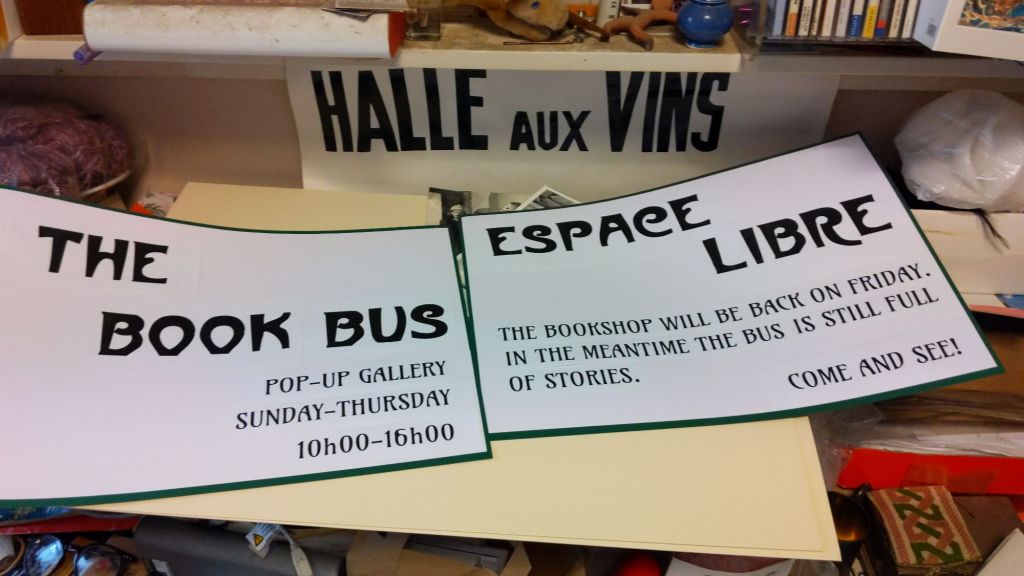
Posters in art nouveau typefaces say:
The Book Bus 
Pop-up gallery 
Sunday -Thursday 10h00-16h00 

Espace Libre 
The bookshop will be back on Friday. In the meantime the bus is still full of stories. Come and see!

This summer I rather unexpectedly found myself coordinating and curating an exhibition. This is a first for me, and I’m rather pleased with the result.

Ventnor Fringe was on. I was going to be there. So was 3267, in the guise of the Book Bus. So far, so normal. I’d missed last year, the baby being just too tiny, and was looking forward to returning to my summer arts hit.

Ventnor Fringe has been getting bigger every year, in terms of both space and time, and this year it was going to be ten days long. It was only going to be reasonably practicable to make the bookshop happen for four days of that, and the preferred distribution of those four days was both Fridays and both Saturdays. Which left a five-day gap in the middle. Perhaps we could have some sort of an exhibition to fill it…

Such was the situation as described to me in mid-June, and to my delight the creative bit of my brain, which has been in and out and mostly out for the past two years, immediately rushed in. Various other people were having ideas too. Brilliant! My brain was coming up with a grand overarching idea to pull it all together:

This bus is usually a bookshop. So what do you get if you take the books out of a bookshop? And what if that space is something that has seen a lot in its time?

A title appeared. Espace Libre. Free Space. Maybe Espace Livre? No, trying too hard. Let it speak for itself. This is just another way to express what I’ve been trying to do with Book Bus Stories, assuming I ever finish the thing. If I had finished the thing it would make an exhibition in itself. But it could make a little part of one, maybe…

I angled for the job of coordinating it all – perhaps a trifle ambitious, trying to do it all from the mainland and with a baby clinging to my legs, but I wasn’t going to let that worry me – and the rest of the gang were extremely happy to let me do it.

So off I went. I selected (extremely select) quotations from my father’s accounts of how he got the bus this side of the Channel in the first place. I polished up three of my own Book Bus Stories to make a small display – and commit myself to finishing the rest of the damn things in time for next year. I spent quite a lot of money on boards and various forms of adhesive. I bought chain and cable ties in the DIY bit of our wonderful local department store, and if the assistant thought it was in any way weird she didn’t let on. I printed out everything I’d written. I posted the whole lot to Ventnor. And I chased and chased and chased the other contributors, and/or my family members who had undertaken to organise the other contributors for me.

Then I got to the Isle of Wight and spent a frantic couple of evenings sticking photos and cards to boards, or, in one case, making holes in a board with a corkscrew and attaching books with string, chain, and cable ties, while the baby was in bed. And we moved the whole lot onto the bus on Sunday morning.

In short, I had a lovely time.

This was a combination of the kind of project and people organising I do in my day job, and the kind of creative work I do in my free time, and it was the first time since I’d gone on maternity leave that I’d got my teeth into either of them in a big way. My brain had come back, and, since I’d been a bit worried that it had dissolved and dribbled out of my ears some time between COVID and quickening, this was incredibly exciting. I can do this kind of thing. Not only is this reassuring in the context of my return to work next week, it’s also encouraging to think that I might be able to return to some of the three or four books I have been attempting to write on and off since 2021.

I’m not going to have a huge amount more free time in which to use reclaimed creative powers. I get a couple of train journeys and a couple of lunch hours every week, and all the fruit trees need pruning. I will aim to get something done. I hope to post here more frequently, too. We’ll see how that goes. In the meantime, here’s a look at The Book Bus: Espace Libre.

on a personal level

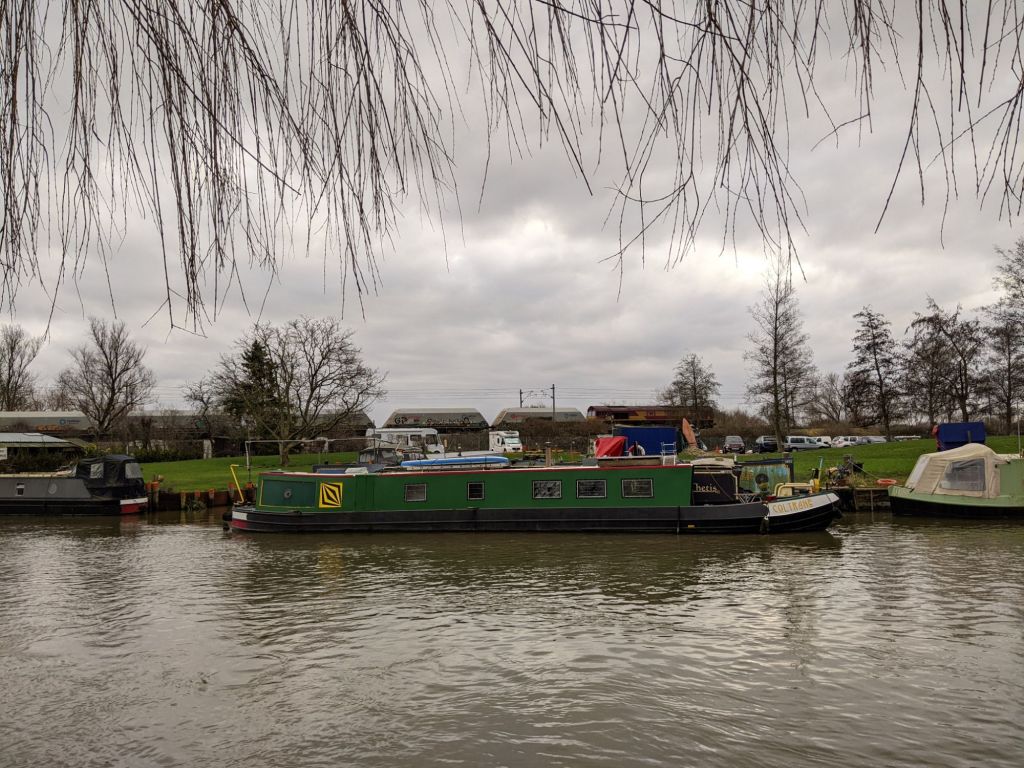
A freight train crosses the back of the picture on a grey day; in front of it, a narrowboat is moored on a river.

Drink red wine from a tumbler.

Add three spoonfuls of sugar to black coffee.

Write a sentence longer than most people’s paragraphs.

Talk to a railway man.

Quote some dreadful Victorian slush.

Try to persuade the nearest soprano to sing some dreadful Victorian slush.

Photograph some buses.

Tell everyone you prefer trains.

Look at three different maps of the same place, none current.

Take the baby to look at trains.

Take a beermat home with you. Take six beermats home with you. (Or: be pleased that the beermat collection has gone to someone who appreciates it.)

Join the Friends of King Alfred Buses. (I have been meaning to do this for ages and have at least/at last managed to print off the application form.)

Yell ‘Trolloper!’ at the cat. (I didn’t, because it was five in the morning and the rest of the household was more or less asleep, despite the noise of the cat/waste paper battle.)

Read the lesson at Mattins. (I get one opportunity per year. I am on the rota.)

Remember the date. Tell people why it’s meaningful on a personal level. Although probably not in those terms.

(Two years without Pa, six months, nearly, with the little one.)

(Thanks to Havi for the concept of SMOPL.)

December Reflections 15: cherished

A toy pig made from beige corduroy. It has one blue eye.

Pa gave me this venerable pig on semi-permanent loan some time in the late 1990s, probably, and told me, “You must cherish him,” so I did, and then gave him back when I went to university, I should think, and then I reclaimed him last year.

I have a few of Pa’s old toys (for a war baby, he did extremely well). I’m still missing one of the Dutch dolls. I think Pa removed her from the dolls’ house to crew a steam engine, but where has she gone? I hope she’ll turn up as we continue to empty the house.

Week-(endings and beginnings)

Two wheelie bins, one of which is decorated with a selection of faded stickers, against an ivy-covered brick wall

The good

Approximately a week before the world changed three years ago I spent a weekend in Bristol. My stated purpose in being there was to help a friend attend her brother’s wedding, but that turned out to be only a few hours of it. Bristol isn’t a city that I know at all well, but even so, wandering around it on a Sunday morning, meeting up with other friends, I found it reflecting back layers and layers of myself and my past and, in the process, beginning to make sense of a disorientating change of direction that had happened to me a month or so before that.

Something similar happened this weekend, except I wasn’t in Bristol, I was in Winchester. Which is the city of my birth, and one to which I used to return every year in my childhood. It’s been less frequent recently, but this time round it had a lot to say to me. We were there for a ‘just over a year since the funeral’ memorial gathering for my father, but I had fortitously discovered that the Church Times Festival of Faith and Literature was going on at the same time, and we arrived with so much time in hand that I was able to go and look at my childhood home (not that I remember it) too. And once again there was that same sense of gathering up everybody I am and used to be and bringing them together into the same person. So many little messages. The bin, which has somehow survived thirty-four years (and the accompanying reflection that my father was such a personality that even his wheelie bin is identifiable as his thirty-four years later). A Progress Pride flag on the pavement. A labyrinth in the university chapel. Witty and erudite conversations about faith and literature, and remembering that I am after all a person of both. And also bringing that person back into contact with the disreputable bus crew member that I was born and still am. And the sense that my brain is working again. And being able to walk up and down the hills of Winchester without being completely exhausted.

Then the gathering itself was excellent. And I was not as exhausted during it as I feared I might be.

The mixed

I didn’t get really, really tired until South Mimms services on the way home. However, I have been really, really tired today.

The difficult and perplexing

Tedious physical symptoms of the ‘You really don’t want to know’ variety.

What’s working

Exercising my particular skill set in the job for which I am the right person.

Reading

This has been a good week for reading! First there was Hood – a very early Emma Donoghue, from back before she started concentrating on historicals. I found the depiction of the 1990s Irish lesbian scene, of which the narrator both is and isn’t really a member, fascinating; the prose was gorgeous; and the whole thing was satisfyingly messy in ways it’s difficult to do these days without someone on Twitter calling you ‘problematic’. Then I read Golden Hill because one of the speakers at one of the FaithLit sessions I had tickets to was Francis Spufford, and that was just tremendously fun.

I must also mention this delightful paper: Jurassic Pork: What Could A Jewish Time Traveler Eat?

Mending

I darned a hole in the elbow of a pyjama top; another, smaller hole has appeared next it, and another one on the other arm. I’ve done some of the holes in one of Tony’s fancy merino T-shirts too.

Listening to

Catherine Fox and Francis Spufford talking about ‘Real faith in imaginary places’ (which made me think that I really must finish off the Reader’s Gazetteer series) and Jay Hulme and Rachel Mann talking about ‘Mapping a landscape of (un)holy desires’ (which made me think that I really must write about the epiphanies of 2020-date; for the moment I would like to express my gratitude to the audience member who made the point about how desire, in the very broadest sense of the word, is basically seen as unseemly for and therefore irrelevant to Christian women – sing it, sister!) Anyway, I really enjoyed both sessions, and failed to take any notes at all.

Mattins at the cathedral on Sunday morning: a modern but quasi-plainsong Benedicite that I can’t say I really enjoyed, but a Stanford Benedictus and a nice depressing Tudor anthem to make up for it (complete with a story about how the composer of the latter attempted to murder the Dean).

Looking at

The Chinese and British exhibition at the British Library. Predictably, I was most taken by a beautifully detailed dolls’ house Chinese restaurant. Yesterday, aside from significant addresses already mentioned, some new King Alfred buses; the most gloriously impractical family car the six of us ever piled into (before it was returned to its spiritual home); and my grandparents’ and great-grandparents’ grave.

Eating

A most excellent Sunday lunch (I had roast beef) at the Running Horse in Littleton, courtesy of my godfather.

Moving

Not much to report beyond walking around various bits of Winchester.

Noticing

Two horse-drawn vehicles (minus the horses) on the back of a rescue truck. Hares, from the train. A pair of tractors waiting to cross the railway line. Quite a few deer in various Hampshire fields. An advertisement for ‘new almshouses’, which feels most Trollopian. A fox running across the road somewhere north of Royston. I have already mentioned the bin.

Appreciating

My fabulous family and bus crew (this is how my family spells ‘found family’).

Acquisitions

A carful of second-hand baby stuff.

Hankering

Various books I liked the look of but didn’t buy.

Line of the week

From Hood:

The wind was a black cat outside, rattling the chimney and spitting at the windows.

This coming week

I am going to attempt to recover some energy, catch up with some admin, and tidy some more of my study. Looking forward to seeing a friend on Friday.

Anything you’d like to share from last week? Any hopes for this week? Share them here!

Lost and found

Two books, 'Field Guide to the Birds of Britain and Ireland', 'Floral Patterns of India', and a white ceramic coaster with a gold letter K, on a padded envelope with 'KAFJ BIRTHDAY 26 JUL 21' written on it in red ballpoint pen

Every time I spoke to Pa over the last few months of his life, he said to me, ‘I still haven’t found your birthday present’. Found, that is, in the room that he used as half study, half bedroom, half model railway layout, and indeed, good luck finding anything in there. He’d given me a hideous charity shop coaster as a sort of joke present on the day itself, but my actual present was lost.

I assumed we’d never find it. Or, rather, I assumed we’d find it and we wouldn’t know. That it would be loose among his own things, indistinguishable from them.

But there it was: a padded envelope, with my initials and the date of my birthday. I cried a bit. Inside: a book of birds, and a book of stickers. Yes. Something I’d like, but something that might have been his own.

We found all sorts of things. There was another envelope, a much older one. Inside was a scarf. The writing on the envelope told us that the scarf was made by my great-grandmother for my grandfather, and it was in remarkably good condition one hundred and twenty years later. Other things were not so well documented. In the same box as the scarf we found several lovely early twentieth century Christmas cards, with no clue as to who sent them, or to whom. Somebody must have kept them for some reason, but I shouldn’t think we’ll ever know now.

We fill our homes with things – because we like them, because somebody important gave them to us, because we don’t get round to getting rid of them. We know what the reasons are; the people who come after us probably won’t, unless we tell them. I can see myself hanging onto that padded envelope; if so, I can see my children, if I have any, chucking it. And we will both be right.

Every item in a house is there for a reason. Some of those reasons are not particularly good ones.

‘Every word on that page is there for a reason,’ my A-level English teacher told me. It was quite possibly the most significant thing I learned at school. Every word represents a choice. Saying it this way, not any of the other ways one might have said it. Keeping it there when you come to reread. Deciding that it needed to be said in the first place.

Pa was an expansive, digressive, eclectic writer. He wrote about all sorts of things, though the nominal subject was usually mass transit. Most of his readers were quite happy to come along for the ride. And I think that his reason for most of the words, like most of the items, was, quite simply, that he liked them.

Here’s something that’s in my house for a reason, a birthday present I most definitely knew about. This was what Pa made me for my fifth birthday. It says so on the back.

A large wooden dolls' house in a cluttered room

Robert E. Jowitt, 1942-2022

A man in a green cap and jacket leans o the radiator of a 1930s bus with a protruding nose and boxy cab

My father died sometime in the night of 7-8 January, about as peacefully as it’s possible to do it, and I still don’t quite know what to say.

Not because there’s nothing to say: everybody I hear from who knew him has something lovely to say, some delightful memory to share. Not because there’s nothing to talk about: there are 79 years to talk about, and I was around for slightly less than half of that.

It’s such a cliché to begin by saying that one doesn’t know where to start that I almost don’t want to admit it, but in this case it’s true. My own tactic to deal with that very real dilemma is to start with whatever first comes to mind, and to worry about reordering it later.

So, in that spirit, here are some things that I want to say about my Pa.

  • He always was Pa, not Dad or anything else.
  • We lived in more or less the same wordscape, sharing hymns and trashy Victorian songs and Shakespeare and quasi-mythological family anecdotes and using quotations as shorthand.
  • I wouldn’t be writing something set in modern-day Ruritania now if he hadn’t read me The Prisoner of Zenda when I was nine or ten.
  • I’m sure that many people who come across this post will be looking for Robert E. Jowitt the transport author and photographer, and that was indeed very much part of who he was. Both his writing and his photography were as eclectic and idiosyncratic as his reading matter. He liked digressions and very long sentences and quotations.
  • If you’d told him that real men don’t read Jilly Cooper he’d have laughed at you.
  • There is still a card on the fridge with a list of the OS maps that he was missing from his collection and which I might have wanted to give him for his birthday.
  • He had a strong sense of whimsy and, I suppose, sentimentality.
  • He was, above all, interested in people. He would quite often ask me about friends of mine who he’d met perhaps twice, five years ago. He could make friends with pretty much anybody. He annoyed transport photography purists by taking pictures with a nun obscuring the numberplate, or a tramp in front of a tram, a shopper or a copper in the way of a tree-lopper. He liked to show public transport in, well, public, putting it in the context of the public it was built to serve and the landscape across which it transported it.
  • He claimed not to be terribly interested in buses, though he would take them in the absence of trams, trolleybuses, or steam locomotives. The one exception was Paris buses, the open-platformed 1930s Renaults. He photographed his first one in 1960 and brought it home in 1970. It’s still running.
  • He gathered the most extraordinary group of people around the buses, a sort of found family before anybody called it that. Bus people, art people, music people, all sorts of people.
  • He never did anything he didn’t want to do.
  • He couldn’t sing but he didn’t let that stop him.
  • He really was impossible to live with.
  • He was interested in birds and ships and architecture and bel canto opera and all sorts of things.
  • He was immensely proud of his children and of our achievements, though if he found something where there was room for improvement we’d hear about it.
  • He was an entertaining raconteur. I can’t tell the stories half so well.
  • The last time we saw each other face to face we talked about We Didn’t Mean To Go To Sea and teamed up in a family game of Settlers of Catan. The last time we spoke on the phone he thanked me for his Christmas present – the 2022 calendar from A Cambridge Diary – and told me that his favourite picture in it was the housemartins.

Is that everything? No, not at all. I could go on and on and on. But it is something. There’s a big gap in many people’s lives now.

Edited to add: the funeral will take place on Wednesday, 2 February – please see the funeral director’s site for details of how to watch online.