Books I intend to finish in 2026

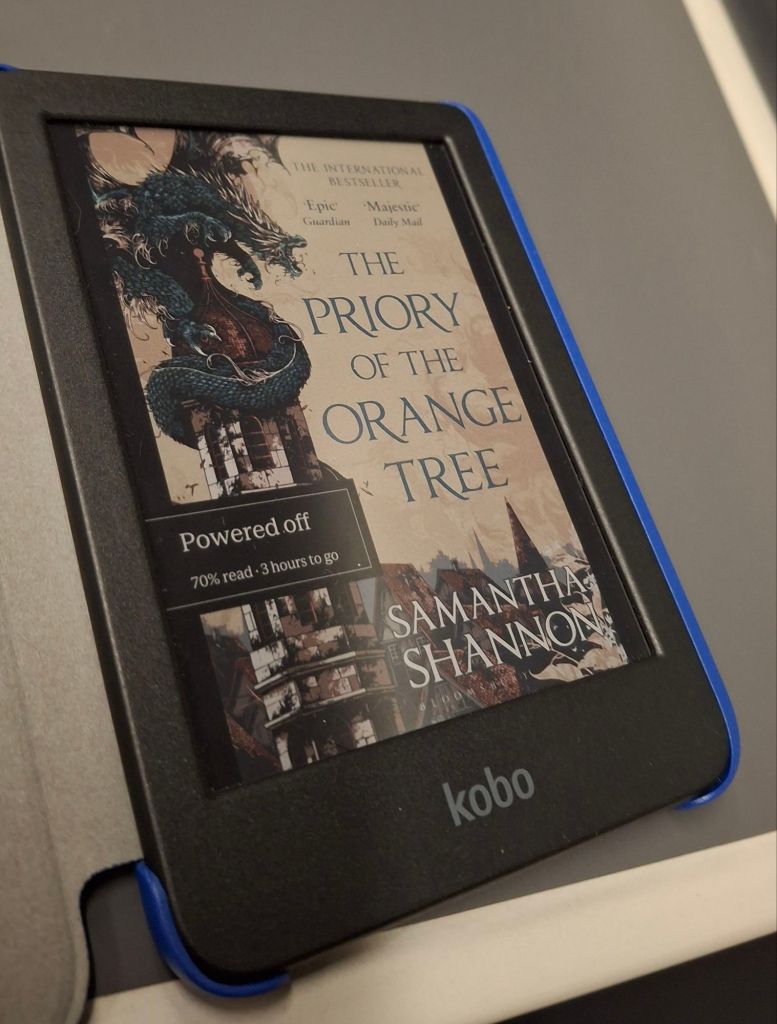
Kobo ebook reader showing the cover of The Priory of the Orange Tree (Samantha Shannon) at 70% read

I started them in 2025, and am enjoying them enough to finish them. I just didn’t get them over the wire before the end of the year.

The Priory of the Orange Tree (Samantha Shannon) would probably have got there but for the fact that it’s a library book. My e-loan expired on Boxing Day, when I was somewhere around the 65% mark. I went straight back to the hold queue, and managed to borrow it again on New Year’s Eve. Now I have until the 15th, and the pressure’s off. Maybe too much so. We’ll see if I can finish it before then. Anyway, it’s great fun: an epic fantasy that’s attempting to, and generally succeeding in, evoking all the dragon mythology of East and West, and throwing in 16th century politics too.

Towers in the Mist (Elizabeth Goudge) has in fact been in progress since before 2025. I can’t remember when I started it, but it was probably some time in 2024. I was enjoying it, but was finding it harder work than I had the brain for at that point. Now I suspect it’s getting in the way of my starting The Players’ Boy, which arrived several months ago and which (most unusually for me and Antonia Forest) I haven’t yet opened. I’m sure I will be in the mood for atmospheric historicals sooner or later.

Public Schools and the Great War: the generation lost (Anthony Seldon and David Walsh) is research for the work in progress now tentatively known as Household Rancour. It’s about as depressing as you’d expect, but very interesting, and very useful for my purposes. I’m very glad that I stumbled across the recommendation while idly scrolling with no thought of writing in my mind.

Everything I’ve Ever Learned About Change (Lesley Garner). Everything I’ve Ever Done That Worked was one of the books that shaped my mind and attitude when I read it in my teens, and I still consciously apply many of its principles (Be A Music Listener; When The Sea Is Rough Mend Your Sails; The Sea Is Your Dinner Companion, etc). Now I’m 40 and have worked more of this stuff out for myself, so Garner’s later books (I also read Everything I’ve Ever Learned About Love last year) aren’t blowing my mind in the same way, but I’m still enjoying this, whrn I remember to read a chapter over lunch.

Spirituality in Season (Ross Thompson) follows the liturgical year, starting with Advent, and I’m reading it in real time, so to speak, so if all goes well I’ll finish it at Christ the King – the end of November.

Everyday Nature: how noticing nature can quietly change your life (Andy Beer) is a book with a section for each day. I started in the autumn of 2024, was going quite well in the spring of 2025, and then, like so many things, put it down when my mother died. So now I’m trying again. I’ve read the bit about dunnocks twice now and still can’t tell the difference between them and sparrows.

On a similar note, The Morville Year (Katherine Swift), a collection of garden columns. But that follows the old year and runs March-March, so I’m saving it.

Waiting

A fluffy black cat (she has white bits, but they aren't visible in this photo) sinks into a burgundy velvet cushion, her eyes only just open

If I’ve been a bit slow on the uptake, I suppose I can blame this lingering lurgy. It’s been two weeks and I’m still lethargic and very conscious that I’m not yet well. I’m better, I think, than I was on Advent Sunday, when I was cold and wobbly and wondering what on earth was wrong with me; certainly better than last Friday, or this Monday; but still not entirely well.

Some friends observed recently that in these days of antibiotics and painkillers (both undoubted benefits to the world at large, let me be clear) we’re stumped by minor illnesses whose symptoms persist. I couldn’t take antibiotics for a cold, and, while I was glad enough of paracetamol and pseudephedrine when my head and ears were aching and I couldn’t breathe without thinking about it, there’s been nothing to be done with the fatigue. Except, of course, waiting. A hundred years ago that would just have been the way things were. You’d have to give your immune system time to do its job, you wouldn’t be able to dose yourself up and power on through.

This year I’ve been reading, very slowly, Kathleen Norris’s The Noonday Demon, in which she examines the cardinal sin/bad thought (depending on which theologians you ask) of acedia. This concept has some overlap with the clinical condition of depression, and is often translated as ‘despair’, but, Norris seems to argue, is perhaps best interpreted as the desire to be somewhere other than where you are. This resonated, often when the toddler just wouldn’t go to sleep, but at other times too.

And recently I picked up Ross Thompson’s Spirituality in Season, in which he talks about three kinds of ‘abyss’, or exclusion:

First, there is exclusion from God, which because God embraces us always, can only be self-wrought; this is sin, leading to hell. Second, there is exclusion from life and being, which by definition is death. And third there is exclusion of our fellow human-beings, which in much of the teaching of Jesus… seems to be equated with the judgement; we are already judged, it seems, by our own response to our neighbour in need.

Then he draws a contrast between the two penitential seasons of Lent and Advent, noting that in Lent we actively confront this abyss (because, as he says, it’s all the same thing) while in Advent we ‘vulnerably experience their great danger, before experiencing at Christmas the one who saves us’.

And then he goes on to talk about waiting, using the example of waiting for a bus. We wait for something (or someone) over whose arrival we have no control at all.

(Here, I would add, we have two options: we can watch, or we can seek distraction. I’m very conscious that lately – the last few months, maybe longer – I’ve been seeking distraction. I’ve been very reluctant to face the inside of my own head, or heart. Too tired. And it’s going to hurt. Maybe. That might or might not be what’s going on. I need to look at that too.)

I read this… in November, if not October. I gleaned some useful facts for my O Antiphons workshop. I noted the reference to W. H. Vanstone’s writing on passivity in the events of Holy Week, which I have also read, and found useful.

And then I spent the first ten days of Advent absolutely hating where I was, furious that I didn’t have the energy to engage in anything that felt like a meaningful observance. And not being able to prepare for Christmas, the sacred or the secular versions, either.

And then it clicked. Waiting. I’m waiting. I’m waiting to feel better. I have very little control over how my body deals with this illness; even my capacity to do nothing is limited. This is, or could be, more meaningful than any Advent devotional book, could teach me more than any twenty-four windows I could open. This is a particularly immersive way to experience waiting, and, therefore, to observe Advent.

Has it helped? Immensely. If nothing else, laughing at my own failure to get it improved at least a couple of days last week. And not at all. Today, for instance, I wrote, I am losing sight of the concept of anything getting better. (And about three minutes after I wrote that, it did.) But that’s the way it goes. If I’d assimilated this brilliant new insight immediately, discovered how to embrace my enfeebled physical state as a symbol of my mortal human state, and glided up to new heights of spiritual consciousness I’d have missed the point, wouldn’t I?

So here I still am. Waiting.