
About time I did one of these again…
The good
A trip to Sheffield for the annual Ultreya GB. I missed last year’s, though I hadn’t intended to (in retrospect, my ideas of what would be possible with a small baby were somewhat unrealistic), and it was good to be back. It was quite a different experience: I was very tired (see below) and also I don’t usually spend the event climbing up and down all the available steps in the cathedral. But it all came together for me in the last hymn – a very lively Amazing Grace – with the banners lined up and the baby clapping along in delight.
Some delightful fellow passengers and some railway staff who may in fact have been angels.
The difficult and perplexing
A month’s worth of interrupted sleep has trashed my immune system, the nursery germs have pounced, and I was very wobbly earlier in the week. And I’m not a nice person when I’m ill and tired.
Two hours and forty minutes on a train, each way. The way back was more trying than the way out.
What’s working
Sloggi long pants. Do they make me feel about a hundred and two? Yes, particularly the beige ones. Is it worth it to make bare legs bearable in hot weather? Absolutely. (Yes, I am aware of the Snag ‘chub rub’ shorts. Quite apart from the hideousness of the name, I can’t see that synthetic material next the skin would help in any way, however much I like their tights.)
Reading
Quite a bit! Having read She Who Became The Sun earlier in the summer, I picked up He Who Drowned The World (Shelley Parker-Chan) when it was on offer a few weeks ago. Equally fun (in its extremely dark way); the magical realism has more of an active influence on the plot this time round. I wasn’t convinced it stuck the landing, but the overall experience was sufficiently enjoyable to render that largely irrelevant.
Also on offer recently was Sea of Tranquility (Emily St John Mandel). This was a bit of a disappointment. I read Station Eleven early in 2020 and was very struck by how vivid and alien the post-apocalyptic world was. Sea of Tranquility, by contrast, all seemed extremely twenty-first century in terms of the way that the characters thought and spoke, with the different settings just so much window-dressing. The time travel plot also didn’t work for me; I think the aim was to subvert the usual clichés, but it just felt like a cop-out.
And Kobo also suggested Consider Phlebas (Iain M. Banks) for 99p, so I decided it was probably time I tried the Culture series.
Yesterday I started One Pair of Feet (Monica Dickens) which is very entertaining so far.
Then today I picked up N or M (Agatha Christie) because it was on the floor. I am less fond of Tommy and Tuppence than I am of most of Christie’s other series detectives, so missed this one on last year’s epic re-read. But I breezed through it and then picked up Postern of Fate to remind myself what happened to the family afterwards.
Writing
Nothing to speak of, though I have been doing a little worldbuilding in my head.
Making
One ridiculously huge baby sock, and now most of one more sensible one. I also converted a little binder into an earring holder (I will try to remember to post pictures of this).
Watching
The Paralympics, on and off. I was pleased to catch Sarah Storey’s umpteenth win, as Channel 4 also showed a decent chunk of the race. (I have found both the BBC and Channel 4 very frustrating in their tendency to show fragments of an event that have a Great British Medal Hope and nothing else. But it’s probably just as well this year, because I’ve had very little telly time.)
Looking at
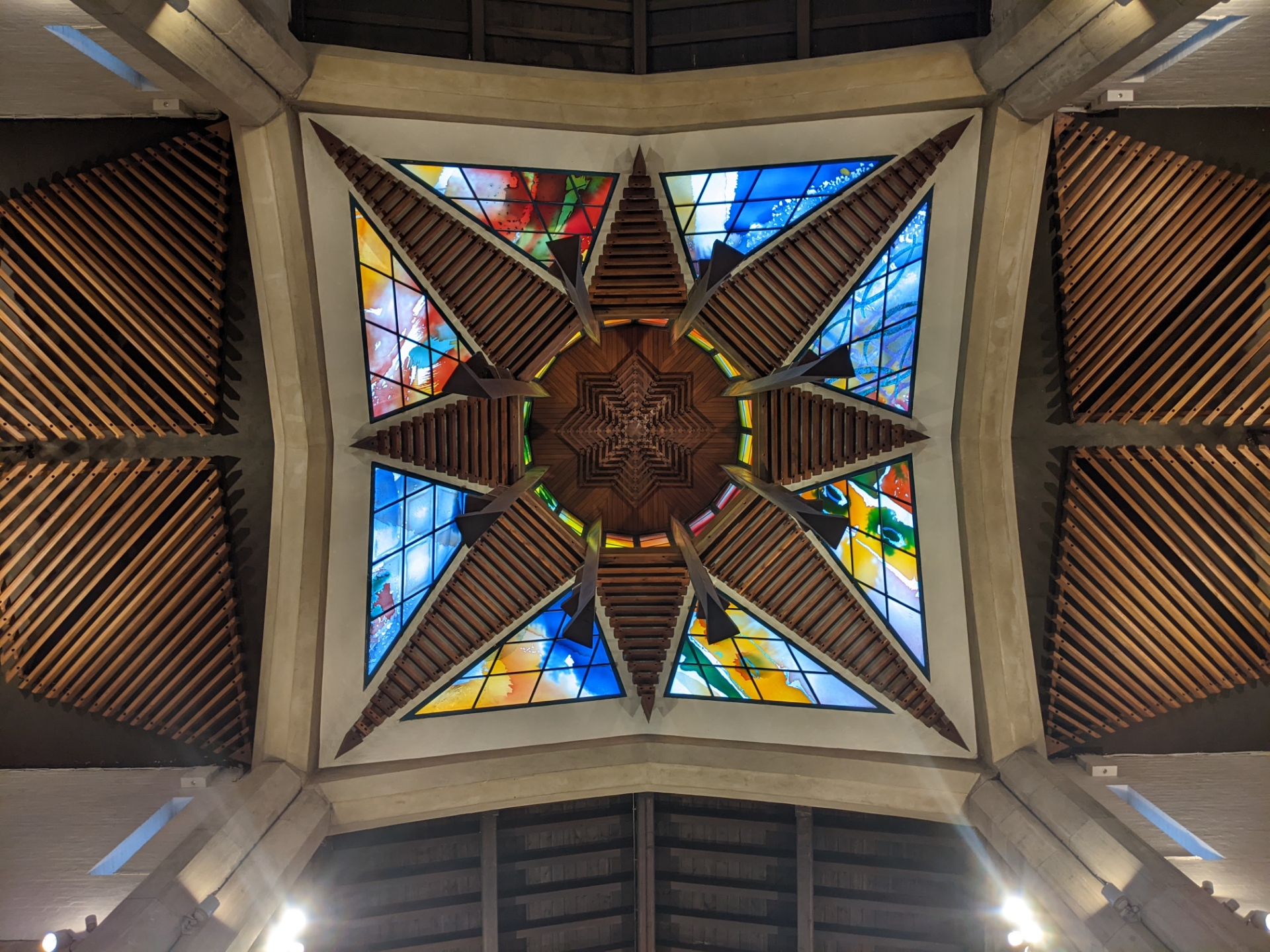
Ely Photographic Club’s exhibition at Babylon Arts. There were a few pieces there that made me smile, and several that were clearly very technically skilled even if not really my thing. Also, Sheffield cathedral.
Cooking
A very hot vegetable curry: the veg box contained a bag of Padrón peppers, every single one of which was the ‘really quite spicy’ variety, so unsuitable for serving as a main/side dish in the usual way. Not one of my most successful dishes, though I’m pleased with it as a creative response to a problem.
Eating
This year’s fancy Magnum flavours, an impulse buy when they were on offer in Co-op. I’m still not entirely convinced that ice cream and popping candy is a happy combination, but it’s different, I’ll give it that.
Moving
We continue our WalkRuns (being runs that are in fact mostly walks).
Noticing
Loads of dragonflies this year. Or possibly damselflies. They don’t stay still long enough for me to be able to tell the difference.
In the garden
Ripe apples. I’ve pruned all the apple trees bar one. The next job is to take out the dead box (or was it privet?) bushes that got eaten by beetles last year.
Appreciating
Cursillo. It’s totally bonkers, but there is space in there for people to be Christians and also themselves, and that is something I was missing for a long time and something for which I continue to be grateful.
And, needless to say, every night when I get to sleep before midnight and get to wake up after six.
Acquisitions
I found a little makers’ cooperative shop in Sheffield and picked up a fabric patch (to join the several I have still to sew on), a sticker, and a pair of teal stud earrings.
Line of the week
Monica Dickens, weighing up her options:
The Land Army? One saw oneself picking apples in a shady hat, or silhouetted against the skyline with a couple of plough horses, but a second look showed one tugging mangel-wurzels out of the frozen ground at five o’clock on a bitter February morning.
This coming week
The emerging routine is slightly disrupted by a committee meeting, and then at the weekend there’s an exciting sea voyage. And that’s the last excursion for a little while, and that’s probably just as well. I might even update this blog more.

 Kathleen Jowitt