Camino Inglés 4: fare forward, travellers

Previously:

Camino Inglés 1: two ways to prepare for a pilgrimage

Camino Inglés 2: Isle of Wight Coast Path (eastern half)

Camino Inglés 3: Isle of Wight Coast Path (western half)

It’s at this point that I apologise to those readers who are here for the walking, because I am mostly going to talk about ferries and trains. If you aren’t interested in train journeys, then you should definitely avoid my series about my Grand Tour, which is coming up in six months or so. For the moment, however, you can skip this post and come back next week for the actual Camino Inglés.

On the catamaran back across the Solent I realised that the pain in my foot was not due to any injury; some part of the structure of my boot had cracked across the top, and was digging in with every step. I had no time to get new boots, let alone walk new boots in, so I resorted to the pair I’d bought in my first year at university.

My stepsister-in-law was getting married in Leighton Buzzard. My father was holding a 75th birthday party in Itchen Abbas. In between the two my brother John and I were walking the Camino.

DSC_0551
These shoes were not made for walking, really.

I constructed an elaborate packing plan across my rucksack and a suitcase, and smiled at the contrast between their contents. Walking boots versus kitten heels; waterproof rolltop bags versus satin clutch; thick socks versus white gloves. My husband hired a car to get us from Cambridge to Dunstable, and from Dunstable to the church, and back to the hotel for the reception (at which I tried a grapefruit-flavoured gin, and didn’t think much of it). And in the morning he took me to Luton station, and I took the train to St Pancras, and then another one from Paddington to Plymouth.

I met John at Plymouth station, together with a friend of his who at that time happened to be living in a camper van on Dartmoor, and we walked down to the port. At this point we had well over an hour to spare before we had to check in to the ferry, so we stopped for lunch at a yachtie place called The Dock. This was appropriate, as the service was laughably slow. Also appropriate was the item on the bill that read ‘BAD/HOUMUS’. The boys, being vegan, both ordered bread, houmus and taramasalata without the taramasalata. They were given the option of double houmus. The order took a very long time to arrive and then it came with taramasalata.

We were five minutes late checking in, which wouldn’t worry me at all on an Isle of Wight ferry, but which made me a little twitchy given the need for passport and security checks. It was fine, really.

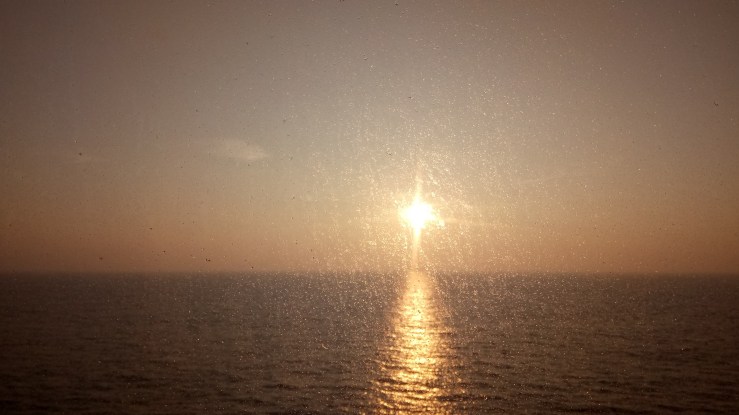
The Pont-Aven was the sort of ferry that wants to be a cruise ship when it grows up, and we felt a bit scruffy with our giant rucksacks. The last time I’d done the Camino we’d crossed from Portsmouth to Caen, and skimped on such luxuries as bunks. This time round, a decade older and richer and wiser, I’d booked a cabin and everything. We sat in the bar and listened to a jazz band who were travelling to a festival in Santander, as the sun set over the sea.
DSC_0556
Sunset from the Pont-Aven

And when they sell rum called Saint James, there is really only one possible response. Mojito.

We retired at a relatively early hour, but I went up on deck at about 11pm to see if I could see anything of France. Not from the port side I couldn’t, but the lighthouse on Ushant was very visible, a double flash every four seconds, the very last flush of the sunset above it, and the moon waxing over the other side.

The next morning I woke up some time before John, and got up to see if I could find breakfast and see dolphins. I spent breakfast eavesdropping on my fellow Britons and thinking that the Brexit vote wasn’t such a surprise. They were whingeing about the breakfast, the price, quality, and quantity thereof. But I forgave them when they pointed out my first dolphins.

I saw three separate groups of dolphins in the end: the first through the ferry window at breakfast; then three side by side quite soon after we went up on deck to look for them specifically, and then, after a very long time in the wind staring at the sea and seeing nothing beyond the rainbows in the spray, just as we were about to give up and go down to pack up, one of the other people watching pointed out a group of six or seven, travelling at right angles to the ship and leaping right out of the water. They seemed quite small and almost luminous in the morning sunlight.
DSC_0563
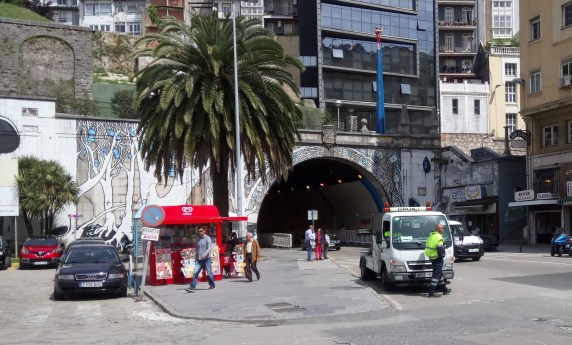
From the station at Santander

In Santander we put our watches forward, which was ridiculous given how far west we were intending to end up, and ate lunch at Café Royalty, where I’d last been ten years before with Anne. The translation of the menu had improved somewhat in the meantime. Then we wandered around the town, poking our noses into shops and covered markets, and looking at street installations meant to show the devastation caused by the fire of 1941. There was also a monument to a ship explosion of1893, and a preserved air raid shelter from the Civil War. We would have gone to look at that, but it was closed. Eventually, being hot and tired, we brought some provisions for the train and went to wait at the station.

We’d previously stopped there to buy the tickets, where my first proper Spanish conversation in a decade had amounted to ‘You know it doesn’t leave until ten past four?’ We did know, and we got the train at ten past four. But I wasn’t really in the right frame of mind to understand about the rail replacement bus service between Llanés and Ribadesella, and, once we’d worked out that was what the guard was talking about, I spent some time in a state of nervous panic before seeking clarification.

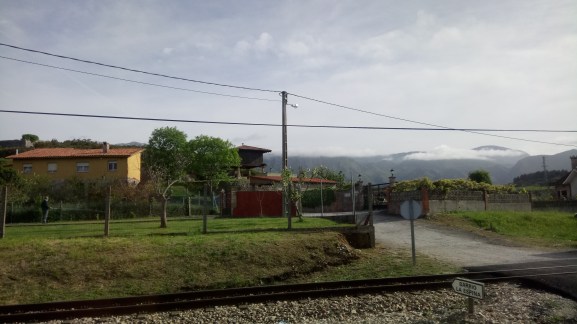
Between what the guard told me, logic, John’s memory of the train he’d been on last time, and some signs along the way, we worked out that the reason for the bus was the electrification of that stretch of line. The bus took us through some spectacular coastal villages. I was struck once again with an impracticable desire to walk the Camino del Norte. The bus driver clearly knowing everyone, telling one passenger to give his regards to his mother, and stopping at another point for a through-the-window conversation with an older man.
DSC_0580
View of the railway, from the rail replacement bus

We ate bread and cheese once back on the train (electric, this one). John had downgraded his veganism to vegetarianism for the duration of this Camino. On his previous trip along this stretch of railway he went all the way from Ferrol to Santander in a day, and didn’t bring anything to eat. We stopped for the night in Oviedo, staying in Hotel Favila, blessedly close to the station. After checking in we wandered around the city, and found very little going on. We concluded that either we’d been lied to all our lives about the Spanish nightlife, or that nothing happens on Mondays, or that nothing happens in Oviedo.
DSC_0587
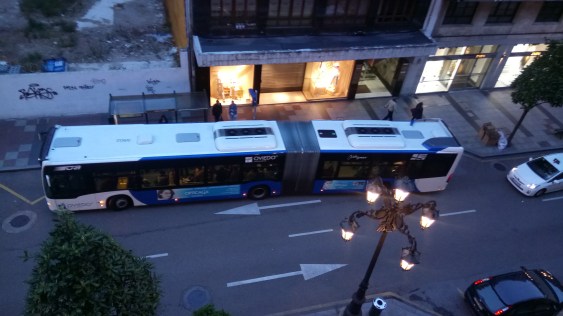
Oviedo bendybus
DSC_0591
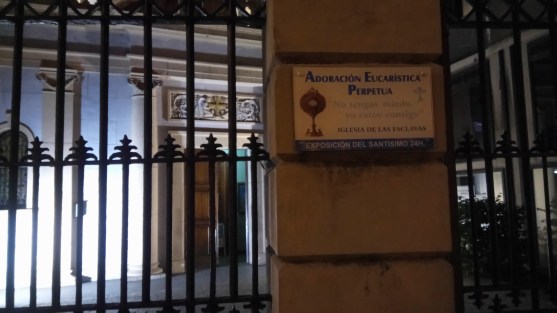
Spiritual succour, 24/7

The next morning it was more lively, and we got further, too, into the old town and the university quarter. They were setting up the market when we went there; the night before all the cafés were clearing up, sweeping the floors and stacking the chairs. After the market we worked our way back, through a park with mighty and dark trees. Where Santander does memorials to tragedies, Oviedo does sculpture. Every other street, every other crossing, a statue or a concept piece or a fountain.
DSC_0598
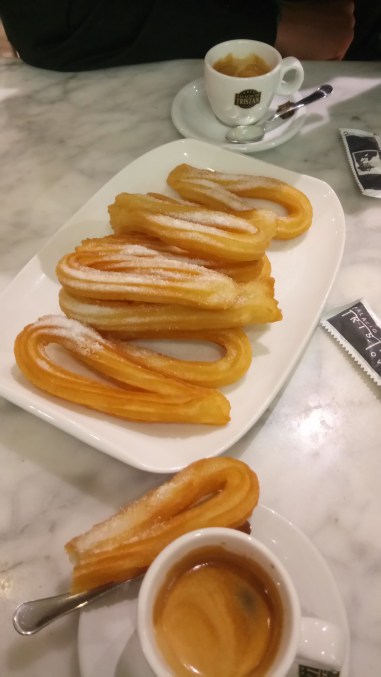
Oviedo breakfast
DSC_0604
Exploring Oviedo

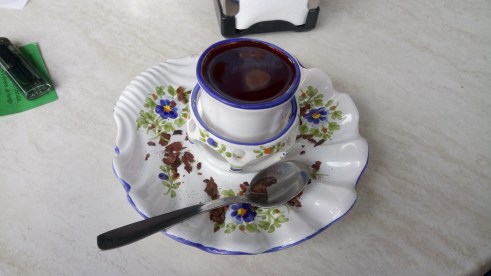
We walked out towards the suburbs and back towards the station. We checked out of the hotel and drank thick, rich, hot chocolate from little cups in holders shaped like scallop shells.
DSC_0620
Hot chocolate

We kept finding ourselves on the Camino, mostly by standing on the pavement being indecisive for too long. Locals saw our rucksacks and directed us in what they assumed was the right direction. In Santander, we’d been accosted by a woman handing out business cards for a hostel on the Camino del Norte. Now, in Oviedo, having an hour or so to spare before our train, we thought we might as well go with it, and we followed the Camino Primitivo for half a mile or so. As far as a bridge over the FEVE line, at which point John saw a bridge a little further down that interested him, a sort of suspension bridge-cum-roundabout, so we went to look at that, and then turned back – and had to explain that no, we weren’t lost, we were going to catch a train to Ferrol.

We found our way back and drank coffee in Café Uría (because it was opposite the station and had a picture of a bicycle on the window) – then caught the train.
DSC_0627
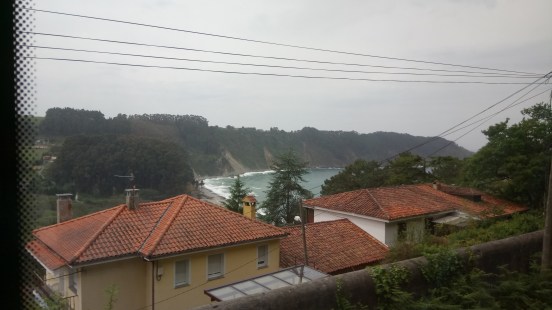
North Spanish coastline, seen from the train

Two hours into the second leg, and the scenery was a sequence of tunnels and steep valleys, eucalyptus trees, viaducts of various ages, hairpin bends a long way beneath us, horreos, houses with shallow roofs of red tiles and yellow plaster walls; maps of the Camino in tiles on the walls of the station buildings; shells here and there. Very occasionally, we glimpsed the sea out to the north.

DSC_0638
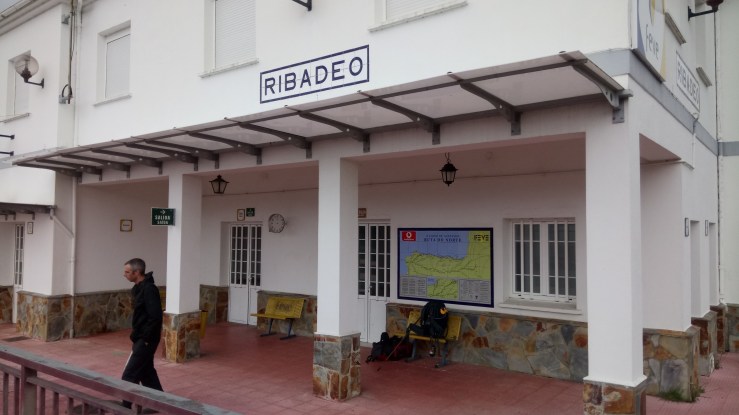
Waiting at Ribadeo for the train to Ferrol

The second rail replacement in as many days (a car this time, not a bus) took us from Navia to Ribadeo. A few kilometres east of Galicia, it started to rain; then a yellowish mist rolled down. I read Four Quartets, and decided that I was growing tired of fog and eucalyptus trees. We could go back the other way, via Palencia.

Checking into the hotel at Ferrol, we found ourselves behind three Japanese men in their sixties – obviously pilgrims, and well-organised ones at that. They had plastic folders with step by step (not quite literally) instructions. As the week went on, we would discover that they rose early, walked fast, and enjoyed themselves when they got to the night’s destination. For the moment, though, we were mostly concerned with getting the key to our room.

There was wi-fi. There usually is, these days. The last time I did the Camino my phone had a screen of three square inches and if you wanted to get on the internet you had to hope there’d be a public access computer in your albergue. This was, no doubt, an excellent spiritual discipline, but in the year of Our Lord 2017 it turned out that daily internet access was a blessing.

Because when I connected my phone to the wi-fi in that hotel and my emails started rolling in, it turned out that Speak Its Name had been shortlisted for the Betty Trask Prize, and the Society of Authors needed a biography, a photograph, and six copies of the book, all of which would have been very difficult to organise without the internet. Not that I did any organising that night. We went down to the bar and drank beer and red wine, and I was very glad that I had one hundred and sixteen kilometres of walking ahead of me to keep me distracted through the embargo.

Next time: we start walking the Camino Inglés. I promise.
What I’m writing next

DSCF2123

What a ride! I mean the Giro d’Italia, of course, and I’m not even going to try to guess what might happen on today’s stage.

But I also mean the blog tour for A Spoke in the Wheel. I had tremendous fun visiting other people’s blogs and talking about how my new book came to be.

And I also mean my travels around Europe – the sleeper to Stockholm, the Semmering line, the Zentralbahn and Jungfraubahn, and the whole three weeks of it.

I suppose you could say I’m now in the warm-down stage. Getting my breath back. I’m not writing a huge amount at the moment; I’m fulfilling a couple of pre-existing commitments, and, of course, writing this blog post.

My next task is to finish writing up my travels of the past couple of years. The Isle of Wight Coast Path and the Camino Inglés, and then this year’s Grand Tour, before I forget it all. (This morning I woke up from a dream where I was at a railway station somewhere in Flanders helping set out a tea table in preparation for Rev’d Richard Coles returning with a school trip, while a truncated Saviem Standard full of Tesco shopping bags did a handbrake turn in a very narrow lane. Nothing like this actually happened.) I’ll be posting all of that, together with a selection of photographs, on this blog.

I’ve also seen an idea I like for another ‘photographs of other people’s books’ series, which I’ll probably kick off in a month or so.

I have promised myself that I won’t start any more big projects until after the travel writeups are done – which means, of course, that the next three books are all trying to write themselves at once. I make no promises as to which order they’ll come in, or even whether they’ll ever happen, but they are:

  • the sequel to Speak Its Name. I haven’t yet managed to persuade myself that Scandal and Folly wouldn’t be an excellent name for it. (But then I have form in this department.) Not everybody can make the letters of Saint Paul sound like a bodice ripper.
  • the post-Brexit Ruritanian swashbuckler, possibly with ice dancing. (Got to get some sort of blade into it somehow…)
  • the murder mystery at a fan convention.

As you see, the chances of my picking a genre and sticking to it remain low.

Grand Départ (we’re off!)

bubbly

I’m back! I have been through eleven different countries, ridden on trains, trams, buses, and a ferry. I have been further north and further east than ever before in my life, and also higher up. I have had a fantastic time and I will write it up over the next couple of months.

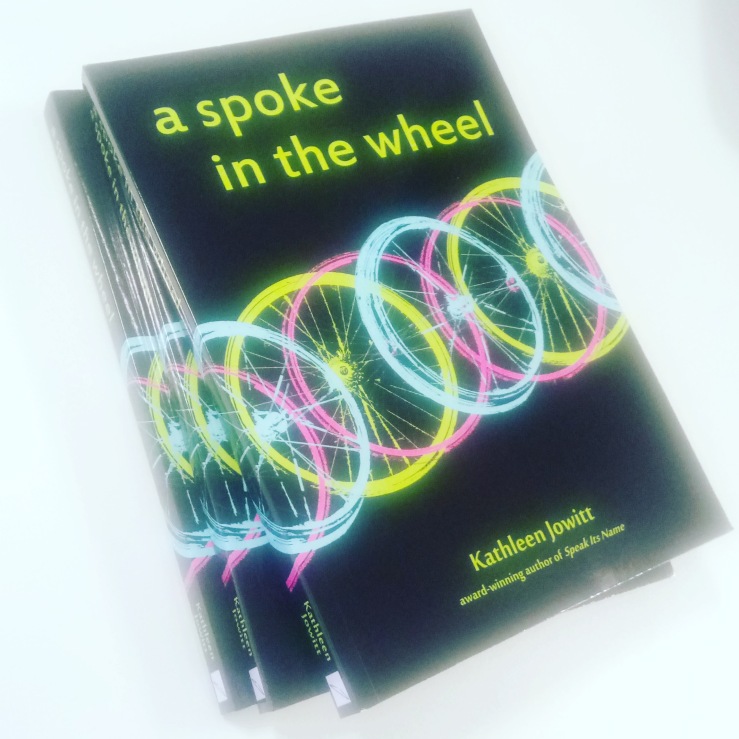
While I’ve been away, the wheels have been turning (see what I did there?), and I’m now very happy to announce that A Spoke in the Wheel is now live.

Available from some reputable booksellers, and some less reputable ones too. I’ll leave you to decide which are which, while I contemplate my laundry and catch up on the Giro d’Italia.

And I’ve got a tour of my own – over the next couple of weeks A Spoke in the Wheel and I will be visiting several friendly book bloggers for reviews, guest posts, and extracts. Here’s what’s coming up…

ASITW blog tour LARGE

A Grand Tour

IMG_20180412_165644_410

If we’re talking cycling (and we probably are, aren’t we?) a Grand Tour is one of the three big ones: the Giro d’Italia, the Vuelta a España, or, of course, the Tour de France. Ben, the – hero? anti-hero? narrator, anyway – of A Spoke in the Wheel, never got quite good enough to ride one of those.

If, however, we’re talking travel, a Grand Tour is a circuit of Europe undertaken by the privileged youth of the eighteenth and nineteenth centuries before they had to settle down and be grown up, sometimes taking several years.

I couldn’t swing more than three weeks off work, but I am spending my Betty Trask prize money going InterRailing. When you read this, I’ll be somewhere between Brussels and Hamburg, assuming no undue disruption from the SNCF strike, of course. I’ll tell you all about it when I get home. (I am aware that I said this about the Camino Inglés. I’m still going to tell you all about that.)

And three weeks from now I’ll have a book to share with you, too. We’ll have a blog tour. A grand one.

A sense of perspective

DSCF2728

A few years ago I read something about a woman who wanted to go to Africa. I forget where I read it, or why the woman wanted to go to Africa in the first place, but I remember that the moral was that she had to become somebody for whom going to Africa was normal. She would never go to Africa until she got to thinking of going to Africa as No Big Deal.

I felt somewhat ambivalent about this at the time, and I still do. On the one hand, I can see the point: if I see a particular ambition, desire, or goal, as being Not For The Likes Of Us, then I’ll never manage it.

On the other, if I see it as No Big Deal, then what on earth is the point of doing it at all?

There’s an irritatingly pious part of me – think first year Hermione Granger, if first year Hermione Granger was into self-help woowoo – that wants to point out that well obviously the moral is that I should try to be more present in everything, because everything is a Big Deal! Which is of course true, every bush is alive with angels and all that, but if she could only be less obnoxious about it then I might be more inclined to pay attention…

All joking aside, it’s very easy for me to forget how far I’ve come.

It’s only in the past few years that things like ‘publish a novel!’ and ‘go InterRailing around Europe!’ have moved out of the ‘things I’d like to do, someday’ category and into ‘things I’m going to do’ – or ‘things I’ve actually done’.

The problem is, the moment they move into ‘things I’ve actually done’, they become No Big Deal. If I can do that, I tell myself, then anybody could.

And I forget. I forget how once it seemed like something that was Not For The Likes Of Us. I forget how many times other people had to tell me, ‘That sounds amazing! You should do it!’ I forget how much work it took to get where I am. I forget that I’m a massive success in the self-publishing world. (It might help if I made more than pocket money from it – but then again, I’d probably think that that was No Big Deal, too.) I forget that I’ve made literal history, that I have been the first person to do this particular something. A small something, admittedly, but still a something.

What’s the answer? Listen to Hermione Granger, I think. Remember to look around, and see what’s there, and enjoy being with it, if possible. Remember to look back, and see how far I’ve come. Remember to look forward, and identify what I want to do, and see that there probably isn’t any particular reason why I shouldn’t.

Pottering

DSC_0794

You know those Saturdays when you don’t really have anything scheduled, but you find yourself busy all the time, and can occasionally display a finished task as proof of your effort? That’s what January has been like for me so far. I’ve been pottering around, doing a thing here, a thing there, hoping that something will get finished sooner or later.

What have I been working on?

  • Well, there’s been the tedious day-to-day stuff of life: cooking, cleaning, keeping the wolf from the door. Sometimes it feels like all my brain goes on the day job and all my time is spent keeping the hamster wheel turning.
  • Speaking of the day job, I’ve been doing a little more at work with my author hat on. Watch this space.
  • A Spoke In The Wheel is out with several different readers, editors and checkers at the moment, so I’m not worrying about it too much. Which is not to say I’m not worrying about it at all. Any of us might miss something! What if I’ve made a mistake, and look stupid? (Then I’ll be no different from the rest of the world, says my partner, and he’s right. But still…)
  • Various elements of the sequel to Speak Its Name have been gathering in my head. Some come in the form of sentences or paragraphs, or even entire pages, which I write down; some are more general insights like ‘Oh! Abby has a blog! An anonymous one!’
  • That means research. I’ve been looking up things like ‘can an international student be a Cambridge choral scholar?’, ‘chemistry PhD subjects’ and ‘Church of England: vocations process’. I’m regretting a few choices I made in Speak Its Name, but I’m stuck with them now.
  • Fandom stuff. I’m very glad to have got back into fandom last year, but it doesn’t half take up a lot of time if I let it.
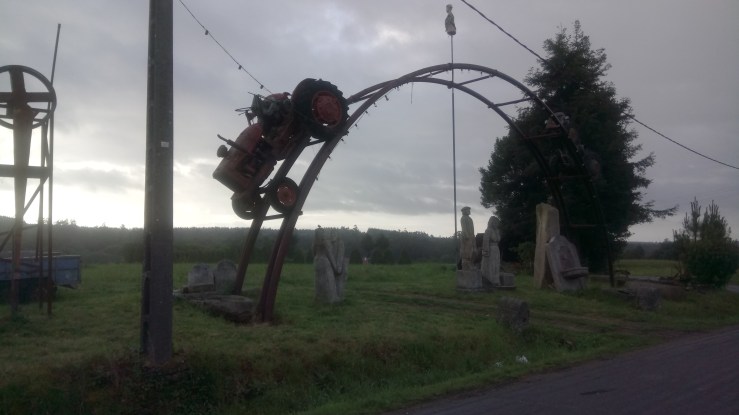
  • Spending my prize money on an epic European rail adventure. My plan is to book the expensive Scandinavian portion of the trip in advance, and spend the remainder of the time following my nose around central Europe, but this does rather rely on me and my rail map and my diary being in the same place at a time when I have sufficient brain power to know that I’m not going to do something stupid that I can’t cancel. And I still haven’t written up my last epic European adventure. (Which will be worth doing. The photo at the top of this post comes from that, and the tractor sculpture wasn’t even the weirdest thing we saw.)

In February I’ll get going in earnest on the launch procedure for A Spoke In The Wheel. Cover reveal? Blog tour? Who knows? We’ll find out!

Always just enough

DSC_0638

Another post about the Camino Inglés that isn’t really about the Camino Inglés. It’s about railways and languages and pizza. And I’ve been thinking about all this quite a lot over the past few days, because I’ve just booked myself an InterRail pass.

To begin the Camino Inglés you have to get to either A Coruña or to Ferrol, and, as I mentioned a couple of days ago, my brother and I chose to do this by means of the overnight ferry from Plymouth to Santander and then the narrow gauge railway east to west along the north coast of Spain. This takes two days whichever way you slice it, and on both days we found the trains afflicted by service alterations.

The first was due to line upgrades, and resulted in a very enjoyable rail replacement bus journey through a string of beautiful coastal villages from Llanés to Ribadesella. The second was due to a train failure, and resulted in a rail replacement car from Navia to Ribadeo. (In the picture above you see my brother waiting at Ribadeo for the train to Ferrol.)

All this was communicated with some difficulty, given the fact that the key players were:

  • railway staff – no English
  • a cyclist at Ribadeo who was trying to go west-east – no Spanish
  • my brother – no Spanish
  • me – some Spanish

And sometimes we could just follow everyone else, but that didn’t work so well when we were the only passengers going to Ribadeo. And having to explain to the conductor on the subsequent train that the reason that our tickets had been franked was because the previous train had broken down… that was a challenge. But we managed – because, I thought, I had just enough Spanish to manage.

I’ve always felt quite strongly about learning a bit of the language of any country I’m visiting. I’ve told myself that it’s about politeness, but I think it might also be about confidence, about control, about knowing what’s going on. Anyway, I spent the three months before our departure brushing up on my Spanish, and I was glad I did.

(Castilian Spanish, that is. If Duolingo had given me an option for Gallego I’d have taken it up!)

I did most of the talking all along the route – to the hotel proprietors, to the waiters and bar staff, to the lady handing out boiled eggs to pilgrims (who spoke Spanish and Italian, and I think German). And all the way I had just enough Spanish to manage.

But at the end of the fourth day of walking – we were less than 20km from Santiago at this point, and tired – I suddenly found myself unable to remember the Spanish for ‘four’, and therefore unable to order the pizza I wanted. So my brother did it. And of course he managed. He had just enough Spanish to manage.

So did the cyclist at Ribadeo. He didn’t speak any Spanish, and the stationmaster didn’t speak any English, but between them they transmitted the idea that the train was terminating and the cyclist would have to come back in the morning. When we arrived they asked me to translate, but in fact they’d already managed it. They had just enough, even though neither of them had any.

I’m hoping that I’ll be able to carry this forwards into 2018. I’m planning on brushing up my German, but even with the best will in the world, I’m not going to be able to learn enough Hungarian to reach my standards of this time last year – and I would quite like to see Budapest. I’m not going to be able to learn enough Danish or Swedish – and I’m planning to start out with Copenhagen and Stockholm. I’m just going to have to trust that what I know is going to be just enough.

Notes from the Netherlands (with pictures, lots of them)

A brief ‘what I did on my holidays’.

I spent a lot of time people-watching. Or bike-watching, I suppose; the people just happened to be riding the bikes. Comparing the fashions in velocipedes between the Netherlands and the UK’s nearest equivalent, Cambridge.

Continue reading “Notes from the Netherlands (with pictures, lots of them)”