100 untimed books: a trick to it

97. a trick to it
97. a trick to it

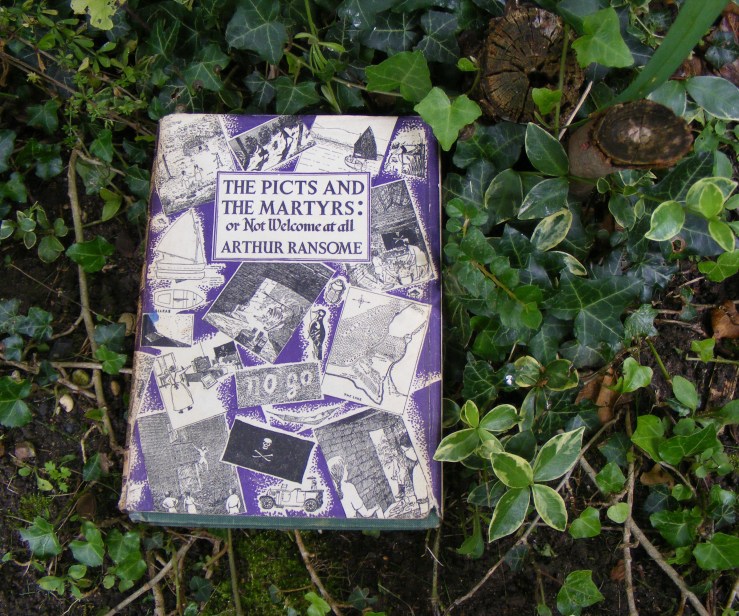
Well, I’m thinking of the rabbit scene. Dick and Dorothea are my favourite characters in the Swallows and Amazons series; I may have grown up in the country, but I wouldn’t know where to start with skinning a rabbit either.

And Ransome’s trick of overlaying an imaginary landscape on a real one – well, an imaginary-real one – is masterful. I honestly believe that these were among the best children’s books of the last century.

100 untimed books

St James’ Way 4: in my end is my beginning

Alresford to Winchester, 25 July 2015

St James’ Way 1: Ultreya

St James’ Way 2: the way of the sluggard is blocked with thorns

St James’ Way 3: the rain it raineth

I promised myself that if it was raining I’d take the bus. It wasn’t. I walked. It hurt.

It was a fantastically beautiful walk. I’m glad I did it. I just would have liked my right leg not to be hurting.

I joined the Itchen to the south of Alresford, first crossing the Watercress Line and walking around the bottom edge of the town. The hotel, and the church of St John the Baptist at which I stopped on my way out of town, were bustling with wedding preparations. As good a day as any to get married, St James, pilgrim through this barren land. And the weather turned out nice for them. I passed the bride’s parents and the wedding dress as I was going down to check out, and wished them well.

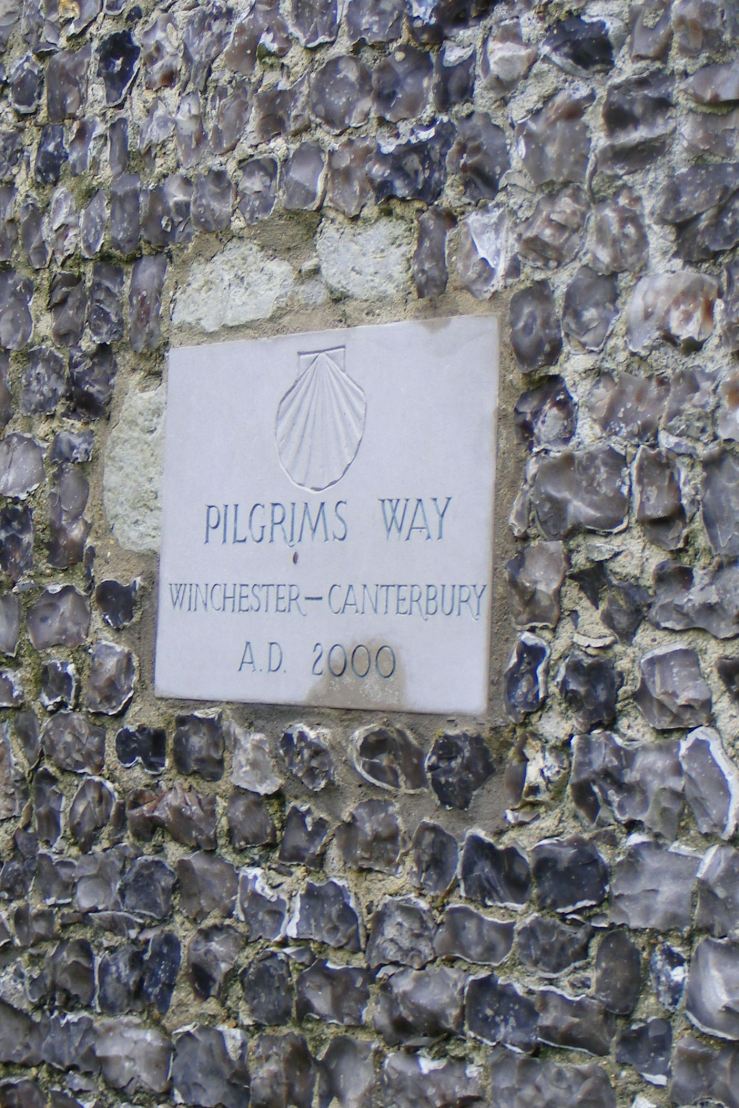
Waymark on the wall of St John the Baptist church, Alresford

Out past the watercress beds, everything very fresh and green after the day before. My leg hurt a lot while walking, but more when I stopped. I joined St Swithun’s Way; it had been St Swithun’s day only last week, and whatever the weather had done then, it clearly wasn’t going to keep it up for forty days. Crossing the main road, and off down a lane into Ovington. I met a confused and frightened sheep coming the other way, herded accidentally by a confused and unwilling cyclist. I could only hope he managed to overtake it before they reached the main road.

My father had recommended the Bush at Ovington, but at that hour in the morning it was closed. I turned right instead and crossed half-way over the Itchen. The path continued down a narrow strip of land in the middle of the stream. It was delightful: the water ran fast and shallow over a pale bed, and speckled fish basked in the sun, twitching their fins gently to stay where they wanted to be.

After a little while another footbridge took me across to the far bank of the river, and I walked on up to the road in Itchen Stoke. Here, my father had told me, I should look out for the Angry Red Eye of the Almighty. ‘Is that a Jowittism?’ I asked.

‘Sort of,’ he told me. ‘It was some neighbour, I believe, but it got taken up in the family.’

The Angry Red Eye of the Almighty

But what is the Angry Red Eye of the Almighty? Having looked at the thing, I’m still not entirely sure, but I can see exactly what that neighbour meant. It’s a lump of red glass caught in the pierced opening – not even a window – at the top of the west end of the church of St Mary. This is another one that’s under the protection of the Historic Churches Preservation Trust, and it’s well worth their attention; it’s an unlikely homage to Sainte-Chapelle in the middle of the Hampshire countryside. The original may have been Louis IX’s over-the-top reliquary, but St Mary’s, Itchen Stoke, has evangelical antecedents as well, and there are no pictures in the magnificent stained glass.

DSCF9438
The east end of St Mary’s, Itchen Stoke

Next I crossed back over the river, through some very boggy fields and past some farm buildings (some converted to offices and studios, some still apparently used for their original purpose), heading west all the while. I stopped at the top of a very steep slope to eat some of my brioche rolls, spreadable cheese and chocolates, and then headed on across a golf course. Then I had to get down again, to the level of the river, following a lane. My leg complained. Still, I was in a better mood than the previous day, as evidenced by the fact that I looked into the church at Itchen Abbas.

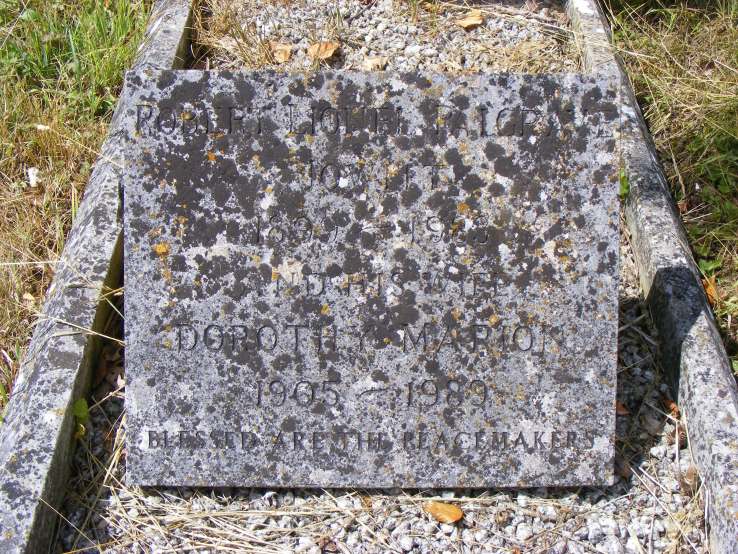
The next item on the list was my grandparents’ grave at Martyr Worthy. Blessed are the peacemakers: they met working for the local branch of the League of Nations. I promised not to light a candle for them at the cathedral; my grandfather in particular didn’t go in for popery.

My grandparents' grave: Blessed are the peacemakers
My grandparents’ grave: Blessed are the peacemakers

The other Worthys lie west of the motorway, and the Itchen splits itself off into a tangle of little streams. I followed both, or all, of them south, into the suburbs of Winchester, and finally into Winchester itself. I passed the pub, the King Alfred, where I was booked in to stay that night. I hadn’t realised, when I’d made the reservation, that it was the birthplace of Friends of King Alfred Buses, another significant presence in my life. Should I go in and drop off my rucksack? No, of course not. I pressed on to the cathedral.

Now, when you’re walking the Camino de Santiago, every bar, hostel and church will have a sello, or rubber stamp, and the prudent pilgrim will collect at least one every day. It’s like collecting stamps in your passport to heaven. Anyone who has got this far in this account of this walk will not be surprised to hear that I didn’t collect any along St James’ Way.

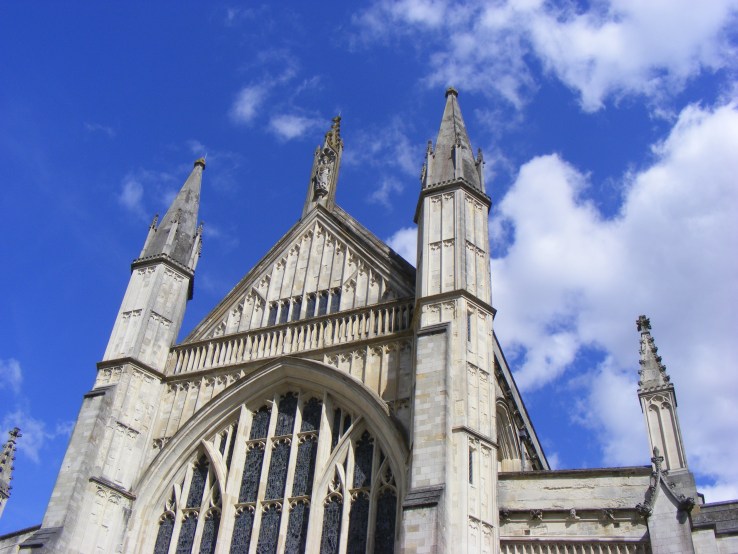
But Winchester cathedral has a sello. Or so I was assured by the guidebook, before I threw it away in disgust at its sopping unreadability. I asked at the desk. No, they couldn’t find it, but the vergers had one in their vestry. I should go in and look around, and see if I could find a verger.

I did that, wandering around and finding a more or less acceptable balance between the plaints of my knee, the desire to get my money’s worth from my free entry, and the bliss of having finally got here, to a holy place. When I got tired of that I found a verger.

‘It’s a good day to arrive,’ he said. ‘St James’ Day.’

I didn’t say, well, yes, I knew that. I asked him to stamp my map, which he did, along with a passport for the Pilgrims’ Way, which I may complete some day.

Afterwards, I hobbled outside to buy an ice-cream and people-watch in the sunshine on the green until it was time for Evensong. I’d made it: foul weather and dodgy knees had failed to daunt my spirit; it was St James’ Day, and I was back in the city of my birth on the eve of my thirtieth birthday. As overambitious plans go, this one had gone rather well.

DSCF9441

Unlikely writing techniques 2: take the book for a drink

The practice of buying your project a beer, like many others I’ve come to use regularly, comes from Havi Brooks’ The Fluent Self. Thoroughly recommended for feeling less like a giant disaster.

Raspberries in cream soda
What a cool drink might look like. This is not sour cherry lemonade, obviously; it’s actually cream soda with frozen raspberries in it. I didn’t take a picture of the sour cherry lemonade because my phone had run out of battery, and also I had other things on my mind.

A couple of Tuesdays ago, opening my notebook after a fortnight’s hiatus, I was conscious of a nasty suspicion of impending stuckness. I’ve written before about how stuckness scares me much less than it used to, but I was still a bit scared by this one. Apart from anything else, the idea behind the deliberate hiatus was to pre-empt the stuckness.

I was hanging around in London for an hour after work before catching the train home. I’d thought that I’d sit somewhere and have a cup of coffee and do some writing. After all, the stuckness hadn’t quite landed. Yet. I thought I had another few hundred words that I could squeeze out.

I went to a bar that came in just below my ‘not for the likes of us’ cut-off, and I sat outside under a parasol, and I ordered a sour cherry lemonade. Across the square, people were watching a big screen with the Williams sisters playing the Wimbledon doubles. I got my notebook and pen out of my handbag.

I’d meant to just work on the book itself, but instead I wrote:

The problem is, I feel I haven’t really got a handle on Polly.

I kept writing, and new possibilities emerged:

This may not actually be a problem if Ben hasn’t got a handle on her either.

Do I need to write something from Polly’s POV and be prepared to junk it?

Do I need to keep ploughing on with Ben and trust that Polly will come through his self-absorption for me as well as the reader?

Then I wrote the thing that was at the root of the stuckness:

I am afraid of running out of plot before I get anywhere near the target word count.

But I had an answer to that, too:

Does Ben have any sort of love life aside from Polly? Has he ever had one? If so, it’s going to have been a mess.

The answer, it seemed, was yes. But it only raised further questions. I knew some of the answers, but not all of them:

(Mélanie, soigneur, tracks him down – but how, why, has she left the team or something – parents tell her where he lives hoping she’ll get him back into the sport. OK, so what happens, is this before or after the middle of the book, it’s got to be after the CC debacle or it’ll anticipate the blackmail aspect, what do Polly and Vicki make of it?)

Then I ordered a vegetarian scotch egg. And very tasty it was too.

I kept writing:

So Polly’s just beginning to fall for Ben, no, not even fall for, look kindly on, and then Mélanie turns up WHILE VICKI’S AWAY WITH GIANNA. Ben neglects Polly, she gets back together with Michael

Why don’t Ben and Mélanie work?

Because the thing that they have in common is misery.

How does it end?

Ben realises that he’s happier 9-5ing than he ever was cycling, even with a team he liked

and Mélanie doesn’t get his responsibilities

nothing awful happens to Polly – in fact, Michael happened to look round so she was fine – but Ben feels awful about it – maybe a burglary?

(what is it? doesn’t go back to organise a meal? ends up staying out all night?

Mélanie doesn’t see Polly as a sexual threat. Ben finds this perversely irritating.

he’s pleased to see her – cross with his parents – painful memories

Polly’s cautiously pleased

Vicki doesn’t approve at all, thinks he should move on or at least make his mind up

maybe Mélanie secretly wants to expose Grande Fino and is looking for other

Bang. I wrote 863 words on the theme of ‘Mélanie secretly wants to expose Grande Fino and is looking for other people to help’ on the train home. By the end of those 863 words most of the rest of the braindump was out of date (Vicki wasn’t away, Polly and Michael were already an item…) but I had the makings of a creditable subplot.

I still don’t have a handle on Polly, but I expect she’ll make herself known in time. I might go out and get a drink and see if she turns up.

Talk of the Town

St James’ Way 3: the rain it raineth

Basingstoke to New Alresford, 24 July 2015

St James’ Way 1: Ultreya

St James’ Way 2: the way of the sluggard is blocked with thorns

I ate breakfast at a café on a trading estate on the way out of Basingstoke for half the price of the hotel one. Then I retraced my steps of the day before. It wasn’t nearly so soul-destroying as it might have been, because it wasn’t the same day and it wasn’t due to a mistake. It was just part of the plan; I knew I was going to have to anyway. I rejoined the route back in Worting. The path climbed steeply away from the main road and took me across another annoying brambly field – the more so because it turned out that I didn’t actually need to go through the brambles – and over the railway. I got slightly lost in a residential area and finally found my way onto the route of a Roman road, with a field on one side, and what I described in my diary as ‘boring houses’ on the other. (‘They’re all homes, Dorothy,’ someone told my grandmother, when she was being snobbish.) Kind ladies with dogs redirected me when I got confused.

It had been drizzling all morning. Now it started raining properly. The route led me into beech woods, where tree roots bulged up in the chalky path. I saw glimpses of brightness through the gloomy trees, and almost thought the sun had come out, but it was just stubble of wheat fields throwing white-gold up towards the grey sky. I came out of the woods, through a farmyard, and back onto the road.

The next challenge was crossing the A30 – confusing and terrifying, like getting from the bottom right hand corner of a letter X to the top left hand corner, if the letter were made of a major road. I walked through more woods, crossed a bridge over the M3 and proceeded up a conference centre’s service road in ever-heavier rain. My mother texted me to see if I had any ideas about songs we might sing at my birthday party, so she could write the music out for the band. I started making a mental list. At the next pub, I told myself, I’d get my notebook out and write them down. The thought sustained me through a tedious stretch of road walking.

The church at Dummer, as seen from the hospitable lychgate

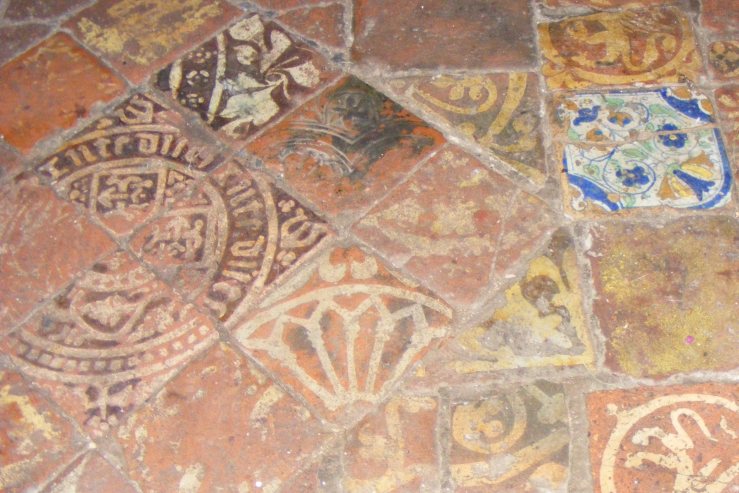
The next pub was in Dummer, and was not yet open. A couple of squares of chocolate in the comparative shelter of the church lychgate had to suffice. I pushed on towards Preston Candover down a concrete path between wheatfields – meeting, as one of them remarked, far more people in the rain than were to be seen out in the sun the previous day. It was another four miles, and it was really, really raining now. I retained enough sense of my purpose to look into a disused church and admire the floor tiles, but my interest was ebbing.

Floor tiles at the disused church of St Mary the Virgin, Preston Candover

On the bright side, the Preston Candover pub was open. Even better, it had started serving lunch about ten minutes before I got there. Spanish menu; Aussie barmaid. Clientele: wellingtons, gin and tonic, and spaniels. Grilled mackerel, new potatoes, fennel and watercress salad, pistachio sponge sundae. It was expensive for a pub lunch, and more than I’d meant to spend, but well worth it both for the food and the chance to sit inside and drip gently.

Sadly, I couldn’t sit inside all day. I set off again. Wetter and wetter and wetter. One utterly obnoxious field that left my boots caked three inches thick, a hole in the hedge that ripped my rucksack cover off, mud mud mud. The great thing about being out in weather that no sane person would be out in is that you can scream as loud as you like without fear of people hearing. So I did. Too much road walking. I decided that I was too wet to care about the 12th century church of St James at Upper Wield, and stomp stomp stomped along the Oxdrove Way, which goes on for ever. FOR EVER. Four miles, apparently. Anyway, when I finally got out at Old Alresford I’d had enough. I abandoned the guidebook, which should have been a huge mistake. Certainly it meant that I had to follow the main road into Alresford, which was slightly terrifying in the gathering gloom and the pouring rain.

I’d booked to stay in the Swan Hotel, which had seemed to my teenage self to be the height of luxury when my godfather had held a birthday party there about twelve years previously. Fortunately, it wasn’t so luxurious that I got kicked out for being soaked to the skin. In fact, it was a perfectly standard country coaching inn. I couldn’t help but feel that the kitschy red paint and monochrome photo wallpaper décor was a mistake in a country coaching inn with exposed beams, but I wasn’t going to complain. There was a bath.

When I’d had a bath (I couldn’t possibly get any wetter, this was at least warm, and when I’d finished washing myself I washed my socks in it) and dried off, I took myself, my diary and my map down to the bar, and ordered a pint and a burger. Then I phoned my father, and discussed party logistics and how to get from Alresford to Winchester, assuming that I could actually walk the next day.

My father is very good at maps, and spent most of his early life in Winchester and its surroundings. He found his own Ordnance Survey Winchester, New Alresford and East Meon, and we worked out a sensible route that would take me past my grandparents’ grave, and also the Angry Red Eye of the Almighty. And you’ll just have to wait until next time to find out what that is.

Next: in my end is my beginning

Unlikely writing techniques 1: not writing

DSCF1353

I’ve participated in a lot of month-long writing events in my time. NaNoWriMo, to start with, and later a lower-pressure imitation where we set our own goals – where ‘goal’ could legitimately equal ‘something, anything at all’. This is one of the kindest, most encouraging communities I’ve ever been part of, and the absence of pressure is, perhaps counter-intuitively, a great motivator. A couple of years ago it moved from running in November only to also having sessions in June and July, and I was very happy indeed.

The more months I devoted to writing, however, the more I noticed that month-long sessions didn’t work for me. The first few days were always brilliant: I dived in and swam around in a glorious sea of words, surfing an exhilarating wave. I’d write on the train, I’d write in cafés, I’d type up what I’d written longhand, editing as I went, and find that I’d doubled it in the process.

After the first few days the ocean would become a stream. I didn’t have that sense of boundless potential any more, but I could tell that there were words queuing up, waiting to be written.

After a couple of weeks the stream would dry up. I could squeeze a hundred words or so out of the dry ground, but they were forced, and looked it. I’d still show up at the daily check-in posts. I’d still have encouraging things to say about other people’s work, but my own had hit a wall.

Last year I decided to see what would happen if I stopped fighting this pattern, and just let it play out instead. For two weeks of every month, I told myself, I wouldn’t even try to write. I wouldn’t think about the book at all. I’d read, or go swimming, or play the piano, or play Animal Crossing, or make patchwork, or read some more, the theory being that by the end of that fortnight I’d have replenished the stocks of whatever resources I’d depleted, and would be ready to move into the next stint of writing.Was it realistic, after all, to expect my mind and my body to sustain a daily writing habit on top of a full-time job? Probably not, and could I blame my writing mind for shutting off when it had had enough?

Is it working? It seems to be. I’m only eight months into it (and the first few weren’t representative, as I was preparing to launch Speak Its Name, and not actually writing) but the indications so far point to it being a sustainable way of work. At the very least, it’s working at least as well as the previous pattern, and it’s stopped me feeling guilty about the times when I’m not writing.

Would I recommend it to you? Not necessarily. You’re welcome to try it – it’s not as if I have copyright on the idea of Deliberately Not Doing Stuff – but don’t feel that you have to persevere with it if it doesn’t work for you. This works for me because it’s what my mind wants to do anyway, and I’ve no idea whether anyone else operates on the same schedule as me. I’d recommend that you look at your own existing patterns and see if you can find a way to make them work better for you. Or a way to stop feeling bad about the fact that they exist. They’ve probably got your best interests in mind.

100 untimed books: travel

20. travel
20. travel

This is a book about travel and it is a travelling book. It has been registered at www.BookCrossing.com, which means that its progress can be tracked around the world. This is a particularly well-travelled book; it started in California and has been through Canada, six other states of the USA, Australia, France, the Netherlands, and Belarus on its way to me. Who knows where it’ll end up next?

100 untimed books

St James’ Way 2: the way of the sluggard is blocked with thorns

Little London to Basingstoke, 23 July 2015

St James’ Way 1: Ultreya

In further evidence in support of the theory that Giorgia is actually an angel, she also washes horrible sweaty pilgrim clothes. She brought them back along with the breakfast. I took my time repacking and adjusting my rucksack, brushing away further flakes of the decaying lining, pulling almost everything almost as tight as it would go, and finally left at about a quarter to ten.

DSCF9403

The first patch of nettles came about a quarter of a mile in. Had I but known it was the first patch, rather than the only patch. This was supposed to be the easy stage, the lazy six miles to let myself recover a bit. Well, the route itself was easy, but the paths in two places were so overgrown and scratchy that my legs became a criss-cross of scratches.

DSCF9410

After the first patch of nettles I’d thought it wasn’t worth zipping the legs back onto my trousers, and yet I kept coming across more and more impassable paths through which I had to force my way, beating aside brambles and nettles and all sorts. Not to mention the plants that propagate their seed by means of adhesion. One of my socks ended up so thick with grass seeds that you could have toasted it, spread it with jam and eaten it for breakfast.

DSCF9412
One of the day’s more passable stretches

Along those six miles, I saw: yellow-and-black striped caterpillars; several ladybirds; the remains of a priory church, still a church through the sheer pig-headedness of the parishioners over several centuries. I saw a golf course. In fact, I saw far too much of the golf course and its hawthorny hedge, through which the footpath was supposed to run, and didn’t. I saw a field of poppies apparently grown as a crop – far too much of that field, too. The drying seed-heads of the poppies were viciously abrasive on my poor scratched legs. I ended up scrambling over a hedge (a very solid hedge, it was) to get out of that damn poppy field, and bought a very satisfying hot dog and coffee from convenient burger van in the layby on the other side. I crossed the road to proceed down a ridiculous nettly path alongside a potato field. At points I had to walk on the potatoes.

DSCF9417
Priory Church, Pamber End

After that I had a respite from brambles and nettles, and walked down a pleasant, leafy path towards Worting. Reaching the village, I left the route and walked east into Basingstoke.

DSCF9420
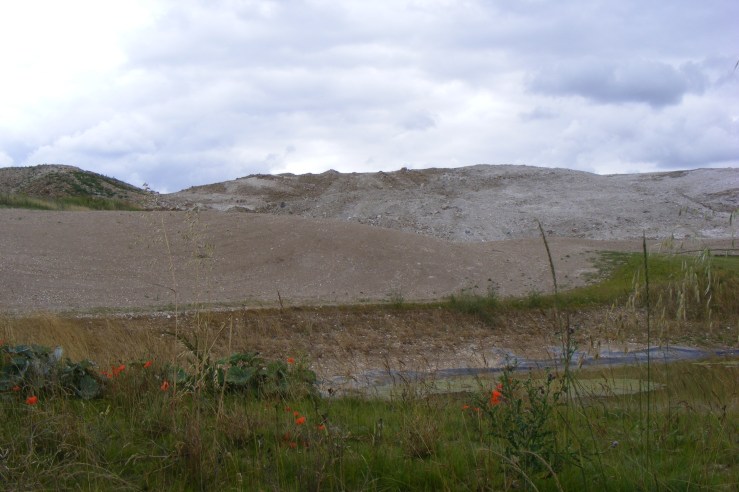
Proper Doctor Who alien planet landscape below the golf course

I ate at the drive-thru Costa at Basingstoke Leisure Park. I didn’t drive through it, or even walk through it; I sat down at a real live table. It made a change from my room in the Premier Inn. There is nothing like the actual hard reality of pilgrimage for dispelling any romantic notions one might have about pilgrimage. You live and walk in the real world, and the road shows you everything. Including Basingstoke Leisure Park.

But I had a bath. I washed my clothes and dried them on the heated towel rail. Spiritual enlightenment is one thing, but on the physical plane the one thing that you need to make a pilgrim really, really happy is a heated towel rail.

I’d meant to go straight to bed, but biology had other ideas (living and walking in the real world, remember?), and I had to cross the Leisure Park and a roundabout to a service station to buy tampons. I picked up a vastly reduced box of All Gold at the same time – by no means the most efficient way of carrying or consuming chocolate on the road, but I wasn’t going to argue with a quid. I had another bath and went to bed.

It took me ages to get to sleep. There was a noisy generator or something right outside my window, which I therefore couldn’t open, so was hot. So I watched a programme about Paula Radcliffe and dropped off eventually. It only occurred to me the next morning that I could have asked to change my room.

Next: the rain it raineth

Bodywork and Soul: a tragedy

Clive was looking infuriatingly pleased with himself. ‘Isn’t she beautiful?’

‘It’s a wreck,’ Helen said flatly. She surveyed the camper van in dismay. Rust-fringed panels, flaking paint, a missing window. ‘Does it even start?’

He shuffled his feet. ‘She will. Just have a little faith, Hel.’

Against her better judgement, Helen took a step closer and peered through the windscreen. The interior seemed to be in even worse condition than the outside, the upholstery cracked and faded, the curtains spotted with mould. ‘Of all the things to do with your bonus… I thought we were going to Turkey.’

‘When I’ve got this beauty up and running, we will,’ he said. ‘We’ll drive there.’

‘And when will that be, exactly?’ Helen demanded. She didn’t bother to wait for the answer.


Clive started with the engine. All that spring he worked on it, spending his weekends in the garage, tinkering and cursing, and his evenings scouring eBay for parts. Helen admitted, grudgingly, that he was at least putting the effort in. And when, on a cool, clear afternoon in late April, the thirsty, spluttering, sigh that she had got so used to hearing from the van was suddenly replaced by a full-throated roar, she couldn’t help running outside to hug Clive, and, feeling a little silly, pat the camper on one of its protuberant headlights.

That evening, they took their dinner out to the van, and ate with plates balanced precariously on their knees. Clive opened a bottle of Chianti, to celebrate. Helen had lit a scented candle to cover the smell of mould. The nostalgic fragrance of sandalwood filled the saloon, and the light flickered gently, disguising the signs of ageing on all three of them.

‘Do you know who it belonged to?’ Helen asked. ‘Where it’s been?’ She imagined long-haired girls wearing flowers and caftans, youths with flared trousers and beards; peace and love and all the idealism of their generation. Suddenly Turkey didn’t seem so far away. They could drive to Morocco, to India, all round the world.

Clive shook his head. ‘The bloke I bought her off rescued her from a scrapyard. Wanted to restore her but never got round to it. I don’t know who had her before.’

‘You’re already doing better than him,’ Helen said, thinking to herself that she was being dangerously optimistic. That would be the Chianti.


The bodywork was worse than the engine. Clive was always on the phone to panel beaters or VW specialists. Empty tins of Hammerite and primer collected in the corner of the garage. Then the top coat, shiny and flawless. Helen wondered, disloyally, if Clive was overdoing it a bit.

She bought an atlas. Perhaps India was a bit ambitious for a first trip. They could go from Land’s End to John O’Groats, something like that. Then Turkey, the next year. Laughing at herself, she lit a patchouli-scented candle for the next celebration dinner.

‘I’ve been in contact with the Owners’ Club,’ Clive said. ‘There’s a rally next month. Interested?’

‘You’re taking the camper?’ She was embarrassingly excited by the prospect of seeing the dratted thing on the road.

Clive frowned. ‘I doubt she’ll be ready for MOT by then. But I might pick up some useful tips. Next year.’

‘I thought we were going to Turkey next year,’ Helen said, lightly.

‘Yes,’ Clive said. He sounded doubtful.


He enlisted Helen’s help with the upholstery, ordering reproduction fabric in authentic patterns, and standing over her and the sewing machine until she shouted at him. ‘How can you possibly expect me to make a decent job of this when you’re breathing down my neck?’

He muttered an apology and stomped off to the garage. When she came out, to apologise and to show him the curtains she had just finished, he was repainting one of the panels.

‘What was wrong with it?’ she asked.

He frowned up at her. ‘I’m redoing the whole lot. This is a much better match – what she’d have looked like originally.’

Helen thought of the roads the camper had travelled, the adventures they would never know about. ‘But don’t you want her to look a little bit lived-in?’

Clive winced.

It was the end of November when Clive admitted that even he couldn’t think of anything left to do. ‘She’s finished,’ he said. ‘She’s perfect.’

Helen smiled. ‘So are you going to book an MOT?’ Even now, with darkness falling at five and the gales blowing in, she found the thought of the open road exhilarating.

Was she imagining his evasive look? ‘Not until the spring,’ he said. ‘There’s no point wasting three months when we won’t be driving.’


‘So,’ she said in April, ‘when are you going to take her for her MOT?’

‘Well,’ he said, ‘yes. That’s the thing. Er. That is. I’ve been thinking. After all the work I’ve put in. I don’t want to spoil it, taking it on the road. You never know what might happen… Oh, love, don’t cry. I’ll ring around the travel agents tomorrow. See about that holiday to Turkey, eh?’