
Speak Its Name has been reviewed over at the Jesus in Love blog. Go for the review, stay for the art and the LGBT Christian history – it’s a fascinating place, sometimes provocative, always interesting.
Author: kathleenjowitt
Unlikely writing techniques 1: not writing

I’ve participated in a lot of month-long writing events in my time. NaNoWriMo, to start with, and later a lower-pressure imitation where we set our own goals – where ‘goal’ could legitimately equal ‘something, anything at all’. This is one of the kindest, most encouraging communities I’ve ever been part of, and the absence of pressure is, perhaps counter-intuitively, a great motivator. A couple of years ago it moved from running in November only to also having sessions in June and July, and I was very happy indeed.
The more months I devoted to writing, however, the more I noticed that month-long sessions didn’t work for me. The first few days were always brilliant: I dived in and swam around in a glorious sea of words, surfing an exhilarating wave. I’d write on the train, I’d write in cafés, I’d type up what I’d written longhand, editing as I went, and find that I’d doubled it in the process.
After the first few days the ocean would become a stream. I didn’t have that sense of boundless potential any more, but I could tell that there were words queuing up, waiting to be written.
After a couple of weeks the stream would dry up. I could squeeze a hundred words or so out of the dry ground, but they were forced, and looked it. I’d still show up at the daily check-in posts. I’d still have encouraging things to say about other people’s work, but my own had hit a wall.
Last year I decided to see what would happen if I stopped fighting this pattern, and just let it play out instead. For two weeks of every month, I told myself, I wouldn’t even try to write. I wouldn’t think about the book at all. I’d read, or go swimming, or play the piano, or play Animal Crossing, or make patchwork, or read some more, the theory being that by the end of that fortnight I’d have replenished the stocks of whatever resources I’d depleted, and would be ready to move into the next stint of writing.Was it realistic, after all, to expect my mind and my body to sustain a daily writing habit on top of a full-time job? Probably not, and could I blame my writing mind for shutting off when it had had enough?
Is it working? It seems to be. I’m only eight months into it (and the first few weren’t representative, as I was preparing to launch Speak Its Name, and not actually writing) but the indications so far point to it being a sustainable way of work. At the very least, it’s working at least as well as the previous pattern, and it’s stopped me feeling guilty about the times when I’m not writing.
Would I recommend it to you? Not necessarily. You’re welcome to try it – it’s not as if I have copyright on the idea of Deliberately Not Doing Stuff – but don’t feel that you have to persevere with it if it doesn’t work for you. This works for me because it’s what my mind wants to do anyway, and I’ve no idea whether anyone else operates on the same schedule as me. I’d recommend that you look at your own existing patterns and see if you can find a way to make them work better for you. Or a way to stop feeling bad about the fact that they exist. They’ve probably got your best interests in mind.
100 untimed books: travel

This is a book about travel and it is a travelling book. It has been registered at www.BookCrossing.com, which means that its progress can be tracked around the world. This is a particularly well-travelled book; it started in California and has been through Canada, six other states of the USA, Australia, France, the Netherlands, and Belarus on its way to me. Who knows where it’ll end up next?
St James’ Way 2: the way of the sluggard is blocked with thorns
Little London to Basingstoke, 23 July 2015
In further evidence in support of the theory that Giorgia is actually an angel, she also washes horrible sweaty pilgrim clothes. She brought them back along with the breakfast. I took my time repacking and adjusting my rucksack, brushing away further flakes of the decaying lining, pulling almost everything almost as tight as it would go, and finally left at about a quarter to ten.

The first patch of nettles came about a quarter of a mile in. Had I but known it was the first patch, rather than the only patch. This was supposed to be the easy stage, the lazy six miles to let myself recover a bit. Well, the route itself was easy, but the paths in two places were so overgrown and scratchy that my legs became a criss-cross of scratches.

After the first patch of nettles I’d thought it wasn’t worth zipping the legs back onto my trousers, and yet I kept coming across more and more impassable paths through which I had to force my way, beating aside brambles and nettles and all sorts. Not to mention the plants that propagate their seed by means of adhesion. One of my socks ended up so thick with grass seeds that you could have toasted it, spread it with jam and eaten it for breakfast.

Along those six miles, I saw: yellow-and-black striped caterpillars; several ladybirds; the remains of a priory church, still a church through the sheer pig-headedness of the parishioners over several centuries. I saw a golf course. In fact, I saw far too much of the golf course and its hawthorny hedge, through which the footpath was supposed to run, and didn’t. I saw a field of poppies apparently grown as a crop – far too much of that field, too. The drying seed-heads of the poppies were viciously abrasive on my poor scratched legs. I ended up scrambling over a hedge (a very solid hedge, it was) to get out of that damn poppy field, and bought a very satisfying hot dog and coffee from convenient burger van in the layby on the other side. I crossed the road to proceed down a ridiculous nettly path alongside a potato field. At points I had to walk on the potatoes.

After that I had a respite from brambles and nettles, and walked down a pleasant, leafy path towards Worting. Reaching the village, I left the route and walked east into Basingstoke.
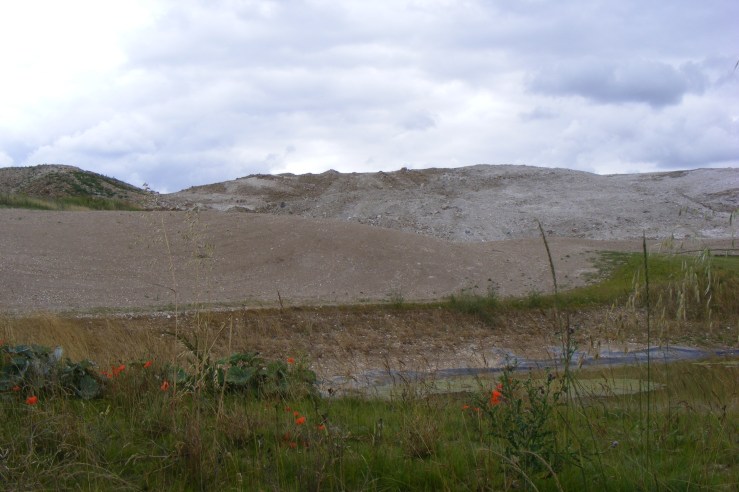
I ate at the drive-thru Costa at Basingstoke Leisure Park. I didn’t drive through it, or even walk through it; I sat down at a real live table. It made a change from my room in the Premier Inn. There is nothing like the actual hard reality of pilgrimage for dispelling any romantic notions one might have about pilgrimage. You live and walk in the real world, and the road shows you everything. Including Basingstoke Leisure Park.
But I had a bath. I washed my clothes and dried them on the heated towel rail. Spiritual enlightenment is one thing, but on the physical plane the one thing that you need to make a pilgrim really, really happy is a heated towel rail.
I’d meant to go straight to bed, but biology had other ideas (living and walking in the real world, remember?), and I had to cross the Leisure Park and a roundabout to a service station to buy tampons. I picked up a vastly reduced box of All Gold at the same time – by no means the most efficient way of carrying or consuming chocolate on the road, but I wasn’t going to argue with a quid. I had another bath and went to bed.
It took me ages to get to sleep. There was a noisy generator or something right outside my window, which I therefore couldn’t open, so was hot. So I watched a programme about Paula Radcliffe and dropped off eventually. It only occurred to me the next morning that I could have asked to change my room.
Next: the rain it raineth
Bodywork and Soul: a tragedy
Clive was looking infuriatingly pleased with himself. ‘Isn’t she beautiful?’
‘It’s a wreck,’ Helen said flatly. She surveyed the camper van in dismay. Rust-fringed panels, flaking paint, a missing window. ‘Does it even start?’
He shuffled his feet. ‘She will. Just have a little faith, Hel.’
Against her better judgement, Helen took a step closer and peered through the windscreen. The interior seemed to be in even worse condition than the outside, the upholstery cracked and faded, the curtains spotted with mould. ‘Of all the things to do with your bonus… I thought we were going to Turkey.’
‘When I’ve got this beauty up and running, we will,’ he said. ‘We’ll drive there.’
‘And when will that be, exactly?’ Helen demanded. She didn’t bother to wait for the answer.
Clive started with the engine. All that spring he worked on it, spending his weekends in the garage, tinkering and cursing, and his evenings scouring eBay for parts. Helen admitted, grudgingly, that he was at least putting the effort in. And when, on a cool, clear afternoon in late April, the thirsty, spluttering, sigh that she had got so used to hearing from the van was suddenly replaced by a full-throated roar, she couldn’t help running outside to hug Clive, and, feeling a little silly, pat the camper on one of its protuberant headlights.
That evening, they took their dinner out to the van, and ate with plates balanced precariously on their knees. Clive opened a bottle of Chianti, to celebrate. Helen had lit a scented candle to cover the smell of mould. The nostalgic fragrance of sandalwood filled the saloon, and the light flickered gently, disguising the signs of ageing on all three of them.
‘Do you know who it belonged to?’ Helen asked. ‘Where it’s been?’ She imagined long-haired girls wearing flowers and caftans, youths with flared trousers and beards; peace and love and all the idealism of their generation. Suddenly Turkey didn’t seem so far away. They could drive to Morocco, to India, all round the world.
Clive shook his head. ‘The bloke I bought her off rescued her from a scrapyard. Wanted to restore her but never got round to it. I don’t know who had her before.’
‘You’re already doing better than him,’ Helen said, thinking to herself that she was being dangerously optimistic. That would be the Chianti.
The bodywork was worse than the engine. Clive was always on the phone to panel beaters or VW specialists. Empty tins of Hammerite and primer collected in the corner of the garage. Then the top coat, shiny and flawless. Helen wondered, disloyally, if Clive was overdoing it a bit.
She bought an atlas. Perhaps India was a bit ambitious for a first trip. They could go from Land’s End to John O’Groats, something like that. Then Turkey, the next year. Laughing at herself, she lit a patchouli-scented candle for the next celebration dinner.
‘I’ve been in contact with the Owners’ Club,’ Clive said. ‘There’s a rally next month. Interested?’
‘You’re taking the camper?’ She was embarrassingly excited by the prospect of seeing the dratted thing on the road.
Clive frowned. ‘I doubt she’ll be ready for MOT by then. But I might pick up some useful tips. Next year.’
‘I thought we were going to Turkey next year,’ Helen said, lightly.
‘Yes,’ Clive said. He sounded doubtful.
He enlisted Helen’s help with the upholstery, ordering reproduction fabric in authentic patterns, and standing over her and the sewing machine until she shouted at him. ‘How can you possibly expect me to make a decent job of this when you’re breathing down my neck?’
He muttered an apology and stomped off to the garage. When she came out, to apologise and to show him the curtains she had just finished, he was repainting one of the panels.
‘What was wrong with it?’ she asked.
He frowned up at her. ‘I’m redoing the whole lot. This is a much better match – what she’d have looked like originally.’
Helen thought of the roads the camper had travelled, the adventures they would never know about. ‘But don’t you want her to look a little bit lived-in?’
Clive winced.
It was the end of November when Clive admitted that even he couldn’t think of anything left to do. ‘She’s finished,’ he said. ‘She’s perfect.’
Helen smiled. ‘So are you going to book an MOT?’ Even now, with darkness falling at five and the gales blowing in, she found the thought of the open road exhilarating.
Was she imagining his evasive look? ‘Not until the spring,’ he said. ‘There’s no point wasting three months when we won’t be driving.’
‘So,’ she said in April, ‘when are you going to take her for her MOT?’
‘Well,’ he said, ‘yes. That’s the thing. Er. That is. I’ve been thinking. After all the work I’ve put in. I don’t want to spoil it, taking it on the road. You never know what might happen… Oh, love, don’t cry. I’ll ring around the travel agents tomorrow. See about that holiday to Turkey, eh?’
100 untimed books: skyline

If the Himalayas aren’t a skyline, I don’t know what is.
This book was a gift from my best friend, who is Norton’s great-granddaughter. Reading it, we discover that he also was prone to blisters. So there you go.
St James’ Way 1: Ultreya
Reading to Little London, 21-22 July 2015
I’m a bit prone to overambitious plans, grand symbolic gestures, and knowing that something is a bad idea and doing it anyway. Whan that Aprille, with his shores soote, and so on, remarks Chaucer, than longen folk to goon on pilgrimages. I think in my case it may have been seeing Chaucer quoted all over the internet on the first day of April last year. That and being about to turn thirty. Being about to turn thirty the day after St James’ day. I had a week’s annual leave booked immediately before my birthday. I had a booklet published by the Confraternity of Saint James describing a walk from Reading to Southampton. I had expansive plans for a birthday party just outside Winchester, my birthplace. It was all too beautiful not to try.
The celebrations began with a team meeting, where a colleague presented me with a beautiful – and completely impractical – bunch of flowers. I’d tried to hint, a few days before, that flowers would not be entirely the sort of luggage I needed to be carrying, but of course I couldn’t make it clear without implying that I was expecting flowers. Flowers always happen, but they’re meant to be a huge surprise. I resigned myself to the flowers.
It was my last day in work before my birthday; another colleague’s birthday was the day before mine; it merited a celebration. We went to the pub for lunch. After a leisurely afternoon back in the office, I hauled myself and my rucksack and my bunch of flowers off to Paddington, and ended up on a hushed commuter train heading westwards.
Reading, a town that I usually like, felt vaguely unsatisfactory. First I discovered that my faithful rucksack, which had served two caminos and six months of hauling washing to the launderette, had succumbed to old age and was shedding flakes of its waterproof lining all over its contents. Then I managed to get my room key card stuck in the door, and so had to stand fuming in the passage until the owner turned up to program a new one for me. The establishment was hardly the Ritz in the first place, and the corridor was perhaps the least glamorous part of it. I wouldn’t have spent five minutes standing there by choice, let alone forty. And I was paying sixty quid a night for this. Having at last been provided with a new key card, I set out into town.
I used to know two people who lived in Reading – at least, I used to know two people well enough to drag them out for a drink at short notice. One of them had moved to Bath, and the other was busy. Given the key card inconvenience this was just as well, but it all contributed to the slight sense of anticlimax. It was just me and St James, then. Fortunately I’d been to Reading before, with the Confraternity of St James, and I knew where to find him. He’s on the gatehouse and in the Roman Catholic church, and in the ruins of the abbey. I stomped down to the abbey and slid the flowers under the fence. St James could have them, and maybe they’d cheer somebody up in the morning. Moored at the bank of the River Kennet was a narrowboat named Ultreya. This was a very good sign: ‘Ultreia!’ is a greeting used by pilgrims on the Camino de Santiago.

I found a Tesco and stocked up on provisions: brioche rolls, Laughing Cow spreadable cheese, and apples. I’d crossed Spain on a similar diet, and I was only walking four days this time. Then I started looking for somewhere to eat that evening. This was where having to fend for myself became particularly significant. Had I been with a companion I’d have probably traipsed all around Reading trying to find the perfect place and rejecting all sorts of entirely plausible eateries until they got fed up and dragged me through the nearest door with a menu nailed up next it. I could feel myself trying to do that, and as my blood sugar got lower and lower I got pickier and pickier. Perhaps I should go to Wetherspoons, but ugh, it’s a pub, and probably full of horrible men, and really I should seek out one of the pubs that my friend recommended me even though he didn’t mention food in the context, and how could I even think of going to a boring chain Italian restaurant. As it was, I dragged myself through the door of the boring Italian chain restaurant, ordered myself some olives and pasta, and got myself fed. Oddly enough, my mood improved vastly after that, and I went back to my bed and slept well, waking once, briefly, at the sound of a clock striking four in the morning.

Breakfast the next morning was in La Baguette, the greasy spoon café to which the B&B was attached. It was entirely acceptable, and provided ample opportunity for people-watching as beaucoup de monde came in to get their cappuccinos, tuna melts and so forth. I found myself less fed up with Reading. It was a bright morning. I set off with some fuss around what the hell do I do with my camera and what the hell has Tony done with this rucksack and what the hell have I put in this rucksack. Tony had expanded everything to its fullest extent, and it took me nineteen miles to work out that I needed to de-expand it again. It made for a painful first day on the road.

That aside, the first section particularly was a joy, walking alongside the river Kennett and the Kennett & Avon canal, watching dragonflies and butterflies flittering around the plants on the bank, looking at the backs of houses whose gardens tumbled down towards the water, dipping my fingers in for benediction where I could safely get close enough. Wide green meadows; two flocks of geese, neither aggressive; a shoal of tiny little fish swirling endlessly around a shallow backwater.

Leaving the river, the route becomes less obvious, and having the OS maps with me was occasionally essential and occasionally confusing. The first challenge was making my way around three sides of a lake on a path not even marked on the map, and wondering whether a half timber-framed, half cream-painted house was the ‘white house’ or the ‘timber-framed’ house mentioned in the guide. Up the first hill – nothing spectacular, but Cambridge had spoiled me for gradients – past the entrance of the police training college, and up towards Home Farm (one of thousands, no doubt) for the first disastrously misleading direction. I ended up going through the farm and along a charming but unnecessary gravelled track, where I ate my lunch under an oak tree, and finally conceded that I’d gone wrong when I emerged onto the road. No harm done, though; it just meant some extra road-walking, and I picked up the route again in Sulhamstead Abbots.

I followed it into Burghfield Common without difficulty and bought an ice cream in the post-office-cum-shop. I sat outside the Methodist church to eat it; I’m sure the Methodists wouldn’t mind. I hope they didn’t mind the sticky patch where the last bit fell of the stick before I could eat it. I minded dropping it, but there we go. Through the Common itself and up a wooded path. I met very few people on the road – there were a number of runners and anglers and cyclists on the way out of Reading, but after that I would not have run out of fingers. The ramblers’ association scout on the road to Sulhamstead Abbots, the dogwalker – that was about it. I stopped for a pint of orange juice and lemonade at the Horse and Groom in Mortimer, where the barmaid was very impressed and very kind. I sat out in the beer garden, saving a parasol from blowing away, until the rain started, at which point I left the parasol to its fate and moved inside again.

Mortimer was the place where I’d originally intended to stop, and I was hurting now. The bad days are always those which have you walking further than you wanted to because there’s no accommodation available sooner. I sulked my way towards Silchester, crossed from Berkshire into Hampshire, and found, in a very proper silver birch copse, tiny sweet-sharp wild raspberries. Then I spent far too long walking around the perimeter of a field trying to work out what the guide meant by the ‘top left corner’ and why it didn’t mention the kissing gate, which, it turned out after I’d gone a long way the wrong way in both directions, I should have gone through in the first place.

After that I was in no mood to turn aside to examine the Roman amphitheatre. I did look into the church, where the organist was practising the Entry of the Queen of Sheba and Jerusalem. Wedding season. I hoped that he would practise quite a bit more, assuming that the wedding was on Saturday. Advised by the guidebook, I duly admired the wall paintings, but was really not in a good mood, and declined to follow the diversions around the Roman remains. At this point it was five miles to go until Little London and bed. The one great advantage of having had to book accommodation in advance was knowing that at least I had somewhere to sleep. Perhaps, I thought, it would even have a bath. But really, the main thing was being able to stop.
Round an interminable wood with a substation in the middle of it, along some more fields and out into the churchyard of St James, Bramley, which I would probably have been able to look inside had I been half an hour earlier and not in great pain. The backs of my knees were particularly painful. I spent some time lying on my back in a field, which was nice, but didn’t get me any nearer being able to stop. I struggled through the next four fields, being baaed at madly by the sheep in the last two, along a lane, over an agonising stile, and out into the road in Little London opposite the Primitive Methodist chapel – as was – now my home for the night. The Methodists had, unwittingly, been providing me with hospitality all the way.
This chapel had become Chapel House Bend and Breakfast, run by Giorgia Aitken, who I am pretty sure is actually an angel. Certainly the place was heaven. I hadn’t quite gone so far as to wish I was dead on the way there, but I’d come close. Giorgia poured me apple juice, showed me the shower (no bath, but it was wonderful in every other way) and brought me dinner. A smoked salmon and salad starter; pasta with leeks and ham; rhubarb crumble. Sublime, and she only charged me a tenner on top of the B&B rate. A quiet, exhausted evening – drinking Pukka ‘detox’ tea because there was some in the kitchen and it reminded me of a pilgrim friend, reading Sherlock Holmes – left deliciously to myself. An early night; a heavenly soft bed.

Issues with Issues: bisexuality and the Church of England
[content note: discussion of a biphobic document, including a specifically biphobic quotation]
Issues in Human Sexuality has become a very Anglican idolatry: a discussion document published in 1988, elevated without consultation to quasi-doctrinal status and making the lives of LGBT members of the Church of England a misery ever since. It’s the document that ordinands are asked to submit to, the document whose logical conclusion is that same-sex marriages can’t be performed or even blessed in church.
Paragraph 5.8, which attempts to deal specifically with bisexuality, has been floating around Twitter lately, and since I have more to say on the matter than will fit into 140 characters, I’ve taken it to the blog.
5.8 The first is that of bisexuality. We recognise that there are those whose sexual orientation is ambiguous, and who can find themselves attracted to partners of either sex. Nevertheless it is clear that bisexual activity must always be wrong for this reason, if for no other, that it inevitably involves being unfaithful. The Church’s guidance to bisexual Christians is that if they are capable of heterophile relationships and of satisfaction within them, they should follow the way of holiness in either celibacy or abstinence or heterosexual marriage. In the situation of the bisexual it can also be that counselling will help the person concerned to discover the truth of their personality and to achieve a degree of inner healing.
The depressing thing about this – no, there are many depressing things about this, but one of the first that springs to mind is that it relies on a definition of bisexuality that no bisexuals use, a myth that is in wide circulation beyond the Church, namely, that ‘bisexual activity… inevitably involves being unfaithful.’ The majority of my secular straight acquaintance agrees that the Church’s attitude to homosexuality is bafflingly uncharitable, but I’ve had to explain a tedious number of times that no, I’m still only sleeping with the person I’m married to.
I began identifying as bisexual in 2007, having first heard the word in 2006. At that point I was in a relationship with the man I was to marry in 2009. Our seventh wedding anniversary was last Monday. Now, you can make all the ‘seven year itch’ jokes you like, but I have never been unfaithful – unless you subscribe to a particularly literalist interpretation of Matthew 5:28, in which case I suggest you check your own eye for logs. I have from time to time developed crushes on other people, told my husband about them, laughed, and moved on. I will be very surprised if that’s not true for the majority of straight people and gay people.
The paragraph also relies on another common misapprehension about bisexuality: that it ceases to exist when somebody begins a monogamous relationship. My own experience gives the lie to that. I was already in a monogamous relationship when I took a long, hard look at the list of everyone I’d ever been attracted to and realised they weren’t all the same gender. Nor did I not stop being bisexual on 20 June 2009. In fact, it was some of the hard thinking that I had to do as part of marriage preparation that gave me the impetus to come out to my husband. (Whose response, by the way, when I showed him this paragraph the other night, was ‘What the fuck?’)
I am ‘capable’ of celibacy, abstinence and heterosexual marriage, though not all at the same time. I’ve done all three in my time, I’ve seriously considered all three, plus a relationship with someone of the same gender, as possible futures, and all the time I’ve been bisexual. What is ‘bisexual activity’, anyway? At present I, a bisexual, am typing a blog post in my lunch break, drinking tea and listening to the Sullivan cello concerto. No infidelity involved. That’s as far as my bisexual activity goes.
I have had counselling in the past. It helped, but not in the way that Issues seems to think it might. It was the beginning of an attempt to achieve what this calls ‘a degree of inner healing’. What eventually came to the surface was the inevitable conclusion that my attempt to ‘follow the way of holiness in… heterosexual marriage’, ignoring all the bits of my personality that didn’t fit that story, hadn’t worked at all; it had led to me leaving half of myself outside the church door. That stint of counselling, and all the thinking I did after that, didn’t ‘heal’ me of being bisexual, because bisexuality is not something that needs to be healed. ‘Dealing with’ bisexuality by ignoring it is, pastorally speaking, a terrible move.
And guess what? The truth of my personality is that I’m bisexual, no amount of counselling is going to take that away, and accepting it, celebrating it, has brought me a degree of inner healing that pretending to be a straight wife never did.
100 untimed books: sweets

When I was little, we had some traveller friends who lived in a converted bus in our back yard. Since most of our other friends lived a mile down a very busy road, my brothers and I spent quite a lot of time with Ed and Jenni, Izak and Riley. When it was fine, we played in the garden. When it was raining, we went to the bus.
Jenni had a copy of Mary Berry’s Step By Step Desserts. I spent many happy hours looking through this book. Later, they moved to France, and we moved to the Isle of Wight, and I haven’t seen them in years, though my father and brother visited them a few weeks ago.
All the same, when I saw a copy in a charity shop I snapped it up. I make recipes out of it occasionally, but mostly I just look, and remember contented rainy afternoons, and very hospitable friends.
The wisdom of rowing coaches
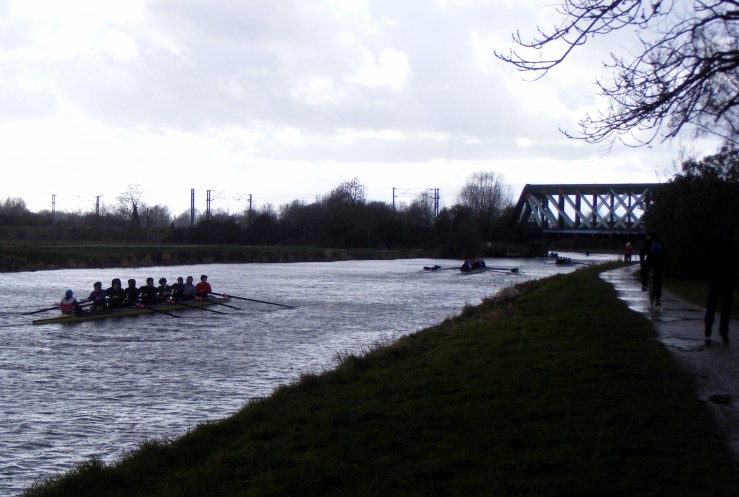
I’ve mentioned before that I live very close to the Cam. What this means is that it’s very rare for me to cycle to the station, go out for a box of teabags, or just have a wander, without seeing a rowing boat or three on the river.
And where there are rowing boats, there are coaches. The rowing coaches cycle up and down the towpath with buoyancy aids slung over their handlebars and with their eyes on the river, yelling at the boats. Sometimes, when the boat has slowed and the blades of the oars are trailing in the water, when the coach has brought their bike to a standstill, I overhear what they tell their charges. I like to listen, because their instructions are often useful clues.
Some seem pretty specific to the sport:
Here’s a trick that might be useful to you: imagine that you’re controlling the oar of the person in front.
Some seem to have more general application.
You should only be spending about 30% of the time on the stroke. The rest is recovery.
And then, yesterday,
You can’t fix the current stroke. You can only fix the next stroke.
You can’t fix the current stroke. You can only fix the next stroke.

