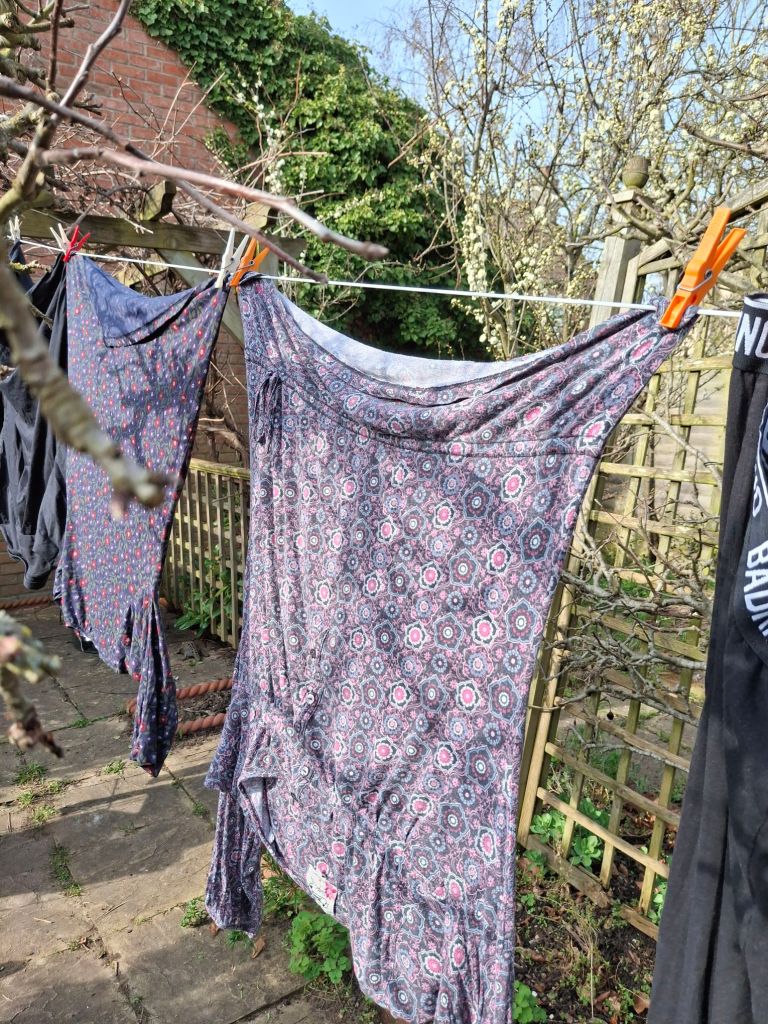
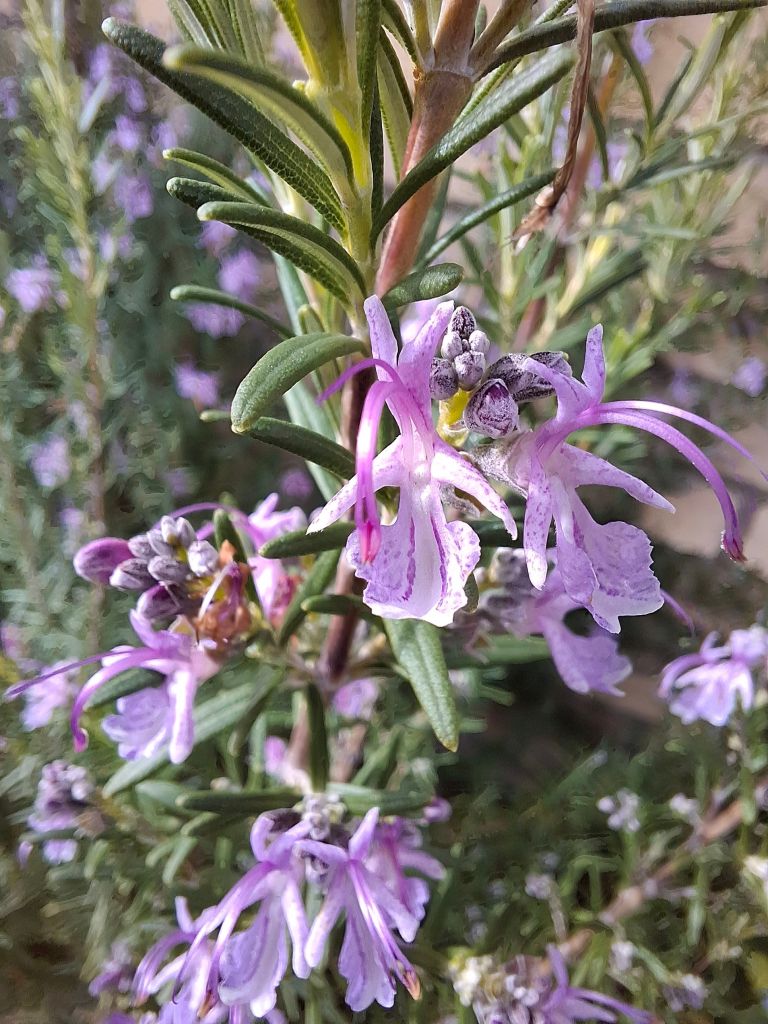
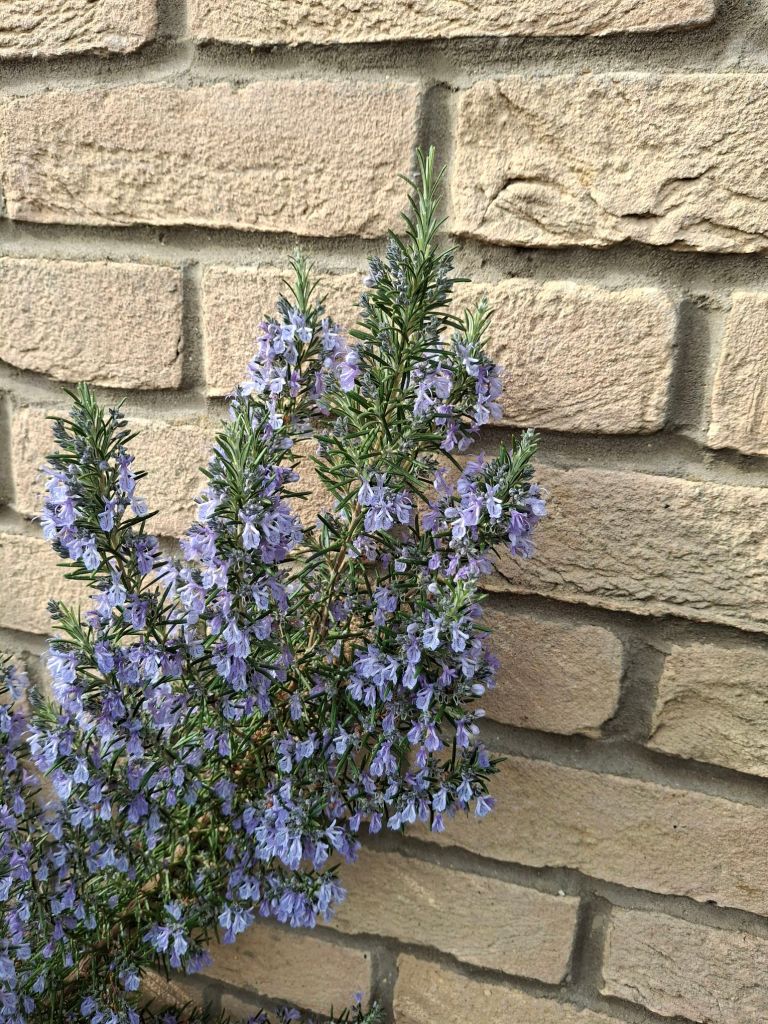
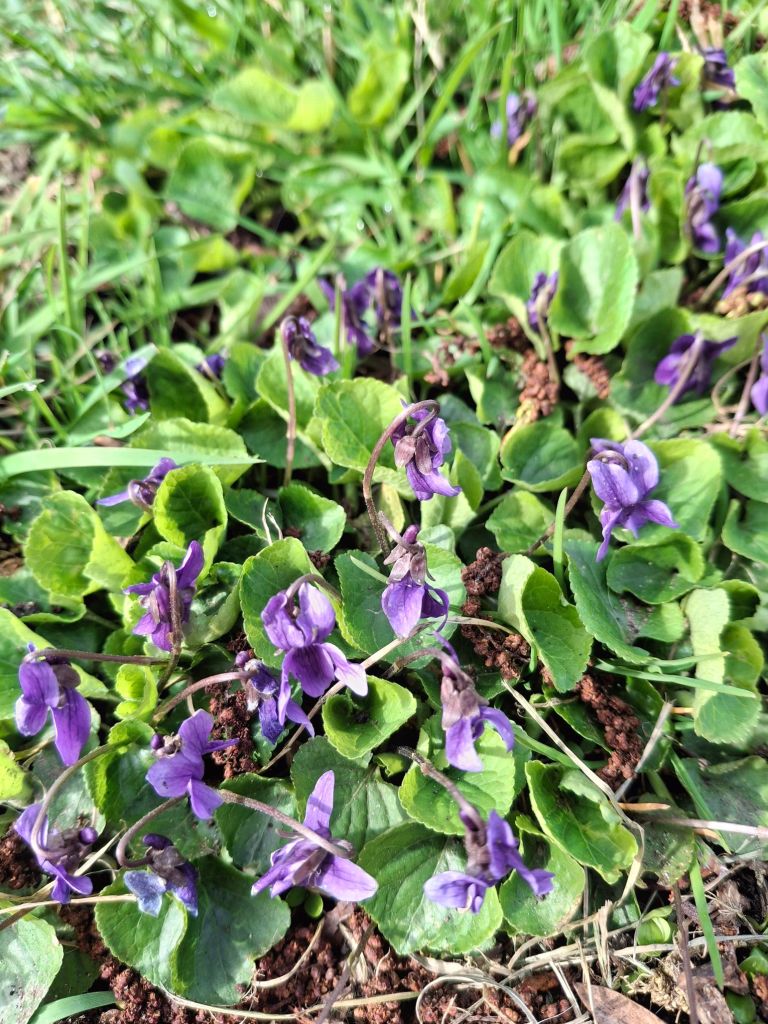
Here’s a very pink-and-purple selection of pictures to mark the tipping point between long nights and long days (in this hemisphere, at least). There’s yellow out there, but I tend to think of that as belonging earlier in the spring, or maybe a little later, as dandelions replace tired daffodils. Here, now, the rosemary is running riot (and quite right too, with Lady Day next week), and the violets are bringing their own colour, and there are grape hyacinths all over the place, and it’s a lovely day to get the washing out. Overhead, there’s white: plum blossom and cherry blossom (next door’s plums are always ahead of ours, so the show goes on and on).
Some people take today as the first day of spring. I prefer the Celtic calendar, which puts it at the beginning of February. Despite the occasional cognitive dissonance (and wasn’t February miserable this year?) I like it that way: mostly because I can’t be doing with Midsummer Day somehow being the first day of summer. Anyway, I’m in too good a mood to argue today. Today’s it’s definitely spring.
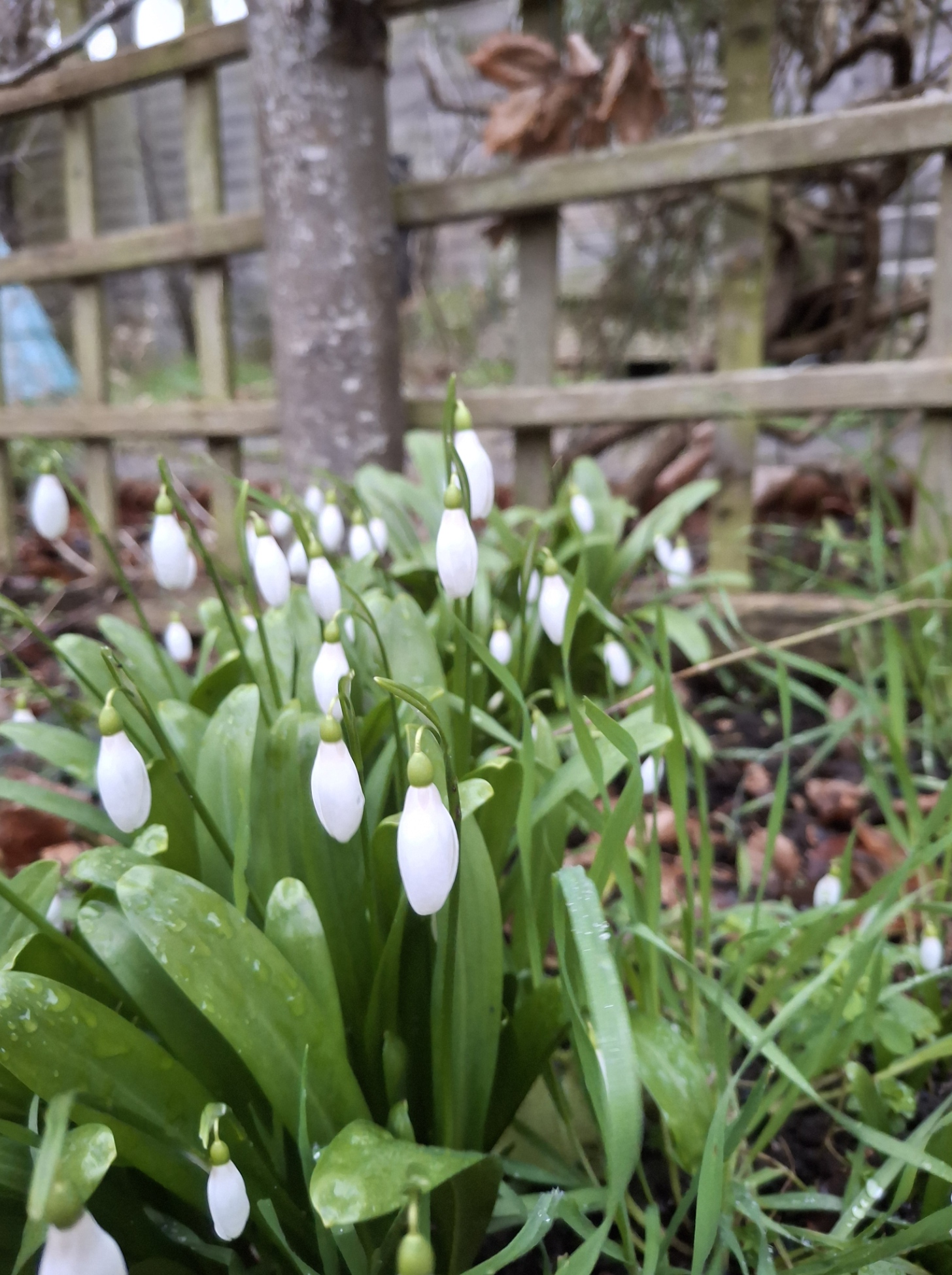
The snowdrops are out for Candlemas, as they should be. It’s been a grey, heavy, sort of a day, no shadows to be seen because there was no sunshine to cast them, so I suppose we’re plodding on into spring. The days are longer. There are buds on the trees.
A presenter on Radio 3 said earlier that Candlemas is the Christian festival of light, and, while I suppose that isn’t entirely untrue, it’s far from being the first thing that springs to mind for me. If I told you that Christmas is the celebration of the mystery of the Incarnation, I’d be correct but pedantic. But for me The Presentation of Christ in the Temple is in the same size print as Candlemas. The light is figurative, although it’s coupled with the physical light of the lengthening days. I rarely manage to get to church in the evening at all these days, so miss out on the candlelit procession which in any case was not much a feature in many of my previous churches.
For me, it’s most poignant as the hinge between Christmas and Holy Week, looking back and looking forward, prophecy and fulfilment and prophecy again. It calls back the glow and the glory, the paradox of God entering God’s world and God’s temple all but unnoticed, and it warns of the sword and the falling and rising. It picks up the disquieting note of myrrh and underscores it: this child was born to die.
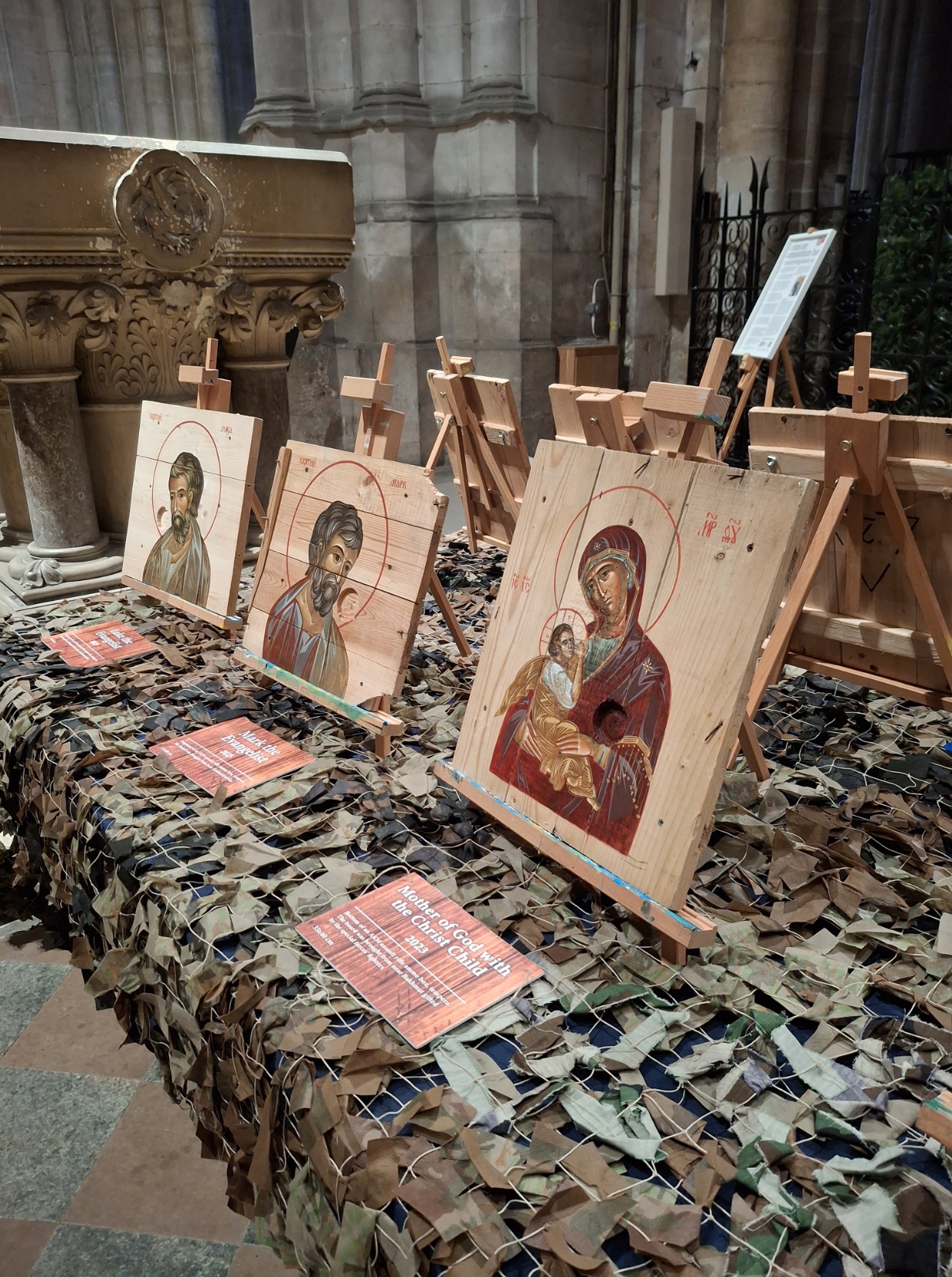
Last week I was able to see these icons by Sonya Atlantova and Oleksandr Klymenko, which are on temporary display in Ely Cathedral. They’re painted on fragments of ammunition boxes recovered from battle zones of the war in Ukraine. The symbolism is obvious but no less effective for that: war and death transformed into love and beauty – but you can’t, shouldn’t, mustn’t forget it. Look at that hole where Mary’s heart is.
Loving anybody leaves you open to the certainty of grief when you have to leave them or lose them (it’s the anniversary of my father’s funeral today, too, Lord now lettest thou thy servant depart in peace); the alternative is, of course, monstrous. Parenthood makes you vulnerable, or, perhaps, aware of how vulnerable you are, how very little you can do alone to protect those who look to you for protection. Candlemas is, for me, when we understand a little more deeply what Christmas means. This child is born to die, because all of us are, and even if this birth and this death change birth and death for all of us, it isn’t going to hurt any the less.
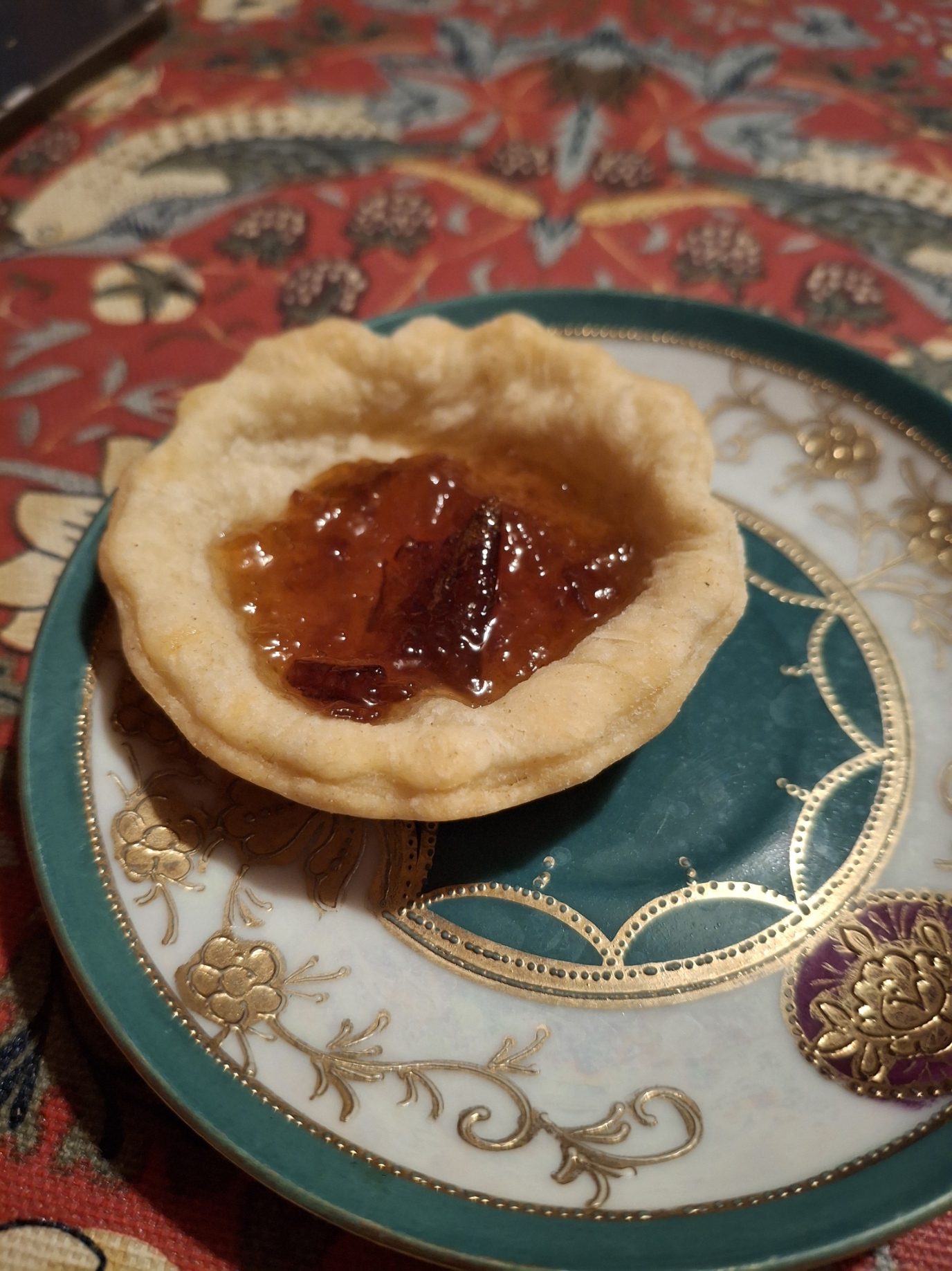
On a lighter (ha!) note, I recall from the Journal of Saw It Somewhere Studies that jam tarts are a traditional Candlemas treat. The shape recalls the Christ Child’s cradle, apparently. This was never a part of my own tradition, but I was making chicken pie for dinner and had some pastry left over, so here we go.
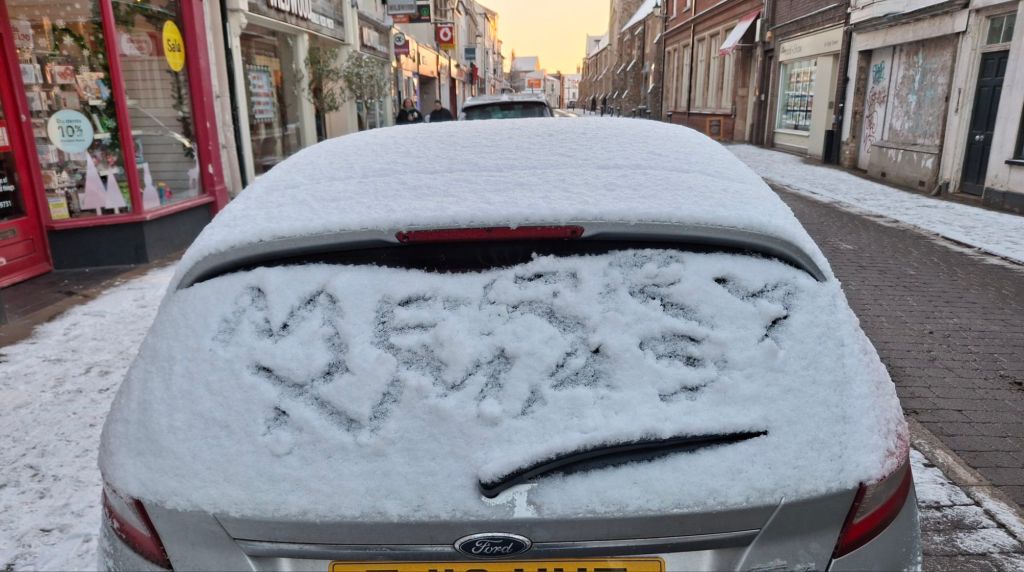
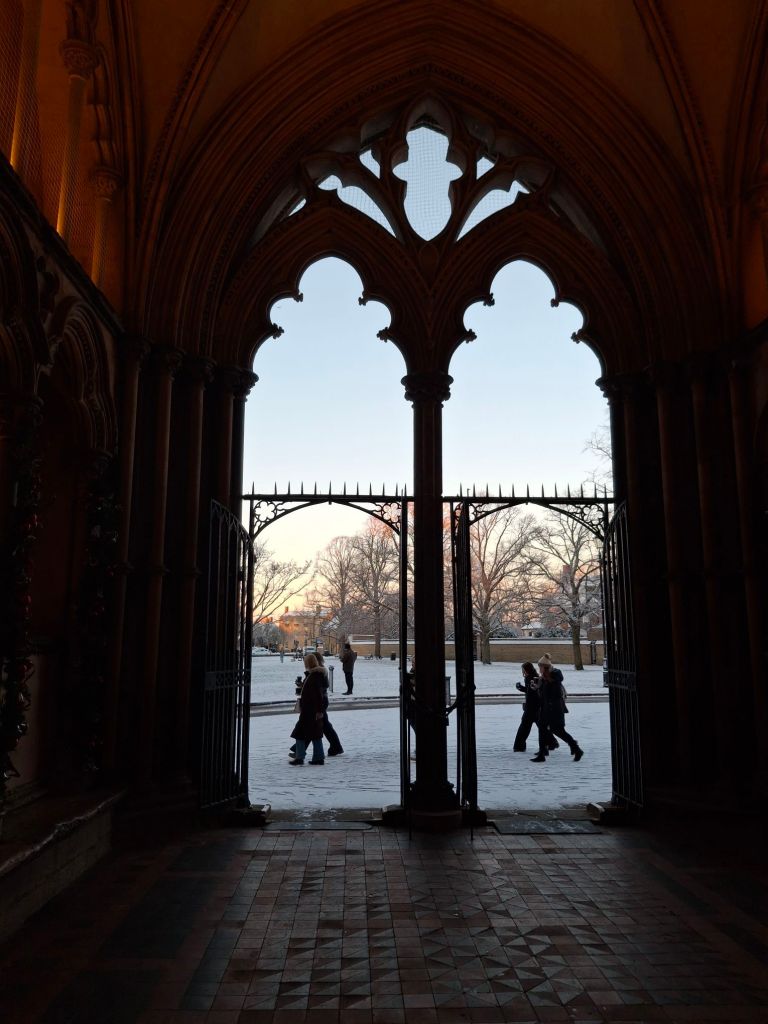
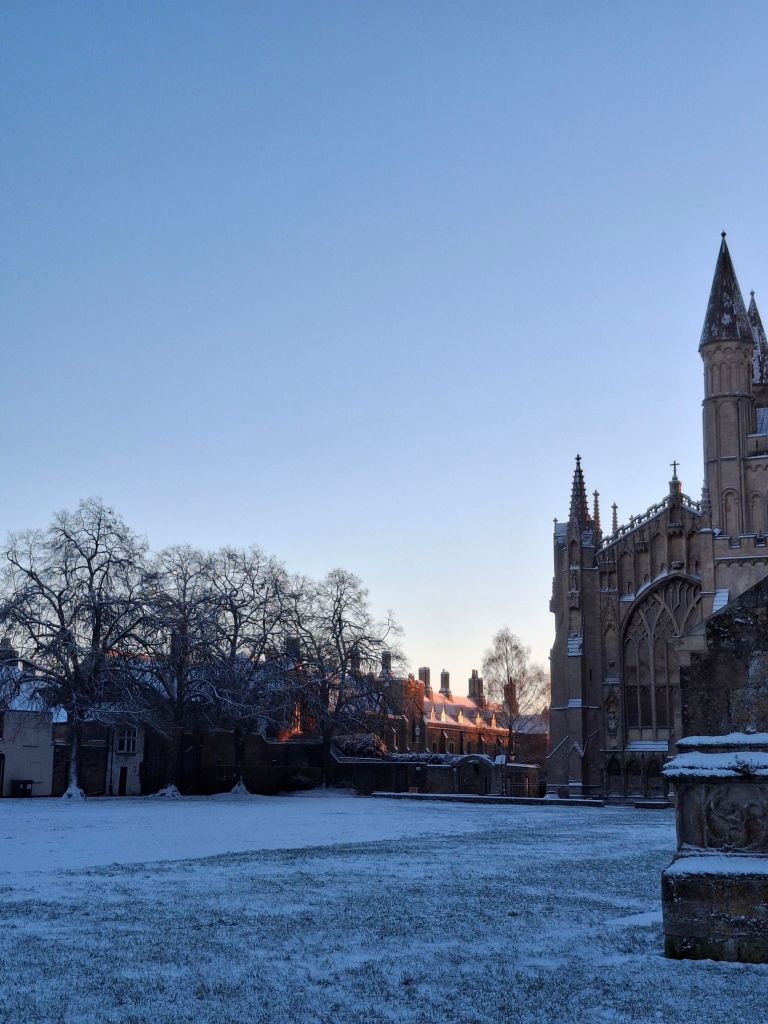
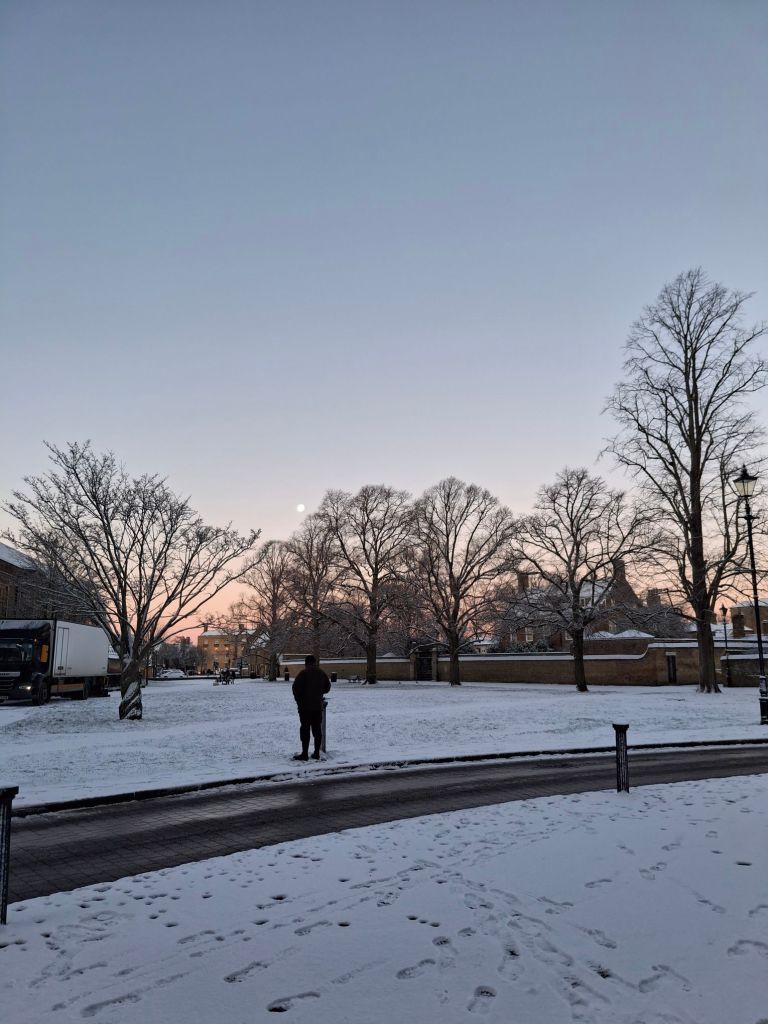
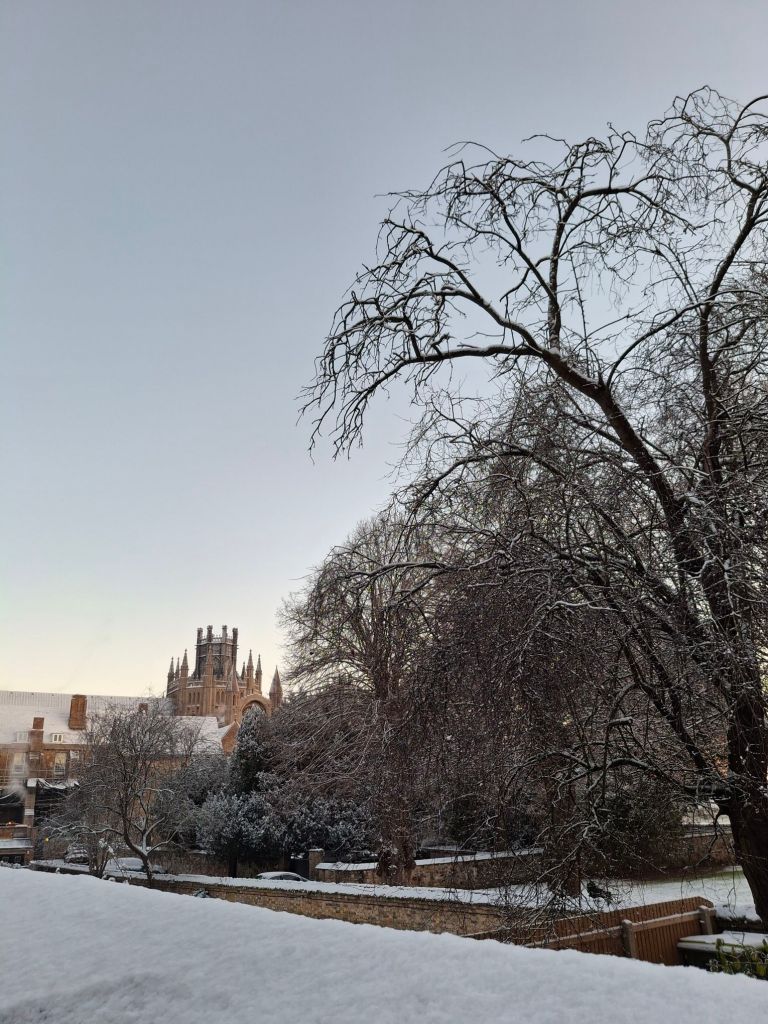
It snowed overnight! We don’t get much of it round here; in fact, it’s been almost exactly a year. So either the perpetrator of this mild act of vandalism is keeping the full twelve days of Christmas, or else someone’s driven in quite a long way without clearing their back windscreen.
Anyway, this time last year we had a pathetic little dusting of snow, and I was in bed, in a good deal of pain and unable to keep any food down, as the leftover gas from my gallbladder removal surgery fought its way around my abdomen. (What sorted it out, for anyone in similar straits, was a little pill called Wind-eze. The packet wasn’t very clear on how it works, but it does.) Today, by contrast, I was able to walk across town in my Wellington boots, stopping at the cathedral to walk the labyrinth (still in wellies – that’s a first!) and eat the last cherry cream choux bun in Caffè Nero. So, contrary to my gloomy posts of the last month, I can and do get better.
I’m still ill. Three weeks, now; in fact, a little more. The really obnoxious symptoms have gone, but if I do just a little too much I find getting out of bed the next day very difficult indeed.
So today I sampled the solstice daylight from the door and then retired, so far as I could, to the sofa. The choir sang O Oriens at Evensong, though I didn’t hear it. Once again, it’s not really how I’d have liked to mark the solstice, but it feels oddly appropriate. And if it feels particularly dark this year – well, it was a new moon yesterday, so maybe it was.
Yesterday we went out to a stately home. There was a choir (OK but not great) singing Christmas carols outside the café, and in the chapel there were volunteers leading any visitors who cared to join in (and most seemed to) in more carols. Yesterday would have been my mother’s birthday. She would have enjoyed nitpicking the choir’s performance, and she always went carol singing on her birthday if she could. I cried, but I was so glad to have done it.
O Oriens. O morning star. O radiant dawn. Come and enlighten those who dwell in darkness and the shadow of death. A whole chunk of morning prayer unexpectedly brightening the evening.
My moon app tells me it’s a waxing crescent, 3% illuminated. Of course it’s not visible in the night time at all, and even if it were, it’s tipping it down out there. Nevertheless, despite all appearances, it might be possible that things are already getting better.
If I’ve been a bit slow on the uptake, I suppose I can blame this lingering lurgy. It’s been two weeks and I’m still lethargic and very conscious that I’m not yet well. I’m better, I think, than I was on Advent Sunday, when I was cold and wobbly and wondering what on earth was wrong with me; certainly better than last Friday, or this Monday; but still not entirely well.
Some friends observed recently that in these days of antibiotics and painkillers (both undoubted benefits to the world at large, let me be clear) we’re stumped by minor illnesses whose symptoms persist. I couldn’t take antibiotics for a cold, and, while I was glad enough of paracetamol and pseudephedrine when my head and ears were aching and I couldn’t breathe without thinking about it, there’s been nothing to be done with the fatigue. Except, of course, waiting. A hundred years ago that would just have been the way things were. You’d have to give your immune system time to do its job, you wouldn’t be able to dose yourself up and power on through.
This year I’ve been reading, very slowly, Kathleen Norris’s The Noonday Demon, in which she examines the cardinal sin/bad thought (depending on which theologians you ask) of acedia. This concept has some overlap with the clinical condition of depression, and is often translated as ‘despair’, but, Norris seems to argue, is perhaps best interpreted as the desire to be somewhere other than where you are. This resonated, often when the toddler just wouldn’t go to sleep, but at other times too.
And recently I picked up Ross Thompson’s Spirituality in Season, in which he talks about three kinds of ‘abyss’, or exclusion:
First, there is exclusion from God, which because God embraces us always, can only be self-wrought; this is sin, leading to hell. Second, there is exclusion from life and being, which by definition is death. And third there is exclusion of our fellow human-beings, which in much of the teaching of Jesus… seems to be equated with the judgement; we are already judged, it seems, by our own response to our neighbour in need.
Then he draws a contrast between the two penitential seasons of Lent and Advent, noting that in Lent we actively confront this abyss (because, as he says, it’s all the same thing) while in Advent we ‘vulnerably experience their great danger, before experiencing at Christmas the one who saves us’.
And then he goes on to talk about waiting, using the example of waiting for a bus. We wait for something (or someone) over whose arrival we have no control at all.
(Here, I would add, we have two options: we can watch, or we can seek distraction. I’m very conscious that lately – the last few months, maybe longer – I’ve been seeking distraction. I’ve been very reluctant to face the inside of my own head, or heart. Too tired. And it’s going to hurt. Maybe. That might or might not be what’s going on. I need to look at that too.)
I read this… in November, if not October. I gleaned some useful facts for my O Antiphons workshop. I noted the reference to W. H. Vanstone’s writing on passivity in the events of Holy Week, which I have also read, and found useful.
And then I spent the first ten days of Advent absolutely hating where I was, furious that I didn’t have the energy to engage in anything that felt like a meaningful observance. And not being able to prepare for Christmas, the sacred or the secular versions, either.
And then it clicked. Waiting. I’m waiting. I’m waiting to feel better. I have very little control over how my body deals with this illness; even my capacity to do nothing is limited. This is, or could be, more meaningful than any Advent devotional book, could teach me more than any twenty-four windows I could open. This is a particularly immersive way to experience waiting, and, therefore, to observe Advent.
Has it helped? Immensely. If nothing else, laughing at my own failure to get it improved at least a couple of days last week. And not at all. Today, for instance, I wrote, I am losing sight of the concept of anything getting better. (And about three minutes after I wrote that, it did.) But that’s the way it goes. If I’d assimilated this brilliant new insight immediately, discovered how to embrace my enfeebled physical state as a symbol of my mortal human state, and glided up to new heights of spiritual consciousness I’d have missed the point, wouldn’t I?
I always take the first week of December as annual leave, and I always tell people that I don’t plan to do very much with it. Well, not two years ago, when I was on maternity leave, obviously, and last year it was the last week of November, but before that I had a long-standing tradition of taking the first week of December as annual leave, and this year I reinstated it.
The theory is that I get a bit of breathing space with which to start my new year. I observe at least the beginning of Advent in a meaningful way. I take some time to look back at the past year and forward to the next one. I do some writing, perhaps. I get a break from the enforced cheeriness of secular office Christmas (this is less dire than it used to be before the pandemic). I take long walks. I contemplate vast clear skies. And yes, I do a bit of shopping and go to the post office at a time of day when the queue isn’t out the door.
That’s the theory.
I’d forgotten that what actually happens is that I get ill. Whatever stinking cold is making the rounds, the moment I take my early December break, it hits me. Cough, headache, runny nose, nosebleeds, any combination of the above.
This year there’s been an earache and a sticky eye as well. Apparently there’s something absolutely miserable going around, and since it’s lasting a fortnight (so says my neighbour) I probably have another week to go.
(Last year, by way of variation, I was fine during my week off, but then had an unpleasant gallbladder flare-up the week after. The year before that, who knows, I had a five-month-old baby and I can’tremember. The year before that I was pregnant and still in the “constantly exhausted” stage. Before that I might have dodged it with the help of the pandemic restrictions. But before Covid it was definitely a thing.)
I’m particularly annoyed this year because this happened when I took three days off in September, too. But I was tired, and I knew that I was tired. I suppose it’s been a hell of a year, and that’s all there is to it.
So I’m trying to let this be a time of patience, as I suppose is only fitting. If I’m not feeling up to trimming the hearth and setting the table, I can still look east, believing that Love the Guest doesn’t mind the cat hair on the cushions or the toys on the floor. (That carol has been in my head a lot recently; I was meaning to write a post about it. Not this week, though.) I’m trying to accept the experience of being ill, even if I can’t enjoy it, rather than wishing I was somewhere, somebody, else. I’m trying to keep my temper. I’m trying not to worry too much about the next few weeks, and mostly managing it, because I just don’t seem to have the energy.
Next year, then, I might remember that my body seems to need rest as much as my mind needs to process and review. I might make myself a list of things that are gentle and restful but still feel appropriate to the season. I might be prepared for the first week or so to be utter chaos, and to trust that there’s meaning in the chaos too, there’s help for my helplessness, there’s space for everything I need to do, and grace for everything I don’t get to. And this year I’ll try to live that.
We got purple carrots in the veg box this week. If I told you I’d been saving them for Advent I’d be lying: in fact I fancied leek and potato soup on Monday, had a really busy day on Wednesday so just defrosted some tomato sauce and cooked some pasta, thought the broccoli was probably more urgent on Friday, and didn’t cook on the other days. So in fact it’s worked out very appropriately with these magnificent carrots arrayed in deep purple for the solemn season of Advent. Some of them even have stars in the middle, as you see, although these didn’t look as striking after cooking.
It’s St Andrew’s day as well, of course. I did think about that (very slightly) in advance, and cooked a bought salmon en croûte in his honour, and thought of my last church, dedicated, like many others in Cambridge, to the first fisherman-apostle. But it’s been a wearing day at the end of a wearing month, and I don’t quite feel as if I’ve properly got started on Advent yet, or given St Andrew the attention he deserves. Plenty more of Advent to come, of course. St Andrew might have to wait for next year.
Not long after I started taking Advent Sunday as my personal new year, somebody asked me whether I was going to push my end-of-year wrap-ups and preparations forward into November. No, I said, the idea was to take the whole of December (and the first week of January, come to that) to do it at a leisurely pace, and to give me something to do other than getting fruitlessly annoyed by all the commercial-Christmas tat.
Which still holds true. My husband bought me a packet of lebkuchen, which are already in the shops: I love them, but I couldn’t quite bring myself to touch them. Not in November. And yet this year I’ve noticed myself looking forward eagerly to Stir Up Sunday – today – the last Sunday of the Church year, Christ the King in new money – and the making of the pudding. Preparing for the preparation. And I’ve been getting out the recipe books and flicking through things that look tasty, things that look fun, things I’d never normally cook or eat but which might be approached in a spirit of “It’s Christmas”.
I do like a nice recipe book. And I have been reasonably adventurous this year. (Quince, ginger and raisin suet pudding, the other weekend, from Modern Pressure Cooking. Very good.) But I’m not usually this diverted by Christmas food.
It’s partly knowing that I’ll get much less church than in the pre-baby days, and other elements of the festival seem more promising (not that I will have any more opportunity to cook, of course).
It’s partly that this year I know I can eat it without causing myself significant abdominal discomfort. (Last year I had my gallbladder removed on 30 December; from the previous Christmas up until that point, eating anything fatty put me at risk of vomiting and hideous pain.)
It’s partly having stayed, last weekend, at a Premier Inn attached to a Beefeater which was exuberantly and prematurely Christmassy.
It’s partly having led an Advent study day yesterday, based on the O Antiphons (usually encountered 17-23 December), and having been preparing for that for several weeks. (We followed it with Evensong, and used the readings for the Eve of Christ the King. They worked very well.)
It might partly be wanting this year to be over and done with. It’s been intense, and often painful, and it’s gone very fast. So why not wrap it up now?
It might partly be wanting an answer to the question So what do we do about the Christmas pudding, in the absence of our mother, who was always in charge of it?How do we stir it, when none of us is near any of the others?
And this year the answer looked like this: I made the Christmas pudding, out of the recipe book that she always used. Except she always used walnuts where the recipe says almonds, and I didn’t have quite enough walnuts, so I made up the difference with pecans. And I found the last-but-one-apple from our trees. And I sent my brothers a Zoom invitation so that they could observe the stirring.
And now the pudding is steaming away quietly on the hob. It wasn’t remotely the same, of course. But it will do. I might even open the lebkuchen.
Everyone else seems to have been talking about January going on forever, but that wasn’t my experience. In fact, it just seems to have disappeared. Between recovering from surgery and recovering from a cold, with a party in the middle, I haven’t been waiting for January to be over so much as for myself to be well enough to enjoy things regardless of the calendar.
I shall not complain. The days are getting longer, the snowdrops are out, and everyone suddenly seems much more cheerful.





 Kathleen Jowitt