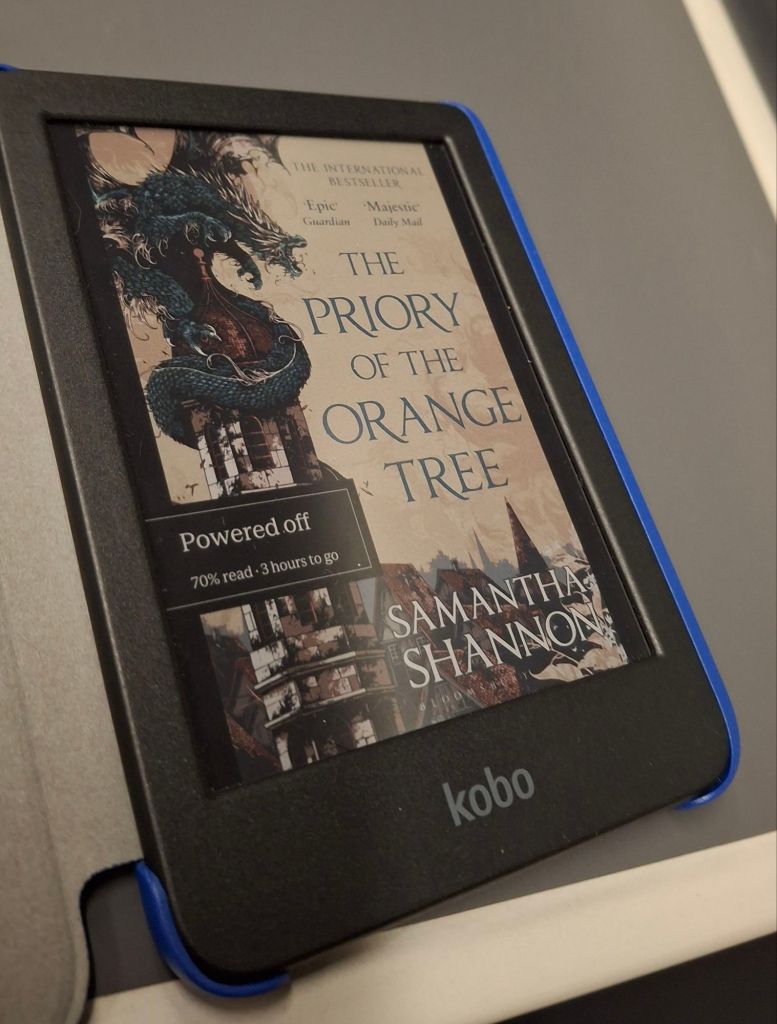
Some things I have read

… since the last time I posted about reading, which I am aware was some time ago. I haven’t been reading much at all, and it’s almost all been non-fiction. (Exception: Where Late The Sweet Birds Sang, Kate Wilhelm; the latest Jill Mansell; and, very early on Sunday morning, Blood Sweat Glitter, Iona Datt Sharma, which was exactly what I needed.)

A lot of that non-fiction has been one good idea, maybe two, expanded upon at great length until a book happens. Examples: several parenting books (your child is a person; whatever they are doing or not doing at the moment, it probably makes sense in their head and it will help you both to try to understand); Oliver Burkeman’s Meditations for Mortals (life is short; might as well get on with things; start anywhere); and Radical Candor (Kim Scott). This was mentioned in the women’s development programme I’m undertaking at work, and turned up in the library, so I borrowed it. As I’m not a manager, most of it was of limited relevance for me, but again, the subtitle (How To Get What You Need By Saying What You Mean) tells the story. I’m not sure that it tells you much that an Ask A Manager addiction wouldn’t.

Nurture the Wow (Danya Ruttenberg). Awful title. I assume this is the “two countries separated by a common language” thing, because I know very few Britons who would be able to say this one without either throwing up or dying of embarrassment, but clearly the US publishers thought it would work. Fortunately I a) knew what it was getting at; and b) had read enough of Rabbi DR’s other work to know that I like her writing. The subtitle is more descriptive, if not much less skin-crawly: Finding Spirituality in the Frustration, Boredom, Tears, Poop, Desperation, Wonder, and Radical Amazement of Parenting. Anyway, this is the best book I’ve yet read that’s intended for religious people who have become parents. It draws on many different traditions, my own included, and addresses pretty much all the emotional and physical and spiritual challenges (and opportunities) that parenthood presents. I’ve just sent my copy off to a friend who’s recently had a baby.

Wholehearted Faith and Searching for Sunday (Rachel Held Evans) – not so much about parenthood, but just the thing when I needed to read something by an intelligent Christian woman of more or less my age who’d thought about things.

To get them off my shelves, where they’ve been since 2013 or thereabouts when I bought them from a Woking junk stall, Honest to God (John A. T. Robinson) and The Ferment in the Church (Roger Lloyd). A fascinating snapshot of the preoccupations of the Church of England in the 1960s, and I think mainly interesting to me as such. Much of it is either the way I think about things anyway or has been superseded. I was amused by the way it seemed to take the Bishop of Woolwich the entire book to notice that he’d replaced one metaphor with another.

Eat Up! (Ruby Tandoh) – enthusiastic about pretty much every sort of food, sceptical about fad diets, scathing about food snobbery. A delicious book.

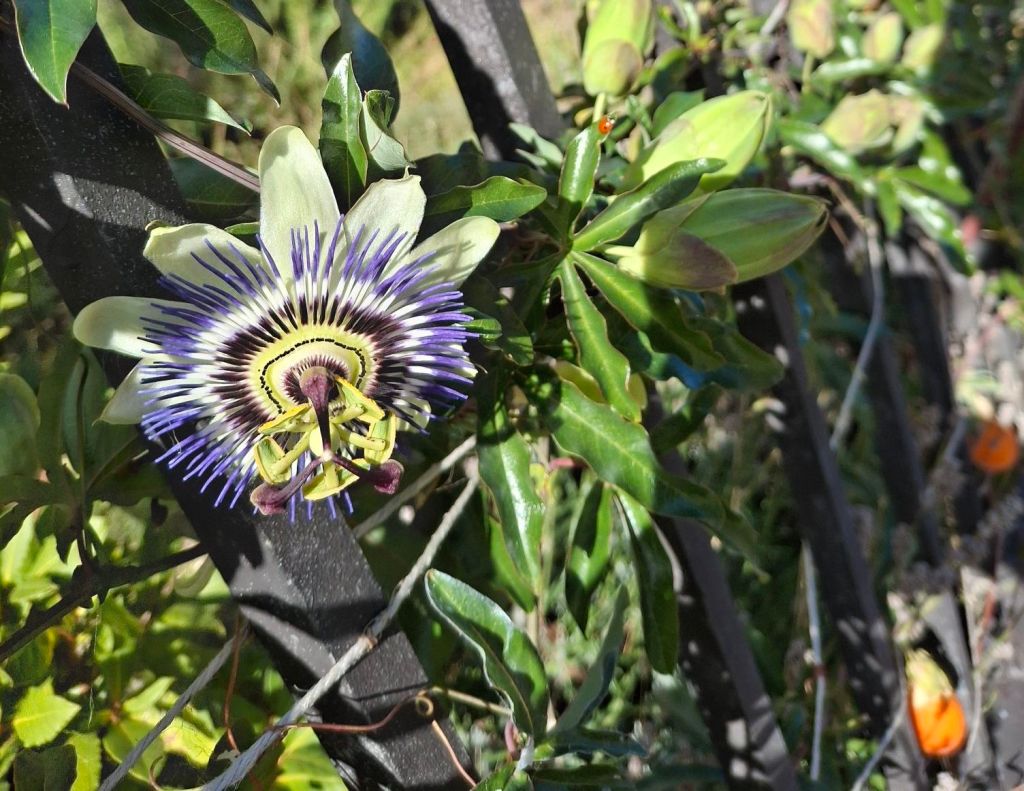
And here’s a picture of a passion flower, because why not.

A passion flower. On a nearby leaf is a small ladybird.

February reads

Moss grows in the cracks between paving stones

Twelve Words for Moss (Elizabeth-Jane Burnett) was a Christmas present from one of my brothers. It’s uncategorisable: poetry, (family) history, memoir, nature – it takes as its starting points the author’s grief at the death of her father and her enthusiasm for mosses, and weaves a narrative between the two.

I got a few chapters in before I noticed that the last sentence of each becomes the first of the next, and went back to the beginning to see what else I’d missed. When I made the deliberate effort to slow down and read the words one by one, it burst into life and turned out to be poetry. Although this did make the occasional nature-documentary-voiceover style introductions of experts somewhat jarring.

What felt simply odd to me was the absence of any sense of Burnett’s father’s personality. I think it must have been a deliberate choice, to convey the gravity of the loss by not really talking about the one who was lost, and I’m not even sure that I can say that it didn’t work for me, but it was alien. If I’d got interested in moss to the extent that Burnett has, my father would have known about it, would have got interested in it on my behalf, and would have bought me books on moss in charity shops and phoned me up to tell me that he’d heard a programme about moss on the radio,and every time I encountered moss now I’d think of him. For me, grief is about that shared connection that can’t be shared any more,  that recoils on me with a jolt because there’s nowhere for it to go now. And fair enough, maybe that’s not the sort of person that Burnett’s father was, but my point is that you just can’t tell from this book.

That doesn’t take away from how interesting a book it is, though, or how lovely the words, and I always enjoy seeing people getting really, really enthusiastic about something. And I have been noticing moss much more.

I’ve been struggling a bit with fiction recently: I find myself not wanting to feel things deeply (plenty of that in real life), so this month’s choices have been deliberately light. Although not in subject matter. Actually, I suppose both this month’s novels grapple with the question of how far we are entitled to influence the lives of our loved ones:

Hate Follow (Erin Quinn-Kong) deals with a subject that’s interested me since it first started hitting the news a decade or so ago: what happens when the children of internet personalities come of age (literally or metaphorically) and are in a position to object to their parents’ use of their names, likenesses, and actions. This was a rather superficial take on the subject: it suffered from a desire to make too many people basically well-meaning and decent. I couldn’t quite believe in the daughter’s ignorance of what her mother was sharing, or in the lawyer’s willingness to be so conveniently helpful.

I picked up The Burden (Agatha Christie, in her Mary Westmacott persona) from the library returns trolley and got through the first part the same day, and the rest of it the day after. It’s the story of the complicated relationship between two sisters; it starts out as a piece of devastating psychological realism (Christie is never sentimental about children or marriage) and goes totally bonkers in the third act. I would not have stopped reading it, though. Interesting data point for the “depiction of disabled character” files: the disabled character is appalling, but they are appalling before they become disabled and the experience does not reform them; they just become appalling in a different way.

Then I spent a lot of yesterday reading The Cuddled Little Vice (Sandman) (Elizabeth Sandifer), a very long article which did a very good job of explaining to someone who never got into comics (no shade on people who did; I just find the combination of visual storytelling and all-caps text harder work than makes for an enjoyable experience) why Neil Gaiman is such a big deal, and how he got into a position to do and get away with what he did and got away with. 57000 words – that’s basically a book – and fascinating, although, of course, horrifying.

Having written all that out, I can’t help thinking of Granny Weatherwax’s adage that sin is treating other people as things. I can’t fit Elizabeth-Jane Burnett into that, though: you could say she treats moss as people, but I don’t see the harm in that.

Recent reads: January

A fluffy black cat lies on a sofa, looking ill-used
As it happens, I have been yelling, if not ‘Touch not the cat!’, ‘Not her face!’ and ‘Not her tail!’, and ‘Don’t pull her fur!’, quite a bit of late…

Mostly non-fiction so far this year. The exception is:

Touch Not The Cat (Mary Stewart), which I read for my romantic suspense book club. We started it last year: I’d been keeping myself to the two chapters per week for scheduled discussion up until the second week of January, when I gave in and finished it off. Having read a fair few Stewarts for this group – and not the Arthurian ones – I was rather surprised by the ESP element (this isn’t a spoiler; it’s introduced very early on) but it worked rather well. I wasn’t so convinced by the parallel 1835 timeline. Usually I read Stewart romances for the armchair travel; this was more armchair nostalgia, as the bulk of the action is set in the region where I grew up. It was equally enjoyable: Stewart is always good for an evocative description or several.

Permanent, Faithful, Stable: Christian same-sex partnerships (Jeffrey John) has been  on the shelf for ages, and I felt both that I really should have read it and that I was fed up with it being there making me feel guilty. A quick read – and it is one – sorted that out. I think it’s probably the most succinct summary of the theological debate around same-sex relationships that I’ve read and would recommend it on that basis, though I did have a few quibbles. (Specifically: I did not feel that the author engaged adequately with the argument that marriage is a human institution and replicates human, patriarchal, systems of exploitation. More generally, I have been bearing a grudge to the tune of the most biphobic remark I’ve ever heard from the platform at a supposedly LGBTQ affirming event. The scene in The Real World where Colette walks out of the LGBTX West Country meeting? Not terribly far from real life.)

This was a fairly old edition, and events, in the form of thousands of actual same-sex marriages, have overtaken it. The arguments still feel very familiar, though.

The Queer Parent: everything you need to know from Gay to Ze (Lotte Jeffs and Stu Oakley) – very much the book I needed to read, squaring as it did the vicious circle where I’ve been feeling increasingly adrift from my bi identity but very conscious that as parenthood goes I haven’t had to deal with any problems that are not common to all. In a weird way, it was most affirming to read an interview with a bi couple who said that they were finding it hard to reconnect with the queer community. But it was interesting (and often humbling) to read about the experiences and decisions that I haven’t even had to think about, from surrogacy to IVF to doing the whole thing as a trans person.

The Road Less Traveled (M. Scott Peck) – was a wild ride. It’s one of those books whose existence I’ve been vaguely aware of for a long time, but could have told you nothing about beyond ‘er, self help?’ Then I read bell hooks’ All About Love last year and was intrigued by Peck’s definition of love which hooks quotes:

the will to extend one’s self for the purpose of nurturing one’s own or another’s spiritual growth

And I think that probably was the most useful part of the book. To summarise the rest of it: life is suffering, because life is change and change inevitably involves suffering; we have the choice as to how we engage with that. It was extremely readable – short chapters, and with most of them the promise of a mystery worked through, which is what I always enjoy about case studies (really I should just go and read more Oliver Sacks). I did feel that it rather lost its way when it got more heavily into the spiritual side of things. And there were a few ‘yikes!’ moments where it became less possible than usual to forget that this was published in 1978.

So it’s going back to Oxfam and I’m keeping All About Love. I’m not sure that I entirely adopt that definition, but it’s still better than a lot that I’ve seen.

December Reflections 4: best book of 2024

This book deserves a longer post, but I’ve lost the evening to a gallbladder flare-up and am feeling too sore/sleepy/shaky to say much more than that it’s good to see someone with the intellectual clout of bell hooks talking seriously about love – something you don’t often come across outside self-help and theology. There’s a bit of both of those in there, but it’s more than that.

Recent reads

Gilt angels support the dark wood roof beams of a cathedral

I ran out of renewals on a library book, which is something I don’t remember having done in a long time, maybe never, and if I did it was probably because I’d lost the book, rather than because I honestly wanted to finish it but was going painfully slowly, which was the case here. The book in question was Eva Ibbotson’s A Glove Shop in Vienna and (as this edition was trying to market itself) Other Winter Stories. In fact I don’t think that even half the stories were particularly wintry, but never mind.

I’m very on-off with Eva Ibbotson. I adored her witch stories when I was a child. Two decades or so later I found her romances for adults simultaneously enchanting and infuriating, and reading this collection I remembered why. On the one hand, there’s the food, the scenery, and the balletomania. This collection also has a carp swimming in a bathtub, which will make perfect sense to anyone who’s encountered a Mittel- to Eastern European Christmas Eve, and made me smile. On the other, there are the manic pixie dream girls (not like other girls!) and the not-really-examined nostalgia for the Austro-Hungarian and Russian empires. I kept finding that I had to be in a very specific mood, and given that I had to be in it eighteen times over it’s no wonder that I ran right up against the renewal limit. But I got there on Thursday lunchtime, wooden spoon in one hand and book in the other, and the second last story nearly made me cry, and I remembered to take it back to the library on Friday morning, so everything was ok.

I continue to read speculative fiction on my e-reader when I find myself awake at strange hours of the night. In more or less chronological order:

Babel (R. F. Kuang) This had a stonkingly good premise and some important things to say, but I kept getting kicked out by careless anachronisms. For reasons which become apparent over the course of the book, it is vital that it is set in the 1830s; a pity, then, about the fountain pens, the respectable women thinking nothing of going into pubs, and the running water in student digs. At one point a character reflects that there will be no omnibus at that time of night. (‘Nor that decade,’ I muttered to myself.) The author has clearly gone to a lot of trouble to get Oxford right, but it’s Oxford of about five years ago. I kept reading, however; couldn’t help it.

Lady Eve’s Last Con (Rebecca Fraimow): a space caper. Our heroine is navigating intergalactic high society, trying to get revenge on the rich bore who broke her sister’s heart, and trying not to fall for his charismatic half-sister. Absolutely delightful.

The King Is Dead (Naomi Libicki): a young man who has failed to distinguish himself on the field of battle is appointed as armour bearer to the deeply traumatised brother of the eponymous late king. As complicated as that sounds, it gets more so. I really appreciated the thoughtful worldbuilding in this: religion, the way magic works, food practices, gender dynamics, all of it coming together to make a complicated and coherent society. And a really satisfying story, too.

December Reflections 6: best book of 2023

Paperback copy of Hood by Emma Donoghue and a hardback copy of Winters in the World: a journey through the Anglo-Saxon year by Eleanor Parker, both on a brightly coloured velvet patchwork scarf

Haven’t been reading much lately so had to go back some months, but here’s one fiction book and one non-fiction.

“Hood” dates from before Emma Donoghue started writing historical fiction, but has become a period piece in its own right – a snapshot of the Irish lesbian scene thirty or forty years ago. Complicated, but generally likeable, characters, and a really convincing portrait of the intricacies and contradictions of grief.

“Winters in the World” is much more recent – in fact, probably the most recent book I read this year. I think it came out late 2022. It’s lovely – a slow journey through the seasons and festivals of the year as seen through early medieval literature. Some of the pieces quoted were familiar, from church or from my long ago Eng Lit degree, but most were new to me. Much more enjoyable and edifying (she tells herself sternly) than arguing online over whether some advertising gimmick invented in 1957 is a sekrit pagan survival. (I don’t actually argue, but I do waste time and emotional energy muttering to myself about it.)

Not pictured, because on my e-reader, Plain Bad Heroines (Emily m Danforth) and Bad To The Bone (Brian Waddington) – two slick, stylish, cynical novels with what I’d like to call a side of magical realism if only that didn’t sound so much like whimsy. Which they very much weren’t.

Secret Lives (E. F. Benson)

Paperback copy of Secret Lives by E F Benson

I’ve been having trouble reading lately (on one occasion I was woken by the thud of the book hitting the floor), but E. F. Benson, in a slightly less caustic mood than usual, hit the spot and I hoovered this up in two days. At first I thought it was just going to be Mapp and Lucia in London, and there is a bit of that about it, but it’s mostly about an ex-typing agency employee living her best life writing exactly what she wants to, getting paid squillions for it, and generally having a whale of a time in the face of snobbery both literary and social. Great fun.

Bicycles and Broomsticks – Kickstarter live now

Bicycles in a museum display

Bikes in Space is back! This is a more-or-less annual publication by Microcosm Publishing, and aside from the bicycles and the speculative fiction implied by the series title there’s always a strong feminist theme. This issue’s theme is bicycles and broomsticks.

And I am back in it. My story is called Layings Out and Lyings In, and features a couple of no-nonsense witch-midwives, one of whom is an early adopter of that marvellous invention the safety bicycle. I had a good deal of fun writing this one.

This is all, well, kicked off by a Kickstarter campaign, and backing the Kickstarter is certainly the quickest and probably the easiest way of getting hold of the book. I should also say that, the more the Kickstarter campaign raises, the more I get paid for my story – so, if you were planning to get it anyway, getting it earlier is more profitable for me.

Unfortunately international shipping is getting ever more ruinous and prohibitive, but readers outside the US can at least get the book itself posted to them, and liaise directly with the publisher to work out other add-ons. Those inside can add on all sorts of goodies (personally I’m casting an envious eye at all the Bikes in Space back issues). Either way, here’s the campaign page. Take a look.

(The bicycles in the picture are in the transport museum at Dresden, which is well worth a look if you’re ever in that neck of the woods.)

The God Painter (Jessica Pegis)

Paperback copy of 'The God Painter' by Jessica Pegis

I’m not sure that I’ve ever read anything quite like this before. Yet it felt very familiar, as if, even if I hadn’t read something like it in the past, I ought to have done.

The God Painter opens with an unexpected but remarkably ordered evacuation of the inhabitants of Earth – all the people, all the pets – and their arrival on a new planet where they are welcomed by seven strange beings. The two principal characters are something of an odd couple: a lesbian painter who immediately recreates the Torre dei Lamberti to make her new house, and a grieving widower with mixed feelings about his role as Vatican consultant.

And yes, the Vatican still exists. Maslow’s hierarchy of needs is taken care of, which leaves the population to carry on with whatever it was doing before: for example, engaging in theological debate about the human body and what it ought and ought not to do. Which is a debate that has got slightly more complicated with the encounter with their new hosts, whose bodies are not very much like human bodies. And the different ways that the various participants engage with the new evidence felt all too plausible. The backdrop might have changed, but human nature hasn’t.

I wasn’t entirely convinced by the worldbuilding, or by the necessity for a whole new planet in which to conduct the experiment, but that’s a nitpick. The lush otherworldliness of it might be its own excuse. As a whole, the book worked. I didn’t see the last twist coming at all, though now I know it seems obvious.

I wasn’t quite sure how neatly it was going to fit into my LGBTQ Christian fiction recommendations, and now that I’ve finished it I can’t quite explain how it does, but you’ll just have to trust me.

The God Painter is a strange and lovely book, with a bittersweet ending. Recommended for those who enjoy a fantastical element in their religious politics and a metaphysical edge to their sci-fi.

The broccoli problem (an update to yesterday’s post)

close-up of a romanesco cauliflower
This is not broccoli. I do not have a photograph of broccoli. Although apparently in the 1950s ‘broccoli’ was the name used for cauliflower.

My library fine was 25p.

And my friend Lesley found broccoli in Maria Rundell’s New System of Domestic Cookery, 1819. According to the delightfully cranky food writer Jane Grigson, it was introduced by a seed merchant in the 18th century, with sales bolstered with leaflets on how best to prepare this exotic and delicious vegetable. It would probably show up at show-offy dinner parties, not (as in the book I was reading) as a dull duty vegetable for the children to force down.

So no, it would not be impossible for the characters in the book to eat broccoli. It would, however, be highly unlikely for them to be wasting it on nursery tea, particularly if the ungrateful little brat doesn’t even like it.

And this is why the Tiffany problem is still a problem. The author might very well be correct, but that’s small consolation if the reader has already been hurled out of the book (and sent their friends off down research rabbit holes). Don’t get me wrong: I still think it can be made to work. I just think it takes work. You’d better start off having your Tiffany addressed as Theophania a couple of times before you use the diminutive. Have her born at Epiphany. Then work out how to explain the connection without bringing your whole plot to a stop for a tedious infodump. It ought to be possible. I can’t say that I’m inclined to try.

Which is to say that I’d have been charmed by the appearance of broccoli at a Regency dinner party, particularly if it had been accompanied by some one-upping commentary on how very talented and superior one’s gardeners were, might I help you to a little macaroni, my dear? I just can’t swallow it (ha!) as a way for the cute moppets to get their greens. Other brassicas are available.

But that’s me. What I’ve really learned here is that this author’s historical stories don’t work for me: they’re not interested in the same things as me. A pity, because I’ve enjoyed their contemporaries, but there we go. I shall have to write snobby broccoli stories myself. Or just cook some.

In fact, says Lesley,

Eliza Acton says that it is boiled, if the heads are large served like cauliflower; the stems of branching broccoli peeled and the vegetable tied in bunches, dressed & served like asparagus on toast. Hardly nursery food!

That sounds rather good.