100 untimed books: thinking of

91: thinking of
91: thinking of

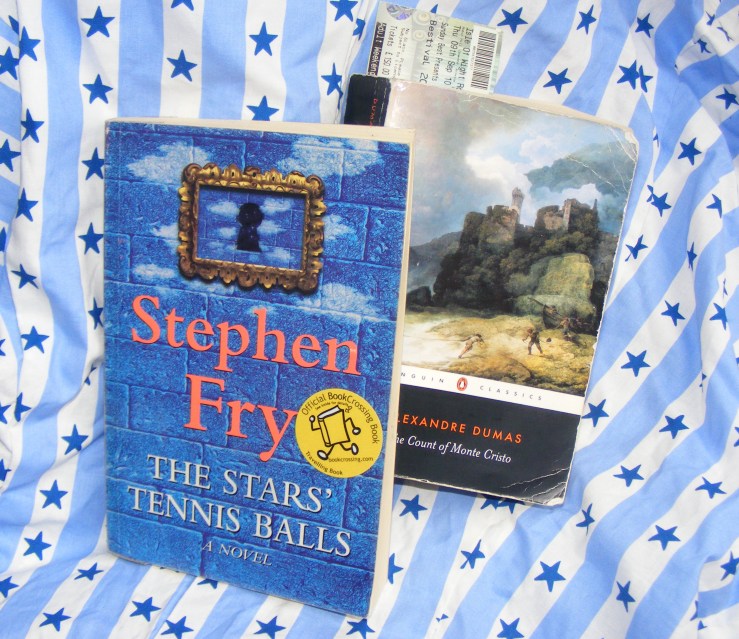
If I’m put on the spot about my favourite book (for example, here), I almost always go for The Count of Monte Cristo. It’s very long, it simultaneously plays to and undercuts Gothic tropes, it has a ton of moral ambiguity, and there is a lot of early nineteenth century opera and a lesbian elopement.

Stephen Fry, regrettably, omits the operatic lesbians, but I really can’t complain about such an affectionate, funny, adaptation as The Stars’ Tennis Balls. He isn’t just thinking of The Count of Monte Cristo, he’s thinking of it with real fondness.

I’ve got a rather long (and probably you-had-to-be-there) anecdote in which I tried to explain one of the jokes to my brother in the driving rain on the Camino Inglés. You might see it in a month or so, when I’ve got round to writing up the journey.

100 untimed books

Sometimes writers don’t write, and that’s fine

Trust me: I'm a card-carrying author
Trust me: I’m a card-carrying author

This week I was enraged, yet again, by a reappearance of the ‘writers write, and nothing stops them writing’ meme. I won’t link to the specific instance, because it was posted under lock, but here’s a (comparatively inoffensive) case of the genus in the wild. (It was the first one that came up on Google. I do not endorse the contents of the rest of the blog, either.)

Articles like this begin with ‘writers write’, which is true, if inane. I said myself, the other week, that the best way to get good at something is to do it and do it and keep doing it.

They then extrapolate.

Some of them add, implicitly or explicitly, ‘every day’. Some of them add, implicitly or explicitly, ‘and don’t make excuses’. Some of them end up implying that any week – any day – that you’re not writing, you’re not a writer.

Which is bullshit.

This is the longest thing I’ve written in days. I’ve written no fiction at all since last Wednesday, and I could quite see this state of affairs continuing all summer. Have I suddenly stopped being a writer? Of course not.

Here is a selection of reasons why I haven’t been writing:

  • I wanted to read Alistair MacLean instead.
  • I have had a lot going on in my day job.
  • I spent last Saturday at Norwich Pride.
  • I’d never seen Die Hard and we had to spend an evening remedying that state of affairs.
  • It was my birthday.
  • A fanfic I’ve been following was updated, so I read that instead.
  • I was off sick for two days and good for nothing other than sleeping and watching Star Trek.
  • I’m not a morning person.

I could point out the ways that all those things that don’t look like writing could contribute to making me a better writer. I could tell you that reading and watching other creators’ work gives me tools to use in my own. I could tell you that time in the ‘real world’ expands the material I have to write about. And that would all be true, but that’s not my point.

Because really, it all comes down to this:

I’ve been really tired and haven’t felt like writing.

That ‘excuse’, yes.

Here are some other reasons, which don’t apply to me, but which do apply to plenty of other writers who may not be in the physical act of writing at this moment:

  • childcare responsibilities;
  • other care responsibilities;
  • having to work two or more jobs to make ends meet;
  • chronic illness or disability;
  • wanting to enjoy that holiday of a lifetime and not spend it on things they ‘should’ be doing.

I’m sure there are many, many more. Feel free to mention them in comments.

These days it’s increasingly difficult to make a living by writing alone, and most of us therefore don’t have the luxury of time devoted to writing. We have to fit it in around the edges, and sometimes the edges themselves are filled up with things like other responsibilities, or sleep, or even fun.

Here’s the thing: I know, because I’ve been here before, and I’ve come through it and written again, that it’s not the end of me as a writer. I very much doubt that anyone would try to tell me that it was, now that I’ve finished and published a book and won an award with it.

I put the first word of Speak Its Name on the page in November 2007. I approved the finished work in January 2016. Did I write every day of those eight-and-a-bit years? Of course I didn’t. And it’s the better for it.

But I also know people who have been discouraged by this ludicrous gatekeeping, who have believed the pernicious myth that because they couldn’t or didn’t devote every spare minute to writing they weren’t ‘really’ a writer, and stopped altogether.

Bullshit, I say again. Stop telling people this. It’s untrue and it’s harmful. It’s not encouraging people to write; it’s doing the opposite.

You don’t get anywhere as a self-published author by caring what other people think about you, but it’s taken me a long time to get past caring what other people think about me. I didn’t tell very many people that I was writing, and it was largely due to the fear of coming up against this idea that I wasn’t.

I am not excusing – or asking you to put up with – the tedious people who bang on and on about how much they’d like to write, or expect you to listen to their detailed exposition of what they would write if only they had the time. You could consider sending them an invoice for your skills as a writing consultant. Certainly if one more person tells me that everyone has a novel in them, I shall find it difficult to restrain myself from attempting to extract theirs by violent means.

But you don’t get to tell people that they’re not a writer. I don’t, either. (That picture at the top of the page? Means basically nothing in terms of my right to assess other people’s writer status.) Nobody does.

100 untimed books: joyful

37. joyful
37. joyful

This book seems to have attracted a lot of adjectives. Beyond KARSAVINA’s ‘enchanting’ on the front cover, the flaps have ‘fascinating’ (three times), ‘exciting and vivid’, ‘enchanting’ again (once the full Karsavina quotation, and once from the News Chronicle), ‘delightfully impetuous’ and ‘irresistibly impetuous’ (the Observer and the Daily Mail respectively, agreeing on something for once), ‘beautiful’, ‘valuable’, ‘charming’, ‘enthralling’, ‘almost a great book’ (The Times, damning with faint praise, there; see also ‘in spite of its horrible title’ from The Spectator), ‘brilliant’, ‘remarkable’, ‘splendid’, and ‘unique’.

And, if that wasn’t enough, I am going to add ‘joyful’.

100 untimed books

Some weekend reading

Happy Saturday! I hope those who are now embarked on summer holidays are enjoying them, and that the weather cooperates with any long-planned activities. Personally, I’m just getting to the end of a week off work, and I’m very slightly less tired than I was when it began, so I’m counting that as a tentative plus.

This week I have a guest post up over at I Heart Lesfic where I talk about the difficulty of finding the book I wanted to read and my consequent decision to write it myself.

There’s also a giveaway of Speak Its Name, which still has a couple of days left to run. You might be lucky!

And I talked to fellow self-published author Helena Fairfax about my favourite places, my least favourite job, and what I’d say to Jenny Lind.

Enjoy!

100 untimed books: slim

12. slim
12. slim

After posting a poem about taking three ‘slim volumes’ walking with me, it seemed only appropriate to include the third (the other two are here and here).

And while I’m on the subject, I’d like to wish all pilgrims a very happy St James’ Day, and hope that anybody currently on the road has ready access to plenty of shade and water.

100 untimed books

The cheapest art

01-DSCF8864

I said in an interview with another author that the greatest lesson I’ve learned in life is that the best way to get better at something is to do it, and do it, and do it again, and keep doing it until you actually are better.

The problem – apart from the frustration of not being better yet – is that doing something over and over can get expensive. Lessons, kit, entrance fees, instruments. Most arts require equipment, tools, raw materials. Canvas, paints, fabric, metal, yarn, thread, chisels, saw blades, goodness knows what.

And if you’re doing something over and over again, you use up more and more of the raw materials, and the chances are you’ll ruin quite a bit of it.

Then – generally speaking – the better you get, the more sophisticated your tools need to be, and you start wanting to work with raw materials of higher quality. Of course, a skilled artist can make something wonderful out of indifferent ingredients, but they will make something better out of better ingredients.

I started out making jewellery with an ordinary sewing needle and some seed beads that had been reclaimed (I assume; I didn’t do the reclaiming) from some evening dress. Proper beading needles were a revelation: they would actually fit through the hole in the bead. The first specialist equipment I bought was a set of three pairs of miniature pliers, which probably cost about a fiver. They were all very well in 2009, but as I got better I started wanting to do more, and I needed more in order to do that. These days I have another, decently sized, set of pliers, and a jig. I use silver wire as well as silver-coloured, and I throw in lapis lazuli alongside blue glass. I’d like to have sheet silver and a pendant drill and a blowtorch or three, and mandrels and a supply of saw blades that will last out until I learn how not to snap them.

Getting good at things takes time. It is also very likely to take space, and money.

But that doesn’t have to happen with writing. Well, the ‘time’ part does, but not so much the ‘space’ or the ‘money’. I’m still ambitious and I still enjoy experimenting – but writing looks pretty much the same. When I was eleven I wrote in a spiral bound notebook with a fountain pen. I’m still using a spiral bound notebook and a fountain pen. These days I also use word processing software, I’ll admit, but it’s not what makes the difference between good writing and bad.

Because words are words. If I write, for example,

‘It’s weird, isn’t it?’ Lydia said. ‘Waiting. Waiting for the wheels of bureaucracy and justice to finish grinding so that we can get on with our lives.’

you can’t tell whether I wrote that on the back of an envelope or on an expensive Mac. And I can’t excuse bad writing by telling you that the kit I wrote it on cost a lot of money.

The wonderful thing is that words are free. I can throw them in willy-nilly and pull them out again without having to worry about waste. I can make a long string of adjectives and delete it without a second thought. I can pick words up in the street just because I like the sound of them, and use them over and over again. I don’t have to save them for a special piece, the way I would a particularly lovely piece of jasper.

Oh, there are things that have made it easier. An English Literature degree, for example, has really helped in understanding how to take texts apart, and, by extension, how to put my own ones together. A childhood in a house filled to the gunwales with books, swimming in words and meeting them as equals, claiming them as my inheritance. Friends who write and who talk about writing.

But there’s nothing particularly special about what I do. I put in the time, that’s all. I use the words that are hanging around, and I don’t worry about where the next ones are coming from. And I write and write and write until I get better.

100 untimed books: coming of age

85. coming of age
85. coming of age

This was one of my absolute favourite books when I was a teenager, and I still love it. It’s a riotous, anarchic story where the characters are refreshingly and unapologetically flawed (and wandering through a gentle alcoholic haze most of the time in a way that would horrify the morality police). Nothing much happens, but everything changes.

It’s just right for these sultry summer days when you never quite know what the weather’s going to do next. Or, if it comes to that, what you’re going to do next.

100 untimed books