Recent reads

Gilt angels support the dark wood roof beams of a cathedral

I ran out of renewals on a library book, which is something I don’t remember having done in a long time, maybe never, and if I did it was probably because I’d lost the book, rather than because I honestly wanted to finish it but was going painfully slowly, which was the case here. The book in question was Eva Ibbotson’s A Glove Shop in Vienna and (as this edition was trying to market itself) Other Winter Stories. In fact I don’t think that even half the stories were particularly wintry, but never mind.

I’m very on-off with Eva Ibbotson. I adored her witch stories when I was a child. Two decades or so later I found her romances for adults simultaneously enchanting and infuriating, and reading this collection I remembered why. On the one hand, there’s the food, the scenery, and the balletomania. This collection also has a carp swimming in a bathtub, which will make perfect sense to anyone who’s encountered a Mittel- to Eastern European Christmas Eve, and made me smile. On the other, there are the manic pixie dream girls (not like other girls!) and the not-really-examined nostalgia for the Austro-Hungarian and Russian empires. I kept finding that I had to be in a very specific mood, and given that I had to be in it eighteen times over it’s no wonder that I ran right up against the renewal limit. But I got there on Thursday lunchtime, wooden spoon in one hand and book in the other, and the second last story nearly made me cry, and I remembered to take it back to the library on Friday morning, so everything was ok.

I continue to read speculative fiction on my e-reader when I find myself awake at strange hours of the night. In more or less chronological order:

Babel (R. F. Kuang) This had a stonkingly good premise and some important things to say, but I kept getting kicked out by careless anachronisms. For reasons which become apparent over the course of the book, it is vital that it is set in the 1830s; a pity, then, about the fountain pens, the respectable women thinking nothing of going into pubs, and the running water in student digs. At one point a character reflects that there will be no omnibus at that time of night. (‘Nor that decade,’ I muttered to myself.) The author has clearly gone to a lot of trouble to get Oxford right, but it’s Oxford of about five years ago. I kept reading, however; couldn’t help it.

Lady Eve’s Last Con (Rebecca Fraimow): a space caper. Our heroine is navigating intergalactic high society, trying to get revenge on the rich bore who broke her sister’s heart, and trying not to fall for his charismatic half-sister. Absolutely delightful.

The King Is Dead (Naomi Libicki): a young man who has failed to distinguish himself on the field of battle is appointed as armour bearer to the deeply traumatised brother of the eponymous late king. As complicated as that sounds, it gets more so. I really appreciated the thoughtful worldbuilding in this: religion, the way magic works, food practices, gender dynamics, all of it coming together to make a complicated and coherent society. And a really satisfying story, too.
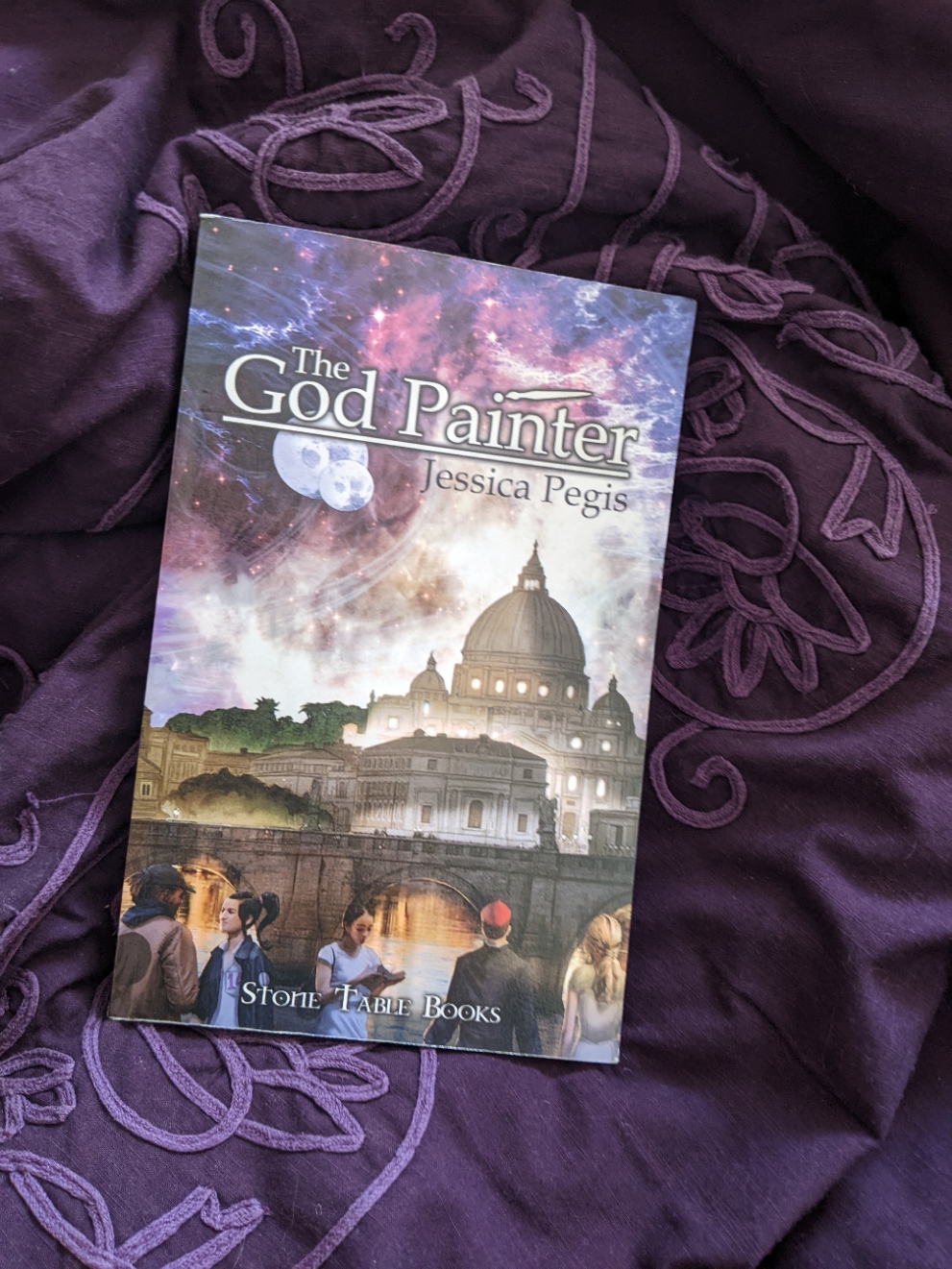
The God Painter (Jessica Pegis)

Paperback copy of 'The God Painter' by Jessica Pegis

I’m not sure that I’ve ever read anything quite like this before. Yet it felt very familiar, as if, even if I hadn’t read something like it in the past, I ought to have done.

The God Painter opens with an unexpected but remarkably ordered evacuation of the inhabitants of Earth – all the people, all the pets – and their arrival on a new planet where they are welcomed by seven strange beings. The two principal characters are something of an odd couple: a lesbian painter who immediately recreates the Torre dei Lamberti to make her new house, and a grieving widower with mixed feelings about his role as Vatican consultant.

And yes, the Vatican still exists. Maslow’s hierarchy of needs is taken care of, which leaves the population to carry on with whatever it was doing before: for example, engaging in theological debate about the human body and what it ought and ought not to do. Which is a debate that has got slightly more complicated with the encounter with their new hosts, whose bodies are not very much like human bodies. And the different ways that the various participants engage with the new evidence felt all too plausible. The backdrop might have changed, but human nature hasn’t.

I wasn’t entirely convinced by the worldbuilding, or by the necessity for a whole new planet in which to conduct the experiment, but that’s a nitpick. The lush otherworldliness of it might be its own excuse. As a whole, the book worked. I didn’t see the last twist coming at all, though now I know it seems obvious.

I wasn’t quite sure how neatly it was going to fit into my LGBTQ Christian fiction recommendations, and now that I’ve finished it I can’t quite explain how it does, but you’ll just have to trust me.

The God Painter is a strange and lovely book, with a bittersweet ending. Recommended for those who enjoy a fantastical element in their religious politics and a metaphysical edge to their sci-fi.

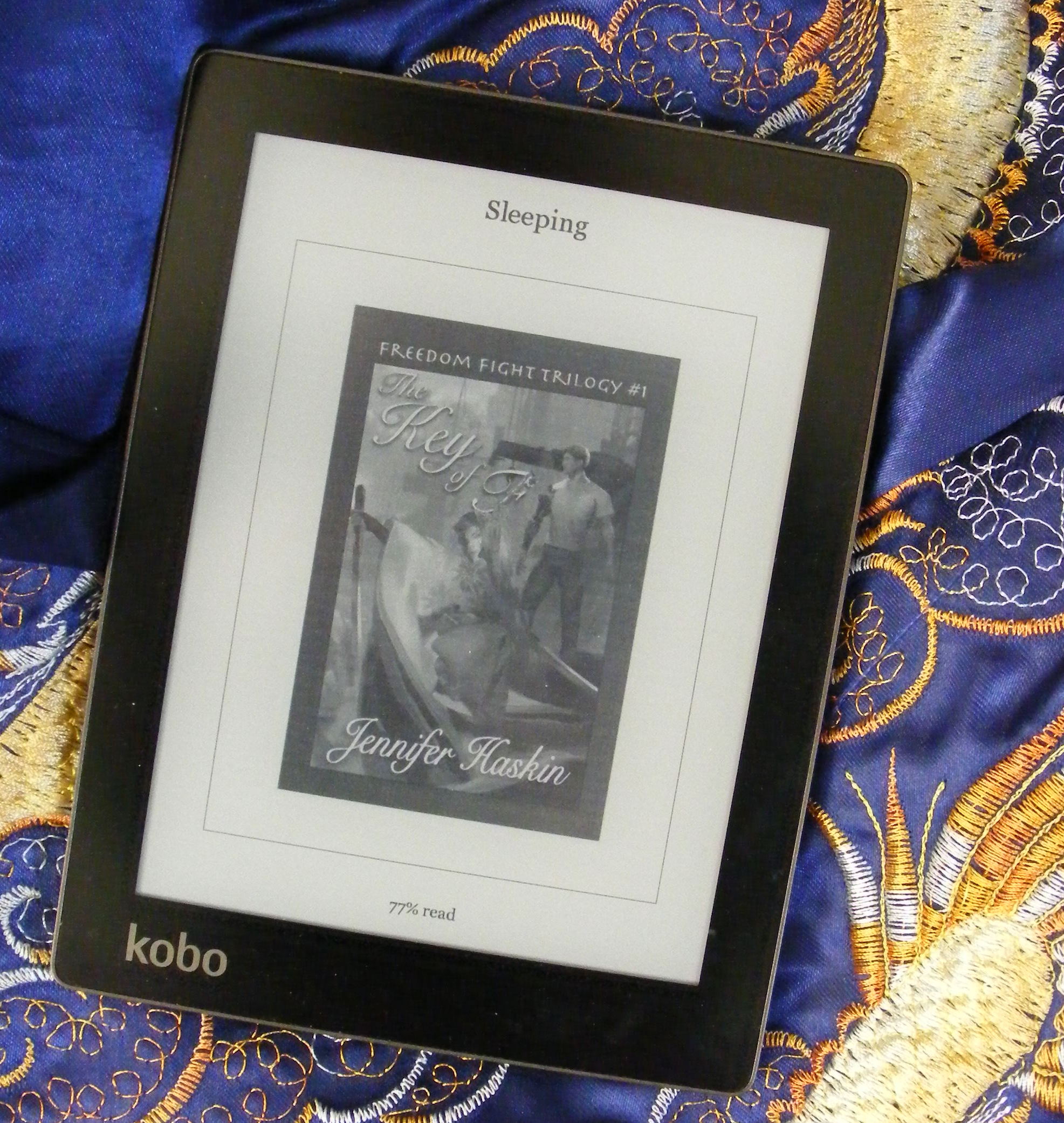
#indiechallenge – The Key of F (Jennifer Haskin)

DSCF8080

The blurb

Though Fale has never discovered who murdered her parents and left her orphaned as a child, she attempts to lead a normal and peaceful life. After all, she is training to be a peacekeeping warrior under the direction of her adoptive father. But, when she starts having strange visions that predict the future on her 18th birthday, it turns her life into anything but ordinary. Alongside her best friends and the man who rejected her three years ago, Fale must discover the truths of her past to achieve her true destiny.

Can she harness her inner warrior to save her people? And can she prove that she is no longer an innocent child to the man she loves along the way?

The author

Jennifer Haskin is an ex-literary agent, author, and portrait artist who lives in Olathe, Kansas with her husband and five children.

The publisher

Rogue Phoenix Press is an ebook publisher representing a wide range of genres. It was established in 2008, though I don’t think I’d heard of it before I read this book.

How I got this book

I took part in the author’s 2 Writer Switch programme. (You can see what she thought about my book on Goodreads!)

The bingo card

Again, I have a lot of options here! This could count towards ‘Genre fiction’ (see ‘My thoughts’ for more on that!), ‘Book from a series’, ‘An author from another country’, ‘A new to you press’, ‘A debut’, or ‘Kids or YA’. I think I’m going to read a few more of the books I’ve got earmarked for the challenge and see where the gaps are on my card; at the moment it feels a bit like the connecting wall on Only Connect.

My thoughts

The Key of F is an ambitious young adult novel that straddles a number of genres. It has the intensive surveillance and the high-tech body modification of science fiction. It has the wizards and mages and the Chosen One narrative of fantasy. And it has the makeovers and petty jealousies of high school and college books. It’s not until about half-way through the book that those three strands come together and we see where it’s all been leading.

The main thrust of the novel follows Fale, an orphan who has been entrusted with a mysterious key and who is on a quest to find her guardian and mentor, Nelson. But of course it’s not as simple as that, and her investigations only present further missions. I did wonder whether her name, and ‘Effailya’, from which it’s derived, could be a punning clue to where this series is eventually going to end up… We’ll see about that one. She’s variously helped and hindered by friends Keron, Izzy and Lisle, who represent other groups within the social makeup of Algea, and the differences between classes and occupations lead to some conflict between the four – something that will no doubt be explored further in later instalments.

I was fascinated by the brief glimpses we got of the system that underpins this world: where people are forced to work in an environment that seems set up to seriously injure them, at which point their only option is expensive prostheses, which they then spend the rest of their lives paying off. It was a neat satire on certain real-life systems, and I’d have liked to have seen more exploration of it. But I was puzzled, too: daiquiris, lasagna, katanas and rock bands suggested the influence of an Earth culture that appeared never to have existed in this world.

This is only the first of the series, so no doubt some of my questions will be answered in the next book!