Saint Vincent of Saragossa

It seems to be a day for deacons. I’m listening to Choral Evensong from St Lawrence, York, and this morning the Daily Prayer app told me that today is Vincent of Saragossa, Deacon, first Martyr of Spain, 304 [Commemoration]. Wikipedia tells me that this martyrdom took place under Diocletian, and notes that according to tradition it involved roasting on a gridiron, a detail which may have been carried over from the hagiography of St Lawrence. As if it were contagious, at least among deacons.

Up until I looked at Wikipedia an hour ago, everything I knew about St Vincent came from this series of tiles – which, since my Spanish is not great and apparently in 2007 my photography skills were worse, wasn’t much. They were displayed – probably still are – in the parish rooms of the church of Santiago in Logroño, to which I and my friend Anne, and another pilgrim, Ursula, were invited by the priest after mass on Palm Sunday. He gave us the run of the place, encouraging us to help ourselves to pizzas and packet soup from the kitchen. It was a kindness that we appreciated very much on a trying day.

And so, eighteen years on (good grief), the name of St Vincent, San Vicente, carries for me an association of hot, salty soup, and olive branches, and warming up on a grey, chilly day, and hospitality gratefully received. It’s been pleasant to think of it today – a day that’s been distinctly cold, and actively misty, a day on which I’ve been glad to be at home, cooking omelettes with potato and red pepper and smelly cheese.

Winter requirements satisfied

Cathedral silhouette against a pale blue sky, framed by a telegraph pole and wire

Saturday was ridiculously beautiful, and also ridiculously busy. It concentrated almost all the busyness for the month of January into one day. I went to a Cursillo training day in the morning (I’m not on the staff this time; I was just showing up to show support) and a party in the afternoon, and in between I practised two duets and made a chilli.

It was also really quite cold. This beautiful hazy morning sharpened and brightened, and the grass was hard and lumpy underfoot, and while we were singing and playing and dancing the fog rolled in and when we left we couldn’t see further than about twenty feet.

And it turns out that what I really needed in order to feel satisfied that winter has happened properly was a) a cold snap; and b) an exuberant party. Which this was. I sang Rossini (sure, it was the Cats’ Duet, but it’s not easy) and danced a Horse’s Brawl. It was great. I went back to work today (from the dining table) and it felt entirely appropriate. The festive season is concluded in style and I am now happy to get on with the rest of the year.

Epiphany

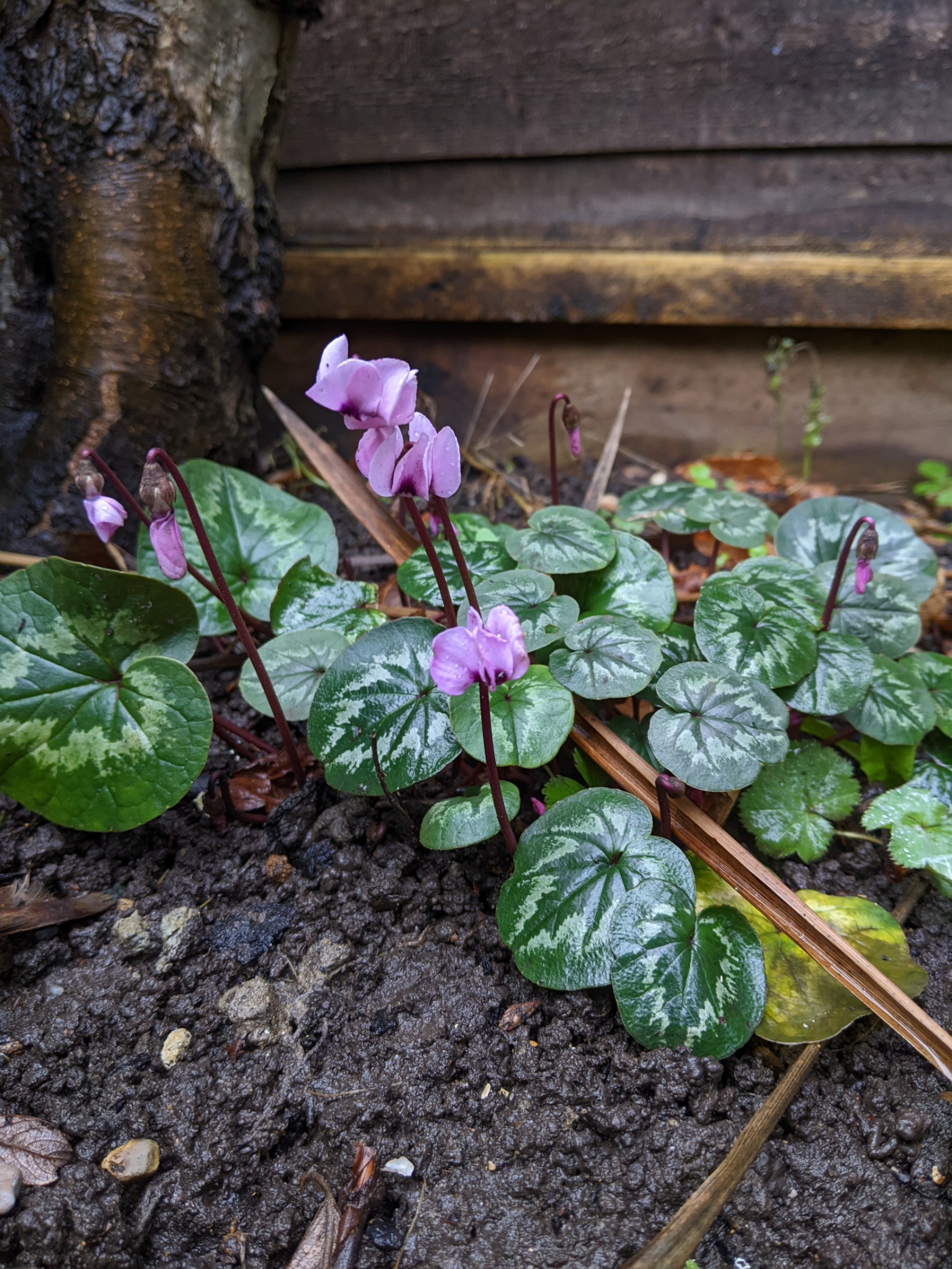
Pale mauve cyclamen flowers and variegated green leaves, shiny with rain, growing in wet ground.

The earth tips back and the light reaches back out to the north, stretches, spreads over us. The sun stays past four o’clock, just a little bit more than eight hours now. The solstice marked the turning point; now I begin to notice.

It’s cold, though. I walked out earlier, just a little way. My loose silky trousers, practical for a healing abdomen, are not so practical for a January walk; I am grateful for my brother’s long-ago recommendation of long-john base layers. I realised, half-way out, that my mind was singing me the enquiry of the Three Kings, the steady four-four of Mendelssohn’s setting keeping pace with my footsteps. Say, where is he born the king of Judea, for we have seen – for we have seen – have seen his star – have see-een his star and are co-ome to ado-ore him – have see-een his star and are co-ome to adore him… These Magi are walking, I think; it isn’t the swaying three-four camel-gait of We Three Kings. Too late, too slow, looking in the wrong place, but getting there in the end.

I caught a glimpse of the cathedral between two houses (you can see it from most places, if you look hard enough) and the flag on the west tower was streaming straight out in a rectangle, like a child’s drawing. The moon, just shy of a quarter, winked through a window of cloud and went away again. I turned, left it at my left shoulder, and turned back towards the sun, and into the wind.

In the garden, the cyclamen have bloomed: sturdy stems, delicate mauve flowers shaped like fantastic head-dresses springing from a rolled band, more outlandish than you’d see in any nativity play. I planted them under the most troublesome of the apple trees, hoping to introduce a little colour against that gloomy fence if nothing else. Suddenly, I’m vindicated.

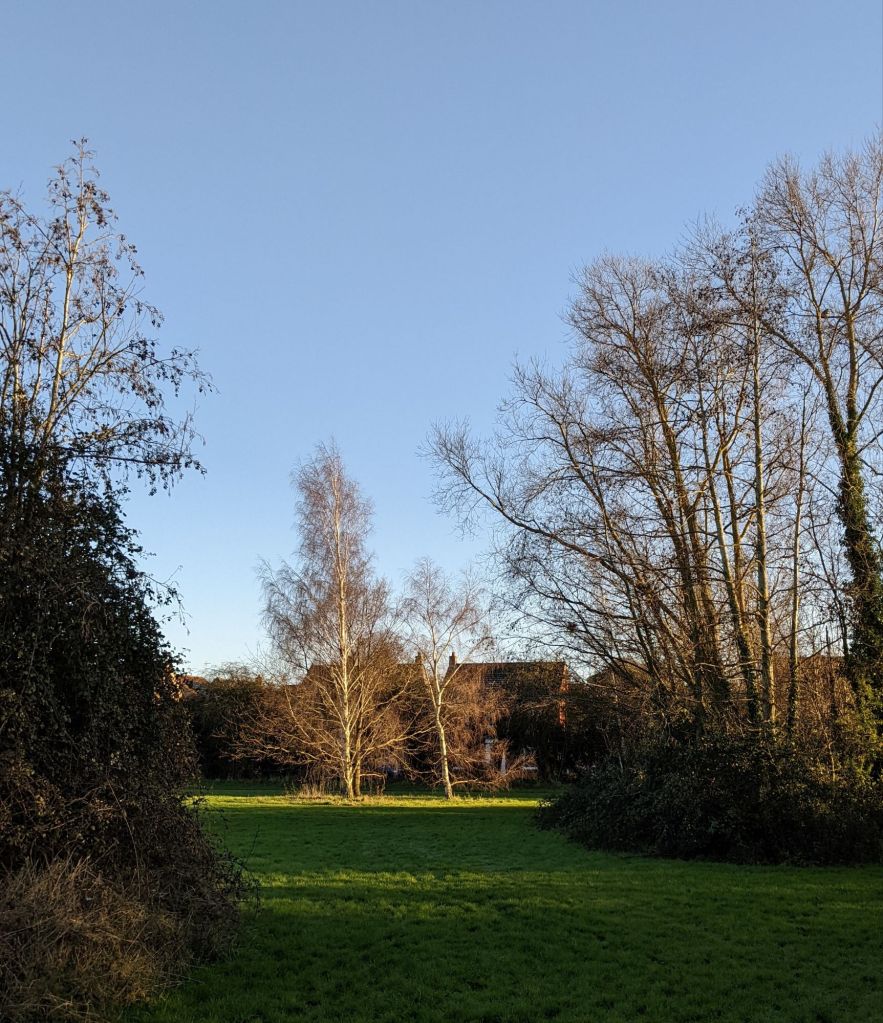
First walk of the new year

Silver birch trees seen across an expanse of grass, lit up with sunlight against a cloudless blue sky

By way of contrast with yesterday, today’s weather was everything that early January ought to be: cold, clear, and lit with gentle gold sunlight. I always struggle, when in recovery, with finding the balance between “keeping active” and “overdoing it”: today’s walk was probably about a kilometre, which was about right. More to the point, it put me in the company of the sun, and the bluetits, and the wagtails, and these trees.

Prosit Neujahr!

Christmas tree ornament: cream-painted metal silhouette of a cherub holding a curled horn

I’ve been feeling pretty sore and wiped out today, and the weather’s been horrible: driving rain before lunch, and a cold wind afterwards. In a different year I would have been in Winchester for the Friends of King Alfred Buses running day; in a different state of health I’d at least have been out for a bracing walk. But there’s something to be said for easing into the New Year with what is, after all, just as longstanding a tradition; for galvanising my intention to make some more music this year (and it needs galvanising: I’ve signed up to sing two duets in little more than a week’s time); for taking time to heal; and for letting pleasure and whimsy and beauty come to me. So we watched the New Year’s Concert from Vienna this morning, and this afternoon I crashed out, first in bed and then on the sofa, and I can’t say that I have any complaints at all about how I’ve spent New Year’s Day.

Equinox

A bee rests on a lavender head, on which only a few flowers are still blooming

It felt rather appropriate to be sitting in the conservatory yesterday, looking out at the roses still just about blooming and ripe apples on the trees, drinking the tea that came with this season’s Ffern perfume, and embroidering a reindeer into a baby hat. Today we rotated the mattress. It’s not exactly a ritual; it’s just that we’re more likely to remember to do it if we link it with the solstices and equinoxes.

I tend to mark the changing of the seasons by the cross-quarter days (I find it less depressing that way) so for me, autumn began at Lammas, at the beginning of August. That doesn’t mean that the half-way point isn’t important, though. It still looks very green outside, but when I look a second time there are a few red and orange leaves, and tonight there’s a patter of rain on the conservatory roof, and the promise of more.

December Reflections 23: seasonal

Slow Time by Waverly Fitzgerald, The Morville Year by Katherine Swift, and a bar of soap garnished with star anise and a dried bayleaf, all on a brightly coloured quilt with baby toys

I don’t know where this year’s gone. (I mean, I know exactly why it’s gone, but that isn’t quite the same thing.) Which is unusual for me, because I usually make a point of being aware of where I am in time.

These last few days, though, it’s all seemed to settle down, though not on account on anything I’ve done myself. The Morville Year, which I’d bought and immediately lost in the extra safe place in which I’d hidden the present I bought at the same time, turned up (as did the present – too late for the birthday for which it was originally intended, but just in time for Christmas). I loved The Morville Hours and the way it moves gently through the cycle of the year, and have been looking forward to reading this, a collection of related articles.

Slow Time is an old friend, a book that’s encouraged me to explore the calendar and the traditions in which I grew up. And one thing that I have already noticed about organised children’s activities is that they are very keen on seasonal themes, so it ought to get easier from here on in.

One last thing. I was amused to note, firstly that I’d run out of my previous soap bar just in time to start the Christmas Spice one – and secondly, that the one I’ve just finished (and had been using all through Advent) was called Wake Up Call. If you know, you know.

December Reflections 6: best book of 2023

Paperback copy of Hood by Emma Donoghue and a hardback copy of Winters in the World: a journey through the Anglo-Saxon year by Eleanor Parker, both on a brightly coloured velvet patchwork scarf

Haven’t been reading much lately so had to go back some months, but here’s one fiction book and one non-fiction.

“Hood” dates from before Emma Donoghue started writing historical fiction, but has become a period piece in its own right – a snapshot of the Irish lesbian scene thirty or forty years ago. Complicated, but generally likeable, characters, and a really convincing portrait of the intricacies and contradictions of grief.

“Winters in the World” is much more recent – in fact, probably the most recent book I read this year. I think it came out late 2022. It’s lovely – a slow journey through the seasons and festivals of the year as seen through early medieval literature. Some of the pieces quoted were familiar, from church or from my long ago Eng Lit degree, but most were new to me. Much more enjoyable and edifying (she tells herself sternly) than arguing online over whether some advertising gimmick invented in 1957 is a sekrit pagan survival. (I don’t actually argue, but I do waste time and emotional energy muttering to myself about it.)

Not pictured, because on my e-reader, Plain Bad Heroines (Emily m Danforth) and Bad To The Bone (Brian Waddington) – two slick, stylish, cynical novels with what I’d like to call a side of magical realism if only that didn’t sound so much like whimsy. Which they very much weren’t.