Sapphic Book Bingo 2022

Join the Sapphic Book Bingo
[Bingo card with boxes arranged in 5x5 grid, each with a heading summarising a particular trope or aspect often found in sapphic books]

I’m about six weeks late with this, but there’s plenty of 2022 still to come, which means that there’s plenty of time still to read books. Plenty of time to take a look at Jae’s Sapphic Book Bingo and mark out a line you might like to fill. There’s still time to fill the whole card, if you’re feeling ambitious.

As ever with Jae’s challenges, there’s a refreshingly wide choice of themes, and my stories fit into quite a few of them. Such as:

  • Speak Its Name is, above all, Lydia’s coming-out story. (It takes her a while to come out even to herself, which was a bit of a challenge when I realised that the whole thing needed to be rewritten and put into her point of view.)
  • It’s also an award-winning book. In fact, it was the first self-published book ever shortlisted for the Betty Trask Prize. Getting shortlisted for the Betty Trask Prize means you automatically win a Betty Trask Award. Will I be forever thrilled to have been shortlisted for the same award as Sarah Waters? Oh yes.
  • I have a few short stories available for free. Find The Mermaid at The Lesbian Historic Motif podcast or Prima Donna at A Story Most Queer (both historical fiction, both podcasts). Or sign up for my newsletter to download Yay or Nay (historical fiction again) or In Little Space (a Christmassy short set between Speak Its Name and The Real World).
  • And you can find Daisy’s Yarn in the new IReadIndies anthology Anything But Romance, free until the end of the month. As you might guess, it’s Not a romance as well as being a free book.
  • Are student politics (Speak Its Name) or the intersection between sexual identity and faith (both Speak Its Name and The Real World) out of your comfort zone? There’s another square for you.
  • As for different sexual orientation or gender identity, Lydia is a lesbian (Speak Its Name is her book) and Colette is bisexual (The Real World is hers, and it’s very, very bi). They’re both cis.
  • They’re an established couple by the time we get to The Real World.
  • I think The Real World is probably my author’s pick. I was flicking through it this morning and thinking that it was worth all the anguish after all.

And if you’re going for the trickier Book Unicorn card, either Speak Its Name or The Real World will of course count for Faith. (You might find some other possibilities on my LGBTQ Christian fiction recommendations post, too.)

There are some that I can’t help you with. I’m too young to have written a sapphic classic, though I’ve read plenty (most recently enjoyed Katherine V. Forrest’s Murder At The Nightwood Bar). I am not a POC author (try Sara Collins, The Confessions of Frannie Langton). Nor am I a newbie (going to have to do some research there). And so forth.

And there are some that are a bit borderline. I’m not sure that I’d count ‘both being rostered to cook baked potatoes’ as a meet-cute, but you might feel differently. (Sadly, my cutest sapphic meet-cute happens in A Spoke in the Wheel, which is not a sapphic book, what with it being narrated by a man and all. But I’ll always have a soft spot for Vicki and Gianna and their background cycling app rivalry meet-cute. Gianna, the silversmith, would be my best shot at an unusual job, too. Oh well.)

If you think one of my books might help you fill a square on your card, you’ll find them, among other places, on Smashwords, where I’m giving a 50% discount to readers playing Sapphic Bingo. Use voucher code TF79U to get the discount.

So that’s it. Have fun. Eyes down.

The Seller of Dreams: a tale for our times

Once upon a time there was a woman who sold dreams for children. Do not mistake me here. She did not sell dreams to children – children, after all, do not usually have much money to spare – but she sold them for the children. She sold them to the parents.

‘Your daughter could be great,’ she would say. That one, she gave away for free.

‘Your daughter could be the greatest.’ And, to do her justice, it was true. She did not bother with those who had not the matter within themselves to make a return on their parents’ investment.

She rarely said much more than that. Not at first, anyway. She had no need. Everyone knew that, of all the dreams of all the sellers of dreams, hers were by far the most likely to come true.

‘There will be a cost,’ she said, each time.

‘We will pay,’ the parents would say.

She would name the price, and again the parents would say, ‘We will pay.’ Most of them said so, at any rate. As for the others – well, their children are not our concern, and whether that was good for them or whether it was ill is not my concern. My business is to tell you how it went with those who pursued the purchase of a dream. After all, you aren’t interested in the others, are you?

And I realise now that I have barely told you the substance of the dreams that this woman sold. They were common enough, in that many wanted them. They were rare indeed, in that few could fulfil them. They looked different – to some they seemed like fame, to others, skill, to others, victory, to still others, beauty, and so forth; to one the dream would seem a golden crown to be placed upon her head; to another, a wreath of laurel leaves – but what I mean to say is that all were the same dream, for this was the only dream the woman sold, and all who came to her knew what they were buying. That was why they were happy to pay what she asked.

‘There will be a cost,’ she said, each time.

‘We will pay,’ the parents said.

‘There will be a cost to your child, too.’

They would all look at the child, and see her wide-eyed and dazzled by the golden dream they hung before her. ‘She will pay.’

Perhaps the parents should have asked what that cost would be. Perhaps then they would have heard: her youth. Or, her health. Or, her freedom. Her happiness. Her future. Or her soul. Perhaps some of them did ask. Perhaps some of them thought it better not to know. I can’t say. At any rate, many of them bought that dream.

And many of them were satisfied with the bargain. The dream they had bought for their daughter was golden indeed; given time, it was very clear that she would be great, that she could be the greatest. I heard once that there were some who paid the price and regretted it, but if you were to ask the woman about them you would find that she did not recognise their names, and nor would you recognise their names, and so we must conclude that they are of no concern to us.

Where were we? Ah, yes. The child whose parents bought a dream for her, a golden, gleaming dream; a dream for which they paid with money and for which she paid with her health and her youth, her future and her freedom and her happiness. And, perhaps, her soul. A golden, gleaming dream, a circlet that rested heavily on her head, with the weightiness of skill and beauty, victory and fame. A dream of greatness.

And it was hers. Do not mistake me. It belonged to her, truly, for – this is a fairy tale, so shall we say, a year and a day? Very well. For a year and a day, she was the greatest, and in her golden dream-crown she ruled over all, and all praised her skill and her artistry, her beauty and her fame. And then –

What?

And then? Nobody wants to know what happened next. Are you sure? Well, if you must. When a year and a day had passed, she woke, and she found that her golden circlet had changed into a wreath of dead brown leaves that crumbled into dust when she touched them, and her limbs were racked with pain, and her bones were the bones of an old woman, and no one remembered her name.

And with agony coursing through her with every step, she went to the city that she had ruled and she saw that another girl was the greatest, another girl wore her crown, another girl had bought and had claimed the dream.

Her parents were furious. ‘The woman tricked us!’ they yelled, and they stamped off to complain, their daughter limping behind them. She would have wept, but she had learned that there was no use in weeping.

She did not weep, but the woman smiled. ‘Why are you surprised?’ she asked. ‘Surely you know that a dream only lasts as long as you sleep.’

The parents ranted and fumed. But the woman turned away. She had no time for them. She had another dream to sell.

The End

A crown embroidered in gold and red thread on a black background

More on the question of sport, and whether it’s worth it all? Try A Spoke In The Wheel:

The first thing I saw was the wheelchair.

The first thing she saw was the doper.

Find out more

Lost and found

Two books, 'Field Guide to the Birds of Britain and Ireland', 'Floral Patterns of India', and a white ceramic coaster with a gold letter K, on a padded envelope with 'KAFJ BIRTHDAY 26 JUL 21' written on it in red ballpoint pen

Every time I spoke to Pa over the last few months of his life, he said to me, ‘I still haven’t found your birthday present’. Found, that is, in the room that he used as half study, half bedroom, half model railway layout, and indeed, good luck finding anything in there. He’d given me a hideous charity shop coaster as a sort of joke present on the day itself, but my actual present was lost.

I assumed we’d never find it. Or, rather, I assumed we’d find it and we wouldn’t know. That it would be loose among his own things, indistinguishable from them.

But there it was: a padded envelope, with my initials and the date of my birthday. I cried a bit. Inside: a book of birds, and a book of stickers. Yes. Something I’d like, but something that might have been his own.

We found all sorts of things. There was another envelope, a much older one. Inside was a scarf. The writing on the envelope told us that the scarf was made by my great-grandmother for my grandfather, and it was in remarkably good condition one hundred and twenty years later. Other things were not so well documented. In the same box as the scarf we found several lovely early twentieth century Christmas cards, with no clue as to who sent them, or to whom. Somebody must have kept them for some reason, but I shouldn’t think we’ll ever know now.

We fill our homes with things – because we like them, because somebody important gave them to us, because we don’t get round to getting rid of them. We know what the reasons are; the people who come after us probably won’t, unless we tell them. I can see myself hanging onto that padded envelope; if so, I can see my children, if I have any, chucking it. And we will both be right.

Every item in a house is there for a reason. Some of those reasons are not particularly good ones.

‘Every word on that page is there for a reason,’ my A-level English teacher told me. It was quite possibly the most significant thing I learned at school. Every word represents a choice. Saying it this way, not any of the other ways one might have said it. Keeping it there when you come to reread. Deciding that it needed to be said in the first place.

Pa was an expansive, digressive, eclectic writer. He wrote about all sorts of things, though the nominal subject was usually mass transit. Most of his readers were quite happy to come along for the ride. And I think that his reason for most of the words, like most of the items, was, quite simply, that he liked them.

Here’s something that’s in my house for a reason, a birthday present I most definitely knew about. This was what Pa made me for my fifth birthday. It says so on the back.

A large wooden dolls' house in a cluttered room

Robert E. Jowitt, 1942-2022

A man in a green cap and jacket leans o the radiator of a 1930s bus with a protruding nose and boxy cab

My father died sometime in the night of 7-8 January, about as peacefully as it’s possible to do it, and I still don’t quite know what to say.

Not because there’s nothing to say: everybody I hear from who knew him has something lovely to say, some delightful memory to share. Not because there’s nothing to talk about: there are 79 years to talk about, and I was around for slightly less than half of that.

It’s such a cliché to begin by saying that one doesn’t know where to start that I almost don’t want to admit it, but in this case it’s true. My own tactic to deal with that very real dilemma is to start with whatever first comes to mind, and to worry about reordering it later.

So, in that spirit, here are some things that I want to say about my Pa.

  • He always was Pa, not Dad or anything else.
  • We lived in more or less the same wordscape, sharing hymns and trashy Victorian songs and Shakespeare and quasi-mythological family anecdotes and using quotations as shorthand.
  • I wouldn’t be writing something set in modern-day Ruritania now if he hadn’t read me The Prisoner of Zenda when I was nine or ten.
  • I’m sure that many people who come across this post will be looking for Robert E. Jowitt the transport author and photographer, and that was indeed very much part of who he was. Both his writing and his photography were as eclectic and idiosyncratic as his reading matter. He liked digressions and very long sentences and quotations.
  • If you’d told him that real men don’t read Jilly Cooper he’d have laughed at you.
  • There is still a card on the fridge with a list of the OS maps that he was missing from his collection and which I might have wanted to give him for his birthday.
  • He had a strong sense of whimsy and, I suppose, sentimentality.
  • He was, above all, interested in people. He would quite often ask me about friends of mine who he’d met perhaps twice, five years ago. He could make friends with pretty much anybody. He annoyed transport photography purists by taking pictures with a nun obscuring the numberplate, or a tramp in front of a tram, a shopper or a copper in the way of a tree-lopper. He liked to show public transport in, well, public, putting it in the context of the public it was built to serve and the landscape across which it transported it.
  • He claimed not to be terribly interested in buses, though he would take them in the absence of trams, trolleybuses, or steam locomotives. The one exception was Paris buses, the open-platformed 1930s Renaults. He photographed his first one in 1960 and brought it home in 1970. It’s still running.
  • He gathered the most extraordinary group of people around the buses, a sort of found family before anybody called it that. Bus people, art people, music people, all sorts of people.
  • He never did anything he didn’t want to do.
  • He couldn’t sing but he didn’t let that stop him.
  • He really was impossible to live with.
  • He was interested in birds and ships and architecture and bel canto opera and all sorts of things.
  • He was immensely proud of his children and of our achievements, though if he found something where there was room for improvement we’d hear about it.
  • He was an entertaining raconteur. I can’t tell the stories half so well.
  • The last time we saw each other face to face we talked about We Didn’t Mean To Go To Sea and teamed up in a family game of Settlers of Catan. The last time we spoke on the phone he thanked me for his Christmas present – the 2022 calendar from A Cambridge Diary – and told me that his favourite picture in it was the housemartins.

Is that everything? No, not at all. I could go on and on and on. But it is something. There’s a big gap in many people’s lives now.

Edited to add: the funeral will take place on Wednesday, 2 February – please see the funeral director’s site for details of how to watch online.

Daily Decoration: the magi

Playmobil figures representing the three kings plus camel surveying a scene dominated by a cardboard shoebox

So here we are. I feel more kinship with the Magi than with anybody else in the nativity set: you spend a long, long time getting anywhere, and you go to the wrong place, and then you finally get there and you’re only just in time, everyone else has packed up and gone home, and you get maybe a day before you get put back in your box and put away. And then you do the whole thing again next year. (I wrote a poem about that a few years ago.)

I was thinking this evening about the gifts that the Magi bring: the gold, frankincense, and myrrh. In the primary school nativity plays I participated in they were represented by cardboard boxes covered in shiny paper. It doesn’t go very far in conveying the weight and gleam of gold, the heavy scent of myrrh or frankincense; it doesn’t do much more than the plastic containers the Playmobil figures are carrying.

This Advent I – along with much of the rest of the Church of England, no doubt – read Music of Eternity, a curated and adapted collection of writing by Evelyn Underhill, the twentieth century mystic. I found it, by turns, thought-provoking, gently challenging, and really quite difficult, and at some point it managed to press some buttons which then stayed pressed all the way through Christmas. I’m not sure it was even the fault of the book; it just managed to convey to me the impression that there is a right way and there is a wrong way, and you, not doing it the right way, are doing it the wrong way. And that took me back to all the churches that have not been the right church for me, but which managed to convey me that I was doing it wrong. Whatever it was.

Evelyn Underhill talks a lot about being self-oblivious and, while I know in my head what she was getting at, me attempting to be self-oblivious summons a persona who really shouldn’t be running the show. (The key word here is, of course, attempting, but this was the kind of response that I observed myself having.) She ran it from when I was about fourteen up until my late twenties, and it was very tiring being her. She was always trying to fit in, she was always trying to be right. She was trying to please, she was trying to protect, but the only way she knew how to protect was to suppress (herself and others) and she did as much damaging suppressing as she would have done by leaving people unprotected. And she ran on weapons grade, grudging, effort. She was trying. She really was trying. She was very trying.

One of the most humbling and delightful discoveries of the last decade has been that God isn’t at all interested in her. God is interested in me. And other people have seen through her to me, and liked me. One of the things that I discovered when I stopped putting all my energy into being her was that other people also had trouble with not being XYZ enough, whatever XYZ was for them, and actually admitting to being human and having trouble with stuff was a far better way to make friends than whatever it was I’d been trying before.

The trouble is that when this persona gets hold of an idea like being self-oblivious as something that is desirable to be, and sees the current-me, who has a much better idea of who she is, well, there’s trouble. Because I can’t be doing with her yelling you’re doing it wrong!!!! at me all the time, I haven’t been doing much at all. And probably I should have a conversation with her and see if she wouldn’t rather be off-duty with a pile of comics and a glass of lemonade, because she shouldn’t have had to be on duty all those years, that wasn’t fair, but I’ve only just recognised her modus operandi.

Anyway, she quietened down this evening, maybe just because I went to church. Epiphany. We got there. Just in time. (Metaphorically, that is. Literally I had five minutes to spare.) And I thought about how tactile, how sensory, the gifts of the Magi were. How very material the Incarnation is. That, while I can conceive of a reality that is so real that compared to it flesh and blood is plastic and gold and myrrh are cardboard boxes, I can only get there through this reality. The way in for me is through who I am and through what is there.

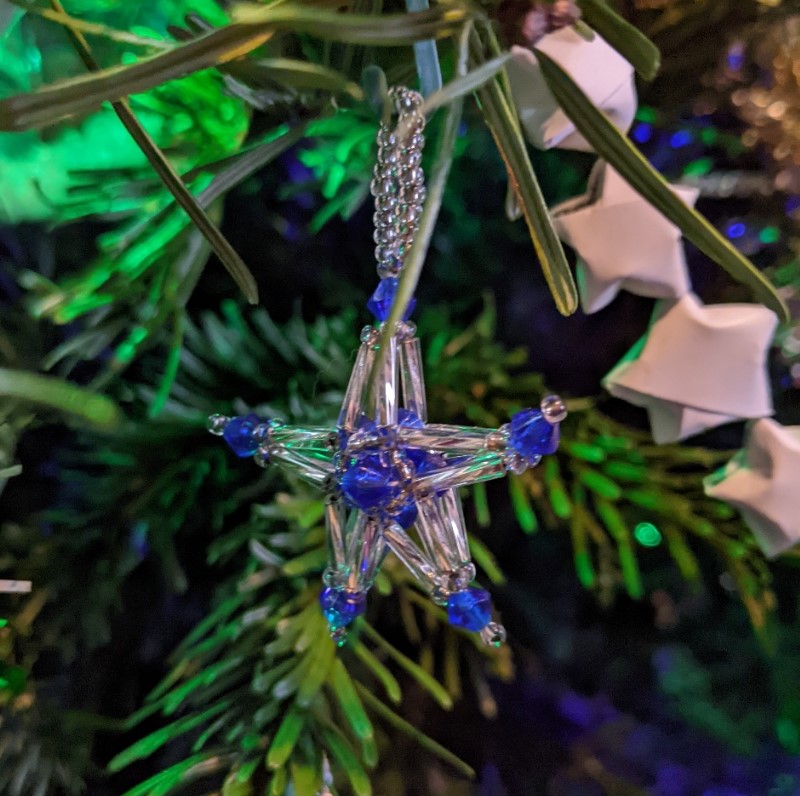
Daily Decoration: bead star

Christmas tree decoration in the fomr of a five-point star made from clear bugles and seed beads and blue bicones

I bought this little star, and a few others like it, from a member of the regional women’s committee back in the day when I was looking after the regional women’s committee.

Working for a trade union, you meet all sorts of people. It’s one of the really interesting things about the job, and it’s been particularly good for me. If I am less stand-offish, shy, or socially awkward than I was a decade ago, a large part of that’s down to the people I’ve worked with and for, union staff and union members. (And a lot of the rest of it is down to my fellow weirdoes on the internet.)

I’d meant to write more, but I’m feeling woozy and achy after yesterday’s jab, and my thoughts are wandering all over the place. So this short and sweet post will have to do, together, of course, with a solid day’s work tomorrow. Side-effects permitting.

Daily Decoration: augmented

Gold plastic Christmas tree bauble ringed with a strip of diamanté trim. Reflected in the bauble is a woman holding a mobile phone.

Nothing special about this bauble: it’s a bog-standard plastic thing. The diamanté trim, however, has a story of sorts. Originally it was attached to the little clutch bag I bought to go with my going-away outfit. I felt that it was a bit too gaudy for the occasion and removed it. After that it hung around the place doing nothing very useful until it occurred to me that I could add it to a Christmas tree bauble, and did. I think I might have had to snip off a couple of jewels from one end to make it fit properly. If so, I chucked them. Even I’m not that much of a hoarder.

I had my booster vaccination this afternoon. Consequently I am feeling somewhat less sparkly than usual, particularly around the left shoulder. Nevertheless, I trust that I will shortly be augmented with enhanced immunity, and will therefore be able to partake more fully and more confidently in life.

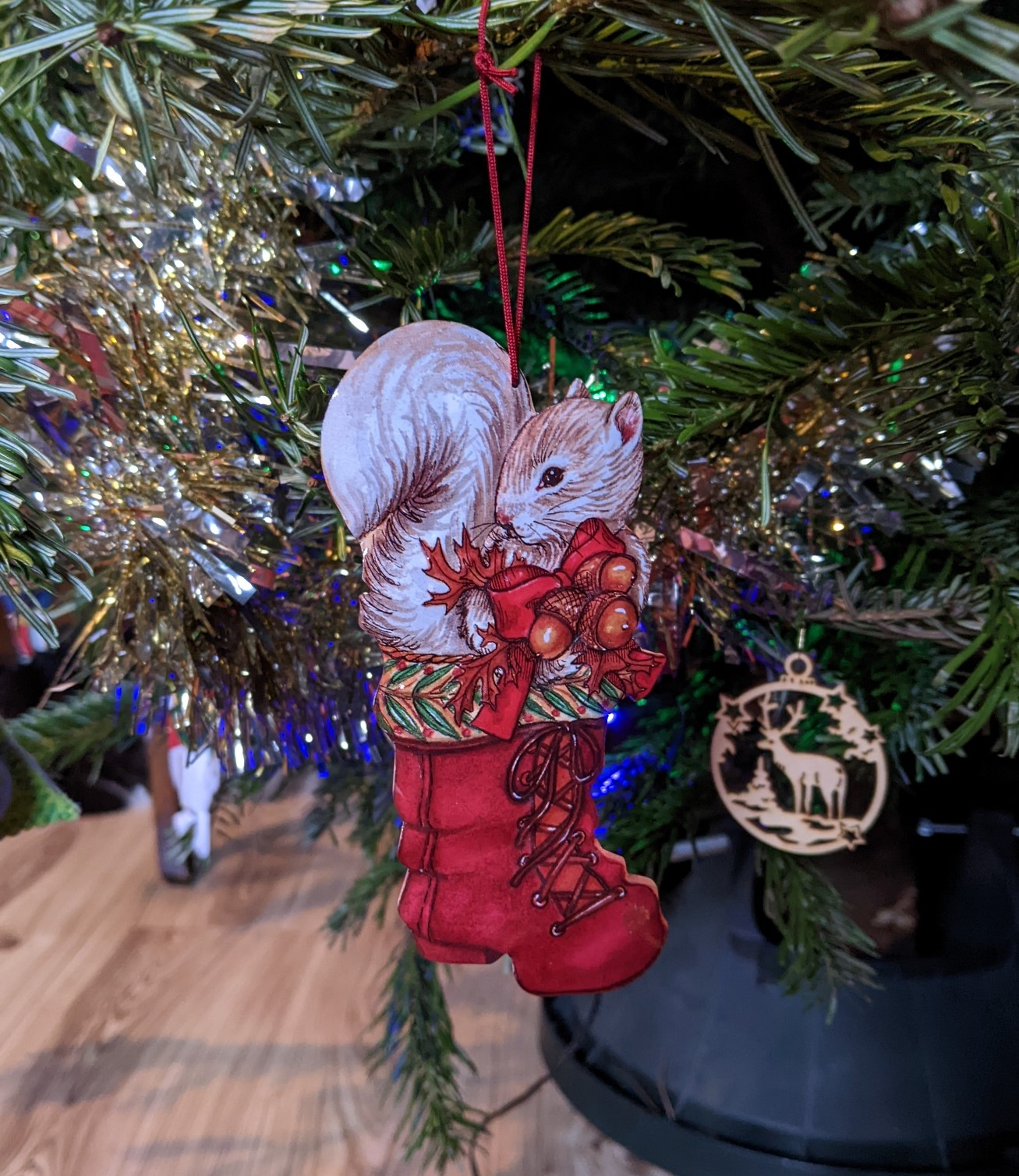
Daily Decoration: dire tinplate squirrel

Christmas tree decoration representing a squirrel sitting in a red boot

Things are getting a bit desperate here. I had to get this squirrel out of the box and hang it on the tree today. It didn’t go up on Christmas Eve because I don’t actually like it very much. But I think I’ll just about manage to find a decoration for each of the last few days of Christmas.

Today has been the last day before I start work again and, after weeks of dense grey cloud alternating with heavy rain, it’s been beautiful. I went out for my first bike ride of the year in the morning (who needs hills when you have Fenland winds?) and this afternoon Tony and I spent a cheerful hour and a half pruning the most awkward of the apple trees and destraggling the wisteria and the vine that grow over the pergola.

Hence the squirrel. We have a couple of visiting grey squirrels who scamper along the fences and steal from the birdfeeders. Today I saw one of them squatting on the pergola, nibbling away at something, I couldn’t see what.

Having spent a significant part of my life on the Isle of Wight, I’m honour bound to disapprove of grey squirrels, invasive species that they are. Particularly when they start stealing from the birdfeeders. On the mainland, however, I have to admit that I quite enjoy watching them. It’s particularly amusing when the Slinky that we installed on the birdfeeder pole does its job and stops them climbing up it from the ground (the squirrel’s own weight stretches the spring and deposits it gently back on the floor), though they’re quite capable of reaching their goal from any of the nearby trees and bushes.

As for the birds, we get sparrows and starlings, great tits (I think), blue tits (I’m almost sure), robins, blackbirds, goldfinches (occasionally), collared doves and wood pigeons, and once, very excitingly, a green woodpecker. Although since it was neither pecking wood nor looking particularly green I had to ask the internet for confirmation. I’ve heard what I think was a hedgehog and have seen what was definitely a hedgehog – twice. The second time was in daylight, though, which is a bit worrying. I put some cat food out for it. The cat food disappeared, but that might just have been cats.

Anyway, it’s been very pleasant to spend some time outdoors today, and I intend to do more of that this year. Perhaps in three months or so I’ll take a deckchair out, and a book.

Daily Decoration: cumulative icicles

The top portion of a Christmas tree, hung with decorations made from beads threaded on wire and representing icicles

There’s nothing particularly special about these icicles. There are six of them. They always go around the top branches of the tree: their length fills in the gap and they pick up the lights and sparkle pleasingly. They’re made from plastic beads threaded on wire, and they were yet another charity shop find in the penniless Guildford days. The beginning of the collection, if you like. That’s rather appropriate, given the way real icicles form: a drop freezing, another drop running over it and freezing onto it, over and over until it’s an elegant spike. It’s rather appropriate given the way that these were obviously made: a bead after a bead after a bead.

2021 was very much a year to be got through one day at a time. While 2020 is, in my head, a timeless, expansive, almost gentle, stretch of enforced freedom, 2021 seemed to call for gritted teeth and the continual effort of putting one foot in front of the other in front of the other in front of the other…

Early on in the year, someone I follow on the internet mentioned that they were aiming to add one sentence to their work in progress every day. I liked the sound of this. As mentioned elsewhere, I have more than one work in progress, and I thought this seemed like a good way of keeping faith with all of them. It has been. I’ve written short stories, fanfic, an essay, one sentence at a time. I’ve written twenty-six thousand words of one novel. I can’t remember the starting wordcount on the other one, but I do know it’s longer than it was. One sentence, one sentence, one sentence. Maybe two if they seem to come as a pair. Maybe more. Even when I didn’t know what I was doing at all, there’s been something to add. A line of description. A line of dialogue. After a while the thing gathers enough momentum to unspool itself into whole paragraphs, chapters, and I can sit down with it for a couple of hours and finish it off. Or else it runs down again, and once again I add another sentence. Just one today. Just one more tomorrow. Open the document. Add a sentence. Save the document. Close the document.

I decided that I wanted to read more poetry. I have loads of poetry books but the imagined sunny afternoons with a glass of white wine and an hour to dip in didn’t materialise nearly often enough. I started to work my way along the bookcase. The next book along. One poem. Tomorrow, the book after that. Today, Amy Clampitt. Yesterday, Kate Spencer. Tomorrow, Omar Khayyam (translated by Edward Fitzgerald) and the day after, Mary Oliver.

Last year one of my brothers gave me a book called My Year In Small Drawings. I can’t really draw but with a space that’s maybe two inches by three inches it doesn’t really matter. Yesterday I drew a man using a laptop from a stock photo. Today I will draw a picture of a picture. I still can’t really draw but that stops being important.

Duolingo. I can tell you that the boy is eating an apple in Polish, Italian, Spanish, French, and German. (Il ragazzo mangia una mela.) I can tell the cat that she is a cat. (She might not know. It’s best to be sure. Jestesz kotem.) Well, I had an A level in French already (le chat mange une pomme) so that doesn’t really count, but as far as the rest of them go I’m building on, at most, a couple of terms of formal learning plus a couple of months in the country in question. Well, there’s a pandemic on, but I can sort out my verb endings while I make my coffee (le chat ne mange pas des pommes; le chat préfère la nourriture sèche).

Teaching myself the piano. A twenty minute timer, and Michael Aaron’s Adult Piano Method. I have yet to master Home On The Range, but I’m getting there faster than I would if I were doing nothing.

Filling in my diary. I use an ordinary engagement diary, A5, week to view, and it’s part scrapbook, part commonplace book, part record of days. That way I can look back and see when was the last time I gathered the compost and when was the last time my right eye did its funny loss of vision thing and when it was I started reading the book I’ve just finished. And I can write down the quotation I want to remember, and I can stick in the pretty oddment that would otherwise be floating around my desk forever.

It hasn’t been every day. Of course it hasn’t. At present everything to the right of middle C is blocked off by the Christmas tree. Some days I’m too tired to write. Some days it is raining and I do not wish to go out to draw strangers using their phones. Some days I forget to read a poem. The diary tends to get updated all at once in front of whatever’s on Eurosport on a Saturday afternoon. It doesn’t matter. If I miss a day, if I miss a week, a month – no guilt. Any day is a good day to do it again.

A poem.

A phrase.

A drawing.

A sentence.

A drop.

Daily Decoration: blue velvet star

Christmas tree decoration in the shape of a five-pointed star, made from blue velvet and embroidered with beads and copper thread

I thought I’d carry this series on until Epiphany. I’m sure I can think of something to say about five more items.

Today’s ornament is this blue velvet star. This came from Oxfam – new. It’s rather fine, if you like that sort of thing, which I do. I love this sort of rich decoration, the sumptuousness of it, particularly at this time of year. I like it in the same sort of way that I like cherry vodka and dark chocolate and going to the theatre and the New Year’s Day concert from Vienna. I wouldn’t want very much of it, and I wouldn’t want it all the time, but once in a while it’s marvellous.

In November, alerted by David at Licence To Queer, I went to see the Noël Coward: Art and Style exhibition at the Guildhall in London. It was excellent – wonderful clothes, fascinating detail about the theatre – but really, my main takeaway was the following:

it is perfectly possible to be a wildly successful polymath while spending most of one’s life in a dressing gown

There was at least one of his dressing gowns on display, as well as some modern ones inspired by Coward’s style. And – which was perhaps equally inspiring – a picture of him sitting up in bed, working, in what looked like a very fancy apartment but was actually a room in the boarding house his mother ran.

This is very much about image, of course, the swan gliding across the surface of the water while paddling furiously underneath. All the dressing gowns in the world can’t replace hard work and talent. (Though I should say that for the next two weeks I intend to read and watch and listen rather than write.) But at the same time, you don’t need to be miserable while doing that hard work. You don’t need to have wall to wall luxury. But if you’re wearing a nice dressing gown, you’re taking your luxury with you.