If the Himalayas aren’t a skyline, I don’t know what is.
This book was a gift from my best friend, who is Norton’s great-granddaughter. Reading it, we discover that he also was prone to blisters. So there you go.

Stories that make sense
If the Himalayas aren’t a skyline, I don’t know what is.
This book was a gift from my best friend, who is Norton’s great-granddaughter. Reading it, we discover that he also was prone to blisters. So there you go.
I’m a bit prone to overambitious plans, grand symbolic gestures, and knowing that something is a bad idea and doing it anyway. Whan that Aprille, with his shores soote, and so on, remarks Chaucer, than longen folk to goon on pilgrimages. I think in my case it may have been seeing Chaucer quoted all over the internet on the first day of April last year. That and being about to turn thirty. Being about to turn thirty the day after St James’ day. I had a week’s annual leave booked immediately before my birthday. I had a booklet published by the Confraternity of Saint James describing a walk from Reading to Southampton. I had expansive plans for a birthday party just outside Winchester, my birthplace. It was all too beautiful not to try.
The celebrations began with a team meeting, where a colleague presented me with a beautiful – and completely impractical – bunch of flowers. I’d tried to hint, a few days before, that flowers would not be entirely the sort of luggage I needed to be carrying, but of course I couldn’t make it clear without implying that I was expecting flowers. Flowers always happen, but they’re meant to be a huge surprise. I resigned myself to the flowers.
It was my last day in work before my birthday; another colleague’s birthday was the day before mine; it merited a celebration. We went to the pub for lunch. After a leisurely afternoon back in the office, I hauled myself and my rucksack and my bunch of flowers off to Paddington, and ended up on a hushed commuter train heading westwards.
Reading, a town that I usually like, felt vaguely unsatisfactory. First I discovered that my faithful rucksack, which had served two caminos and six months of hauling washing to the launderette, had succumbed to old age and was shedding flakes of its waterproof lining all over its contents. Then I managed to get my room key card stuck in the door, and so had to stand fuming in the passage until the owner turned up to program a new one for me. The establishment was hardly the Ritz in the first place, and the corridor was perhaps the least glamorous part of it. I wouldn’t have spent five minutes standing there by choice, let alone forty. And I was paying sixty quid a night for this. Having at last been provided with a new key card, I set out into town.
I used to know two people who lived in Reading – at least, I used to know two people well enough to drag them out for a drink at short notice. One of them had moved to Bath, and the other was busy. Given the key card inconvenience this was just as well, but it all contributed to the slight sense of anticlimax. It was just me and St James, then. Fortunately I’d been to Reading before, with the Confraternity of St James, and I knew where to find him. He’s on the gatehouse and in the Roman Catholic church, and in the ruins of the abbey. I stomped down to the abbey and slid the flowers under the fence. St James could have them, and maybe they’d cheer somebody up in the morning. Moored at the bank of the River Kennet was a narrowboat named Ultreya. This was a very good sign: ‘Ultreia!’ is a greeting used by pilgrims on the Camino de Santiago.

I found a Tesco and stocked up on provisions: brioche rolls, Laughing Cow spreadable cheese, and apples. I’d crossed Spain on a similar diet, and I was only walking four days this time. Then I started looking for somewhere to eat that evening. This was where having to fend for myself became particularly significant. Had I been with a companion I’d have probably traipsed all around Reading trying to find the perfect place and rejecting all sorts of entirely plausible eateries until they got fed up and dragged me through the nearest door with a menu nailed up next it. I could feel myself trying to do that, and as my blood sugar got lower and lower I got pickier and pickier. Perhaps I should go to Wetherspoons, but ugh, it’s a pub, and probably full of horrible men, and really I should seek out one of the pubs that my friend recommended me even though he didn’t mention food in the context, and how could I even think of going to a boring chain Italian restaurant. As it was, I dragged myself through the door of the boring Italian chain restaurant, ordered myself some olives and pasta, and got myself fed. Oddly enough, my mood improved vastly after that, and I went back to my bed and slept well, waking once, briefly, at the sound of a clock striking four in the morning.

Breakfast the next morning was in La Baguette, the greasy spoon café to which the B&B was attached. It was entirely acceptable, and provided ample opportunity for people-watching as beaucoup de monde came in to get their cappuccinos, tuna melts and so forth. I found myself less fed up with Reading. It was a bright morning. I set off with some fuss around what the hell do I do with my camera and what the hell has Tony done with this rucksack and what the hell have I put in this rucksack. Tony had expanded everything to its fullest extent, and it took me nineteen miles to work out that I needed to de-expand it again. It made for a painful first day on the road.

That aside, the first section particularly was a joy, walking alongside the river Kennett and the Kennett & Avon canal, watching dragonflies and butterflies flittering around the plants on the bank, looking at the backs of houses whose gardens tumbled down towards the water, dipping my fingers in for benediction where I could safely get close enough. Wide green meadows; two flocks of geese, neither aggressive; a shoal of tiny little fish swirling endlessly around a shallow backwater.

Leaving the river, the route becomes less obvious, and having the OS maps with me was occasionally essential and occasionally confusing. The first challenge was making my way around three sides of a lake on a path not even marked on the map, and wondering whether a half timber-framed, half cream-painted house was the ‘white house’ or the ‘timber-framed’ house mentioned in the guide. Up the first hill – nothing spectacular, but Cambridge had spoiled me for gradients – past the entrance of the police training college, and up towards Home Farm (one of thousands, no doubt) for the first disastrously misleading direction. I ended up going through the farm and along a charming but unnecessary gravelled track, where I ate my lunch under an oak tree, and finally conceded that I’d gone wrong when I emerged onto the road. No harm done, though; it just meant some extra road-walking, and I picked up the route again in Sulhamstead Abbots.

I followed it into Burghfield Common without difficulty and bought an ice cream in the post-office-cum-shop. I sat outside the Methodist church to eat it; I’m sure the Methodists wouldn’t mind. I hope they didn’t mind the sticky patch where the last bit fell of the stick before I could eat it. I minded dropping it, but there we go. Through the Common itself and up a wooded path. I met very few people on the road – there were a number of runners and anglers and cyclists on the way out of Reading, but after that I would not have run out of fingers. The ramblers’ association scout on the road to Sulhamstead Abbots, the dogwalker – that was about it. I stopped for a pint of orange juice and lemonade at the Horse and Groom in Mortimer, where the barmaid was very impressed and very kind. I sat out in the beer garden, saving a parasol from blowing away, until the rain started, at which point I left the parasol to its fate and moved inside again.

Mortimer was the place where I’d originally intended to stop, and I was hurting now. The bad days are always those which have you walking further than you wanted to because there’s no accommodation available sooner. I sulked my way towards Silchester, crossed from Berkshire into Hampshire, and found, in a very proper silver birch copse, tiny sweet-sharp wild raspberries. Then I spent far too long walking around the perimeter of a field trying to work out what the guide meant by the ‘top left corner’ and why it didn’t mention the kissing gate, which, it turned out after I’d gone a long way the wrong way in both directions, I should have gone through in the first place.

After that I was in no mood to turn aside to examine the Roman amphitheatre. I did look into the church, where the organist was practising the Entry of the Queen of Sheba and Jerusalem. Wedding season. I hoped that he would practise quite a bit more, assuming that the wedding was on Saturday. Advised by the guidebook, I duly admired the wall paintings, but was really not in a good mood, and declined to follow the diversions around the Roman remains. At this point it was five miles to go until Little London and bed. The one great advantage of having had to book accommodation in advance was knowing that at least I had somewhere to sleep. Perhaps, I thought, it would even have a bath. But really, the main thing was being able to stop.
Round an interminable wood with a substation in the middle of it, along some more fields and out into the churchyard of St James, Bramley, which I would probably have been able to look inside had I been half an hour earlier and not in great pain. The backs of my knees were particularly painful. I spent some time lying on my back in a field, which was nice, but didn’t get me any nearer being able to stop. I struggled through the next four fields, being baaed at madly by the sheep in the last two, along a lane, over an agonising stile, and out into the road in Little London opposite the Primitive Methodist chapel – as was – now my home for the night. The Methodists had, unwittingly, been providing me with hospitality all the way.
This chapel had become Chapel House Bend and Breakfast, run by Giorgia Aitken, who I am pretty sure is actually an angel. Certainly the place was heaven. I hadn’t quite gone so far as to wish I was dead on the way there, but I’d come close. Giorgia poured me apple juice, showed me the shower (no bath, but it was wonderful in every other way) and brought me dinner. A smoked salmon and salad starter; pasta with leeks and ham; rhubarb crumble. Sublime, and she only charged me a tenner on top of the B&B rate. A quiet, exhausted evening – drinking Pukka ‘detox’ tea because there was some in the kitchen and it reminded me of a pilgrim friend, reading Sherlock Holmes – left deliciously to myself. An early night; a heavenly soft bed.

[content note: discussion of a biphobic document, including a specifically biphobic quotation]
Issues in Human Sexuality has become a very Anglican idolatry: a discussion document published in 1988, elevated without consultation to quasi-doctrinal status and making the lives of LGBT members of the Church of England a misery ever since. It’s the document that ordinands are asked to submit to, the document whose logical conclusion is that same-sex marriages can’t be performed or even blessed in church.
Paragraph 5.8, which attempts to deal specifically with bisexuality, has been floating around Twitter lately, and since I have more to say on the matter than will fit into 140 characters, I’ve taken it to the blog.
5.8 The first is that of bisexuality. We recognise that there are those whose sexual orientation is ambiguous, and who can find themselves attracted to partners of either sex. Nevertheless it is clear that bisexual activity must always be wrong for this reason, if for no other, that it inevitably involves being unfaithful. The Church’s guidance to bisexual Christians is that if they are capable of heterophile relationships and of satisfaction within them, they should follow the way of holiness in either celibacy or abstinence or heterosexual marriage. In the situation of the bisexual it can also be that counselling will help the person concerned to discover the truth of their personality and to achieve a degree of inner healing.
The depressing thing about this – no, there are many depressing things about this, but one of the first that springs to mind is that it relies on a definition of bisexuality that no bisexuals use, a myth that is in wide circulation beyond the Church, namely, that ‘bisexual activity… inevitably involves being unfaithful.’ The majority of my secular straight acquaintance agrees that the Church’s attitude to homosexuality is bafflingly uncharitable, but I’ve had to explain a tedious number of times that no, I’m still only sleeping with the person I’m married to.
I began identifying as bisexual in 2007, having first heard the word in 2006. At that point I was in a relationship with the man I was to marry in 2009. Our seventh wedding anniversary was last Monday. Now, you can make all the ‘seven year itch’ jokes you like, but I have never been unfaithful – unless you subscribe to a particularly literalist interpretation of Matthew 5:28, in which case I suggest you check your own eye for logs. I have from time to time developed crushes on other people, told my husband about them, laughed, and moved on. I will be very surprised if that’s not true for the majority of straight people and gay people.
The paragraph also relies on another common misapprehension about bisexuality: that it ceases to exist when somebody begins a monogamous relationship. My own experience gives the lie to that. I was already in a monogamous relationship when I took a long, hard look at the list of everyone I’d ever been attracted to and realised they weren’t all the same gender. Nor did I not stop being bisexual on 20 June 2009. In fact, it was some of the hard thinking that I had to do as part of marriage preparation that gave me the impetus to come out to my husband. (Whose response, by the way, when I showed him this paragraph the other night, was ‘What the fuck?’)
I am ‘capable’ of celibacy, abstinence and heterosexual marriage, though not all at the same time. I’ve done all three in my time, I’ve seriously considered all three, plus a relationship with someone of the same gender, as possible futures, and all the time I’ve been bisexual. What is ‘bisexual activity’, anyway? At present I, a bisexual, am typing a blog post in my lunch break, drinking tea and listening to the Sullivan cello concerto. No infidelity involved. That’s as far as my bisexual activity goes.
I have had counselling in the past. It helped, but not in the way that Issues seems to think it might. It was the beginning of an attempt to achieve what this calls ‘a degree of inner healing’. What eventually came to the surface was the inevitable conclusion that my attempt to ‘follow the way of holiness in… heterosexual marriage’, ignoring all the bits of my personality that didn’t fit that story, hadn’t worked at all; it had led to me leaving half of myself outside the church door. That stint of counselling, and all the thinking I did after that, didn’t ‘heal’ me of being bisexual, because bisexuality is not something that needs to be healed. ‘Dealing with’ bisexuality by ignoring it is, pastorally speaking, a terrible move.
And guess what? The truth of my personality is that I’m bisexual, no amount of counselling is going to take that away, and accepting it, celebrating it, has brought me a degree of inner healing that pretending to be a straight wife never did.

When I was little, we had some traveller friends who lived in a converted bus in our back yard. Since most of our other friends lived a mile down a very busy road, my brothers and I spent quite a lot of time with Ed and Jenni, Izak and Riley. When it was fine, we played in the garden. When it was raining, we went to the bus.
Jenni had a copy of Mary Berry’s Step By Step Desserts. I spent many happy hours looking through this book. Later, they moved to France, and we moved to the Isle of Wight, and I haven’t seen them in years, though my father and brother visited them a few weeks ago.
All the same, when I saw a copy in a charity shop I snapped it up. I make recipes out of it occasionally, but mostly I just look, and remember contented rainy afternoons, and very hospitable friends.
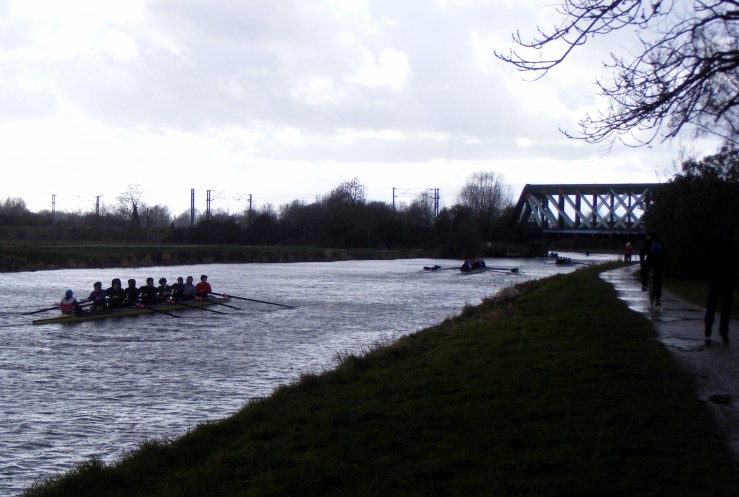
I’ve mentioned before that I live very close to the Cam. What this means is that it’s very rare for me to cycle to the station, go out for a box of teabags, or just have a wander, without seeing a rowing boat or three on the river.
And where there are rowing boats, there are coaches. The rowing coaches cycle up and down the towpath with buoyancy aids slung over their handlebars and with their eyes on the river, yelling at the boats. Sometimes, when the boat has slowed and the blades of the oars are trailing in the water, when the coach has brought their bike to a standstill, I overhear what they tell their charges. I like to listen, because their instructions are often useful clues.
Some seem pretty specific to the sport:
Here’s a trick that might be useful to you: imagine that you’re controlling the oar of the person in front.
Some seem to have more general application.
You should only be spending about 30% of the time on the stroke. The rest is recovery.
And then, yesterday,
You can’t fix the current stroke. You can only fix the next stroke.
You can’t fix the current stroke. You can only fix the next stroke.
Minor spoilers for Speak Its Name in this, including an extract from a chapter very near the end.
I mentioned last time that my main purveyor of author tracts (warning: that’s a link to TV Tropes, and if you follow it you may lose the rest of the day) in Speak Its Name was Peter. Which is not really surprising, when you consider that the book started out as a story of how getting too interested in student and/or Christian politics can play havoc with what you thought was a vocation to ordained ministry. That’s pretty much where I was when I started writing it, after all, so it made sense to bestow some of my own opinions upon the character who was dealing with that.
The other one was Abby, who is Lydia’s cousin, and who is in some ways much closer to an author avatar (TV Tropes again), or at least an author caricature. (‘A self-insert who turns up at the end to pontificate,’ was how I put it to one of my editors.) I am not blonde, or pregnant, or given to wearing pink, but at the time of writing I was very aware that I looked a lot like the Perfect Christian Woman. And – aside from the fact that my family is much less of a clusterfuck than the Hawkins – this was very much what my experience looked like.
‘What I wanted to say,’ Abby said, ‘was that I know that our family is not at all helpful when it comes to relationships that happen in anything like the real world, and that I know that your parents are if anything less helpful than my parents and that – if you wanted me to – I would come out.’
Lydia choked on her prosecco. ‘What?’
Abby told Colette, in a stage whisper, ‘I said it wasn’t a helpful family.’ Then, in more serious tones. ‘I’m bi.’
Lydia could think of nothing to say. Colette, clearly amused, said, ‘She looked less shocked when I told her I had a crush on her.’
Abby smiled, though it looked like an effort. ‘I wasn’t ever going to tell anyone. Not in the family, at least. It never occurred to me that I might not be the only one.’
‘Same,’ Lydia just managed to squeak. ‘Does Paul know?’
‘Of course – I wouldn’t have married him if I couldn’t tell him that.’
‘People must do,’ Lydia said. ‘Oh, God, this must happen all the time.’
Abby nodded. ‘I know four or five – happily married, most of us, still in love, still Christian, still trying to find a way to be truthful, always knowing how bloody lucky we are: that we could so easily have gone the other way, fallen for someone we couldn’t take to church with us…’
Except… when I was reading it through, on the second to last editing pass, I was struck by the horrifying thought, Good grief, that sounds miserable.
And then I remembered that was me, that the last paragraph there describes precisely the way I thought about myself and my faith and my bisexuality at the time I was writing. I might as well have put it in there so that I could say to anyone who asked, ‘You know the bit with Abby at the end? That’s basically where I am.’
Not any more. Somewhere in the writing process I’d moved far beyond where Abby was. I was mostly out, as opposed to being mostly closeted. I’d stopped thinking that the only appropriate way for me to be bisexual was quietly. I’d realised what a mess I’d made of myself by trying to do that. I’d started speaking up, and out.
The project is never what you think it is. I thought Speak Its Name was about vocation, and politics, and faith, and sexual orientation, and it is, but it is mostly about being OK with who I am, and I had to learn more about that before I could finish it. Writing a book changed the book, and changed me.
I suspect that writing Wheels will have something to teach me about working too hard and physical capacity and the importance of not doing things. I asked to learn more about that, after all.
I suspect that I do not currently have the breadth of understanding to imagine what it’s going to teach me. I suspect that it’s going to go far beyond juggling my working patterns and keeping every other weekend free. I suspect that it’s going to take me apart and put me back together again, and maybe I’ll notice while it’s actually happening, and maybe I won’t. Maybe, like last time, I’ll just happen to glance back over my shoulder and think, Good grief, is that where I was? What a very long way I’ve come.
I’ve been thinking more about Me Before You and ableism, and I think I’ve finally managed to pin down what disturbs me about the book. Spoilers, as before, for that book, and also for Wide Sargasso Sea by Jean Rhys and Jane Eyre by Charlotte Brontë, and for my Speak Its Name. As ever, there’s a picture first so that you have a chance to click away.

My current book club has a practice of actually discussing the book, which was a bit of a culture shock, but, you know, I’m getting used to it. There was an interesting discussion last time around about Wide Sargasso Sea, Jean Rhys’ reply to Jane Eyre. One member of the group had found the book dissatisfying. The bookseller had described it to them as a ‘feminist work’, and they were disappointed that the main character, Antoinette, retained very little agency and ended up thoroughly subjugated – in fact, in the same attic in which Brontë’s Rochester had incarcerated her over a century before.
I felt, and argued, strongly that Wide Sargasso Sea is indeed a feminist work. I don’t think that the fact that Jane Eyre still happens, that Rochester’s wife still ends up in the attic, stops it being feminist. I don’t believe that a book has to end ‘and they smashed the patriarchy and lived happily ever after’ for it to be feminist. I believe that feminist literature has as much of a responsibility to present the problems inherent in the world in which we’re currently living, and the consequent detriment to women, as it does to offer a glimpse of a world beyond that. If not, Virago’s output for most of the seventies, eighties and nineties was a huge waste of time. There has to be a place for books that portray the unpleasant aspects of the world we live in.
I put some things into Speak Its Name that I don’t agree with. Religiously-motivated abuse, homophobia, one-true-wayism. In fact, I put them in because I don’t agree with them. I think they’re absolutely awful. But they happen. I don’t think they should happen. I don’t think they have to happen. If my writing Speak Its Name (and generally being loudly queer and Christian) can contribute in even a minuscule fashion to a world where they stop happening, then I’ll be delighted. Besides, a novel where nothing controversial ever happens and all the characters agree with the author’s worldview is not going to be a very good book*.
So why am I still so suspicious of Me Before You?
After all, I’ve just said that it’s not anti-feminist to point out that it wasn’t much fun being a woman in a westernised culture in the early nineteenth century.
It’s not homophobic to point out that it’s not much fun being a lesbian in a socially/religiously conservative milieu.
It doesn’t have to be ableist to point out that it’s not much fun being disabled in early twenty-first century Britain.
The problem for Moyes is, I think, that she hasn’t quite picked up how much of the unpleasantness is contextual.There are moments where she almost gets it – the scene at the racecourse, with its accessibility nightmare topped off by the revelation that Will doesn’t like horseracing anyway, which would probably have emerged earlier had Lou not gone into ‘able saviour’ mode, is a lovely satirical demonstration of the social model of disability at work. But Moyes and her hero Will both seem to have bought into the idea that this is how things are always going to be. Disabled parking spaces will never be in an appropriate place, ramps will always be too steep, well-meaning non-disabled people will never stop to ask what a disabled person actually wants or needs… This is always going to be a world, says Me Before You, that a disabled person literally would not want to live in. And it never stops to ask whether that might be something to do with the world as opposed to the person.
I don’t believe that. I don’t believe that’s the way that the world has to be. Sadly, I don’t believe that Me Before You‘s lazy assumptions about what being disabled is actually like have contributed to changing it.
*There were originally three speeches in Speak Its Name that express my pure opinions, which I would have happily claimed for myself regardless of who was saying them or what the context was. Two of them I gave to Peter. One of those was the rant about bus preservation, which isn’t particularly relevant to this post and got deleted anyway. The other comes a couple of paragraphs before the end of the Summer chapter, where he tells Lydia that God always welcomes her, and that anyone in the Church who doesn’t has got it’s wrong. That’s all me. Well, my High Church reader pointed out that Peter would say ‘the Church here on earth’, but apart from that it’s me.
And the third was Abby’s point, very near the end, about the hidden bisexuals. At the time I wrote it, that was my own experience. Not any more – but that’s another story.
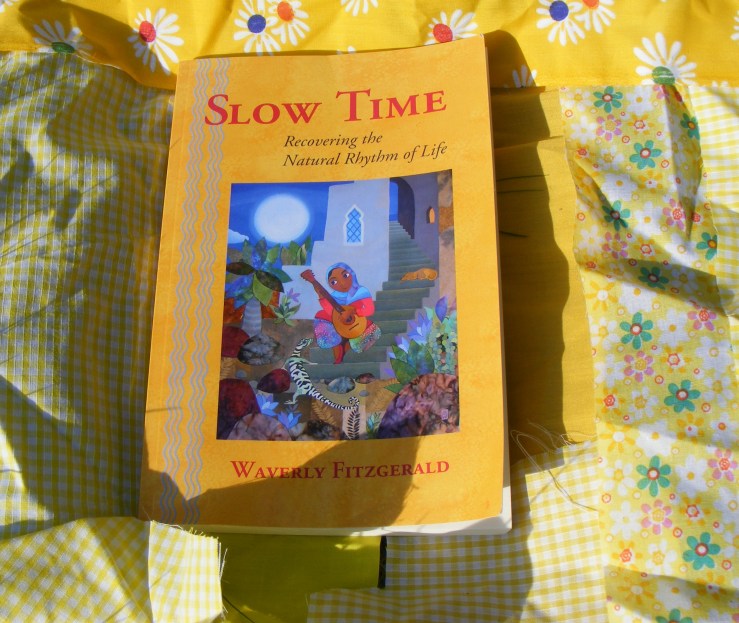
I’ve seen Slow Time described as ‘The Artist’s Way, but for time’. It’s a twelve-week workbook for exploring one’s relationship with time and seasons, and, like all these things, you skip the bits that make you roll your eyes (the astrology, for me) and play with the bits that appeal.
I wouldn’t recommend it to hardcore Quakers who Don’t Do Festivals, but I was surprised how much I, as a wacky but orthodox Anglican, got out of it.
Here’s how this post works. I talk a bit about a book club I used to belong to. Then there’s a picture of an electricity pylon. Then there’s a content note. Then there’s the same picture of an electricity pylon. Then there are spoilers for Me Before You by Jojo Moyes, and for Overload by Arthur Hailey. If you wish to avoid spoilers, stop reading before you get to the pylon.
My previous office had a book club. From the beginning the emphasis was more on the ‘club’ than the ‘book’. At first we waited until everyone had read the book before we arranged the meeting. When we realised that it had taken us two years to read eight books we started going ahead with the meetings regardless of how many people had got through the one in question. The result of that was that the meetings became five minutes of book talk against two hours of gossip. The night we were meant to talk about Me Before You was hijacked by… in fact, I think it was my leaving do – and we never talked about the book at all. It’s been in the news, and therefore my mind, recently, and so I’m going to talk about it now.

[content note: discussion of euthanasia in fiction in the remainder of this post and in the external posts linked to]
I’ve been following the coverage around the release of the film version of Me Before You with some interest. I was troubled by the book at the time that I read it, over two years ago now, but what with one thing and another (read: my leaving do) never got around to discussing it.
If you want an itemised list of the problematic aspects of Me Before You, I can’t do better than refer you to this comprehensive sporking by Cara Liebowitz.In fact, I’m going to quote her summary, too:
“Me Before You” is a novel turned movie that focuses on Louisa, who takes a job as a personal care attendant for a wealthy quadriplegic man who hates himself, her, and everyone around him, in that order. She falls in love with him, though she can’t dissuade him, in the end, from going to Dignitas in Switzerland to end his life. Because being disabled is soooooooooo terrible and tragic, didn’t you know?! /sarcasm
The problematic aspects of Me Before You can be sorted into the following categories:
My impression is that I would sort these differently from the way that Liebowitz does, and other readers will of course sort them their own ways. I’ll also refer you to this post by disabled writer David Gillon. Whether Jojo Moyes would agree with any of us is of course another question, and to a certain extent is irrelevant.
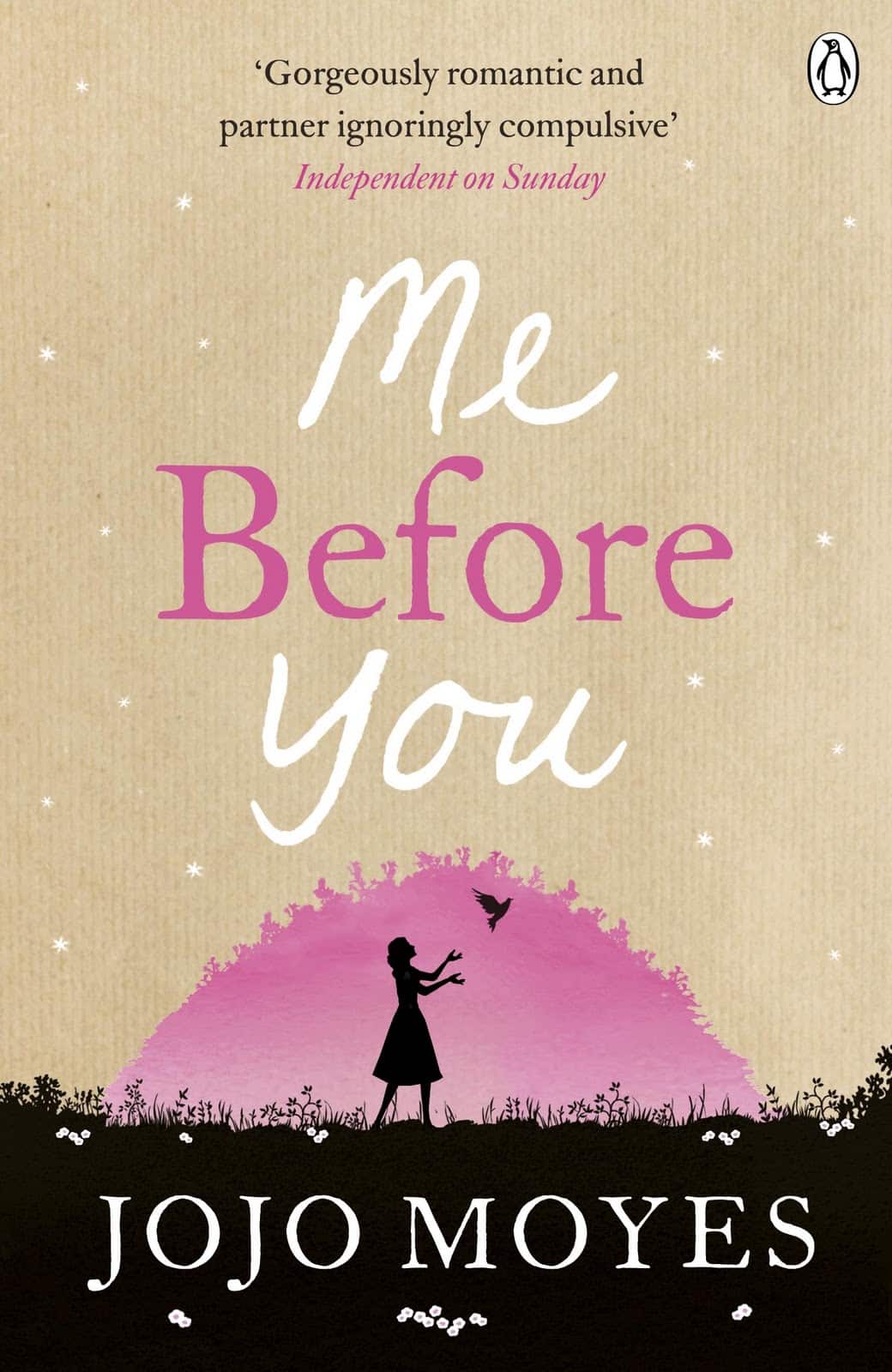
My own feeling is that she forfeits the benefit of the doubt. Choosing the ending that she does – for which I was basically prepared from the start by the cover of the paperback edition I read, which makes some problematic assumptions of its own – she acquiesces to the prevailing cultural narrative that it’s better to be dead than disabled. She never really interrogates that, not in any meaningful way, and the net result is that Will gets no character development whatsoever.
Of course there’s an argument to be made about autonomy, and personal choice, and what that looks like when physical capability is restricted, but, contrary to the protestations of the film director, the direction that Me Before You chooses doesn’t feel like the ‘brave’ one to me. In fact, it felt far less progressive than Arthur Hailey’s Overload, which, though it was written thirty-three years earlier, I’d read only a couple months before.
Overload is magnificently tacky, and occasionally plain bizarre. It has ecoterrorism, irresponsible parenting (don’t let your children fly kites near overhead lines, people), a man who loses his penis and is promised a prosthetic one, some frankly appalling health and safety failings, and an equally appalling protagonist who spends the book shagging his way around the female half of the cast list. And mostly this makes my skin crawl, but…
One of said cast list is Karen Sloan, who is a far less miserable and more interesting fictional quadriplegic than Will Trainor. She’s portrayed as a sociable, attractive woman who desires and enjoys sex, who desires and enjoys life. She has a fulfilling social life. A neighbour’s child regards it as a privilege to perform small acts of care for her. Her eventual death, when the overload of the title leads to her respirator running out of battery, is presented as a tragic accident, not a ‘merciful release’.
I’ve been taking notes on how not to fail on my own account. After all, Wheels or Bonk or whatever we’re calling it these days has a disabled main character and a non-disabled narrator who starts out as a clueless jerk. Some things I’m going to try:
It really doesn’t feel like rocket science. Perhaps ‘fail less than Me Before You‘ is just a very low bar.
In this post I talk about unreliable narrators in works by various authors, some of whom are or were very prolific, and some of whom are famous for only one or two works. I don’t name any of the books, but in some cases it won’t be difficult to work out. I also discuss the career choices of characters in Little Women, The Princess Diaries, and the Chalet School series. I’d advise you not to read on if spoilers particularly bother you.
I am also more opinionated than usual, and don’t apologise for it, though I respect your right to enjoy books that I don’t, or not enjoy books that I do. This is, as ever, implied.
Here follows a picture of some street art to give you a chance to escape.
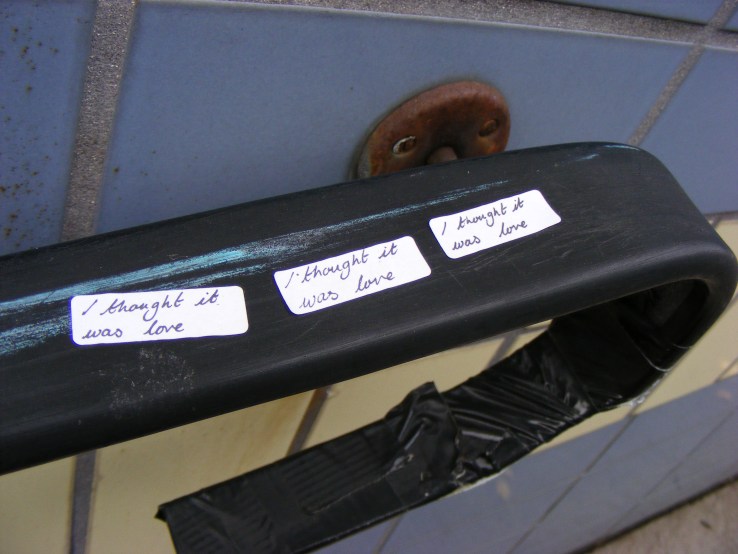
I mentioned a couple of weeks ago that I enjoy writing unreliable narrators. I enjoy reading them, too. I like to see convincing human beings with their own little biases and weaknesses, who think they’re being ever so objective but are in fact revealing their assumptions and prejudices on every page.
What I am not so keen on is the recent trend for malicious, self-consciously unreliable narrators, the ones who turn on you when you get to the end of the book and say, ‘oh, sorry, did you believe me? MORE FOOL YOU! I’m WRITING A BOOK, you know, and I can write LIES if you like!’
There are two reasons why it annoys me.
Firstly, it breaks the fourth wall and, with it, the implied understanding between author and reader.
I’ve never been particularly interested in reading about writers. I remember getting annoyed by the number of heroines of children’s books who wanted to be, or indeed became, writers. There are an awful lot of them, starting with Jo March in Little Women and stretching all the way to Mia Thermopolis in The Princess Diaries. Almost certainly further, in fact. Joey Maynard in the Chalet School was particularly irritating: she was in a school story, writing school stories. How far down did it go? There are good reasons for this, of course, like the dearth of respectable careers for women in the nineteenth century, but I always felt it betokened a certain lack of imagination.
Something of this irritation has carried over into my reaction to unreliable narrators. I don’t want to be reminded all the time that I’m reading something that’s been written. If good prose is like glass, allowing you to see through it to the story, then reading about writers writing is like a frosted bathroom screen – and getting to the end of a story that turns out to have an unreliable narrator is like walking through a plate glass window. Dramatic, but not actually something you want to do all that often.
Which brings me to my second objection. It’s a bit overdone, and I think it could do with a rest. It’s not just the thriller writers who are at it: big litfic names like Ian McEwan and Lionel Shriver have produced knowing, irritating, unreliable narrators in the last decade or so, and there are only so many times that I can enjoy reaching the end of a book to find that everything that came before is basically meaningless. Apart from anything else, a character who’ll pull that on you is probably not a character with whom you want to share too much headspace.
So far as I’m concerned, you get one free pass on that trick. Not one free pass per author, either. One free pass per reader. And Agatha Christie took mine, years ago.
 Kathleen Jowitt