The tireless music

DSC_0490

This hasn’t been a spectacular year for me, in musical terms. I’ve sung very little that I hadn’t sung before. I’m only a few pages further forward in the Adult Piano Method. I haven’t touched the cello. All the same, I feel as if I’m in a different place, that I’m a better musician, than I was twelve months ago. And I think that that’s largely been down to the simple act of showing up and singing. Consolidation. Every time I sing the Duruflé Requiem, I get better at it. The bits that freaked me out last year are less forbidding this year; the bits I learned in Guildford are old friends. Every time I sing anything, I get better at it, and better at singing.

‘Tireless music’ feels more true than it would have done a year ago. I haven’t had to flake out on choir once this autumn, which is a vast improvement. Eating on the train home before choir practice has really helped. Great Northern trains have not helped so much, but I’ve never been more than a quarter of an hour late.

What else?

  • I replaced a broken cello string and tuned the cello. Haven’t played it yet, but having it playable is a step in the right direction.
  • I led what they call a rousing chorus of Goodnight Irene at a… wake? memorial? celebration? A party, anyway.
  • I had a go with an otamatone, which is a delightfully silly instrument. I have this idea that long acquaintance with a fretless stringed instrument ought to make it fairly easy to get fairly good fairly quickly… I like the theory.

Next year I’d like to develop a reliable top F. I can get a top F at home with the piano; I’d like to get sufficiently comfortable with it that I can also summon it in company, in a cold church. I’d like to sing more appalling Victorian slush (I non-ironically love The Lost Chord, OK?) and get good at it.

I’d like to replace the cello spike. (The current one is too short, and has been since I was fifteen or so.) I’d also like to get to the end of the first volume of the piano tutor.

So much for what I’d like to do. Now for the doing of it. Just keep showing up.


The title is from ‘Saint Paul‘, a long poem by Frederick H. W. Myers. Some other verses from that poem make up ‘Hark, what a sound, and too divine for hearing’, which is possibly my favourite Advent hymn. Here‘s the tune played by brass band.

Take courage

DSCF2072

Courage is a word that I’ve been playing with on and off for three or four years now. I’ve gone from feeling very ambivalent about it to wanting more of it, wanting to put it at north and steer by it.

Today I’m particularly conscious of its connections with cor, coeur, corda – heart. Of late I’ve been feeling more comfortable with hearts – wearing them, drawing them, writing <3.

Today courage feels like what I need to be me, but more so.

My parents couldn’t have known, over thirty years ago, that A F would end up standing for as fuck, and if they had they probably wouldn’t have given me middle names starting with those initials. I noticed the connection earlier this year, and thought it was brilliant. Do I want to be Kathleen af? Yes, yes I do. But it’s going to take courage.

I think that perhaps the opposite of courage – for me, today – is shame. I’ve been thinking about shame quite a lot over the past few days. I seem to be remarkably prone to it, more than seems reasonable. I dwell. Little errors or awkwardnesses, things that (I tell myself) most people would just laugh off and move on from, stay with me for literal years, bring with them resentment and embarrassment. “That person knows about when I did that thing.” I blush and stutter and assume they haven’t forgotten. I haven’t forgotten. (They’ve almost certainly forgotten. I’m the one who’s stuck, ensnared in that shame that’s trying to keep me from letting it ever happen again. Whatever it was.)

I want – in both senses, lack and desire – the courage to let those things exist, to allow them to have existed and to let them go. I want the courage to be most fully myself. I want the courage to be Kathleen af.

The tipping point

DSCF2530

As has probably been obvious, I’ve struggled quite a bit with this book, with believing in its quality and in my ability to make it happen. Expectations are higher than they were last time. For a start, there are expectations. Last time round I kept everything under my hat until I had something that I knew was good. This time I’ve had people looking at my work almost from the very beginning. (Next time, I’ll put my hat back on and keep things under it.)

I’ve discovered that with every book there comes a point during editing – for me, anyway – where

‘this can’t go out looking like that!’

tips over into

‘good, yes, let’s polish the rough spots and get the thing out of the door!’

It coincides pretty much exactly with the point where I’ve gone through so many edits myself that I can’t see what’s good and what’s bad any more. The point where I know something still needs fixing, but heaven alone knows what it is.

What I know now is that this is the point at which it makes sense to bring in the editing party, because otherwise the poor things get bombarded. There were times this year when they were getting a new draft every month, although I don’t believe any of them tried to read every one of those. Thank goodness.

Anyway, I reached that tipping point a couple of weeks ago. I can’t see what more I can do with this book. I’m hoping that my editors can. If they can, they’ll be getting gin. (If they can’t – they’ll be getting gin.) But I’m beginning to believe that it might actually be OK.

Light

DSCF2601

It is St Lucy’s day, which used to fall on the shortest day of the year before they started messing around with the calendars. John Donne wrote a poem about that. Even today, with a week yet to go until the solstice, it was fairly gloomy, with a great grey raincloud settling down over London and only dispersing half an hour or so before sunset.

But ‘Lucy’ is from ‘lux’: light.

This year, light has come most obviously from the little box on my desk: a grid of bright white LEDs shining up into my eyes. I started switching this on in August. Every day it measures out ninety minutes of light for me.

It’s made a huge difference. I’ve remained cheerful and functional all the way through into December. Oh, I’ve occasionally had to retreat under my headphones, or make a strategic cup of tea, or whatever, but this autumn I have not had to hide in the stairwell and cry. I really am impressed by how well it’s worked.

But I have found light elsewhere, too. All along the waterfront in Ghent (that’s where the blue birds in the picture are). Slanting across the floor of a huge, quiet, Spanish cathedral. Glinting off the river three minutes’ walk from my front door. Through office windows and church windows and on bright seas. After rainstorms. At the end of tunnels. It’s the contrast that does it.

I didn’t realise until this year how much better things could be when I get enough light.

Noticing

DSC_1150

My perception is that 2017 has not been a very good year for noticing. And by ‘not been a very good year’ I mean that I haven’t been very good at it. And by ‘noticing’ I mean that sharp, intense, take-your-breath away sort of awareness, of feeling very much present, of having a sense of the substance and nature of a thing. I’ve written very little poetry this year, and that seems like evidence of my not having noticed very much.

Why might that be? It might partly be because the camera on my phone has got all fuzzed up (Friday afternoon wasn’t nearly as hazy as the picture at the top of this post suggests), and so I’ve stopped looking for things that might make good photos, and so I’ve stopped looking.

It might be that I’ve been forgetting to look.

It might be that I’ve been looking in the wrong places. It might be that looking is the wrong verb. It might be that I need to listen, smell, touch or taste instead.

It might be that what ‘noticing’ means for me now is different from what it meant three years ago – although two striking sunsets (or, more to the point, my reaction to them) suggest that this isn’t necessarily the case.

It might be that most of my noticing happens on the train (the early morning sunset on the Hertfordshire hills is simply glorious) and so I can’t just stand and look at it; I’ve usually been whisked onwards.

It might be that things are generally better for me than they have been in previous years, so I haven’t been noticing my own noticing.

It might be that previous years’ noticings, being the most memorable parts of those years, stick out more and run together until I half-persuade myself that 2014, for example, was a golden succession of constant awareness of the glories of the universe, whereas 2017, at this much closer distance, seems like a couple of interesting moments stuck together with tedium.

All those explanations seem plausible. I don’t know which of them are true, and maybe I never will. And you know, even noticing that I don’t think that I’ve been noticing is in itself noticing, so perhaps I’m not doing as badly as all that.

Enjoying things

DSCF2432
This year flamingos are a thing. I am attempting to let myself like flamingos even though everyone else does too…

The year before last I had a major realisation regarding the fact that it is OK for me to want what I want.

I managed to forget that, and this year followed it up with a major realisation regarding the fact that it is OK for me to enjoy what I enjoy.

There’s a part of me that’s very embarrassed about admitting to liking anything. Liking things is bad enough, but admitting to liking them? Nobody wants to know. Everybody will laugh. And so on…

I don’t know when those buttons got installed. Perhaps it was at school, when I found that the things that I liked were so weird that nobody else had heard of them. Perhaps it was at home, because liking things tends to cost money. Either way, they seem to have been with me for a very long time.

And then I’m suspicious of anything that looks like a fad, anything that seems to be flogging something. If there are twenty copies of The Little Book of Whatever propped up on the counter at Waterstone’s, I’ll avoid Whatever everywhere else it pops up. Even if Whatever is something that, left to myself, I’d probably enjoy.

I worry about what other people will think. Is what I’m reading/listening to/watching too juvenile? Too highbrow? Too tacky? Too problematic? Am I just showing off? Is there some reason why I shouldn’t be enjoying it?

The answer is always ‘yes’, of course. Nothing and nobody is perfect. What I am beginning to learn is that this is irrelevant.

This year I’ve begun to break free of all that and just enjoy things. This year I’ve been following rabbit holes. I’ve let myself be interested in things. At the beginning of the year with my virus-infested brain unable to cope with anything more heavyweight than a fluffy anime, I watched Yuri!!! on Ice. That got me interested in figure skating (leading me to re-read White Boots, watch the actual events on Eurosport, and resolve to learn to skate when they finally get round to opening a rink near me) and Russia (leading me to Tolstoy and an exhibition at the British Library). I read Blackbird, an alternate universe fanfic where the characters are reimagined as spies, and that took me off to John Le Carré and Helen Dunmore.

Some of that’s proper intellectual stuff. Some of it, less so. I don’t really care. It’s all been fun. Last time I got into something (cycling, by accident – but that’s another story) I got a whole book out of it. But I’m still feeling faintly embarrassed about being interested in anything, and I really do want to get past that. I want to be enthusiastic! I want to enjoy things and not care what people think!

I don’t need anybody else’s permission to enjoy things – but I’d really like to have my own. An exercise that I’ve been doing on and off and that I want to carry into 2018 is naming, every day, one thing that I’m enjoying or am interested in, and one thing that I want. Today I’ve been watching the snow. At the moment the freezer is defrosting and I’m enjoying listening to the drips and occasionally prodding at lumps of ice to see if they’ll fall off yet. It’s not remotely productive; it isn’t even inherently interesting, but I’m taking pleasure in it. And identifying that and admitting it and being OK with it is a very good start.

Down the rabbit hole: reading in 2017

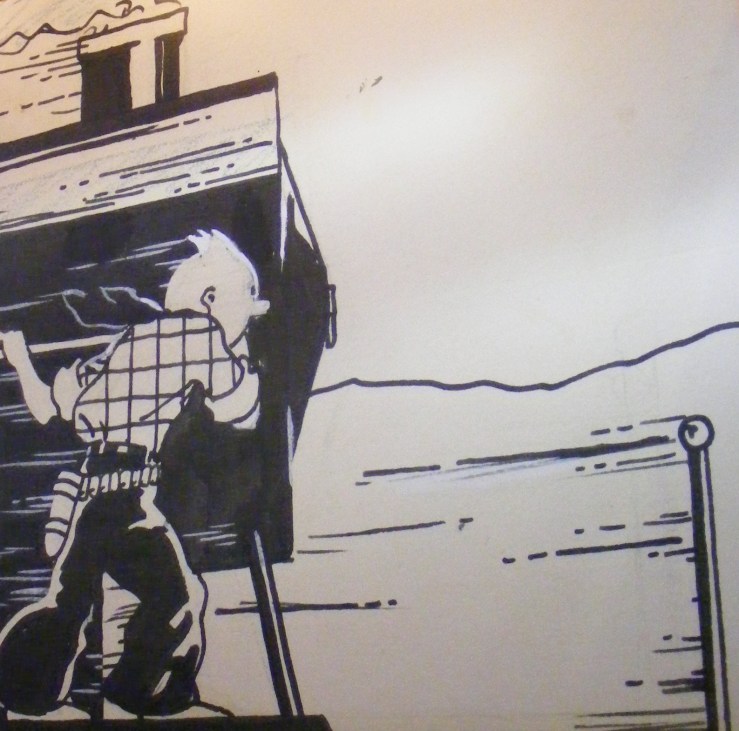
tintin

I’ve read some great books this year. In fact, I can’t remember enjoying a year’s reading so much since I was a teenager. I started out with a whole lot of comfort reading to get me through the New Year virus and the associated sleepless nights (fanfic; the Richard Hannay series), and… kept on with the comfort reading. No, not necessarily comfort reading. Some of it was distinctly uncomfortable. But this year I’ve read far more things just because I wanted to read them.

I picked things up because they were old favourites that I wanted to revisit (White Boots), or because I’d heard of them years ago and had always meant to get around to reading them (The Towers of Trebizond), or because someone gave them to me (A Good Hiding), or because someone mentioned them in passing on something totally unrelated and I liked the sound of them (The Hare with Amber Eyes). I read some new things by authors whose work I’ve enjoyed in the past (Trouble for Lucia and Meet Me at Beachcomber Bay), and I experimented with some new authors (Four Steps).

This year I read thrillers (The Spy Who Came In From The Cold) and mysteries (The China Governess). I read fanfic (Blackbird). I read memoir (The World of Cycling According to G) and biography (though I’ve yet to reach the end of the giant Rudolf Nureyev one). I read chicklit (To the Moon and Back). I read literary criticism (Literary Allusion in Harry Potter). I read children’s books (Alice’s Adventures in Wonderland and Through the Looking Glass). I read non-fiction. I read poetry (Listen to the Green; Four Quartets; Measured Extravagance).

I read fewer things for motives of self-improvement (La Dame aux Camélias). I read a couple of things just to get them off my shelves (Mulligan and The Widow). Next year I’d like to get more things off my shelves without reading them.

I followed rabbit holes and felt less guilty about enjoying what I read (pretty much everything, but particularly the Victorian and early twentieth century British stuff). I think I’ll write more about that tomorrow. The only book that I deliberately abandoned was Snuff – to my mind it’s the point in the Discworld series where the quality takes an obvious and understandable turn for the worse, and I just couldn’t bear to keep going with it. I may also give up on Will Grayson, Will Grayson before the year’s out, because I’m finding the chapters without capitalisation rather an effort to read.

Last year I decided not to bother recording my reactions to books, and just wrote down what I actually finished. This strategy continued to work this year, and I find that the memorable ones are memorable and the rest of them aren’t, and my reactions don’t make much difference, really. And then of course there are the books that are enjoyable but not memorable, and looking back at previous years’ records I can’t actually tell the difference between those and the books that I was pretending to enjoy because I thought I should.

I’ve finished sixty-six books so far, and will probably get a couple more in before the end of 2017. (Last year I managed seventy-eight, but more of those were things that I Felt I Ought To Read, either for self-improvement reasons or because I’d got them free and felt I should get my money’s worth… yeah.) Most of my reading time was on the train, with a little bit at lunchtimes or bedtimes.

I think this year I’ve come to understand that I’m not reading for anybody else – not for friends, not for colleagues, not for my own readers or even for my future self. I’m reading for me, now.

It’s fun.

2017: the year I won a Betty Trask Award

DSC_0557

I was in Spain when I got the news, on the way to Ferrol to start the Camino Inglés to Santiago de Compostela. My brother and I had spent all day on a very slow train from Oviedo: along the north coast, through mist and eucalyptus trees, eating bread and cheese. We’d spent the previous day on a very slow train, too, and the day before that on a ferry from Plymouth. I’d turned the data off on my phone to avoid roaming charges, and there probably wouldn’t have been any coverage anyway.

So when we were checked into the Ferrol hotel and I connected my phone to the wi-fi, all my emails came in at once. Most of them were boring. But there was one that was from Paula Johnson, and it had the subject line Betty Trask Prize.

I did not have my author hat on. I had my pilgrim hat on. I’d sent the latest draft of A Spoke in the Wheel off to my specialist editors and put it out of my mind, and so far as I was concerned Speak Its Name was minding its own business. I’d been using the literary part of my brain for reading T. S. Eliot and translating between English and Spanish. At that moment I did not know what the Betty Trask Prize was.

Then I read the email about it, and I remembered. I remembered that it was awarded to the best debut book by an author under the age of 35. I remembered putting my book in for it. And now, it seemed, my book had been shortlisted for it.

I said, ‘Holy fuck,’ and showed the email to my brother. He was equally impressed, but pointed out that the email said that this was strictly confidential. So, rather than tell anyone else, we went downstairs and had a drink in the hotel bar.

There followed six days during which I could not talk about it with anybody other than my brother, who, obviously, already knew. It was just as well that I had a walk of 116 kilometres to keep my mind off it.

We’d reached Santiago and begun our journey home again by the time the news broke. I spent a scorching Palencia afternoon watching the Twitter notifications roll in and understanding that everything had changed. I hadn’t realised what a big deal it was, what big names had won it, what big names had said very complimentary things about my book. I hadn’t realised that I would come away with an award whatever happened.

I’d brought Four Quartets with me thinking that Little Gidding would have the most to say to me (‘We shall not cease from exploration/and the end of all our exploring/will be to arrive where we started from/and know the place for the first time’), but really The Dry Salvages seemed much more apposite:

Fare forward, travellers! not escaping from the past
Into different lives, or into any future;
You are not the same people who left that station
Or who will arrive at any terminus,
While the narrowing rails slide together behind you;
And on the deck of the drumming liner
Watching the furrow that widens behind you,
You shall not think ‘the past is finished’
Or ‘the future is before us’.
At nightfall, in the rigging and the aerial,
Is a voice descanting (though not to the ear,
The murmuring shell of time, and not in any language)
‘Fare forward, you who think that you are voyaging;
You are not those who saw the harbour
Receding, or those who will disembark.

When I returned my life was different, and so was I.

*

Everything has changed. Nothing has changed.

I’m not quitting the day job. (I like the day job!) Sales have settled down to where they were before, and I’m still self-publishing. No contract has materialised as a result of the award, and I have to say that I’m really quite relieved about that. Going back through journal entries from the last couple of years, I’ve found at least three instances of ‘they turned me down… and it was a massive relief, because the longer I went without hearing from them, the more I knew I wanted to do my own thing!’ You’d think I’d have learned by now.

Finishing the next book has been difficult: I’ve had to keep clambering over the conviction that this one won’t and can’t be as good as the last. Perhaps it would have been difficult anyway. Second novels are notorious, after all. Certainly all the palaver around the prize slowed up the publishing process for A Spoke in the Wheel. I’d meant for it to come out in July, but I’m glad it hasn’t. The extra few months have helped me get some perspective – and get several more edits in.

Being shortlisted for the prize gave me a credibility that I hadn’t had before. But I’d already had to move beyond worrying about credibility. I had to develop a strength of belief in the quality of my own work before I was able to self-publish. Having said that, it’s been a massive ego boost. The last lingering doubts that whispered maybe Speak Its Name wasn’t as good as I thought it was… they’ve been dispelled. Gone.

And it’s made it easier to talk about being an author. I’ve been fortunate enough to experience very little scepticism or hostility regarding my self-published status, but it’s always been at the back of my mind as something that might happen. These days I can introduce myself as an author, secure in the knowledge that I’ve got one hell of a comeback if it does.

So I’m going to keep on doing my own thing. I always was going to. But it’s very good to know that my decision to do so has been vindicated.