Return of the writing brain

Sky, winter sunlight, and bare branches are reflected in a puddle on a tarmac path

My writing brain started up good and proper yesterday. I don’t know why. Maybe it’s having managed to post here every day for a month and more. Maybe it was having a day in which I’d promised myself I’d do no work and only minimal Cursillo admin. Maybe it’s because it’s almost eighteen months since the baby was born and that’s just how long it takes for a brain to get going again. Maybe it’s because I did some actual proper singing and it unblocked some metaphorical tubes. Or maybe I’d just knitted some arbitrary length of combined sock. Who knows.

Anyway, in the morning I found myself rereading some things I’d written. I fixed an plot hole in one of them. And I found myself thinking more and more about the project I was working on up until, well, a little more than eighteen months ago. Actually, it’s been bouncing around in my head for the last few days, but yesterday it started demanding my attention. And now it’s telling me I need to read the book on the Dance Band Era, and get hold of a wind-up gramophone and play the 78s, and rescue all the rest of the dance band 78s, and read I don’t know, who survived the First World War and wrote about it? Siegfried Sassoon, read Siegfried Sassoon, and oh yes, definitely David Blaize, and probably pick up that First World War history that I got about as far as 1915 in, and find out about twilight sleep and would an upper middle class woman be expected to breastfeed in 1924, and work out a better name for my hero (he is called Julian at the moment, which is a bit misleading)… And probably reread Romeo and Juliet just for the hell of it except that’s probably not the best use of my limited time, or rewatch it, except goodness knows I never get three straight hours free these days. And I would say read Surprised by Joy if I hadn’t just read it and concluded that, while I’m very pleased for C. S. Lewis that he got out an environment that was making him miserable, it would have been useful for me if he’d stayed on and could have written about what it was like being at school and watching form by form carted off to war, knowing your time was coming. (And good grief I don’t think his Professor Kirkpatrick as written would have let him get away with the logical fallacies in Mere Christianity, but that’s not remotely relevant.)

I started getting lines writing themselves again. I found myself wanting to reread what’s already there to make sure I hadn’t written them already, or written something that they would contradict. The cogs were turning, turning, getting up to speed. The writing brain was well and truly running. It kept me up mapping what fandom (such as there is) calls the Montacrew onto early twentieth century public school dynamics (let the reader understand). And then the toddler woke up and insisted on a really, really long feed.

You recall that I am meant to be resting and recovering. So yes, today was a washout (although I did some more singing practice and am feeling a lot better about my impending performance – and finished reading Touch Not The Cat, which is very slightly relevant.) So no, I haven’t actually added any new words to this project yet. But I’m so very glad to see it again.

Excavating writing fossils 2: yarn forward

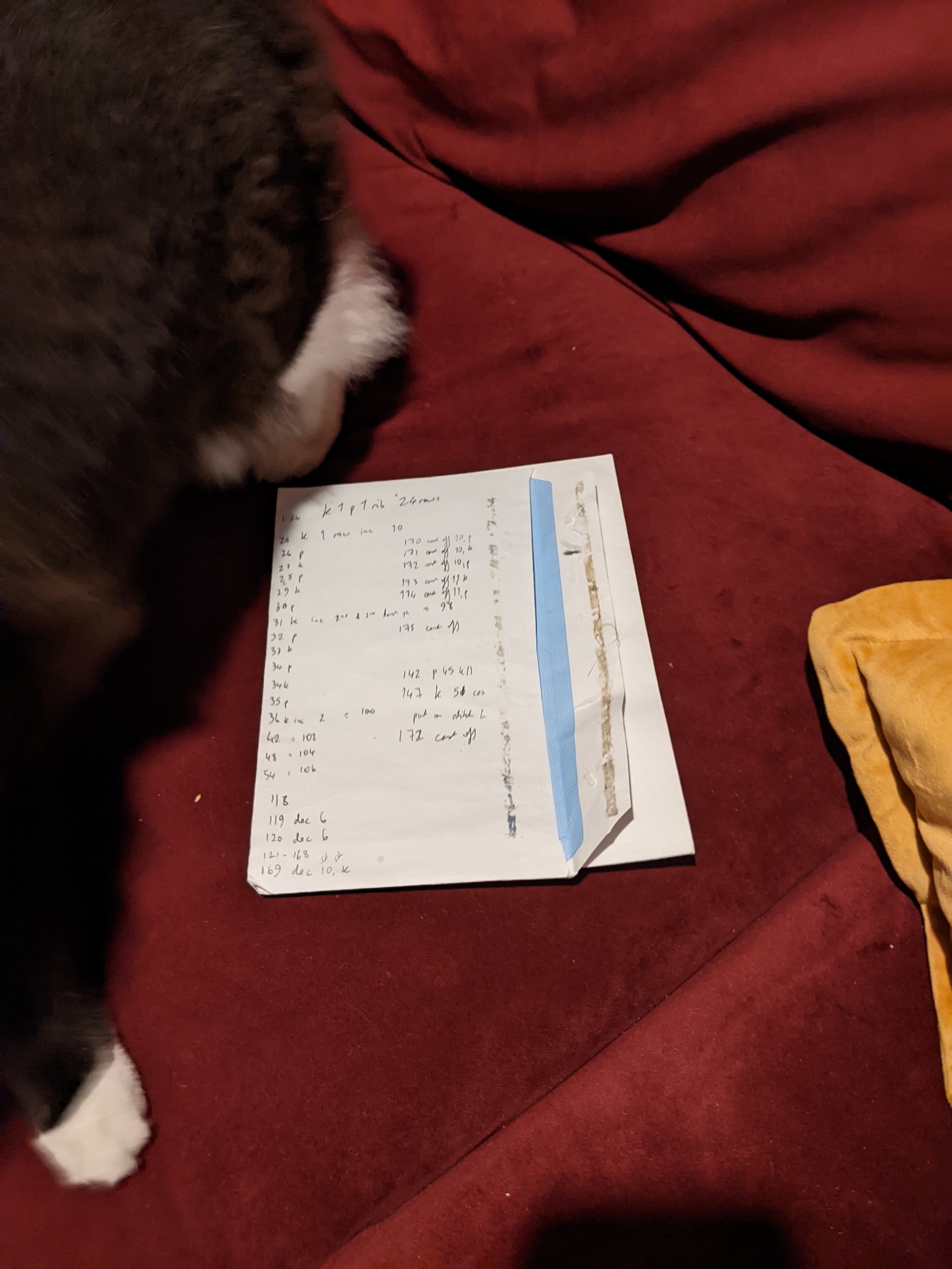
A folded A4 envelope with knitting instructions written in two columns. A fluffy black cat with white paws is passing through the frame.

I still have another page from a dead notebook to share with you, but this isn’t it. This, as you see, is an old envelope with a bit of knitting pattern written on it. Indeed, it fell out of a knitting book earlier today as I was finishing a baby hat – this hat:

A baby's knitted hat in grey yarn with a white trim and a pattern of deer and a crowned heart in white

Experienced knitters will see that this hat and the pattern on the envelope have nothing to do with each other. Indeed, as with the last post, I can remember exactly what I was trying to do: lengthen a short-sleeved blouse to turn it into a cycling jersey. I didn’t finish that; it’s still sitting at the bottom of my knitting bag.

I’m a bit of an intermittent knitter, you see. At the moment I am possessed with a wild enthusiasm for it, am telling myself that I am going to make all the socks in Cute Knits for Baby Feet, and plenty for myself as well. Since socks are a lot quicker than blouses I may even get a few finished. As you see, I have most definitely finished that hat.

Then I turned the envelope over, and I found something quite different:

The other side of the envelope has a note reading:
'Daisy's friend is called Pippin.
The alien actress is bewildered by people mistaking her stage name for her real name or vice versa'.
The cat is reclining behind the envelope as if posing

Daisy’s friend is called Pippin.

The alien actress is bewildered by people mistaking her stage name for her real name or vice versa

I know exactly what that’s about too. Or, rather, exactly what those are about: these are two separate notes about two separate stories.

The first one is Daisy’s Yarn. (Here, have a PDF.) That got finished, rejected by whatever call for submissions I originally wrote it for, shopped around a bit, and picked up by a podcast that now seems to have vanished off the face of the earth. Fairly standard.

The second one is a Book Bus Story. Or it’s going to be a Book Bus Story. I don’t really have a proper link for that yet, but it’s going to be something like this, except a book. There’s a draft of that story on the page – it’s inspired, by the way, by the way that transport enthusiasts often make a careful note of 3267’s 1970 British registration number and ignore the real story – but I’m not happy with it yet. My hope is to get Book Bus Stories done so that I can sell it at next year’s Ventnor Fringe. Will that happen? Who knows? I have a lot of writing hopes and at the moment most of them just aren’t happening.

That’s not all there was to the envelope.

The envelope is presented spread out with two A6 invitation cards to The Authors' Awards and The Authors' Awards Winners' Tea Party, Tuesday 20th June 2017

Invitations to my first and – so far – most glamorous literary prize event. I swanked about that quite enough back in 2017, so I won’t repeat myself now. All the same, it was quite a boost to my self-esteem to remember that I was there and I did that.

I don’t know if I can save the alien actress story. There are more words to it than that line, but there isn’t much more substance, and I have no idea what it needs. I’m almost certainly going to frog that blouse. Tony gave me one of his cycling jerseys and it fits me fine, and anyway, I haven’t been out on my road bike for well over two years.

That’s not really the point, though. The point is this: all the years when I wasn’t doing any knitting aren’t relevant now, when I am, when I’m finishing hats and socks all over the place, and looking forward to trying cables for the first time. I was knitting, and then I wasn’t, and now I am again. So I might as well trust that it’s going to be the same for writing, that I’m going to get back into it, writing notes to myself and turning them into stories within months or weeks.

Maybe there’ll be more glamorous prize nights. Or any sort of prize nights. I don’t mind. At the moment I’d just like to be sure that I’m going to get another book done – and I can’t be sure, because the only way to get a book done is to do it, and at the moment I’m not doing it. But I’m glad this particular fossil came to the surface: it makes me believe that I can.

Excavating writing fossils

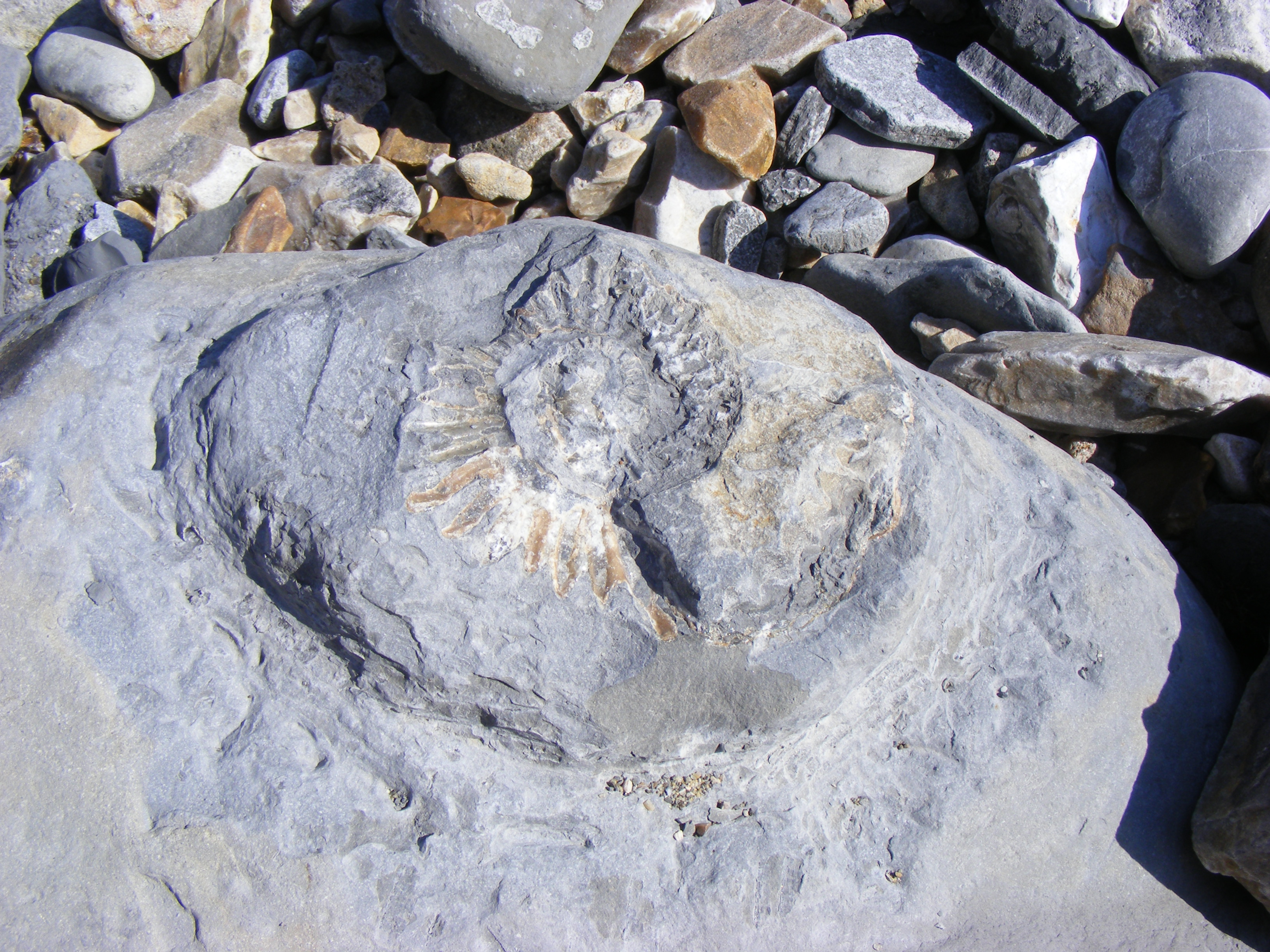
A large rock on a stony beach contains a battered ammonite fossil

I’ve been clearing out my desk. Well, both my desks, actually: we’re all moving around at work so I’ve taken the opportunity to chuck quite a lot of stuff. But I meant my desk at home, the bottom drawer of which is full of exercise books containing longhand drafts of my three novels and quite a lot else besides.

It isn’t quite so full now. Having decided that the literary critics of the future are unlikely to care enough to compare my early drafts with the finished products, and that I need the space, I’ve started ripping out and recycling pages. I’ve been glancing through them as I go, though. I’ve noticed a few things: the mild shock when I come across a character with what is now the wrong name; the surprise when I find snippets from projects which I’d have said shared nothing with each other butted up on facing pages; the odd work-related note. I didn’t think I’d started A Spoke In The Wheel before I’d got Speak Its Name done and dusted, but there are Polly and Vicki just across the page from Peter and… who’s Gina? Oh, right, yes.

Then there’s this. It’s a sort of warm-up exercise, trying to get myself into the right frame of mind – that is, the character’s frame of mind – to write one of the trickier scenes in Speak Its Name. I can’t remember now whether I felt particularly stuck and needed to write something that wasn’t the scene to get myself going, or whether I just knew that it had to be good, but I knew immediately what this was all about.

Lydia is fed up with Colette because:

  • she doesn’t appreciate how easy she has it
  • she never washes up
  • she is pressurising [sic] her to come out
  • it was her idea to get Becky involved
  • it would never have happend if Will hadn’t found out, this whole house…
  • so scared of confrontation, so conflict averse, never talk about anything
  • unilateral decisions about the two of them
  • always cooks late
  • bigoted about science
  • thinks Lydia’s friends are stupid and lets it show
  • this house is not as much fun as she thought it was going to be
  • and she hates being beholden to people
  • in a way she’s responsible for Lydia having to think about any of it
  • Lydia still doesn’t quite believe a F/F relationship can be godly, blames Colette for getting her into it
  • she is just so noble and self-sacrificial it’s not true
  • why both, when they can’t be married?

That’s Colette who’s just so noble and self-sacrificial, as if you couldn’t guess. I do like the way that this is a mixture of the little day-to-day annoyances and the big existential incompatibilities. And I’m pleased that almost all these themes are still in play in The Real World, even though things have moved on. At least my characterisation’s consistent.

Then down the bottom of the page I’ve written:

give them something to laugh about

“coming out party”

The coming out party comes quite a bit later, in the finished work; apparently it was very much connected to this scene in my mind – but I’d forgotten: that’s what this row is about. I’m not sure about ‘give them something to laugh about’; it might be what turned into ‘He shall have his resignation’. Which really does come quite a bit later – and is very much connected to the ‘coming out party’.

Interestingly, the next thing I wrote wasn’t the row. It was the making up. Over the page:

Lydia stayed in bed until past ten eleven, until she could be sure that Colette would have left the house. She had been awake for hours, had watched the narrow line of pale December light creep across the ceiling, listened to the rain spitting pettily against the window…

Which isn’t all that different from what ended up in the finished book. Page 214 of the paperback, if you’re playing along at home:

Dawn broke and dulled to drizzle. Lydia stayed in bed until past eleven, until she could be sure that Colette would have left the house; she lay there watching the narrow line of light creep across the ceiling, listening to the rain spitting listlessly against the window…

Now I catch myself thinking about why I made those changes; if they were successful; whether I’d do the same thing again. Which wasn’t going to be the point of this blog post. Apologies, hypothetical literary critics of the future; that’s all you’re going to get. Most of this volume’s already gone for recycling, and that presumably included the actual row (now page 210-214).

Which was going to be my point: that little exercise worked, even if it wasn’t quite the way I was expecting, or indeed, remembered. I’ll try to remember, next time I’m stuck on or intimidated by a scene: write it down, write down everything that’s going on in the point of view character’s head, wind it up and wind it up, and then – let it go. Stand back and let the scene write itself. Even if it wasn’t the one you were expecting.

Week-end: red plush seat season

Ornate theatre auditorium with a lot of gilt and red plush, seen from high up in the gallery

The good

A serenely joyful Monday. Visiting friends. A night at the opera. Red and yellow trees. Ripe pears. There have been some lovely moments this week. And there is encouraging progress on the Bicycles and Broomsticks Kickstarter.

The mixed

You know, I really could enjoy autumn if only I didn’t have to do so much. And by ‘have to’ I mean ‘want to’, ‘feel obliged to’, and ‘be contractually obliged to’. As it is, I find myself simultaneously getting irritated by the memes about the joy of crunchy leaves and pumpkin spiced lattes, while enjoying the crunchy leaves. (I have never tried a pumpkin spiced latte. I have never tried a plain latte, not being overly fond of milk.)

And! I finally finally finally got up to date with my accounts (I use You Need A Budget). It took an awful lot of coffee, but I did it, and nothing is telling me reproachfully that it was last reconciled nine months ago.

The difficult and perplexing

I’m boring myself here, but I’m tired. I’m beginning to wonder, actually, whether I’m not so far over Covid as I thought I was. But it may still be the time of year, combined with the nasty shock of things actually happening.

What’s working

High drama, sequins, lounging on the sofa, hot baths, soap made with coffee grounds.

Reading

I progressed a little further with The Master and Margarita. The Master has now shown up. In The Fellowship of the Ring we have reached the Old Forest and Tom Bombadil has shown up. In non-fiction, I read the introductory sections of Philip’s Guide To The Night Sky (see Acquisitions) and very much enjoyed the general Sir Patrick Mooreness of the writing. I will return to the seasonal specifics later.

Writing

Some editing on Book Bus Stories. Some connections in Starcrossers, which continues to head north towards ten thousand words. I’m going to finish joining it all up and then see what I can cut. Or throw myself on the editor’s mercy. Maybe both.

Mending

I’ve been having a lot of fun with the darning loom this week. I’ve darned a pyjama top (it’s very obvious that I mostly sleep on my right side), a pair of walking socks, a pair of ordinary socks, two pairs of jeggings, and one of Tony’s merino T-shirts.

Watching

Tosca (English National Opera, London Coliseum). I’d never actually seen Tosca and felt it was about time, and really, when you can get tickets for a tenner and I’m in London anyway, why not? So I did. It was an enjoyable show, very trad production (bicorne hats and all), good singing, understudy (?) Scarpia acquitted himself very well, Tosca herself was great, though I think Caravadossi ran away with it. My formative Tosca is Agatha Christie’s short story Swan Song, so (without spoilers) I’m always slightly surprised when the opera keeps on going for another forty minutes after Vissi d’arte (or Love and Music in this case, as ENO do everything in English). I am glad I did not accidentally leave at the interval.

Although I will say that the ten pound seats are proportionately tiny, front to back, and I was glad it wasn’t a full house and there was space for us to spread out.

Another three episodes of Heartstopper with my friend N, with popcorn and everything. It’s very charming, but my overwhelming reaction is relief that I never have to go to school ever again.

Also, what I need to get me through the dark evenings is a bucketload of sequins, unconvincing musical cuts, and dodgy scoring, and since figure skating doesn’t hit Eurosport until this coming Friday I’ve been watching Strictly Come Dancing.

Cooking

Bubble and squeak (accompanied by fierce debate as to whether you can really call it that when it isn’t made with leftovers); upside down chocolate pear pudding (experimenting this time with adding ground almonds and more milk than I’d meant to). I’ve just peeled and chopped up all the time-limited apples for apple sauce. I filled a saucepan with apples, resulting in half a saucepan of apple sauce, and there is still most of a bowl of (more durable-looking) apples left.

Eating

Pears. Some of them have been divine. The trouble with pears is that they so often go straight from rock-hard to rotten. I had one on Sunday that was both at once. I cut the rotten end off and sliced up the sharp remainder and ate it with Comté cheese. Very good.

I had a very nice paneer kebab at Le Maison Bab in Covent Garden before the opera. And a cocktail called a Paloma Pomegranate to go with it. Very nice. Very pink.

Playing

Ticket to Ride with N and M (not the Agatha Christie ones), followed by Labyrinth and Funny Bunny with M.

Noticing

How quickly the leaves are changing. And they really are lovely this year.

In the garden

As you might have guessed, apples and pears.

Appreciating

Pure distilled emotion. Lie-ins.

Acquisitions

It is always great fun to explore the charity shops of a town you don’t live in. I did very well, and came away with a knitted top, a Friedrich Hollaender/Marlene Dietrich songbook, the vocal score for Cowardy Custard (never heard of it, but it is a way to acquire a lot of Coward music all at once), Consider Phlebas, Philip’s Guide to the Night Sky as mentioned above, The Woman Who Stole My Life (I do like Marian Keyes), By Royal Command (Charlie Higson made a very entertaining interviewer; I’m interested to see what the Young Bond books are like), The Star of Kazan (to replace an copy with a snot stain – not mine), and all five acts of Mireille. Which I think I have only ever encountered on a pianola roll before now.

Hankering

Well, I was looking at a couple of leather jackets, but neither of them fitted well enough to convince me. This reminded me of my intermittent desire for a proper bomber jacket with a sheepskin or knitted collar. And I was very tempted by a darning loom with twenty-one hooks and a long board (the hooks more than the board, if I’m honest). Plus things I’ve mentioned in previous weeks and may buy now I’ve sorted out my money and payday has arrived.

Line of the week

In the Old Forest:

In the midst of it there wound lazily a dark river of brown water, bordered with ancient willows, arched over with willows, blocked by fallen willows, and flecked with thousands of faded willow-leaves.

Saturday snippet

A currently load-bearing bit of Starcrossers:

She used a word I didn’t know. “I suppose you’d call it a guess, though it’s more than that. You’re obviously from the Containment, you enjoy a certain level of rank, though perhaps enjoy isn’t the word, and none of the other Heir’s heirs have a reputation for venturing into Crew territory.” For the first time, she smiled. “And yes, they do also show me the news pieces.”

This coming week

A relatively quiet one at work. I think. I’d like to get the first draft of Starcrossers done and maybe even move on to working out what can come out. A Cursillo event on Saturday, which I am hoping will come together. And there’ll be some figure skating to watch.

Anything you’d like to share from this week? Any hopes for next week? Share them here!

Notes to self

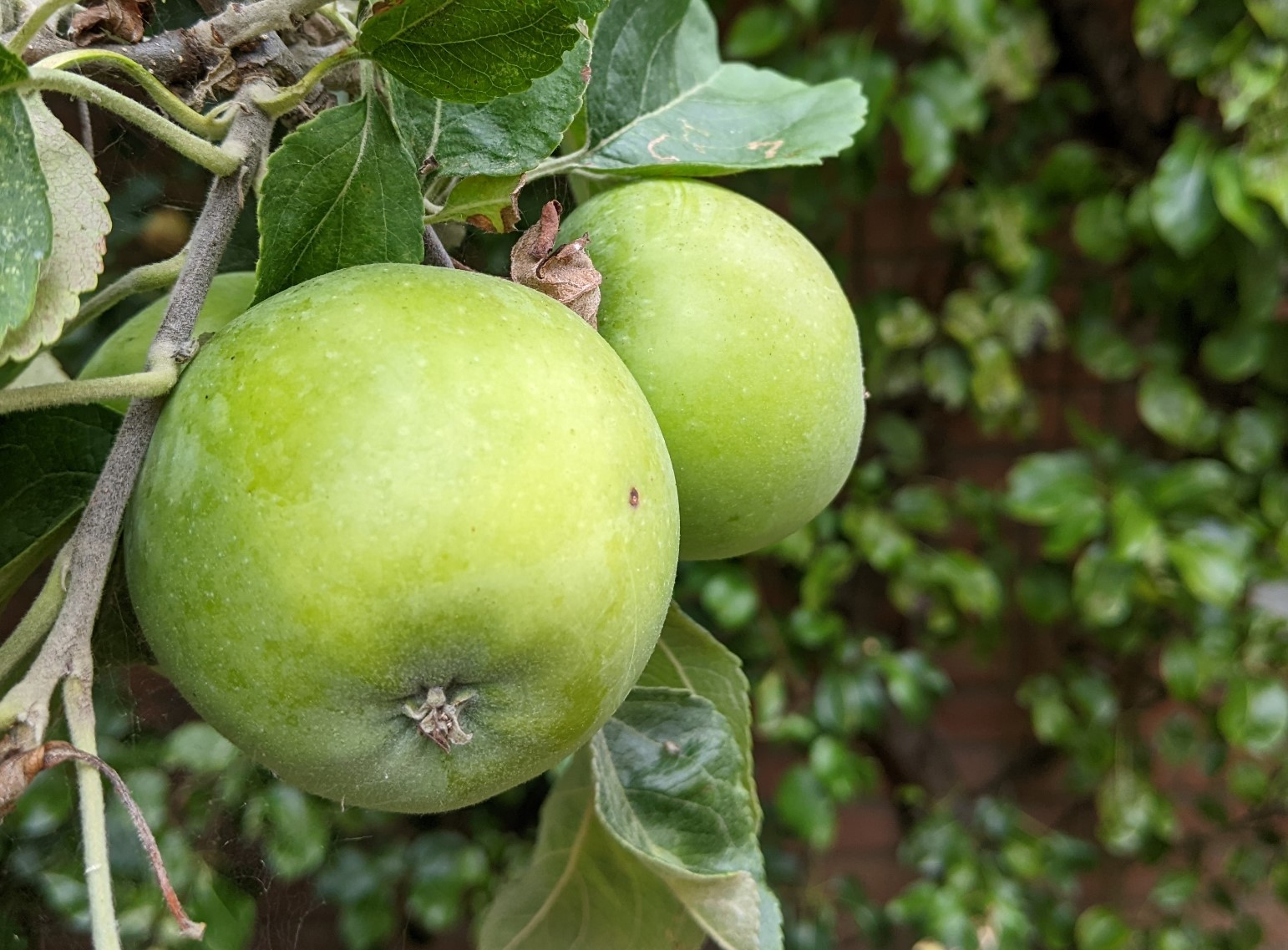
Green apples growing on a tree

I think I’ve mentioned before that the project I’ve been calling ‘the Romeo and Juliet thing’ is my first attempt at a full-length historical novel. I’m rather enjoying it. Apart from digging around to find out things like how many staff a typical upper-middle class household would have and how many of them would be addressed by their surnames, and what all the relevant railway companies were called, there’s the deeper task of getting into the mindset of a different age. It’s fascinating. (It’s also an excuse to reread a whole load of Agatha Christie and Dorothy L. Sayers mysteries.)

I am well used to writing characters who are simultaneously stuck in their own heads and detached from their own emotions, whether by shame, depression, or the closet, but this is another level: a whole population that just isn’t talking about anything. My hero is slightly more articulate than the type described by George Mikes in How To Be An Alien:

If he wants to marry a girl, he says:

“I say… would you?…”

If he wants to make an indecent proposal:

“I say… what about…”

But not very much more so. It is 1919, after all.

All this sort of thing is surprisingly fun to write, but it leaves a lot to be done by the narration. If the characters aren’t talking, I have to talk for them. If they can’t talk about feelings, I have to show that those feelings exist – because they do, they’re powerful, maybe even dangerous, and perhaps even more so because they’re not fully expressed. I’m using third person omniscient, though it’s pretending to be third person limited most of the time. (That is, I know everything, but I don’t tell it all, and most of the time I restrict myself to what’s going on inside a particular person’s head.)

Anyway, the proposal does happen in actual words. But in a moment of writing cowardice I chickened out of writing the first kiss – which prompts the proposal – and instead left myself a note in square brackets:

[this has to be really hot]

Helpful, no? As the old Nicorette adverts used to say, don’t tell me, tell me how. Of course I rolled my eyes at myself on every subsequent readthrough until eventually I wrote the damn thing and, yes, made it really hot. The current readthrough, however, has prompted the uncomfortable reflection that it hasn’t really been earned. Not yet. If the kiss needs to be really hot, so does everything leading up to it, otherwise it doesn’t work any more than the proposal, and then the decision to accept doesn’t make any sense either. And then the remainder of the book – about four fifths of it, I’d guess – don’t work at all.

And I think I also need to bring in my second point of view earlier, and do more from her perspective. It’s feeling a bit one-sided at the moment, and it’s vital that both parties are seen to be invested.

Time to write myself some more notes.

[this bit also needs to be really hot]

and

[this bit too]

I’m sure I’ll thank myself for it later.

Regrouping, rethinking, reprioritising

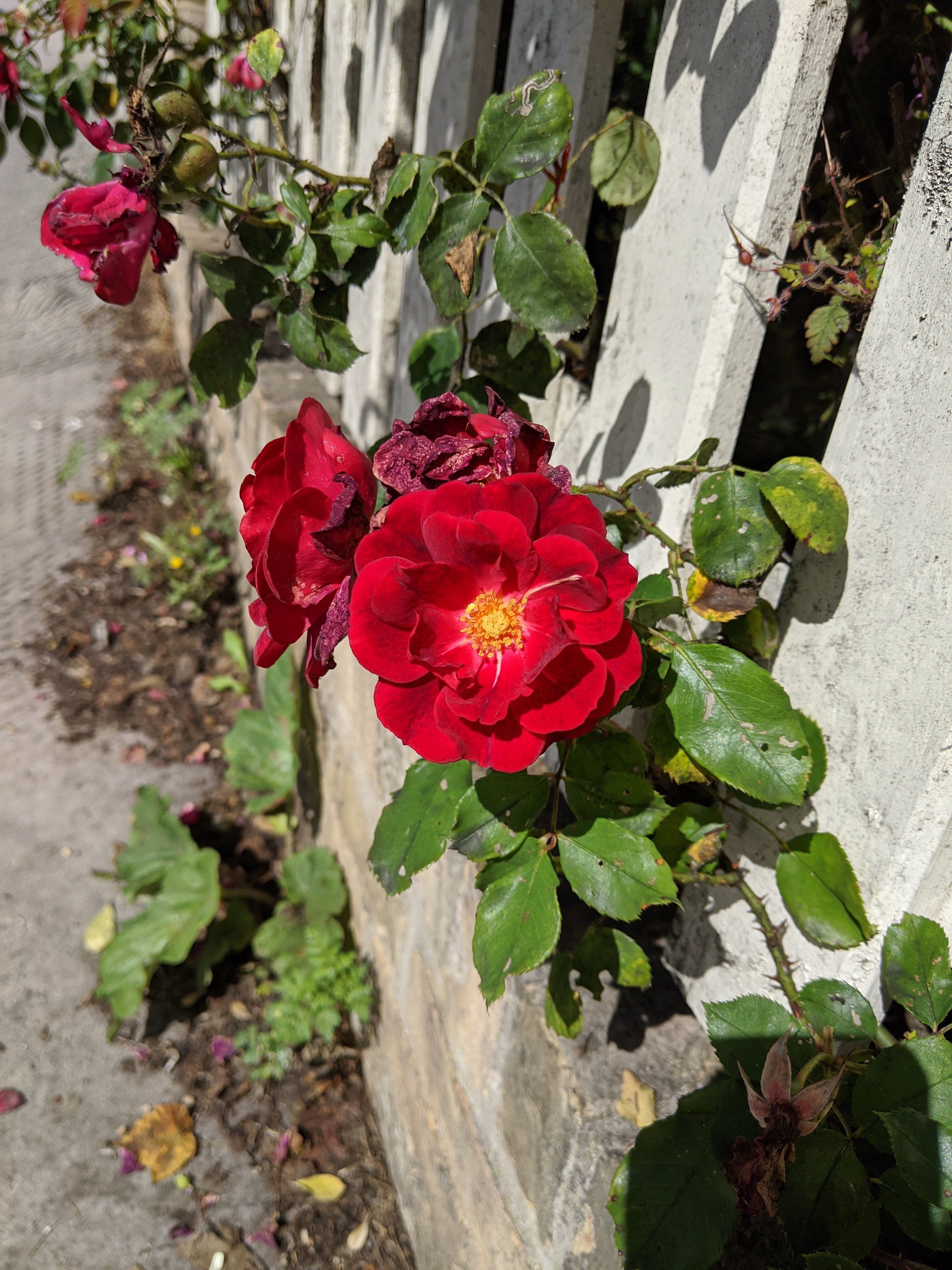
a full-blown red rose peeping out from between concrete fence posts

I’ve been writing. I’ve filled eight and a half pages of my current exercise book since Thursday morning. Granted, one of those is taken up with an extremely sketchy sketch map, but the rest are all writing.

And on Thursday, or it might have been Friday, I had one of those lovely moments where a whole chunk of book suddenly makes sense. It’s not finding a missing jigsaw piece, because I am a long way away from knowing how many pieces this puzzle has, let alone that there’s one specific one lurking under the sofa. It’s more like finding that the grey-beige piece you thought was part of a building is actually the sunlit bit of tree and now you can join this bit you’ve already done to that bit and suddenly you understand what’s going on with that weird clump of maroon.

I thought I was writing about sending my heroine away to school. I was writing about sending my heroine away to school. But it turned out that I was also writing about her relationship with her parents, and their relationship with the gap which used to be her brother, and how family solidarity means that she can’t talk about any of that with her new husband.

This accounts for one and a third of those eight pages. Not much, in the grand scheme of things. Maybe about 300 words. But it’s made all four of them (I’m not counting the brother; he gets his moments elsewhere, but the really important thing in this part is that he isn’t there) jump out from the page; it’s made the connections between them make sense.

It was a relief, I can tell you. Nothing like that had happened this year and, while I’ve been grimly plugging away, it was all feeling more and more hopeless. Back at the beginning of April, when I was still having to take a nap after a few hours of doing anything remotely interesting, I wrote:

And as it goes on I feel like less and less of a writer. It’s as if I’m no longer the person who has written and self-published three novels, that was someone else, I don’t know how to do it any more, and really what is the point anyway, only five people are going to like it and I will have to find five different people from last time because yet again I am doing something weird and it won’t sell. Possibly Speak Its Name set my expectations unreasonably high.

By the end of April, I was getting away with fewer naps, but I still had no enthusiasm. There were days when I really did think this was it. I thought I’d had my time as a writer. I’d done my three novels, I’d got on a couple of shortlists, the last one was a bit of a flop anyway, and there wasn’t anything more coming.

I didn’t say so. Not over here. For a start, that would have involved writing. I didn’t have the energy for a big flounce, nor yet to explain myself decently. So I just slipped quietly off the radar for a while. And look, it turns out that I was wrong.

Several things have been going on here. In no particular order…

A grim first third of the year

They usually talk about quarters, don’t they? But between bereavement and lingering Covid, things were horrible all the way through to the end of April. I managed to slog on with a sentence per day on everything through the first three months of it, but Covid did for my physical capacity. And, while it was useful to know there was a good reason for my complete and utter lack of energy and motivation, that didn’t go very far to replace it.

Too many projects on the go

At once point I was working actively on:

  • the Ruritanian thing
  • the Romeo and Juliet thing
  • a non-fiction, how-to, workbook sort of thing about writing a book while doing a job
  • Book Bus Stories
  • a collection of historical sapphic short stories (my mind keeps trying to call this historical sapphical, a genre that Hamlet’s players didn’t quite get around to…)

Not to mention things for work and other occupations, things that might have come out without my name on, but which none the less took up mental energy.

It made sense for a long time. The Ruritanian thing was terribly coy and rarely wanted to be the main act. The how-to thing quite often wrote large chunks of itself without my really noticing. And I’ve always found that the best way to stay invested in a project is to keep working on it. After all, it wasn’t much more difficult to add one sentence each to five projects than it was to add five sentences to one, and some days it was easier.

I’m not sure when it stopped making sense. Probably with Covid. I’d realised I needed to focus more by the beginning of April, which tracks. And really, before then I was too ill for it to be of any benefit anyway.

Your regularly scheduled mid-book slump

This happens every time. Every single time.

It was particularly derailing with Speak Its Name because, this being my first time, I didn’t know that this was a thing that happened. Moreover I hadn’t yet proved to myself that I could finish a book.

This time, though, it really threw me. I’d had two significant life events, one of which knocked me emotionally, and the other physically. Intellectually, too. I had the brain fog, and it is not an asset in writing anything at all. Once again I was in unknown territory, and I had no way of knowing whether I’d be able to find my way back from either of them.

This time I actually have given up on a book

Temporarily, at least. I’ve put the Ruritanian thing on the back burner, and maybe I’ll turn off the gas altogether. We’ll see.

The thing with several of these projects was that they weren’t serving their original purpose. The Ruritanian thing, for example, was meant to be light-hearted fun which I would, eventually, be able to share with my father. Well. And then another person I’d have loved to read it, A. J. Hall, died last month. I’m one of many people who can’t quite believe she’s gone, and, though I didn’t know her nearly so well as some of my friends, there’s a big hole in my reading and writing life. If I ever do finish this wretched book it won’t be as good as A. J. Hall would have made it – nobody had quite the same knack for seeing what I needed to cut and telling me so – and it’ll be dedicated to two people. I don’t know. Maybe it’ll be something that I’ll need to finish one day. But it’s certainly stopped being light-hearted fun.

The sapphical historical anthology, meanwhile, was meant to be an easy way to get a book out this year, as the idea was that the greater part of it was already written. Which is true; the only problem is that the rest of it turned out to be ridiculously hard and I can’t be bothered. I have two concepts for additional stories, but I don’t have the plots to go with them. I could make them happen with pure elbow grease, but not at the same time as everything else. It has not turned out to be easy and I’m not going to get a book out this year.

The non-fiction work about how to write your book alongside doing your day job… Well, I was having significant difficulty doing my day job at all, let alone anything else. At some point I’ll add a chapter with the message that sometimes life sucks and you just can’t write; don’t beat yourself up. That can wait, though.

So this time I really have ditched everything except the Romeo and Juliet thing, which, as described at the top of this post, is coming up roses (by that or any other name. Note to self: anything doing with Roses of Picardy?) and made that the main event. And it’s repaying me generously for my undivided attention.

As for Book Bus Stories, well, it’s probably about three quarters done. And I suspect that when I return to the Book Bus it’ll start writing itself again. It usually does. It seems to be perfectly happy looking after itself.

Emerging from the fog

Half-open tulip streaked red and yellow

I think I’m getting better. I cycled up the hill to the post office this lunchtime. Granted, I also had to have a nap at the end of the working day, but it’s still encouraging. What’s particularly encouraging is the fact that both the bike ride and the nap left me feeling more cheerful. And optimistic.

I’ve been having ideas. I’ve been thinking how remiss it is of spy thriller writers who set their books in 1960s Paris to fail to include a Paris bus. That might be another one for the Book Bus stories. I’ve been thinking what a lovely meet-cute I gave my B couple in A Spoke In The Wheel and wondering if I might write a spin-off. That’s another two ideas to add to ‘something inspired by Saints Felicity and Perpetua’ and ‘something in Victorian Stancester’ for the sapphical-historical anthology I was talking about last time. (I added up all the existing stories that could go in there, by the way. 25,000 words, so I’d want to write at least as much again.)

Ideas are great, but they’re only the beginning. Where I’m having difficulty is developing them into something that’s sturdy enough to support a narrative. That’s the kind of thing that I’d usually work out with myself over the course of a walk, and I haven’t been up to walking. Usually I’d be saying to myself, So, this spy, why is he on this bus? Is he meeting someone? Going somewhere? Half an hour into a walk, I’d have an answer, and with the answer I’d have a plot. But that circuit just isn’t running at the moment.

And ideas aren’t even necessarily terribly useful, since there’s at least one school of thought that says that I’d be best off returning to the Romeo and Juliet thing. And I will do that, just as soon as I’ve finished this blog post. But my goodness, it’s nice to have something going on in my head.

I remember that this time last year I was talking about reading St Augustine over Easter. I’m not sure that I’d have managed it even without taking into account a complicated and tiring, though ultimately very enjoyable, family event. The best-laid schemes and all that… But even so, it is spring, and the tulips are out, and so is the apple blossom, and today I saw two goldfinches at the bird feeder, and I have ideas.

Lost and found

Two books, 'Field Guide to the Birds of Britain and Ireland', 'Floral Patterns of India', and a white ceramic coaster with a gold letter K, on a padded envelope with 'KAFJ BIRTHDAY 26 JUL 21' written on it in red ballpoint pen

Every time I spoke to Pa over the last few months of his life, he said to me, ‘I still haven’t found your birthday present’. Found, that is, in the room that he used as half study, half bedroom, half model railway layout, and indeed, good luck finding anything in there. He’d given me a hideous charity shop coaster as a sort of joke present on the day itself, but my actual present was lost.

I assumed we’d never find it. Or, rather, I assumed we’d find it and we wouldn’t know. That it would be loose among his own things, indistinguishable from them.

But there it was: a padded envelope, with my initials and the date of my birthday. I cried a bit. Inside: a book of birds, and a book of stickers. Yes. Something I’d like, but something that might have been his own.

We found all sorts of things. There was another envelope, a much older one. Inside was a scarf. The writing on the envelope told us that the scarf was made by my great-grandmother for my grandfather, and it was in remarkably good condition one hundred and twenty years later. Other things were not so well documented. In the same box as the scarf we found several lovely early twentieth century Christmas cards, with no clue as to who sent them, or to whom. Somebody must have kept them for some reason, but I shouldn’t think we’ll ever know now.

We fill our homes with things – because we like them, because somebody important gave them to us, because we don’t get round to getting rid of them. We know what the reasons are; the people who come after us probably won’t, unless we tell them. I can see myself hanging onto that padded envelope; if so, I can see my children, if I have any, chucking it. And we will both be right.

Every item in a house is there for a reason. Some of those reasons are not particularly good ones.

‘Every word on that page is there for a reason,’ my A-level English teacher told me. It was quite possibly the most significant thing I learned at school. Every word represents a choice. Saying it this way, not any of the other ways one might have said it. Keeping it there when you come to reread. Deciding that it needed to be said in the first place.

Pa was an expansive, digressive, eclectic writer. He wrote about all sorts of things, though the nominal subject was usually mass transit. Most of his readers were quite happy to come along for the ride. And I think that his reason for most of the words, like most of the items, was, quite simply, that he liked them.

Here’s something that’s in my house for a reason, a birthday present I most definitely knew about. This was what Pa made me for my fifth birthday. It says so on the back.

A large wooden dolls' house in a cluttered room

Daily Decoration: cumulative icicles

The top portion of a Christmas tree, hung with decorations made from beads threaded on wire and representing icicles

There’s nothing particularly special about these icicles. There are six of them. They always go around the top branches of the tree: their length fills in the gap and they pick up the lights and sparkle pleasingly. They’re made from plastic beads threaded on wire, and they were yet another charity shop find in the penniless Guildford days. The beginning of the collection, if you like. That’s rather appropriate, given the way real icicles form: a drop freezing, another drop running over it and freezing onto it, over and over until it’s an elegant spike. It’s rather appropriate given the way that these were obviously made: a bead after a bead after a bead.

2021 was very much a year to be got through one day at a time. While 2020 is, in my head, a timeless, expansive, almost gentle, stretch of enforced freedom, 2021 seemed to call for gritted teeth and the continual effort of putting one foot in front of the other in front of the other in front of the other…

Early on in the year, someone I follow on the internet mentioned that they were aiming to add one sentence to their work in progress every day. I liked the sound of this. As mentioned elsewhere, I have more than one work in progress, and I thought this seemed like a good way of keeping faith with all of them. It has been. I’ve written short stories, fanfic, an essay, one sentence at a time. I’ve written twenty-six thousand words of one novel. I can’t remember the starting wordcount on the other one, but I do know it’s longer than it was. One sentence, one sentence, one sentence. Maybe two if they seem to come as a pair. Maybe more. Even when I didn’t know what I was doing at all, there’s been something to add. A line of description. A line of dialogue. After a while the thing gathers enough momentum to unspool itself into whole paragraphs, chapters, and I can sit down with it for a couple of hours and finish it off. Or else it runs down again, and once again I add another sentence. Just one today. Just one more tomorrow. Open the document. Add a sentence. Save the document. Close the document.

I decided that I wanted to read more poetry. I have loads of poetry books but the imagined sunny afternoons with a glass of white wine and an hour to dip in didn’t materialise nearly often enough. I started to work my way along the bookcase. The next book along. One poem. Tomorrow, the book after that. Today, Amy Clampitt. Yesterday, Kate Spencer. Tomorrow, Omar Khayyam (translated by Edward Fitzgerald) and the day after, Mary Oliver.

Last year one of my brothers gave me a book called My Year In Small Drawings. I can’t really draw but with a space that’s maybe two inches by three inches it doesn’t really matter. Yesterday I drew a man using a laptop from a stock photo. Today I will draw a picture of a picture. I still can’t really draw but that stops being important.

Duolingo. I can tell you that the boy is eating an apple in Polish, Italian, Spanish, French, and German. (Il ragazzo mangia una mela.) I can tell the cat that she is a cat. (She might not know. It’s best to be sure. Jestesz kotem.) Well, I had an A level in French already (le chat mange une pomme) so that doesn’t really count, but as far as the rest of them go I’m building on, at most, a couple of terms of formal learning plus a couple of months in the country in question. Well, there’s a pandemic on, but I can sort out my verb endings while I make my coffee (le chat ne mange pas des pommes; le chat préfère la nourriture sèche).

Teaching myself the piano. A twenty minute timer, and Michael Aaron’s Adult Piano Method. I have yet to master Home On The Range, but I’m getting there faster than I would if I were doing nothing.

Filling in my diary. I use an ordinary engagement diary, A5, week to view, and it’s part scrapbook, part commonplace book, part record of days. That way I can look back and see when was the last time I gathered the compost and when was the last time my right eye did its funny loss of vision thing and when it was I started reading the book I’ve just finished. And I can write down the quotation I want to remember, and I can stick in the pretty oddment that would otherwise be floating around my desk forever.

It hasn’t been every day. Of course it hasn’t. At present everything to the right of middle C is blocked off by the Christmas tree. Some days I’m too tired to write. Some days it is raining and I do not wish to go out to draw strangers using their phones. Some days I forget to read a poem. The diary tends to get updated all at once in front of whatever’s on Eurosport on a Saturday afternoon. It doesn’t matter. If I miss a day, if I miss a week, a month – no guilt. Any day is a good day to do it again.

A poem.

A phrase.

A drawing.

A sentence.

A drop.

The third dimension: when a book comes to life

A cardboard cut-out character from a toy theatre in front of a backdrop from same

I love the moment when it turns out that the book I’m working on is, in fact, going to turn out to be a book.

The first time this happened to me was with Speak Its Name. That was my first book and I didn’t really know what I was doing. I had the backdrop (student politics) and I had the characters (students) moving in front of it, occasionally affected by it, but never affecting it. It was flat. Boring.

Then I realised that what I needed to do was to get my most political character involved in the politics.

It sounds so simple. Perhaps it was. All I can say is, it took me a very long time to realise, and it changed the whole book for the better. It turned it from two dimensions into three, like inflating a bouncy castle, or sewing a pair of trousers together. It wasn’t just that my characters were now joined to the background at the point where one of them decided to involve the Students’ Union. It joined all sorts of other bits together, and it made the whole thing neater, more coherent. More interesting. It made the whole book work.

A Spoke in the Wheel and The Real World were, so far as I can remember, better behaved. Oh, getting The Real World nailed down was rather like wrestling an octopus that was also Tam Lin, but it always felt like something, well, real, if I could only get a handle on it. And with A Spoke In The Wheel both characters and plot landed more or less fully formed, bar a giant hole in the middle that I had to work out how to fill.

This time it happened at about the 50,000 word mark. No, I’m not doing NaNoWriMo, but I decided to take advantage of the general #AmWriting mood to make some progress on the Ruritanian thing. This is the project that I’ve been working on, off and on, for the last three years if not more. It seems to prefer being a side project. It modestly shuffled out of the way to let me concentrate on The Real World. It refused to be written at all earlier this year, and only started cooperating when I got swept off my feet by the historical thing. Nine months further on – nine months in which I’ve been trying to add a sentence to each project each day – it’s suddenly taking itself seriously.

Now this, being a Ruritanian thing, requires plot. It requires plot on a level that I’ve never contemplated before. There are double-crosses and Chekhov’s guns and timetables. The action of the last book happens over the course of a year. The action of this book takes place over the course of five days. I discovered the other day that I had my main character drinking five coffees between midnight on Saturday and Sunday lunchtime. I’m counting the espresso martini here, but still.

Of course, that’s easily fixable. I’ve already turned one of those coffees into a slice of cake. The real challenge has been getting the characters to do the things that are needed for the plot to happen in ways that make sense for them. Because if the characters don’t work, then the plot doesn’t work.

When I’m stuck on a book, one thing that helps me is writing down why I’m stuck. Sometimes I like to make an occasion of this. This time, I was just on the train. (Not that taking the train isn’t an exciting novelty these days.) I wrote down the things I needed to invent or research. Then I wrote down the thing that was bothering me, the thing I knew I’d have to fix sooner or later:

George shouldn’t be involving his untrained relations and he knows that.

Or, as paraphrased for Twitter,

Bringing Milly back makes George looks like a callous dimwit.

And yet Milly has to come back (she’s the narrator!) and George has to be both decent and competent. That’s the whole point of his being in this book at all.

So I kept writing.

He doesn’t have a choice with Amelia. But he needs a damn good reason for Milly to come back… There’s got to be more to it than ‘it might come in useful’.

I went down a couple of dead ends. Something that Amelia tells George that Milly doesn’t know about? Something that brings in a couple of other characters? My brain was working faster than I could write, so it wasn’t coming out as great prose.

Milly is the only person who has seen several key players by sight, so it makes sense to keep her on the spot. But that’s what’s putting her in danger. Sending her home is for her own safety.

I kept writing. Half a page later, it hit me.

Hang on. What if they do get Milly to share – and then don’t act on that? Yes. Milly spills the beans and thinks it’s all cleared up. George arrives, wants to find out more. Milly is the obvious candidate to find out more.

Bingo.

That adjusts the stakes just enough to make everyone’s actions plausible. It makes sense for Milly to come back. It makes sense for George to let her.

A (really encouraging) bonus: I now have a much better idea of at least one of the villains. And the [plot goes here] bit in the antepenultimate (there’s a good word) chapter.

Of course it’s going to demand a whole lot more changes – because most of the 54,000 words I had down were written on the assumption that Milly didn’t share – but I don’t care about that. It makes the whole thing work.

I love that moment.