For me, the new year came in with a whimper, not with a bang. I was in bed long before the bangs started, knocked flat by this virus that everyone’s been getting. And it’s taken me a while to get up and running. There’s a lot to catch up with, or, at least, there could be, if I were thinking in terms of needing to catch up with things.
The crib should have gone away. It didn’t. It’s going to have to stay up until Candlemas now, and for once the Magi get to stay by the manger for more than a day. (The parrots were a present from a friend, who’d seen this crib and got ideas about how to improve mine.)
The printer is out of toner. Which means that I haven’t printed off the current draft of A Spoke in the Wheel. Which means that I haven’t read the current draft of A Spoke in the Wheel. And I’m aware that there’s more to it than the simple fact that the printer’s out of toner.
The snag is the usual one. I am scared of reading it because I am worried that I will come across a problem that is unfixable. Perhaps I have failed to do some essential bit of research and have made a mistake that’s going to kill the whole plot. Perhaps I have managed to be unintentionally yet monumentally offensive. It’s always a variation on one of those two. Perhaps. Perhaps. Perhaps.
There are two potential ways to deal with this. The first is to wait it out. I’ve lived with myself long enough to know that I do get things finished, eventually, and that if the book and I want to spend two months hiding for each other then perhaps that’s just what we need to do, and we’ll find each other in good time. The second is to get somebody else to read it for me. Sooner or later I would anyway, but this is a much earlier stage in the process, and I find myself reluctant to pass it out before it’s as good as I can get it unaided.
At the moment, while I’m still getting over this illness and blessed with a contented lack of urgency, I’m going with the first option. I spent far too much of last year worrying that I hadn’t done enough, that I wasn’t writing fast enough, and, now that feeling’s a long way off, I’m going to enjoy its absence. The book can wait.
I have never written any blue curtains, so I can’t comment on those. In fact, I think I’ve only written two pairs of curtains, and specified the colour of one of those pairs. They were yellow.
This is what my English teacher told me:
Every word on that page is there because the author wanted it to be there.
The curtains are only in the book at all because the author wanted them to be there. If they described every item of furniture, every fixture and fitting, in a room, then the reader would die of boredom long before any action could begin. Instead, the author has to trust that the reader will fill in the background details subconsciously. This can cause problems for someone trying to convert a textual work into a visual one. In fact, it’s called the Jane Austen’s curtains problem.
Given that, why mention the curtains at all? Why make them blue, if not some other colour? There’s probably a reason, and it’s worth thinking about what it might be.
Colette’s room looked out over the back garden, down towards the railway and across the town. The terraces ran in neat russet lines down the hill; on the other side of the river, the beech trees in the park were vivid amber, and the yellow-grey stone of the old town glowed gold in the October light.
‘Wow,’ Lydia said, ‘you get a lovely view of the cathedral from here.’
‘I know; I’m very lucky. It’s my reward for having the smallest bedroom.’
The window was open, a cool breeze stirring the yellow curtains. Down in the garden they could hear Peter bellowing, ‘Fa-ac me-e te-e-cu-um plangere!’ as he put his laundry up on the clothesline.
When I gave Colette a pair of yellow curtains – and, almost more importantly, when I didn’t take them out again during editing – there were various things in my mind.
Real curtains
I don’t have a particularly visual imagination, and find that inventing objects doesn’t come naturally to me. Consequently, I do tend to appropriate real life objects. The horrible red leather sofa at Balton Street, for example, is real; it was an eyesore in a university friend’s flat. Colette’s curtains belonged to one of my own housemates. (No, that doesn’t mean that she’s the model for Colette. If it comes to that, the friend with the red leather sofa is nothing like anybody at Balton Street.)
Autumn
The yellow curtains call back to the first paragraph in that extract, where there’s already a lot of colour. Russet, amber, yellow-grey, gold: Stancester in autumn. Autumn is traditionally associated with decay, but this is the beginning of the academic year and the beginning of the story. I had to make it all glow very brightly. And yellow can be autumnal but it’s also strongly associated with spring: jasmine, daffodils, primroses, and so on. The beginning of the year. Things awakening.
Liturgy
In the Church (not Lydia’s church, but she doesn’t need to know this) yellow equals gold equals white: the colour of rejoicing, the colour for feasts, for Christmas and Easter, for weddings and baptisms. In most of the rest of the book the dominant colour is purple. Partly because I like purple, yes, but partly because it’s associated with waiting, penitence, mourning, fasting. Colette, the out bisexual character, could very well have purple curtains. But she doesn’t. She isn’t waiting or penitent or mourning or fasting at the moment, though she’ll do all of those things over the course of the book. She’s content in who and what she is in a way that Lydia can’t understand yet. And the curtains are yellow.
Did I do all that consciously, deliberately? I doubt it, at least in the first draft. As best I can remember, my thought process went something like:
looking out of the window – oh, better have some curtains, then – any particular curtains? – A’s curtains – yellow curtains
That’s not really the point. The point is that they remained yellow. This mention of yellow was a lot less deliberate than any mention of purple, but I kept it because it worked.
Later, when Lydia recalls the incident, the curtains are mentioned again, but their colour isn’t:
And the clear autumn breeze lifting the hem of the curtain, and Peter singing in the garden, and her soul standing on the threshold of its self-made prison, not yet ready to step out, but knowing for the first time that there was a world outside it.
Because their colour isn’t relevant here. The point now is that the window’s open.
It’s always worth thinking about the curtains.
And this approach goes for any detail. Why is Peter singing that particular line? Because it’s a lot of fun to sing, and I know that because I’ve sung tenor in the Dvorak Stabat Mater myself. Because it does sound a bit dirty if you don’t immediately realise that it’s not in English, and this scene needed to go a little way beyond Lydia’s comfort zone.
One could also say that the meaning of the Latin is relevant. Make me weep with you. The speaker is asking to enter more fully into the suffering of Mary, the Mother of God, and there is certainly a sense in which the book is about expanding one’s spiritual experience.
But that’s a bit of a stretch. I’m pretty sure that I wasn’t thinking of that when I put it in. So I don’t know, maybe the maker of that meme has a point after all.
Yes, the curtains were fucking yellow. But if there hadn’t been a reason for that then they wouldn’t have existed at all.
the Fairy Godmother. I’ve been the Fairy Godmother on and off for years, mostly at work. She’s the one who knows the answers, the one who gets things done on surprisingly limited resources.
the Queen of Hearts. This is a very new persona and I’m still finding my way into being her. She’s the one who lives by love and not by guilt; she’s the one who’s managed to find a balance between living with integrity and not burning out.
Black Pen and Red Pen, Writing and Editing, go hand in hand. I love them both and I’m counting them as one.
the Pilgrim. Always on the way to somewhere, or looking at a map, working out where the next somewhere will be.
the one who looks fantastic in hats, and bright red, and bright red hats, and knows it, and also doesn’t care what anybody else thinks.
They’re not on the table any more. They have been for the last several months; now, with a week off work, I’ve finally got round to turning up and pinning the bottom 55cm of these curtains.
My mother made these to hang in the sitting room of the house where I grew up, a rambling Victorian pile in the depths of the Marches. Two pairs: one to close off the big bay (creating a fantastic den), and the other for the other window. I commandeered that second pair when I moved into an awful bedsit in Guildford; which was also a rambling Victorian pile.
The curtains cheered it up considerably, though they didn’t do much about the dodgy light fitting, the leaking wall, or the mice.
Now I’m adapting them to shut the draught out from two pairs of french windows. Our current flat is about a century newer, and has fewer pretensions of grandeur.
I’ve persuaded myself that I don’t need to cut anything off the bottom; a metre would, I think, be my cut-off (ha ha) point for that. If I ever find myself living in a decaying Victorian mansion again I’ll be grateful for those couple of feet. I’m still a bit worried that they’ll pull the whole curtain rail down, but I think that if there’s a serious danger of that happening then it’ll happen regardless of whether I cut anything off.
Also on the table, metaphorically speaking: a quilt for my godson – which is why Voyages of the Celtic Saints is there with a pencil marking the page with a picture of a Romano-Celtic trading ship, which I’ve adapted for the design. (He’s called Joseph. I’ve put the Glastonbury thorn in there, as well. And some saw-tooth. And a pyramid. And the whole thing is very bright, riffing off the ‘coat of many colours’ theme. I’m not sure which Biblical Joseph he’s named after.) Various pre-Christmas tasks, none of which I’ve really started yet, because it feels a bit early.
And, of course, A Spoke In The Wheel. I’ve finished the first draft and I’m keeping out of its way until January. It’s been an interesting experience, going from zero to 68,000 words in the course of a year, and I’m not sure that I would choose to repeat it. At times it’s felt a bit joyless, nose-to-the-grindstone, arse-in-chair, duty-writing. And that’s even with my fortnights of not-writing in between my fortnights of writing. The next one, I tell myself, I’ll do differently. No, I’m not sure how. Yes, there’ll be a next one. Probably the sequel to Speak Its Name, though I have a few other ideas bouncing around. Whatever it is, I won’t dive straight into it – or, if I do, I’ll give myself more meaningful breaks in the middle of it.
After I finished the first draft of A Spoke In The Wheel mid-way through November I turned my attention to some shorter, light-hearted, frivolous pieces – some of which you may see here at some point – and have enjoyed widening my focus. Because if I’m writing for fun, I want it actually to, you know, be fun.
No particular reason for this photo, except that I took it in July 2013
I’m a little awed by how fast this book has happened. Speak Its Name took me just over eight years. A Spoke In The Wheel is at eight months, and counting.
Speak Its Name went like this:
July-October 2007: planning. I fill a whole notebook with maps, family trees, and diagrams of what all my main characters – who, at the time, were the original six living at Alma Road – thought of each other.
November 2007: writing. 54,000 words. A very few of those are still extant: some of the chapter headings are extracts from a guide to running AngthMURC written by Peter, and most of those come from this first draft.
April 2008: writing again. Beginning a second draft. I didn’t get very far with this. It was in a much nicer typeface, but it was very self-consciously and archly Barchester, and I gave up after about 3500 words. Even less of this survives, though there are a few fossils in the chapter headings.
2011: another draft, incorporating sections of the previous two. The point of view is increasingly assigned to Peter and Colette.
November 2011: writing something completely different, I have a stoopid epiphany about how to plot.
I am at this moment bewildered and delighted by the way that two original characters have not only developed their own inevitable characters by means of nature and nurture, but have dragged their own plot in with them, because when A is the child of Y and Z, and B is the child of W and X, of course it follows that they will do F, G and H, because this is who they are, and this is the world they live in. And this is just as well for me, because goodness knows I can’t do plot.
November 2012: the House of Laity blocks women bishops. I am furious. I write a scene from Lydia’s point of view. I keep writing. I discover that Becky needs to be one of the movers and shakers in the political plot strand.
Two bits of plot joined themselves up in my mind, and suddenly the whole second half of the story has some actual structure and things are happening because of who the characters are. It’s like watching a bouncy castle get inflated, or making a pair of trousers, or something – all these shapeless pieces begin to fit together and make something that has three dimensions, and bits of which attach to other bits that you hadn’t expected.
July 2013: I discover that Lydia needs to be the hero of the story, and that more of it needs to come from her point of view. This is intimidating, because in the original concept she doesn’t come out until half way through, and now I have to spend the first half in her head? Thanks, story. However, it also becomes clear that if I do this it will be easier to incorporate the other side of the political story. I start writing more scenes from Lydia’s point of view. I blast through 40,000 words – and this is counting from November 2012, not any of the previous drafts. I make a timeline out of six sheets of A3 paper and of A4, and crawl around on the floor filling it in. I blast through 50,000 words. Then 60,000 words. I salvage some words from the 2011 draft.
August 2013: I spend a week on choir tour. When I’m not singing I’m writing. In the evenings, back in the dormitory, I’m cutting up the manuscript with a pair of scissors, rearranging the plot into a workable structure. I also take a trip to Ilchester, to get a feel for the geography of the place.
September 2013: I keep writing, though my pace has slowed a little. By the end of October I’ve hit 74,000 words.
November 2013: I start looking for holes – not necessarily plot holes, but bits where I’ve written [plot goes here] – and filling them. By the end of the month, it’s basically done. Or so I think.
December 2013: at an office Christmas party, somebody asks me, ‘But how did you get involved in all the church politics?’ I realise that the answer is too boring for words. Later, I realise that therefore I need to cut all the committee scenes. So why don’t I just take out everything that isn’t from Lydia’s point of view, and then see what’s missing?
May 2014: I come up with a title. I write a blurb.
June 2014: I edit.
July 2014: I start sending excerpts and synopses to agents.
By contrast, A Spoke in the Wheel has gone more like this:
August 2015: we are watching the Vuelta a España, and my husband makes a throwaway comment about how endurance athletes would be among the few people who would understand the spoon analogy of chronic illness.
It has taken me ten months to get as far with A Spoke in the Wheel as I got with Speak Its Name in eight years. Of course, it’s arguable that I should start the clock in late November 2012, because very little of the final version of Speak Its Name was written before that. July 2013 was where the real action was. Then there’s the time I spent playing the waiting game with agents and publishers.
The other thing that strikes me, writing all this out, is how much of Speak Its Name happened in 2013, which was a difficult year in many other respects. My husband was finishing up his PhD, and I was supporting both of us. He was job-hunting, and I knew that, even if he was successful, the chances were that we’d have to move and I’d have to get another job myself (we did, and I did). And yet I wrote most of the book that year.
And it may yet be that A Spoke In The Wheel has some surprises for me, and I’ll have to do some serious redrafting before I’m done. All the same, I think the really serious lessons were the ones I learned last time round: how to plot; how to make the characters drive the plot; how to let characters make really terrible decisions even when I didn’t want them to.
I’m hoping to release A Spoke In The Wheel some time next summer, ideally during one of the Grand Tours, when the world has cycling on the brain. Looking at this, it feels as if this is perhaps going to be manageable.
The film The Way follows a baby boomer dentist, played by Martin Sheen, and some acquaintances he picks up along the way, along the Camino Francés to Santiago de Compostela.
I am the worst person with whom to watch it – well, me and every other returned pilgrim, I suppose – because I find it difficult to restrain myself from giving a running commentary on every building and geographical feature I recognise. And, at a little more than half way through, screaming, ‘Where’s the meseta gone?’
The meseta is the plain that takes up a lot of Castile and a significant distance of the Camino – nearly two weeks, at the speed we went. It is day after day of flat, grinding, almost featureless, path. It’s either hot and dusty, as it was when we walked it, or bitingly cold, as it will be when my brother cycles it in November. There is an awful lot of it, and it goes on, and on, and on.
You wouldn’t know this from The Way. Oh, there are some shots of cornfields and what have you, but they come nowhere near conveying the sheer thirsty tedium of the meseta. In The Way, you get the mountains at the beginning and the hills at the end, but you don’t get the long, long plain in the middle. It’s like one of those greetings cards that pulls out from both sides to reveal as much again in the middle. It’s an oddly truncated pilgrimage.
Of course, a hundred kilometres of nothing would have made The Way a very different film. Havi Brooks talks about the slowmotion montage, how practice (or any repetitive activity, really) feels like you’re not getting anywhere, and how in a film it would be over in a flash, except you’d still have the sense of time passing.
In terms of the current book, I am in the middle of the slow motion montage, half-way across the meseta. Slogging away. Cranking out another hundred words, another page, another five hundred words. Catching sight of a snippet, and thinking it’s terrible. Re-reading a page, and thinking perhaps it isn’t so bad. Re-reading a chapter, and counting the holes in the fabric.
Filling the holes.
Another hundred words. Another fifty words. Another sentence.
I am beginning to see a line of hills in the distance.
It’s been an exhausting autumn for me. September is always difficult, October takes me further into the darkness (until that blessed moment when the clocks go back and I’m getting up in the light again) and this year it’s been further complicated by my having begun a new job just over a month ago.
I’m enjoying the job, but it takes up a lot of my brain capacity, and by the time I get home I’m good for nothing but a cup of tea and an episode of Star Trek: Deep Space Nine. Nor are my (usually infallible) train journeys working. Part of it is where I’ve got to with the book: I’ve reached the point of diminishing returns, where the majority of the plot is down on the page, and I don’t have any big scenes left to throw myself into. It’s detailed work now, filling in little gaps, writing perhaps a sentence at a time. Those magic summer evenings when the words were dropping off my pen feel like a very long time ago.
I’ve been taking things easier. For the first time since I started this project, I’ve modified my goal and entertained the possibility of writing less than eight thousand words in a month. I’ve hit the fifty thousand word mark, and from here on in it’s as important to take out unnecessary words as it is to put new ones in.
The traditional storm of doubt has swept in. It feels as if it’s never going to be finished, and that I am going to offend all my friends, and nobody will ever speak to me again, and also it’s not worth bothering with. The infuriating thing about this round is that I now know that this is a temporary state of affairs, so I might as well just push on through. I can’t really allow myself the luxury of a good sulk, because it would feel ever so fake.
There are two things that are encouraging optimism, however:
The majority of the plot is, as I say, down on the page. I’m using the red pen more than the black pen, and I really enjoy editing.
November is just around the corner, and that means that my secret online writing group will be firing up for another month of cheerleading.
I’d flicked through the book in the shop, as you do, but it was only when I’d brought it home and started at the beginning that the irony struck me.
I remembered the problem – my problem, I should say – with Julia Cameron.
Morning pages. Or, rather, her insistence that morning pages are essential, that, before you do anything else, you should dump the contents of your head into a notebook, and that if you have to get up early to do it, then that’s what you should do.
I understand the theory, and I am perfectly willing to admit that dumping the contents of my head into a notebook has been very useful to me on more than one occasion. I just can’t do it every day, and I definitely can’t do it first thing in the morning.
I am not a morning person. I am particularly not a morning person when it’s dark when I have to get up. And I have to get up at six thirty as it is. September hits me like a steamroller, every year, when the morning retreats that little bit further and whatever it is in my head that gets me out of bed stops working. If I were to set the alarm for 6.10am, I would spend the twenty minutes between it going off and my having to start getting ready for work lying in bed hating myself. I’ve tried it.
In fact, I was very happy to realise this morning that it’s now October and therefore not too depressing to look forward to the clocks going back.
And so morning pages are not an option for me. I am not even tempted. At this time of year, any sort of ritual that asks me to get up earlier than strictly necessary is not an option for me. So I’m not doing them.
I will, however, read the rest of the book with interest and an open mind.
What I am working on at the moment is retaining the baby – in this case, Julia Cameron’s otherwise humane, compassionate and patient approach to the artistic process – while ditching the bathwater. She runs the bath too hot for me.
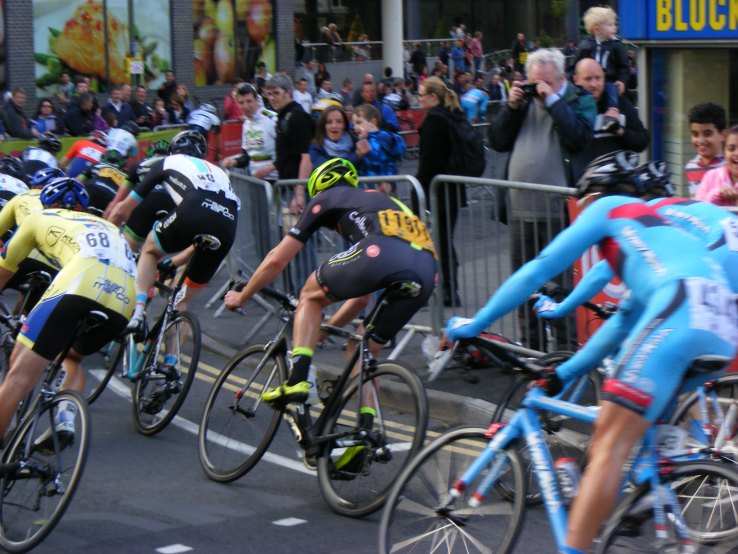
… things go whooshing past (the peloton sweeps round the Woking one-way system during the Tour Series 2013)
Wheels (that’s still its working title, and it’s still not going to be its real title) is rolling along quite nicely, sitting just under fifty thousand words. Much of what’s there at the moment is dialogue, stick figures having witty conversations in a thick fog. I’ll have to go back and put in the descriptions later.
So far, so familiar. What is a new experience for me is writing a first person narrator who’s… not unreliable, exactly, but not at all objective. True, I ended up with something similar in Speak Its Name, written in claustrophobically tight third person with a point of view character who wouldn’t come out even to herself. The difference is, Speak Its Name didn’t start out that way. It started out with multiple points of view, with multiple foibles and inconsistencies, but where I always knew what was ‘really’ going on.
Cutting everything down to fit into Lydia’s point of view was interesting. There are things that I knew and she didn’t. The most significant one is that Becky isn’t a trinitarian. If Lydia had known that – well, she’d have to deal with that, and it would add a huge chunk of drama onto a part of the book that really didn’t need any more drama. So I know that, and so do some of the other characters, whose thoughts on the matter we don’t hear, but Lydia never finds out.
Writing first person from scratch, I’m having to spend all my time in one character’s head, and I keep discovering things that he doesn’t know, and can’t know. He’s self-centred and often oblivious to subtext and body language. A friend read through the first couple of chapters few days ago, and made a throwaway comment about another character’s ‘flirtatious wink’.
‘Hang on,’ I said – to myself, ‘that wasn’t flirtatious!’ I wondered if I ought to clarify that it wasn’t flirtatious, and, if so, how.
Except the more I thought about it, the more I realised that… yes, it does make an awful lot more sense if she is flirting with him. Which puts a whole new complexion on the first half of the book, and leaves me with the problem of how to have her get over him, but it also makes the end a lot more convincing.
So now my challenge is to incorporate this new knowledge into the draft. My narrator can stay oblivious, but I can’t.
This is not exactly a new idea. I have heard it expressed thus:
Write drunk. Edit sober.
Google tells me that Hemingway didn’t say that. I don’t write drunk myself, because if I’m drunk I’m either in company or about to fall asleep. None the less, it points towards a helpful concept.
Or – which perhaps gets closer to the point that Hemingway might have been trying to make, assuming he’d said anything like, Write drunk, edit sober:
Begin by putting in everything you like. Finish by taking out everything you can.
I don’t know who said that, but I owe them a lot. Do you know? Google’s no help at all; it’s just sending me to sanctimonious anti-procrastination blogs.
Here are some important principles:
Nothing is going to be perfect on a first attempt.
If something is not fun, people are less likely to do it.
There is nothing wrong with making it fun.
There is a lot of suspicion about this kind of thinking. Received wisdom says If It’s Not Difficult, It’s Not Worthwhile, and No Pain, No Gain, and other upright, joyless maxims.
To all of which I say, well, maybe. But I feel very strongly that the reverse does not hold true. The fact that a writer made themselves absolutely miserable during the writing process does not automatically make the finished project readable. In fact, it makes it very likely that there will never be a finished project.
What writing whatever the hell you like looks like will vary. Here are some examples.
Skipping the difficult bits
I’ll say more about this another day, because I suspect it’s of limited application, but I am living proof that there are more ways to approach writing than –
Begin at the beginning, and go on until you get to the end, and then stop.
If what’s in my head at the moment is the climactic battle scene, then I write the climactic battle scene and trust that the rest will follow. Personally, I find it very useful to have something to aim at.
You might not want to skip straight to the climactic battle scene, but if you’re having trouble working out how your antagonists meet in the first place, it’s worth beginning with the very vivid picture that you’ve had in your head for weeks, with one of them hiding up a tree and the other eating a picnic underneath it. Or whatever it is.
But really, when the entire internet is banging on about how important it is to nail the first line, is it surprising that many writers never get to the second line? Skip the first line. It’ll come in its own good time.
Writing ‘unpopular’ themes
Anyone who’s interested in being published conventionally by somebody else should probably skip this section, because I’m writing this from a place where I don’t give a damn about pleasing anybody else, and I’ve never worked out how to please a publisher.
Nobody this side of the Pond wants to publish a book about an evangelical Christian lesbian at university, with bonus internecine student politics. But I wanted to write it, and it turned out that a fair few other people wanted to read it. And it may sound like a statement of the obvious, but if I hadn’t been writing what I wanted, I doubt I’d have been able to finish it.
If all of us stuck to writing what publishers thought would sell, fiction would be very pale, male and stale. The #WeNeedDiverseBooks hashtag exists for a reason, and if you have more patience than me and are prepared to persuade a mainstream publisher to pick up a story that looks a bit different from everything else on the shelves then I wish you the very best of luck.
And, not to seem too serious, if you want to write about Romans when conventional wisdom says it’s going to be Vikings for the next five years, then go with the Romans.
Writing ‘unnecessary’ things
I also put in all sorts of self-indulgent in-jokes, trying-too-hard symbolism, author filibusters, and mots d’escalier, because it amuses me to do so. Sometimes ‘what I’d have said to Mrs Smith about my missing homework if only I’d thought of it in time’ becomes a piece of sparkling dialogue. Once, writing under a different name, I gave the heroine a Cousin Teresa in a nod to the Saki story, and Cousin Teresa ended up a very important character. There’s a bit in Speak Its Name that got there purely because I’d been dealing with too many standing orders committees and wanted to relieve my feelings by writing a truly incompetent motion.
Sometimes… Well, that’s where we get to:
The second half
You will have noticed that I’ve talked a lot about the ‘putting in’, the ‘drunk writing’, and not much about the ‘sober editing’, the ‘taking out’. That’s partly because you may end up taking out less than you expect of what you put in when you were writing what the hell you felt like. Or you may not. I don’t know. Rory’s dreadful motion to the Students’ Union stayed in; Peter’s thoughts on Bristol VRs didn’t. Nor did quite a lot of stuff that seemed very necessary and worthy when I wrote it.
But it’s mostly because my main point today is about having fun, and giving oneself permission to have fun. I might talk more about editing another time, but in the meantime I’m going to refer you to Joanne Harris, who talks more sense about writing than pretty much anyone else on Twitter.
None of which is to say that editing cannot be fun, or at the very least satisfying. I rather enjoy it, myself (and don’t think I don’t know about cutting huge chunks that I really loved writing); I understand that for others it can feel like cutting off one’s own arm. In which case, changing the metaphor may help.



 Kathleen Jowitt