I wasn’t ready for Advent last year, either. That’s part of the point of it. Wachet auf. Wake up!
(I’ve heard Wachet Auf twice today, and sung Lo! he comes with clouds descending twice, too. It’s definitely Advent. Ready or not, here it comes.)
It’s early, of course. It’s as early as it can be: Christmas falls on a Sunday, so Advent stretches out for the full four weeks. The calendars (except this one), the candles, the prompt blogs, the poetry anthologies all start on the first of December, and here we are with four days of November left to fill.
In fact, I’m not even sure about the prompt blogs. Kat McNally has shut up shop. Project Reverb seems to have gone AWOL. I think I will join in December Reflections, but I find myself wanting to work with prompts for writing rather than photography. I like to look back over the year that has been, and forward to the year that’s coming.
What am I going to do?
What am I going to do?
I’ve got the end of a box of chocolates in my drawer. I have a shelf full of poetry books. I have plenty of candles, even if they don’t have numbers on.
I wrote this week, in another place,
I’d like to get better at doing nothing, feel more comfortable with empty space.
Perhaps these four days – well, three, now, really – are an opportunity.
No particular reason for this photo, except that I took it in July 2013
I’m a little awed by how fast this book has happened. Speak Its Name took me just over eight years. A Spoke In The Wheel is at eight months, and counting.
Speak Its Name went like this:
July-October 2007: planning. I fill a whole notebook with maps, family trees, and diagrams of what all my main characters – who, at the time, were the original six living at Alma Road – thought of each other.
November 2007: writing. 54,000 words. A very few of those are still extant: some of the chapter headings are extracts from a guide to running AngthMURC written by Peter, and most of those come from this first draft.
April 2008: writing again. Beginning a second draft. I didn’t get very far with this. It was in a much nicer typeface, but it was very self-consciously and archly Barchester, and I gave up after about 3500 words. Even less of this survives, though there are a few fossils in the chapter headings.
2011: another draft, incorporating sections of the previous two. The point of view is increasingly assigned to Peter and Colette.
November 2011: writing something completely different, I have a stoopid epiphany about how to plot.
I am at this moment bewildered and delighted by the way that two original characters have not only developed their own inevitable characters by means of nature and nurture, but have dragged their own plot in with them, because when A is the child of Y and Z, and B is the child of W and X, of course it follows that they will do F, G and H, because this is who they are, and this is the world they live in. And this is just as well for me, because goodness knows I can’t do plot.
November 2012: the House of Laity blocks women bishops. I am furious. I write a scene from Lydia’s point of view. I keep writing. I discover that Becky needs to be one of the movers and shakers in the political plot strand.
Two bits of plot joined themselves up in my mind, and suddenly the whole second half of the story has some actual structure and things are happening because of who the characters are. It’s like watching a bouncy castle get inflated, or making a pair of trousers, or something – all these shapeless pieces begin to fit together and make something that has three dimensions, and bits of which attach to other bits that you hadn’t expected.
July 2013: I discover that Lydia needs to be the hero of the story, and that more of it needs to come from her point of view. This is intimidating, because in the original concept she doesn’t come out until half way through, and now I have to spend the first half in her head? Thanks, story. However, it also becomes clear that if I do this it will be easier to incorporate the other side of the political story. I start writing more scenes from Lydia’s point of view. I blast through 40,000 words – and this is counting from November 2012, not any of the previous drafts. I make a timeline out of six sheets of A3 paper and of A4, and crawl around on the floor filling it in. I blast through 50,000 words. Then 60,000 words. I salvage some words from the 2011 draft.
August 2013: I spend a week on choir tour. When I’m not singing I’m writing. In the evenings, back in the dormitory, I’m cutting up the manuscript with a pair of scissors, rearranging the plot into a workable structure. I also take a trip to Ilchester, to get a feel for the geography of the place.
September 2013: I keep writing, though my pace has slowed a little. By the end of October I’ve hit 74,000 words.
November 2013: I start looking for holes – not necessarily plot holes, but bits where I’ve written [plot goes here] – and filling them. By the end of the month, it’s basically done. Or so I think.
December 2013: at an office Christmas party, somebody asks me, ‘But how did you get involved in all the church politics?’ I realise that the answer is too boring for words. Later, I realise that therefore I need to cut all the committee scenes. So why don’t I just take out everything that isn’t from Lydia’s point of view, and then see what’s missing?
May 2014: I come up with a title. I write a blurb.
June 2014: I edit.
July 2014: I start sending excerpts and synopses to agents.
By contrast, A Spoke in the Wheel has gone more like this:
August 2015: we are watching the Vuelta a España, and my husband makes a throwaway comment about how endurance athletes would be among the few people who would understand the spoon analogy of chronic illness.
It has taken me ten months to get as far with A Spoke in the Wheel as I got with Speak Its Name in eight years. Of course, it’s arguable that I should start the clock in late November 2012, because very little of the final version of Speak Its Name was written before that. July 2013 was where the real action was. Then there’s the time I spent playing the waiting game with agents and publishers.
The other thing that strikes me, writing all this out, is how much of Speak Its Name happened in 2013, which was a difficult year in many other respects. My husband was finishing up his PhD, and I was supporting both of us. He was job-hunting, and I knew that, even if he was successful, the chances were that we’d have to move and I’d have to get another job myself (we did, and I did). And yet I wrote most of the book that year.
And it may yet be that A Spoke In The Wheel has some surprises for me, and I’ll have to do some serious redrafting before I’m done. All the same, I think the really serious lessons were the ones I learned last time round: how to plot; how to make the characters drive the plot; how to let characters make really terrible decisions even when I didn’t want them to.
I’m hoping to release A Spoke In The Wheel some time next summer, ideally during one of the Grand Tours, when the world has cycling on the brain. Looking at this, it feels as if this is perhaps going to be manageable.
I’ve been thinking a lot about burnout this year. I’ve been there a few times. It’s a known hazard of being brought up in an activist family. It’s a known hazard of being a member of an organised religion. It’s a known hazard of working for a trade union.
It’s what happens when you’ve signed petitions until your email inbox is nothing but Avaaz and 38degrees, and when you marched against pretty much everything, and when your weekends have disappeared into doorknocking or leafleting or selling flowers of solidarity, and you’ve bought fair trade, and you don’t own a car and you haven’t travelled by air since 2007, and you can’t remember which of the cereal brands you’re meant to be boycotting, and buying cheap stuff is exploitative and buying expensive stuff is extravagant, and the personal is political, and the political is personal, and you’ve voted, and you’ve badgered several other people into voting, ruining your relationships in the process, and after all that the world is still a mess and you’re still feeling guilty because you haven’t fixed it.
For example, this was me in 2012:
It was all very well when I was fifteen and had no life and was all idealistic, but these days I do not have the energy to be any more political than I am paid to be, and I am sick to the back teeth with everyone else’s Causes, while simultaneously feeling guilty for Not Caring and therefore obviously being a Horrible Person. I don’t think I have any causes left myself. I am so tired of them all.
I have been back in that place this past year. It probably dates back to before the general election in May 2015. I have felt so burnt out, so powerless, so useless, and it’s been particularly difficult because of the way that things have been falling apart. I’ve been feeling that I should be doing something and knowing that there is very little I can do and that nevertheless that’s no excuse for not trying. Filling the unforgiving minute with sixty seconds’ worth of distance run, and all that. So you keep going either until the world is fixed, or until you fall apart, whichever is the sooner. Guess which is the sooner.
I think it might be a defence mechanism. I think it’s what happens when your body works out that the reason you won’t rest is because you care, so it stops you caring.
In August, trying to channel a version of myself who wasn’t exhausted and jaded and burnt out, I wrote this to myself:
you are loved, you are enough
even though you don’t know how to be an activist and an introvert
even though you think you have probably had it with activism of any sort anyway
because so much activism seems to have become about telling people that they aren’t enough and they don’t do enough
and however much you do it’s never enough
because guess what, you can’t fix the world by yourself
and you’ve learned enough to know it’s not your job to bully other people into fixing the world with you
even though you stopped volunteering to do stuff ages ago and the desire to volunteer for stuff has yet to re-emerge and maybe it never will
even though you can’t tell how much of this is predictable August head-stuff and how much is real
and you fear that everyone will think it’s head-stuff while it’s been co-existing with being OK, actually
this thing goes two ways and you’re allowed to be the one who says NO
and do you know,
yes, the thing that is right is often costly and challenging
but!
a) not always, sometimes it can be easy
b) just because something is costly and challenging does not mean that it is right
and you can’t make something right by making it harder
you are loved, you are enough
[and no, this is not a trick designed to make you get up and start doing stuff just because you’ve been told you are enough as you are]
[you think you’ve met that one before]
if you stayed in bed forever you would be loved, you would be enough
and I’m not even going to tell you that you won’t stay in bed forever
because I don’t want you to think that this is in any way conditional
you are loved, you are enough
you are loved, you are enough
that’s it.
And yes, of course some of it was predictable August head-stuff and I feel better now. And at the same time I do not want to get into that state again.
A few weeks ago, having been recovering gradually through September and October, I wrote this on Twitter:
I have been feeling guilty for most of my conscious life for not fixing the world.
Logically, one has to stop fixing things well before all the things are fixed, perhaps before any of them are.
The question is, how to stop feeling guilty about stopping.
Because eventually, you reach the point where you have to stop because you’re feeling burnt out and exhausted.
Perhaps so much so that you can’t imagine ever wanting to start again. And yet your sense of worth is tied up in fixing things.
Meanwhile the rest of the world carries on fixing and breaking things, depending on your point of view, and always wants you to help.
This is where I’m trying to break the pattern this time: to move my sense of self-worth away from what I do or don’t do, and towards the simple fact that I’m human.
I was giving myself permission to stop trying to fix things, to accept that there are certain things that are basically unfixable, that there are certain people’s opinions that won’t be changed, that push push push all the time doesn’t work. That even if I’d managed, for example, to get to the Stop The War march, the war wouldn’t have stopped.
The next day – obviously feeling better for having got all that out – I continued the conversation with myself, and wrote in my diary:
I think that if I am ever to fix anything it will be by writing fiction. It is the way that I share the ways in which I fix myself. And I can’t fix anybody; they have to work it out for themselves; and fiction helps us make the jump, because we have to put in the work.
It made more sense at the time, but what I think I meant was this: fiction – reading it, writing it – has been instrumental in helping me understand that I am human, and that being human is enough. Whether I’m writing, whether I’m working, whether I’m falling apart, being human is enough. Who knows, maybe that will stick. Maybe that was my last burnout. Maybe next time I’ll remember to stop before I fall apart.
In the meantime, I’m going to avoid putting the same pressures on myself, and on anyone else.
Telling people that they’re not doing enough to fix things, or that they’re trying to fix things the wrong way, is not going to get things fixed, or get them to do more.
Or, if it does get them to do more, it won’t last long, because it will hasten their inevitable burnout, and things will remain unfixed.
More of a story over Paris, this one. I’ll tell you, one day.
I have had a character named after me in a short story about Captain Von Trapp invading Paris in a submarine. It’s part of a delightful series called Stories Under Paris: an ambitious project to write a story for each one of the hundreds of Métro stations. The result so far is a collection of whimsical, joyous fantasies; my favourite (again, so far) is The Story of the Un-Drowned Princessfor Château d’Eau. Although of course I’m always going to have a soft spot now for Léon Gambetta and the Battle of the Métro, for Midshipman Jowitt’s sake.
Midshipman Jowitt exists because I supported the author on Patreon, which, if you haven’t already heard of it, is a sort of crowd-funding site to support artists. Like other crowd-funders like Kickstarter or Indiegogo, the creator can choose to set perks according to the level of funding the individual supporter chooses to pay. And one of the rewards at the level I chose to support was to get a character named after me, though I have to admit that this had very little to do with my decision to become a patron. That was more because I love the whole concept of Stories Under Paris and am keen to see it continue for all three hundred and something stations. And if all this is sounding fearfully extravagant, well, I could easily spend more on a magazine, for writing I enjoyed less.
I have to admit to having some reservations about Patreon – not least, the way that it’s going to turn into a pyramid scheme for artists if only artists use it – but I can also see its potential, to provide a sustainable income for full-time writers, composers, etc, or to cover the costs of a hobby. Whatever, being a supporter has worked out pretty well for me.
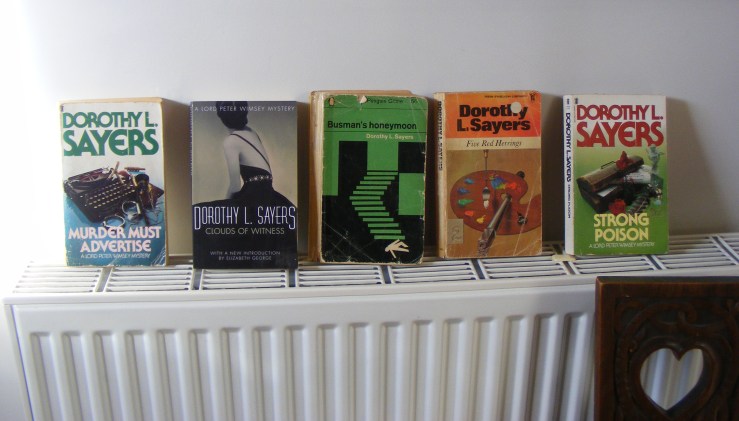
I can never quite decide who is my favourite Golden Age detective novelist, Agatha Christie or Dorothy L. Sayers. Today I’m going with Sayers.
I started with Busman’s Honeymoon. Fortunately, reading things out of order has never bothered me much. Didn’t understand much of it at the time. It didn’t stop me.
Don’t worry, that radiator wasn’t on, and anyway, I took all the books off it as soon as I’d finished taking the photo.
Tomorrow evening my church choir will be singing Maurice Duruflé’s Requiem. It’s an oddly appropriate choice for Remembrance Sunday, and it feels even more so given recent events: it was commissioned by the Vichy government in 1941, but Duruflé only finished it in 1947, after the war was over and the world was picking up the pieces.
Part of that, I suspect, is because Duruflé had a tendency to drag his feet on things he didn’t want to do. Only one of his works, the Notre Père, is not based on Gregorian chant, and that is because he only finished it after his wife had started writing it for him, having been requested repeatedly to set the Lord’s Prayer in the vernacular.
But part of it is the simple fact that art takes time. To create, to perform, to consume art, absorbs our attention for long enough to give us a new perspective. The six years that it took Duruflé to write the Requiem, the forty minutes that it takes to sing or to listen to it – that time makes space for things to change, for us to change.
For a couple of years I had a habit of picking up The Count of Monte Cristo in about October, when the days were getting shorter and my mood was getting lower. It’s about 1100 pages long; by the time I got to the end, something would have shifted.
One of the greatest gifts of art is the way that it takes us out of what we think is our own timeline; shows us – sometimes quite literally – the bigger picture; allows us to step back from the overwhelming emotion. Sometimes that feels like a betrayal: how can we possibly feel any less angry, any less hurt, any less scared, than we do at the moment? Surely this devastating news deserves nothing less than everything we have?
The last news story that made me cry was the murder of Jo Cox MP, just before the referendum in which the UK voted to leave the European Union. After that, nothing has really surprised me. Disappointed me, yes, but not surprised me.
The one before that was the General Synod decision in 2012, the one that voted against the appointment of women bishops. That was a November vote, too.
From where I am now, I am thinking, gosh, was that all I had to cry about in 2012? But it only seems trivial now because I know what happened next. When I’d cried about it, I wrote a blog post. Having written the blog post, I found that I was still hurt and angry, still feeling rejected because of a fundamental part of my own identity, and the only thing I could think of to do with that was write fiction.
Lydia choked, rolled onto her side, and sat up. ‘I never realised,’ she said wonderingly, ‘how much it was going to hurt. It goes right into the heart. They don’t want me. They were OK with the person they thought I was, so long as she stayed in her place, and was happy to teach the approved version of events and not rock the boat, but they don’t want the person I really am. I always knew, in theory, that I was only there on sufferance, that as soon as anyone worked out who I really was I’d be out on my ear, but it didn’t hit me until today how terrible it was, when you understand the reality that nobody wants you.’
That was where I began with the final draft. It went on from there: a year of writing; a year of editing; a year of becoming brave enough to put it out under my own name. I burned up the anger that had first fuelled it; I put it all into the text.
By the time I published Speak Its Name on 2 February 2016, six women had been consecrated as bishops in the Church of England. While I was writing, things had changed.
I’m not saying that things will magically become better if we can only wait it out. For some people it is, indeed, already too late. I am not saying that art can fix everything. There are some things that are just wrong. Nevertheless, it is the best tool that I have to make something good, something useful, perhaps even something beautiful, out of emotions that, left unchecked or harnessed for ill, will destroy the world.
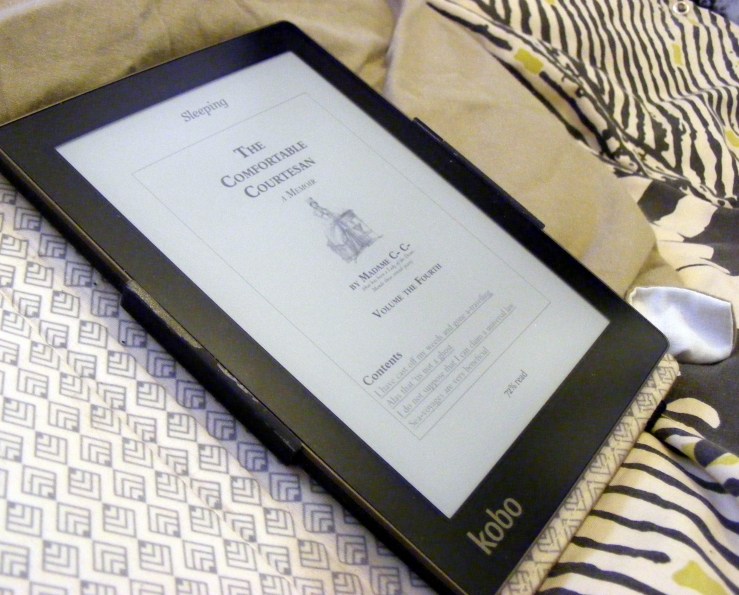
The Kobo was a Christmas present last year. I mostly use it for reading: long fanfic; out of copyright books from Project Gutenberg; new books, when it’s looking unlikely that I’ll get to a bookshop in time to read the thing before the next book club meeting; books that in paper format would be too thick or heavy to go in my handbag; things that exist in electronic format only.
If you haven’t come across The Comfortable Courtesan yet, I thoroughly recommend her. She’s the narrator and main character of an early nineteenth century soap opera that’s been going for about eighteen months in our time, and several years in the time of the action. It’s often gentle, occasionally melodramatic, always sex positive, usually funny, sometimes sad, and invariably a welcome interlude in my day.
Coming up with a title is my least favourite part of writing a book. I think it’s the weight of expectation. My usual method is to pick a working title, usually one word, and pray for something better to turn up.
I was really pleased when Speak Its Nameoccurred to me: the association with same-sex love, combined with the overarching theme of saying things the way they are, made it pretty much perfect.
Anyway, I think I might finally have one for the book that I’m currently working on, which I’ve been calling Wheels for want of anything better. I had been wondering if I could pun on spoke/speak, getting sidetracked by West Side Story (wire-spoke wheel in America!), and scouring If for lines to appropriate or undermine. However, for the moment I have settled on (drumroll, please!):
A Spoke in the Wheel
Or I might drop the indefinite article:
Spoke in the Wheel
Or maybe make it plural:
Spoke in the Wheels
Or wake up tomorrow and wonder what on earth I was thinking. We’ll see. But at the moment it feels like I’m on the right track.





 Coming up with a title is my least favourite part of writing a book. I think it’s the weight of expectation. My usual method is to pick a working title, usually one word, and pray for something better to turn up.
 Kathleen Jowitt