Listening to the stories: Our Witness

dsc_1218-e1523560356304.jpg

Some people have very specific ideas about what a Christian story ought to look like. You can tell by looking at the reviews of Catherine Fox’s books on Amazon. Too much swearing: one star. A story about Christians can never, ever, include the F-word. Other stories are to be ignored, overwritten, or, if the worst comes to the worst and one finds oneself reading one, given a one-star review.

Because Christians don’t swear. Except they do. We do. I do. And if you say you don’t – well, I’ll happily believe you, but it doesn’t stop the rest of us existing. Or swearing.

I really enjoyed the Lent course I attended this year. We started with something constructed by the Diocese of Ely, improvised icebreakers concerning the idiosyncrasies of our socks, ate snacks introduced with increasingly tenuous connections to the themes we were talking about (the Club biscuits – ‘set apart’ in their own wrappers, but yet together in the packet, and therefore an illustration of ‘holiness’, were my personal favourite) and tried to discern our own callings. For many of us, I think, that turned out to be something about being who we were, about not trying to force ourselves into what we thought a Christian ought to look like, about showing up, just as we were, and trusting that this was who we were meant to be.

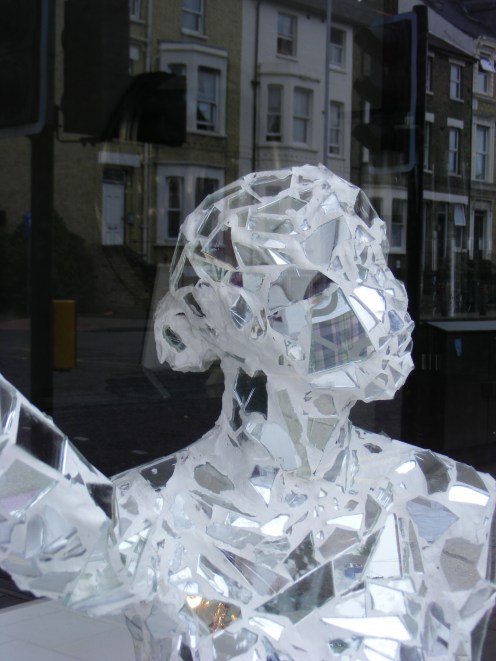
For me, that was about being out as bisexual. It often is. From curling up in a ball the first week, muttering darkly that actually the Church isn’t necessarily a safe space to be yourself, to outing myself by telling a story of when I outed myself, to making and wearing symbolic jewellery (see picture at the top of this post) being myself as a Christian does tend to involve to ensuring that people know that I’m queer, and that I believe that that’s how God created me.

I’m always aware of a push-pull: the pull of the conviction that what other people think about me is none of my business; the push of knowing that, if I don’t say in so many words that I’m bisexual, people will assume that I’m straight. And – particularly in Christian circles – because I’m bisexual married to a man, if I don’t say that I understand a hypothetical relationship with someone who wasn’t a man to be as valid as the actual one that I have with someone who is, there’s the risk that people will assume that I chose to be with a man because he was a man. As opposed to falling for this person that I happened to live with.

In LGBT Christian jargon this is known as the ‘Side A/Side B’ question. (I have to look up which side is which every time.) Side A is LGB Christians who see no contradiction with same-sex sexual activity. Side B is LGB Christians who accept their identity but who would understand acting on same-sex sexual desires as sinful.

My problem is that I am very much Side A, but I know that in a heteronormative society I look very much Side B. And the only way to correct that assumption is to fill in the gaps, to tell the story. I am always telling stories, both fictional stories and true stories, and it’s almost always because the story that I’m hearing, or that I’m reading, isn’t the whole story. And when stories that don’t fit the dominant narrative – whether that’s Christians don’t say ‘fuck’ or A woman who’s married to a man must be straight or Christians don’t have sex with people of the same gender – are erased, it’s all the more important to keep telling them.

And so we come to Our Witness: the unheard story of LGBT Christians. The British edition came out last year; the US edition was released yesterday. Our Witness tells the stories – mine, The Amazing Invisible Bisexual Christian, and many, many more. The stories are all different, but they resonate with each other. If you’ve already bought the British edition and you only wanted to read my story, you don’t need to read it in the American edition. It’s the same, bar an ‘own goal’ metaphor which didn’t survive the voyage across the Atlantic. If, however, you’re looking for different stories, for a wider sample of all the different voices that make up this communion we call the Church, then read both. Every voice, every story, adds something to the symphony, and the more I listen, the richer the sound becomes.


The proof is a pudding

DSCF7036

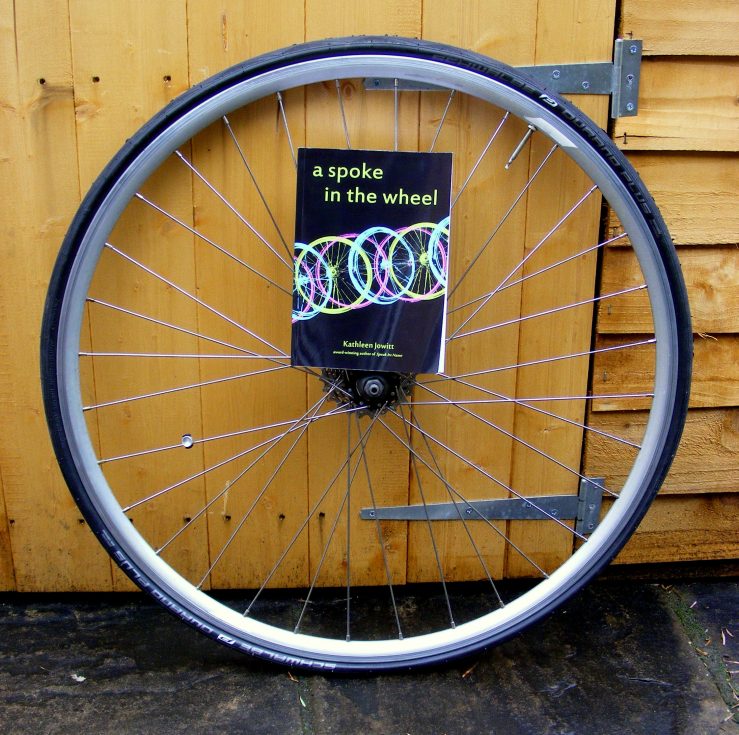
‘Pudding’ is a lot more polite than what I actually said when I took my first look at the proof copy of A Spoke in the Wheel.

The front cover has come out beautifully; it looks rather better in real life than it does in that photo. The inside… not so much. The text on about half the pages had been misaligned, and came out an odd shade of purple.

The photo below shows (bottom right) one of the offending pages, (bottom left) one of the pages that was just about all right, and (top) a spread from Speak Its Name for comparison.

comparison

Since then, I’ve been engaged in correspondence with Lulu, who have been very apologetic and promise that this is very rare. I do hope so. There was an article in the latest edition of The Author by a man who prints his own books, but I feel that this is taking things a bit far even for a control freak like me.

Having said all that, I’m feeling a lot better about the whole thing than I was this time last week. The cover looks good, the ebook looks good, the interior of the paperback will look good when it’s printed properly, and we are on track.

I’ve been here before

DSC_0523

Still no proofs. Well, no, that’s not fair – they’ve almost certainly arrived by now, but I haven’t had the opportunity to go and pick them up. I’ve been away for the last week, so I haven’t been fretting too much, but I am very aware of how much I just want to be done already.

That’s normal for this stage in proceedings.

Other things which seem to be normal for this stage in proceedings:

  • wanting people to read it. The more people who read it and tell me that actually my portrayal of [whatever I’m worrying about this week] is OK, the better I feel about it.
  • not wanting people to read it. People tell me about how much they’re looking forward to reading it and I mutter and shuffle. What if it’s a horrible disappointment? I’m putting my soul on a plate here. At least, that’s what it feels like. To everyone else, of course, it’s just a book. I have to remind myself that, even if they are disappointed, they’re not disappointed in my soul, but only in a book.
  • relatedly, the conviction that I’ll have managed to offend all my dearest friends.
  • being able to see, albeit from some distance, the point where what other people think doesn’t seem relevant any more, the point where I say: It’s done. I did the best I could. It’s just going to have to do.

Waiting

dsc_0736-e1521145850585.jpg

I have this idea that I’m a very patient person.

One of the things that I’ve discovered over the last four years or so is that writing involves an awful lot of waiting. Waiting for agents and publishers to get back to me. Waiting for editors to finish reading the latest draft and tell me what they make of it. Waiting for myself, to get the perspective that I need in order to make any meaningful decision about what to do next.

Self-publishing cuts out some, but not all, of that waiting. I’ve talked before about the fact that I have to do absolutely everything myself. At least that means that I have something to be getting on with while I’m waiting.

Waiting for emails. Waiting – as I have been all this week – for the proof copy to be printed. Waiting – as I will be tomorrow – for the thing to arrive.

The thing about waiting for the proofs is that I can’t do anything else to the book. There’s no point reading through, because I might have to change something. And there’s no point in changing anything before the proofs come back, because then I’ll only have to order another set. And I can’t approve the book for distribution because something might need changing.

And actually it turns out that I am terrible at waiting. I’ve spent all week refreshing my orders page, waiting it to flip from ‘Fulfilling’ to ‘Shipped’. That happened today, and now I don’t have anything to refresh.

Maybe the book will turn up tomorrow. And if it doesn’t, well, there’s not much I can do. Except wait.

Late to the #IndieAthon party

indieathon-9

On Monday my mother texted me to say ‘Looks like ASITW is very timely’. I texted back to say, ‘Haha, it always is’, and felt slightly smug about being with it for once.

Yesterday I looked at Twitter and discovered that I’d missed a good thirty per cent of an initiative that’s very relevant to my interests, as they say, and now I feel less smug.

#IndieAthon is a month-long celebration of self-published authors and small presses. The organisers have this to say:

Throughout the month you can read however many books you want, not all of them have to be for the readathon of course, but the goal is to read as many indie-published or self-published books as you want! The only limitation to what you can read is that it has to be either self-published or published by a small or independent publisher to count for the readathon. The books can be old, new, popular, unpopular, fiction, non-fiction, anything!

We also would really like you to post reviews of the books you read on Goodreads, Amazon and wherever else you want to post it! Reviews are so important for authors, and especially for smaller authors it can make a huge difference!

There’s a bingo card and everything!

So, hello, #IndieAthon, here I am, sneaking in through the back door, hanging my coat over a chair, grabbing a drink from a tray, and pretending I’ve been here all along.

Um. Er. Yes. Hello. I’m Kathleen Jowitt, and my book Speak Its Name* was the first self-published book ever to be shortlisted for the Betty Trask Prize. I’m in the middle of preparing my second novel, A Spoke in the Wheel, for publication, and that’s my excuse for not having looked at Twitter properly all month.

I’m self-published and very glad of it. Why? One word. Freedom. Self-publishing gives me the freedom to do my own thing, and to do my own thing at my own pace. I’m only answerable to myself. I don’t have to worry about whether anybody actually wants to read a book about a Christian lesbian university student finding her way out of the closet, or, if they liked that, whether they’ll then be interested in a disgraced professional cyclist.

I don’t have to please other people to get my book into print. I just have to put the work in myself. I’m free to experiment, to tell the stories that nobody else tells.

And I’m free to do my own thing at my own pace. I’m the only person who gets to set me deadlines. If I decide that something needs an extra six months’ work to get it really good, I’m free to put those six months in. Conversely, if I have a spare couple of hours and I want to get going on the back cover copy or the front cover design, then I can do that. I don’t have to wait on decisions from anybody else.

Sometimes it’s a scary thing, this freedom. It means taking responsibility for every little thing. Every word that makes it into the finished book is there because I put it there, and it stays there because I didn’t take it out. I can – and I do – ask other people to read for inaccuracy and insensitivity, but the decision whether or not to respond with changes remains with me. The cover, typesetting and formatting, are exactly as good as I can get them.

Any errors or infelicities remaining, as it says on my acknowledgements page, are my own. But I wouldn’t have it any other way.

In good company

DSCF2819

A Spoke in the Wheel stands at 69,591 words, and I think it’s done. It’s gone through a ream of paper and goodness knows how many drafts.

So far, I’ve had comments from seven people on one or more of those drafts. Some were on early drafts that frankly I’m blushing to think about now. Some were on what was, up until yesterday, the very latest draft. Some of those comments have been detailed, line by line, word by word. Some have been more general. Some have been delivered in person, some via email, some over the phone. Some were on very specific aspects of the book. Some were on the thing as a whole.

(Nobody picked up on the fact that I had two Chapter 10s. Or Chapters 10. Whatever. I caught that just now.)

Some of them have me muttering, ‘Oops!’ Some of them have me muttering, shamefacedly, ‘Oh, good point.’ Some of them have me muttering, defensively, ‘Well, it works on the eschatological level!’ Some of them I just don’t agree with. Some of them flat out contradict each other.

Two novels’ worth of experiment have left me with a workable approach:

If two people whose judgement I trust make the same comment, I act on it.

One person might miss a reference or misunderstand something, or simply fail to see what I’m trying to do. But if two people say the same thing, I don’t argue.

I might not make the change that either one of them suggests. I might change something to make what I originally meant to say clearer. I might delete an entire scene to get away from it.

And I can be one of those two people. If one person’s comment has me muttering, ‘Oh, good point,’ then the chances are I’ll be changing something, even if nobody else mentions it.

And here’s the other important thing:

If someone who knows more than I do about the subject I’m writing about tells me that I’ve got something wrong, I act on it.

In this book, I’ve changed things after being advised on How Wheelchairs Work, How To Go Running, Things One Might Purchase To Improve One’s Bike, and How Prescriptions Work, among other things. No doubt there will be something that all of us have missed, and if I’m lucky it will be something as innocuous as that chapter heading, because, for a self-publisher more than anybody, the buck stops here.

That being so, I am most sincerely grateful to all my editors, beta readers, nitpickers, whatever you want to call them. Their work, their patience, their enthusiasm, their encouragement, make the writing process much less lonely and the work so much better. Without them I don’t think I’d ever finish this book. Indeed, the next thing on my list is to write the acknowledgements page.

The final stretch

DSC_0837

On Thursday I got the last email through from my horde of editors, beta-readers, and nitpickers. At least, the last one that I’m going to pay any attention to. At least, the last one that I’m going to pay any attention to until I’ve got the manuscript prepared for print, at which point I’ll bring in a proofreader. And I’m only paying attention to this one because I’d already heard most of the comments over a pint the previous week and decided that they were things that I could fix.

Because I’ve reached the point where I am just about ready to be done with this book. Next time I will schedule the launch for September or October, so that I’m not doing all the preparation during my busiest time at work.

Work know about my writing now – and are very supportive of it. Sometimes terrifyingly so. ‘Kathleen can run a creative writing workshop! And a self-publishing one!’ somebody said the other day. I responded ‘Self-publishing is mostly hiding under the table and crying.’ I haven’t yet reached that stage. Not quite. However, I really am very tired and very aware that I could have made this easier for myself.

The feeling of just having had enough, though, that’s one that comes with every book (at least, it’s been two out of two so far). As the last of the comments come in I find myself wanting somebody to say,

‘It’s fine. Stop worrying. Just put it out there.’

They don’t. They won’t. Quite right, too. I didn’t ask them to. I asked them to find things that needed fixing, that didn’t ring true, that held up the pace, and they’ve done that. And the thing about self-publishing is that there’s only one person who can tell me that it’s time to put it out there. And that person is me.

I’m not quite ready to say it yet. But I’m very nearly there.

Reflecting life: the Staunch Prize and writing honestly

2014 June July 153

There’s been a little bit of controversy this week around the new Staunch prize for thrillers where ‘no woman is beaten, stalked, sexually exploited, raped or murdered’. And about time, says one side of the argument. For too long, lazy writers have been fridging women for the sake of a cheap plot point, and exploitative writers have been using violence against women to titillate male readers. The other says, No. Writers need to be free to explore and subvert difficult themes. Women should not be told that their own experience is off-limits.

As a reader, I can see myself falling on either side of the fence depending on my mood. It might be quite nice to read a book in the knowledge that it’s safe to get attached to the female characters. On the other hand, if I pick up a book knowing that a character, or several characters, must get to the end of it alive because otherwise it wouldn’t have been eligible for this prize, that would spoil the suspense a little.

‘Does a woman die in this?’ is a bit of a blunt instrument, but then so is any means of categorizing books.

As a writer, I don’t have a horse in this race. The books that might possibly end up being eligible for this prize are third and fourth in the ‘to write’ queue, so we won’t be seeing much of either of them for a good five years, I’d have thought – by which point this prize will have become well established, or else have disappeared entirely.

I don’t really see much point in getting upset about this. Establishing a prize for books that don’t include one particular plot point doesn’t stop anybody writing that plot point, it just stops their book being entered for that prize. I’m sure that 2018 and 2019 will see just as many dead women on the bookshelves as previous years, and that many of those books will still engage with the question in a thoughtful or angry manner. If we start to see an increase in people arguing that the only right way to write something is not to write it, that’s when I’ll start getting worried.

No prize is for everyone. I’m not just talking about criteria that restrict entry according to age or whether one’s been published before. Most prizes are out of bounds to me because of my self-published status (and it’s an absolute delight to find one that isn’t). What I mean is, not every book will be suitable for every prize. In 2007 I thought briefly about entering (a very embryonic version of what eventually became) Speak Its Name for a Scripture Union writing competition in memory of Patricia St John. I’ll pause here for you to read up on Scripture Union and Speak Its Name. And then laugh.

No, there’s no point in my getting irritated by a prize that I’m not going to enter. It does raise a more interesting question, though. How do we respect our own and others’ experience? How do we give an honest portrayal of the problems that a [member of a marginalised group] is likely to encounter without giving the impression that being a [member of a marginalised group] is wall-to-wall awfulness? Where is the line between representation and exploitation? Can we say that we’ve dealt with enough of all this bullshit in the real world and just give ourselves a night off?

This is something that I’m thinking about quite a lot as I work through the final edits on A Spoke In The Wheel, and as the sequel to Speak Its Name unfolds itself in my mind. How do I show the grinding misery that is the modern British benefits process without buying into damaging assumptions about what makes life worth living for disabled people? How do I show Lydia engaging with the institutional homophobia of the Church of England and its vocations process (yes, we’re going there) without undermining her integrated identity as a lesbian Christian? It is something that I think about as I watch Yuri!!! on Ice, where homophobia just doesn’t exist, and as I read Check, Please!, where homophobia exists but never touches our heroes, and the ways that those work and don’t work for me.

I’m still thinking, and still writing, and really, the best answer that I can come up with is that no single book is going to do this. We need the escapist books that can be opened in the confidence that everybody’s going to be OK. We also need the books that expose the awful things that people do to other people. We need the books in the middle, where we know that awful stuff will happen or might happen, but that the characters we love will come through somehow. That middle space is where my books – or at least the ones that have emerged so far – sit, and all I can do is write them the best I can. And, so far as I’m concerned, people are very welcome to establish prizes for any of them.


Many places we don’t know

DSCF9842
A familiar London landmark

Here is what two thirty-something-year-olds, who have spent a lot of time in many various types of churches and who have often travelled into London by rail, sound like watching the last two episodes of Around The World With Willy Fogg:

– King’s Cross? From Liverpool?

– Westminster Cathedral? Really?

– Well, this is a Spanish programme. Maybe they’ve decided he’s Catholic.

– Why is he wearing vestments in the street?

– At least they’ve got the colour of the stole right.

– No, that’s Westminster Abbey. They’re just wrong.

You may well point out that the hero of Around The World With Willy Fogg is a lion who wears a top hat, and that’s a fair point. This is children’s television, and one might as well put the increasing price of stamps  down to the fact that Postman Pat now has a two vans, a motorbike, and a helicopter as expect logic. But sending the Liverpool trains to King’s Cross requires me to believe not only in a world where animals wear clothes, but also in one where all the northbound trains leave London from one sole station. Which would make much more sense than the real world, but there we go. Actually, thinking about it, I can’t fault Willy Fogg’s decision to avoid Euston. It’s one of my least favourite stations, ahead of Birmingham New Street and only slightly behind Gatwick Airport.

One of the other eyebrow-raising things about Willy Fogg was the way that Fogg’s acquaintances at the Reform Club seemed to know about his movements almost as soon as he does. This despite the fact that the action is set during a period of history where news cannot travel across the sea any faster than a human (or a top-hat-wearing lion) can. I can give Willy Fogg a pass on this one, but I’m less indulgent when Joseph O’Connor makes the same mistake in Star of the Sea.

We all have our own areas of expertise, our own sensitivities, our own knowns that may well be authors’ unknowns. And so, when a character is meant to know more about a particular subject than their author does, and when a reader knows more than the author, any mistakes are likely to come to the surface.

Apart from how to get to the North West and the difference between Westminster Abbey and Westminster Cathedral, I know enough about the career of Kathleen Ferrier, for example, to know that she was singing the role of Orpheus when she broke her leg on stage, not Eurydice, as Rose Heiney assumes in The Days of Judy B.. And that wouldn’t be a problem, except for the fact that it’s Judy B.’s singing teacher, who really ought to know better, who says that. I know enough about the Church of England to know that it’s unlikely that a bishop would wear a ‘soutane’ to a secular function, as Kate Lace assumes in The Chalet Girl, and very unlikely that he’d call it that.

I know enough to know that I’ve almost certainly missed something myself.

And so, as I wait for the edits to come in on A Spoke In The Wheel, I am nervous. I am nervous about what I may have got wrong about professional cycling and about disability benefits and about how flood defences work. I am nervous about what I may have got wrong about the road to Preston and about doping and about working for a charity. I am nervous about what other people will see that I cannot.

Where possible, I have asked people who know more about those things than I do to read the manuscript and advise me, but I know that it’s inevitable that something is still going to slip through the gaps. I can only hope that it’s not going to be something too embarrassing.