Section 28: the chip on my shoulder

Earlier this week I was an interviewee over at Louise Walters‘ blog, where I talked about my experience as a self-published author and being shortlisted for the Betty Trask Prize. (I really recommend Louise’s blog if you want an insight into the differences between mainstream publishing and self-publishing. She’s done both, and writes about them very eloquently.)

I mentioned in passing my theory that Section 28 had killed off the genre in which my book might have been published conventionally. And I’ve written a longer piece for LGBTQ Reads about that – about my experience as a writer, and about my experience growing up in that context, as someone whose schooling was entirely overshadowed by erasure on a national scale, and who didn’t even know it at the time.

Getting the timing right

2013 August Wells 089

The next book – after A Spoke in the Wheel, I mean – looks like it’s going to be the sequel to Speak Its Name. I like knowing what the next thing is, and I like having a first draft to turn to when I’m fed up with editing, and vice versa; but on the other hand, there are some things I am going to have to think about pretty sharpish.

The big one is this: Speak Its Name is set at a deliberately vague point in time. It’s set after same-sex marriage became legal in the UK but while the Church of England is still being obstructive. So that would be any point between 2013 and now, really. And that works, because student politics are somewhat detached from the real world, and what happens in Speak Its Name really could happen in any year. But my characters are going to have to grow up and go out into the real world, and so the sequel is going to have to be more firmly tied in to wider Church of England politics. Not just the Church of England. The Anglican Communion.

Some interesting things have happened there this week.

For those of my readers who weren’t frantically refreshing the #pisky feed on Twitter on Thursday afternoon, and who missed the news in the general General Election hoo-hah, the Scottish Episcopal Church voted to allow same-sex weddings. That’s the sort of thing that my characters would have opinions about. I don’t think anybody would be moving to Scotland (Lydia’s far too low church to cope as a Pisky) but it would definitely come up in conversation.

Other things have happened this year. There was the finale of the Shared Conversations, a vote Not To Take Notice, another depressing chapter in the Jeffrey John saga, the tired old question of whether one can be an evangelical Christian and behave decently to LGBT people (spoiler: yes), and now, God help us all, a Tory/DUP coalition. I have strong opinions on all those things, and, my characters being who they are, most of them will have to as well.

Of course, that’s assuming the action of the sequel is happening this year. Last year the picture was different; next year it will be different again.

Another minor problem might arise from the fact that I’ve probably overwritten the Bishop of Bath and Wells (the real one, not the baby-eating one) by putting a cathedral city down on top of Ilchester. Can Somerset support that many cathedrals? Quite possibly not.

At the time of writing I’ve got about a thousand words down. Before I can go much further I’m going to have to make a firm decision about when things happen. I couldn’t do a Catherine Fox and write in real time – I’m too much of a chopper and changer for that – but I do need to have a better idea of how the plot fits into current affairs.

On one level it really doesn’t matter. I know the basic arc of the plot, and that won’t really change. (Is that a spoiler? It might be a spoiler.) On another, it’s integral to the whole thing. The obstacles along the way are going to change depending on precisely when I set it, and, unless I move it to another universe entirely, I have to take current affairs into account. Things are happening that I can’t ignore, not if I want to write a novel that has anything to say about what life’s like in the Church at the moment. And I do.


While I’m here, a couple of links. From my alma mater: Alumna author shortlisted for award. And from me: the book giveaway for Speak Its Name is open until 20 June.

Celebratory giveaway

I am still celebrating Speak Its Name being shortlisted for the Betty Trask Prize.

When I first heard the news, I got a glass of red wine for myself and a glass of Estrella Galicia for my brother.

When the news went public, a week later, we went out for dinner and I got a bottle of white Rioja. (This was a mistake. I’ve drunk and liked white Riojas in the past, but this one was disgustingly sweet. Perhaps the name – Diamante – should have been a clue.)

When I told my team at work I bought cake.

Now I’m celebrating with a giveaway at Goodreads. Wander over there if you’d like to be in with a shot at winning a copy of my book. Some people whose work I admire very much thought it was rather good…

Goodreads Book Giveaway

Speak Its Name by Kathleen Jowitt

Speak Its Name

by Kathleen Jowitt

Giveaway ends June 20, 2017.

See the giveaway details
at Goodreads.

Enter Giveaway


Getting used to the idea (of being the first self-published author shortlisted for the Betty Trask Prize)

It’s been ten days since the news broke, and I’m gradually getting used to the idea. Ideas, plural. That my book has been shortlisted for a major literary prize. That, whatever else happens, I have won £3000 to spend on foreign travel. That people whose writing I admire a huge amount have read my book. That people whose writing I admire a huge amount liked my book. Joanne Harris. Michèle Roberts. Simon Brett.

I’m pretty sure that this will turn out to have been life-changing, but in the meantime life goes on. I cycle to the station and I catch my train; I reset some passwords and I design a flyer or two. And I get used to the idea.

So do the people around me: the ones who knew before that I’d written a book, and the ones who didn’t. I’d kept it reasonably quiet at work, at church, in the extended family. People who followed me on Twitter probably knew; people who didn’t, probably didn’t.

And I have to admit that it’s suddenly become a lot easier to tell people. It’s not just, ‘I’ve written a book.’ It’s ‘I’ve written a book, and some very good writers think it’s good.’

One of the most important requirements of self-publishing, and one that I really didn’t appreciate until I did it myself, is a sheer bloody-minded refusal to give a damn what anybody else thinks. Or, less aggressively, the willingness to accept that every aspect and defect of the book is my own responsibility.

I appreciate the apparent contradiction between those two paragraphs, believe me.

I can only speak for myself, but I found that the bloody-mindedness didn’t land until just after I turned thirty. (Which may go some way towards explaining why I’m the first self-published author to be shortlisted for the Betty Trask Prize. The upper age limit is 35.) Up until then I was looking for somebody else to affirm my sense that my book was good, that it was worth putting out into the world. I was looking for somebody else to take responsibility. In the end, I had to do it for myself.

Of course I can see now that it would always have been my responsibility, no matter how many other people were named on the acknowledgements page, no matter who took the final decision to put the thing out into the world. It’s come into starker focus for me, that’s all.

I have this sense that I’m trying to get to the point where I genuinely, honestly, don’t care what anyone else thinks, no matter who they are, no matter what their qualifications. In the meantime, however, a judging panel composed of Joanne Harris, Michèle Roberts, and Simon Brett likes my book. I think that’s going to keep me smiling for a long, long time.


A couple of links

I’m still a little bemused by the fact that I now exist in a universe where I’m a headline in The Bookseller, but here it is: Self -published debut on Betty Trask Prize shortlist

And while I was away this very touching review appeared on Love Bytes Reviews. Becca says:

I love this book also because even though the book was fictional it reflects real life. So many people today struggle for so many reasons and being told you are bad or disgusting when the opposite is true can be crushing. People are still worthy of love no matter what they do or how they live their lives, as Lydia learned and finally accepted. The people who love you are who matter.

On top of the world

Santiago de Compostela
Well, on top of the cathedral of Santiago de Compostela, to be precise…


We made it to Santiago, we had a great deal of fun along the way, and I’ll tell you all about it when I’m typing on a proper keyboard.

And I know I said that you wouldn’t be hearing much from me until I got home, but I’ve had some immensely exciting news. In fact, I’ve had to keep it quiet all the way from Ferrol, but I’ve had plenty of other things to keep my mind off it. 1 in 5 gradients, leaking boots, ordering meals without meat in Spanish. That sort of thing.

Today, however, the press release has come out, and I can tell you that I’m the first self-published author to be short-listed for the Betty Trask Prize. I’m absolutely delighted.

Fanfic policy

It occurred to me that I should probably have a fanfic policy.

On the one hand, it seems a little bit unnecessary, given that as far as I know nobody has any intention of writing any fic for Speak Its Name. On the other hand, I’ve written the first fic in many a tiny fandom, and it feels like false modesty to assume that nobody at all, in the whole world, ever, would want to write in a universe just because I was the one who invented it.

I must make one thing clear: this is a policy for me. What anybody else does is up to them.

As soon as a world of my creation is taking up space in someone else’s head, it’s their business what they do about that. Personally, I do not mind at all if people write the missing scene or the crossover with Check, Please! or the OT3 or the coffee shop AU, or if they nominate it for Yuletide, or if they want to argue with the premise of the whole thing through the medium of fiction.

More to the point, my minding or not minding is irrelevant. I cannot and would not stop anyone writing (see also drawing, making fanmixes, whatever) what they like.

However. As a creator, I need to keep my own headcanon tidy. While I doubt it’s going to become a full-blown series, I am planning a sequel to Speak Its Name, and I could do without its getting tangled up with anyone else’s conception of the world. As a fan, I know it is dreadfully awkward when a canon creator leaves a comment, even an approving one, on one’s fic.

And so this is my policy regarding fanfic of my works: I’d rather not have it drawn to my attention. I won’t go looking for it and I certainly won’t comment on it.

Stationery Love at Jera’s Jamboree

I talked to Shaz over at Jera’s Jamboree about my finicky taste in exercise books, my abiding preference for paper diaries, and my unashamedly fannish choice of ink colour. In short, stationery love.

There’s a picture of a page of the first draft of A Spoke in the Wheel, too, if you’re really desperate to know more about that. Although I should warn you that it’s pretty much illegible, and I deliberately chose a page that doesn’t give away much of the plot.

The patchwork analogy

For some people, writing a novel is like knitting. You begin at the beginning, and you go on until you get to the end, and then you stop.

Personally, I’m very glad that I was born into the age of the word processor, because I absolutely cannot do that. Oh, I’ve tried. But if a scene, a moment, a phrase, from chapter thirty-two is dancing around in my head, then I can’t settle down to write chapter one.

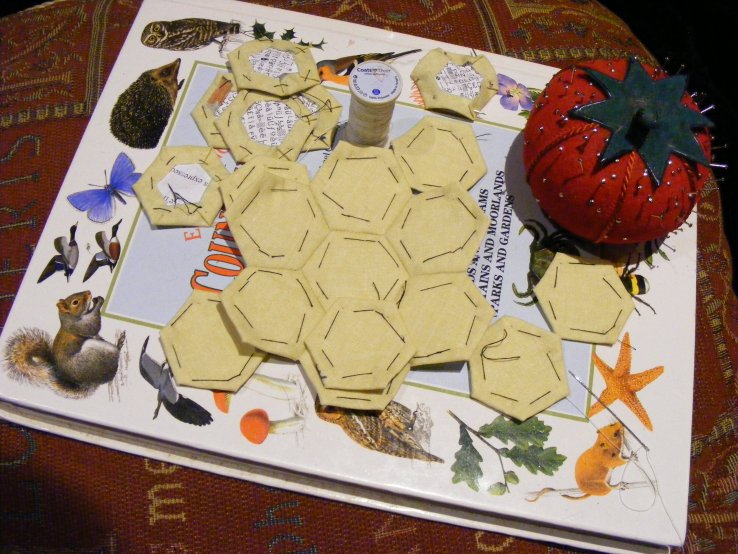
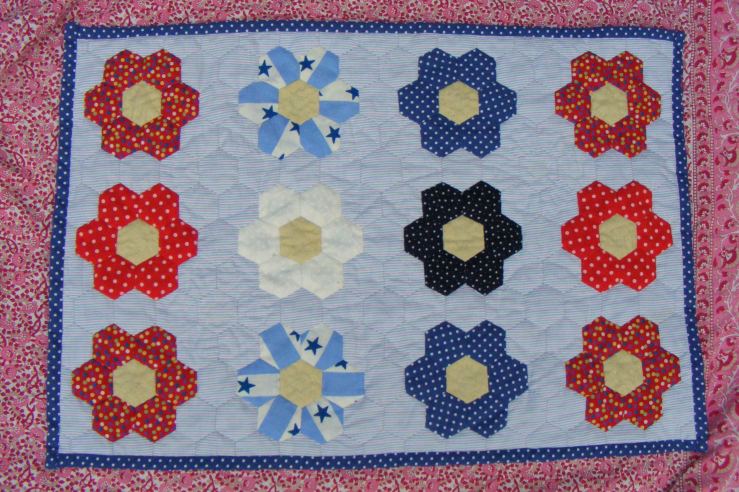
For me, it’s more like patchwork. Or one particular project, anyway, which was more of a freehand effort than most of my quilts. Let me demonstrate:

You have a general idea of what you want to create, and you start with an idea that takes your fancy. In this case, it was the four seasons, and I thought I’d begin with a jolly yellow sun for summer.dscf9859
You might want to incorporate something that wouldn’t quite fit into a previous project. (I made more of those blue flowers than I needed. Never mind! The spares will do for spring!)
dscf9347

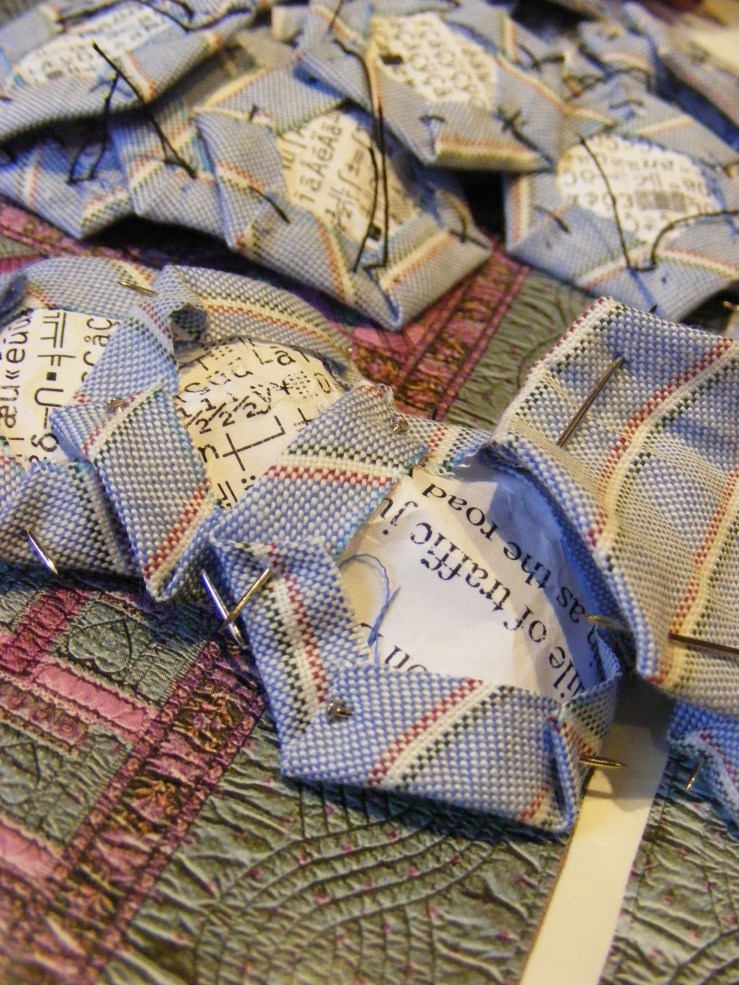
(This is a bit meta. Any patches in here which are in English, as opposed to gobbledegook, are from the now-deleted first chapter of Speak Its Name.)
dscf0336

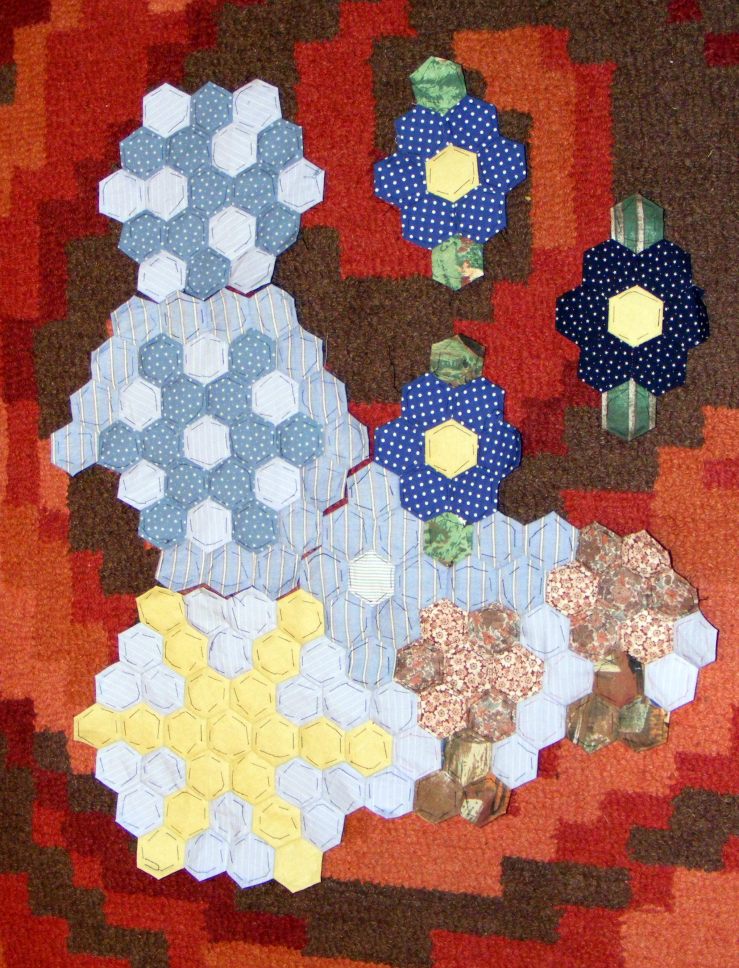
You get all your ideas down and then move them around a bit, seeing how they fit best, what needs to come after what.
dscf0211

As you go along joining things together, you see where things can be tightened up.
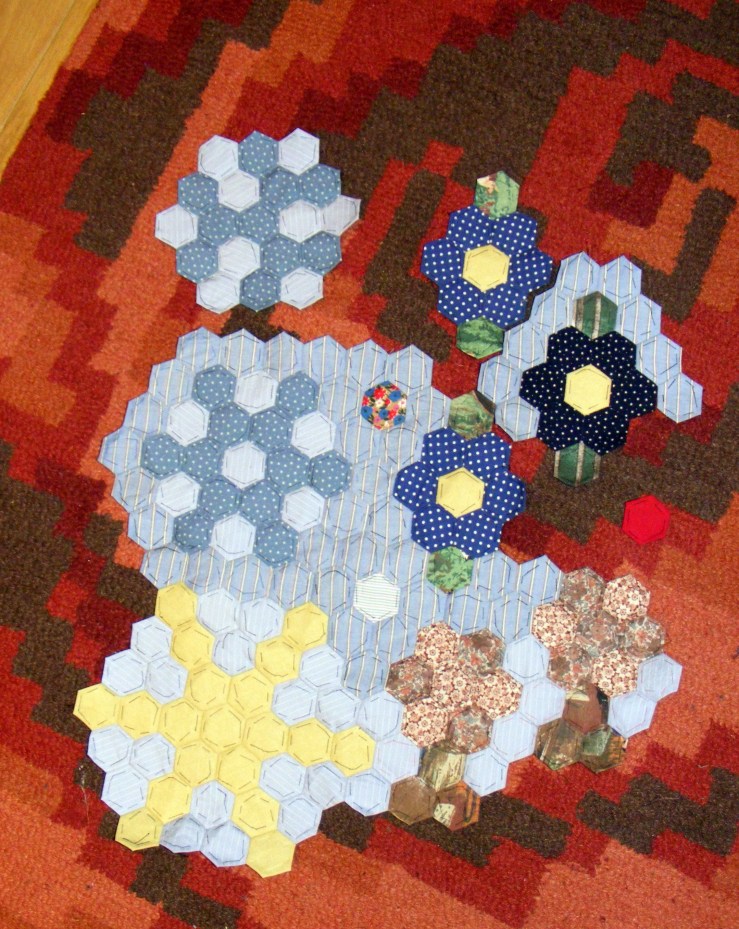
dscf0330

You see where the gaps are, and you start filling them…
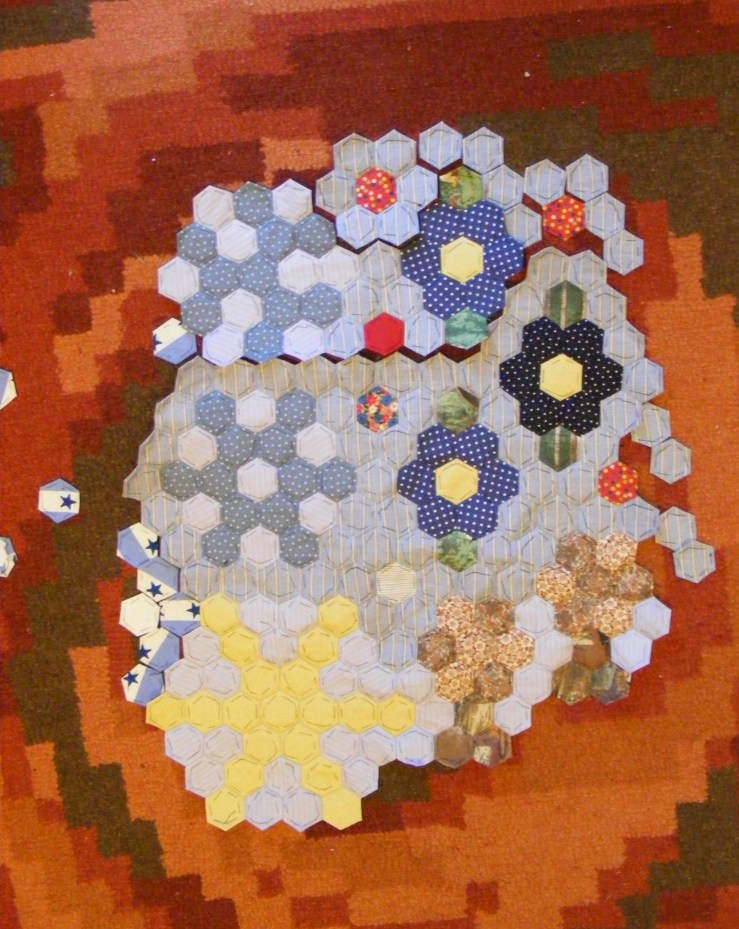
dscf0341

… until you get something that’s more like the right shape.
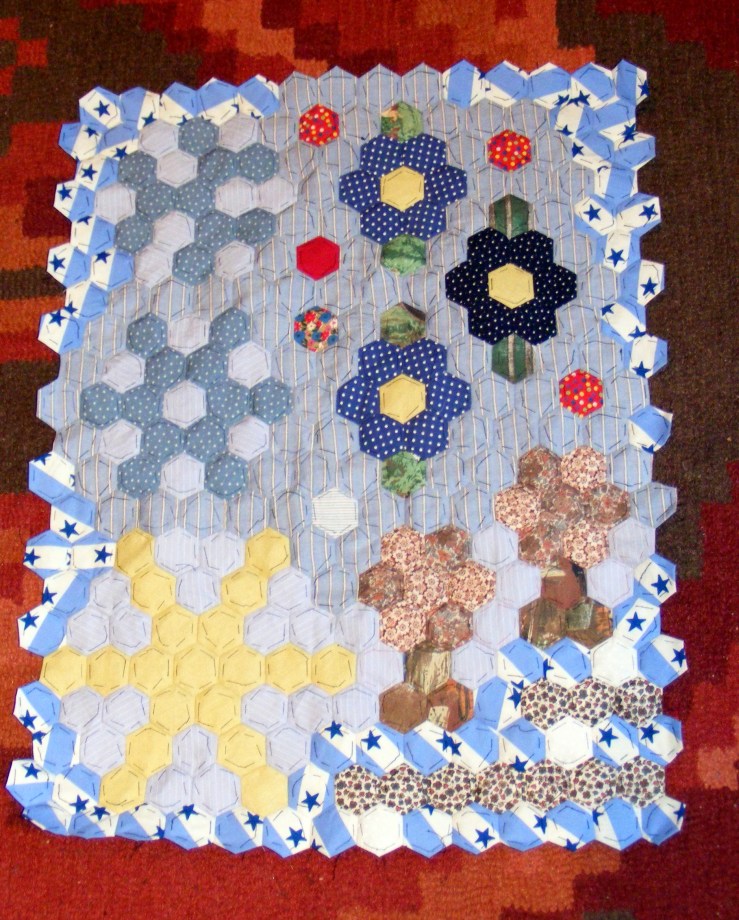
dscf0664

At that point, you can start tidying it up, taking out the things that were only there to hold it in shape during construction.
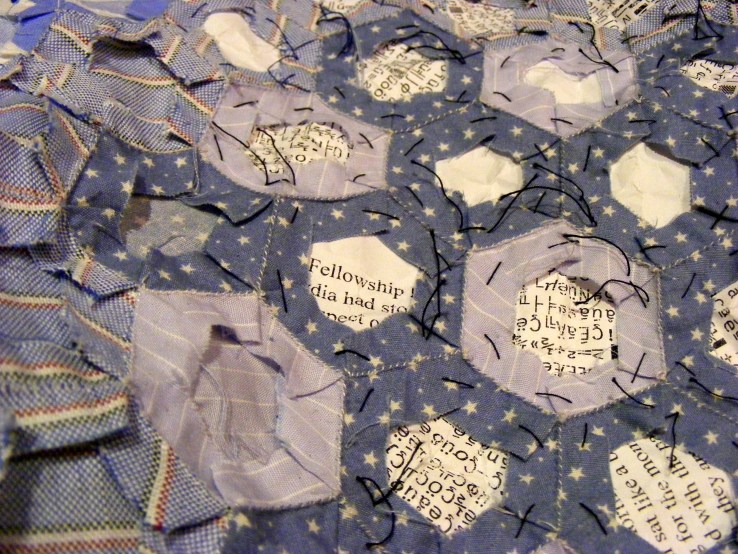
dscf0665

Now comes the backing and the pinning and the quilting, the crawling around on the floor and swearing a lot. You feel like you’re nearly there, but there’s still a frustrating amount left to do. (This is where the analogy falls down a bit. This is, oh, I don’t know, the proofreading. And waiting for people to get back to you to tell you where you’ve got things wrong.)
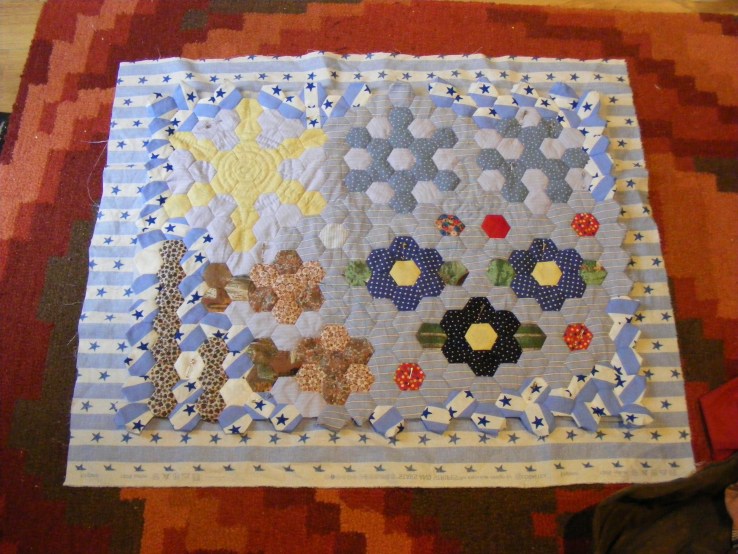
dscf0732

But once you’ve done that then there’s just the finishing off. And then you can feel rather pleased with yourself. Because the thing’s done, and while it doesn’t perhaps look exactly the way you once envisioned it, it’s not nearly as bad as you once thought it was going to be.
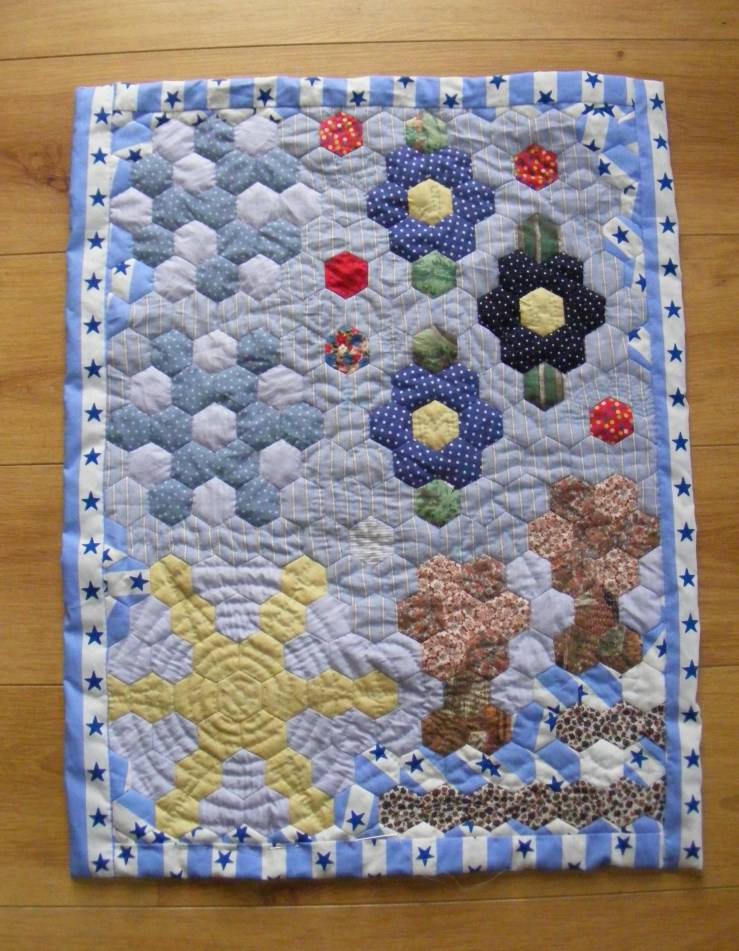
dscf0969

Good news

dscf0127

Speak Its Name was a finalist in the 2016 North Street Book Prize for self-published books (scroll down to the bottom of the page – then scroll back up and read about the actual winners). I’m very pleased about this indeed.

News from the Church of England is also good, though I find myself less excited than I might perhaps have been a couple of years ago. This time around, I got so frustrated by the bi erasure from both sides that I never managed to get into the debate. And I can’t help feeling that things have come to a pretty pass when Synod opt not to note a report that was so dreadful that the Bishops felt that they had to apologise for it and we feel obliged to be grateful for this.

I’m thinking a lot about the Syro-Phoenician woman, thinking about the tables that I sit at and the ones whose legs I prowl around hopefully. Some time over the last few years, it seems, I started wanting more than crumbs.