Daily Decoration: in-tray trees

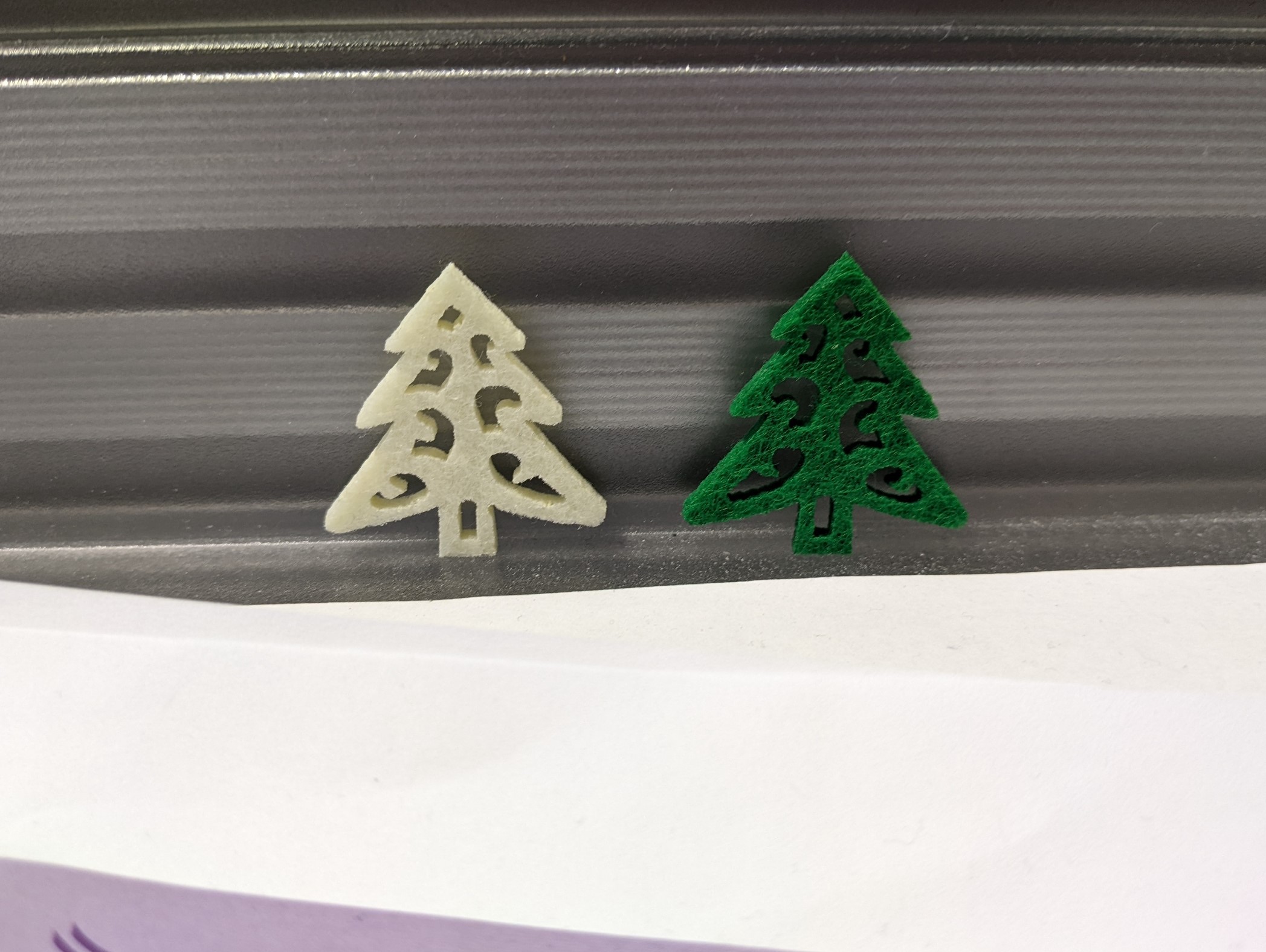
Two tiny felt cut-outs, one cream and one dark green, in the shape of Christmas trees, standing in a transparent plastic tray

These little felt trees live in the in-tray on my desk at the office. My fabulous ex-colleague Hazel gave them to me several years ago, and they’ve been there ever since. I’m not sure that I really count them as decorations, since they’re there all the time, but they seem rather poignant today.

Given recent developments, it’s quite possible that I won’t see any of my colleagues in the flesh again before Christmas, and, much as I’m usually reluctant to get deep into Office Christmas (I simply cannot be that cheerful for that long) this isn’t a normal year. Actually it’s all a bit sad – almost more so than last year, when all of us were online all the time.

I missed the last great shutdown because I was busy moving house at the time: my week’s leave folded seamlessly into Lockdown I. Today I thought briefly about taking these trees home. I don’t think it would really make any difference, though.

Daily Decoration: German roundels

Three laser-cut plywood Christmas tree decorations, with (left to right) a nativity scene, a church with an onion dome, and an angel kneeling on a shooting star), each in a circle with stars around the edge

These three roundels (I don’t think I can really call them baubles when they’re flat) are part of a set that was a Christmas present from my aunt several years ago. This is the aunt who lives in Germany, near Frankfurt, and in 2007 I spent a couple of months living with her and her family while I was trying to work out what to do with my life.

I don’t remember any of the churches in and around Frankfurt looking much like the one in the middle there. That’s a style that I associate more with Bavaria and Austria. When I was out there I attended a charismatic church led by one of my aunt’s colleagues. It was a bit of an eye-opener after a a childhood in rural Anglicanism and three years at the university chapel. Somebody had a prophetic image for me. I’d never had one of those before, and I didn’t really know what to do about it, though in retrospect I don’t think they were far off.

One of the questions associated with moving to a new place is: where will I go to church? Pretty soon after I came back from Germany, I moved to Guildford. I was miserable for a lot of the time that I lived in Guildford, but the one thing I never regretted was ending up at Holy Trinity for the Advent Carol Service (I’d been aiming for the cathedral, but had drastically misjudged the time it would have taken to walk there). It was just the church I needed: it had an inclusive approach, intelligent preaching, a reassuring stability, and, in its excellent but non-auditioned choir, a way that I could contribute even when my confidence was absolutely shot and I was hanging on by a thread. We kept going there even after we moved to Woking and I was quite a bit saner.

Later, we moved to Cambridge – Chesterton, to be precise. I thought that St Andrew’s was our parish church. In fact, it wasn’t, but it was the church I needed. Not that I immediately realised this. We happened to land on a family service, which was not really our thing. A couple of months later, we hit a sung eucharist and found that there was indeed a choir that we could join. I went to family services quite a bit more when we were settled there, though. I ended up contributing more than I’d expected, too: by the time we moved on, I was a PCC member, leader of the twenties and thirties study group, and occasional reader and intercessor, as well as a choir member.

I mentioned last year that moving house in a pandemic had its advantages. One of those was the fact that church went online, so I could hang on at St Andrew’s for far longer than would have been feasible in other times. I even got involved in leading informal worship (I’d imagine all that’s still on Youtube) and was still doing that up until this summer. In theory, the great onlining could also have meant that I could get a taste of other churches via their Youtube channels, though in fact I didn’t do any particular church shopping that way. When the churches opened up again after the long 2020 closure I started going to Ely Cathedral. I’m still feeling like a complete newbie (pandemic time may have something to do with this) but I’m starting to get to know people and get involved in things.

I always do seem to end up at the church I need, even if it’s not immediately obvious why that’s the case. It’s almost as if someone has a better idea than I do…

As for working out what to do with my life: well, it all worked out, but not because of any particular effort or thought on my part, and it took rather longer than two months. I’m hoping to get back to Germany next year.

Daily Decoration: distance pigs

Six small ceramic pigs with loops on their backs for hanging, lined up under a lamp

I can’t be in two places at once. Nor can anybody else. Even at Christmas. It is for this reason that in the early years of this century I started buying identical pairs of decorations, one for the tree at my father’s house and one for the tree at my mother’s.

As I and my brothers have acquired partners, who also have families and trees, the number of different places where we all could be has necessarily multiplied. So, therefore, has the number of decorations. This year there are six little pigs, one for our tree and the rest for other people’s. Just because I liked the little pigs.

This year I’ve seen more of my extended family than I’d expected, though not as much as I’d have liked. There has been some lovely news in one part of the family and some awful news in another part. A little china pig isn’t much, to say, ‘thinking of you, missing you, lots of love, maybe I’ll be with you next Christmas’. But it’s something.

Why bother/why I bother

Large sculpture made of arches of wire with thousands of metal fish hanging from them
Your Waves Go Over Me: an installation by Mark Reed at Norwich cathedral

There is plenty wrong with the world at the moment. (There always has been. I tend to find this comforting; you may not.) And much of it is the big stuff, the kind that needs big solutions. Bigger than me.

The actions that I can take are small. There is very little that I can control, and not much more that I can influence in any meaningful way. And yet I keep taking small actions. Not as many, or as often, as I’d like to. But some. Why?

I am one, but I am one of many.

I work for a trade union, so it’s perhaps easier for me to remember this than it is for some others. It does help, working with people who share many of my values and many of my ideals. We don’t always agree on the best way to achieve change, or even what a particular change should look like. It can be a slog: there’s an awful lot to do. But every so often we manage to change something for the better, something we wouldn’t have managed on our own.

My brother tells me that the reason he stopped flying was that I stopped flying. (And the reason that I stopped flying was that I read a news article – well over a decade ago now, since I haven’t flown since 2007 – about some bishop or other giving up flying.) We have more influence than we think we do. Not much more, perhaps. But some.

It can affect the big stuff.

In this category I’d place things like writing to my MP. If it’s just me writing to her, she probably isn’t going to act on it. If tens or hundreds of her constituents do, she’s more likely to. She might still not do it. But at least I’ve made it that little bit more difficult for her to tell herself she’s doing what her constituents want.

Maybe I’d put things like buying fair trade under this header, too. The 30p difference between the fair trade option and the not fair trade option doesn’t make much difference to me, and it probably doesn’t make much difference to the farmer either. But across millions of customers and thousands of farmers it adds up.

It made a difference to that starfish.

Have you heard that story? I came across it when I was just old enough to get the point and just young enough not to find it unbearably cheesy. Some small actions do make a big impact, depending on the perspective you’re looking from.

Picking up three pieces of litter doesn’t do much about the great Pacific garbage patch (which in any case is mostly made of fishing nets, not plastic straws, please stop banning plastic straws), but it can make a path look visibly more attractive; and if I’ve put one can in the bin then that’s one hazard taken out of the way of the local wildlife.

It made a difference to me.

In my office most of the doors are decorated with the sort of quotations that are usually described as ‘inspirational’. (I avoid the word ‘inspirational’ where possible, but it’s probably the appropriate one here.) One of them is from Joan Baez, one of the few artists I have gone out of my way to see live, and it says: Action is the antidote to despair. I mention this one – I remember this one, in contrast to all the other doors in the building – because in my experience it is true. I am very prone to despair. It seems to come along for the ride with depression, whether as cause or symptom I’m not sure. And yet doing something (a tiny something: taking the compost out, telling somebody they’ve dropped their ticket, passing on some unwanted plates to a neighbour who does want them) has a disproportionately cheering effect. Assuming I can get that far in the first place.

It helps me. Does it help anyone or anything else? If I’m honest, if I’m at the point where I’m worrying about that, I’m not actually in a place where I care.

I just do.

Do something (or don’t do something) for long enough, and it shades into sheer habit. My mother has been boycotting Nestlé since the early nineties; consequently, there’s a whole shelf of chocolate bars that I just don’t see. Does that make any difference to Nestlé’s bottom line? Well, no, because I was never their customer to start with. It’s just habit now. It doesn’t really make any difference to me, either. I’ll have a dark Chocolate Orange, if I can find one. (Do they even still make them?)

Because I am a person who does this.

This is where it can get deeply philosophical. How far is what I am determined by what I do?

I don’t always. Up until yesterday, I hadn’t written to my MP about anything for months. For all I know she was wondering if I’ve died or moved away. Now she knows I haven’t. And that I feel strongly enough about the Elections Bill to tell her how strongly I feel about it.

Choosing hope, and choosing hope by taking an action, over and over again, becomes at once a symbolic and a physical act of resistance. It becomes almost a praxis, an observance. For me, it’s an outworking of my religious faith, but I don’t think it has to be. Challenging my natural propensity for gloom changes the world – or, at least, the world I live in. And that’s the only world that I can do anything about.

C.A.T.S.: Cycling Across Time and Space – Kickstarter live now

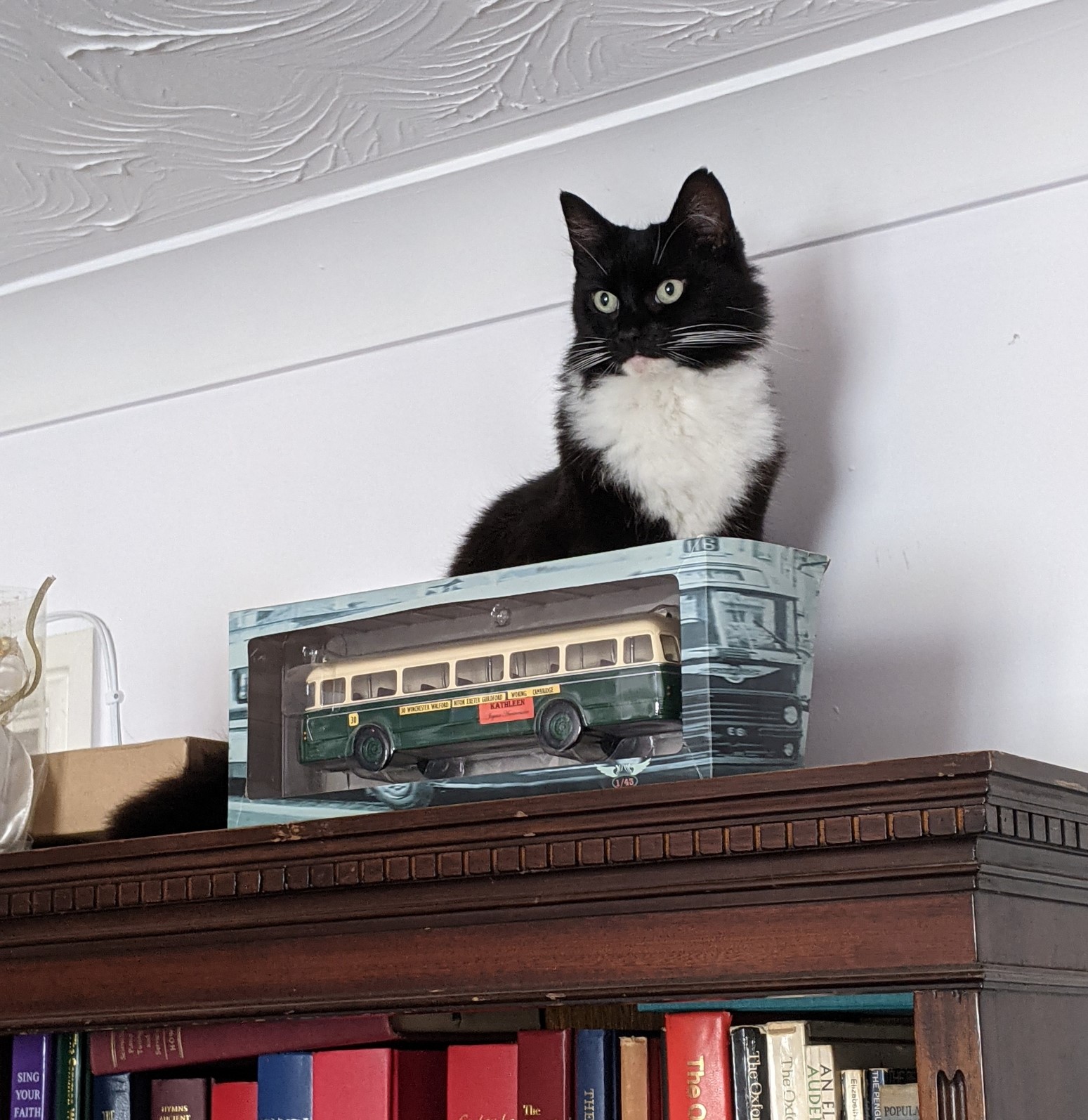
Fluffy black and white cat seated on top of a bookcase, in front of a model bus

This is Port. As of last Monday, she lives with us. She has spent most of the intervening week sleeping, eating, mewing for attention, being generally gorgeous, and climbing up to high places. It is very good to have a cat around the house; previously we have had to make do with talking to other people’s cats. Which is not the same thing at all.

In other exciting cat-related news, the Kickstarter for the latest Bikes In Space anthology is now live, and the theme of this edition is CATS, and I have a story in there. In Miss Tomkins Takes A Holiday it’s some time in the 1930s and a union organiser sets out on a well-deserved cycling break, accompanied by her cat Aster. Trouble follows them, but the two of them are very well-equipped to deal with it.

There are ten other sci-fi/fantasy stories in there, all featuring cats and bicycles, and all looking like they’re going to be a fun read. The Kickstarter offers all sorts of combinations of formats and rewards, depending on whether you prefer paperback or ebook or fancy getting a T-shirt or sticker as well. Have a look.

A kid on a BMX bike flies across the moon with a cat in the basket shooting lasers out of their eyes

Time is cyclical

I’ve been feeling quite ill these last few days (not COVID – I got the test results back this morning) and was looking back through my locked journal to see how long it took me to get over it the last time I was feeling this awful. Quite a while, it turns out – the thing kept coming back – but it reminded me that I was feeling much worse then than I am now, so on the whole I found cause for hope. What I also found was the following, which amused me rather, given the fact that I didn’t properly get going on the, er, sequel to Speak Its Name until September 2018. And it didn’t have a title until September 2019. Or so I thought. Just have a look at that last line. Apparently there was some little part of me that knew all along.

Jan 28 2017, 12:58pm

A Spoke in the Wheel

65K; first draft finished. I read it through this morning, having been avoiding it all January, and discovered that it’s neither as bad nor as miserable as I’d though it was. There is, as always with my first drafts, too much talk and not enough action; there’s a break that doesn’t need to exist between the middle and final thirds; but there’s nothing that isn’t fixable.

I’d got very hung up on the fact that it’s not going to be as good as Speak Its Name (whatever that means); and probably it isn’t, but that’s not really the point. It’s definitely going to be different.

Sequel to Speak Its Name

About a thousand words worth of oddments. Real-world developments in the Church of England are depressing, and look like they’re going to settle down into a sort of Don’t Ask Don’t Tell stalemate. I can work with that, plot-wise – in fact, it means that I could continue bimbling along in the vague non-timeline that I was using in the original, though having thought about it I’m not sure that I do want to do that any more – but you know, given the choice, I’d rather the real world sorted itself out.

Small patchwork quilt of hexagons in primary colours
No particular reason for this picture, beyond the fact that it’s cheerful and also dates from January 2017.

Hyperlocal travel writing: the sofa

I have been in Verona.

Not literally.

Well, technically, yes, I’ve stood in a very long queue for the ladies’ at the railway station between getting off a train from Venice and getting on one to Brenner(o). Technically, I have been in Verona. But that wasn’t my point.

Figuratively, I have been in Verona.

Dark screen showing DVD covers for three different versions of Romeo and Juliet, plus other Shakespeare plays

I started off in January in kitschy, fictional, Verona Beach, because I needed to remind myself of Romeo and Juliet in a hurry, and the version that was at that moment the most accessible was the Baz Luhrmann one.

Now, I am just the age to have hit compulsory school Shakespeare when Romeo+Juliet had been out long enough to become the version that English teachers turned to (and Titanic was just out, and Leonardo DiCaprio was a very big thing indeed). My teens are a bit of blur at this point (not for any sex/drugs/rock’n’roll reasons; it’s just that we spent an entire year moving house) but I’m reasonably sure that I studied Romeo and Juliet three times running at three different schools. I only really remember one of those with any clarity (it was, interestingly enough, the school I struggled with the most, but I did enjoy English): we watched the Luhrmann version; we watched the Zeffirelli version, too, but it was the tat-tastic, somewhere-on-the-American-West-Coast, Verona Beach that’s stuck in my memory.

Anyway, that was January. I finished off the thing I’d watched it for in the first place, and I thought no more about it. Then I fell down the rabbit hole. It was the discovery that Alan Rickman had played Tybalt (BBC, 1978) that had me leaving scorched rubber in the search bar and resulted in the delivery of a parcel of DVDs (it comes in a set with the major tragedies, and I thought I might as well add in the Zeffirelli version, not to mention the Branagh Much Ado About Nothing, and make the most of the postage charge).

BBC Verona is much like other BBC sets of the seventies: very much a stage set, earnestly reproducing balconies and battlements in painted plywood. Alan Rickman as Tybalt is pretty much exactly how you’d expect Alan Rickman to be as Tybalt. Perfect casting, to my mind.

Reminding myself of Zeffirelli’s Verona, I suddenly saw what the BBC had been going for, how much it owed to the earlier production. It wasn’t filmed in the real Verona but I had to look it up to check. (It’s not like I would know from the railway station lavatories, after all.) This Verona is made of stone: it’s all walls and pavements and battlements, and feels at once very authentic and very claustrophobic.

Then I remembered the existence of the musical. Musicals, plural, if you count West Side Story, which to my mind is one of the best musicals in existence, but is very much not set in any sort of Verona. The Presgurvic musical, though, very much is. Welcome to Verona, my beautiful Verona, the city where the families make the law, the city where everyone hates everyone else. (Translation mine, from the earworm: the original actually rhymes and scans and is probably in a different order.)

I’d watched the Hungarian version years ago and had vague memories of a grungy, punky set and a heart-breakingly optimistic Romeo. It’s still up on Youtube, so I watched it again. My memories were correct; also, there’s a lot of fire. There’s also a real sense of a city that runs on hatred. This isn’t the Sharks and the Jets floating on top of a city that doesn’t know much about them and doesn’t care at all; this is somewhere that wouldn’t even know what it was if it didn’t have the feud. I found the Italian version, too. That’s less fiery, more gothic. This Verona is somewhere between the Middle Ages and the apocalypse.

One cannot watch videos all the time, but one of the great things about working from home is that one can have whatever music one likes in the background (and so can one’s partner, at the other end of the landing). So I’ve been listening to the French version a lot. I have yet to fork out for Spotify Premium, so I get the government popping up and telling me what to do if I’m an EU citizen (alas!) in between Mercutio yelling ‘Je maudit vos familles! Je maudit vos maisons!’ and Romeo losing it. But then I also get people popping up to ask me to sort out their login problems, so somebody’s death scene is always going to get interrupted sooner or later.

Then I found my CD of the Bellini opera. Actually, I found the libretto booklet, which had somehow got separated from the CDs. Flicking through it, I discovered something that made me go, ‘Ohhhhhhhhh!’

… A grave reason spurs Capulet to this urgency. Maybe a sudden storm hangs over the heads of the Guelphs: maybe the Montagues are rising again in enmity! May they perish, ah! perish, those savage, insolent Ghibellines!

Now, all I know about the Guelphs and the Ghibellines comes from reading Dorothy L. Sayers’ introduction to her translation of Dante Alighieri’s Divine Comedy several years ago, and about all I had remembered was that they were opposing parties. It hadn’t occurred to me that the feud in Shakespeare might have had anything to do with real world partisanship, but it seemed really insultingly obvious now. I looked it up on Wikipedia, and there it was staring me in the face: Ghibelline swallow-tailed merlons on the ‘Casa di Romeo’, of the Montecchi family of Verona.

Small collection of clutter including a battered paperback copy of 'The Divine Comedy: Hell' by Dante, translated by Dorothy L. Sayers, and the insert from a CD of I Capuleti e i Montecchi by Vincenzo Bellini.

I picked up Dante again – I’d been thinking of reading it over Easter anyway – and reread the introduction. I hadn’t remembered entirely accurately: there were plenty of family feuds going on alongside the Guelph-Ghibelline stuff:

… the Italian nobility was violently divided by internecine clan feuds like those of the Campbells and MacGregors, so that each great family was a law unto itself and its followers, overriding the native constitution, bearing rule according to its own tribal custom, and indulging in perpetual raids and vendettas against its rivals…

After setting out the broader political context, Sayers focuses on Dante’s life, following him from Florence into exile in (wouldn’t you know) Verona and, ultimately, Ravenna. Then I spent three quarters of an hour listening to Dr Eleanor Janega tell me about Boccaccio’s Florence, and now I’m trying to remember why it is that Ravenna’s stuck in my memory. Maybe the Diarmaid McCullough History of Christianity…?

Meanwhile, cycling season has been getting underway. I like watching the cycling: often it’s two hours of scenery followed by ten minutes of excitement, but the scenery’s worth it. Strade Bianche: the white roads around Siena. Tirreno-Adriatico: west to east, sea to sea, cypress trees and red roofs, hilltop villages, Roman ruins… This weekend, it’s Milan-Sanremo. Par for the course for a spring in which I’ve been seeing a rather lot of Italy, not to mention a whole lot of Veronas, from my sofa.

Map showing main rail lines in northern Italy

Between books

Grey stone building with an arch that leads through it to another arch and a grassy space beyond.

If I were to tell you that I’m not writing anything at the moment, it would be an evident falsehood. I mean, here I am, tapping away, writing a post. I spent the afternoon writing things for work. And even when I’ve finished this post I’ll move on to the short story I’m trying to finish for an end of January deadline.

I’m not even not writing a book. Technically.

I have the Ruritanian thing, but that’s something I’m writing for fun, and when it stops being fun I stop writing it. I also stop writing it when real politics makes fictional politics feel either too depressing or too frivolous to write about. There are days when I think I can subvert the trope of the plucky English adventurer fixing other people’s countries, and there are days when it seems too far gone even to be subverted. I think I’ve worked out a way around that, but at present I don’t have the motivation for the plotting and planning and Post-It manoeuvres that it would need. I’ve written about 5000 words on it since Christmas. It’ll get done when it gets done, and if I’m happy with it I’ll publish it.

I have a couple of other semi-active projects – one on writing while keeping the day job, and one very specific and experimental anthology.

I know what comes next for Stancester, but I’m not starting on that for reasons including: a) I don’t know how it finishes; b) it feels a bit heavy; c) [monster story about how everyone who liked the first two will hate it because it won’t be lesfic]; d) I’ve only just been there.

So I’m not not writing, at all. But I am consciously playing with the idea of not writing, of seeing who I am when I’m not writing. I’m playing with the idea of being enough, of being sufficient, when I’m flopped on the sofa watching the skiing, when I’ve slept through my alarm, when I’m writing three words in half an hour, when I’m not writing anything at all. In these times when doing nothing has become the virtue that perhaps it always should have been, I’m giving myself a bit of space, and resisting the temptation to fill that space with work or guilt. Or trying to, anyway.

Perhaps what I really mean is that I’m writing when I feel like it, and writing what I feel like, and giving myself a break from the associated hustle. I am stepping away from Twitter, which (for me) seems to be the highway to fruitless rage and depression. I am dropping my expectations of when the next book will be finished and what it will be. I am going to stop chasing reviews. I might write nothing but short stories. I might write nothing at all. I might abandon the Ruritanian thing entirely, or I might get it out in time for Christmas. I might post here less, or I might post here more. You never know.

December Reflections 31: my word for 2021

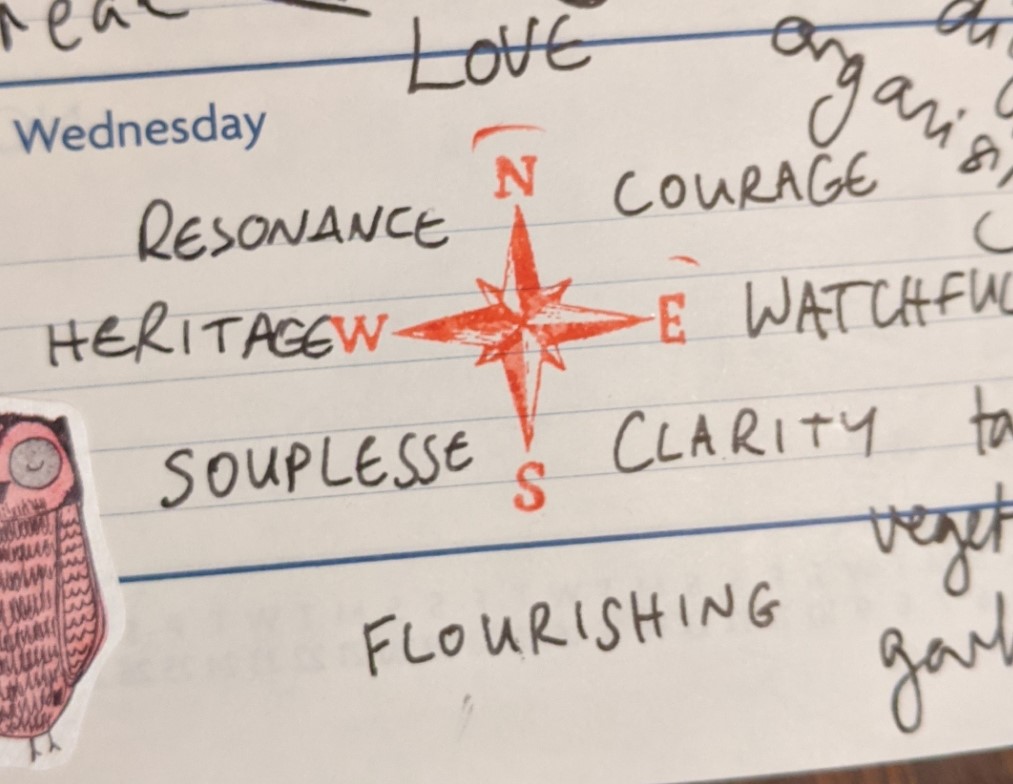
a compass rose stamped in red ink with the words
LOVE
COURAGE
WATCHFULNESS
CLARITY
SOUPLESSE
HERITAGE
RESONANCE
handwritten around it, with LOVE at North and then proceeding in a clockwise direction, in black ink

Why use one word when eight will do? Less flippantly, it’s been my custom for the last few years now to set a compass for the coming twelve months. This year I’ve been layering the hours onto that eight-pointed cycle, too, so it looks rather like this (the hyperlinks go to the Angel of the Hour, which I’ve been using this year to give structure to my working day):

NORTH – LOVE – CHRISTMAS – VIGILS

NORTH EAST – COURAGE – CANDLEMAS – LAUDS

EAST – WATCHFULNESS – LADY DAY (or Easter) – PRIME

SOUTH EAST – CLARITY – MAY DAY – TERCE

SOUTH – FLOURISHING – ST JOHN – SEXT

SOUTH WEST – SOUPLESSE – LAMMAS – NONE

WEST – HERITAGE – MICHAELMAS – VESPERS

NORTH WEST – RESONANCE – ALL SAINTS – COMPLINE

There are some there I’ve used before – love, courage, clarity – and some new ones – heritage was a bit of a surprise, and souplesse comes from cycling commentary, where it means something like flexibility, style, smoothness. I think I’ll need to feel my way into both of those.

It probably deserves to have a space of its own, and not be mixed up with my takeaway order and what I did at work that day, but actually I rather like it that way. Because that’s the point of it: all time is holy; this dark into light, light into dark, cycle is the structure that underlies life as I experience it.

December Reflections 30: thank you for…

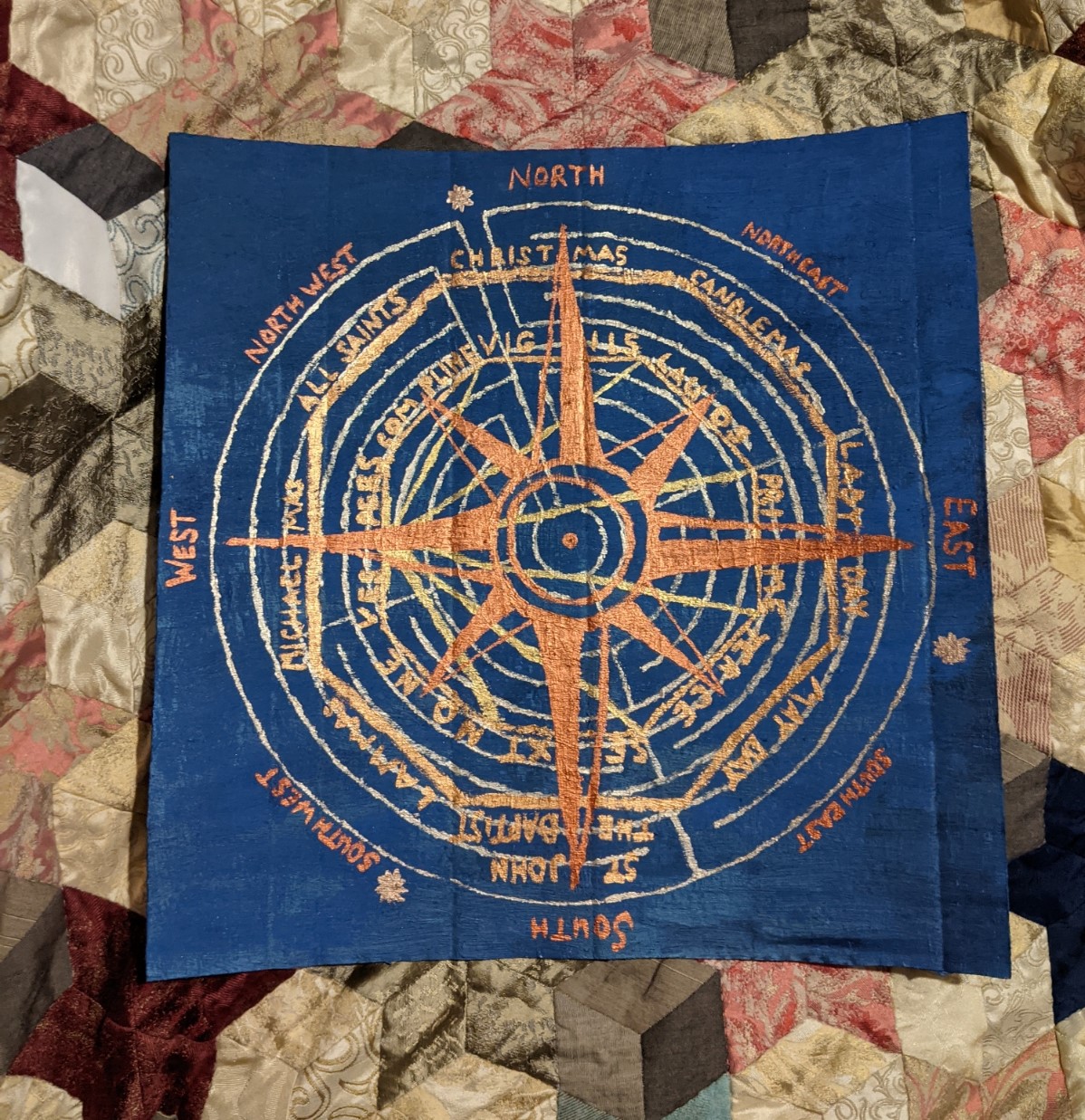
square of blue-painted cardboard with a compass rose, labyrinth, stylised shell, and the names of the monastic hours and the quarter and cross-quarter days added in metallic paint

… time and space.

Thank you for the protection and privilege of being able to work from home.

Thank you for the opportunity to settle gently into our new home. Thank you for the business of settling in, as a distraction from the culture shock outside.

Thank you for the neighbours we’ve sort of met.

Thank you for the time to get another book done and out in the world.

Thank you for the time to reread Agatha Christie novels and watch skiing and generally do nothing of importance at all.

Thank you for the gift of three hours every working day.

Thank you for the garden, and books, and books in the garden.

Thank you for here. Thank you for now.