A story from two blue notebooks

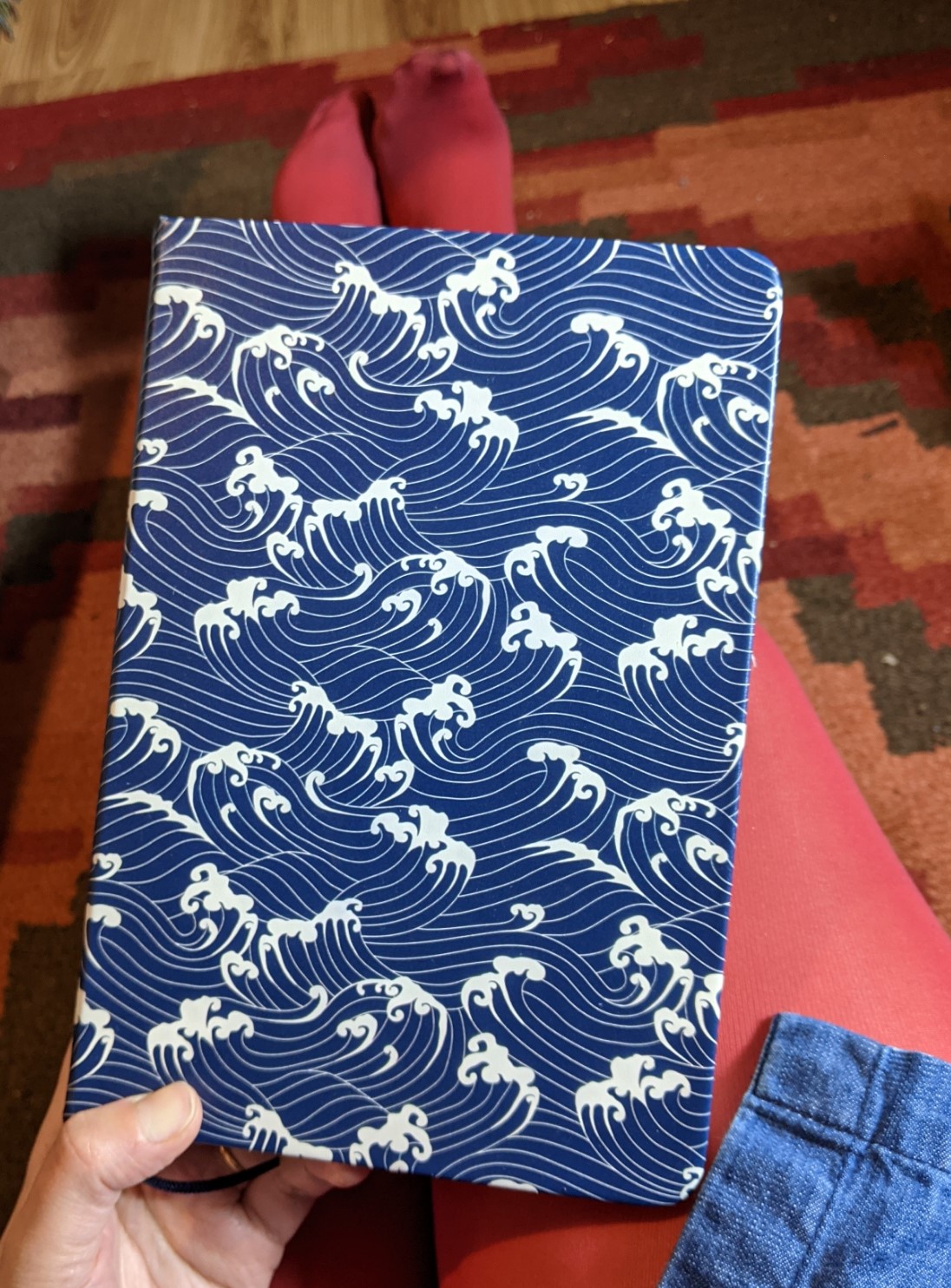
Hardback notebook with a cover pattern of blue and white waves

I was in Paperchase at St Pancras station.

Well, you see, I’d been writing everything, all of this, down in a little book, and I’d nearly finished it, so I went to Paperchase for a new one.

I always end up writing the story that I need to hear. And I don’t know whether I’ll ever be good enough to tell this one in fiction, or even if it’s a story that can work in fiction at all, ever, and it seems possible that someone else needs to hear it sooner than that. After all, I’ve found over and over again that, whatever’s happening, I’m not the only one to whom it’s happening. So I’m telling it now.

And I was looking at the shelves of notebooks, thinking about which one to choose, and I had a sudden, very strong sense that I wouldn’t need another one.

I bought one with a pattern of waves in blue and white. That was the Tuesday.

I’ve told the notebook story five or six times now. It’s a good story, a convincing one. It always surprises me how effective it is. I go in expecting pushback, argument, a compassionate suggestion that perhaps I’m mistaken in what’s going on in my own heart, and every time the other person accepts it.

Well, you’d hope they would. It’s true, after all.

On the Wednesday, I went to church. Lunchtime communion at St Pancras. St Pancras new church. And I was about half way there, walking along the pavement on the north side of the Euston Road, the wind blowing a few dead leaves around my ankles, when I understood.

It wasn’t there any more.

The leaving makes a better story than the arrival did. The arrival was cumulative, a succession of comments, questions, observations, from others.

2017. I’d been leading the twenties-and-thirties Bible study group. The ordinand we had on loan from Westcott said to the youth worker, afterwards, ‘Kathleen’s very good at this. Has she thought about ordained ministry?’

The youth worker reported this conversation to me. ‘And so I said to him, I don’t know, you should ask her!’

I thought it was just that I’d picked up some adult education skills from my day job. And forgot about it.

2018. The curate invited me to a Cursillo weekend. I thought it sounded fantastic. It wasn’t until I was signed up and paid up that she said, ‘Yes, that was where it all started for me.’

Oh, I thought. And then, Oh, well. And forgot about it.

I told a friend about the plot of the novel I was working on, how it all hinged on the fact that you can’t be ordained in the Church of England and be in a same-sex marriage. He asked me if my own vocation was going anywhere.

I’d forgotten that I’d ever told him about that.

I said no, though the curate had said what she’d said about Cursillo. And then I forgot about it.

I undertook tutor training. My first thought was how can I use this for church? It occurred to me that thirty-three was quite an appropriate age for all this to kick off again, really. I forgot about it.

I went on the Cursillo weekend and had my mind and my faith expanded in all sorts of other ways, and forgot about it.

I saw young women in dog collars – one in a bookshop, one on a train – and decided that it was confirmation bias.

I remembered Mary Poppins. The wind changes. I could smell the excitement in the air, and I knew what it was, and I didn’t want to admit it.

Returning to my novel, I asked the youth worker about the selection process. Most of my mind was focused on what I’d got wrong, what was going to screw up the timeline, what was going to rescue the arc. A little part of it was watching myself all the time to see if any of it pinged me as something that I was meant to be doing. It didn’t.

2019. I could feel it, smell it, sense it lurking in the undergrowth, waiting.

I demanded a neon sign. The next neon sign I saw said:

Started at the bottom

Now you’re here

It didn’t really help.

I decided that anything that felt that much like horrible and inevitable doom couldn’t be of divine origin. Possibly it was just that I needed a holiday.

(I did need a holiday.)

I prayed to feel better about it, if it was real.

With the twenties-and-thirties group, I was leading a course called SHAPE, designed to help people explore their gifts and their callings. In my day job, I was testing an online tool called Value My Skills. I was very aware of a parallel existence running alongside the life that I was leading, something that was more than a possibility and less than a probability.

I found myself thinking that if I got to the end of the SHAPE course without anything having come up, I was probably safe.

The week before Holy Week was peculiarly intense. Conversations and experiences piled on top of each other.

‘No, it’s not actually a thing, just a lurking sense of doom,’ I said to someone.

‘I’ve heard it often feels like that,’ they said to me.

I applied for a promotion at work in the knowledge that it was very possible that my future lay elsewhere.

I asked the Cursillo spiritual director about spiritual direction. She asked some questions about my church involvement. I answered: I was leading the twenties-and-thirties group, singing in the choir.

‘Hmm,’ she said. ‘I wonder what God’s got planned for you in, say, three years…’

I thought, oh fuck oh fuck oh fuck.

I emailed people. I dragged people out to lunch. Nobody was surprised. Their lack of surprise was both infuriating and gratifying.

I didn’t get shortlisted for the promotion. It was rather a relief: I couldn’t have fitted anything else in my head that week.

I told the curate. She prayed for me, and I, who very rarely got visual images in prayer, saw a small square of fog clear, and a set of railway points switch from one track to another. And I knew then, that if this was going to turn out to be true, that was the moment I knew it. She got me onto the reading rota and the intercessions rota and the PCC; she told the vicar.

The vicar was kindly, thoroughly, interrogative, and made it clear that I was going to have to get used to talking about this. I remembered that this was the part I’d hated the last time round.

I wept through the service. I wept because it was gone.

That was the thing: it wasn’t the first time.

At the beginning I thought I’d be able to treat it as if it was the first time, but it wasn’t long before I found myself saying, ‘Well, the last time this happened…’ and having to explain what happened last time.

‘I suppose it came out in my last year of university. I applied for a few pastoral assistant jobs, but I didn’t get any of them.’

But I couldn’t remember what it was like before. I couldn’t remember why I wanted to do it. I couldn’t remember the wanting to do it, only the desolation afterwards.

‘And it just disappeared. I walked the Camino, and by the time I got to the end it had gone, and I hadn’t noticed.’ And then I didn’t know what to do with myself, so I went to Germany as an au pair, and then I still didn’t know what to do with myself, and the year after that was the worst year of my life.

All I had was bad poetry, and a handful of stories that didn’t quite say what I needed to say. What if the widow had her mite returned to her? What if the big fish had received new orders and spat Jonah out on some beach nowhere near Nineveh? There was Abraham and Isaac, reprieved at the last moment, but that seemed a bit melodramatic. Didn’t it?

It felt like a wonderful secret. It felt terrifying and inevitable. It felt like writing a novel used to, back when I didn’t tell anybody about writing a novel.

Returning to my novel, I was struck by how wrong I’d got it. The point of view character wasn’t the one who had a vocation to ordained ministry; that was her girlfriend. But I’d bestowed on both of them the sense of creeping doom, the malevolent attraction of a black hole, that I associated with a vocation when I didn’t have one. Now I could see that it didn’t feel like that at all. When I was in the middle of the thing, there was an excitement about it, a joyful anticipation, a feeling of rightness, of everything making sense.

I read The Night Manager and for once found myself identifying with the main character accepting the call to adventure, rather than inwardly yelling at him not to do it.

I dragged out boxes of old diaries, started sifting through years’ worth of online journals. How many times had I learned this and forgotten it again? I went to Paperchase and bought a notebook with a gold-dotted blue cover. I promised myself that this time I wouldn’t forget.

I realised that I’d been thinking about it for ages. It was just that the feelings had caught up with me.

I worried about turning into a Church of England pod person with naff coasters with Bible verses on.

I knew I needed to become a person who could talk about it, and I didn’t know how to become a person who could talk about it without ceasing to be myself.

I went to an enquiries evening and was too shy to talk to the Diocesan Director of Ordinands and Vocations. I learned that the next thing to do was to book myself onto the vocations course.

I was under no illusions – certainly not the ones that would have tripped me up had I gone straight into selection and formation and ministry after university. I follow a lot of Clergy Twitter, after all.

But it seemed plausible that a decade working for a member organisation with big ideals and petty politics, one which depended for its continued operation on the labour of a lot of ageing volunteers, might have been just what I needed to equip me to deal with the Church of England. Last time might have been the wrong time. This might be the right time.

I did not book myself onto the vocations course.

I failed to do anything practical about it at all, just kept writing in my blue notebook with the gold spots.

It felt more and more like where I was going.

The Sunday before Advent, the Diocesan Director of Ordinands and Vocations was the guest preacher. I talked to her, mentioning a little petulantly that the rest of my life seemed to be trying to happen at the same time (my husband and I had finally scraped together the deposit for a mortgage). She got me booked onto the next term’s vocations course.

On the Friday, the House of Bishops put out an even more tin-eared statement than usual, and I couldn’t help seeing the funny side. I wore a rainbow skirt to church that Sunday.

I went to the first session of the course.

That was the Wednesday before I went to Paperchase.

I saw the course through, as best I could given the challenges posed by Great Northern Rail (sometimes I got from London to Ely on time, and sometimes I didn’t) and (later) having to join in by Zoom over the phone, because the course had gone online and we didn’t have broadband at the new house. It was interesting, and enjoyable, and, for me, irrelevant.

I stuck around, waiting to see if the vocation was going to come back, whether it had been scared off by my moving house, or lockdown, or something. It didn’t.

I finished the novel. I started telling people that it had gone.

It’s ten months now since it went away; it already feels like another life. After the desolation came the relief. I don’t want to do this. I would have done it if I’d had to, but I’m glad I didn’t have to.

The other day I found a mind map that I made when it was there and new and I was trying to make sense of it. There it all was, in my own handwriting, and it was nothing to do with me.

And I still don’t know why it happened: why it came, and why it went away.

Was it a piece of research that got a bit too immersive?

Did I need to know what a vocation felt like in order to know when I didn’t have one?

Am I off on another circuit of the labyrinth, bound to follow a long and winding path to get back to the same place?

The more time elapses, the less I think about those questions. The answer’s always the same, anyway: I don’t know.

And I suspect I won’t, not for a long time.

Advent Sunday

Advent calendar window, lit from behind, labelled 'First Sunday of Advent', with a picture of Christ in majesty with two skeletons.

I’ve shared a picture of my lovely six-sided Advent calendar in previous years. Advent is a season of varying length, of course, so sometimes, as this year, the traditional ‘starts on 1 December’ calendar is missing a few days. This one, however, has doors for St Andrew (30 November) and each Sunday of Advent, so this year it works perfectly. First Sunday of Advent today. St Andrew tomorrow. Then we’re into December.

I don’t have anything terribly original to add to the myriad observations about how weird this year is, the plethora of jokes about how today is March 274. Nevertheless, I have been thinking a lot about time this year. I revisited Waverly Fitzgerald’s lovely Slow Time and David Steindl-Rast’s Music of Silence. Pottering in my garden, I thought about The Morville Hours. Exploring Ely, I found two new sundials. This evening I listened to The Annunciation by Edwin Muir, and noticed myself noticing all the signifiers of time passing in the second half, noticed my mind leaping to a friend’s setting of The Spacious Firmament On High. Time. Time and space.

And where I am I? What have I learned? Nothing more than to try to be here, and now. I suspect that I’ll be writing a lot about that over the next month.

I love Advent. I’ve been looking forward to it for ages. And yet this morning found me late for church (over YouTube, so nobody knew!), pulling my top on as the processional played, breakfasting on cake. Somehow, Advent has crept up on me. It often does.

Even in normal times, time has never behaved the way I’ve thought it should. I remember the Advent calendar that was a pyramid shape, so that each day it had a little more wax to burn, and the closer it got to Christmas the longer I’d have to wait to blow it out. Not the sort of thing that King Alfred would have used for a candle clock.

So here I am. Here and now. I seem to know less than I ever did, and to be far less bothered by that than I’d ever have expected. I’ll be taking part in Susannah Conway’s December Reflections project again this year, looking back over the last twelve months, looking forward to the next twelve months.

To the pedantic western Christians reading this, Happy New Year! To everyone else, I hope March 274th is treating you well.

A #BeautifulStory in which nothing much happens

LGBTQIA Christians on Twitter have been responding to a video from the Church of England Evangelical Council by sharing their experiences as queer people of faith under the hashtag #BeautifulStory. For what it’s worth, here’s mine. I posted it on Twitter yesterday, but it’s probably easier to read here and, because this is the first time I’ve written a lot of it down, I didn’t want to lose it in my feed.

I’m not sure that mine is a particularly #BeautifulStory. Nor is it a particularly ugly one. It’s a bit awkward, and a bit messy, and for the first twenty years of my life I didn’t know that I had it. I grew up under Section 28, you see.

Consequently, I didn’t come across the word ‘bisexual’ until I was 20. If I’d heard it earlier, my life might have been very different. But then again, it might not, because I had many other things going on in it. Including a lot of Scripture Union books.

My church and family were Church of England, slap bang in the middle of the road. I continued down the middle of that road at university. But it’s very easy to internalise certain interpretations of Scripture, particularly if they seem to be more decisive than the alternative.

Anyway, I’d had a few half-hearted crushes on boys in my teens, so I couldn’t be gay. My cousin asked me (at my 18th birthday party) whether I liked women or men. I do wish he’d given ‘both/and’ as an option – though at that point the honest answer would have been ‘neither’.

(I should probably have said that this isn’t a particularly exciting story, either!)

So I went to university, dodged (or did I???) the Christian Union by sheer luck (was committed to symphony orchestra; both met on Tuesdays), had various crushes on various people, ended up going up with a bloke I lived with. (Who was and continues to be lovely!)

Despite studying English Lit and therefore having at least some exposure to queer theory, the first point at which I was prompted to apply it to myself was a Livejournal meme (the old sort of meme which was a series of statements which you bolded or struck out as appropriate)

One of those statements was ‘I am openly bisexual and have completely different reasons for being attracted to men or women’. I thought about that one for a while. I couldn’t say that it was true, for several reasons, but denying it didn’t feel right either.

And that was as far as it went. Meanwhile, the Christian Union drama went on and on and ended, the year after I graduated, with someone suing the Students’ Guild. The drama had got me to articulate my convictions about faith and sexuality to myself.

This was because the drama had a lot to do with the ‘religious freedom/Biblical teaching/equalities’ faultline, though that wasn’t where it had started. Never mind that. I couldn’t reconcile anti-LGBTQ theology with the Gospel.

I hoped and suspected that same-sex marriage, if it ever happened, would sort things out. What I didn’t do was apply any of my thinking to myself. Because I was in a heterosexual relationship, so why would I need to think about any of that? And for quite a while, I didn’t.

So. Graduated. Got engaged to the chap I mentioned upthread. (What I didn’t say is that we met in chapel choir, and that he was agnostic at the time and is now a churchgoing atheist. Which doesn’t seem to bother anybody…)

The beautiful irony in this #BeautifulStory is the fact that it was Church of England marriage preparation courses that got me to take a long, hard look at myself and appreciate that I couldn’t keep on keeping what I knew about myself to myself. So I came out to my fiancé.

And again, nothing much happened. We got married, moved house several times, sang in the choir together, both knowing I was bi. It didn’t make any difference. As one of my friends once said, being bisexual merely doubles the pool of people with whom one doesn’t commit adultery.

All of that is still true. And yet… It does make a difference. Because knowing I was bi and having my husband know I was bi wasn’t enough. Without realising, I was pushing part of myself down, leaving part of myself outside the church door.

I was thinking that part of myself was not acceptable – despite the fact that I’d have been horrified to catch myself thinking that about any other #FaithfullyLGBT person.

There’s a character in my first novel who’s a bit of a caricature of the Perfect Christian Woman. Wife, mother, pink top, cross pendant, etc. She’s also bi, but nobody knows, because she’s so good at projecting the PCW image. In a way, she’s a rather unflattering self-portrait.

Quite a lot happened the year I turned 30 – in my head and heart, at least. I finally found the gumption to self-publish. And I untangled a whole load of that internalised biphobia. I realised that nobody had hurt me as much as I had hurt myself.

And, self-publishing, on the last but one editing pass, I revisited my self-portrait, my Perfect Christian woman, and thought, Good grief, she sounds miserable. I’d moved on.

In between times, I was coming out to people, some of whom were at church. Sometimes it was awkward, sometimes it was a relief, sometimes it was awful. Every time my knees went wobbly afterwards. After a while I decided that I’d act as if everybody knew, and stop worrying.

But of course heteronormativity plus a different-sex partner meant that people always assumed – actually, ‘assumed’ is too strong a word – that I was straight, so I kept having to come out. I came out online, I came out offline. I came out to my family, to clergy, to colleagues.

I came out so many times to my (high turnover) Bible study group that I started to wonder if my purpose on earth was to demonstrate to ordinands (this was a Cambridge church, so got a lot on placements) that they were likely to encounter bolshy queer laypeople.

Now I’ve moved and will have to do it all over again. I have a few lapel badges to assist me. And it does get easier with practice (and not caring so much what people think, or whether they even think it.)

And this is really what my #BeautifulStory has been. From the outside, it looks very similar to the way it looked 15 years ago. But inside I am constantly being renewed and transformed.

I am constantly coming to understand more of who and what I am, and how that glorifies God much more than my previous half-life. I take all of myself to church, these days.

My novels tend to have more action than this. If you want a fictional #BeautifulStory, try Speak Its Name. If you want to know why this is still a big deal in the Church of England, The Real World is out now.

Meanwhile, in the real world…

IMG_20200709_180932

Do you remember how, back at the beginning of lockdown, various obnoxious productivity types were telling us all that if we didn’t come out of it with a new skill or a novel then we were all pathetic failures? I haven’t heard so much from them recently. That may have something to do with my spending less time on Twitter. Or the obnoxious types may have discovered that in fact it’s not so easy to get things done with a global crisis going on outside, and have shut up.

As it happens, I’ve learned a few new skills – painting walls, making curtains, changing taps – but they’ve had more to do with having just moved house than with enforced leisure. I’ve continued to work full time, so, apart from the commute (which I’ve gleefully replaced with an additional daily hour in bed) I haven’t had much in the way of enforced leisure. Anyway, I went into lockdown with a novel, or, at least, 93,000 words of one, so it would be a bit of a cheat to claim that it had anything to do with coronavirus. If anything, I was hoping to make it shorter. As it is, I’ve now got 94,661 words. They’re better, though. They’re quite a lot better.

They’re good enough for me to say, tentatively, that this book’s going to come out this year.

I’m aiming for a release date in November. Of course, this means that I need to have everything done in September, which means that I’ve only got a couple of months to get things done. But that feels achievable, now, in a way that it didn’t at the beginning of the year.

Meanwhile, my existing books will remain free to download from Lulu until the end of this month. After that they’ll go back to full price. Consider this fair warning, and, if you haven’t grabbed them already, you can find them here:

Things I know people won’t like about The Real World

DSC_0131

Well, the clue’s in the name, really, isn’t it? Granted, The Real World is set in 2017, which was not quite so spectacularly apocalyptic as 2020’s turning out to be.

That’s one of the reasons why I’ve been quiet around here recently: there’s plenty that’s wrong with the real world, and quite often I feel that the best way for me to contribute to righting it is to show up for my job, to be part of a collective campaigning against racism and transphobia rather than pontificating in my own tiny corner of the internet.

The other reason is that by half past five I tend to feel that my eyeballs will start dribbling out of their sockets if I look at my screen for a moment longer. I turn my computer back on in the evenings, and convert some thoughts into pixels, but it’s slower going than it used to be. I’m not missing my commute, exactly, but it did make a lovely chunk of time that was for writing and nothing else.

So the first thing that people won’t like about The Real World is:

  • I don’t know when it will be published. The last time I had a date in mind, I was thinking of this September, to coincide with the beginning of the academic year. I’m pretty sure I won’t make that now, and, while I’m feeling more optimistic that I will, you know, get this wretched thing finished, I couldn’t tell you when that will be.

Apart from that:

  • Church politics. Church processes. The small but important faultlines between different churches and different Churches. My first beta reader pointed out, tactfully, that there didn’t seem to be anything else. I’ve added some other things since, but there’s still quite a lot of Church stuff in there.  (Depending on your point of view this may, of course, be a feature rather than a bug.)
  • Not everybody gets what they want. In fact, hardly anybody gets what they want. I don’t think this is a pessimistic book, but it’s set in, well, the real world, and at least one of the characters wants two things that are, in the real world, mutually exclusive. And, while an author can of course wave a magic wand and make everything better, that doesn’t feel honest to me; it doesn’t feel respectful to those real people who are having to make those impossible decisions.
  • I’ve managed to develop Unpopular Opinions about a concept that’s a major theme in this book. I’m hoping that my opinions haven’t hijacked everything else, but that’s for the reader to decide. I had an epiphany some time last year when I realised that, just because a character happened to agree with me, it didn’t mean that they were right, but it’s undeniable that they do have their say.
  • Portraying depression from inside the head of someone who has it is probably a risky move. I’m gloomily resigned to the probability of someone mistaking depiction for endorsement, but I’m not looking forward to that.

The thing that I don’t like about it at the moment (apart from the fact that it still needs a lot of work) is the fact that it’s stubbornly refusing to go below 93,000 words, and at the moment I can’t see whether that’s because 93,000 words is, in fact, the length it needs to be, or because there’s something that needs to come out.

I’ll keep you posted. Probably. In the meantime, I hope the real real world is being kind to you.

A brief update (and free books)

Hello friends! I hope you’re keeping well. It’s a funny old time – though I think perhaps it feels less strange for me as we moved house two weeks ago, so the general chaos of curtain rails and cardboard boxes has drowned out the background, global, disquiet. And we still don’t have broadband at the new place so I haven’t been online much.

However, I have seen that many institutions, artists, musicians and writers, have put their work online for free, to go at least a little way towards brightening the gloom or passing a few dull hours. And I thought I’d do likewise. The ebook versions of both of my novels can now be downloaded for free from Lulu. The price reduction should eventually filter through to the other online bookshops.

If you’re trying to come to terms with the sudden absence of sport from your life, try A Spoke In The Wheel. If your church, university, or both, has moved online and you’re missing the politics (erm…) you might prefer Speak Its Name. Feel free to download both if you like! I’m in the fortunate position of being in salaried work that I can do from home, so I won’t be disadvantaged by people reading my books for free. And, once I’ve got fed up with putting up picture hooks and painting walls, I’ll finish the next book, and you’ll be able to buy that one.


Pilgrims

that’s the way of it: you meet them
over and over, evenings, lunchtimes,
along the road,
at cafés, fountains, benches,
along the road,
you meet them, wish them well,
you move on
or they move on
along the road
you meet them, over and over,
meet them
along the road,
along the road,
you move on
or they move on
along the road,
you don’t know
the last time you meet them
that that
was the last time you met them
along the road

Going forward

DSC_0722

‘Well,’ my manager often says after some particularly unfortunate circumstance has come to light, ‘we are where we are.’

This post is going to be less about where we are (goodness knows we could argue about that for the next decade and more) and more about where I’m going to go from here. If you’d like to join me, I’d be glad of the company, but this is primarily a personal response.

I’m operating under two assumptions. Firstly, that life is going to get generally worse for people under the current government and outside the European Union. Secondly, that the referendum was not won on truths, or lies, or facts, but values.

If I’m wrong about either of those… well, it doesn’t actually make much difference. If life in fact gets better for more people, then I’ll be delighted, and the referendum is done, if not done with.

So what do I do with that?

I intend to work – to continue working – to make life better for as many people as I possibly can. At the moment I think that what that looks like is to continue turning up to my day job in trade union education, where we work to equip people with the skills, the knowledge, the confidence that the education system failed to give them. I think it looks like campaigning to rejoin the European Union. I think it looks like working damned hard to protect our rights in the meantime. In any case, I commit to responding to suffering with kindness rather than cruelty (and I think that means never, never, saying ‘I told you so,’ no matter how tempting that might be). I commit to operating from hope.

And I intend to talk more about my values. I believe in openness, open-mindedness, justice, kindness, equality, fulfillment, respect, redemption, transformation, hope, love. I think that I need to talk more about why I believe in those things, and what that means for me.

I find myself without a snappy line to finish this post off, and I suppose that isn’t really surprising. Because I don’t really know what happens next. I don’t know what the end looks like. All I can do is set a course forward.


December Reflections 30: thank you for…

IMG_20191230_171555_851

… surprising and exciting developments.

Perhaps they shouldn’t be surprising. When in the autumn we added up the balances of our various savings accounts and found that they made a mortgage deposit, that was after many years of channelling a direct debit in that direction.

What else?

The opportunity to serve on a Cursillo weekend. I wrote a couple of days ago about ‘the privilege of loving people’, and this was largely what I had in mind. Making tea for people, putting chairs out for them, washing their hands… it was wonderful.

Good progress on two books. The Real World is more or less there in terms of word count, and I’m looking forward to diving back in with a red pen in a couple of weeks’ time. The Rassendyll Kidnapping is a lot more nebulous, but a whole load of plot came together in my head at the beginning of December, and I got most of it down before I forgot it again.

Time with family and friends – particularly a week with my family at and around Ventnor Fringe, and a week with the in-laws on a narrowboat on the river Avon, and another week with my friend Anne in York. I’d like to see more of more people next year, though.

The chance to see the best cyclists in the world ride past me.

New people and new places. Theatre. Museums. Good books. Good food. A really interesting talk that made me think about food differently. (The very short version: delight and sharing.) Wide-ranging conversations, leading (I think) to interesting places.

2019 hasn’t been a year of fruition, exactly, but it’s certainly been a year of emerging shoots. And I’m thankful.