Getting used to the idea (of being the first self-published author shortlisted for the Betty Trask Prize)

It’s been ten days since the news broke, and I’m gradually getting used to the idea. Ideas, plural. That my book has been shortlisted for a major literary prize. That, whatever else happens, I have won £3000 to spend on foreign travel. That people whose writing I admire a huge amount have read my book. That people whose writing I admire a huge amount liked my book. Joanne Harris. Michèle Roberts. Simon Brett.

I’m pretty sure that this will turn out to have been life-changing, but in the meantime life goes on. I cycle to the station and I catch my train; I reset some passwords and I design a flyer or two. And I get used to the idea.

So do the people around me: the ones who knew before that I’d written a book, and the ones who didn’t. I’d kept it reasonably quiet at work, at church, in the extended family. People who followed me on Twitter probably knew; people who didn’t, probably didn’t.

And I have to admit that it’s suddenly become a lot easier to tell people. It’s not just, ‘I’ve written a book.’ It’s ‘I’ve written a book, and some very good writers think it’s good.’

One of the most important requirements of self-publishing, and one that I really didn’t appreciate until I did it myself, is a sheer bloody-minded refusal to give a damn what anybody else thinks. Or, less aggressively, the willingness to accept that every aspect and defect of the book is my own responsibility.

I appreciate the apparent contradiction between those two paragraphs, believe me.

I can only speak for myself, but I found that the bloody-mindedness didn’t land until just after I turned thirty. (Which may go some way towards explaining why I’m the first self-published author to be shortlisted for the Betty Trask Prize. The upper age limit is 35.) Up until then I was looking for somebody else to affirm my sense that my book was good, that it was worth putting out into the world. I was looking for somebody else to take responsibility. In the end, I had to do it for myself.

Of course I can see now that it would always have been my responsibility, no matter how many other people were named on the acknowledgements page, no matter who took the final decision to put the thing out into the world. It’s come into starker focus for me, that’s all.

I have this sense that I’m trying to get to the point where I genuinely, honestly, don’t care what anyone else thinks, no matter who they are, no matter what their qualifications. In the meantime, however, a judging panel composed of Joanne Harris, Michèle Roberts, and Simon Brett likes my book. I think that’s going to keep me smiling for a long, long time.


Giving up, and giving up on giving up

This year I’ve been doing Lent differently; by which I mean that I’ve not been doing very much differently at all. I haven’t given up anything, partly in an attempt to disconnect the idea of virtue from that of self-deprivation, and partly to see if there’s any correlation between Lenten discipline and the seasonal depression that tends to land early in March and lift around Easter.

It turns out that not giving up meat, not giving up alcohol, not giving up coffee, not giving up tea, not giving up biscuits, and not giving up anything else, has made precisely zero difference, and March has been as much of a slog as it always is. This has, oddly enough, made me feel rather optimistic. It would have been annoying to discover that I’d brought all my misery on myself by trying too hard to be ‘good’. Next year I can do what I feel like doing and not worry about it. And I also know for next year not to schedule any social events during March, because I’ll either flake out and disappoint people, or turn up and then cry and embarrass them.

I keep meaning to write about the structure of the Church year, and how useful I find it. Firstly, there’s the way that it keeps turning on and on with or without my involvement. I can fail to get out of bed three Sundays running, work a weekend away, and then go on holiday, and when I come back I can still reorient myself by the colour of the altar frontal, the readings, and the anthem. And then there’s the fact that there is actually an officially sanctioned time for feeling dreadful, followed by a time of feeling a huge amount better and being thankful for that. That bit’s coming up soon. I’m looking forward to it.

We’ll turn it around

dscf9952

I’ve spent quite of lot of 2017 being ill. The boomerang virus has hit me three times since New Year’s Eve. At the moment it’s manifesting in a hacking cough, set off by a) singing anything longer than a bar and a half in one breath; b) laughing; c) breathing in cold air. Previously it’s made itself known in extreme lethargy, fever, sniffles tending to nosebleeds, headaches, lack of sleep, a sore throat, and a cough. Not, fortunately, all at once. Or, at least, not for long.

Consequently, I’ve spent quite a lot of 2017 wrapped up in a blanket and occupying myself with things that haven’t needed much energy. In what is perhaps not a coincidence, I have fallen hard for Yuri!!! on Ice, which is a very sweet and optimistic anime about figure skating. This despite my having had no prior interest in either anime or figure skating. It just seems to appeal to the same part of my brain that likes epaulettes and grand opera and dark chocolate. And Ruritania.

It’s probably also significant that Yuri!!! on Ice takes place in a universe where there’s no homophobia and where the sport system can be trusted. By contrast, I have spent the last year writing in a universe where sport chews you up and spits you out, and several years before that writing in a universe where homophobia is depressingly and devastatingly real. So perhaps I just needed a break.

There are parts of my brain that think it is absolutely appalling of me to be watching anything at all light and fluffy (not to mention admitting to it in public) when As We All Know The World Is Going To Hell. (There are other parts of my brain that don’t like my admitting to liking anything at all, including epaulettes, grand opera, and dark chocolate, because that’s really embarrassing, apparently. And another one that’s pointing out that I promised myself several years ago that I’d never apologise for my reading or watching material, because if an English Lit degree doesn’t give you the right to read what you like without feeling guilty about it, what does? Brains, eh?)

The thing is, it’s not as simple as that. In the same way that one can’t (at least, I can’t) read The Prisoner of Zenda and Rupert of Hentzau without reflecting that Rudolf V is actually a pathetic excuse for a king who deserves everything he gets, and wondering whether there’s a Ruritanian Communist Party, it’s difficult to watch Yuri!!! on Ice without acknowledging that, sadly, Russia doesn’t work like that, and China doesn’t work like that, and probably skating doesn’t work like that either. Which makes for some genuinely interesting fanfic; but I’ve been reading a lot of fluff, too.

It’s a constant push and pull: between escapism and realism (but how real is the realism?), between optimism and pessimism; the tension between the world as one would like it to be and the world as one fears it is; the question of what truth looks like in fiction. I feel the urge to complicate the simple stuff; and to give the miserable stuff a happy ending; to question whether an ending that an author clearly intended as happy is as happy as all that; and to equip other people’s characters with the tools to get out of the mess they were left in. It’s a question with which a consumer engages as much as a creator. Actually, I find that the lines are blurred, and that I’m arguing with something with everything I write: some other book, something someone else said, adding another layer to the debate.

On which subject: I’ve got back into the editing process for A Spoke In The Wheel this week, after spending all of January too knackered and too scared to look at it. It turns out that it’s neither as bad nor as miserable as my mind had made it out to be. (Again, I say, brains, eh?) And I find myself wondering, now, where it falls on that continuum between realism and escapism. I’ve tried to set it in the real world, where zero hours contracts and sexism and burnout exist. I’ve got a friend checking it at the moment for errors in my portrayal of the notoriously dreadful UK disability benefits process. It’s fairly cynical about sport, or, at least, the narrator is.

But I find, re-reading it, that on the whole it’s hopeful. And I’m glad about that. Apart from anything else, it occurs to me that if we can’t let ourselves imagine a better world, we’re unlikely ever to get one.

Delaying

dsc_0281

For me, the new year came in with a whimper, not with a bang. I was in bed long before the bangs started, knocked flat by this virus that everyone’s been getting. And it’s taken me a while to get up and running. There’s a lot to catch up with, or, at least, there could be, if I were thinking in terms of needing to catch up with things.

The crib should have gone away. It didn’t. It’s going to have to stay up until Candlemas now, and for once the Magi get to stay by the manger for more than a day. (The parrots were a present from a friend, who’d seen this crib and got ideas about how to improve mine.)

The printer is out of toner. Which means that I haven’t printed off the current draft of A Spoke in the Wheel. Which means that I haven’t read the current draft of A Spoke in the Wheel. And I’m aware that there’s more to it than the simple fact that the printer’s out of toner.

The snag is the usual one. I am scared of reading it because I am worried that I will come across a problem that is unfixable. Perhaps I have failed to do some essential bit of research and have made a mistake that’s going to kill the whole plot. Perhaps I have managed to be unintentionally yet monumentally offensive. It’s always a variation on one of those two. Perhaps. Perhaps. Perhaps.

There are two potential ways to deal with this. The first is to wait it out. I’ve lived with myself long enough to know that I do get things finished, eventually, and that if the book and I want to spend two months hiding for each other then perhaps that’s just what we need to do, and we’ll find each other in good time. The second is to get somebody else to read it for me. Sooner or later I would anyway, but this is a much earlier stage in the process, and I find myself reluctant to pass it out before it’s as good as I can get it unaided.

At the moment, while I’m still getting over this illness and blessed with a contented lack of urgency, I’m going with the first option. I spent far too much of last year worrying that I hadn’t done enough, that I wasn’t writing fast enough, and, now that feeling’s a long way off, I’m going to enjoy its absence. The book can wait.

December Reflections 30: thank you for…

dscf2027

Much has happened in 2016 for which I am grateful.

That was not going to be the opening sentence. I have just deleted an apologetic introductory screed in which I explained that I knew it had been a dreadful year on the large scale. I am not going to apologise for having had some things that were not unilaterally appalling happen to me. Some good things did happen.

Thank you, 2016, for:

  • the positive reception for Speak Its Name
    • No, it hasn’t sold thousands, but the people who have bought it have liked it a lot.
  • my new job
    • It is a huge privilege to witness people growing in skill and confidence through adult education, and I’m also grateful that my involvement in this is compatible with my introverted personality.
  • vastly improved levels of confidence
    • This time last year I would not have been contacting bloggers out of the blue to see if they were interested in reviewing my book, I’ll tell you that much.
  • glimmerings of progress in some other personal matters
    • Operation Safe House II? Operation Mission to Mars? Well, maybe.
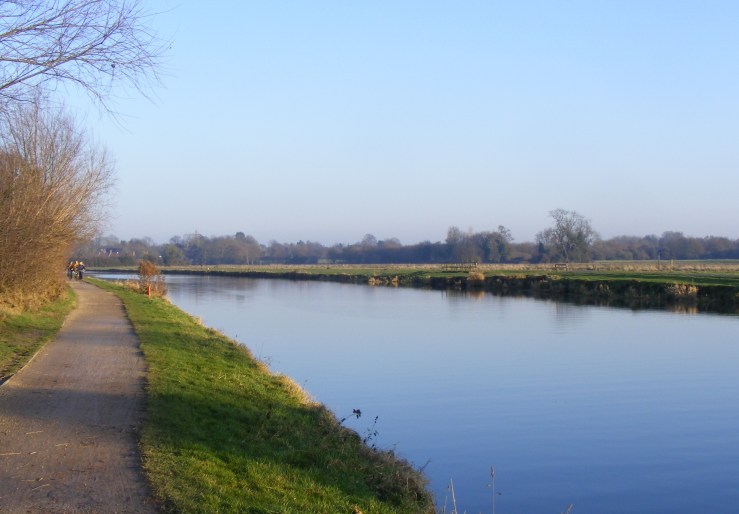
  • walks along the river
    • Getting off Twitter has helped every time. Getting out of the house has helped most times. A brisk four miles (up to the lock, and back again) makes things an awful lot better.
  • time by the sea
    • A long weekend in Lyme Regis in April; a week in Ventnor in July, and then another few days there just now.
  • the love and support of friends and family
    • I really do have some excellent people in my life.
  • perspective
    • Even when things inside my head have been dreadful, I have never forgotten that this is not reality. I think this might have been the first year that this happened.
  • the music.

December Reflections 17: five years ago

dscf1981

Five years ago, I was writing to December prompts for the first time, though I seem to have done a whole heap at once. This was Reverb 11.

Five years ago, I was beginning to come to terms with some things that I now accept as the price of admission for being who I am. That I’m not at my most energetic, creative or enthusiastic at this time of year. That winter will always be difficult. That uninterrupted good health is not, after all, something to be expected as a right.

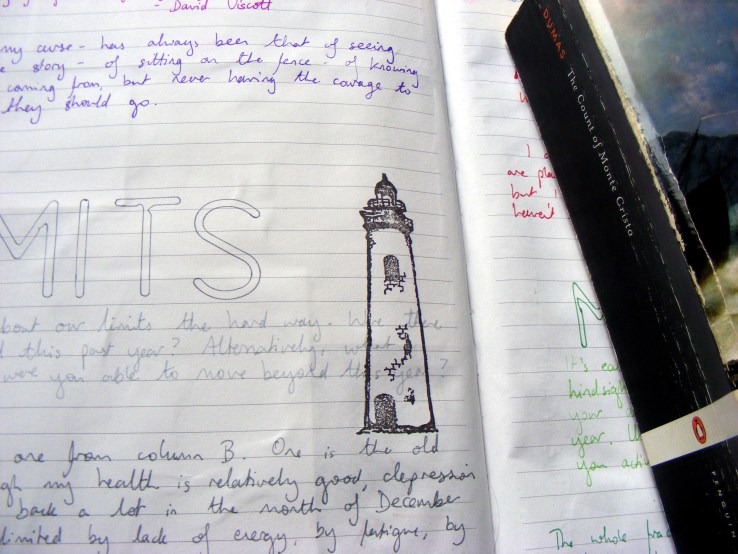
Five years ago, my diary was much more colourful than it is today. This is actually one of the less exuberant pages: elsewhere there are stickers, collage, glittery pens, all sorts. I think the reason I’m not doing that so much at the moment is the fact that the chest of drawers wherein I keep all that gubbins is no longer in the same room as my diary; these days it’s much easier to write in black fountain pen, the book resting on my knees, with my feet up on the sofa.

And I was just learning the use of fandoms that take a while to get through. I was reading The Count of Monte Cristo and watching early Doctor Who. The book was probably a little less battered five years ago.

December Reflections 8: on the ground

dscf1919

On the ground. Grounded. Down to earth with a bump.

This is new ground, or, rather, what is on top of the ground hasn’t been there long. Pavement and fallen leaves; much of the ground in London looks like this at the moment. It all feels a bit artificial: neat, and new, and even the trees have been put there by somebody.

It’s Thursday, and things are difficult again. It’s dark when I get up now, and it’s dark when I leave work, and in between it’s grey. I pour music into my ears and light into my eyes, and it helps a little bit, but not enough, and I’ve got to do it all again tomorrow. I’m taking comfort in the fact that, for the moment at least, I retain enough of a sense of humour to appreciate ‘Greenleaf 1’.

December Reflections 7: five things about me

dscf1915

Five people I am:

  1. the Fairy Godmother. I’ve been the Fairy Godmother on and off for years, mostly at work. She’s the one who knows the answers, the one who gets things done on surprisingly limited resources.
  2. the Queen of Hearts. This is a very new persona and I’m still finding my way into being her. She’s the one who lives by love and not by guilt; she’s the one who’s managed to find a balance between living with integrity and not burning out.
  3. Black Pen and Red Pen, Writing and Editing, go hand in hand. I love them both and I’m counting them as one.
  4. the Pilgrim. Always on the way to somewhere, or looking at a map, working out where the next somewhere will be.
  5. the one who looks fantastic in hats, and bright red, and bright red hats, and knows it, and also doesn’t care what anybody else thinks.

December Reflections 4: circles

dscf1904

I’ve had bicycles on the brain this year. No, I’ve had bicycles on the brain since I stepped out of Woking station one day in May 2011 and found myself in the middle of a cycle race – but this year in particular I’ve been thinking about bicycles, writing about cyclists, photographing bicycle wheels, watching cycle races – and riding bicycles.

This one’s new – well, new to me. I bought it from my brother in July. The great thing about it is that allows me to cycle at both ends of a railway journey, rather than just the home end – which, if I’m visiting someone who lives a fair distance from a station, for example, is handy.

Anyway, there are lots of circles in it, handily depicted on the diagram on the down tube. (Is it a down tube, on a Brompton?) Also in circle news of 2016, I had a poem called ‘Circles’ included in Purple Prose: bisexuality in Britain. And I thought a lot about spirals, about labyrinths, about recurrence, about finding oneself back where one started, about the other sort of cycle. I thought about experience, about how I can compare any experience that I have now to experiences that I have had previously, and to experiences that I can imagine having in the future.

Next year I’m intending to publish A Spoke In The Wheel. I’m going to return to Santiago de Compostela, completing a cycle of a decade. Apart from that? I don’t know, which is unusual for me. By this point in the year I tend to have a good idea of what’s coming up in the next one. As things stand at the moment, I have a very strong sense of having finished a lot of things I’ve been working on, of having achieved most of the goals I identified, of having resolved many of the challenges that arose in my twenties, and not being entirely sure what comes next.

I’ll definitely do some cycling, though.

Postcards from a journey through burnout

I’ve been thinking a lot about burnout this year. I’ve been there a few times. It’s a known hazard of being brought up in an activist family. It’s a known hazard of being a member of an organised religion. It’s a known hazard of working for a trade union.

It’s what happens when you’ve signed petitions until your email inbox is nothing but Avaaz and 38degrees, and when you marched against pretty much everything, and when your weekends have disappeared into doorknocking or leafleting or selling flowers of solidarity, and you’ve bought fair trade, and you don’t own a car and you haven’t travelled by air since 2007, and you can’t remember which of the cereal brands you’re meant to be boycotting, and buying cheap stuff is exploitative and buying expensive stuff is extravagant, and the personal is political, and the political is personal, and you’ve voted, and you’ve badgered several other people into voting, ruining your relationships in the process, and after all that the world is still a mess and you’re still feeling guilty because you haven’t fixed it.

For example, this was me in 2012:

It was all very well when I was fifteen and had no life and was all idealistic, but these days I do not have the energy to be any more political than I am paid to be, and I am sick to the back teeth with everyone else’s Causes, while simultaneously feeling guilty for Not Caring and therefore obviously being a Horrible Person. I don’t think I have any causes left myself. I am so tired of them all.

I have been back in that place this past year. It probably dates back to before the general election in May 2015. I have felt so burnt out, so powerless, so useless, and it’s been particularly difficult because of the way that things have been falling apart. I’ve been feeling that I should be doing something and knowing that there is very little I can do and that nevertheless that’s no excuse for not trying. Filling the unforgiving minute with sixty seconds’ worth of distance run, and all that. So you keep going either until the world is fixed, or until you fall apart, whichever is the sooner. Guess which is the sooner.

I think it might be a defence mechanism. I think it’s what happens when your body works out that the reason you won’t rest is because you care, so it stops you caring.

In August, trying to channel a version of myself who wasn’t exhausted and jaded and burnt out, I wrote this to myself:

you are loved, you are enough
even though you don’t know how to be an activist and an introvert
even though you think you have probably had it with activism of any sort anyway
because so much activism seems to have become about telling people that they aren’t enough and they don’t do enough
and however much you do it’s never enough
because guess what, you can’t fix the world by yourself
and you’ve learned enough to know it’s not your job to bully other people into fixing the world with you
even though you stopped volunteering to do stuff ages ago and the desire to volunteer for stuff has yet to re-emerge and maybe it never will
even though you can’t tell how much of this is predictable August head-stuff and how much is real
and you fear that everyone will think it’s head-stuff while it’s been co-existing with being OK, actually
this thing goes two ways and you’re allowed to be the one who says NO
and do you know,
yes, the thing that is right is often costly and challenging
but!
a) not always, sometimes it can be easy
b) just because something is costly and challenging does not mean that it is right
and you can’t make something right by making it harder
you are loved, you are enough
[and no, this is not a trick designed to make you get up and start doing stuff just because you’ve been told you are enough as you are]
[you think you’ve met that one before]
if you stayed in bed forever you would be loved, you would be enough
and I’m not even going to tell you that you won’t stay in bed forever
because I don’t want you to think that this is in any way conditional
you are loved, you are enough
that’s it.

And yes, of course some of it was predictable August head-stuff and I feel better now. And at the same time I do not want to get into that state again.

A few weeks ago, having been recovering gradually through September and October, I wrote this on Twitter:

I have been feeling guilty for most of my conscious life for not fixing the world.

Logically, one has to stop fixing things well before all the things are fixed, perhaps before any of them are.

The question is, how to stop feeling guilty about stopping.

Because eventually, you reach the point where you have to stop because you’re feeling burnt out and exhausted.

Perhaps so much so that you can’t imagine ever wanting to start again. And yet your sense of worth is tied up in fixing things.

Meanwhile the rest of the world carries on fixing and breaking things, depending on your point of view, and always wants you to help.


This is where I’m trying to break the pattern this time: to move my sense of self-worth away from what I do or don’t do, and towards the simple fact that I’m human.

I was giving myself permission to stop trying to fix things, to accept that there are certain things that are basically unfixable, that there are certain people’s opinions that won’t be changed, that push push push all the time doesn’t work. That even if I’d managed, for example, to get to the Stop The War march, the war wouldn’t have stopped.

The next day – obviously feeling better for having got all that out – I continued the conversation with myself, and wrote in my diary:

I think that if I am ever to fix anything it will be by writing fiction. It is the way that I share the ways in which I fix myself. And I can’t fix anybody; they have to work it out for themselves; and fiction helps us make the jump, because we have to put in the work.

It made more sense at the time, but what I think I meant was this: fiction – reading it, writing it – has been instrumental in helping me understand that I am human, and that being human is enough. Whether I’m writing, whether I’m working, whether I’m falling apart, being human is enough. Who knows, maybe that will stick. Maybe that was my last burnout. Maybe next time I’ll remember to stop before I fall apart.

In the meantime, I’m going to avoid putting the same pressures on myself, and on anyone else.

Telling people that they’re not doing enough to fix things, or that they’re trying to fix things the wrong way, is not going to get things fixed, or get them to do more.

Or, if it does get them to do more, it won’t last long, because it will hasten their inevitable burnout, and things will remain unfixed.

Guilt is not a sustainable motivator.