It is entirely appropriate that I bought this mug for myself
There was a minor kerfuffle recently regarding Ros Barber (of whom I had never heard before she popped up in the Guardian) and her thoughts on those who choose to Self-Publish And Be Damned. Since her arguments have been roundlyrefuted by people who have published more books and made more money than I have, I won’t wade in on that particular point. Also, this was a fortnight ago and nobody cares any more.
All the same, I’ve been meaning for a while to explain how I made the decision to self-publish.
Up until last year, self-publishing wasn’t on my list of options. It wasn’t because I didn’t know about it. I knew about it. I knew people who had done it. I thought they were incredibly brave. Personally, I was too scared of the following factors to contemplate it myself:
the gargantuan amount of work that I’d have to do (or organise) myself, rather than outsource to the publisher’s friendly in-house editors, cover designers, proof-readers, publicists, and so forth;
the huge amount of money I assumed it would cost;
the possibility of some joker taking some element of my book personally and trying to sue me;
people whose opinion I respected thinking the less of me, as a writer and a person.
It wasn’t that I didn’t think my book was good. I wouldn’t have been sending it round agents and publishers if I didn’t think it was worth, well, publishing.I just wanted somebody else to tell me that.
I already knew that the target audience for my book was limited. I knew that it would be difficult to sell even if it were very, very good. At the same time, I knew that there would be people with whom it would resonate, who would enjoy it, who would find it useful. I’d written it to relieve my own feelings, but I knew that those feelings were not unique to me. I didn’t want to leave the thing languishing on my hard drive for ever, but I was far too scared to self-publish. What would people think?
Last year turned out to be fairly heavy in the ‘personal epiphanies’ department. I discovered that I thought the institution of marriage human at best and idolatrous at worst. I told people to stop fucking apologising for swearing in front of me. I moved from thinking of myself as a ‘liberal’ Christian to thinking of myself as a ‘radical’ one.
I found that other people’s ideas about who I was and what I was worth were becoming less important to me. I found that I no longer needed other people’s approval. I didn’t need a fairy godmother to give me permission to go to the ball. I was my own fairy godmother. I got myself a dress and a pair of shoes, and I gate-crashed the party.
Put like that, it doesn’t seem like much. Looking back from where I am now, it doesn’t seem like much. You’ll just have to take my word for it that it was an epic mental shift.
I did send the manuscript to one last publisher after I’d made the decision to self-publish. I felt a bit ambivalent about it, but a family member had gone to some trouble to get them to take a look at it and it seemed churlish not to.
You can’t imagine how relieved I was when they weren’t interested. I’d gone beyond wanting someone else to do all the hard work. I’d taken control, and now I didn’t want to relinquish it. I had learned to say: Yes. This is my work. I am not ashamed to claim it, to put my name on it, to send it out with no one’s approval but my own. And it turns out that I don’t want to go back from that.
Once upon a time, this was going to be the opening scene of Speak Its Name. Not this particular version, which slots in after another deleted scene where Lydia’s mother is driving her to Stancester (literally, not metaphorically), but it definitely started with a wedding. I was trying to do something clever with doubling and framing; also to introduce all the Alma Road characters; also to drop in the point that the ministers of a marriage are the couple themselves. It does all that, but it also introduces three completely unnecessary characters and slows up the action. And it doesn’t involve Lydia.
The wedding was at Wardle Street Methodist Church. Lily Wicks, former President of Stancester University Anglican, Methodist and United Reformed Church Society, AngthMURC for short, was marrying Ross Whitehouse, former Social Secretary of the same organisation – a commitment that most of their friends affected to deplore, on the grounds of their excessive youth, but were secretly rather pleased about.
‘And after all,’ Peter Nathan observed to Olly Sennick as they awaited the arrival of the bride, ‘who cares if they have only just graduated? If you know what you want, you know what you want.’
‘Well,’ Olly said, cattily, ‘Lily always knows what she wants, and Ross is so laid back that I don’t think he much cares. Ridiculous institution, anyway. It’s just a piece of paper. I can’t see why they need a vicar.’
Peter could not resist rising to that particular piece of bait. ‘Not a vicar, in a Methodist church. You’re right, though: technically, it’s the couple themselves who are the ministers of the marriage. The chap in the dog-collar is just the registrar.’
‘Hmph,’ Olly said.
The pair of them, together with their housemates and various other friends who, if anyone had asked them, ‘Bride or groom?’ would have replied, ‘Um…’, filled the second row on both sides of the church. Peter glanced left and right. On Olly’s other side sat Ruth, attending her last service at Wardle Street before leaving to start her PhD in America. Across the aisle was Colette, managing to look slightly dishevelled even today. She saw him looking, and turned away, a flush streaking up her cheekbones. Peter sighed, and told himself – again – to stop barking up that particular tree. It was pointless, offensive, and liable to cause difficulties sharing a house in the year ahead.
Speaking of which… The two unknown quantities sat on Colette’s right – her friend Becky, the Lancastrian Quaker (loud, but not, so far as Peter had seen, obnoxious), and then her friend Will, the incongruous posh-boy Evangelical, to whom Olly seemed to have already developed a violent antipathy. (Why? It couldn’t be the Christianity alone, or Olly could hardly have survived last year, stuck in the middle of the assorted gaggle of Anglicans and Methodists. It wasn’t as if he had a strong personal liking for anybody beside Georgia…)
Georgia’s seat was empty, of course; she had a place reserved on the front row, handy for bouquet-catching and train-bearing and whatever else a chief bridesmaid was meant to do. Although – was that her voice? Peter looked at his watch.
‘Early,’ Olly said. ‘Trust Lily.’
‘She’ll be wandering around talking to people, and Georgia will be trying to shove her back in the car and drive round the block a few times until she’s properly late.’
‘Not a wise move, in Stancester on a Saturday. Particularly not in Freshers’ Week.’
‘Do you know, I had actually forgotten, for five seconds, that it was Freshers’ Week?’ Peter groaned. ‘And, no matter how bad the hangover, I have to be up tomorrow to shepherd all the little baby firsties to Chapel. I bet there won’t even be any…’ He shook his head. ‘Just don’t remind Georgia, OK?’
Colette leaned across the aisle and said, reproachfully, ‘She’ll be fine once it’s actually started. Actually I think it’s been good for her, being bridesmaid. It’s taken her mind off AngthMURC stuff.’
‘I love Georgia, and I know I voted for her,’ Peter said, ‘and she does get stuff done, but I’m still not convinced that her taking over from Lily was the best idea in the world, from the point of view of harmony in the home and everybody’s mental health. Wait until you’ve lived with her for a term: you’ll see.’
‘Dunno why she wastes her time with it, anyway,’ Olly said. Peter put it down to the enforced churchgoing, and ignored him.
‘What are we – Colette began, but she was interrupted by a well-intentioned fanfare on the electric organ. Peter was the first to his feet, Olly close behind, the whole congregation rising and simultaneously turning to look over its collective shoulder at the west door.
Peter felt surreptitiously in his breast pocket for the card on which he had printed his reading, just to make sure that it was still there. He could have done it without the text, at a pinch, but it was 1 Corinthians 13, which everyone knew from all the other weddings they had ever been to, and to complicate matters Ross had insisted on compiling his own ‘translation’ from all the versions he liked. This, Peter was fairly certain, was not legal (though you never knew, with Methodists), but at least it wasn’t the Street Bible. He wondered if he was nevous, and rejected the thought: he read, in church, without the stutter, which, he thought, showed, if anything did – but here came the bride.
‘End of an era,’ Olly murmured, as Lily passed them, and winked.
I expressed my sincere thanks to the editors of Speak ItsName with a line on the acknowledgements page, a signed copy, and a bottle of gin.
I did not thank my cover designer, my typesetter or my publicist in this manner, but I’m making up for it now. They’ll have to share, though. I’ll end up completely plastered otherwise.
The payment for the first month’s worth of sales of Speak Its Name came through today, so I’ve celebrated by upgrading this blog and getting rid of the adverts. Over the next week or so I’ll have a play around with the layout, too. Don’t panic if it all looks different.
I’ve had a lovely review from Gemma at The Accidental Book Reviewer. (Full disclosure: this is a paid service, and also Gemma is a friend – one of the lovely people I met through marrying into the Discworld fandom. I do not usually pay for book reviews, but this is a new venture for her and I wanted to support it.)
I’ve turned on the thingummy at Goodreads that allows you to ask me questions. I’m working my way through the defaults at the moment, but if there’s something you want to know about me, my writing or Speak Its Name, I’ll move your question to the head of the queue. (Goodreads won’t mind. It’s only a robot.) Or you can ask me here.
The picture, incidentally, is a few weeks old, and the sweet peas in it are now a good ten centimetres tall. Things move fast when you’re not watching them.
A very happy Easter to all those who have been, or still are, celebrating it today – and to those who feel like they’ve only left church to sleep since Thursday, I wish you a sit-down and a glass of wine.
I’ve been taking things a bit easier of late, and will continue to do so for the next couple of weeks (might post, might not, depending on how I feel) – but there’s an interview with me at Women & Words today if you want something to read.
Another bit from the first year’s action that went in the great Lydia takeover. Once again I note my fondness for ‘C…l…’ names. I was rather sad to ditch Milly…
Georgia came up the road at a jog, hair flapping, cheeks rosy. ‘Hi, Colette.’
‘Morning. I don’t know how you’re so energetic. It’s January, and it’s tipping it down!’
‘I’ve only been down to Clifford’s Bridge and back,’ Georgia said, as if that wasn’t half-way across the city, and then, ‘Some days I just need to run and run.’
Colette did not know what to say to that. She just nodded. ‘Have you had breakfast?’ she asked. That at least was a safe question.
‘I had phase one of breakfast before I went out. Phase two is now.’ Georgia ran a hand over her forehead, shiny with rain and sweat. ‘Drat. I meant to get some milk on the way back.’
‘Whoops,’ Colette said. She shook the last reluctant envelope into the recycling bin and turned to go back indoors. Georgia followed her upstairs to the kitchen.
The timing was unfortunate. Olly was using a tea-towel to dust off a perfectly clean bowl. Seated at the table was a rumpled looking (but oh-so-sexily rumpled!) girl with big blue eyes and dishevelled blonde hair. She was wearing what Colette recognised as Olly’s dressing gown, and, by the looks of it, not much else. She looked better than she had any right to at that time in the morning and in that garment.
Olly stared at Georgia. Georgia stared at Olly. The air grew denser, and the girl looked at Colette. Colette said, helplessly, ‘Hi. I’m Colette.’
‘Camilla. Milly.’ There was money in her voice.
Colette gestured at Georgia, who was hitching up her damp jogging bottoms. ‘Georgia. We’re Olly’s housemates.’
‘Hi. Hi.’ Camilla – Milly – smiled slowly, apparently oblivious to the thickening awkwardness.
Georgia was not going to help. Colette asked, ‘So, how do you know Olly?’
‘Oh, one of my friends dragged me along to Archery yesterday afternoon, and of course Olly was there as a member.’
‘You’re a first year?’
‘Oh, yes.’
Georgia said, ‘Excuse me,’ and stomped off to the bathroom. Olly shrugged, but, since he was standing behind Camilla, only Colette saw.
‘Which hall are you in?’ Colette asked, having failed to think of a less boringly Freshers’ Week sort of question.
‘Ward.’
The newest, shiniest hall of all. That figured. ‘Do you like it?’
‘It’s not too bad.’
No, she must be aware of the atmosphere; she’d be talking more if she were genuinely unaffected. Desperately, Colette asked, ‘What are you studying?’
‘French and Spanish.’
French and Spanish. Colette probably knew something about French and Spanish, if only she could think of it, and if only Olly would stop gawping at her and turning progressively redder in the face. ‘Cool. I believe Stancester’s Languages School is pretty high up in the league tables.’
Camilla shrugged; the dressing gown slipped a little way down her shoulder. Colette tried not to look. ‘Yes, it’s not bad. I tried for Oxford, of course.’
‘Didn’t we all?’
Olly, contributing to the conversation at long last, said, ‘Oxbridge rejects, the lot of us. Don’t worry. There are plenty around.’
Colette was running out of small talk. She said, ‘Well, I need a shower. Stuff to do. Nice to meet you,’ and fled.
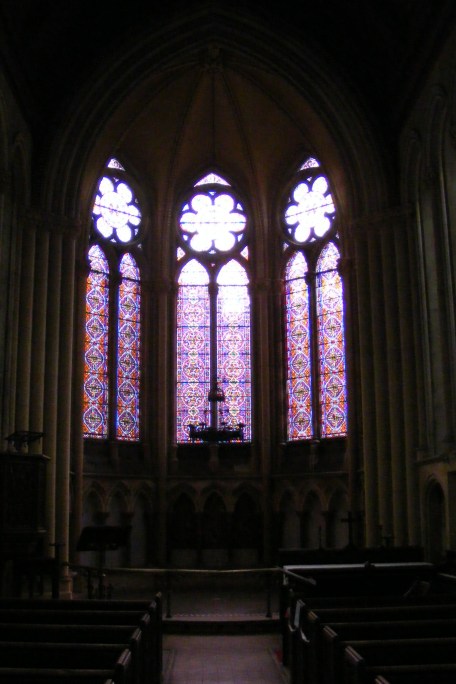
Not actually Sainte Chapelle; it’s St Mary’s, Itchen Stoke, which is about as good an illustration of the complicated nature of the history of Christianity as I’ve got on my hard drive
I got an ebook reader for Christmas, which is great, because it means I’ve been able to read heavy books on the train. One of them is Diarmaid McCulloch’s Christianity: the first three thousand years, which I am enjoying far more than I expected. It’s much more nuanced than the accompanying TV series, which had me muttering, ‘no, affirming the humanity of Christ is not actually heretical’, and is hilariously bitchy in places and very interesting throughout. At least, if you find deeply-felt squabbles over apparently trivial differences with appalling results interesting, which I do. I’ve given up apologising for Those Christians Over There and whatever they’ve done now, but I do feel that it’s worth knowing how they got there, and how I got here, and what we still have in common. And getting to very different places using the same map has been a feature of Christianity since, oh, the book of Acts.
In that spirit – here’s the AngthMURC/Cathsoc committee meeting that happens between chapters 2 and 3 of the first section of Speak Its Name. All the inter-denominational schism and bitchiness that the heart could desire.
‘Hmph!’ Sophie said, when Peter had finished reading out Jake’s email. ‘Well, it’s a pity, but I can’t say I’m surprised.’
There was just about space for the six of them around the kitchen table at 27 Alma Road. Georgia was in fact at the sink, frantically washing up mugs so that due hospitality could be offered. Sophie, Tim and Kasia, the operative half of the Cathsoc committee, were squashed onto the bench on one side; Becky, still in her pyjamas, crunched toast opposite them; Peter sat on the wobbly chair, at the end that wasn’t against the wall, and spread ancient AngthMURC paperwork across the vinyl tablecloth.
‘I don’t suppose we could compromise?’ Kasia said.
‘How do you mean?’ Georgia asked.
‘Well, of course we can’t sign their Statement – have you read the thing? – but could we perhaps suggest the Creed instead?’
‘No,’ Becky said, blinking over very strong coffee. ‘Sorry – that was a bit abrupt. I didn’t mean to be rude. What I mean is, of course you could, but I wouldn’t sign it. Wouldn’t sign anything. I’d still come, but I couldn’t be involved in the organising if that was the condition. Same with most of the Friends, I would think.’
Olly wandered into the kitchen in his dressing gown, said, ‘Oh, God. Christians. Shouldn’t you all be at church?’
‘Colette’s gone,’ Becky said.
‘Hmph. Vicarious holiness, eh?’ He wandered out again.
‘I doubt Fellowship would go for the Creed,’ Peter said, as the door shut. ‘They would say it’s too woolly. Anyway – which one? Half the Evangelicals I know don’t believe that Jesus descended into Hell, which excludes the Apostles’, and if we use the Nicene then we’ll start filioque all over again.’
‘Ah,’ Kasia sighed, ‘those were the days. Proper schism, none of your modern namby pamby stuff! Do we even have any Orthodox who’d want to be involved?’
‘You never know,’ Georgia said, peeling off the rubber gloves. ‘So are we going to write a tactful email to Jake Warner telling him to take a long walk off a short pier?’
‘Why are you all looking at me?’ Peter asked, with an injured air. ‘OK, OK, I’ll write it. And I’ll email the rest of Fellowship, too, letting them know it’s still happening. Together with an annotated copy of the Statement of Belief, explaining why it’s exclusive bullshit?’
‘No,’ Georgia said, apparently before she realised he was joking.
‘It’d be handy to have,’ Sophie mused. ‘We could make hundreds of copies and hand them out at the Freshers’ Squash. Poach a few members from Fellowship…’
‘Which reminds me,’ Tim said, ‘I still owe you lot my three pounds fifty for this year. I assume you’ve still got me listed as a member, since I’m still getting AngthMURC emails.’
‘You are. And I’m still getting Cathsoc ones,’ Georgia told him. ‘Fair exchange, no robbery.’
‘Remind me,’ Becky said, ‘why the Statement is exclusive bullshit? I always get stuck on the fact that they make you sign the bugger.’
‘Penal substitution, and sola scriptura.’ Kasia ticked them off on her fingers.
‘In English?’
‘Oh, Lord,’ Peter said. ‘OK. Penal substitution is the theory – which some Evos will try to make you believe is held by all Christians, but which really, really isn’t – that humanity is so fucked up that God (who in this version of events is omnipotent, omniscient and benevolent, but apparently really unimaginative) has to torture somebody horribly to make it all better.’
‘That somebody being Jesus,’ Tim put in, helpfully.
‘See me looking blank,’ Becky said. ‘Don’t take it personally. It may never make sense to me; Quakers aren’t really big on sin.’
‘I vaguely recall Father Steven explaining it all using There is a green hill far away,’ Peter said, ‘but I can’t remember how.’
‘That’s really helpful.’ Georgia was getting impatient.
‘And what was the other thing?’ Becky asked.
‘Oh, sola scriptura. The Bible alone – as a means to determine God’s will, I mean. They mean,’ Kasia corrected herself. ‘Leaving out of it tradition and reason.’
‘And experience,’ Georgia added.
‘Leaving the poor old Wesleyan quadrilateral wobbling on one leg, and causing alarm and despondency through the Church Rational,’ Peter said.
‘What about the Spirit?’ Becky asked, and laughed bitterly when nobody answered.
Then, if you are at all interested in feminism, Golden Age detective fiction or Shakespeare (not to mention the Church, Taylor Swift or Movember), wander around the rest of Quite Irregular. It’s one of my favourite blogs and I’m delighted to appear there.
There are some very early lines in here. The whale gag dates from the very first draft of all. Some of it will feel vaguely familiar, as I ended up recycling bits into Lydia’s internal monologue, though I think some of the duplication may have been deliberate. At one point I had the idea of showing the same event from several different points of view. I think cutting it down to a single one was the right move in terms of structure, but it did mean losing a lot. I’m afraid, though, that this is all you’ll ever get about Why Olly And Will Hate Each Other So Much.
Will looked very much like any other stereotypical Stancester student – rah, sloane, Oxbridge reject, call them what you will. He had the floppy hair and the flippy-floppy flip-flops; he owned a wardrobe of rugby shirts, all of which he wore with the collar turned up.
Stancester, despite vigorous attempts by the Public Relations department to shake off the label, was generally acknowledged to be a university for Oxbridge rejects. It had always been fairly likely that a certain proportion of those who lacked the brains or motivation to reach the dreaming spires even leaping from the springboard of private education would end up settling for the rather less dizzy heights of Stancester’s prosaic and distinctly square blocks.
Will was among this number and was not ashamed to admit it. But the Lord looks at the heart, and Will’s beat, with well-meaning, exuberant devotion, to the glory of God the Father.
As Olly had informed Peter, it had not always been thus. Despite the best efforts of a cathedral school, the Dean’s sermons, and Religious Education, Will had never really grasped the point of it all. Oh, he enjoyed the singing, he would nod approvingly when people talked about the United Kingdom being culturally Christian, but it had never, he said, reached the deepest part of his being.
Nor had he ever really expected it to – particularly not three weeks into his first term at university, when the hangover that he had been trying to outdrink since Freshers’ Week had caught up with him, he was despairing of ever getting his head around Professor Bullen’s take on employment law, and he had just got onto the reserve hockey team. Some good, some bad, but none of it really the kind of experience that would obviously lead one to God.
God, however, works in mysterious ways, a fact that Will was to discover over and over again over the course of his university career.
Had he thought about it at all, Will would have compared his first term, to living inside a kaleidoscope, it had been such a colourful whirl of reality, illusion and violent agitation. His Freshers’ Week and the fortnight following it had been like one long school reunion. He had, he estimated, had alcohol in his bloodstream for eighty-five percent of his waking hours, and been roaring drunk almost every night. He had joined the cricket club, the rowing club, the sailing club, and several more that he only remembered when they sent him emails. Occasionally he had been to a lecture. He had, in fact, had a whale of a time.
It was the Tuesday of Week 3 when the whale seemed to tire of its parasitical passenger and vomited him out onto dry land. There was nothing special about Tuesdays; and this one was no different (so far as he could judge) from any other Tuesday. He had no more of a hangover than usual; his contract law lecture was no more boring than usual; his friends were, if anything, more scintillating and amusing than usual. Had you asked him how he felt about life, he would have blinked at you a little and replied that yes, on the whole he was pretty satisfied with it.
Will could not have told you what was so intriguing about the neon yellow poster that appeared, from a distance, to bear the single word Perfection? He could not have told you why he crossed the dining hall to look at it more closely, nor why, having deciphered the legend Want to know more? Look out for SUCF events throughout weeks 3 & 4!, he did not simply identify it as harmless, if silly, Christian propaganda and dismiss it as irrelevant. He walked on and ate his lunch, but the one-word question danced infuriatingly in his mind. Perfection?
He saw an identical poster that afternoon, blu-tacked crookedly to a door and, below it, a half-sheet screaming excitedly Ken Garnett HERE 4pm!!! Will consulted his watch. It was three minutes to four. He hesitated for less than a second before pushing open the swing door and – he could not have told you why – walking in.
After the event Will was, in his own mind at least, perfectly capable of explaining the mysterious attraction the Perfection? poster had for him. ‘It’s like, yeah, the Lord just, just, led me to that event; it’s like He was saying to me, “Will, you’ve just got to stop this sinful life you’re leading, you’ve just got to stop it and follow me.” He was saying to me, “Will, you’ve got to change”. And yeah, that was it, basically.’
Others put it down to boredom.
The effects of Will’s conversion upon his life were not immediately obvious to the casual observer. He continued to participate enthusiastically in the social life of the university’s sporting circle, both in the sport itself and in the attendant lager consumption, and was not noticeably more dedicated in his attitude to his academic work. He managed, however, to squeeze a few more hours into each week of his crowded calendar, and in them applied himself to Bible study, prayer meetings and good works. His circle of friends expanded to include Christian Fellowship members from every conceivable background. This was how he ended up frying eggs and bacon every Friday morning at Saint Martin’s Centre for the Homeless – a commitment he fulfilled religiously no matter how bad his hangover – and that was how he met Becky.
Will and Becky’s friendship was an unending mystery to acquaintances on both sides. Each one’s upbringing, politics and religious views were manifestly at odds with the other’s. Will said ‘sconn’; Becky said ‘scoane’. Becky said ‘laff’; Will said ‘lahf’. One would have assumed that all they had in common was the greasy frying pan at Saint Martin’s. It was impossible to deny, however, that there was more to the bond than the coincidence of the shared Friday mornings, and, against all the odds, Becky and Will got on like a house on fire. They teased each other mercilessly, mocked each other’s accents, brightened each other’s life with unceasing affectionate bickering and entertained the other volunteers and the homeless diners queuing up for their breakfast. Somewhere between the mocking and the insults the eggs and bacon got cooked.
In fact, it was Becky who had invited Will to fill the sixth space in Alma Road, back in the spring of first year. He had missed the boat in the scramble for housing; his Fellowship friends assumed that he would be sharing with people from the Sailing Club; the sailors took it for granted that he would have found a home with the Christians. Which, in the end, he did – but not those Christians, and anyway, Becky tended to get twitchy when people called her ‘Christian’. Olly, too – well. Will tried not to think too hard about Olly, but there it was: evidently a cathedral school hadn’t done much for either of them.
Leaving all that aside, even the ever-gregarious Will had secretly admitted that it was something of a relief when Becky turned to him across a sinkful of hot greasy water, and asked, ‘Who are you living with next year, anyway? Because I’m going in with my flatmate Colette and some of her friends, but I know they’re still one down…’
‘I hadn’t quite got as far as that,’ Will said, sheepishly. ‘I’ve got so much going on, you know? But yeah, if your house does have a spot going that would be great.’
She flashed a grin at him. ‘Brilliant! I’ll have a word with Colette, just to make sure they’ve not found anyone else, but it sounds like we’re good to go!’
And so they were. He wondered, sometimes, if he would have changed his mind had he known that Olly Sennick was one of this vague group of ‘Colette’s friends’ before he signed the contract – but never wondered too hard. After all, he concluded, every time, it was probably part of God’s plan. Perhaps he would be the one to lead Olly to God. Perhaps…




 Kathleen Jowitt