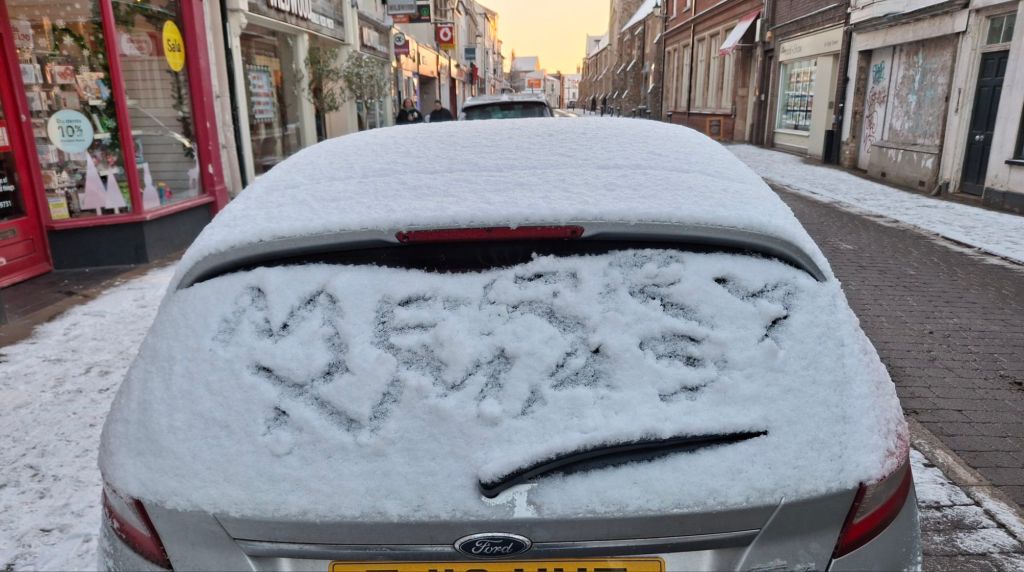
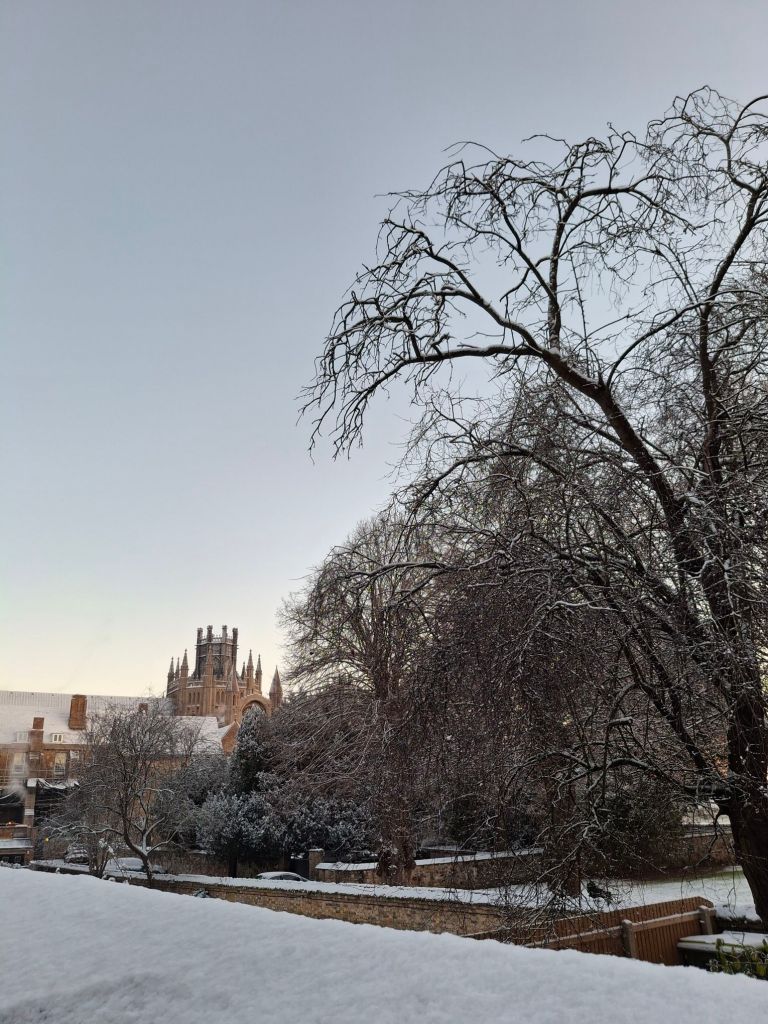
It snowed overnight! We don’t get much of it round here; in fact, it’s been almost exactly a year. So either the perpetrator of this mild act of vandalism is keeping the full twelve days of Christmas, or else someone’s driven in quite a long way without clearing their back windscreen.
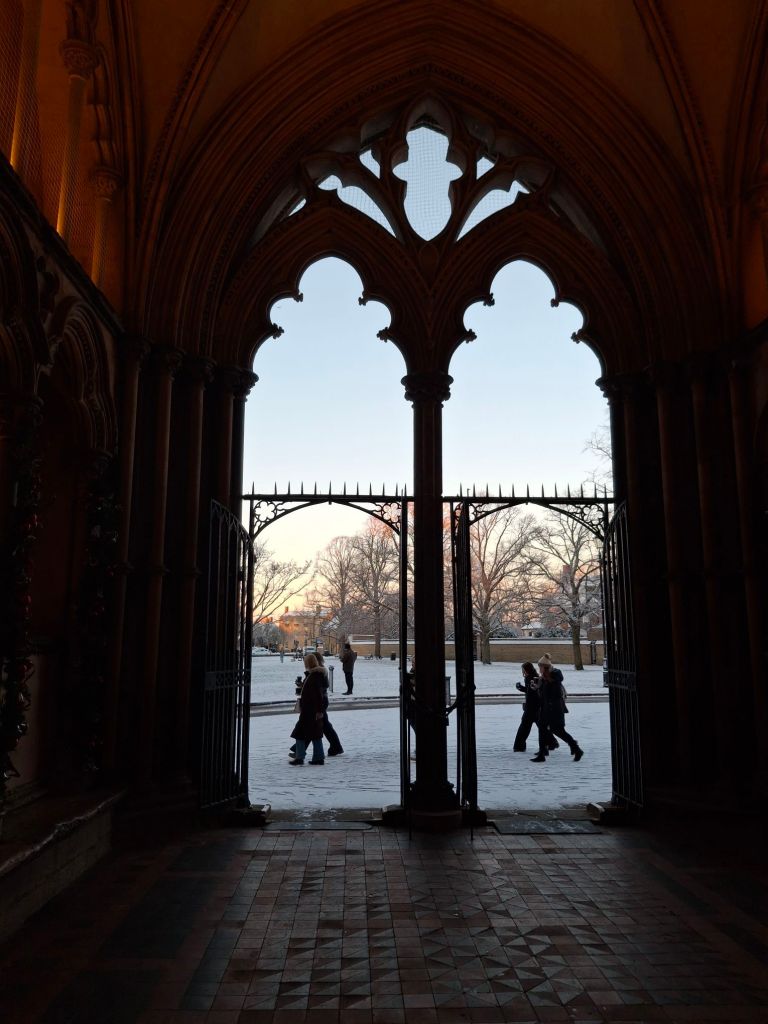
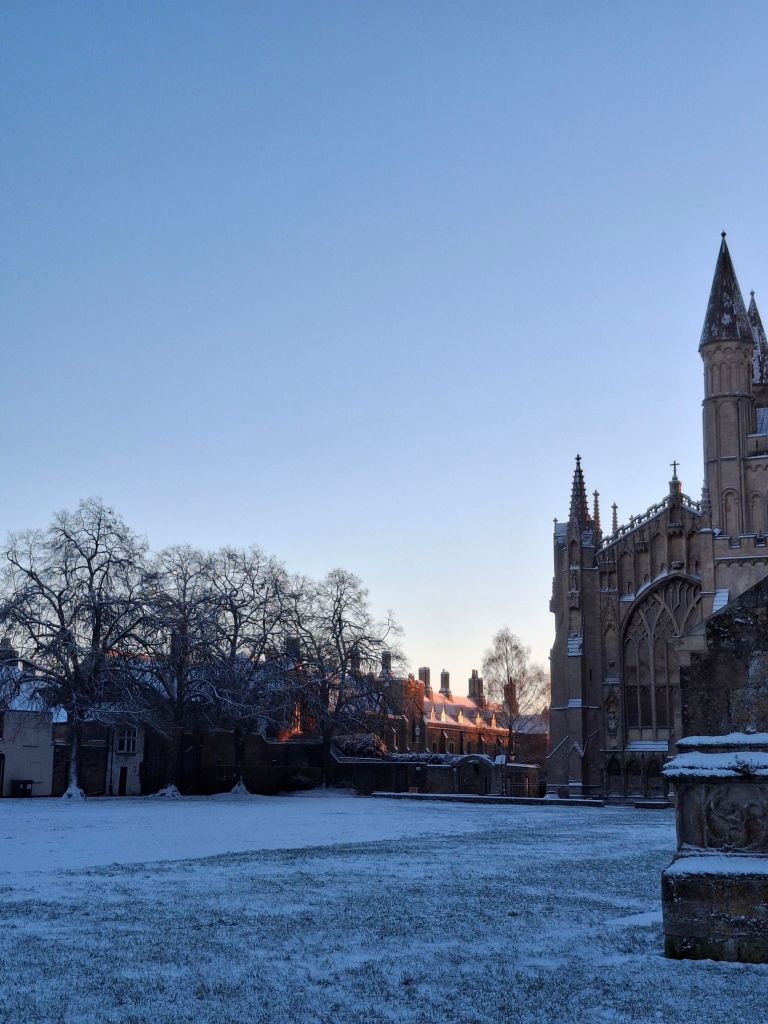
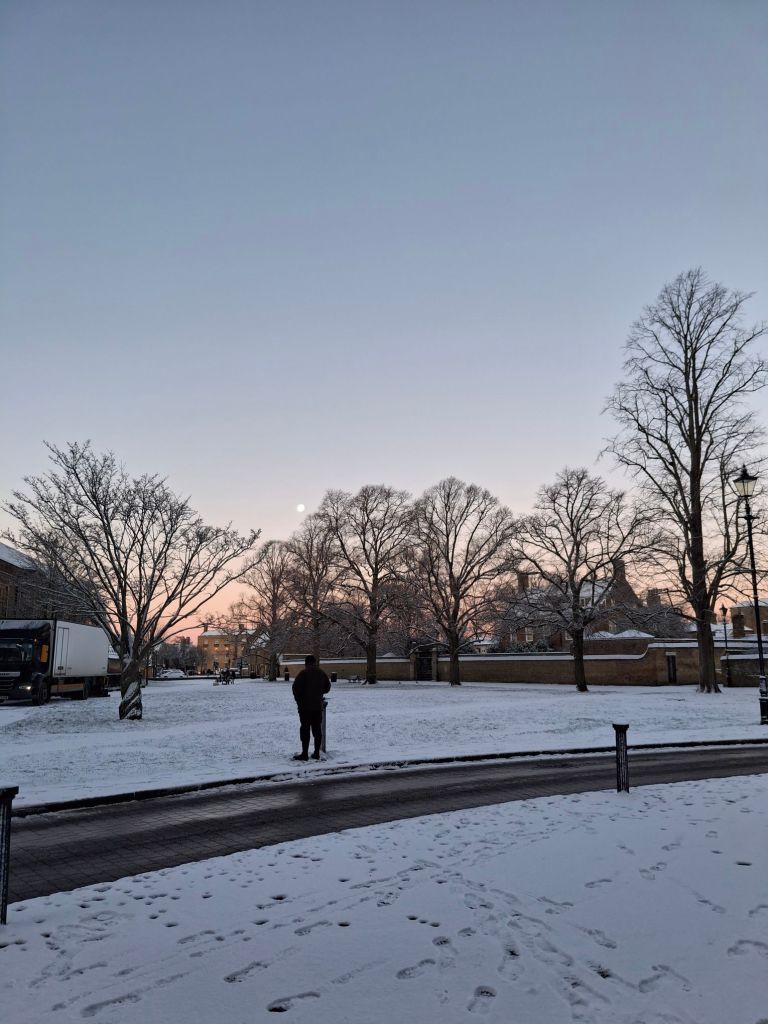
Anyway, this time last year we had a pathetic little dusting of snow, and I was in bed, in a good deal of pain and unable to keep any food down, as the leftover gas from my gallbladder removal surgery fought its way around my abdomen. (What sorted it out, for anyone in similar straits, was a little pill called Wind-eze. The packet wasn’t very clear on how it works, but it does.) Today, by contrast, I was able to walk across town in my Wellington boots, stopping at the cathedral to walk the labyrinth (still in wellies – that’s a first!) and eat the last cherry cream choux bun in Caffè Nero. So, contrary to my gloomy posts of the last month, I can and do get better.
Another cold day, but clear and sunlit, and all the trunks and branches of the trees glowing – the silver on the birches, the golden lichen on the hazels and oaks, and the moon between them. I walked – not as far as yesterday, but further than I’ve managed on other days – and kept going further than I strictly needed to because it was too beautiful to stop so soon. It’s so good to be able to do that again.
I took a slightly longer walk today, long enough for my legs to stop feeling wobbly and then start feeling wobbly again. I came out from the corridor of trees and stopped at the road for longer than I usually would, noticing the pull of the flat land beyond the A10. It was cold, and there was no sun so it felt colder, and I would have liked to cross the main road and walk out under the grey sky towards the band of pale pink. Instead, I carried on, noticing how very cold it was, how very bare the trees, how very spiky their twigs. I reminded myself that I wasn’t going to feel this weak forever, that this wasn’t COVID or pregnancy, that it was going to be a matter of days rather than months. Thought that I ought to pump up the tyres of my road bike for when I should be ready to cross the road, but not yet. Then, in the trees, birdsong: I guessed it was a robin, and then looked up, and up, and saw it at the very top.
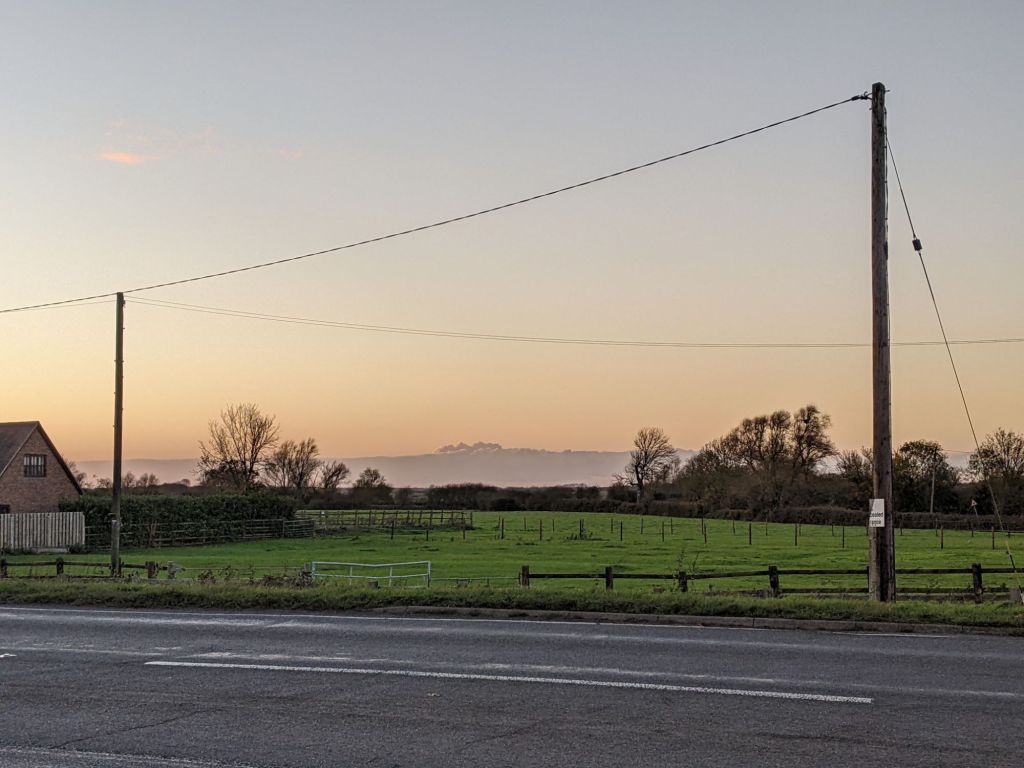
I went out for a walk this afternoon, climbing from sea level, or just below, to the heady height of about twenty metres above. When I came down again I could almost believe that we had a range of hills the far side of the fen.
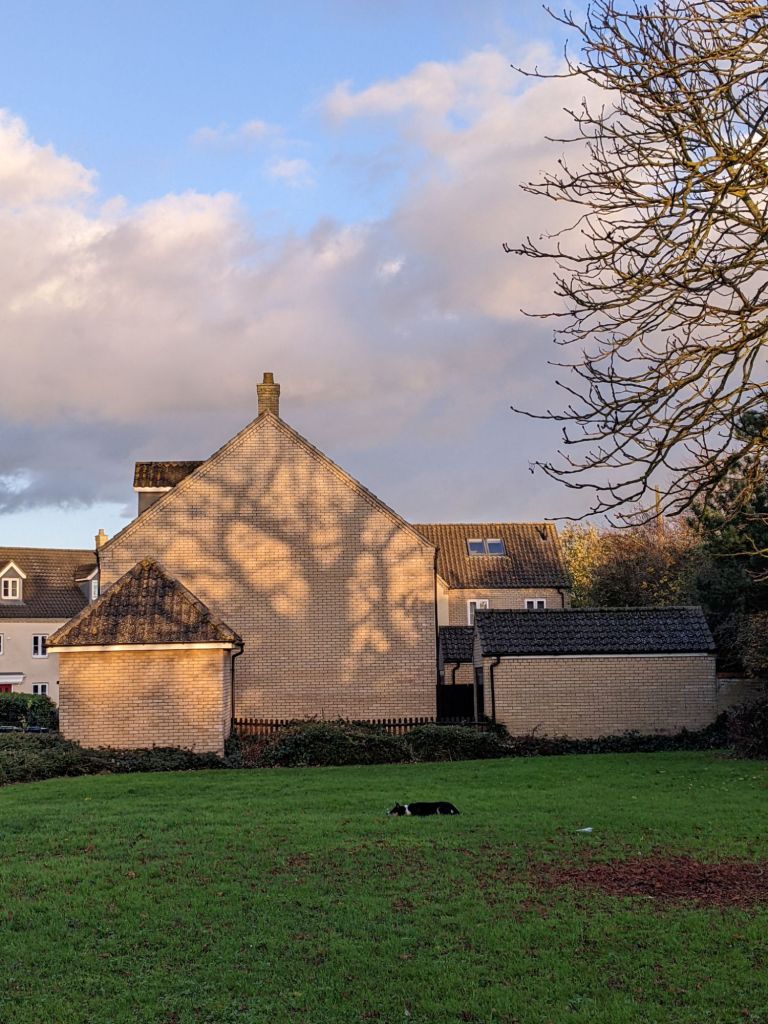
I also saw a spectacular shadow and several good dogs, of whom one is featured here:
It’s been a while since I walked my usual walk. Last month I slipped getting out of the shower and bashed my knee: I couldn’t get downstairs for three days, it took me seven to get out of the house, and for several weeks more it was painful if I moved it the wrong way. You can imagine how frustrating this was. Even now I can’t straighten my leg fully. Then I’ve had various things to buy and places to be, so I’ve been using my walking energy getting into town. But today I went out and I walked for fifty minutes, just for the pleasure of going for a walk. It was great.
I’ve been wanting to post more on this blog, and also wanting to record more of what I’ve been up to and what I’ve enjoyed. So this is the first of what I hope will be an ongoing series of weekly… check-ins? reports? I like neither of those terms. But I know what I want to do, even if I can’t describe it. So I’m just going to start doing it. Expect varying length, disparate headings (stolen from various people across the internet), and weeks where nothing happens at all.
The good
Ely Pride. This started last night with a talk at the cathedral from Rev Dr Charlie Bell. I am not sure that I can convey how very good it is to have one’s church say in so many words that LGBT+ people are welcome, so you’ll just have to take it on trust. The main event was today, and it was joyous.
Gorgeous flowers from my in-laws, extending my birthday a little further.
The mixed
Sad to see a great colleague go, but her leaving do was brilliant. A couple of ex-colleagues turned up, too: good to see them again.
The difficult and perplexing
A load of internalised biphobia (this has been going on for a while, and nearly stopped me going to Pride today; I’m glad it didn’t succeed). And a stubbed toe. And an hour of (unfounded) family panic.
Noticing
Dragonflies whizzing around the green spaces. Sunflowers in the allotments (you can see the Royston ones from the train). Starlings.
Reading
Wanderlust: a history of walking, Rebecca Solnit. This was one of the two books I got from the Book Bus. (I am, this year, a model of restraint.) I’m enjoying this: Solnit talks about walking as a political act as much as anything else, and she talks about all sorts of walking. Some things I did know already and a lot that I didn’t.
Rough Music, Patrick Gale. My mother’s been recommending this author to me for ages, largely on account of the Isle of Wight connection, but I finally got around to reading him in this book from the sale at Ely library, and it’s mostly set in Cornwall. Very readable; one of those dual timeline narratives. A potential entry for The Reader’s Gazetteer – B for Barrowcester. Reading the notes at the end, it’s based on Winchester. I didn’t pick that up at all despite having been born in Winchester, but then I’m usually there to look at buses.
Husband Material, Alexis Hall. Well, this was where my Tuesday evening went. I lounged on the sofa, chuckling away. Delightful. It felt a little strange, because it felt very, very familiar. Hardly surprising: when I was writing The Real World I spent quite a lot of time wondering if after all Richard Curtis hadn’t said it all better in Four Weddings and a Funeral, and Husband Material is very much riffing on that seminal romcom. Anyway, it is refreshing to see something else that really digs into the question of marriage. Even if it did get me thinking that it is as well that Issues in Human Sexuality has nothing to say about lemon sorbet. (There’s one other person in the world who’ll find that funny. Oh well.)
Making
Patchwork. Secret project.
Cooking
Pickled plums. And an improvised sort of pie made of plums and very old filo pastry from the freezer. The rest of the plums got frozen, though I should probably go and see what else I can harvest before the wasps get it.
Summer Open Exhibition at Babylon Arts. This was fascinating for the sheer range of artists and styles on show, and my reactions to them. I like bright textiles but not bright acrylics. I like moody pastels of Fenland skies. I dislike the self-consciously quirky except where it was made of steel. I am fascinated by the intricate. I am predisposed to like linocuts. It takes a lot to impress me with a photograph. I did know that @smolrobots is based somewhere in the vicinity, but I’d forgotten. And so on. Eavesdropping on other people’s reactions was also fun.
Listening to
I’ve been to Evensong three times this week (another of those things that I could do far more often than in fact I ever do). There’s been a visiting choir, and they really got into their stride today. Jackson in G (used to sing it at Guildford, but haven’t done it for years) and then something called Song to bring us home by Tamsin Jones.
Drinking
Sidecars. Or, as they somehow ended up getting called, Sidehorses. Don’t ask, or, at least, don’t ask me. I also had a strawberry slushie today, the first in a very, very long time.
Line of the week
This is from the Rebecca Solnit:
Imagine it doing seventy on the interstate, passing mesas and crumbling adobes and cattle and maybe some billboards for fake Indian trading posts, Dairy Queens and cheap motels, an eight-cylinder Sistine Chapel turned inside out and speeding toward a stark horizon under changing skies.
One of my great comforts this past year has been travel writing: reading it, and visiting in my imagination all the places that I can’t visit in the flesh. But it’s also made me appreciate where I am. And that made me remember that in fact I live in a city that’s a popular tourist spot in ordinary times.
Actually, I don’t believe that’s necessary. No matter where we live, we can approach our streets,gardens, kitchen tables, with a travel writer’s eye (and perhaps an attitude of self-parody, if need be). Take a look at this: Travel and Food Diary: Quarantine Edition.
So, if you’d like to jump in and share your hyperlocal travel writing, please do. (#HyperlocalTravelWriting ought to do it.) We can visit each othervirtually, travel the world, see the sights, taste the food, smell the scents, from our computers.
At the same time, it felt a bit like cheating to go straight in with the cathedral and Oliver Cromwell and all the rest of the attractions on my doorstep. They’ll come later, I’m sure. But I thought I’d start with something more ordinary: the path I walk most days.
Start at the north end. Immediately, there’s a choice. Left or right? Left, the path is narrower and the trees are closer. Right, the wider path is split down the middle: red for cycles, grey for pedestrians. They clasp between them a broad green space. There’s probably a dog or two bounding across it: a black labrador, maybe.
Left or right? It doesn’t matter. This wasn’t so much a fork as a spoon, and you started at the very tip of the bowl. If you didn’t dip down to the subway under the main road, drawn by the allure of a takeaway (not, in these times, a film or a swim) at the leisure park, or follow one of the little paths off to the left to find yourself somewhere at the end of a cul-de-sac, you’ll be where the bowl meets the handle. Now the two paths join, split the difference, become a sinuous strip of tarmac self-consciously meandering between the houses on the left and the trees on the right. The cycle track ends, but the cyclists continue: a lad on a paper round, sporty-looking people on mountain bikes, small children wobbling on stabilisers or whizzing off on balance bikes. Scooters, too. Dirt tracks, made by children or dogs, lead off into the trees and emerge again a little further on, for the pleasure of going nowhere in particular.
Beyond the trees, the A10 roars on. Somebody’s going somewhere, even if it isn’t you. South, towards Cambridge and London. North, towards the sea. The birds keep singing regardless. Thrushes, sparrows, pigeons. You might even hear a cockerel.
Now the path dips, loses a couple of metres in height. You notice it, out here in the Fens. The path broadens a little, becomes concrete, passes a small water processing plant, is barred by a gate (easy to walk round, and a particularly good blackberry spot in the autumn), meets the road. Not the main road, but the one that takes the traffic into the city from the north west. The cars (it mostly is cars) coming from the south whose drivers wish to do this veer into the middle lane, slow rapidly, and wait for the southbound lane to be clear. From the north, it’s easier. Meanwhile, the main flow of traffic – cars, white vans, grimy lorries, huge tractors in primary colours, hauling gleaming-bladed implements behind them – keeps on going.
Cross the road, and pause on the other side. Look up the hill. There’s the cathedral, effortlessly imposing. You’d have to climb a bit to get to it, more than you’d think from looking at it from here. You’ll have to climb anyway, following this path.
Again, the planted tree barrier has grown up on the right, recently enough that you can still see the plastic guards around the trunks, long enough ago that some of the trees have swelled enough to push them off. Hazel, silver birch, blackthorn, wild roses, brambles. Even in winter, the rosehips make the hedges bright. The houses are a little further away, but every so often a path branches off to take residents off into the maze that only they have really got their heads around.
Still it continues, an artificial path winding through artificial bumps and mounds, little bridges crossing little drains. Chunky plastic benches are provided at decent intervals. This is a path for people. Keep on climbing, and you come to a wide, open green. Look at the houses, spot which ones have been made to the same pattern as each other. Watch the dogs joyfully chasing balls. There might even be someone with a kite. Some new trees were planted this winter, filling in some more of the space between the path and the road: try to picture what it’ll look like when they’ve grown up. At the top end, there’s another little bridge, and then you’re back on this same climbing, tarmac path, tucked between the houses and the road, except now the road is quite a way beneath you.
At the top of the hill the path gives onto a square of houses with an impressive playground and a majestic horse chestnut tree, older than anything around it. Keep on past it.
If it’s been dry, or very cold, or if you’re not too worried about your shoes, you might as well leave the path and climb up to the top of the little mound which really is as high as you can get. Look down on the road, look west across the fen, look at the morning sky. Follow the hedge line or walk the ridge, sloping down southwards. Or you can keep on along the path, which has its own rewards: huge variegated ivy leaves; snowdrops and crocuses, or, later, cherry blossom; or later still, the orange balls of buddleia globosa, thick with bees; a bush full of opinionated sparrows; a copper beech hedge; a bright-beaked blackbird.
And then you’re at another road. Look left, and there’s the cathedral again; right, the roundabout to sort the Ely traffic from the northbound traffic from the southbound traffic from the westbound traffic and the traffic that wants the filling station or the Travelodge. And straight ahead, a tranquil field, ploughed or green, and another lone chestnut tree, its branches sweeping downwards, hazy in the morning light.
A rather trying morning. It began yesterday evening, when I forgot to buy milk, and continued when I remembered that one isn’t allowed to post things like power banks to France.
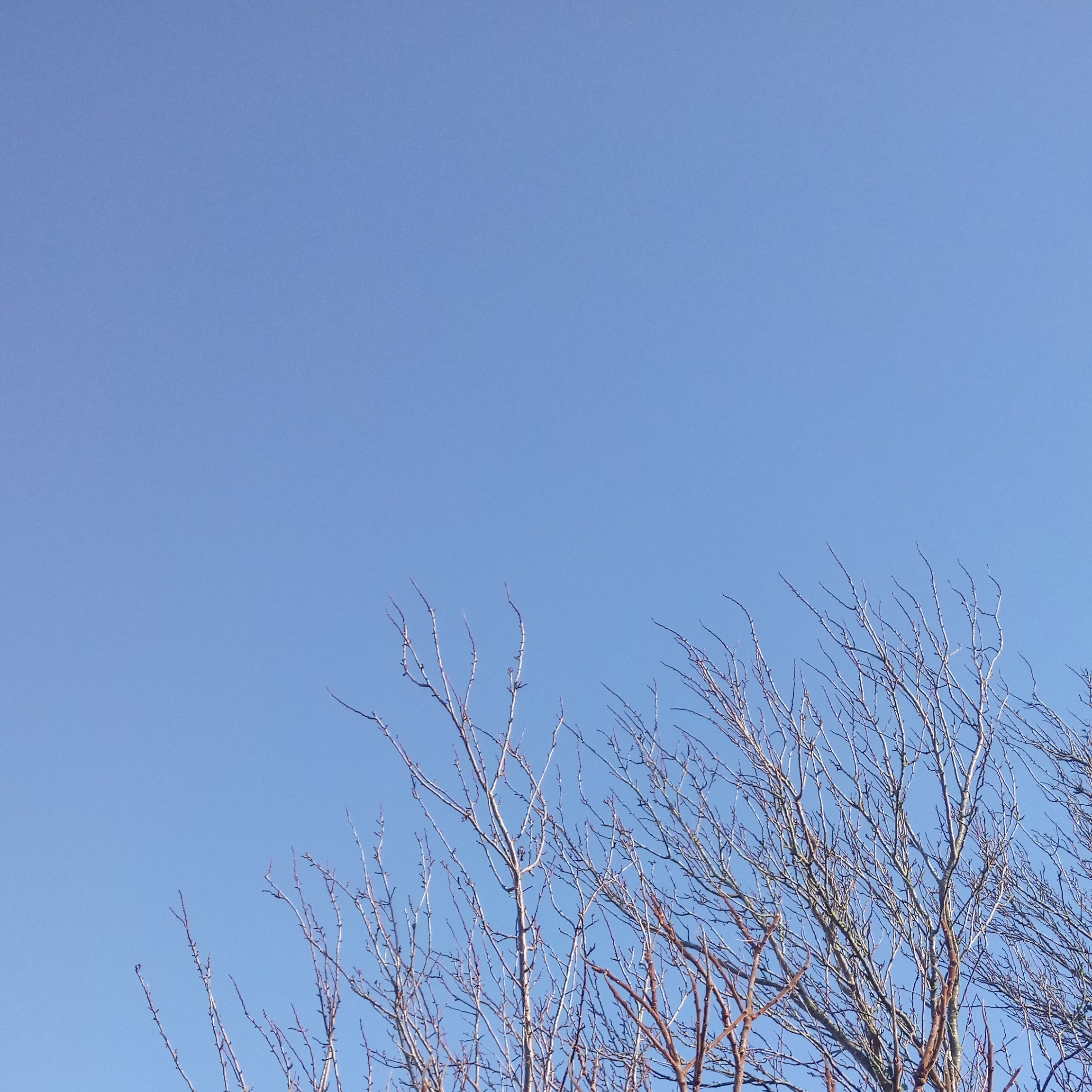
But then, cycling back from the post office and the supermarket, I happened to look up, and I was struck by the cool, clear, blueness of the winter sky.
I postponed my plans of ‘getting on with things’ and went for a walk alongside the river. Sometimes I find living in such a flat area uninspiring, but today, with a huge dome stretched from horizon to horizon above me, I hummed ‘The spacious firmament on high’ and had no complaints.
The next day’s stage was much less ridiculous. My boots were still wet – of course – when I put them on, and my blisters were still present. All the Compeed was the wrong size, so I’d had to fasten it down with standard Elastoplast over the top. But the profile of the day’s route was considerably flatter.
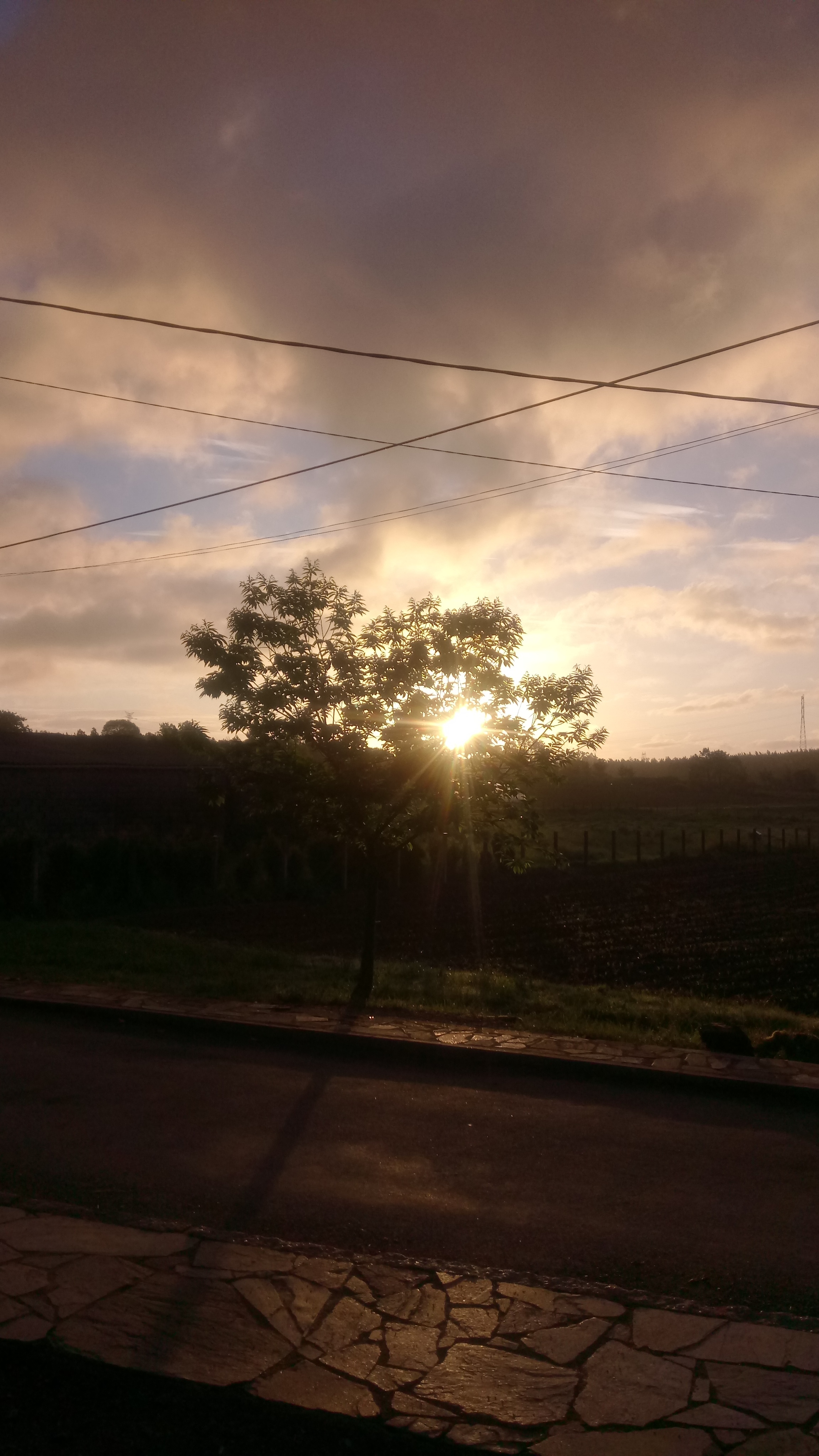
The weather started out rather lovely, a moody sunrise, though with something of a headwind even then. The first hour’s walk took us through a village with an impressive array of sculptures. One was a huge stone Santiago – it wasn’t the four metres that the guidebook claimed, but it was still pretty imposing. Others were huge dinosaurs, or made from reclaimed farm equipment, and were just plain bizarre. We couldn’t linger and take many photographs, however, because our presence seemed to be upsetting the village dogs. Or so we thought at first. After a little while we decided that perhaps they were more interested in barking at each other than at us.
There was off-again on-again mizzly rain through the first few kilometres, then a proper downpour after we’d stopped in A Rúa for our first cup of coffee. We promptly ordered a second…
After that it drizzled a bit harder, and I put my waterproof on, and got Diamonds On The Soles Of Her Shoes stuck in my head. I observed that this wasn’t necessarily a desirable state of affairs, because surely the diamonds would wear through the soles and start digging into the feet? These and other pointless conversations got us to the bar O Cruceiro (the book said that Carolina, the owner, speaks English; she does, and with an English accent) and had the first and last boccadillos of this Camino.
We were perhaps five hundred metres down the road when the rain really started coming down. I attempted to explain to John why it is funny that Stephen Fry elected to name one of the characters in his The Stars’ Tennis Balls ‘Portia’… Because the equivalent character in the original is called Mercédès, that’s why… Maybe you had to be there.
It rained steadily and hard for about an hour and a half, or however long it took us to go five kilometres. Maybe it wasn’t as long as an hour and a half. Anyway, my boots soaked through to my socks and my waterproof soaked through to my T-shirt, and I was going to have to wear at least some of it again the next day.
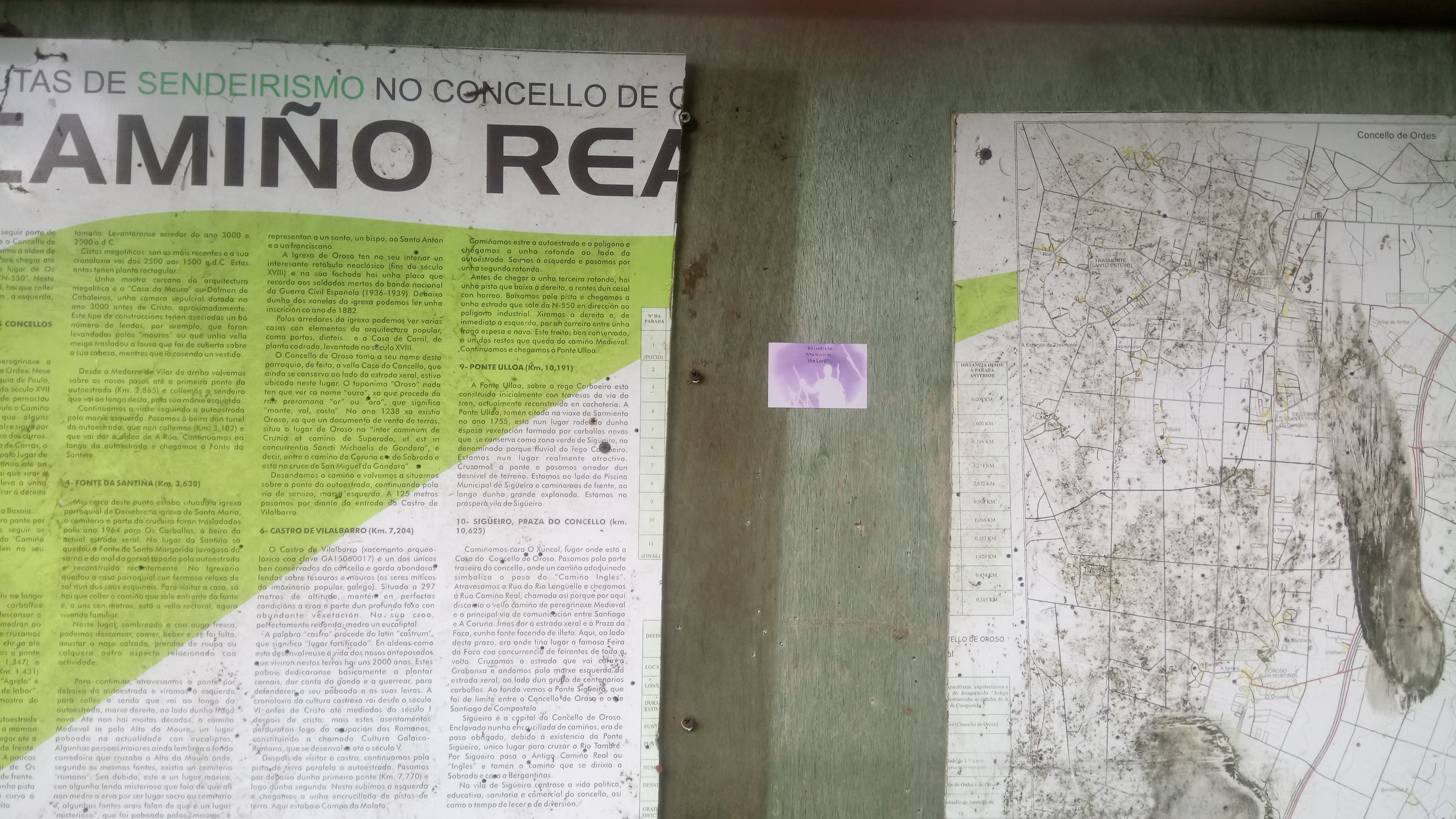
‘Blessed is he who trusts in the Lord’ – fine, but I’d still like a complete signboard, really.
The rain let up at long last, but the wind kept on going. We slogged down a very broad, straight, forest track that felt like it went on forever. That’s the thing with a straight road: unless you’re travelling very fast, it seems as if you’re not making any progress at all. On a twisty turny one you do at least get frequent changes of scenery.
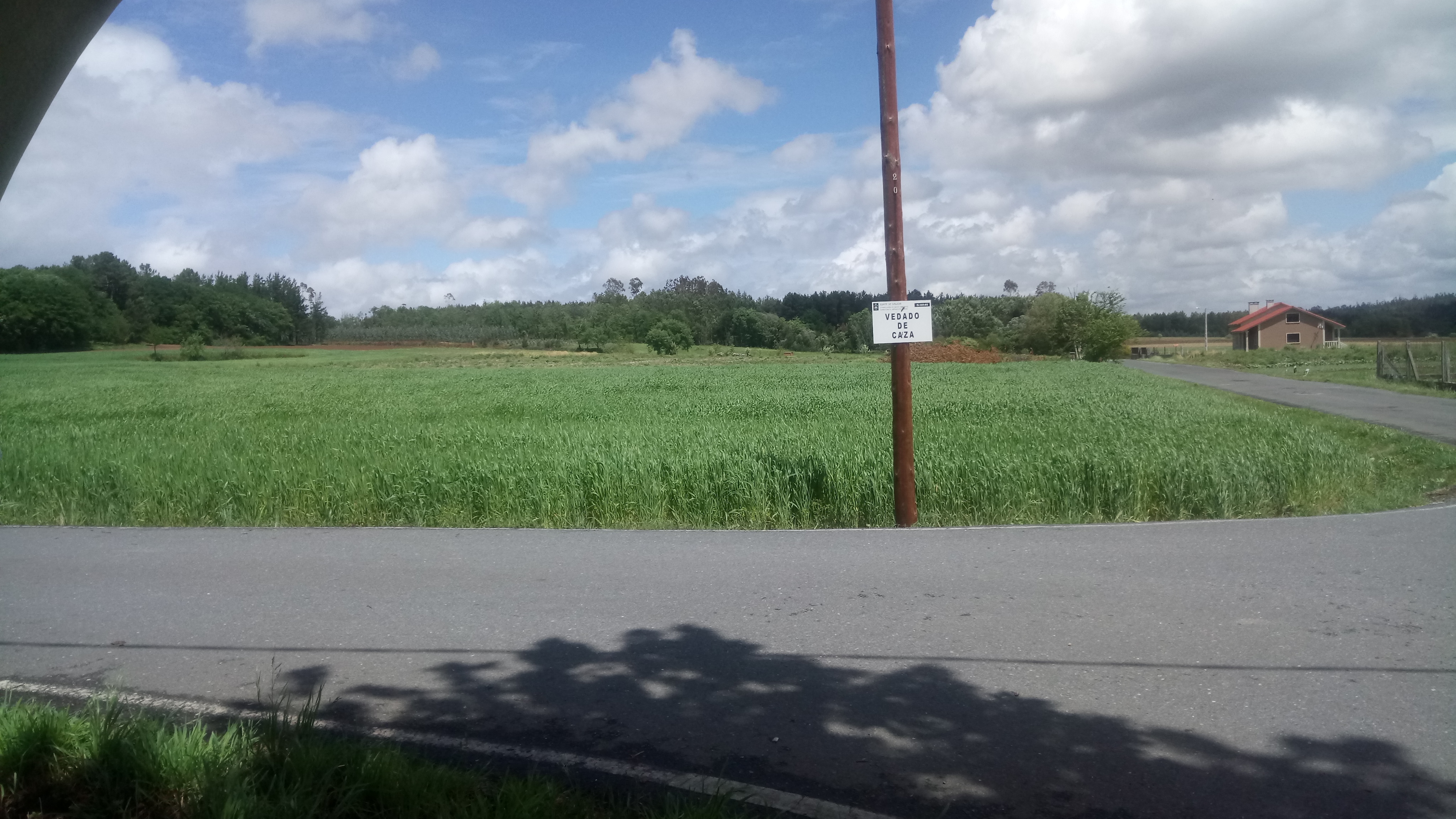
Wind ruffling the fields – looking back the way we’d come from
This scenery changed after about four kilometres, and we sat down in yet another handy bus shelter and watched the wind ruffling the crops in the field opposite. Having recovered our spirits, we plodded on into Sigüeiro, around the edge of an industrial estate and then through a pleasant park.
On the way out of the park we passed several fairground stands and marquees. One seemed to be a beer tent; our Spanish pilgrim friends waved as we passed by. There was obviously some sort of local festival or fête going on, which we weren’t quite in the mood to appreciate. We booked in at the first albergue instead. And when I say ‘booked in’ I mean ‘walked in and had a bit of a sit down until someone turned up’. We didn’t mind. It was a very nice albergue.
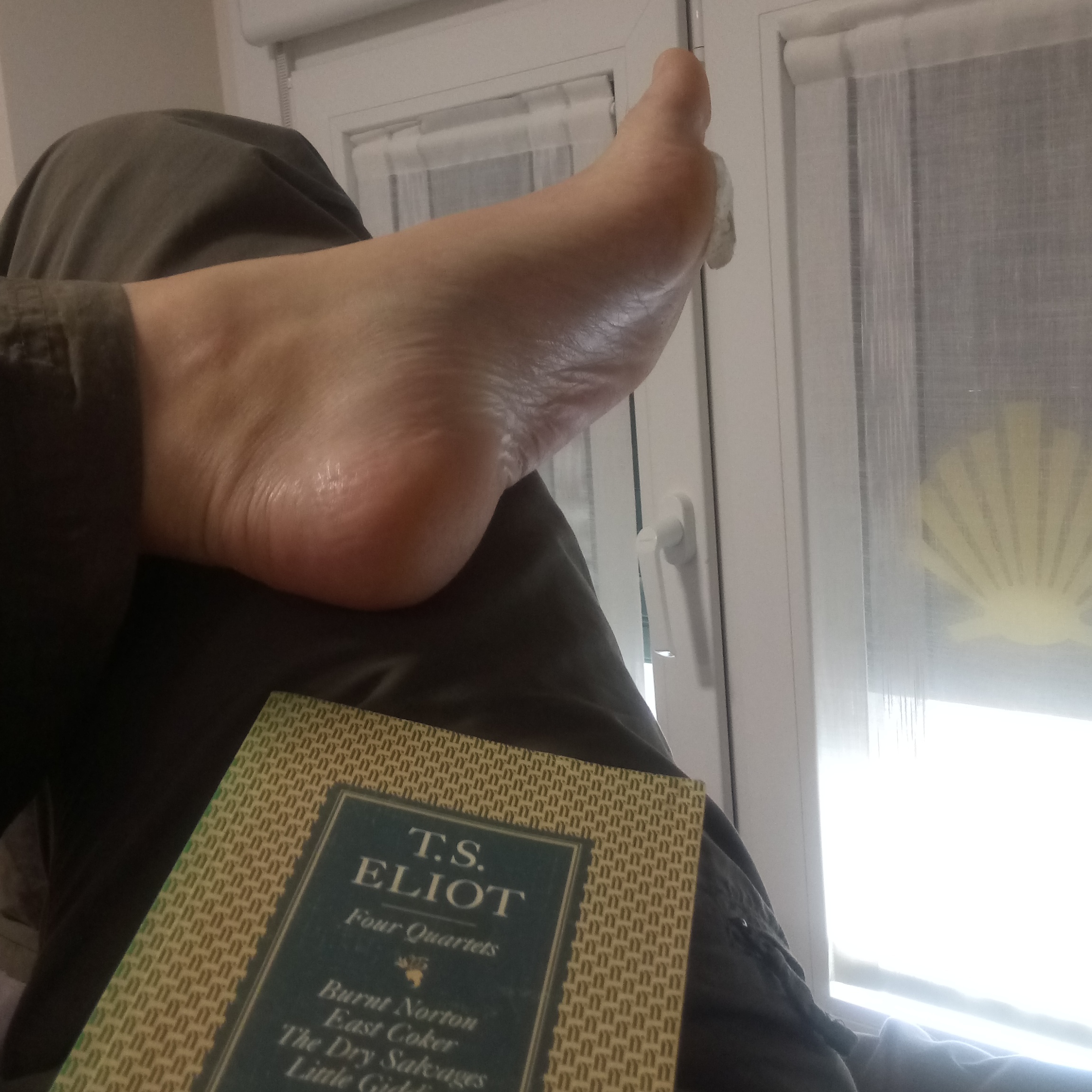
The sun and wind coming into Sigüeiro had gone some way to dry everything off again, but I still felt pretty clammy and horrible, and once I’d had a shower and John had worked out the tumble dryer I retired to my bunk dressed in pants, trousers, sports bra and fleece and read Four Quartets until I’d warmed up a bit.
We went out into Sigüeiro to have a look at the fair and get some food. The fair was mostly shutting up for the evening, so, after wandering up and down the row of stands, we moved on to the ‘food’ part. For reasons that I now can’t remember, we settled on a pizza place.
It was at this point that my Spanish failed. I’d been doing most of the talking all the way along, and my skills had improved along with my confidence. But at this point I was tired and hungry and I absolutely could not remember the Spanish for ‘four’ – which made ordering a four cheese pizza a little difficult. So John did it, and it was fine, and there was pizza.
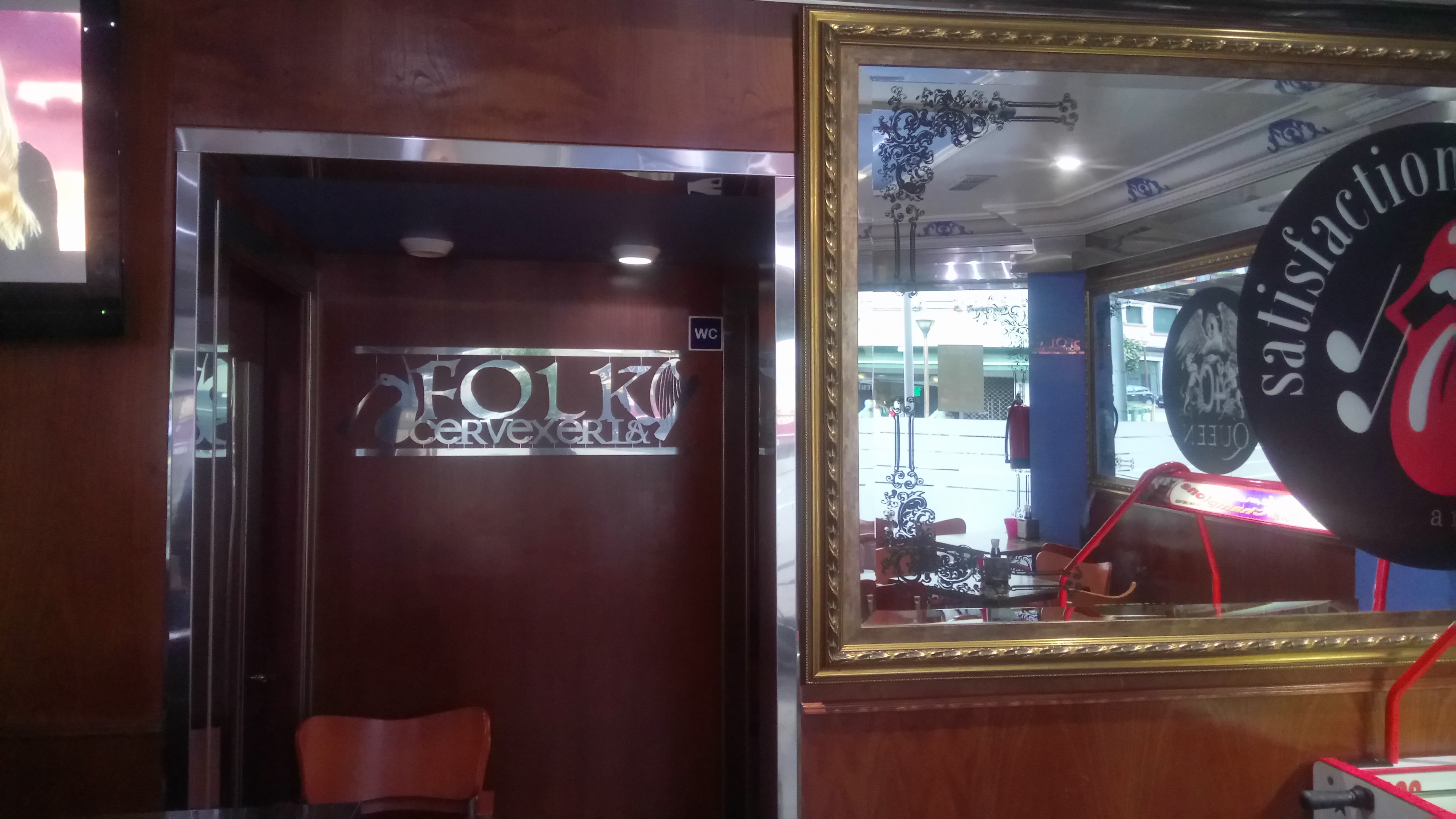
Then we decided that, since we were in a town, we might as well go out for a drink. We fixed on an establishment named ‘Folk Cervexeria’, which was not at all folky; it had Beatles and Queen memorabilia all over the place. It also had a slightly odd atmosphere. We stayed for one drink and then retired to the albergue.
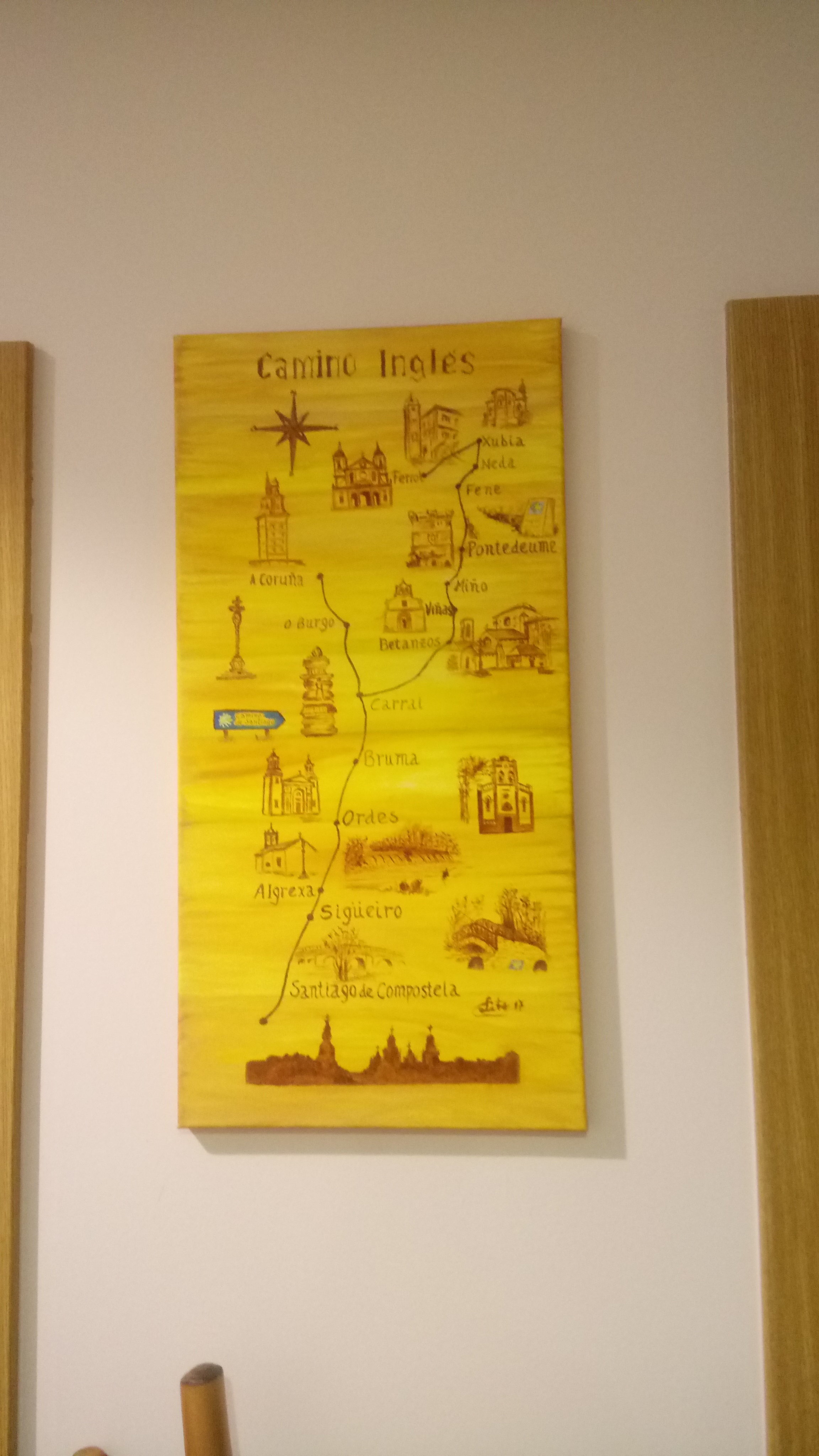
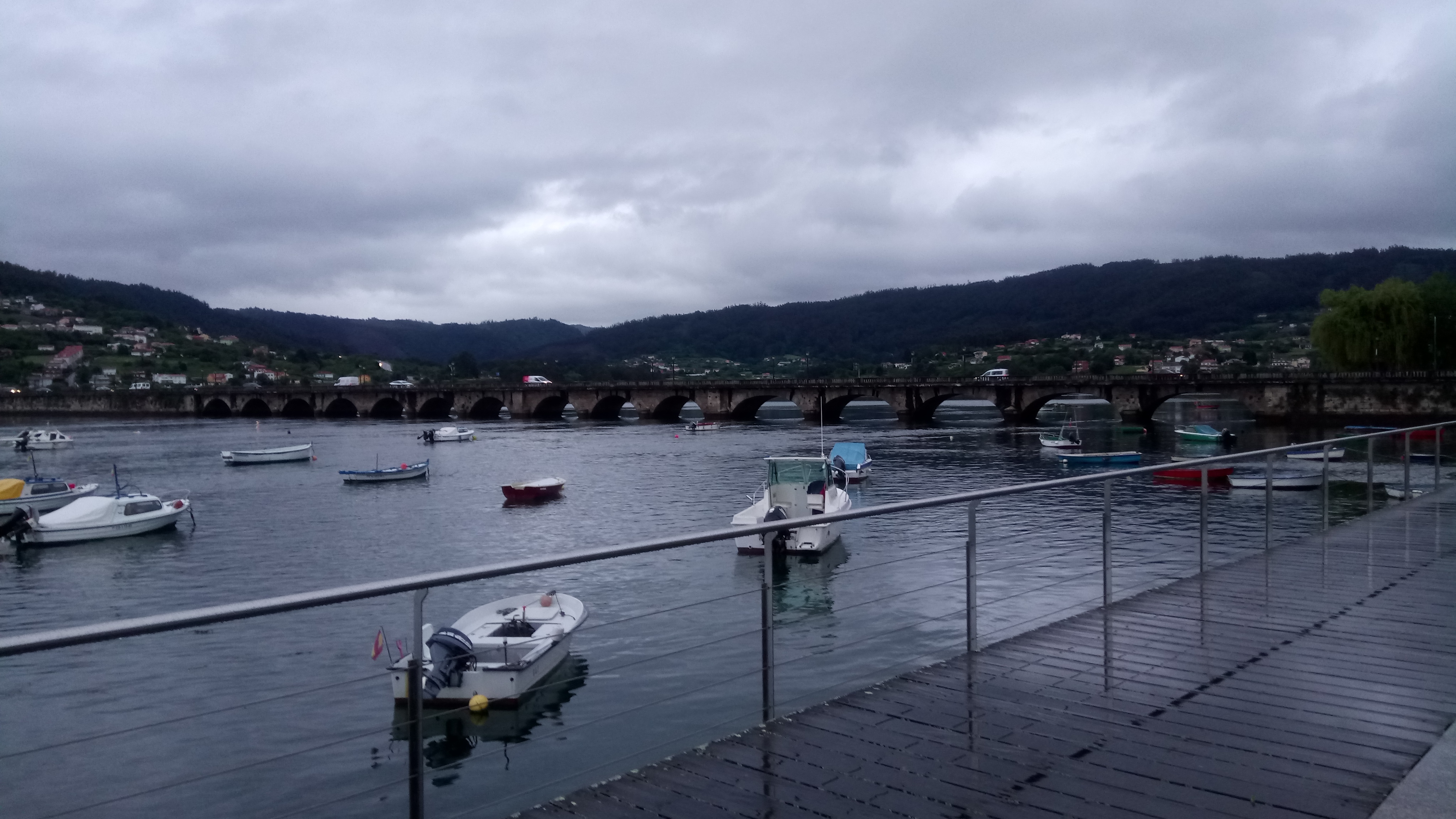
The Camino Inglés delights in taking you from sea level, up uncomfortably steep gradients, and back to sea level again. Sometimes this is repeated several times over the course of one day. The route from Pontedeume to Betanzos is a case in point. We started on the waterfront. The bar where we ate breakfast (coffee and cold churros) was on the next street along. (The Japanese pilgrims, incidentally, ate their breakfast in the albergue at ten past six.) After that, we joined the route and it went straight up.
Uphill through Pontedeume
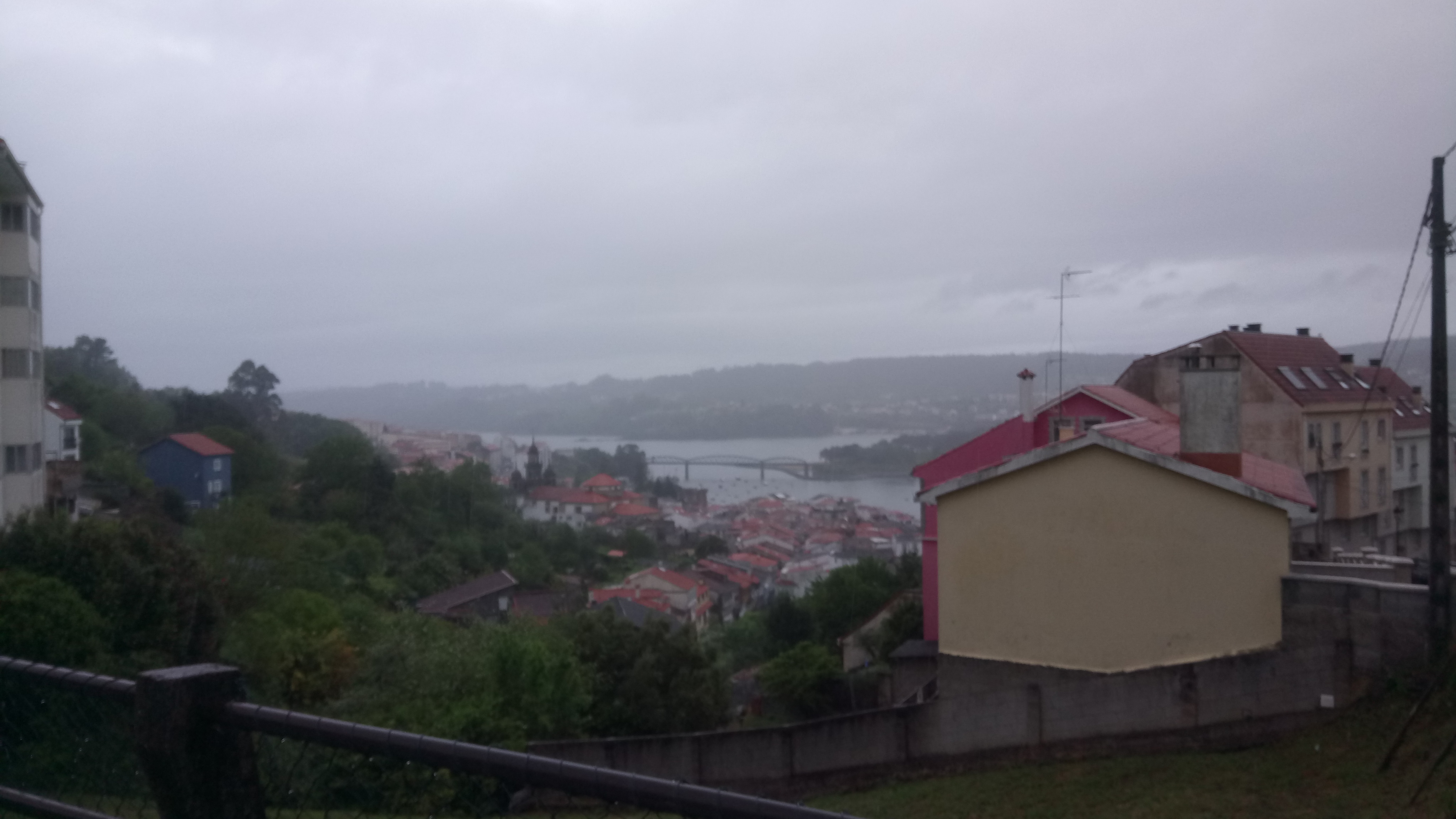
And it’s not as if either of us is unfamiliar with the concept of ‘up’. Our parents live in Ventnor, which is about as close as Britain gets to those Mediterranean seaside towns where the streets are arranged in higgledy-piggledy lines up a cliff. This was something else. (It was also raining.) Within about fifteen minutes (give or take a diversion to look at the church of Santiago, which was shut, and several breaks for me to catch my breath) we’d climbed one hundred and fifty metres and were looking down on the town and the bay.
Looking back down across Pontedeume
Once we were out of the town, the gradient became less punishing. The rain, however, continued to fall, and I gave up on any hope of my boots drying out. I kept my waterproof trousers on all day – even after it stopped raining I couldn’t be bothered taking them off, and anyway, they were snug enough to compensate for my walking trousers being a size too big.
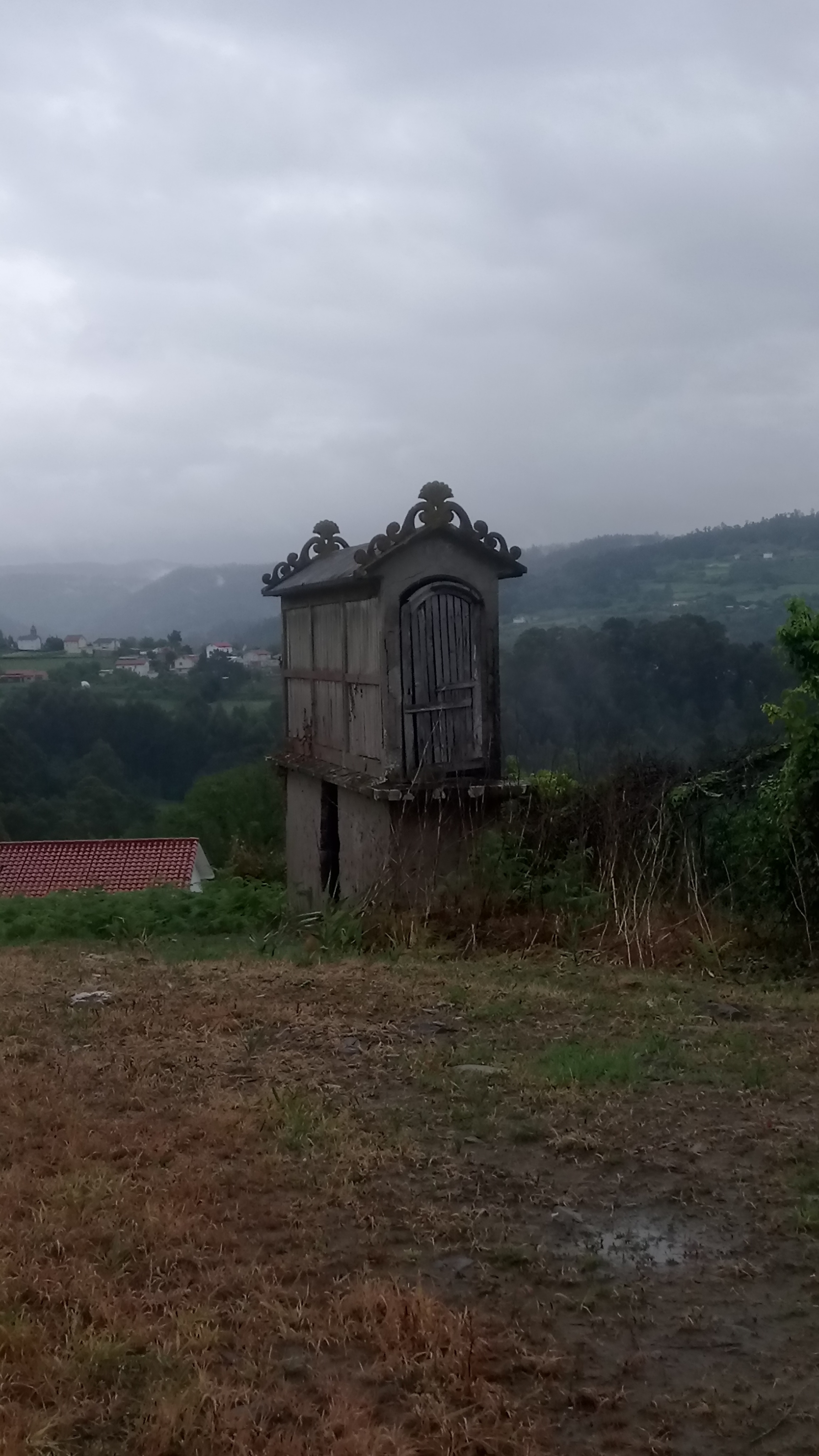
Horreo with entirely appropriate rooftop decoration
We were up and down all day. The first downwards gradient was a gentle one, taking us down through scrubby woodland (a nature reserve, I think) towards a golf course. That was deserted, of course, in this weather. The path led straight across, and then into a copse and across a little brook.
After that there were some fairly tedious bits over and then alongside a motorway, leading at last into Miño. This was a reasonably sizeable town, and had a choice of bars. Sitting outside one of them were three pilgrims we didn’t recognise. We stopped for a cup of coffee in the next one along, and then kept on going.
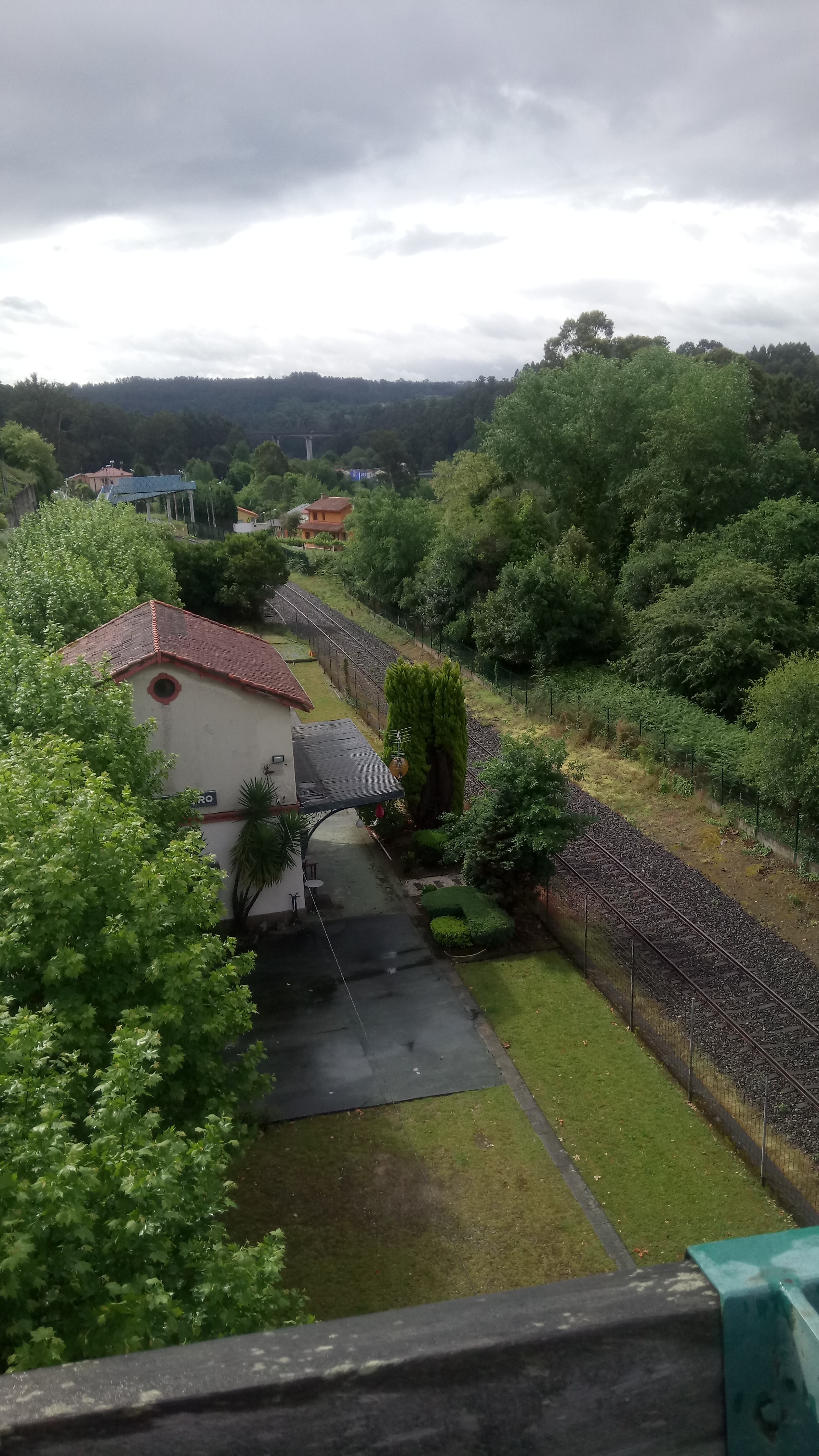
Looking down on the railway line at Miño
Downhill, again. Heading out of town, the path led gently down all the way down to sea level, and after that up, and up, and up, above the level of the motorway flyovers. 20%. One in five. At least the maths was easy.
We sat on a bench in a dilapidated children’s playground at the top to get our breath back and eat Naked bars. (Naked bars are very good if you’re hiking with a vegan, or hiking as a vegan. They don’t melt, and they don’t crumble too badly.) Then there were lots of single track lanes. We met two dogs (one a very friendly puppy) on one of them and, a little further down the hill, looked back to find that a dapple-grey horse was following us. We had no idea what to do about a loose horse; fortunately it got fed up with the idea after a hundred yards or so, and turned off into a field.
A rural bus shelter made a decent spot to stop for lunch. More of the same followed: narrow roads, little hamlets. I was surprised to find the road surface not too hard on my feet, but I was still very tired by the end of the day. Then, at last, a field of allotments (and a briefly interested cat), and we proceeded into the walled town of Betanzos.
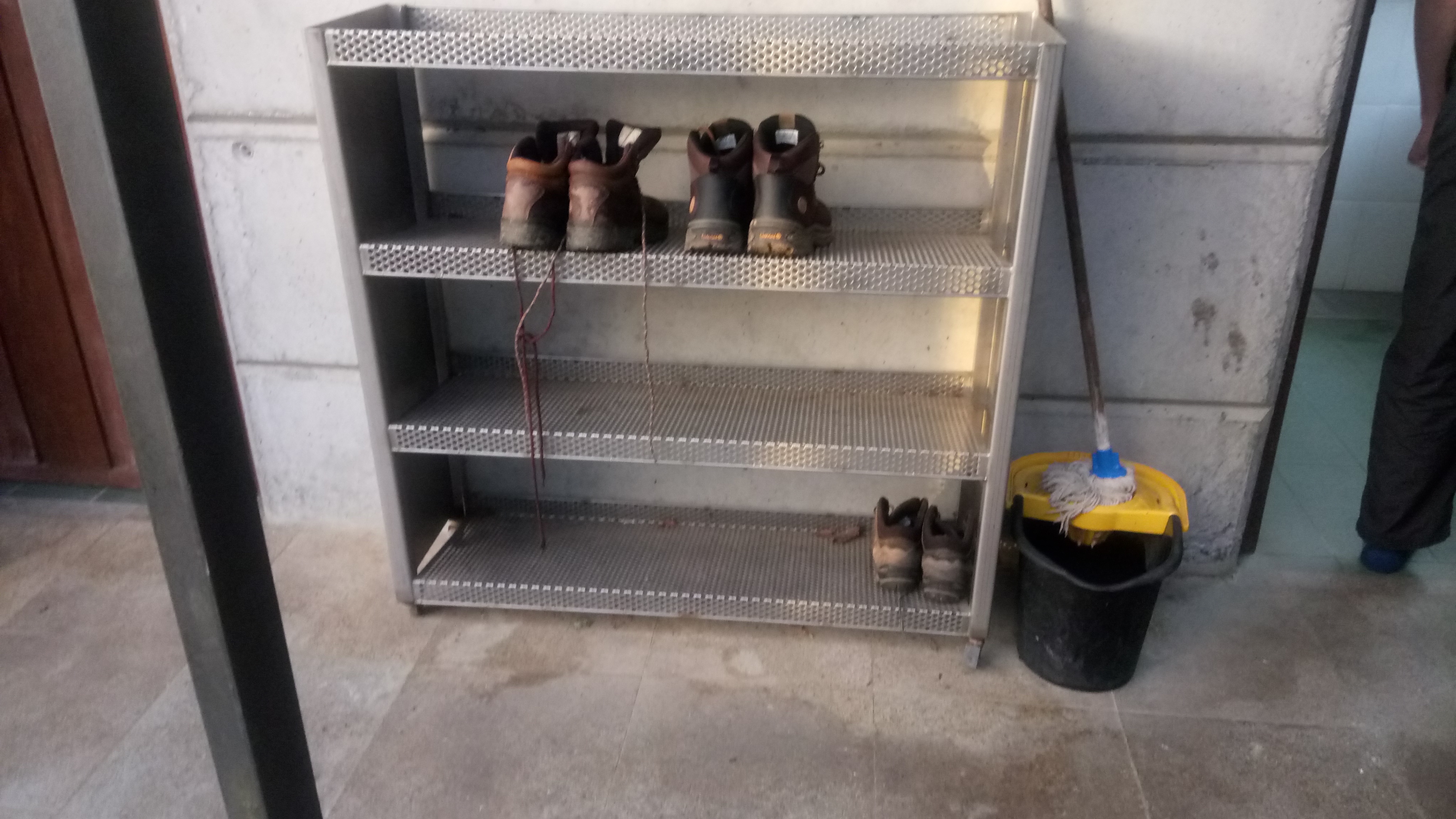
The Betanzos albergue was big, and well-appointed. There were two floors of dormitories, laundry rooms (yes, plural), boot racks, sitting rooms, a kitchen and dining area, plenty of showers, and wi-fi. Also the heights of joy and depths of despair that come with hearing, and then believing that one has misinterpreted, the word ‘secadora‘. And the joy that returns when it does in fact turn out to mean ‘tumble dryer’.
Granted, there was a very odd mark on the ceiling above the shower that I used (mould, I thought) but generally speaking it was all that one would wish. We bagged bunks, unpacked, went off to take showers, and, as our father would say, ‘went and died for an hour or so’.
There were more pilgrims here than at Pontedeume. The trio we’d seen earlier had turned up here, and turned out to be Spanish; apart from them, there was an Italian man in his sixties, and, of course, the three Japanese men.
The churches and streets of Betanzos
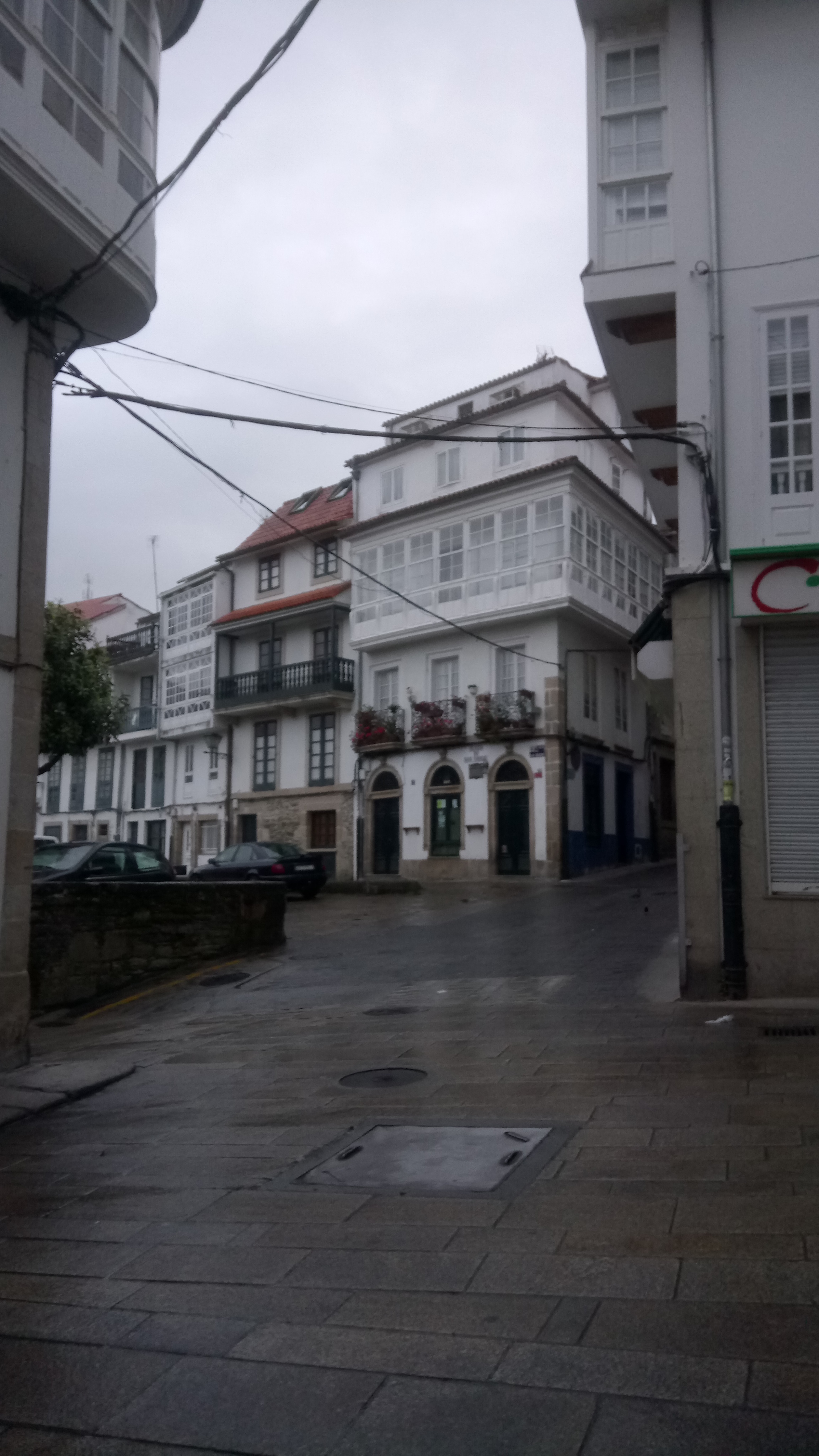
I looked at my boots to see how far the line of damp had receded (not as far as I’d have liked) and dragged John out to see the churches of Betanzos and their fabulous Romanesque architecture. I liked the houses, too; as in Ferrol and Pontedeume, many of them were magnificent affairs of three or four storeys, with graceful glazed balconies on the upper floors.
After that we set off to look for O Pasotempo, and food.
The CSJ guidebook described O Pasotempo as –
‘a sort of rural Spanish Victorian theme park erected in 1893 by a couple of local men who made their fortune in South America and came home to share the wealth and cultural excitement with their home town’.
So of course we had to look at it.
It was a gloriously eccentric nineteenth century pleasure garden, dilapidated in a way that was just the right side of the boundary between ‘charming’ and ‘public health hazard’, and filled with all sorts of weird and wonderful sculptures. Shells set into the walls. A relief map of the Panama Canal. A panel of clocks – the usual London – New York – Paris set-up, except not, because it was made of plaster, and there were about 25 clock faces in total, and the central one said Buenos Aires. Half mermaids. A mandarin duck. A mallard duck with ducklings. (These were real.) Plaster figurines of intrepid explorers on camels. Caves! With fake stalactites! And dragons! We agreed that it was like Blackgang Chine, only considerably weirder. We loved it.
This slideshow requires JavaScript.
I had mismanaged my blood sugar to the point where there was no question of holding out for food until we got back to the albergue. But the supermarket that we had passed on the way to O Pasatempo had a café. The café provided sugary drinks and snacks. The supermarket provided longer term sustenance. We stocked up for the next couple of days, then walked back to the albergue to cook and eat some of our purchases. ‘Cook’ in this context meant ‘heat up in the microwave’. It made a change from bread and cheese.
Afterwards, we sat in the sitting room upstairs, reading, and talking to an American pilgrim who was doing a little mending. This was more in resignation than in expectation, as she had been waiting for so long to recover for an injury that her visa had run out, and she was going to have to fly home without completing her Camino. But she was still going to do her sewing.
For my part, I wondered morbidly if I was coming down with a cold. But I embraced the power of denial, and went to bed.
Next time: the most wonderful surprise of the whole Camino. And some eggs.











 Kathleen Jowitt