2017: the year I won a Betty Trask Award

DSC_0557

I was in Spain when I got the news, on the way to Ferrol to start the Camino Inglés to Santiago de Compostela. My brother and I had spent all day on a very slow train from Oviedo: along the north coast, through mist and eucalyptus trees, eating bread and cheese. We’d spent the previous day on a very slow train, too, and the day before that on a ferry from Plymouth. I’d turned the data off on my phone to avoid roaming charges, and there probably wouldn’t have been any coverage anyway.

So when we were checked into the Ferrol hotel and I connected my phone to the wi-fi, all my emails came in at once. Most of them were boring. But there was one that was from Paula Johnson, and it had the subject line Betty Trask Prize.

I did not have my author hat on. I had my pilgrim hat on. I’d sent the latest draft of A Spoke in the Wheel off to my specialist editors and put it out of my mind, and so far as I was concerned Speak Its Name was minding its own business. I’d been using the literary part of my brain for reading T. S. Eliot and translating between English and Spanish. At that moment I did not know what the Betty Trask Prize was.

Then I read the email about it, and I remembered. I remembered that it was awarded to the best debut book by an author under the age of 35. I remembered putting my book in for it. And now, it seemed, my book had been shortlisted for it.

I said, ‘Holy fuck,’ and showed the email to my brother. He was equally impressed, but pointed out that the email said that this was strictly confidential. So, rather than tell anyone else, we went downstairs and had a drink in the hotel bar.

There followed six days during which I could not talk about it with anybody other than my brother, who, obviously, already knew. It was just as well that I had a walk of 116 kilometres to keep my mind off it.

We’d reached Santiago and begun our journey home again by the time the news broke. I spent a scorching Palencia afternoon watching the Twitter notifications roll in and understanding that everything had changed. I hadn’t realised what a big deal it was, what big names had won it, what big names had said very complimentary things about my book. I hadn’t realised that I would come away with an award whatever happened.

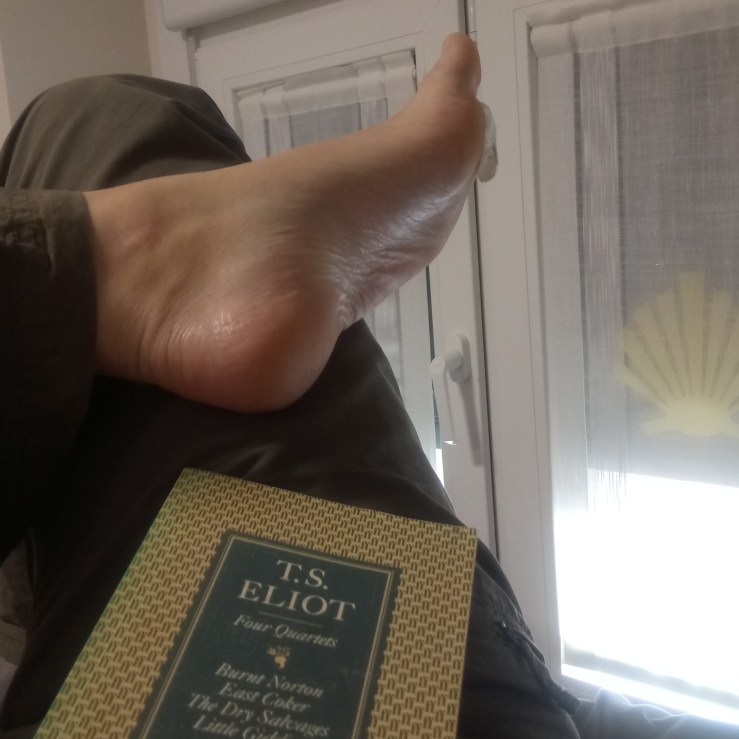
I’d brought Four Quartets with me thinking that Little Gidding would have the most to say to me (‘We shall not cease from exploration/and the end of all our exploring/will be to arrive where we started from/and know the place for the first time’), but really The Dry Salvages seemed much more apposite:

Fare forward, travellers! not escaping from the past
Into different lives, or into any future;
You are not the same people who left that station
Or who will arrive at any terminus,
While the narrowing rails slide together behind you;
And on the deck of the drumming liner
Watching the furrow that widens behind you,
You shall not think ‘the past is finished’
Or ‘the future is before us’.
At nightfall, in the rigging and the aerial,
Is a voice descanting (though not to the ear,
The murmuring shell of time, and not in any language)
‘Fare forward, you who think that you are voyaging;
You are not those who saw the harbour
Receding, or those who will disembark.

When I returned my life was different, and so was I.

*

Everything has changed. Nothing has changed.

I’m not quitting the day job. (I like the day job!) Sales have settled down to where they were before, and I’m still self-publishing. No contract has materialised as a result of the award, and I have to say that I’m really quite relieved about that. Going back through journal entries from the last couple of years, I’ve found at least three instances of ‘they turned me down… and it was a massive relief, because the longer I went without hearing from them, the more I knew I wanted to do my own thing!’ You’d think I’d have learned by now.

Finishing the next book has been difficult: I’ve had to keep clambering over the conviction that this one won’t and can’t be as good as the last. Perhaps it would have been difficult anyway. Second novels are notorious, after all. Certainly all the palaver around the prize slowed up the publishing process for A Spoke in the Wheel. I’d meant for it to come out in July, but I’m glad it hasn’t. The extra few months have helped me get some perspective – and get several more edits in.

Being shortlisted for the prize gave me a credibility that I hadn’t had before. But I’d already had to move beyond worrying about credibility. I had to develop a strength of belief in the quality of my own work before I was able to self-publish. Having said that, it’s been a massive ego boost. The last lingering doubts that whispered maybe Speak Its Name wasn’t as good as I thought it was… they’ve been dispelled. Gone.

And it’s made it easier to talk about being an author. I’ve been fortunate enough to experience very little scepticism or hostility regarding my self-published status, but it’s always been at the back of my mind as something that might happen. These days I can introduce myself as an author, secure in the knowledge that I’ve got one hell of a comeback if it does.

So I’m going to keep on doing my own thing. I always was going to. But it’s very good to know that my decision to do so has been vindicated.

This year I have punched 0 Arians

DSCF2811

Today it is the feast of St Nicholas, famous for:

  • distributing presents to deserving children;
  • punching Arius at the Council of Nicaea

so it seemed like a good day to consider my relationship with the rest of the Church and how that’s changed this year. As I say, I haven’t punched anybody, although if I’d happened to meet Franklin Graham I might have made an exception.

I seem to be pretty much settled in what I still think of as my ‘new’ church. ‘It takes years to train a man to love me,’ says Katisha in The Mikado; similarly, it takes years for me to begin to feel at home in a new place.We’ve been here three years now, and I’m getting the hang of it. It suits me well: I’m just a Parish Anglican, really, not very High Church and really not very Low Church. The current church has a cycle of services that runs from ‘about as low as I’m comfortable with’ to ‘slap bang in the middle of my comfort zone’. And I get to sing.

I did go to Little St Mary’s for St James’ Day, however, because my protestations about Not Being That High go out of the stained-glass window when it comes to things Jacobean.

I’ve joined a house group for people in their 20s and 30s. It’s a little bit anarchic – sometimes someone volunteers to lead an evening or a series of evenings; sometimes we just make it up as we go along. It’s been good. I’d forgotten – perhaps I didn’t know – how good it is for me to pray with other people.

I went to two launch events for Our Witness and found both very refreshing. It’s an unusual experience, to walk into a church full of strangers and to know that nobody’s going to think it remotely odd that I manage to be simultaneously bisexual and Christian.

It’s been an interesting year to be bisexual and Christian more generally. There was that Report on Marriage and Same-Sex Relationships and the Synod vote not to take notice of it. There was another chapter in the Jeffrey John saga. There was Tim Farron’s resignation. There was the Scottish Episcopal Church vote to allow same-sex marriage in church and the various reactions from the rest of the Anglican Communion. I continued to think that perhaps destroying the institution of marriage would not be such a bad thing, although my own continued to be enjoyable.

Meanwhile, my own internalised biphobia was prowling and prowling around – possibly more this year than last. I’m still not sure who I’m out to (at church and elsewhere) or what they think about it. On the other hand, I began to be able to articulate a growing sense of my sexuality aligning with my spirituality – and then going to Pride with a lesbian Christian friend was a joyful and affirming experience and I grinned solidly all afternoon.

What does next year have for me, in terms of church and Church? I’m not sure at all: I don’t seem to be able to visualise it at all. That might mean that it’s going to be about learning more and going deeper; or it might mean that there’s something huge and unexpected coming. We’ll find out!

Presence

foot

Last year I wrote:

presence

  • as in here
  • as in now
  • as in presents
  • as in being
  • as in showing up
  • as in real
  • as in poise

And then on New Year’s Eve I went down with the virus that was sweeping the nation. This took up most of January, on and off, during which I:

  • spent a lot of time feeling absolutely exhausted
  • kept on editing A Spoke in the Wheel, which has a lot to do with physical ability and disability
  • watched Yuri!!! on Ice, which also has a lot to do with physical ability, all the way through at least twice
  • planned a pilgrimage to Santiago de Compostela

And I was exquisitely aware of what I could do and what I couldn’t do.

I got better. I walked a lot, working my way up to being able to do fifteen miles in a day and not . I made it to Santiago (and am still intending to write all that up). I’m still quite into Yuri!!! on Ice. (And what I really like about it is the way that it deals seriously with physical limitations and spiritual themes in a universe where there is no homophobia; I also spent this year in the Church of England, after all.) I have nearly finished A Spoke in the Wheel, and it’s still about physical ability and disability, though it’s also about burnout.

Presence ended up mostly being about physicality, but also about being a spiritual creature, about paying attention to what it’s like to exist in a body, and what it’s like to exist in time and space. Being me, here, now. Knowing what I can do and what I can’t do, and moving things between the categories. And all sorts of things seemed to come back to that. Slow travel. Being in the body that I’m in, experiencing sex and desire and love the way that I do. Blisters. Going to church when I didn’t feel like it. Pilates classes. Burnout. Depression. Sudden striking moments of awareness of the created world: unexpectedly, intensely, appreciating the taste of soup or the way the sunlight falls on the collar of someone’s coat. Frustration at having so little time that is truly my own.

The Incarnation, for me, is the most remarkable thing about Christianity: that the sacred is physical, that the physical is sacred. That’s what presence seems to be about, for me.

I don’t think that I know anything now that I didn’t know last year. Not in terms of facts, at least. (Except for a lot of figure skating terminology, and that I really do need to get some new walking boots before my next long hike.) Or perhaps that all that I have learned has gone to show how much I don’t know. I still feel that I know very little about presence, that I still have a lot to learn – but that perhaps a little has sunk in, that I’m beginning to understand about being who I am.

A compass for 2018

DSCF2805

Happy New Year! Well, a happy new year to those who are celebrating it today, anyway.

Personally I’m all for celebrating the new year as often as possible. I celebrate it on Advent Sunday, along with the rest of the western Church, at Easter, when I generally stop feeling so grim, and at my birthday. I also celebrate it when the number ticks over from 2017 to 2018 and, if necessary, at the start of the academic year in September. But Advent is, for me, the big one. I take the whole month to do it. Ease the new year in gently. Look back, look forward. Light some candles. Sulk about how everyone else seems to be managing to be cheerful and excited.

Usually I observe Advent with some kind of reflective, communal, blogging exercise, but the days of reflective, communal blogging exercises seem to be past. Besides, I don’t seem to be in the mood for asking myself searching questions or nominating the best book or best day of 2017. I want to do something, but it’s not Reverb; so I think I shall just bumble around and do my own thing, picking and choosing exercises from elsewhere on the internet, and not answering any questions if I can help it.

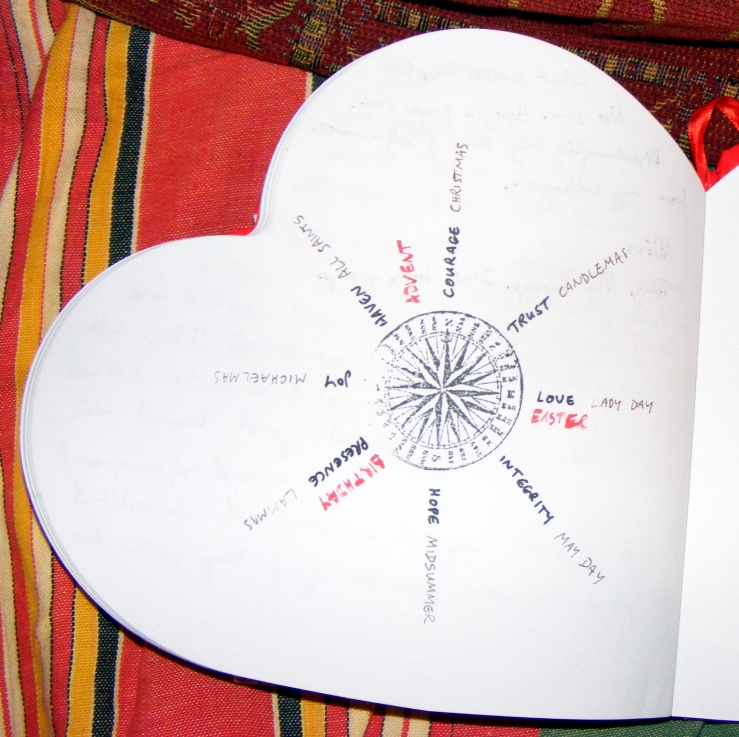
I’m starting with a compass, identifying the qualities I wish to have in my orbit in 2018.

North is COURAGE

North East is TRUST

East is LOVE

South East is INTEGRITY

South is HOPE

South West is PRESENCE

West is JOY

North West is HAVEN

Some of these are concepts that have been important to me for several years. PRESENCE was my word for this year just gone. INTEGRITY came in around 2012, I think, and hasn’t left. COURAGE got me through 2014. HAVEN, on the other hand, is a new one. I’ll probably end up writing about some or all of these at some point over the next couple of weeks.

After writing the qualities in, I put the quarter days at the cardinal points, and the changes of season at the ordinals. (My life has been much better since I decided that summer begins on May Day and August is actually part of autumn.) I also put my three main new years on there. Other than Lady Day/Easter, they’re slightly out of step with the rest of the compass, but they do seem to want to be on there.

Some of the conjunctions between festivals and qualities are striking; some are amusing. PRESENCE coming in at Lammas, just after my birthday, is both. Some I don’t quite see. (HOPE needs to come in at Midsummer, otherwise it’s downhill all the way; but why JOY at Michaelmas?)

Anyway, knowing me I’ll either revisit this every day until next Advent, or forget about it immediately. Or revisit it every day for the next three weeks and then forget about it completely.

Courage to trust; love with integrity;

Hope for presence; joy in the haven.

Haven for joy; present with hope;

Integrity of love; trusting courage.

Courage/Hope

Love/Joy

Trust/Presence

Integrity/Haven

Courage with love, hope with joy

Trust in integrity, present in the haven

Things I know people won’t like about A Spoke in the Wheel

DSC_0564
Don Quixote and Sancho Panza deciding that today is not the day to go tilting at wind turbines

(This concept stolen from the fabulous Ankaret Wells – whose books I like very much, incidentally.)

  • the first person narrator. This is a turn-off for a surprising number of people; personally, I feel that if it was good enough for Charlotte Brontë and Charles Dickens, it’s good enough for me.
  • the swearing. There was a bit of effing and blinding in Speak Its Name; there’s a whole lot more in A Spoke in the Wheel, for the simple reason that this one isn’t coming from the point of view of an Evangelical Christian with a very good reason for keeping a close watch on what comes out of her mouth.
  • our hero isn’t falsely accused. Oh, yes, he is accused, but it isn’t falsely. This isn’t really a spoiler, as he admits to his doping history in the second line. However, if you were looking for a squeaky-clean athletic Adonis forced to fight to clear his name, you won’t find him here.
  • a disabled character who has a sex life and actually quite likes being alive.
  • it’s very political. This was meant to be a gentle, fluffy, boy-meets-girl romance, but with characters I could actually believe in. It turned out political. Everything I write turns out political. One of these days, I keep saying, I will write a gentle, fluffy book with no politics in it, but it hasn’t happened yet.
  • not the sort of politics I wrote about last time. Barchester this ain’t. This time we’ve got the hell that is the benefits system, the social model of disability, zero hours contracts; the fine line between carrying out an effective boycott and depriving oneself of one’s vital goods and services; and whether sport can ever really be ethical. There’s not a monstrance or a worship committee in sight. (Maybe next time…)

To which all I can say is, oh well. I’ve enjoyed writing it. Some people have enjoyed reading it; and some others may enjoy reading it too. And really, that’s all you can say of any book.

Ways to help your author friend sell a book

2013-07-02 12.18.05
Pass it on

Assuming, of course, that this is something that you want to do. Many of my friends have very little interest in my book, and this is absolutely fine. We are friends because we have a shared interest in something totally different. These tips are only for people who actually want them!

Talk about it

Not in an ‘I’m my friend’s unpaid salesperson’ way, because that’s a very good way to lose all your other friends, but just in a natural, ‘if we’re talking about books, my friend wrote a book [and it got published/won a prize/got a good review]’ kind of way. Word of mouth is a wonderful thing. Nobody can want to read a book if they haven’t heard of it. You get to brag about your author friend. Your author friend gets someone else hearing about their book. Apart from anything else, it builds credibility. The more people who talk about them as an author, the more seriously they get taken.

And by ‘talk’, of course, I also mean ‘Tweet, post about on Facebook, include in shelfie picture on Instagram, leave casually on coffee table when expecting company, etc’.

Lend it

This one divides opinions among authors. There is a school of thought that says that every book lent is a sale lost. I don’t agree with that. As a reader I can point to dozens of books that I’d never have bought at full price, but which I came across some other way (book swap shelf at work/charity shop/lent by my mother/Bookcrossing.com) and which I loved so much that I went on to seek out more by the same author.

As an extreme example, I know someone who shoplifted his first Discworld book – then bought all the rest of them full price. I don’t actually recommend this course of action, but it does go to show… something.

Anyway, if you buy my book and then lend it to someone else, I won’t mind at all.

Order it

Ask your library to get it in for you – then it might reach other people when you’ve finished it and taken it back. Authors do receive a small amount of money when their books are borrowed from libraries.

Or you can order it from a bookshop, and if bookshops get the idea that this is something that people want to buy, they might start stocking more copies, and other people might then see it and buy it. Well, we can dream.

Give it

Only to people you think might like it, obviously. Books can be surprisingly tricky presents, but, depending on the book and the occasion and the recipient, they can work well.

I’d recommend mine for: the person who’s about to go to university; the person who is simultaneously LGBT and Christian; the person who would benefit from knowing that LGBT Christian people exist; the person who likes Catherine Fox’s books. Extrapolate for the book that you have in mind. (You might have to read it first. You might not.)

If you’re fed up with having your own copy knocking around the house, then by all means give it to a friend or a jumble sale or charity shop. See ‘Lend it’, above, for my rationale on this – and if you want my opinion on which particular charity shop to give it to, see this post and extrapolate for your own home town.

Review it

The more (honest, balanced) reviews a book gets, the more credible it becomes. And for those of us who don’t get into the Times Literary Supplement, reviews by real people are particularly valuable. Review it on your blog, review it on Goodreads or LibraryThing or Amazon.

Nobody quite knows how Amazon works, but I have seen a hypothesis that if an author reaches a certain number of reviews, they start popping up in the ‘Customers also bought items by’ recommendations. (Authors currently popping up in this manner on my Amazon page are Kate Charles, Winifred Peck, Simon Park, and Kate Charles. I don’t know how many Kate Charles has sold to be there twice, or, indeed, if that’s got anything to do with it at all.)

In this case you really should read it first. Although with some reviews, one does wonder.

Nominate it

This is only really recommended if you have a thick skin, as it is a well-known fact that book clubs can get vicious. Favourite books, and books by favourite authors, can come out shredded. Having said that, selling a dozen copies all at the same time is really exciting for us small-time authors. Maybe nominate it and then stay in bed with a heavy cold when the time comes to actually discuss it? Or perhaps show up at the meeting the far side of several gins?

If you’d rather not be present when it gets shredded, then there are quite a few literary awards that accept nominations from the general public. If you think it merits an award, obviously, but your opinion is as good as anyone else’s. A nomination can make an author’s day. Actually winning something can make their year.

Any more ideas?

I’m sure I’ve forgotten something! Tell me in comments.

No, it *is* about enjoying it

DSCF9908
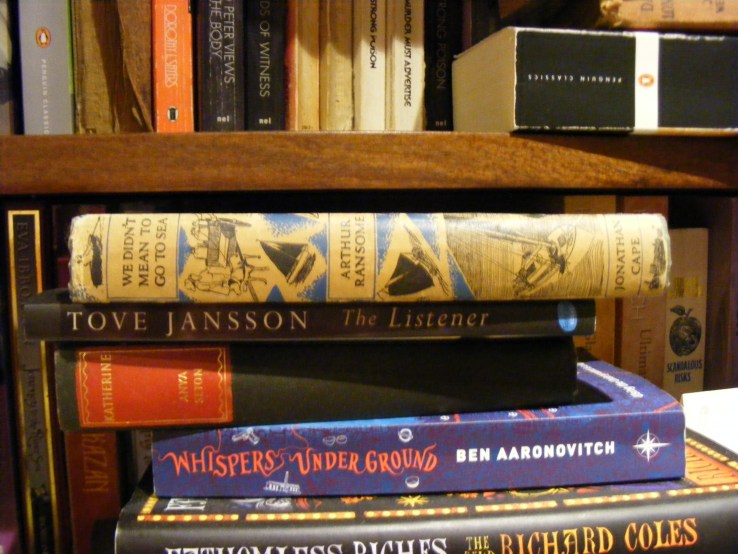
A very grainy photo of some books I’ve enjoyed. You might not enjoy these. That’s fine!

On Thursday I took part in a workshop for union learning reps, exploring ways of promoting reading and writing for pleasure in the workplace. One of the initiatives that they work with is the Reading Ahead challenge – members are encouraged to choose six reads (which could be anything from a haiku to War and Peace) and write a brief review of each of them. The idea is to make reading less off-putting, to demonstrate that it’s for everybody.

One of the ULRs told a story about someone who had managed to put one of her recruits right off joining in the challenge.

‘And what are you reading at the moment?’ he’d asked. She’d told him, had said, a little apologetically, that maybe it wasn’t the most intellectual thing in the world, but she was enjoying it.

‘But it’s not about enjoying it, is it?’ he said. ‘It’s about challenging yourself, learning something new.’

That person was wrong. WRONG.

It is about enjoying it.

I’m going to write that bigger:

It *is* about enjoying it

And if the person who said that it isn’t was the person I think it was, I’m going to tell him so when I next see him.

This person is also wrong, or, at least, missing the point spectacularly. If we try to make people read because it is good for them, they will never enjoy reading. It’s like eating enough vegetables, or getting enough exercise: if you do it because you think you should, you’re constantly fighting with yourself and sooner or later you give up because you just hate yourself so much for making yourself do it.

The world is full of things that we read because we have to. Bills. Textbooks. Contracts. Procedures. They are not fun. Why should we extend that misery to the rest of our reading life?

The more people read for fun – read because they genuinely enjoy it, because they would rather be reading than doing something else – the easier they will find it when they come to reading what’s dull, or difficult, but essential.

Can we enjoy reading challenging material? Of course we can. Personally, I have just downloaded Le Tour du Monde en Quatre-Vingt Jours – yes, in French – which is going to be a challenge, and also something that I will enjoy. As one of my friends says, ’embrace the power of AND’. We can also keep reading things that we’re not currently enjoying in the hopes that we will enjoy them eventually.

But to deliberately seek out things to read that we don’t expect to enjoy… no. No, thank you.

In much the same way as one gets tired of doughnuts very quickly if one eats nothing but doughnuts, it’s unlikely that people will read nothing but [that book you’re thinking of] and [that other book you’re thinking of]. And really, if they did, would that be such a problem?

The more we read – the more we read for pure pleasure – the more we will find our horizons expanding and our tastes diversifying. If we just let people read what they want to read, and keep reading what they want to read, they’ll probably end up reading something that comes up to the exacting standards of the person who terrorised that poor potential Reading Ahead challenge participant.

But that’s not the point. Enjoyment comes first. Life is too short to drag ourselves through things we’re not enjoying just because somebody thinks they’re good for us.

It is about enjoying it. In fact, enjoying it is the most important thing.