A reader’s guide to Cambridge charity shops

The fruits of an afternoon's research
The fruits of an afternoon’s research

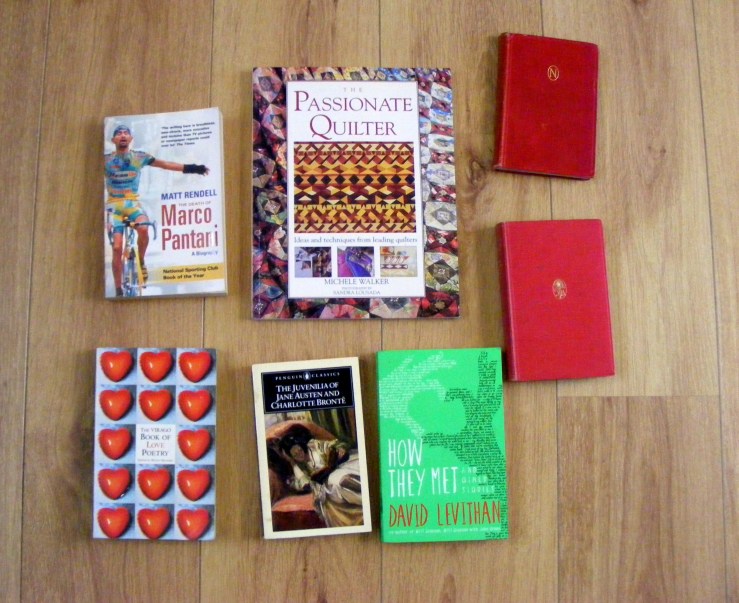
I have always bought books in charity shops, and, so long as charity shops, books, or I continue to exist, I always will. There wasn’t much spare money around when I was growing up, and besides, I have a perverse liking for things that are out of print.

In terms of books, charity shops are good for:

  • things I have a vague idea that I’m collecting (for example, Blue Peter annuals, or John Buchans in the red Nelson edition, which is the only thing that fits on the second shelf of my big bookcase);
  • last year’s bestsellers;
  • impulse buys.

Charity shops are not so good for:

  • things that have only just been published, though you occasionally get lucky;
  • rare or specific books, though you occasionally get lucky;
  • things you need within a tight timeframe, though you occasionally get lucky.

I spend less time in charity shops than I used to, mainly because there are none within walking distance of my office – at least, not if I want to get out and back and spend a reasonable amount of time actually in the shop all within my lunch break. However, there are always Saturdays. I’ve lived in Cambridge for getting on for three years now, and have explored a reasonable portion of the city in that time. There are two streets in particular that have an abundance of charity shops: Burleigh Street and Mill Road.

Charity shops fall into two broad categories. There are the carefully curated, and the undiscriminatingly chaotic.

The latter are, of course, by far the best for books. You never know what you’re going to find; you pick up things you’d never heard of because you are intrigued by the picture on the spine or because the title reminds you of something you were looking for six months ago. You never find what you’re actually looking for, but the chances are you’ll find something else worth reading.

In the carefully curated category, by contrast, you will find two stingy shelves of books, whose contents will be unremittingly boring, and suspiciously similar to those in every other carefully curated charity shop in the street. If you’re looking for last year’s bestseller, this is the place to go. If not, it won’t take you long to scan the shelves and decide there’s nothing to keep you there. (You will also find some inoffensive and deeply boring clothes, and the ones with an ‘Atmosphere’ label will probably cost a pound more than they were originally sold for in Primark.)

A more promising subset of ‘carefully curated’ is the specialist charity bookshop. There are two of these in Cambridge – the Oxfam bookshop on Sidney Street, and Books for Amnesty on Mill Road. The great advantage of these is the fact that the books are arranged in a coherent and logical fashion, and, if you know what you’re looking for, you can be in and out within three minutes.

However, the chances are that you’ll pay a similar price to those charged by specialist second-hand dealers. Which is good for the charity, of course… up to the point where you don’t buy the book because you didn’t want it that much. And of course, if you don’t know exactly what you want, the choice can be somewhat overwhelming.

My two favourite shops on Burleigh Street are Oxfam and the RSPCA. Oxfam has  a vast range of all sorts of stuff over two floors. The books are helpfully arranged by category, and there are plenty of categories, and there is plenty of variety within those categories. The last thing I got in there was a book of poems by Luci Shaw, and the thing before that was A Murder Is Announced. It’s also, so my father informs me, good for Ordnance Survey maps.

The RSPCA doesn’t have such a wide selection, but what it does have is of good quality. I picked up the bulk of my Buchan collection there. The British Heart Foundation tends to have interesting books. Like all BHF shops, it’s crammed full of too much stuff, both second-hand and the hideous ‘new goods’, but it can be worth fighting your way to the back left-hand corner. I wouldn’t go out of my way to any of the others, and have resolved never to give books to the Scope shop, which sends them (so one assistant told me, at least) for pulping if they haven’t sold after only a fortnight on the shelf.

Mill Road has the Sally Ann, which is a spacious shop with a lot of stuff in it, and another Oxfam, this one affably scruffy. The YMCA is comparatively new. It has hardly any books, but I did get A Book of Escapes in there.

It is worth going beyond the railway bridge, if only for the RSPCA bookshop. This is less like a charity shop and more like something you’d find in Hay-on-Wye. Books everywhere, stacked on the top of shelves, on the floor. Penguins, Pelicans, Viragos, old hardbacks, old paperbacks… It’s wonderful.

I don’t recommend going round all the charity shops in one day. There are, after all, only so many books that can be loaded into a bike basket before the steering goes all skew-whiff.
December Reflections 9: best day of 2016

dscf1508

On my birthday I found a labyrinth in the shape of a diplodocus.

It was a great birthday anyway. I was staying with my family on the Isle of Wight. We visited my favourite second-hand bookshop. There was a picnic on the beach, with stuffed vine leaves and huge chocolate cookies, and my youngest brother bought everyone ice creams. I opened my birthday presents on the beach, and one of them was a book about the labyrinths in the London Underground.

Then we walked up from the beach to look for lizards at La Falaise car park. We found a lizard, and then, a little further up the cliff, we found a lizard of another sort. I’d had fossils and spirals on the brain all year – and what’s a labyrinth but a very particular sort of spiral? And moreover, because of the way that one follows the path of a labyrinth into the centre, and then follows it back out again, it’s a very appropriate thing for a birthday. You can let the last year go on the way in, and welcome the next one on the way out.

Later, my oldest brother treated us to tapas; and we rounded off the day with pink lychee liqueur. It was a fabulous birthday.

Portals

A few years ago, back when I first started celebrating the new year at the beginning of Advent, somebody asked me if I was going to move all my December rituals back, as well.

I said no. The whole point was to acknowledge transition as a gradual process. The world doesn’t suddenly change at the moment the sun sets on the last day of Ordinary Time, any more than it suddenly changes at the stroke of midnight between December and January. I’m always changing, and so is the world around me, and this time of year, when it feels as if everything is dead and nothing is changing, is a particularly good time to take stock, to see what has changed over the past twelve months (give or take). Change is gradual, and so, therefore, is my new year. It’s not so much a step into the unknown as it is a step forward into what I can see, trusting that what I can’t yet see will make itself known.

Less like this:

dscf1811

And more like this:

dscf1840

Looking (for photographs, and not)

dscf1836

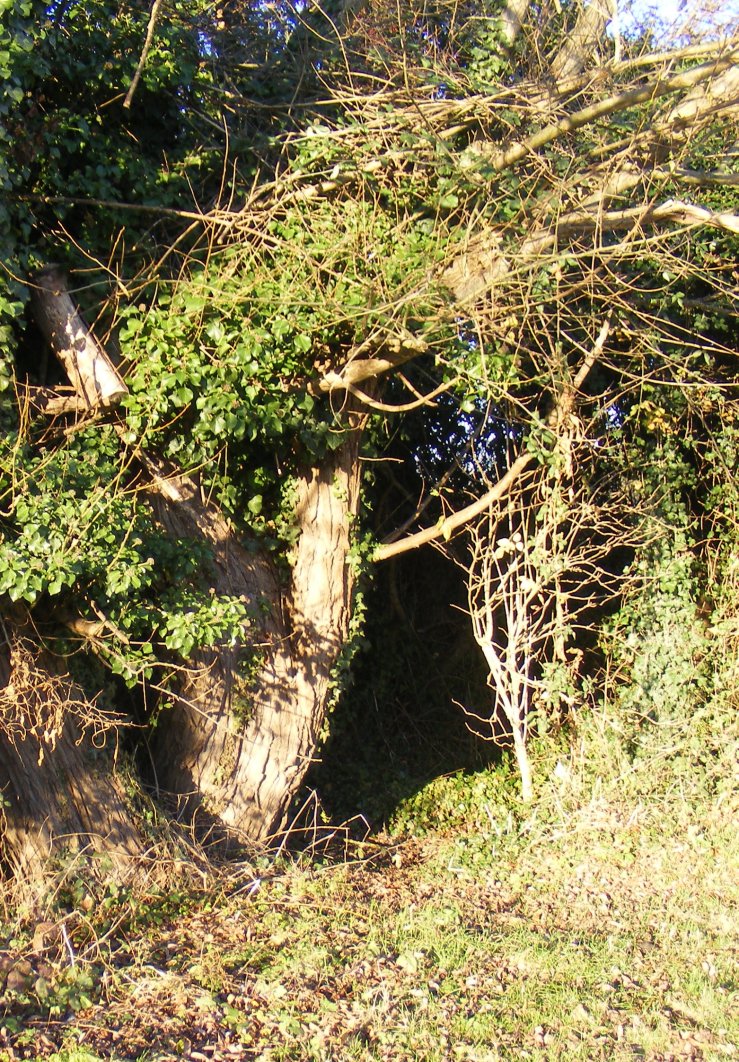
I took my camera out for a walk today. It’s been a bright, chilly day, with golden light and long shadows, and frost on the ground that the sun hadn’t reached. There is less colour now than there was a week ago; the leaves have fallen, and yet – there are red berries in the hedgerows; the sky is a cool turquoise, and the river throws it richer and deeper, and the bare branches are somehow a vivid green. The low sun flatters it all, intensifies it.

People worry a lot about Instagram and Twitter, and what we’re missing, and whether we don’t see things properly when we’re looking through a viewfinder, and sometimes I think they have a point. But more often, I find that looking for a photograph just makes me look, full stop. Looking for beauty helps me find beauty; and often, I forget.

This year, I will take more photographs. I will look for more photographs. Even, perhaps, when I’m not carrying a camera.

A square of chocolate and a quiet hour

I’ve had my attention drawn to another Advent calendar that runs all the way through Advent: Advent Calendar for Depressed People. I’m liking the look of it so far. And through that I found this: #FuckThisShit: an Advent devotional

It’s no secret that I find this end of the year difficult. My mental state is dependent on the hours of daylight. I begin to notice in September. October is awful, always. Then the clocks go back, and dawn comes before my alarm clock goes off, and suddenly I can function again. The inevitable is delayed for two or three weeks… until here it is. Mornings are impossible again. And people are expecting me to be cheerful because It’s nearly Christmaaaaaas!

I cannot be cheerful for an entire month. This is why I take Advent so seriously.

Advent makes room for my inevitable grumpiness, fatigue, disorganisation, lack of motivation. A square of chocolate and a quiet hour, and perhaps that’s all I can manage. Opening the doors, turning the pages: because these are small things, I make time for them. The candles burn down, one, two, three, four, and somehow there’s always just enough left of the first one when the time comes for them all to be lighted. Advent provides me with a solid structure at the very time of year I most need one. Day after day (and they get shorter and shorter) it guides me through, and somehow, when I ought to be the least spiritual and responsive to beauty, I find the time; I stop; I look; and there it is.

Advent is not meant to be wall-to-wall cheeriness. It’s a combination of solemnity and awe, anticipation and terror; wanting everything to be over, and knowing that we’re a very long way away from that; having a keen sense of my own unpreparedness, and knowing that my preparedness isn’t entirely relevant, after all.

Empty space

I’m not ready for Advent this year.

I wasn’t ready for Advent last year, either. That’s part of the point of it. Wachet auf. Wake up!

(I’ve heard Wachet Auf twice today, and sung Lo! he comes with clouds descending twice, too. It’s definitely Advent. Ready or not, here it comes.)

It’s early, of course. It’s as early as it can be: Christmas falls on a Sunday, so Advent stretches out for the full four weeks. The calendars (except this one), the candles, the prompt blogs, the poetry anthologies all start on the first of December, and here we are with four days of November left to fill.

In fact, I’m not even sure about the prompt blogs. Kat McNally has shut up shop. Project Reverb seems to have gone AWOL. I think I will join in December Reflections, but I find myself wanting to work with prompts for writing rather than photography. I like to look back over the year that has been, and forward to the year that’s coming.

What am I going to do?

What am I going to do?

I’ve got the end of a box of chocolates in my drawer. I have a shelf full of poetry books. I have plenty of candles, even if they don’t have numbers on.

I wrote this week, in another place,

I’d like to get better at doing nothing, feel more comfortable with empty space.

Perhaps these four days – well, three, now, really – are an opportunity.

Not many people can say that

More of a story over Paris, this one. I'll tell you, one day.
More of a story over Paris, this one. I’ll tell you, one day.

I have had a character named after me in a short story about Captain Von Trapp invading Paris in a submarine. It’s part of a delightful series called Stories Under Paris: an ambitious project to write a story for each one of the hundreds of Métro stations. The result so far is a collection of whimsical, joyous fantasies; my favourite (again, so far) is The Story of the Un-Drowned Princess for Château d’Eau. Although of course I’m always going to have a soft spot now for Léon Gambetta and the Battle of the Métro, for Midshipman Jowitt’s sake.

Midshipman Jowitt exists because I supported the author on Patreon, which, if you haven’t already heard of it, is a sort of crowd-funding site to support artists. Like other crowd-funders like Kickstarter or Indiegogo, the creator can choose to set perks according to the level of funding the individual supporter chooses to pay. And one of the rewards at the level I chose to support was to get a character named after me, though I have to admit that this had very little to do with my decision to become a patron. That was more because I love the whole concept of Stories Under Paris and am keen to see it continue for all three hundred and something stations.  And if all this is sounding fearfully extravagant, well, I could easily spend more on a magazine, for writing I enjoyed less.

I have to admit to having some reservations about Patreon – not least, the way that it’s going to turn into a pyramid scheme for artists if only artists use it – but I can also see its potential, to provide a sustainable income for full-time writers, composers, etc, or to cover the costs of a hobby. Whatever, being a supporter has worked out pretty well for me.

100 untimed books: electronic

40. electronic
40. electronic

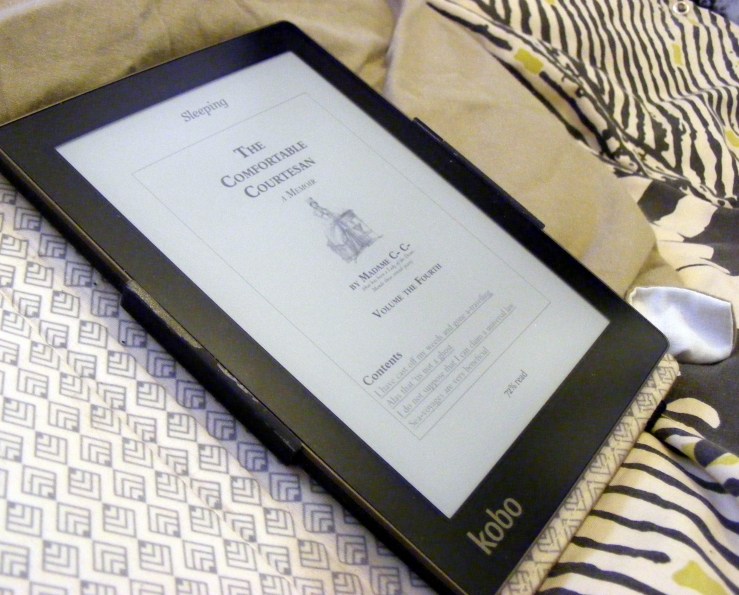
The Kobo was a Christmas present last year. I mostly use it for reading: long fanfic; out of copyright books from Project Gutenberg; new books, when it’s looking unlikely that I’ll get to a bookshop in time to read the thing before the next book club meeting; books that in paper format would be too thick or heavy to go in my handbag; things that exist in electronic format only.

If you haven’t come across The Comfortable Courtesan yet, I thoroughly recommend her. She’s the narrator and main character of an early nineteenth century soap opera that’s been going for about eighteen months in our time, and several years in the time of the action. It’s often gentle, occasionally melodramatic, always sex positive, usually funny, sometimes sad, and invariably a welcome interlude in my day.

100 untimed books

LGBTQ Christian fiction book recs

20161008_153542

Note: this began as a spontaneous blog post in 2016 and has metamorphosed into an ongoing rec list over the years. I add relevant books to it as I read them, and am always on the lookout for more. The fact that a book appears on this list doesn’t necessarily imply that I thought that it was particularly good, just that it matches the criteria in the third paragraph below.

I got chatting on Twitter with the user of the Diverse Church account about books with LGBTQ Christian characters, and how few of these there actually are.

Now, at least part of the reason I wrote one (now two) of my own was that I was frustrated with the lack of representation. However, I’ve found a few over the years, and it only seems fair to share the intel. In this post, I’m only listing books I’ve actually read, but in some cases it was a while ago. I’m adding warnings, but there’s always a possibility that I’ll not have remembered something horrible. Proceed at your own risk!

While not all of these end with hugs and puppies, they do start from, or at least eventually arrive at, the assumption that being Christian and being LGBTQ are not incompatible states, and call, in one way or another, for affirmation.

As for things I haven’t read (yet)… I’ve found Jesus in Love to be a very interesting source of recommendations. There’s also the reliqueer tag on LGBTQ Reads. Do add your own – either for individual books or authors, or for rec sites or round-ups – in comments!

On to the books…

Michael Arditti, The Celibate. The AIDS crisis and the narrator’s own personal crisis meet head-on. Warning for some gory Ripperology and [see spoilers in footnotes]*

Michael Arditti, Easter. Set in a London parish over the course of one Holy Week, with multiple storylines playing out across the congregation, seen from multiple perspectives.

Jaye Robin Brown, Georgia Peaches and Other Forbidden Fruit. US young adult. The narrator is the daughter of a radio minister, is herself a committed Christian, and is an out lesbian. None of which is a problem in Atlanta, but when her father remarries and the reconfigured family moves to a more conservative part of Georgia, she agrees to go back in the closet, just for the time being. Things only get more complicated when she falls for one of the girls at her new church.

Paula Boock: Dare, Truth or Promise. New Zealand teen fiction of the ‘challenges of high school’ type. One of the main characters is Roman Catholic, and there’s a lovely scene with her priest, which meant a lot to me back in the day.

Carol Anne Douglas: Sister Matthew and Sister Rose: Novices in Love. Does what it says on the tin, really, with a side of magical realism. Both novices express a good deal of frustration with the rules of the convent and the Roman Catholic Church, but at least one of them appears to maintain a strong faith in spite of this.

Catherine Fox: Lindchester chronicles (Acts and Omissions, Unseen Things Above, Realms of Glory). Barchester for the modern day, with outright representation of gay and lesbian characters and engagement with the politics.

Elena Graf: This Is My Body. A romance between an Episcopalian priest and former opera singer and a professor of philosophy, set in a seaside town in Maine. It’s very refreshing to read a romance between two women (two older women, at that) which deals seriously and respectfully with questions of faith.

Aster Glenn Gray: Briarley. M/M Beauty and the Beast retelling, in which one of the main characters is a parson in wartime rural England. I loved this. Full review here.

Radclyffe Hall: The Well of Loneliness. Definitely short in the hugs and puppies department, but I couldn’t leave it off the list, for much the same reasons as those that Kittredge Cherry explains over at Jesus in Love.

Heather Rose Jones: Alpennia series. (Daughter of Mystery, The Mystic Marriage, Mother of Souls). Low fantasy, early nineteenth century, Ruritanian. I ate these books up with a spoon, but I append a health warning as the fantasy element crosses over with the religious element in a way that might not work for everybody. Nevertheless, they do include at least one character who speaks positively and explicitly about the intersection between her faith and her sexual identity, and absolutely deserve their place on this list.

Kathleen Jowitt: Stancester series. (Speak Its Name, The Real World). I wrote these, on the basis that if you can’t find what you’re looking for you might as well create it yourself. Faith, identity, and student politics on a West Country university campus. 

A. M. Leibowitz, Anthem. A worship leader’s confessional song becomes an accidental Christian hit. Particularly entertaining for anyone who’s ever had to stifle a snigger at the unintentional suggestiveness of some worship music.

A. M. Leibowitz, Passing on Faith. The gay son of one homophobic pastor (and brother of another) falls for his affirming Christian neighbour. This is the first in a series; I haven’t read the rest of it yet.

Rachel Mann, The Gospel of Eve. Many fucked up things happen in this book, and it’s hardly a spoiler to say that there isn’t a happy ending, but the relationship between two women ordinands is by far the least fucked up. Or, at least, only in the way that relationships generally are.

J. B. Marsden, Bobbi and Soul. Romance between an Episcopalian priest and a doctor, with nice background details of rural Colorado and both main characters’ workplaces.

ed. Gabriela Martins, Keep Faith. This anthology of short stories includes two featuring queer Christian girls: “Godzilla” (Kate Brauning), a perceptive examination of what it’s like to be the token same-sex couple in a well-meaning affirming church youth group, and “Whatever She Wants” (Kess Costales), whose time-lapse structure works well to show how its narrator comes to understand who she is and how her faith fits with that. (I reviewed the anthology as a whole here.)

Jessica Pegis: The God Painter. Sci-fi novel in which the entire population of Earth is evacuated to another planet, and finds that all the old divisions still exist despite surprising new evidence. Reviewed here.

Alex Sanchez: The God Box. American teen fiction, also of the ‘challenges of high school’ type; engages the question head on throughout the book.

Caren J. Werlinger: In This Small Spot. A bereaved doctor enters an abbey, only to find herself falling for one of the nuns. I loved most of this and had some reservations about the rest of it. Reviewed here (spoilers, but there’s a warning before you get there).

Sarah L. Young, Plus One. Another American YA book. One of the narrators is bisexual and (presumably) Roman Catholic; there’s quite a lot of discussion about how her faith affects her reaction to an unplanned pregnancy, but she doesn’t seem to experience any conflict between her faith and her sexual orientation. Reviewed here. (Edit: unfortunately the publisher has folded, but you may be able to pick up a second-hand copy.)


* child sexual assault, connected with gay identity in a way that I found quite distasteful. But ultimately affirms the holiness of queer sexuality.