Looking forward to Kingsblood

2013 August Wells 076Ankaret Wells, whose books are great and who I credit with showing me that self-publishing could be far more fun and far less trouble than I had always feared, has teamed up with Irene Headley, whose writing is always insightful and often hilarious, to write a new fantasy series, Kingsblood. And it looks like it’s going to be fantastic:

The bitter years of the Cousins War are over… for now.
The grandsons of Kharis Sidonia are dukes and kings, and the last kinsmen of the deposed King Gilbert the Bloodless are hunted exiles… for now.
Winter holds armies at a standstill, and in Briege, the suitors of the new Duchess of Bergomance protest that they are at her feet… for now.
Before the thaw breaks, Ambrosia of Bergomance must choose a husband, and place her people in the hands of another, greater, power, By her side are two men – her uncle Thomas of Wharram, loyal to his family above all else, and Nicolas ás Ithel, who has spent most of his life as a hostage.
Thomas and Nicolas become lovers and allies…
For now.

There are extracts at Ankaret’s blog and at Irene’s. The first work is coming out in December.

I’m really looking forward to this one.

A reader’s guide to Cambridge charity shops

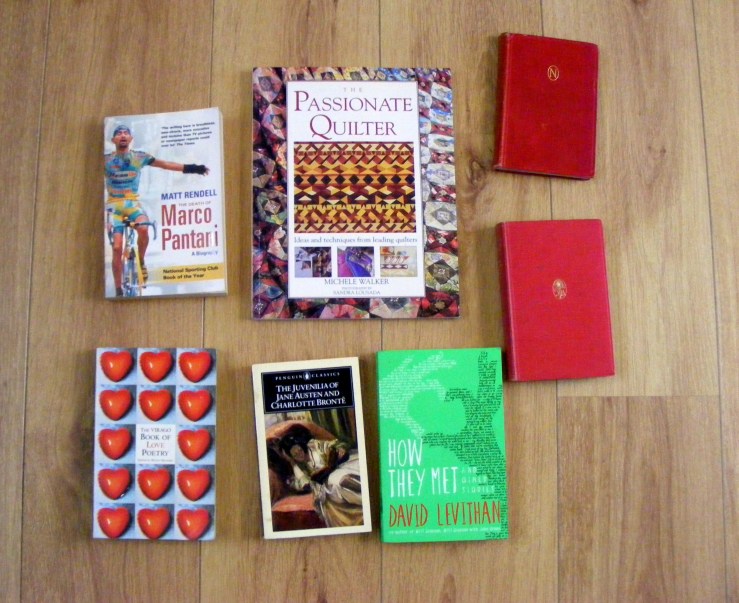
The fruits of an afternoon's research
The fruits of an afternoon’s research

I have always bought books in charity shops, and, so long as charity shops, books, or I continue to exist, I always will. There wasn’t much spare money around when I was growing up, and besides, I have a perverse liking for things that are out of print.

In terms of books, charity shops are good for:

  • things I have a vague idea that I’m collecting (for example, Blue Peter annuals, or John Buchans in the red Nelson edition, which is the only thing that fits on the second shelf of my big bookcase);
  • last year’s bestsellers;
  • impulse buys.

Charity shops are not so good for:

  • things that have only just been published, though you occasionally get lucky;
  • rare or specific books, though you occasionally get lucky;
  • things you need within a tight timeframe, though you occasionally get lucky.

I spend less time in charity shops than I used to, mainly because there are none within walking distance of my office – at least, not if I want to get out and back and spend a reasonable amount of time actually in the shop all within my lunch break. However, there are always Saturdays. I’ve lived in Cambridge for getting on for three years now, and have explored a reasonable portion of the city in that time. There are two streets in particular that have an abundance of charity shops: Burleigh Street and Mill Road.

Charity shops fall into two broad categories. There are the carefully curated, and the undiscriminatingly chaotic.

The latter are, of course, by far the best for books. You never know what you’re going to find; you pick up things you’d never heard of because you are intrigued by the picture on the spine or because the title reminds you of something you were looking for six months ago. You never find what you’re actually looking for, but the chances are you’ll find something else worth reading.

In the carefully curated category, by contrast, you will find two stingy shelves of books, whose contents will be unremittingly boring, and suspiciously similar to those in every other carefully curated charity shop in the street. If you’re looking for last year’s bestseller, this is the place to go. If not, it won’t take you long to scan the shelves and decide there’s nothing to keep you there. (You will also find some inoffensive and deeply boring clothes, and the ones with an ‘Atmosphere’ label will probably cost a pound more than they were originally sold for in Primark.)

A more promising subset of ‘carefully curated’ is the specialist charity bookshop. There are two of these in Cambridge – the Oxfam bookshop on Sidney Street, and Books for Amnesty on Mill Road. The great advantage of these is the fact that the books are arranged in a coherent and logical fashion, and, if you know what you’re looking for, you can be in and out within three minutes.

However, the chances are that you’ll pay a similar price to those charged by specialist second-hand dealers. Which is good for the charity, of course… up to the point where you don’t buy the book because you didn’t want it that much. And of course, if you don’t know exactly what you want, the choice can be somewhat overwhelming.

My two favourite shops on Burleigh Street are Oxfam and the RSPCA. Oxfam has  a vast range of all sorts of stuff over two floors. The books are helpfully arranged by category, and there are plenty of categories, and there is plenty of variety within those categories. The last thing I got in there was a book of poems by Luci Shaw, and the thing before that was A Murder Is Announced. It’s also, so my father informs me, good for Ordnance Survey maps.

The RSPCA doesn’t have such a wide selection, but what it does have is of good quality. I picked up the bulk of my Buchan collection there. The British Heart Foundation tends to have interesting books. Like all BHF shops, it’s crammed full of too much stuff, both second-hand and the hideous ‘new goods’, but it can be worth fighting your way to the back left-hand corner. I wouldn’t go out of my way to any of the others, and have resolved never to give books to the Scope shop, which sends them (so one assistant told me, at least) for pulping if they haven’t sold after only a fortnight on the shelf.

Mill Road has the Sally Ann, which is a spacious shop with a lot of stuff in it, and another Oxfam, this one affably scruffy. The YMCA is comparatively new. It has hardly any books, but I did get A Book of Escapes in there.

It is worth going beyond the railway bridge, if only for the RSPCA bookshop. This is less like a charity shop and more like something you’d find in Hay-on-Wye. Books everywhere, stacked on the top of shelves, on the floor. Penguins, Pelicans, Viragos, old hardbacks, old paperbacks… It’s wonderful.

I don’t recommend going round all the charity shops in one day. There are, after all, only so many books that can be loaded into a bike basket before the steering goes all skew-whiff.

We’ll turn it around

dscf9952

I’ve spent quite of lot of 2017 being ill. The boomerang virus has hit me three times since New Year’s Eve. At the moment it’s manifesting in a hacking cough, set off by a) singing anything longer than a bar and a half in one breath; b) laughing; c) breathing in cold air. Previously it’s made itself known in extreme lethargy, fever, sniffles tending to nosebleeds, headaches, lack of sleep, a sore throat, and a cough. Not, fortunately, all at once. Or, at least, not for long.

Consequently, I’ve spent quite a lot of 2017 wrapped up in a blanket and occupying myself with things that haven’t needed much energy. In what is perhaps not a coincidence, I have fallen hard for Yuri!!! on Ice, which is a very sweet and optimistic anime about figure skating. This despite my having had no prior interest in either anime or figure skating. It just seems to appeal to the same part of my brain that likes epaulettes and grand opera and dark chocolate. And Ruritania.

It’s probably also significant that Yuri!!! on Ice takes place in a universe where there’s no homophobia and where the sport system can be trusted. By contrast, I have spent the last year writing in a universe where sport chews you up and spits you out, and several years before that writing in a universe where homophobia is depressingly and devastatingly real. So perhaps I just needed a break.

There are parts of my brain that think it is absolutely appalling of me to be watching anything at all light and fluffy (not to mention admitting to it in public) when As We All Know The World Is Going To Hell. (There are other parts of my brain that don’t like my admitting to liking anything at all, including epaulettes, grand opera, and dark chocolate, because that’s really embarrassing, apparently. And another one that’s pointing out that I promised myself several years ago that I’d never apologise for my reading or watching material, because if an English Lit degree doesn’t give you the right to read what you like without feeling guilty about it, what does? Brains, eh?)

The thing is, it’s not as simple as that. In the same way that one can’t (at least, I can’t) read The Prisoner of Zenda and Rupert of Hentzau without reflecting that Rudolf V is actually a pathetic excuse for a king who deserves everything he gets, and wondering whether there’s a Ruritanian Communist Party, it’s difficult to watch Yuri!!! on Ice without acknowledging that, sadly, Russia doesn’t work like that, and China doesn’t work like that, and probably skating doesn’t work like that either. Which makes for some genuinely interesting fanfic; but I’ve been reading a lot of fluff, too.

It’s a constant push and pull: between escapism and realism (but how real is the realism?), between optimism and pessimism; the tension between the world as one would like it to be and the world as one fears it is; the question of what truth looks like in fiction. I feel the urge to complicate the simple stuff; and to give the miserable stuff a happy ending; to question whether an ending that an author clearly intended as happy is as happy as all that; and to equip other people’s characters with the tools to get out of the mess they were left in. It’s a question with which a consumer engages as much as a creator. Actually, I find that the lines are blurred, and that I’m arguing with something with everything I write: some other book, something someone else said, adding another layer to the debate.

On which subject: I’ve got back into the editing process for A Spoke In The Wheel this week, after spending all of January too knackered and too scared to look at it. It turns out that it’s neither as bad nor as miserable as my mind had made it out to be. (Again, I say, brains, eh?) And I find myself wondering, now, where it falls on that continuum between realism and escapism. I’ve tried to set it in the real world, where zero hours contracts and sexism and burnout exist. I’ve got a friend checking it at the moment for errors in my portrayal of the notoriously dreadful UK disability benefits process. It’s fairly cynical about sport, or, at least, the narrator is.

But I find, re-reading it, that on the whole it’s hopeful. And I’m glad about that. Apart from anything else, it occurs to me that if we can’t let ourselves imagine a better world, we’re unlikely ever to get one.

December Reflections 17: five years ago

dscf1981

Five years ago, I was writing to December prompts for the first time, though I seem to have done a whole heap at once. This was Reverb 11.

Five years ago, I was beginning to come to terms with some things that I now accept as the price of admission for being who I am. That I’m not at my most energetic, creative or enthusiastic at this time of year. That winter will always be difficult. That uninterrupted good health is not, after all, something to be expected as a right.

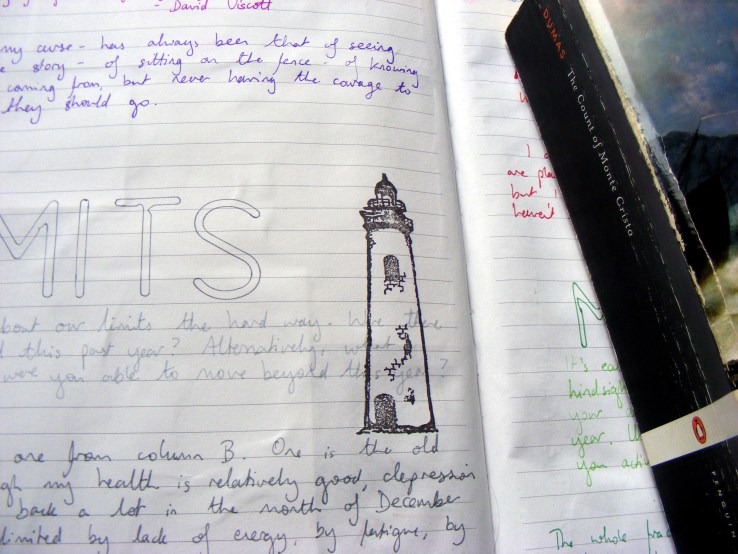
Five years ago, my diary was much more colourful than it is today. This is actually one of the less exuberant pages: elsewhere there are stickers, collage, glittery pens, all sorts. I think the reason I’m not doing that so much at the moment is the fact that the chest of drawers wherein I keep all that gubbins is no longer in the same room as my diary; these days it’s much easier to write in black fountain pen, the book resting on my knees, with my feet up on the sofa.

And I was just learning the use of fandoms that take a while to get through. I was reading The Count of Monte Cristo and watching early Doctor Who. The book was probably a little less battered five years ago.

December Reflections 5: best book of 2016

dscf1907

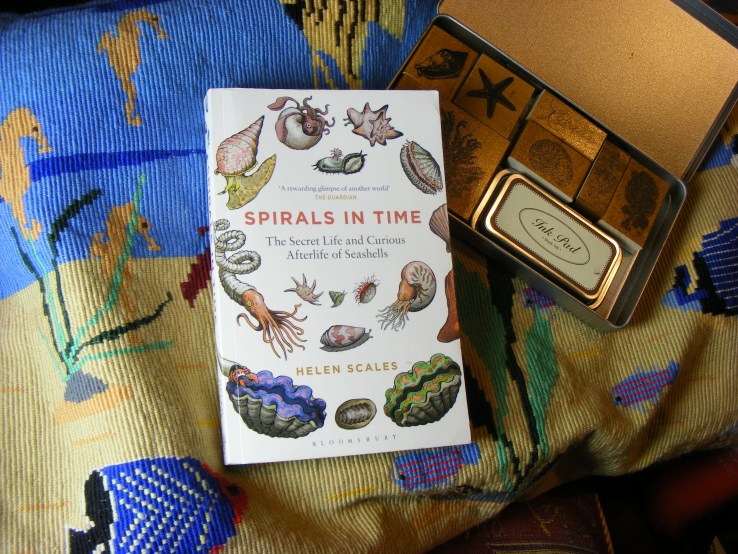
This year I went to Lyme Regis, where they are so proud of their ammonites that they incorporate them into the design of the lamp-posts. And I picked one up from the beach at Charmouth. And I thought a lot about spirals, and nautilus, which are living fossils, and about snails, and when I saw this book, with this title, it seemed meant. It’s a delightful book, very readable pop science with some fascinating thought experiments (how can you not love the Imaginary Museum of All Possible Shells?), gorgeous pictures, and good stories. Look at this, for example:

There are even molluscs that use their shells as greenhouses. Heart Cockles are small, heart-shaped and pink, and can be found lying on sandy seabeds near coral reefs. Like other bivalves they sift nourishment from the water, but they also grow food inside their bodies. Colonies of photosynthetic microbes in their tissues harness sunlight to make sugars.In return for a free feed, the shells give the microbes, known as zooxanthellae, somewhere safe to live and a ready supply of light; the shells have small, transparent windows that let the sunshine in.

Spirals In Time (Helen Scales). Thoroughly recommended even if you’re not as hung up on seashells as I am.

Not many people can say that

More of a story over Paris, this one. I'll tell you, one day.
More of a story over Paris, this one. I’ll tell you, one day.

I have had a character named after me in a short story about Captain Von Trapp invading Paris in a submarine. It’s part of a delightful series called Stories Under Paris: an ambitious project to write a story for each one of the hundreds of Métro stations. The result so far is a collection of whimsical, joyous fantasies; my favourite (again, so far) is The Story of the Un-Drowned Princess for Château d’Eau. Although of course I’m always going to have a soft spot now for Léon Gambetta and the Battle of the Métro, for Midshipman Jowitt’s sake.

Midshipman Jowitt exists because I supported the author on Patreon, which, if you haven’t already heard of it, is a sort of crowd-funding site to support artists. Like other crowd-funders like Kickstarter or Indiegogo, the creator can choose to set perks according to the level of funding the individual supporter chooses to pay. And one of the rewards at the level I chose to support was to get a character named after me, though I have to admit that this had very little to do with my decision to become a patron. That was more because I love the whole concept of Stories Under Paris and am keen to see it continue for all three hundred and something stations.  And if all this is sounding fearfully extravagant, well, I could easily spend more on a magazine, for writing I enjoyed less.

I have to admit to having some reservations about Patreon – not least, the way that it’s going to turn into a pyramid scheme for artists if only artists use it – but I can also see its potential, to provide a sustainable income for full-time writers, composers, etc, or to cover the costs of a hobby. Whatever, being a supporter has worked out pretty well for me.

Art, time and change

dscf0324

Tomorrow evening my church choir will be singing Maurice Duruflé’s Requiem. It’s an oddly appropriate choice for Remembrance Sunday, and it feels even more so given recent events: it was commissioned by the Vichy government in 1941, but Duruflé only finished it in 1947, after the war was over and the world was picking up the pieces.

Part of that, I suspect, is because Duruflé had a tendency to drag his feet on things he didn’t want to do. Only one of his works, the Notre Père, is not based on Gregorian chant, and that is because he only finished it after his wife had started writing it for him, having been requested repeatedly to set the Lord’s Prayer in the vernacular.

But part of it is the simple fact that art takes time. To create, to perform, to consume art, absorbs our attention for long enough to give us a new perspective. The six years that it took Duruflé to write the Requiem, the forty minutes that it takes to sing or to listen to it – that time makes space for things to change, for us to change.

For a couple of years I had a habit of picking up The Count of Monte Cristo in about October, when the days were getting shorter and my mood was getting lower. It’s about 1100 pages long; by the time I got to the end, something would have shifted.

One of the greatest gifts of art is the way that it takes us out of what we think is our own timeline; shows us – sometimes quite literally – the bigger picture; allows us to step back from the overwhelming emotion. Sometimes that feels like a betrayal: how can we possibly feel any less angry, any less hurt, any less scared, than we do at the moment? Surely this devastating news deserves nothing less than everything we have?

The last news story that made me cry was the murder of Jo Cox MP, just before the referendum in which the UK voted to leave the European Union. After that, nothing has really surprised me. Disappointed me, yes, but not surprised me.

The one before that was the General Synod decision in 2012, the one that voted against the appointment of women bishops. That was a November vote, too.

From where I am now, I am thinking, gosh, was that all I had to cry about in 2012? But it only seems trivial now because I know what happened next. When I’d cried about it, I wrote a blog post. Having written the blog post, I found that I was still hurt and angry, still feeling rejected because of a fundamental part of my own identity, and the only thing I could think of to do with that was write fiction.

Lydia choked, rolled onto her side, and sat up. ‘I never realised,’ she said wonderingly, ‘how much it was going to hurt. It goes right into the heart. They don’t want me. They were OK with the person they thought I was, so long as she stayed in her place, and was happy to teach the approved version of events and not rock the boat, but they don’t want the person I really am. I always knew, in theory, that I was only there on sufferance, that as soon as anyone worked out who I really was I’d be out on my ear, but it didn’t hit me until today how terrible it was, when you understand the reality that nobody wants you.’

That was where I began with the final draft. It went on from there: a year of writing; a year of editing; a year of becoming brave enough to put it out under my own name. I burned up the anger that had first fuelled it; I put it all into the text.

By the time I published Speak Its Name on 2 February 2016, six women had been consecrated as bishops in the Church of England. While I was writing, things had changed.

I’m not saying that things will magically become better if we can only wait it out. For some people it is, indeed, already too late. I am not saying that art can fix everything. There are some things that are just wrong. Nevertheless, it is the best tool that I have to make something good, something useful, perhaps even something beautiful, out of emotions that, left unchecked or harnessed for ill, will destroy the world.

LGBTQ Christian fiction book recs

20161008_153542

Note: this began as a spontaneous blog post in 2016 and has metamorphosed into an ongoing rec list over the years. I add relevant books to it as I read them, and am always on the lookout for more. The fact that a book appears on this list doesn’t necessarily imply that I thought that it was particularly good, just that it matches the criteria in the third paragraph below.

I got chatting on Twitter with the user of the Diverse Church account about books with LGBTQ Christian characters, and how few of these there actually are.

Now, at least part of the reason I wrote one (now two) of my own was that I was frustrated with the lack of representation. However, I’ve found a few over the years, and it only seems fair to share the intel. In this post, I’m only listing books I’ve actually read, but in some cases it was a while ago. I’m adding warnings, but there’s always a possibility that I’ll not have remembered something horrible. Proceed at your own risk!

While not all of these end with hugs and puppies, they do start from, or at least eventually arrive at, the assumption that being Christian and being LGBTQ are not incompatible states, and call, in one way or another, for affirmation.

As for things I haven’t read (yet)… I’ve found Jesus in Love to be a very interesting source of recommendations. There’s also the reliqueer tag on LGBTQ Reads. Do add your own – either for individual books or authors, or for rec sites or round-ups – in comments!

On to the books…

Michael Arditti, The Celibate. The AIDS crisis and the narrator’s own personal crisis meet head-on. Warning for some gory Ripperology and [see spoilers in footnotes]*

Michael Arditti, Easter. Set in a London parish over the course of one Holy Week, with multiple storylines playing out across the congregation, seen from multiple perspectives.

Jaye Robin Brown, Georgia Peaches and Other Forbidden Fruit. US young adult. The narrator is the daughter of a radio minister, is herself a committed Christian, and is an out lesbian. None of which is a problem in Atlanta, but when her father remarries and the reconfigured family moves to a more conservative part of Georgia, she agrees to go back in the closet, just for the time being. Things only get more complicated when she falls for one of the girls at her new church.

Paula Boock: Dare, Truth or Promise. New Zealand teen fiction of the ‘challenges of high school’ type. One of the main characters is Roman Catholic, and there’s a lovely scene with her priest, which meant a lot to me back in the day.

Carol Anne Douglas: Sister Matthew and Sister Rose: Novices in Love. Does what it says on the tin, really, with a side of magical realism. Both novices express a good deal of frustration with the rules of the convent and the Roman Catholic Church, but at least one of them appears to maintain a strong faith in spite of this.

Catherine Fox: Lindchester chronicles (Acts and Omissions, Unseen Things Above, Realms of Glory). Barchester for the modern day, with outright representation of gay and lesbian characters and engagement with the politics.

Elena Graf: This Is My Body. A romance between an Episcopalian priest and former opera singer and a professor of philosophy, set in a seaside town in Maine. It’s very refreshing to read a romance between two women (two older women, at that) which deals seriously and respectfully with questions of faith.

Aster Glenn Gray: Briarley. M/M Beauty and the Beast retelling, in which one of the main characters is a parson in wartime rural England. I loved this. Full review here.

Radclyffe Hall: The Well of Loneliness. Definitely short in the hugs and puppies department, but I couldn’t leave it off the list, for much the same reasons as those that Kittredge Cherry explains over at Jesus in Love.

Heather Rose Jones: Alpennia series. (Daughter of Mystery, The Mystic Marriage, Mother of Souls). Low fantasy, early nineteenth century, Ruritanian. I ate these books up with a spoon, but I append a health warning as the fantasy element crosses over with the religious element in a way that might not work for everybody. Nevertheless, they do include at least one character who speaks positively and explicitly about the intersection between her faith and her sexual identity, and absolutely deserve their place on this list.

Kathleen Jowitt: Stancester series. (Speak Its Name, The Real World). I wrote these, on the basis that if you can’t find what you’re looking for you might as well create it yourself. Faith, identity, and student politics on a West Country university campus. 

A. M. Leibowitz, Anthem. A worship leader’s confessional song becomes an accidental Christian hit. Particularly entertaining for anyone who’s ever had to stifle a snigger at the unintentional suggestiveness of some worship music.

A. M. Leibowitz, Passing on Faith. The gay son of one homophobic pastor (and brother of another) falls for his affirming Christian neighbour. This is the first in a series; I haven’t read the rest of it yet.

Rachel Mann, The Gospel of Eve. Many fucked up things happen in this book, and it’s hardly a spoiler to say that there isn’t a happy ending, but the relationship between two women ordinands is by far the least fucked up. Or, at least, only in the way that relationships generally are.

J. B. Marsden, Bobbi and Soul. Romance between an Episcopalian priest and a doctor, with nice background details of rural Colorado and both main characters’ workplaces.

ed. Gabriela Martins, Keep Faith. This anthology of short stories includes two featuring queer Christian girls: “Godzilla” (Kate Brauning), a perceptive examination of what it’s like to be the token same-sex couple in a well-meaning affirming church youth group, and “Whatever She Wants” (Kess Costales), whose time-lapse structure works well to show how its narrator comes to understand who she is and how her faith fits with that. (I reviewed the anthology as a whole here.)

Jessica Pegis: The God Painter. Sci-fi novel in which the entire population of Earth is evacuated to another planet, and finds that all the old divisions still exist despite surprising new evidence. Reviewed here.

Alex Sanchez: The God Box. American teen fiction, also of the ‘challenges of high school’ type; engages the question head on throughout the book.

Caren J. Werlinger: In This Small Spot. A bereaved doctor enters an abbey, only to find herself falling for one of the nuns. I loved most of this and had some reservations about the rest of it. Reviewed here (spoilers, but there’s a warning before you get there).

Sarah L. Young, Plus One. Another American YA book. One of the narrators is bisexual and (presumably) Roman Catholic; there’s quite a lot of discussion about how her faith affects her reaction to an unplanned pregnancy, but she doesn’t seem to experience any conflict between her faith and her sexual orientation. Reviewed here. (Edit: unfortunately the publisher has folded, but you may be able to pick up a second-hand copy.)


* child sexual assault, connected with gay identity in a way that I found quite distasteful. But ultimately affirms the holiness of queer sexuality.

J. K. Rowling, symbolism, and context

I thought that I really ought to write something about the recent kerfuffle around J. K. Rowling’s revelation that Remus Lupin’s lycanthropy is a metaphor for HIV, which I thought we all knew already, but apparently not.

More specifically, I thought that I really ought to write something about the claim, which took me right back to the Dumbledore-is-gay revelation, that if she wanted to write a gay character she should just write a gay character and stop fannying around with all this symbolism.

Then I thought that I really couldn’t face writing something about it.

Then I remembered that I already had.

Section 28 was in force when I was at school. This is what it said:

a local authority “shall not intentionally promote homosexuality or publish material with the intention of promoting homosexuality” or “promote the teaching in any maintained school of the acceptability of homosexuality as a pretended family relationship”

Local authorities are responsible for, among other things, public libraries and state schools, and one of the effects of this was the complete absence of LGBT characters in children’s and teen literature that was written or published in the UK. We didn’t have the British equivalents of David Levithan, Alex Sanchez, or Nancy Garden. Nobody would publish them. The one book with any queer characters in my school library that I remember was Dare, Truth or Promise – written and published in New Zealand. Mentioning Nancy Garden above reminds me that the school library did have The Year They Burned The Books. Oh, the irony.

(Somebody asked me which book that was in. It’s kind of a spoiler, but if you click on the tweet it should take you to the question and my answer.)

And it took a good few years for the UK teen publishing world to catch up, and yes, I do have a horse in this race:

Which is not to say that I think that it was a good idea to come out now (pun not exactly intended, but I’m not deleting it now I’ve noticed it) and say what the symbolism actually, like, means. If the reader didn’t pick it up the first time round then bashing them over the head with it isn’t going to help, and it’s just going to annoy the ones who got it, didn’t like it, and were doing their best to ignore it.