Later this week I’ll be back on the Isle of Wight for Ventnor Fringe, an independent arts festival that turns every conceivable nook and cranny in this delightfully higgledy-piggledy Victorian resort into a performance space. Ventnor is possibly my favourite town in the entire country, but I have never yet managed to make it down there for the Fringe. Until now.
You may well find me in the Book Bus in St Catherine’s churchyard, where I’ll have copies of both my books on sale. (Mine are new. Everything else on there is second hand.) The bus (which is the one in the picture above) will be there all week, and is open from 10am to 6pm; I have to eat and sleep and would quite like to see some of the other events as well, so I can’t guarantee that I’ll necessarily be there when you happen to turn up. But hey, it’s a bus full of books; you don’t need me to be around to have a whale of a time there.
All this talk of independent events reminds me of an initiative I came across via Twitter this week, Just A Card. The idea is that if everybody who came into a [studio/craft shop/art gallery/bookshop] bought ‘just a [card/brooch/fridge magnet/book]’, that establishment would be able to remain in business for rather longer than it would otherwise.
Obviously I’m not advocating filling your house up with useless crap that you hate, particularly not if money’s tight; but if you find something cheap and pleasing, something that you think that a friend or family member might appreciate even if it’s not your thing, then buying it might go a little way to keeping an independent business going.
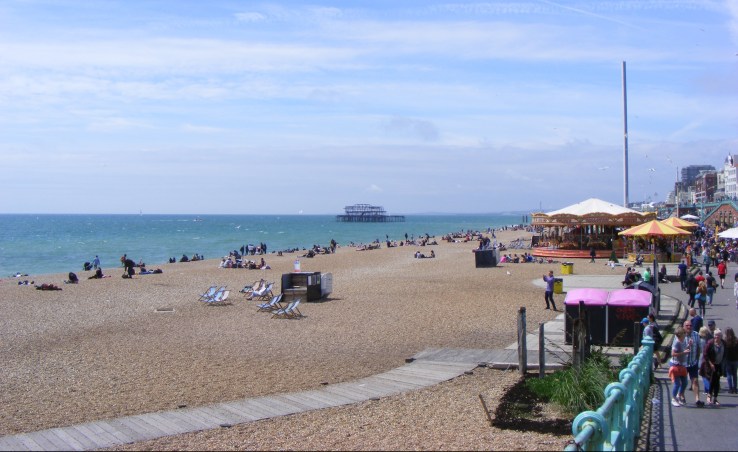
(Connoisseurs of British seaside towns may legitimately point out that this is obviously Brighton, not Ventnor. Unfortunately I don’t have a picture of the bus in Ventnor, although by this time next week I almost certainly will have fixed that.)
I went down to the Isle of Wight to walk the Coast Path over the long weekend of the May bank holiday. This was cutting things a bit fine, and I didn’t really have a plan for what I would do if I discovered that I wasn’t up to a long walk. I didn’t think too hard about that. The Isle of Wight is, quite literally, home turf; I know its footpaths and byways better than I know those of any other county. It was where I first discovered the sanity-saving practice of walking, and the combination of a familiar landscape and a moderately challenging parcours would make the perfect warm-up.
I took a train straight down from London on the Thursday evening, and started out walking from Ventnor the next morning. My mother accompanied me as far as the seafront. I walked around the edge of the paddling pool, which has a concrete map of the Isle of Wight in the centre. Perhaps I was setting an intention on the micro scale to work through on the macro scale or some woowoo like that. I didn’t walk all the way round, which, considering how things worked out, might suggest that there’s more to the woowoo than I’d first thought.
I set out eastwards along the sea wall; I’d decided to go anticlockwise around the Island, as I had on my previous Isle of Wight Coast Path attempt. Some public benefactor has set up a scale model of the Solar System along the coast between Bonchurch and Ventnor. I counted off paces between planets. The sun is about the size of a football, an orange-painted sphere springing up from the end of the railing. Shortly afterwards the path heads away from the sea, up the cliff, over a delightful little stream with wild garlic blooming on its banks, and past St Boniface Old Church. I looked in. It’s a lovely church: ancient, tiny, and set apart from hustle and bustle, even more than the rest of the Isle of Wight, even more than the rest of Bonchurch.
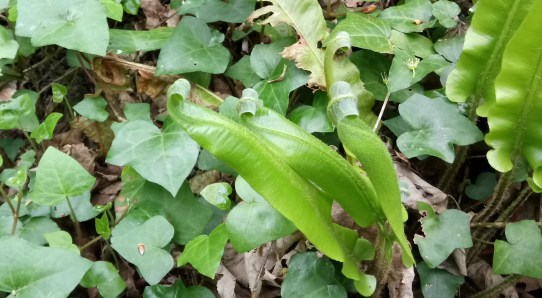
Hartstongue and ivy underfoot at the Landslip
The sun was trying to break through as I kept on eastwards, and managing it in selected patches on the sea. I lost sight of the sea when I plunged into the tangled vegetation of the Landslip. I don’t think I’d ever walked through there in spring before. It was lovelier than ever, erupting in green, with intensely purple bluebells – possibly they weren’t bluebells at all. I followed the path up and down and up again, picking my way through tree roots and flights of worn steps, emerging at last between brick walls at Dunnose. I headed on past sprawling Victorian hotels into Shanklin.
Extreme blueness
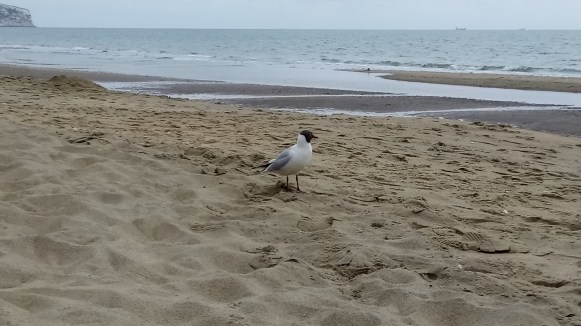
The great thing about going anticlockwise is that at Shanklin one goes down the steps that run between the clifftop and the beach, not up them. I stayed on the seawall all the way to Sandown out of sheer laziness: I couldn’t be bothered to find where the route goes inland. Besides, I thought, if one’s walking a coast path one might as well stick as close to the sea as possible.
Black-headed gull on the beach at the foot of the Shanklin steps
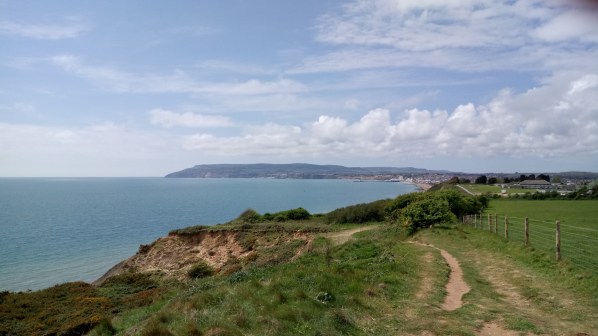
I bought and ate Turkish Delight ice cream from the children’s activity centre on Shanklin seafront, which didn’t seem to be doing a huge amount of business otherwise. When I got into Sandown it was just about lunchtime, so I sat in a café and waited for their fryer to heat up, then ate chips before heading off on the long climb north-east to Yaverland and Culver. All day it had been getting steadily brighter, and by the time I reached the top of Bembridge Down there was brilliant sunshine.
Looking south and west from Culver
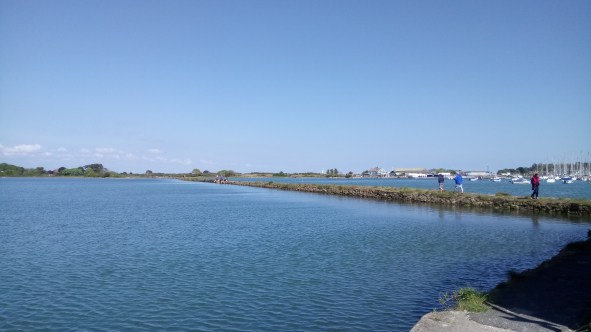
This took me about as far east as it was possible to get; now I turned the corner of the island and went around the edge of the harbour at Bembridge, picking my way across the causeway and then moving a little way inland along the edges of fields. Unlike the last time I’d walked the Isle of Wight Coast Path, I managed not to get lost around the Priory Bay Hotel: there was some sort of organised run going the other way and lots of little pink flags marking the route. I had to stand out of the way of runners every so often.
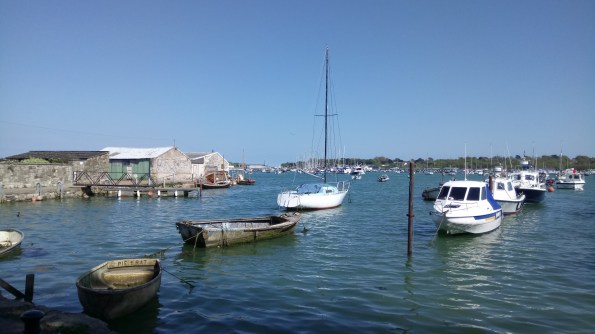
Bembridge HarbourAlso Bembridge HarbourCrossing the causeway
I ate another ice cream – rum and raisin, this time – in a stiff breeze at Seaview. After that I thought I might as well push on to Ryde, where I had a better choice of buses, so I followed the sea wall around the edge of Puckpool Park. That meant more concrete, and my knees and the soles of my feet didn’t like it much. But the bus home to Ventnor was a nice forty-five minutes’ sit-down.
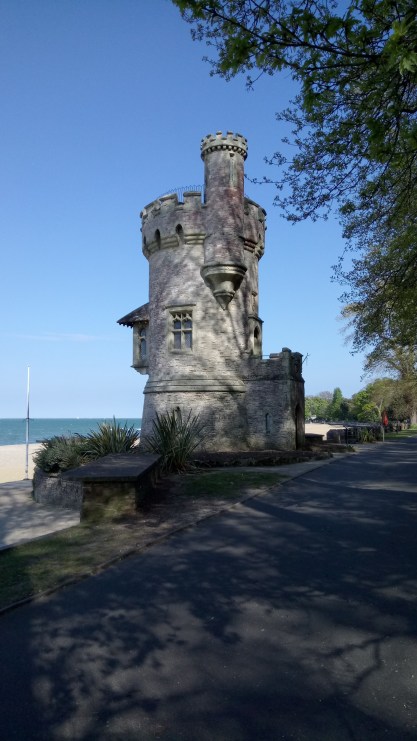
The magnificently appalling Appley Tower
I ended up setting much later than I’d meant on the second day. I was just about to leave without John when he got up and wanted to come, and then we were about to miss another bus so delayed another half hour…
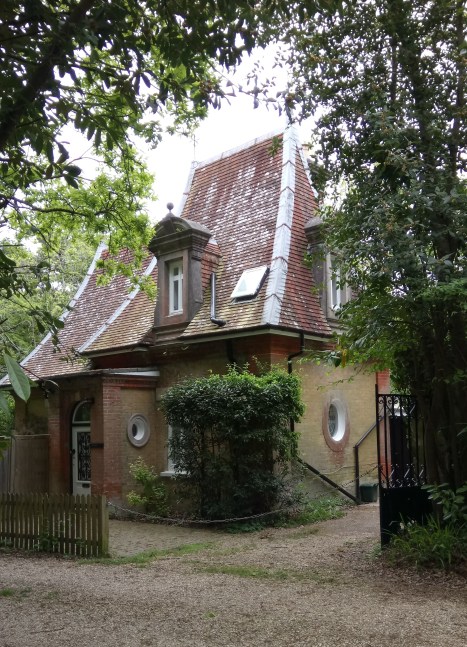
We messed around a bit buying snacks (vegan for John) in the Sainsbury’s at Ryde, then got going properly. We admired the magnificent Victorian houses on the way out of town, with their cupolas and their barge boarding and their fish scale tiles. We admired the lodges and the more modern houses on the way into Quarr, and debated a bit as to whether one of them had been on Grand Designs and, if so, which.
A Quarr lodge
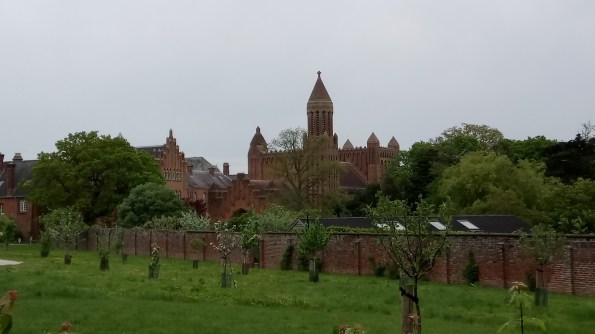
We talked to a jolly old buffer working in his front garden; he told us that at one point in the 19th century house prices in Ventnor outstripped those of central London. We stopped in the grounds of Quarr Abbey to look at the pigs; the previous time I’d done the Coast Path there were piglets as well, but not this time.
Quarr AbbeyA Quarr Abbey pig, reclining
It started raining at Wootton Bridge. This was at least an excuse to try my new waterproof trousers. John had the sort of poncho that’s basically an oversized binbag. On the way up through the housing estate above Wootton Bridge we met one of John’s colleagues, who was rather horrified by the state of his face and then caught him up on all the workplace gossip.
After that it was a long, long descent towards Whippingham, walking on the road all the way. A little way down the road I lost the vision in my right eye so stopped to take my jumper off and wait to be able to see again. This had been happening intermittently ever since I trapped a nerve in my neck the previous summer, and seemed to be associated with overheating. (Some months later, I took it to the GP, who had never seen anything like it, and referred me to a consultant, who had, and told me that it is fairly common in, I quote, ‘young people’. It had been a while since anybody had called me a young person.)
We met many cyclists coming the other way, some coping better with the hill than others. This was the beginning of a long tedious traipse into Whippingham (no pavement, a lot of criss-crossing the road to be on the safer edge of blind bends) and then East Cowes (pavement alongside main road). It was boring and, given the unforgiving surface, painful. I promised myself that I never had to do it again, and that I wouldn’t.
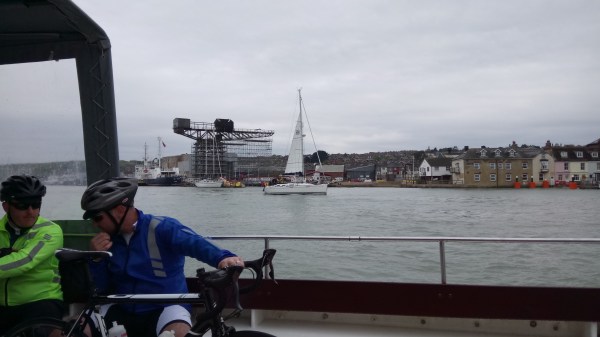
We stopped for lunch at one of the fish and chip restaurants in East Cowes. The floating bridge was out of action, so we were ferried across the Medina in a little launch called the Jenny Lee. It had stopped raining by this point but was still pretty gloomy. Having taken my waterproof trousers off, I managed to sit in a pool of leftover rain.
Aboard the Jenny Lee
West Cowes seemed yachtier than ever. We went on along the sea wall as far as Gurnard, at which point we got the map out, engaged in some posturing about being able to go on if the other wanted to, and I finally called it in favour of giving up. This was, I thought, a useful data point for the Camino. I hoped there would be less road walking. We called on John’s local bus knowledge (he has driven a lot of Isle of Wight buses, on and off over the years) and walked up to the nearest bus stop and went home.
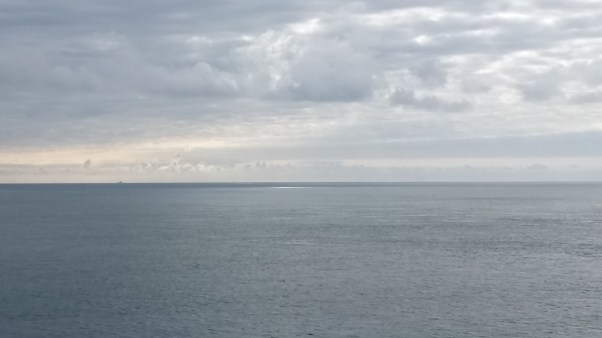
Next time: the rest of the Isle of Wight Coast Path – or is it? Will the paddling pool woowoo be too strong? Have valuable lessons been learned? How many more photographs of the Channel and the Solent can there possibly be?
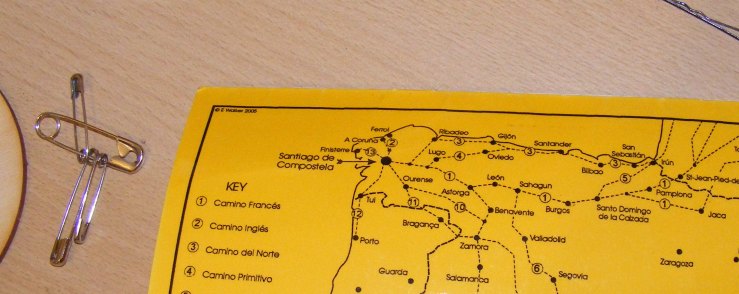
The first time I heard about the Camino Inglés was when I was about to set off on the Camino Frances in the early spring of 2007. The credencial – pilgrim passport – issued by the Confraternity of Saint James had on the inside back cover a map of the various pilgrim routes across Spain. At the time, of course, I was interested in the one running due east all the way across the map from the French border. Almost a decade later –
‘What’s that little short one?’ I asked.
‘That little short one’ was the Camino Inglés, and there was a reason for its being short. The English pilgrims would take a ship to the ports of Ferrol or A Coruña and head south. Considering the conditions of medieval ships, this would probably have been just as penitential as doing the whole thing on foot, the way that continental pilgrims could.
These days, the Camino Inglés is one for the connoisseurs. Short – too short (if starting at A Coruña) or only just long enough (if starting at Ferrol) to get the compostela, the certificate of completion and ticket to heaven – but none the less intense. I ordered a guidebook from the Confraternity and looked at the profile and distances with some horror. On the Camino Frances, we’d aimed to walk between fifteen and twenty kilometres every day. The Camino Inglés would call for days of up to twenty-nine kilometres, and steep with it.
When I walked the Camino Frances, I was twenty-one, had finished university with some of my student loan left over (that was just about possible, back then) and hadn’t started work yet. There was no reason on earth why I shouldn’t take seven weeks to walk five hundred miles. A decade on, and gainfully employed, seven weeks was out of the question: anything more than a fortnight required special permission from my line manager.
I’d considered the idea of walking a long Camino in stages, and discarded it again. It hadn’t worked for me on the Pilgrims’ Way (in fact, I’ve yet to make it any closer to Canterbury than Hollingbourne) and the complications of all those extra transfers out and back were too daunting. Plus, I suspected that for me it wouldn’t feel like a Camino. But the five days of the Camino Inglés had definite possibilities.
My brother John volunteered to join me on the walk. This was equal parts reassuring (while I’m not scared of travelling on my own, I wasn’t going to turn down the company) and daunting: John was a lot fitter than me, and had cycled the Camino Frances all the way from Mont-St-Michel the previous autumn. I was worried about keeping up with him, particularly after I, along with half the country, went down with a debilitating and depressing virus in January. I spent a lot of time lying on the sofa bed looking up at the scallop shell which I’d suspended from the curtain rail, and teaching myself more Spanish from Duolingo.
As I recovered, I assigned myself a regime of walks, increasing distance and increasing weight carried. To compensate for the notorious flatness of the Cambridgeshire terrain, I included an optimistically daily climb up the stairs to the top floor of my office. I actually managed an average of three times per week or so. I planned a circuit of the Isle of Wight Coast Path to get some more gradients into my legs, and then over-committed myself and postponed it.
I made kit lists and compared them with what I actually possessed. I considered the relative merits of the two rucksacks in my possession, and compared them both with the third option: buying a new one. There was the one that I’d taken when I walked the Camino Frances and St James’ Way, which fitted like a dream (at least once I’d got the straps adjusted correctly) but whose lining was collapsing into flakes; there was the one I’d got at university, which I’d never taken on a serious walk and which didn’t have anything impressive in the way of support; or there was the off-putting hassle of going to a shop and making a decision and spending another seventy quid. In the end I invested in a whole lot of waterproof bags and went with the one I knew I could carry.
I booked train tickets and ferry tickets and hotel rooms; I made the whole thing fit around my stepsister-in-law’s wedding and my father’s 75th birthday party.
Meanwhile, John was cycling home from his winter job in a ski resort in the French Alps. His Strava updates showed long distances and hours in the saddle, crossing off swathes of France. I worried some more about whether I’d be able to keep up with him.
Then he came off his bike. A very gory photo on Facebook told part of the story; a phone call from my mother supplied the rest of the details. He’d made it all the way to Lisieux before a stick got caught in his front wheel and brought the whole thing to an abrupt and bloody stop.
‘Will he still want to do the Camino?’ I asked, when we’d established that the only lasting damage would be cosmetic.
‘Oh yes,’ she said. ‘I should think so.’
He did.
Happy St James’ day, to anybody celebrating it! I’m going out for tapas tomorrow.
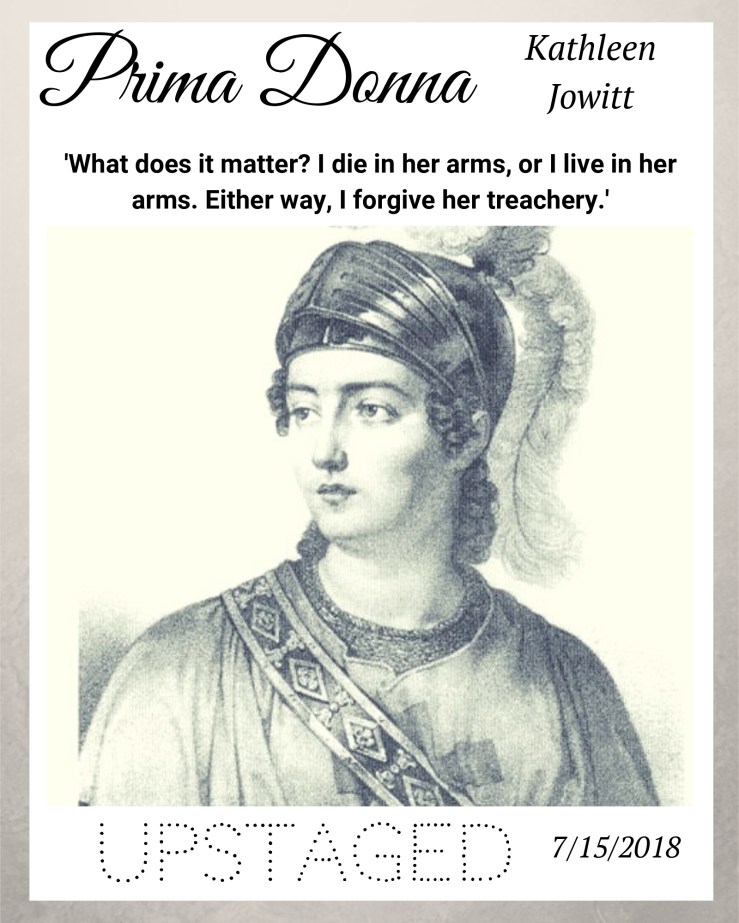
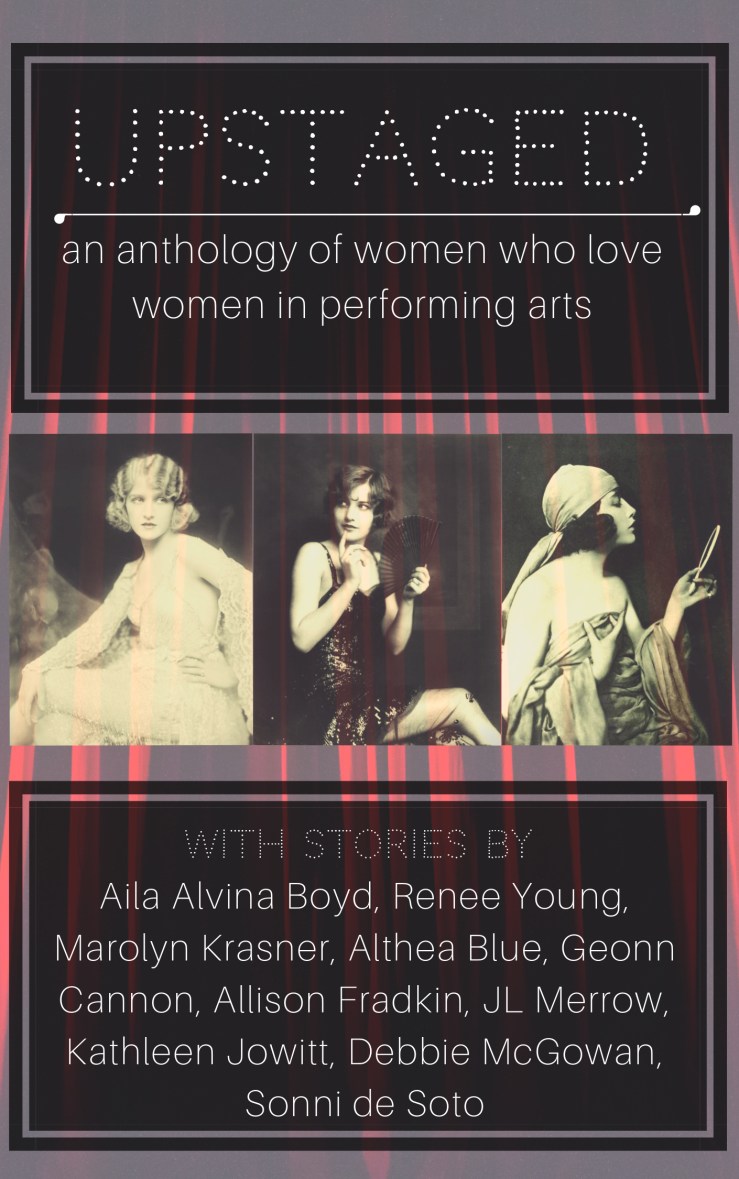
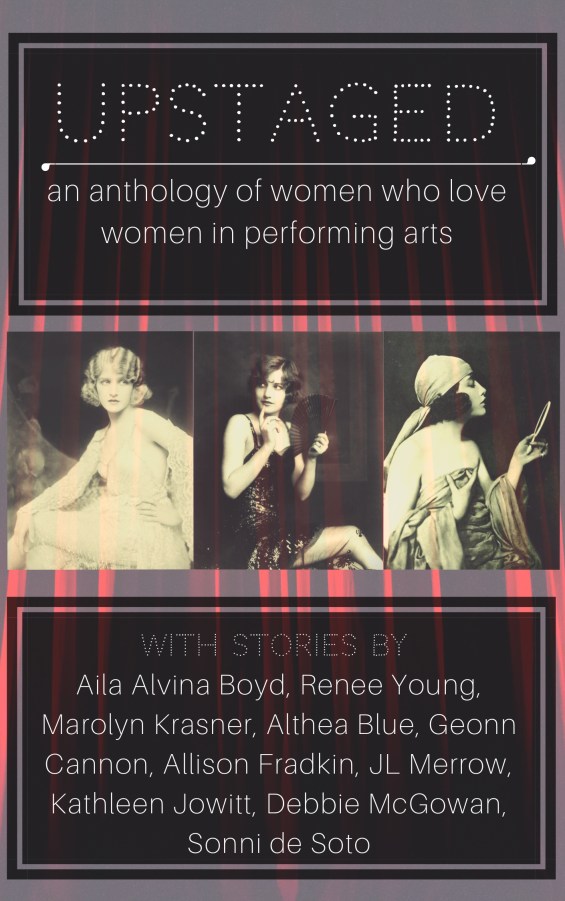
I’m very pleased to say that Upstaged!: an anthology of women who love women in performing arts is available now, and that it contains my story Prima Donna. It’s a delightful selection of short stories published by Supposed Crimes, who specialise in F/F fiction across a variety of genres.
The ‘performing arts’ in question are many and varied – my story is (of course) about opera, while others feature panto, silent film, burlesque, plays and musicals.
The genres are many and varied, too. We have steampunk, sci-fi, romance, slice-of-life, and straight (or not-so-straight) historical. Settings range from the 1830s to the far future, from Broadway to New Helsinki. Not all the stories will be to everyone’s taste – that’s the nature of such a diverse collection – but all the same I think there is something in there for everyone.
Last month I had the very great privilege of announcing the winner of UNISON’s first-ever creative writing competition at National Delegate Conference in Brighton.
I’d never judged anything before, and this was an enjoyable, if intimidating, place to start. We’d asked entrants to work with the theme of ‘Learning: past, present, and future’. My fellow judges were Genevieve Clarke, from The Reading Agency, Andrew Jennison, UNISON learning rep at De Montfort University and mastermind of the #DMUReads scheme, and Kirsi Kekki, Policy Officer for English and maths learning at Unionlearn.
Reading through all the entries was a very pleasant way to spend an afternoon, and rereading and deliberating over my choices occupied my mind for the next couple of weeks. Names were removed, along with other identifying information, before the entries were passed to the judges. There were also a couple of genuinely anonymous entries, which we couldn’t consider. I took a look at those, too, out of interest, and I think one of them might have made the final six if it had only been sent in with a name attached. The moral of that is: be brave!
Interestingly enough, deciding on the winner was easy. There was only one entry that all four of us had on our own personal shortlists. It was agreeing on the rest of the shortlist that was difficult. Some of us had firm favourites that didn’t appear at all on others’ lists. And I certainly looked at a couple of other lists, saw entries that I hadn’t included, and said, ‘Yeah, good point…’ Writing is such a subjective thing to judge; readers’ tastes vary so much. At least, ours did!
What made the winning entry stand out from the rest of the field? In a word, consistency. Conservative Party Conference 2050 started strongly, with an attention-grabbing burst of onomatopoeia, and it never faltered. It built on that with a rousing testament to the power of learning, and finished with a twist that had more than one of us laughing out loud. There isn’t a weak word in it.
As for the rest of the shortlist, we tended to favour pieces that took risks, or that went in a slightly different direction from the obvious. Petrichor, for example, was the only entry that had a narrator who wasn’t human.
Three personal accounts of learning made it into the final shortlist, reflecting a heavy weighting of entries with that theme. However, one of those, A Teacher Prepares, was written from a teacher’s point of view rather than a student’s, and another, Learning: a love story, drew the theme of learning into all aspects of the writer’s life with rueful, self-deprecating humour.
With all that said, There, Inside Of Me didn’t try anything fancy, just told the poet’s own learning story in a few well-chosen words. And we had a few submissions involving post-apocalyptic visions of education; of these, A Different Class stood out because of its strong worldbuilding and bleak humour.
I got to announce the shortlist and the winner. My colleague Clair got to read the winning entry out, and had far too much fun pretending to be a Tory MP.
I very much enjoyed being a judge, although it did tie up more of my work time than I’d expected. Out of curiosity, I went Googling to see how the real pros do it. This is what one of the 2014 Man Booker Prize judges said:
All six judges read 156 books submitted by 94 publishing imprints, and argued about them. That sentence makes this part sound rather breezy. For just over six months, I read a novel a day.
Whew. Reading that, I’m very glad that we imposed a 1500 word limit on our competition.
I can’t say that I’m surprised. It was in fact North Face, which is the last novel that Mary Renault wrote before giving up on writing about straight people and moving to South Africa. The rest of this post will contain spoilers, because I feel that I probably ought to explain a little.
The unpleasant hero is Neil Langton, who spends the whole book alternately mansplaining, manpaining, and trying to persuade the unfortunate Ellen that she ought to sleep with and/or marry him for her own good.
He achieves both.
The biscuits are metaphorical – well, a simile, really, and a very odd simile it is, too.
So far he had brought her; if it seemed well to him that she should part with her virginity as a casual epilogue, after an exhausting emotional crisis, in the abrupt and flickering desire of weariness – a satisfaction as brief and trivial as the biscuit which, wakeful, one reaches from the bedside tin – then this must be the perfect, the only possible thing, and she would embrace it gladly.
Sexy, no? No.
As for the incest, I still can’t work out whether we’re meant to think the reason that Ellen wasn’t attracted to her (now deceased) childhood friend Jock is because of the Westermarck effect, or because he literally was her brother. So it actually isn’t as incestuous as the book group made it sound. Or is it?
On a less baffling note, the winners of the giveaway, as determined by Random.org, are VivieH and joannechillhouse. I will be emailing you for your addresses.
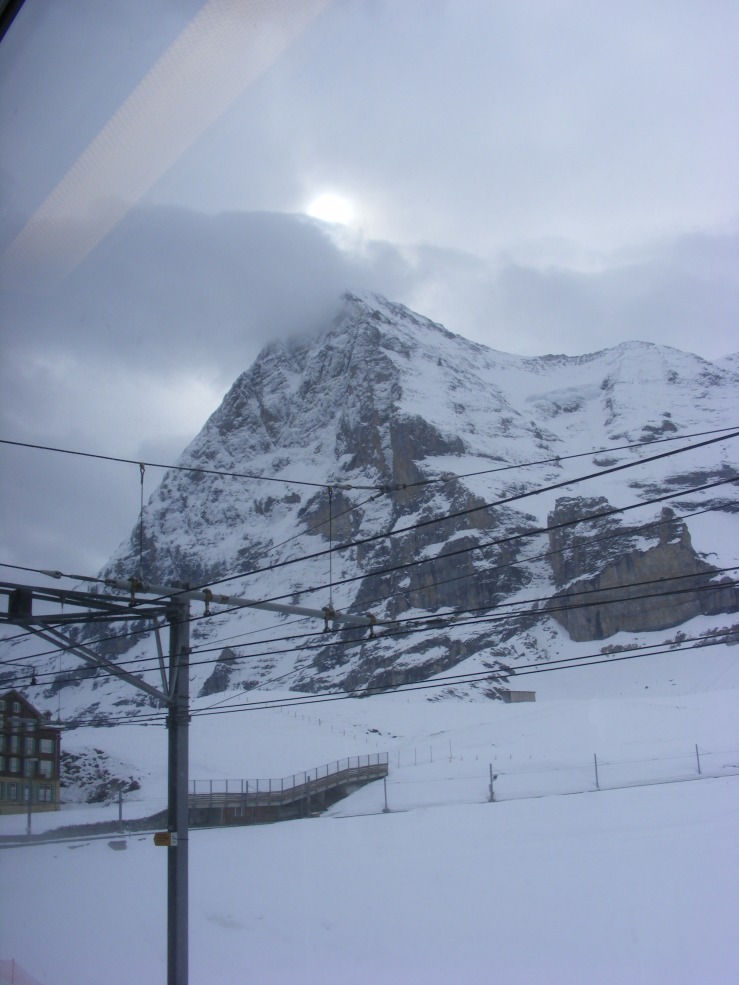
The picture, by the way, shows the north face of the Eiger as seen from the train at Kleine Scheidegg, and rather appropriately obscured by the weather.
Apparently it’s National Reading Group Day. For the next three hours, anyway. I thought about celebrating by putting together a set of reading group questions for each of my books, but I’ve yet to come across a group that actually uses those. In my experience most people are quite capable of talking about what did and didn’t work for them.
One reading group I used to belong to didn’t always get around to talking about the book at all, but I think that was an extreme case.
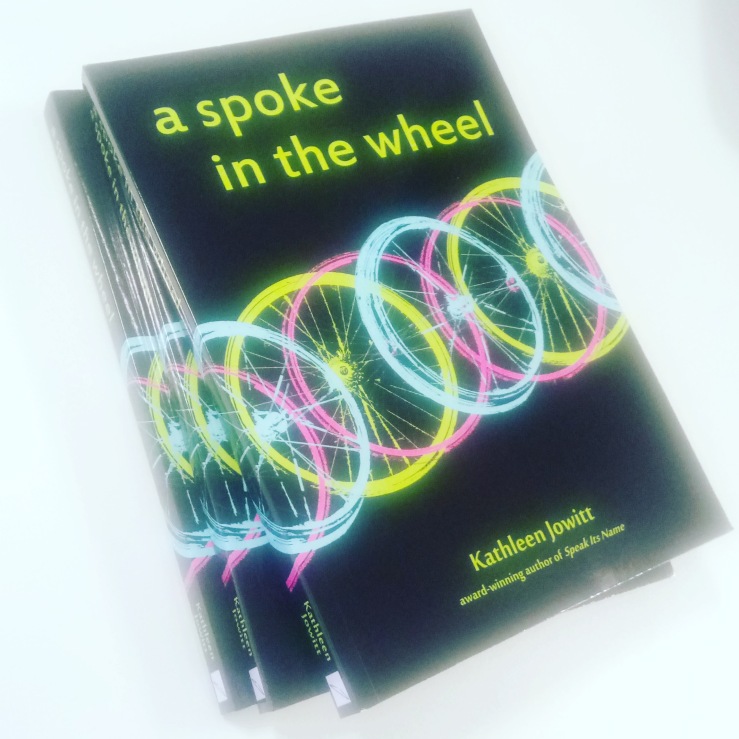
Instead, I’m going to take advantage of the fact that there is a book group in my latest book, A Spoke In The Wheel. As the old meme (almost) says, I put a book in your book, so you can read while you read… The book group aside, A Spoke In The Wheel is the story of what happens when a disgraced professional cyclist meets a disabled cycling fan; a story of assumptions, of redemption, and of coming to terms with one’s own limitations. And to give you that opportunity to read it, I’m hosting a giveaway.
The book group scene is below. They’re talking about a real book. It isn’t by Ian McEwan, despite what Polly thinks. The first person to identify the book wins a copy. Anyone who comments here with a guess that turns out to be incorrect will be entered into a draw for a second copy.
In short:
leave a comment on this post with the title and author of the book that you think this reading group might be discussing
the first person to guess correctly wins a copy
people who guessed incorrectly are entered into a draw for a second copy
if no one guesses correctly then I’ll draw for both copies from the incorrect guesses
if you have no idea, take a wild guess. What’s the worst that could happen?
this draw will take place on Saturday 23 June
I am prepared to send the prizes anywhere in the world
Those present at the discussion that inspired this (they know who they are) will not be eligible. If they feel hard done by they should comment with an alternative book, and if I find their suggestion sufficiently amusing I might enter them into the draw anyway.
Vicky texted me later in the day to say that she’d been sent home ill by her boss (who clearly wasn’t such a sadist as she’d made out) and could I pick Polly up on my way home. It seemed that one of Polly’s church ladies was going to drop her off at the Three Bottles after some event, and Vicki was going to pick her up when she got home from work. Quite why the church lady couldn’t take her all the way home I couldn’t work out, but since it wasn’t really any of my business I didn’t ask, just texted back to say that would be no problem. And, because I had a headache, felt slightly virtuous about it.
The Three Bottles was quite lively for a week night. I eventually found Polly at a small table behind a very rowdy book group. The substitution of me for Vicki didn’t seem to be a particular disappointment, so she’d evidently been warned.
She motioned me to sit down, and murmured, ‘I’ve been eavesdropping for the last quarter of an hour. They’ve established that the biscuits were metaphorical, but they can’t work out whether or not the incest was literal.’
‘What on earth are they reading?’ I kept my voice down too, though it was hardly necessary.
‘I’m not sure. I haven’t been able to catch sight of the book. It sounds vaguely like Ian McEwan, but I don’t think it’s one I’ve read, if so. The biscuits don’t sound right. Though the whole group seems to want to stab the hero in the face, which does.’
‘Right,’ I said. I still hadn’t put anything on my new library card, and whatever this book was, it didn’t seem like a very good place to start. ‘What about a drink?’ I offered. Now that I was inside, in the warm, I was reluctant to go out into the rain. My headache was getting worse, though; I hoped I wasn’t coming down with Vicki’s cold. I told myself that it was probably just dehydration.
She smiled. ‘Yeah, why not?’
‘What’s yours?’
‘Orange juice, please.’
I went to the bar. My timing was bad: two of the women from the book club had got up just before me, and were putting in an order for their entire table. I thought I heard someone say my name, but when I looked around nobody seemed to be trying to get my attention. The place was crowded; I’d obviously been mistaken.
The first thing I saw was the wheelchair.
The first thing she saw was the doper.
Ben Goddard is an embarrassment – as a cyclist, as an athlete, as a human being. And he knows it.
Now that he’s been exposed by a positive drugs test, his race wins and his work with disabled children mean nothing. He quits professional cycling in a hurry, sticks a pin in a map, and sets out to build a new life in a town where nobody knows who he is or what he’s done.
But when the first person he meets turns out to be a cycling fan, he finds out that it’s not going to be quite as easy as that.
Besides, Polly’s not just a cycling fan, she’s a former medical student with a chronic illness and strong opinions. Particularly when it comes to Ben Goddard…
I’m very pleased to say that my story Prima Donna will be appearing in Supposed Crimes‘ upcoming anthology Upstaged.
My author copy came through yesterday, and I’m planning on spending the weekend reading it. I know what’s in my story, of course (opera, travesti, people jumping to conclusions and having to find their way back from them, and more opera) but the rest of the anthology is new to me, and it looks very intriguing…
Presenting the Revial of Jan, Aila Alvina Boyd – Years after blowing her Broadway debut, a former actress is convinced by the playwright to come out of retirement in order to revive the role that pushed her to the brink of insanity.
The Helsinki Incident, Renee Young – After an unexpected, erotic encounter with a mysterious and beautiful stranger, the lead guitarist of a band touring mining outposts across the solar system rediscovers her love of music.
I, Stage Manager, Marolyn Krasner – A short love story about a stage manager, eccentric theater types, a kooky best friend, and leather daddies.
End of an Era, Althea Blue – In the years leading to the death of the silent film, many careers were ended prematurely. But do we really know everything there was to know about the silent stars who faded away?
Knife’s Edge, Geonn Cannon – Amid the insanity of the circus, Arlie and Ru must place absolute trust in each other. Arlie trusts that the blades will hit their intended target, while Ru trusts that Arlie won’t flinch. It would only take the smallest of mistakes to destroy that trust.
I Think I’m Gonna Like It Queer, Allison Fradkin – Theatre is an ensemble of inflection, projection, and rejection. So when 16-year-old Reyna—a performer who’s part prima donna, part dreamgirl next door—desires a duet with Melinda, the ingénue who plays her best friend, she can’t just run and tell that. Or even run and tell Melinda. But with the arrival of a triply threatening romantic rival, it’s five to places and ten to one that Reyna had better act on her feelings before the curtain closes on her chances.
London Lark, JL Merrow – Repairing a salvaged automaton becomes a labour of love for apprentice tinkerer Harriet Hodgkins. But the clockwork coquette is destined for resale, and Miss Pandora’s restoration will signal their separation—unless Hodgkins can engineer a more auspicious ending.
Prima Donna, Kathleen Jowitt – Everybody knows why the great Signora Valli left the Licorne opera company. Everybody, that is, except Monsieur Perret, who’s taken the brave – some would say foolish – decision to cast her opposite rising star Delphine Vincent-Leclerc in Rossini’s Tancredi. But what everybody knows is only half the story.
Oh No She Didn’t!, Debbie McGowan – Once upon a time, in the not so faraway land of small-town amateur dramatics, there lived a widow called Marcy and her beautiful, grown-up daughter, Ginny…
Rise or Shine, Sonni de Soto – What is Cadence Carrington to do? Her public life is colliding fast with her private persona, when her boss at the governor’s office sets his eye on shutting down the club she secretly performs burlesque at as featured dancer and femme fatale, Rebel Rouser. It’s only a matter of time before she’s found out, but the question is will she choose Cady’s steady, straight-laced life or will she choose to be the Rebel she knows she is at heart?
A. M. Leibowitz, the editor, says:
We had everything from actual plays to space operas to period pieces to contemporary romance. These talented storytellers captured womanhood, and women on stage and screen, in all their beautiful, wonderful glory. In the end, I was only able to take ten stories. These are the ones that made me laugh and cry and want to sing. There are erotic and sensual tales, gender non-conformity, trans women, lesbians and bisexuals, politics, falling in love, parenting, youthful crushes, opera, toe-tapping musical numbers, death-defying stunts, humor, and more. This anthology is a celebration.
What a ride! I mean the Giro d’Italia, of course, and I’m not even going to try to guess what might happen on today’s stage.
But I also mean the blog tour for A Spoke in the Wheel. I had tremendous fun visiting other people’s blogs and talking about how my new book came to be.
And I also mean my travels around Europe – the sleeper to Stockholm, the Semmering line, the Zentralbahn and Jungfraubahn, and the whole three weeks of it.
I suppose you could say I’m now in the warm-down stage. Getting my breath back. I’m not writing a huge amount at the moment; I’m fulfilling a couple of pre-existing commitments, and, of course, writing this blog post.
My next task is to finish writing up my travels of the past couple of years. The Isle of Wight Coast Path and the Camino Inglés, and then this year’s Grand Tour, before I forget it all. (This morning I woke up from a dream where I was at a railway station somewhere in Flanders helping set out a tea table in preparation for Rev’d Richard Coles returning with a school trip, while a truncated Saviem Standard full of Tesco shopping bags did a handbrake turn in a very narrow lane. Nothing like this actually happened.) I’ll be posting all of that, together with a selection of photographs, on this blog.
I’ve also seen an idea I like for another ‘photographs of other people’s books’ series, which I’ll probably kick off in a month or so.
I have promised myself that I won’t start any more big projects until after the travel writeups are done – which means, of course, that the next three books are all trying to write themselves at once. I make no promises as to which order they’ll come in, or even whether they’ll ever happen, but they are:
the sequel to Speak Its Name. I haven’t yet managed to persuade myself that Scandal and Folly wouldn’t be an excellent name for it. (But then I have form in this department.) Not everybody can make the letters of Saint Paul sound like a bodice ripper.
the post-Brexit Ruritanian swashbuckler, possibly with ice dancing. (Got to get some sort of blade into it somehow…)
the murder mystery at a fan convention.
As you see, the chances of my picking a genre and sticking to it remain low.
We’re nearly there! The very last stop on the blog tour takes A Spoke in the Wheel to Books, Teacup and Reviews, where you can read an excerpt. Yesha will be reviewing the book later in the summer, as well.
Thank you to all the bloggers who have welcomed me – and thank you for joining me on the ride. It’s been fun!







 Kathleen Jowitt